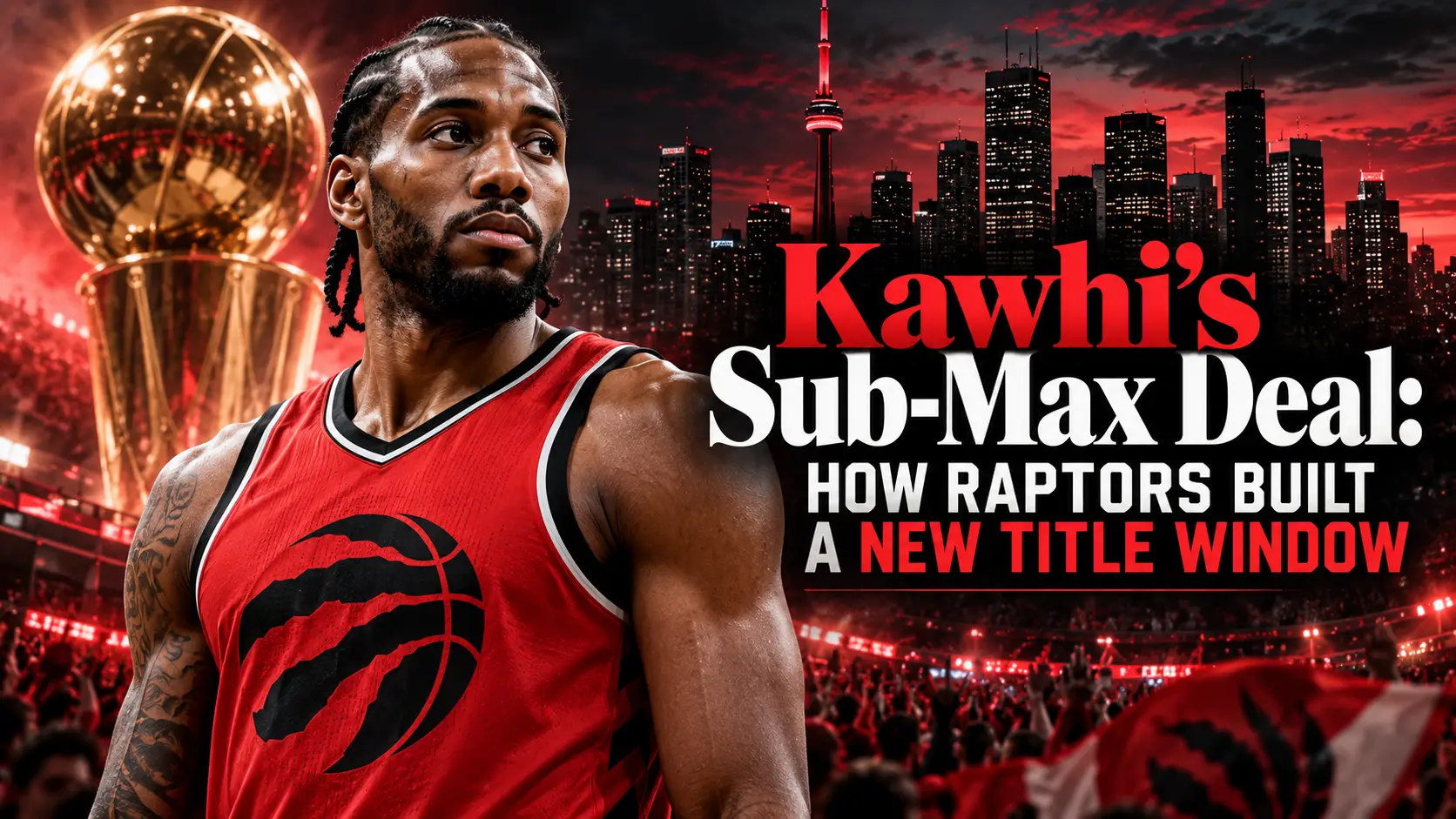
Kawhi Leonard’s return to the Toronto Raptors marks one of the most audacious front-office pivots in modern NBA history. After a protracted transaction delay driven by the league’s exhaustive investigation into the Los Angeles Clippers’ salary-cap circumvention, Raptors General Manager Bobby Webster finalized a franchise-altering trade to reacquire the two-time Finals MVP. Toronto surrendered a substantial package comprising Brandon Ingram, Gradey Dick, two unprotected first-round draft selections in 2031 and 2033, a 2027 pick swap, and a pair of second-round picks. While the trade significantly depleted the organization’s long-term draft assets, Webster moved swiftly to secure competitive stability by signing Leonard to an immediate two-year, $115 million contract extension that features a player option for the 2028–29 season.
The extension bridges Leonard’s existing $50.3 million salary for the 2026–27 campaign into a comprehensive three-year, $165 million commitment. More significantly, Leonard chose not to demand the full $126.6 million maximum he was eligible for, leaving roughly $11.6 million on the table across the two extension years. When coupled with his formal waiver of a $7.45 million trade kicker to facilitate the transaction out of Los Angeles, Leonard surrendered nearly $19 million in total compensation. In an NBA economic environment dominated by the highly restrictive collective bargaining agreement ratified in 2023, these financial concessions fundamentally alter Toronto’s roster-building capacity. This strategic discount creates crucial financial breathing room beneath the luxury tax aprons, empowering the Raptors to fortify their roster and pursue a second championship banner.
The Mechanics of Financial Sacrifice: Deconstructing Leonard’s Sub-Max Extension
Evaluating the real value of Leonard’s contract requires examining the CBA’s statutory mechanisms governing Veteran Player Extensions. Because Leonard was acquired via trade and extended within six months, the Raptors were legally capped at offering a 20% first-year increase over his 2026–27 base compensation of $50.3 million. Had Leonard delayed discussions until the six-month mark post-trade, his maximum eligible extension figure would have expanded to nearly $128 million. Instead, both parties prioritized immediate cost certainty and roster agility ahead of training camp.
| Contract Component | Maximum Eligible Allocation | Agreed Extension Terms | Realized Cap Savings |
| Waived Trade Kicker | $7,450,000 | $0 (Waived) | $7,450,000 |
| 2027–28 Base Salary | $60,360,000 | $56,097,561 | $4,262,439 |
| 2028–29 Base Salary (Option Year) | $66,240,000 | $58,902,439 | $7,337,561 |
| Two-Year Extension Total | $126,600,000 | $115,000,000 | $11,600,000 |
| Cumulative Financial Concessions | — | — | $19,050,000 |
The commitment was limited to two additional seasons because the NBA’s Over-38 rule prevents franchises from offering long-term contracts that expose them to deferred cap hits after an aging veteran turns 38. Entering his age-35 season, Leonard’s new deal secures his services through his age-37 campaign.
The 2028–29 player option provides mutual strategic flexibility. While reports indicate Leonard intends to conclude his career in Toronto, this optional year lets him opt out in the summer of 2028 to negotiate a multi-year deal at a substantially lower average annual value (AAV). This approach mirrors the late-career cap-smoothing maneuvers pioneered by Kevin Durant and LeBron James, deliberately clearing salary cap room as Toronto’s younger core players reach high-earning veteran extensions.
By reducing his compensation by roughly $5.8 million annually compared to the maximum threshold, Leonard directly protects the Raptors from breaching the dreaded second apron. For the 2026–27 season, the league has established the salary cap baseline at $164.961 million, the luxury tax threshold at $200.428 million, the first apron at $209.015 million, and the punitive second apron at $221.686 million. Updated projections for the 2027–28 season forecast a $176 million cap, a $213 million tax line, and an estimated second apron of $236.5 million. Operating beneath that second apron threshold is mandatory for any franchise hoping to maintain operational mobility, as exceeding it eliminates the Mid-Level Exception, freezes future draft picks, and forbids contract aggregation in trades. Leonard’s discount preserves Toronto’s ability to actively shape its roster.
Balance Sheet Analysis: Toronto’s Cap Sheet and Apron Headroom
Shedding Brandon Ingram’s $40.0 million salary and Gradey Dick’s $7.13 million scale contract allowed Toronto to absorb Leonard’s $50.3 million figure while adding only $2.87 million in net payroll. As a result, the Raptors enter the 2026–27 season with an active roster payroll hovering near $202.7 million. This puts Toronto slightly over the luxury tax threshold of $200.43 million, but leaves about $6.3 million of breathing room beneath the first apron and a comfortable $19 million buffer below the second apron.
| Player | Position | Age | 2026–27 Active Salary | 2027–28 Projected Salary | Contract Mechanism / Expiration |
| Kawhi Leonard | SF | 35 | $50,300,000 | $56,097,561 | Extended through 2028–29 (Player Option) |
| Scottie Barnes | PF | 25 | $41,754,690 | $45,095,065 | Designated Maximum Extension |
| Immanuel Quickley | PG | 27 | $32,500,000 | $32,500,000 | Multi-year commitment ($97.5M remaining) |
| RJ Barrett | SG/SF | 26 | $29,616,071 | Unrestricted Free Agent | Final guaranteed season; extension eligible |
| Jakob Poeltl | C | 31 | $19,500,000 | $27,300,000 | 3-year, $104M extension begins 2027–28 |
| Collin Murray-Boyles | PF/C | 21 | $6,649,560 | $6,982,040 | Team Option (Rookie Scale) |
| Allen Graves | PF | 20 | $4,065,720 | $4,269,000 | First-round pick scale (2026 No. 19 overall) |
| Ja’Kobe Walter | SG | 22 | $3,811,800 | $5,835,866 | Rookie scale; extension eligible summer 2027 |
| Andre Jackson Jr. | SG/SF | 24 | $2,537,526 | Non-guaranteed | Defensive wing depth |
| Kyle Anderson | SF/PF | 33 | $2,449,421 | Veteran Minimum | Rotational facilitator |
| Trayce Jackson-Davis | C | 26 | $2,406,205 | Team Option | Frontcourt rim protection |
| Jamal Shead | PG | 24 | $2,296,271 | Restricted Free Agent | Primary defensive point-of-attack guard |
| Jamison Battle | SF | 25 | $2,296,271 | Non-guaranteed | Perimeter shooting specialist |
| Jaden Bradley | PG | 23 | $2,000,000 | $2,200,000 | Converted standard contract ($9.3M/4yr) |
Before Leonard’s extension, front-office projections showed about $87 million in room below the luxury tax line heading into the 2027–28 offseason. The combination of Leonard’s $56.1 million year-one extension rate, Barnes’ salary escalating to $45.1 million, and Jakob Poeltl’s extension taking effect at $27.3 million commits roughly $128.5 million to three players.
Without Leonard’s financial concessions, this top-heavy wage structure would have immediately forced the franchise across the $236.5 million second apron threshold once supporting rotation spots were filled. Instead, Leonard’s sub-max extension gives the front office the financial agility to upgrade the roster rather than shed rotation talent to avoid prohibitive penalties.
Strategic Reinvestment: Weaponizing Financial Flexibility for Roster Upgrades
The financial surplus from Leonard’s discounted contract gives Toronto distinct operational paths to upgrade the roster around its veteran superstar. Rather than being paralyzed by apron penalties, Bobby Webster can pursue three primary roster-building avenues: restructuring the frontcourt, utilizing preserved exceptions, and retaining internal talent.
Addressing the Frontcourt Dilemma and the Center Position
The most pressing roster question facing the Raptors is the center position. While Jakob Poeltl remains a disciplined rim protector and effective screen-setter, his age, history of recurring back injuries, and failure to surpass 60 appearances in three consecutive seasons present significant long-term durability risks. These limitations were evident during Toronto’s seven-game first-round playoff series against the Cleveland Cavaliers, where Poeltl struggled to defend in space against perimeter pull-up shooters and dynamic roll-men.
Compounding this on-court concern is Poeltl’s contract: a three-year, $104 million extension that takes effect in 2027–28 and carries cap hits of $27.3 million, $29.4 million, and $27.3 million through 2030. Allocating nearly $30 million annually to an aging, non-shooting center severely limits roster flexibility.
This dynamic makes Detroit Pistons center Jalen Duren an intriguing trade candidate. Duren has been engaged in a prolonged contract dispute in Detroit, creating friction that could force a sign-and-trade or an early-exit transaction. Duren’s vertical athleticism, offensive rebounding, and switchable perimeter defence would give Toronto an elite rim-runner whose timeline matches Scottie Barnes (25) and Immanuel Quickley (27).
Because Toronto remains below the second apron, the front office retains the right to aggregate contracts in trades. This lets Webster explore trade frameworks such as pairing RJ Barrett’s expiring $29.6 million deal with draft assets to entice Detroit, while offloading Poeltl to a third team that needs traditional rim protection.
Even if a blockbuster trade for an external center doesn’t materialize, Leonard’s financial concessions provide a viable internal solution in sophomore forward Collin Murray-Boyles. Murray-Boyles demonstrated elite lateral mobility and defensive versatility during his rookie campaign, suggesting he can thrive as a modern small-ball center in closing lineups.
Playing Murray-Boyles alongside Leonard and Barnes provides elite defensive coverage at a fraction of the cost, making Poeltl expendable. This gives Toronto the option to trade Poeltl for high-end perimeter shooting depth while absorbing smaller matching salaries.
Preserving Critical Collective Bargaining Agreement Mechanisms
Under the 2023 CBA, maintaining payroll below the second apron preserves several key roster-building mechanisms that second-apron teams lose entirely:
First, the Raptors retain access to the Non-Taxpayer Mid-Level Exception (NTMLE), projected between $13.5 million and $15.0 million, as well as the Taxpayer Mid-Level Exception. Teams operating above the second apron cannot access any mid-level exception. This tool gives Toronto the flexibility to sign impactful veteran three-and-D wings or secondary play-makers without parting with draft capital or young assets.
Second, avoiding the second apron protects Toronto’s ability to participate in the mid-season buyout market. Under second-apron restrictions, teams cannot sign any waived player whose pre-waiver salary exceeded the mid-level exception. By staying below these apron levels, Toronto remains an attractive landing spot for playoff-tested veterans bought out by lottery teams in February.
Third, Toronto avoids the freezing and cascading relegation of its future draft assets. Second-apron teams have their first-round draft picks frozen from trade eligibility for seven years, and repeated offences automatically relegate those selections to the end of the first round. Because Toronto surrendered unprotected first-round picks in 2031 and 2033 to reacquire Leonard, maintaining control and liquidity over its remaining draft assets is essential for future transactions.
Sustaining the Young Supporting Core: Barrett, Shead, and Walter
Beyond external trades, the financial margins created by Leonard’s extension are vital for managing Toronto’s internal extensions. RJ Barrett enters the final guaranteed year of his contract at $29.6 million, and his strong postseason performance against Cleveland—averaging 24 points per game and hitting an overtime buzzer-beater in Game 6—will demand a competitive market extension.
Retaining Barrett without crossing into second-apron territory would have been mathematically impossible had Leonard demanded his full maximum extension. The $5.8 million annual discount Leonard provided covers the exact margin needed to re-sign Barrett to a fair market deal.
Similarly, backup point guard Jamal Shead will reach restricted free agency after the 2026–27 campaign. Shead’s relentless point-of-attack defence has made him an indispensable rotational guard for Darko Rajakovic.
Concurrently, former lottery pick Ja’Kobe Walter becomes extension-eligible in July 2027, with his new contract scheduled to take effect for the 2028–29 season. Leonard’s structural flexibility—including the option to decline his 2028–29 player option and sign a lower-AAV multi-year deal—ensures the Raptors can retain Shead and Walter without compromising roster depth.
Tactical Cohesion: On-Court Evolution Under Darko Rajakovic
While salary sheet agility creates opportunities, championships are ultimately won between the baselines. The roster built around Leonard addresses the primary weaknesses that led to Toronto’s first-round playoff exit against the Cavaliers.
Solving the Half-Court Isolation Bottleneck
During the 2026 postseason, Toronto’s offence frequently stalled in high-pressure fourth quarters. While head coach Darko Rajakovic’s 0.5-second passing philosophy elevated the Raptors to an elite regular-season assist rate, physical playoff defences routinely disrupted their ball movement and motion principles. Brandon Ingram struggled to create clean looks against aggressive defensive double-teams, frequently resulting in inefficient contested isolations and late-clock turnovers.
Kawhi Leonard provides the elite half-court scoring engine Toronto lacked. Even at 35, Leonard remains one of the league’s most clinical three-level scorers. Last season with the Clippers, Leonard produced a career-high 27.9 points alongside 6.4 rebounds, 3.6 assists, and 1.9 steals per game, shooting 50.5% from the field and 38.7% from three-point range across 65 games. His ability to establish deep post position, knock down elbow pull-ups, and convert contested mid-range jumpers gives the Raptors an elite scoring option when their offence breaks down.
This scoring gravity directly benefits Immanuel Quickley and Scottie Barnes. Quickley thrives as a perimeter shooter and secondary ball-handler off pick-and-rolls, operating with more space as opposing defences collapse on Leonard’s post touches.
Barnes can operate as a dynamic point-forward out of the high post, running dribble-hand-offs or finding weak-side cutters. With Leonard anchoring late-game possessions, Barrett is freed from primary scoring responsibilities, allowing him to attack tilted defences as a downhill slasher.
Assembling an Elite Switchable Defensive Front
Defensively, Toronto now possesses one of the most versatile forward combinations in the NBA. The trio of Scottie Barnes, Kawhi Leonard, and Collin Murray-Boyles gives Rajakovic a dynamic, switchable defensive core. Barnes earned NBA All-Defensive First Team honours last season, displaying exceptional rim protection, weak-side shot blocking, and the lateral quickness to guard all five positions.
This defensive versatility is crucial for managing Leonard’s physical workload. Leonard is no longer required to defend the opposition’s primary perimeter creator for 38 minutes a night. Barnes and Jamal Shead can take on tough perimeter assignments, allowing Leonard to play as an off-ball roamer who disrupts passing lanes with his 7-foot-3 wingspan.
In high-stakes playoff situations, Rajakovic can deploy small-ball lineups featuring Barnes at center, Leonard and Murray-Boyles at the forwards, and Quickley and Shead in the backcourt. This configuration lets Toronto switch across all five positions, suffocate pick-and-roll actions, and control the defensive glass without conceding easy paint touches.
The Eastern Conference Hierarchy and the Championship Path
Toronto’s pursuit of a championship requires navigating an increasingly competitive Eastern Conference. Rival front offices have made aggressive roster moves, elevating the conference’s overall depth.
| Eastern Conference Contender | Core Roster Foundation | Primary Strategic Threat to Toronto | Toronto Matchup Advantage |
| New York Knicks | Jalen Brunson, Karl-Anthony Towns, Mikal Bridges, OG Anunoby | Elite floor spacing, offensive shot-creation, dynamic wing defence | Physical forward size; Leonard’s ability to isolate against mismatches |
| Philadelphia 76ers | Joel Embiid, Tyrese Maxey, LeBron James, Jaylen Brown | Dominant star power, interior size, half-court execution | Superior transition speed; targeting Philadelphia’s defensive recovery pace |
| Cleveland Cavaliers | Donovan Mitchell, Darius Garland, Evan Mobley, Jarrett Allen | Continuity, elite interior rim deterrence, guard scoring | Size advantages with Barnes and Leonard attacking Cleveland’s small backcourt |
| Miami Heat | Giannis Antetokounmpo, Bam Adebayo, Terry Rozier | Relentless interior paint scoring, physical rebounding | Five-out spacing lineups that pull opposing rim anchors away from the paint |
| Boston Celtics | Jayson Tatum, Derrick White, Jrue Holiday, Kristaps Porzingis | Perimeter three-point volume, disciplined switchability | Mid-range scoring efficiency countering drop coverage schemes |
While the Eastern Conference has numerous formidable rosters, Toronto has a crucial advantage in structural flexibility. Heavyweights such as Philadelphia and Boston face immediate roster constraints due to second-apron restrictions, severely limiting their ability to modify their teams mid-season.
Because Toronto remains beneath the second apron thanks to Leonard’s sub-max extension, the Raptors retain the operational flexibility to make targeted mid-season adjustments. Whether that means trading for frontcourt athleticism or using the buyout market for shooting depth, Toronto is positioned to adapt to postseason matchups.
Conclusion: The Architecture of Sustained Contention
The reunion between Kawhi Leonard and the Toronto Raptors is far more than a sentimental encore; it represents a focused, calculated push for championship contention. By pairing an elite, battle-tested superstar with an ascending franchise cornerstone in Scottie Barnes, Toronto has successfully built a roster that blends veteran playoff execution with elite young talent.
Leonard’s decision to accept a sub-max extension and waive his trade kicker demonstrates a shared commitment to building a sustainable winner. He recognized that maximizing every available dollar would strip the franchise of the surrounding talent necessary to navigate four gruelling postseason rounds. The financial margin Leonard created allows Bobby Webster to:
- Protect the franchise from the severe operational restrictions of the second apron.
- Preserve contract aggregation options, draft pick liquidity, and mid-level exception mechanics.
- Maintain the financial flexibility needed to re-sign RJ Barrett, retain Jamal Shead, and extend Ja’Kobe Walter.
- Explore frontcourt upgrades, including pursuing dynamic big men like Jalen Duren or expanding Collin Murray-Boyles’ role as a small-ball defensive anchor.
Seven years after leading the franchise to its historic 2019 title, Leonard has positioned himself to conclude his Hall-of-Fame career where he achieved legendary status. With head coach Darko Rajakovic signed to a long-term contract extension and a versatile, defensively elite roster behind him, the Raptors have the talent, coaching stability, and payroll flexibility to compete with anyone in the NBA. If front-office management uses the financial resources Leonard left on the table effectively, the Larry O’Brien Trophy could soon return to Toronto.
Works cited
- Raptors, Kawhi Leonard agree to two-year, $115M extension: report, https://toronto.citynews.ca/2026/09/22/raptors-kawhi-leonard-agree-to-two-year-115m-extension-report/
- Kawhi Leonard’s return to Toronto is official as Raptors and Clippers, https://www.foxsports.com/articles/nba/kawhi-leonards-return-to-toronto-is-official-as-raptors-and-clippers-complete-longawaited-deal
- Toronto Raptors offically announce the Kawhi Leonard trade – Reddit, https://www.reddit.com/r/nba/comments/1wgmhw4/toronto_raptors_offically_announce_the_kawhi/
- Leonard signs 2-year, $115-million US extension with Raptors, https://www.cbc.ca/sports/basketball/nba/kawhi-leonard-toronto-raptors-extension-9.7354202
- Just in: Toronto Raptors All-NBA star Kawhi Leonard has agreed on, https://www.reddit.com/r/nba/comments/1wnivs2/charania_just_in_toronto_raptors_allnba_star/
- Toronto Raptors Cap Sheet – 2026/2027 Season – Capsheets.com, https://www.capsheets.com/toronto-raptors-cap-sheet-2026-2027-season/
- Kawhi Leonard reportedly expects to finish his career in Toronto, https://www.facebook.com/TSN/posts/kawhi-leonard-reportedly-expects-to-finish-his-career-in-toronto-after-agreeing-/1644750287017102/
- NBA Second Apron Brutal Rules: 2026-27 Salary Cap & Trade, https://www.stadiumrant.com/nba-second-apron-brutal-rules-2026-27/
- Kawhi Leonard contract: What $115 million extension … – CBS Sports, https://www.cbssports.com/nba/news/kawhi-leonard-toronto-raptors-contract-extension/
- Kawhi agrees to two-year extension with Raptors – CTV News, https://www.ctvnews.ca/toronto/sports/article/kawhi-agrees-to-two-year-extension-with-raptors/
- Just in: Toronto Raptors All-NBA star Kawhi Leonard has agreed on, https://www.reddit.com/r/torontoraptors/comments/1wniwin/just_in_toronto_raptors_allnba_star_kawhi_leonard/
- Raptors’ Kawhi Leonard contract opens three-year title window for Toronto, https://raptorsrapture.com/raptors-kawhi-leonard-contract-opens-three-year-title-window-for-toronto
- Kawhi Leonard’s long-term future with the Toronto Raptors revealed, https://basketnews.com/news-255953-kawhi-leonards-long-term-future-with-the-toronto-raptors-revealed.html
- NBA’s 2027-28 Salary Cap Projected To Rise To $176 Million With, https://fadeawayworld.net/nba-media/nbas-2027-28-salary-cap-projected-to-rise-to-176-million-with-213-million-luxury-tax-line
- [Katz] The NBA recently informed teams of its updated salary-cap, https://www.reddit.com/r/nba/comments/1wfac5f/katz_the_nba_recently_informed_teams_of_its/
- NBA announces $2 million news for all 30 teams’ future one month, https://www.yardbarker.com/nba/articles/nba_announces_2_million_news_for_all_30_teams_future_one_month_before_the_2026_27_season/s1_17664_44296980
- 2026-27 Raptors Roster: Contracts, Salaries, Options and Depth Chart, https://www.si.com/nba/raptors/onsi/2026-27-toronto-raptors-roster-contracts-salaries-options-depth-chart
- Raptors Trade Idea Lands Kawhi Leonard and Jalen Duren, https://www.si.com/nba/raptors/onsi/toronto-raptors-trade-idea-kawhi-leonard-jalen-duren
- 2026–27 Toronto Raptors season – Wikipedia, https://en.wikipedia.org/wiki/2026%E2%80%9327_Toronto_Raptors_season
- 2026-27 Toronto Raptors Roster and Players – NBA – FOX Sports, https://www.foxsports.com/nba/toronto-raptors-team-roster
- Google Sports Data, https://support.google.com/knowledgepanel/answer/9787176
- NBA contract update: Toronto Raptors signs 23-year-old 6-foot-3er guard to multi-year deal for $9.4 million, https://timesofindia.indiatimes.com/sports/nba/top-stories/nba-contract-update-toronto-raptors-signs-23-year-old-6-foot-3er-guard-to-multi-year-deal-for-9-4-million/articleshow/134400305.cms
- Fortunes depend on Kawhi Leonard as Raptors prep for new season, https://www.sportsnet.ca/nba/article/fortunes-depend-on-kawhi-leonard-as-raptors-prep-for-new-season/
- Toronto Raptors offseason recap, early 2026-27 season preview – TSN, https://www.tsn.ca/nba/article/raptors-receive-an-a-for-off-season-grade-with-kawhi-trade-complete-at-last-n1-49951883/
- Who do you think the FO will be targeting in a trade after Kawhi joins, https://www.reddit.com/r/torontoraptors/comments/1w8cl40/who_do_you_think_the_fo_will_be_targeting_in_a/
- A Speedrunner’s Guide to Kawhi Leonard Trade: 2026 Edition – Reddit, https://www.reddit.com/r/torontoraptors/comments/1uka91g/a_speedrunners_guide_to_kawhi_leonard_trade_2026/
- Kawhi Leonard trade grades: Clippers get ‘A+’ for masterful pivot as, https://www.cbssports.com/nba/news/kawhi-leonard-raptors-clippers-trade-grades/
- Raptors sign head coach Rajakovic to multi-year extension – CBC, https://www.cbc.ca/sports/basketball/nba/toronto-raptors-sign-head-coach-rajakovic-to-multi-year-extension-9.7256002
- Toronto Raptors roster for the 2026-2027 Season The arrival of, https://www.facebook.com/61557677228165/posts/toronto-raptors-roster-for-the-2026-2027-season-the-arrival-of-kawhi-leonard-eas/122264981636255907/
- 2026-2027 Toronto Raptors UPDATED Lineup after the … – YouTube, https://m.youtube.com/watch?v=Xfm5NWynTfs
- What would Kawhi Leonard bring to Raptors in 2026? – YouTube, https://www.youtube.com/watch?v=jjyRxVNQCC8
- NBA Future Power Rankings: Three-year outlooks for all 30 teams, https://www.tsn.ca/nba/article/nba-future-power-rankings-raptors-sit-11th-in-three-year-outlooks-for-all-30-teams-n1-49894769/
- “This Is $25 Million More”: NBA Insider Issues Stark Warning on Raptors $115M Kawhi Leonard Deal, https://www.basketballnews.com/news/basketballnews-nba-active-news-this-is-twenty-five-million-more-nba-insider-issues-stark-warning-on-raptors-one-hundred-fifteen-million-kawhi-leonard-deal/
- Kawhi Leonard-led Raptors agree to multiyear contract … – KENS 5, https://www.kens5.com/article/syndication/associatedpress/kawhi-leonard-led-raptors-agree-to-multiyear-contract-extension-with-coach-darko-rajakovic/616-1372aa5c-ff31-42b9-bf88-d8b7a559d6bc


Leave a Reply