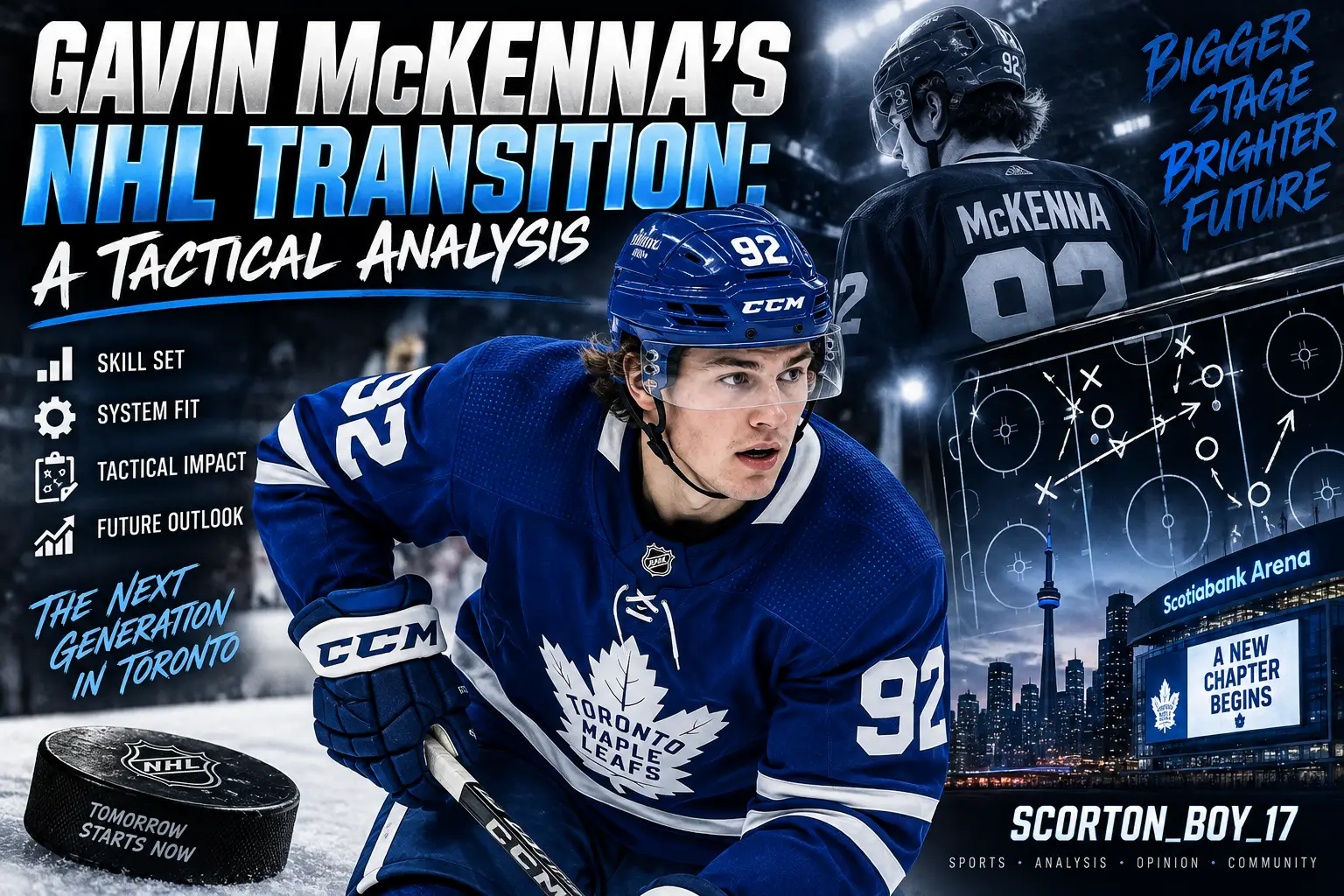
The Gavin McKenna NHL transition plan in Toronto does not require the immediate top-line baptism historically forced on first-overall selections drafted by rebuilding franchises. Unlike environments where an eighteen-year-old phenom is immediately thrust into twenty-plus minutes of head-to-head competition against opposing shutdown pairs, the Toronto Maple Leafs possess the veteran depth, finishing talent, and institutional insulation necessary to manage McKenna’s development with tactical precision. General manager John Chayka and head coach Jim Hiller have established a measured development blueprint: ease the 2026 top selection into five-on-five action through sheltered third-line minutes, weaponize his world-class vision immediately on the top power-play unit, and orchestrate an earned mid-season promotion into the top six once his physical processing of professional contact stabilizes.
This staged acclimation balances physical preservation with offensive impact. Across an anticipated 74 to 78 regular-season games, a realistic performance baseline projects McKenna to record 18 to 22 goals and 44 to 48 assists for 62 to 70 points. Backed by 22 to 26 power-play points generated alongside the shooting talents of Auston Matthews and William Nylander, this phased deployment shields McKenna from the physical wear of the Atlantic Division’s premier checking lines while giving Toronto a balanced, three-line scoring attack.
Successfully executing this transition requires examining how McKenna’s technical habits translate to NHL ice, how Toronto’s roster construction supports an insulated deployment model, what empirical performance markers dictate an elevation to Matthews’ flank, and how historical rookie precedents inform his development runway.
Gavin McKenna NHL Transition: Tactical Profile and Physical Development
McKenna enters the NHL following one of the most prolific scoring tracks in modern amateur hockey. During his 2024–25 campaign with the Western Hockey League’s Medicine Hat Tigers, McKenna authored a 54-game point streak, finishing with 129 points across 56 contests before transitioning to Penn State University for 2025–26. In the NCAA, competing against older, physically mature competition, he led the conference in scoring with 51 points in 35 games to secure the Big Ten scoring title.
Tracking data demonstrates how McKenna’s spatial awareness and puck skills compensate for his physical stature:
| Technical Skill Metric | Amateur Tracking Benchmark | Structural Translation to NHL Execution |
| Expected Primary Assists (xA1/60) | 2.6 per 60 minutes (Tied with C. McDavid & M. Marner in draft/D+1 years) | Immediate high-danger chance creation through inner-slot seam distribution. |
| Slot Pass Completion Volume | 99th percentile across CHL and NCAA data tracking | Consistent ability to manipulate defensive sticks and pass through layered coverage. |
| Puck Transition Deception | 40 space-creating passes per 60 minutes | East-west lateral manipulation that freezes flat-footed defensemen at the blue line. |
| Physical Stature & Leverage | 5-foot-11, 170 pounds at combine testing | Susceptibility to straight-line pinches and physical erasure along the end boards. |
| Defensive Zone Wall Habits | Inconsistent off-puck engagement in low-to-high board battles | High risk of extended defensive zone time if matched against heavy cycling units. |
McKenna controls pace through deception rather than pure north-south speed or strength. He approaches rush entries using dynamic crossover sequences that force opposing defensemen to pivot prematurely, allowing him to cut inside to the middle of the ice or slide pucks into trailing lanes. His passing webs consistently elevate his linemates’ shooting percentages by pulling defenders out of shooting lanes.
At 170 pounds, however, McKenna faces a significant physical transition. In the NCAA, his even-strength on-ice shooting percentage dipped sharply when physical defensive pairings closed his lanes and contested his touches. In the NHL, opposing defensemen close gaps with explosive speed and deliberate contact. Placing McKenna on Toronto’s top line on Opening Night against opposing shutdown pairings like Gustav Forsling, Charlie McAvoy, or Victor Hedman would expose him to heavy hits and constant physical pressure, increasing his injury risk and chipping away at his offensive confidence.
Phase One 5-on-5 Deployment: Third-Line Insulation and Even-Strength Sheltering
To manage McKenna’s physical adaptation, Jim Hiller’s optimal structure places the rookie on the third line at five-on-five, insulated by veteran forwards who can handle defensive responsibilities and win board battles.
| Forward Line | Left Wing | Center | Right Wing | Tactical Role & Zone Responsibility |
| Line 1 | Matthew Knies | Auston Matthews | Jack Roslovic | Primary matchup unit, heavy offensive forechecking, top-tier shooting. |
| Line 2 | Easton Cowan | John Tavares | William Nylander | Secondary scoring unit, low-cycle generation, transition rush threat. |
| Line 3 | Gavin McKenna | Nick Paul | Dakota Joshua | Sheltered offensive generation, heavy board support, forecheck recovery. |
| Line 4 | Colton Sissons | Teddy Blueger | Brandon Duhaime | Defensive shutdown unit, penalty killing, neutral-zone checking. |
Placing McKenna on a third line anchored by Nick Paul (6-foot-4, 234 pounds) and Dakota Joshua (6-foot-3, 218 pounds) provides a functional tactical ecosystem. Nick Paul possesses the defensive instincts, positional discipline, and puck-protection ability to absorb heavy contact, while Joshua consistently establishes aggressive forechecks to disrupt opposing breakout passes.
This deployment creates three specific operational advantages:
- Puck Recovery and Space Creation: Paul and Joshua win the puck along the boards, letting McKenna operate in open space in the high slot and along the half-wall rather than grinding through defensive-zone scrums.
- Targeted Zone-Start Optimization: Jim Hiller can give McKenna an offensive-zone start rate between 62% and 68% against opposing bottom-six forwards and third-pairing defensemen, maximizing his scoring chances while limiting his defensive-zone coverage.
- Regulated Ice Time: Limiting McKenna’s early even-strength minutes to roughly 11:30 to 12:30 per contest keeps him fresh, allowing him to play with pace and creativity rather than wearing down over an 82-game regular season.
Starting McKenna in a sheltered role does not diminish his standing in the organization; it gives him room to adjust to the NHL’s physical pace without the constant pressure of matching up against an opponent’s top players.
Special-Teams Weaponization: Quarterbacking the Primary Power-Play Unit
While sheltering McKenna at five-on-five protects his physical development, restricting his special-teams usage would hold back Toronto’s offence. During the 2025–26 season, the Maple Leafs struggled with static perimeter passing and predictable entries after Mitch Marner’s departure. The roster features exceptional pure finishers in Matthews and Nylander, alongside Darren Raddysh’s heavy shot from the point, but lacked an elite, deceptive playmaker to orchestrate puck distribution.
McKenna addresses this tactical need from day one. On the power play, the physical wear of wall battles drops considerably, replaced by a premium on vision, pass velocity, and spatial deception—areas where McKenna already matches high-end NHL standards.
| Tactical PP1 Position | Assigned Player | Shooting Hand | Operational Function & Passing Lanes |
| Right Flank / Half-Wall QB | Gavin McKenna | Left | Primary puck distributor, entry carrier, cross-seam passer to weak-side one-timer. |
| Left Flank / One-Timer | Auston Matthews | Left | Primary trigger, weak-side catch-and-release, rotational high-to-low threat. |
| Net-Front / Down-Low Bumper | Matthew Knies | Left | Net-front screening, low puck retrieval, redirect option, physical space clearing. |
| High Slot / Bumper Rover | William Nylander | Right | Quick-release shooting from the slot, weak-side recovery, mid-zone give-and-go option. |
| Point Trigger / Distributor | Darren Raddysh | Right1 | Slap-shot threat from the blue line, lateral puck circulation, blue-line hold. |
Placing McKenna on the right half-wall immediately revitalizes Toronto’s power-play structure:
- Zone Entry Efficiency: McKenna excels at crossing the neutral zone with speed, delaying at the blue line, and making cross-ice entry passes that allow the unit to establish clean offensive possession.
- Opening Seam-Pass Options: Operating on his off-wing as a left-hand shot on the right half-wall, McKenna faces the play with an open stick angle, making it difficult for penalty-killers to predict whether he will thread a seam pass to Matthews, shoot, or slide the puck down low.
- Dual-Option Shooting Support: With Raddysh providing a high-volume point shot and Matthews presenting an elite one-timer release from the weak-side flank, penalty-killers cannot overcommit to McKenna, giving him the space he needs to operate.
Allocating 3:00 to 3:30 of power-play time per game gives McKenna a steady source of scoring opportunities. It builds his confidence, gets him on the scoresheet early, and avoids the developmental stagnation that can occur when highly drafted playmakers are kept in limited roles across all game situations.
Off-Ice Insulation and the Tavares Billeting Blueprint
The mental pressure of playing in Toronto as an 18-year-old first-overall selection is a major variable in McKenna’s development. Moving from a remote upbringing in Whitehorse, Yukon, to Toronto’s intense media spotlight presents clear off-ice challenges.
Recognizing this, the Maple Leafs arranged for McKenna to live with former captain John Tavares and his family during his rookie season. Tavares, who was granted exceptional status in the OHL at age 14 and selected first overall by the New York Islanders in the 2009 NHL Draft, experienced a similar transition when he billeted with veteran forward Doug Weight as an 18-year-old rookie. Having successfully hosted younger players like Easton Cowan and Fraser Minten in previous seasons, Tavares gives McKenna an established support system to decompress off the ice.
On the ice, Tavares also serves as a natural linemate for McKenna during intermediate game situations. While Tavares’ open-ice speed has declined, his spatial awareness, puck retention below the goal line, and net-front touch remain strong. If Hiller looks to adjust his combinations without overburdening McKenna against opposing top lines, moving McKenna onto a second line with Tavares offers a smart, balanced compromise.
Progression Thresholds for Top-Six Elevation
Graduating McKenna from his sheltered third-line assignment to Toronto’s top six is an earned transition governed by specific performance indicators. Rather than sticking to an arbitrary calendar date, the coaching staff will monitor three primary tracking and execution metrics to decide when to move him up:
| Assessment Metric | Tactical Evaluation Focus | Target Promotion Threshold | Operational Risk If Unmet |
| Contact Absorption | Neutral-zone turnovers under physical contact | < Giveaways per 60 minutes over a rolling 15-game sample. | High-danger odd-man rushes conceded against elite transition teams. |
| Defensive Zone Wall Work | Controlled breakout execution under forecheck pressure | > Successful defensive-zone touch-to-exit conversion rate. | Hemmed inside the defensive zone, leading to defensive fatigue. |
| 5-on-5 Play Driving | On-ice expected goals percentage (xGF%) against middle-six competition | > xGF% over regular five-on-five minutes. | Net-negative territorial impact when matched against top-pairing defensemen. |
Tracking these metrics gives the coaching staff an objective framework to guide McKenna’s progression throughout the season:
| Deployment Stage | Target Game Range | Five-on-Five Linemates | Five-on-Five ATOI | Zone-Start Deployment | Primary Tactical Focus |
| Stage 1: Adaptation | Games 1 to 20 | Nick Paul (C), Dakota Joshua (RW) | 11:30 – 12:30 | Heavy offensive sheltering (65%+ OZS) | Establishing game speed, PP1 execution, minimizing turnovers. |
| Stage 2: Evaluation | Games 21 to 45 | John Tavares (C), Jack Roslovic (RW) | 13:00 – 14:00 | Moderate offensive sheltering (56%–60% OZS) | Cycling below the goal line, intermediate matchup testing. |
| Stage 3: Top-Six Fit | Games 46 to 82 | Auston Matthews (C), Matthew Knies (LW/RW) | 14:30 – 15:45 | Balanced matchups (50%–53% OZS) | Primary line playmaking, high-danger chance creation with Matthews. |
Between Games 25 and 40, as McKenna demonstrates consistent puck management and improves his wall play, the Maple Leafs can integrate him into the top six alongside Auston Matthews and Matthew Knies.
This combination gives the unit a balanced tactical structure:
- Matthew Knies: Operates as the physical power forward, forechecking aggressively, disrupting passing lanes, and recovering pucks along the boards.
- Gavin McKenna: Serves as the primary transition carrier and distributor, using his speed and vision to enter the offensive zone and thread passes through defensive coverage.
- Auston Matthews: Focuses on finding soft areas in defensive coverage to utilize his world-class wrist shot and one-timer.
Moving Jack Roslovic down into a third-line scoring role balances the lineup’s depth, giving Toronto three dangerous scoring lines as the schedule turns toward the playoffs.
Historical Rookie Precedents: The Marner Framework Versus the Lafrenière Hazard
To establish realistic expectations for an undersized, playmaking winger entering the NHL at 18, it is helpful to examine historical player paths over the past two decades:
| Forward Prospect | Draft Year & Slot | Rookie Season Deployment Model | Rookie Year ATOI (Total / PP) | Rookie Production | Primary Calder Trophy Outcome |
| Patrick Kane | 2007, #1 Overall | Instant top-six forward with high-leverage PP1 responsibilities. | 18:22 Total (3:45 PP) | 82 GP: 21G, 51A, 72P (28 PPP) | Calder Trophy Winner |
| Mitch Marner | 2015, #4 Overall | Sheltered offensive 3rd line (Bozak, JVR) + PP1 half-wall distributor. | 16:49 Total (2:42 PP) | 77 GP: 19G, 42A, 61P (21 PPP) | NHL All-Rookie Team |
| Alexis Lafrenière | 2020, #1 Overall | Buried on third line without top power-play usage (veterans favoured). | 13:53 Total (1:02 PP) | 56 GP: 12G, 9A, 21P (0 PPP) | Missed Calder Finalist Ballot |
| Connor Bedard | 2023, #1 Overall | Thrown directly onto 1st line/PP1 on a depleted roster without veteran insulation. | 19:28 Total (3:37 PP) | 68 GP: 22G, 39A, 61P (21 PPP) | Calder Trophy Winner |
| Gavin McKenna (Projected) | 2026, #1 Overall | Structured Phase: Sheltered 3rd line + PP1, graduating to top line. | 16:45 Total (3:15 PP) | 76 GP: 20G, 46A, 66P (24 PPP) | Prime Calder Contender |
This historical context highlights two critical lessons:
- The Mitch Marner Model as the Gold Standard: Toronto successfully applied this development approach in 2016–17. Marner avoided head-to-head defensive assignments by playing on a line with Tyler Bozak and James van Riemsdyk, while coach Mike Babcock leaned heavily on his playmaking on the top power-play unit. Marner produced 61 points in 77 games, established his confidence, and developed into a perennial All-Star. McKenna’s deployment plan follows this proven blueprint.
- Avoiding the Lafrenière Pitfall: In New York, Alexis Lafrenière was relegated to bottom-six five-on-five minutes while being kept entirely off the top power-play unit in favour of established veterans, recording zero power-play points and just 21 total points in 56 games as an 18-year-old. Giving McKenna consistent PP1 ice time provides the production baseline needed to prevent that developmental stall.
Statistical Forecasts Across Multi-Variable Scenarios
Evaluating McKenna’s rookie campaign across multiple performance scenarios illustrates how ice time, shooting percentages, and deployment roles directly impact his statistical totals:
| Outcome Projection Scenario | Games Played | Even-Strength Goals / Assists | Power-Play Goals / Assists | Total Statline (G-A-PTS) | Average Time on Ice (ATOI) | Tactical Context & Likelihood |
| Conservative / Floor Scenario | 70 GP | 9G, 22A | 4G, 15A | 13G – 37A – 50PTS | 14:45 ATOI (2:15 PP) | Extended stay on line three; shifts to secondary power-play unit; occasional maintenance rest days. (20% Probability) |
| Realistic / Target Baseline | 76 GP | 14G, 27A | 6G, 19A | 20G – 46A – 66PTS | 16:45 ATOI (3:15 PP) | Planned progression: third-line start, permanent PP1 distributor, top-six graduation by midseason2. (65% Probability) |
| Ceiling / Calder Winner Scenario | 80 GP | 17G, 34A | 8G, 23A | 25G – 57A – 82PTS | 18:30 ATOI (3:45 PP) | Instant chemistry with Matthews by November; top-ten league-wide power-play conversion rate. (15% Probability) |
In the realistic baseline projection, McKenna finishes with roughly 20 goals and 66 points across 76 games. Even-strength secondary assists will naturally accumulate through his transition passes to Matthews, Nylander, and Knies, while his primary assist rate on the power play should pace near the top of Toronto’s roster. A projected on-ice shooting percentage of 9.5% to 10.5% at five-on-five aligns with historical marks for high-end playmaking rookies deployed in sheltered offensive roles.
By balancing structural insulation at five-on-five with creative freedom on the power play, Toronto protects Gavin McKenna from premature physical burnout while maximizing his unique playmaking abilities. Rather than asking an 18-year-old to shoulder the franchise’s expectations on day one, this measured approach lets McKenna build his game methodically, establishing a foundation that benefits both his long-term trajectory and the team’s postseason ambitions.
Works cited
- Gavin McKenna – Stats, Contract, Salary & More – Elite Prospects, https://www.eliteprospects.com/player/576982/gavin-mckenna
- https://theleafsnation.com/news/report-toronto-maple-leafs-plan-easing-gavin-mckenna-into-lineup
- Google Sports Data, https://support.google.com/knowledgepanel/answer/9787176
- New Leafs GM Chayka: Berube a ‘tremendous’ coach – TSN, https://www.tsn.ca/nhl/article/new-leafs-gm-chayka-berube-a-tremendous-coach/
- The Gavin McKenna era begins with immense promise, and a, https://mapleleafshotstove.com/2026/09/05/gavin-mckenna-2026-27-player-preview/
- Maple Leafs Training Camp Battles, Part 3: Building out PP1, the, https://mapleleafshotstove.com/2026/09/16/maple-leafs-training-camp-battles-part-3/
- Scouting Report: How Gavin McKenna dominated the WHL and, https://www.eliteprospects.com/news/2026-nhl-draft/scouting-report-how-gavin-mckenna-dominated-the-whl-and-what-hell-bring-to-penn-state
- Gavin McKenna to live with John Tavares and his family … – TSN, https://www.tsn.ca/nhl/article/maple-leafs-rookie-mckenna-to-live-with-veteran-f-former-captain-tavares-this-season/
- Gavin McKenna – Wikipedia, https://en.wikipedia.org/wiki/Gavin_McKenna
- Gavin McKenna scores Michigan at Leafs rookie practice, talks living with John Tavares and playing with Auston Matthews, https://russianmachineneverbreaks.com/2026/09/11/gavin-mckenna-leafs-scores-michigan-john-tavares-roommate-auston-matthews-linemmate/
- How good of a prospect is Gavin McKenna? : r/hockey – Reddit, https://www.reddit.com/r/hockey/comments/1q4r5xo/how_good_of_a_prospect_is_gavin_mckenna/
- Film Room: Why Gavin McKenna should go first overall in the 2026, https://www.eliteprospects.com/news/2026-nhl-draft/film-room-why-gavin-mckenna-should-go-first-overall-in-the-2026-nhl-draft
- Maple Leafs Training Camp Battles, Part 1: Top-Six Openings, https://mapleleafshotstove.com/2026/09/14/maple-leafs-training-camp-battles-part-1/
- Toronto Maple Leafs NHL Line Combinations – Daily Faceoff, https://www.dailyfaceoff.com/teams/toronto-maple-leafs/line-combinations
- The projected Maple Leafs 2026-27 opening night lines: Who gets, https://www.hockeypatrol.com/nhl-team/toronto-maple-leafs/the-projected-maple-leafs-2026-27-opening-night-lines-who-gets-left-out
- Toronto Maple Leafs Line Up | StatMuse, https://www.statmuse.com/nhl/ask/toronto-maple-leafs-line-up
- Maple Leafs’ John Tavares outlines advice for Gavin McKenna: ‘I think you just want him to be himself’, https://theleafsnation.com/news/toronto-maple-leafs-john-tavares-outlines-advice-gavin-mckenna-you-just-want-him-to-be-himself
- McKenna quickly taken under wing of well-versed Tavares with, https://www.nhl.com/news/gavin-mckenna-taken-under-john-tavares-wing-with-toronto-maple-leafs
- Maple Leafs’ John Tavares Is Excited To Mentor Gavin McKenna, https://thehockeynews.com/news/latest-news/maple-leafs-john-tavares-is-excited-to-mentor-gavin-mckenna-hes-an-unbelievable-kid
- John Tavares on living with Gavin McKenna in his rookie season as, https://mapleleafshotstove.com/2026/09/16/john-tavares-on-living-with-gavin-mckenna-in-his-rookie-season-as-leaf/
- Maple Leafs Training Camp Battles, Part 2: Who partners with Raddysh, who rounds out the top four D, and who claims the final spot?, https://mapleleafshotstove.com/2026/09/15/maple-leafs-training-camp-battles-part-2/
- “McKenna is too good to play with players who can’t think the game, https://mapleleafshotstove.com/2026/09/16/anthony-petrielli-discusses-mckennas-lineup-spot-on-sn590/
- Stats for player Kane, Patrick #88 (RW) – Chicago Blackhawks, https://www.officepools.com/nhl/entity/player/4240
- Patrick Kane – Olympic Ice Hockey – Team USA, https://www.teamusa.com/profiles/patrick-kane
- Patrick Kane Average Time On Ice In His Career | StatMuse, https://www.statmuse.com/nhl/ask/patrick-kane-average-time-on-ice-in-his-career
- Patrick Kane Stats | NHL.com, https://www.nhl.com/blackhawks/player/patrick-kane-8474141/stats
- 2007-08 NHL Debuts | Hockey-Reference.com, https://www.hockey-reference.com/leagues/NHL_2008_debut.html
- Mitch Marner’s 2016-17 Season Rookie Report Card | FOX Sports, https://www.foxsports.com/stories/nhl/mitch-marners-2016-17-season-rookie-report-card
- Mitch Marner Time On Ice Average By Season | StatMuse, https://www.statmuse.com/nhl/ask/mitch-marner-time-on-ice-average-by-season
- Mitch Marner biography: career, stats, style – hockey players, https://allhockeyplayers.com/mitch-marner/
- Mitch Marner: News, Stats, Game Logs | RotoWire, https://www.rotowire.com/hockey/player/mitch-marner-4774
- Mitch Marner Stats | NHL.com, https://www.nhl.com/goldenknights/player/mitch-marner-8478483/stats
- Alexis Lafrenière – Wikipedia, https://en.wikipedia.org/wiki/Alexis_Lafreni%C3%A8re
- Alexis Lafreniere: News, Stats, Game Logs | RotoWire, https://www.rotowire.com/hockey/player/alexis-lafreniere-5916
- New York Rangers left winger Alexis Lafreniere has really found his, https://www.facebook.com/thehockeynews/posts/new-york-rangers-left-winger-alexis-lafreniere-has-really-found-his-game-in-this/1372209111614740/
- Patrick Kane Stats, Height, Weight, Position, Title, https://www.hockey-reference.com/players/k/kanepa01.html


Leave a Reply