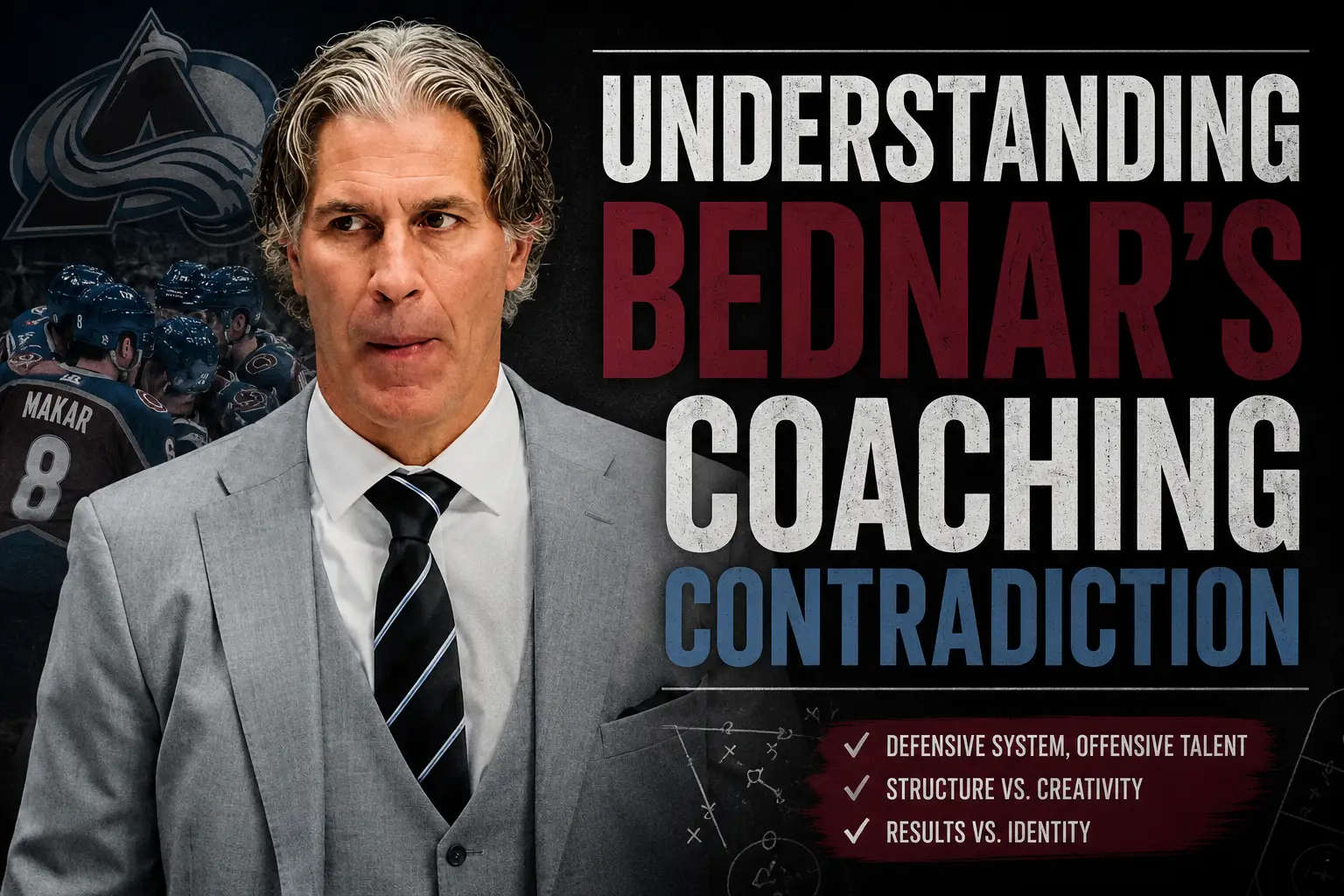
The Paradox of Tenure and Success in the Modern NHL
In the hyper-competitive and strategically fluid ecosystem of the National Hockey League (NHL), the evaluation of a head coach is rarely a simple binary calculation of absolute success versus absolute failure. It is, instead, an ongoing calculation of marginal utility, tactical adaptability, and psychological resonance within the locker room. For the Colorado Avalanche, the 2025-26 season encapsulated this paradox perfectly. Under the leadership of head coach Jared Bednar, the Avalanche assembled the finest regular season in the history of the franchise, posting a staggering 55-16-11 record to accrue 121 points and capture the Presidents’ Trophy.1 They commanded the league statistically, leading all 32 franchises with 302 goals for (an average of 3.68 per game) while simultaneously boasting the NHL’s stingiest defence, surrendering a mere 197 goals throughout the 82-game campaign.2
By every traditional metric, Jared Bednar is not just a good coach; he is one of the premier bench bosses of his generation, and his legacy in Denver is unassailable. Since his unexpected hiring late in the summer of 2016 following the sudden departure of Patrick Roy, Bednar has overseen a dramatic, holistic organizational rebuild.4 He shepherded the team from a historically poor 22-win season in his debut year to a 2022 Stanley Cup championship, establishing himself as the second-longest tenured coach in the NHL, trailing only Tampa Bay’s Jon Cooper.5 Bednar holds the franchise record for coaching victories, surpassing Michel Bergeron in January 2023 with his 265th win, and recently crossed the 400-win threshold as an NHL head coach.1 Furthermore, he holds the unique distinction of being the first coach to win the ECHL’s Kelly Cup (2009), the AHL’s Calder Cup (2016), and the NHL’s Stanley Cup (2022).1
However, professional hockey does not grade on a curve of past accomplishments, nor does it reward regular-season dominance with postseason immunity. When a franchise boasts a core of generational, prime-age talent—including Nathan MacKinnon, Cale Makar, Mikko Rantanen, Gabriel Landeskog, and Devon Toews—the mandate is absolute: championship contention is the only acceptable outcome, and any deviation from that trajectory is viewed as an organizational failure.7 Despite the regular-season dominance that defined the 2025-26 campaign, the Avalanche’s postseason trajectory since hoisting the Stanley Cup in 2022 has been defined by systematic underachievement, tactical stagnation, and emotional fragility in critical elimination scenarios.
Following the championship parade, the Avalanche have suffered a first-round exit to the Seattle Kraken in 2023 1, consecutive first-round exits to the Dallas Stars in 2024 and 2025 8, and a humiliating four-game sweep at the hands of the Vegas Golden Knights in the 2026 Western Conference Final.3 The narrative surrounding Bednar has shifted. Prior to falling behind 3-0 against Vegas, the consensus was that his job was entirely safe, insulated by a recent contract extension and a long history of regular-season success.7 Following the sweep, the discourse has pivoted sharply; while he may survive the immediate summer due to the mitigating context of severe roster injuries, he will undoubtedly begin the 2026-27 season on the hottest seat in the NHL.7
This exhaustive analysis evaluates why the Colorado Avalanche have reached a strategic impasse under Jared Bednar, answering the complex question of why a franchise must sometimes move on from a demonstrably “good” coach. By examining the tactical failures of the 2026 postseason, the psychological realities of coaching shelf life, the severe constraints of the salary cap, and the evolving demands of NHL playoff hockey, the evidence overwhelmingly suggests that the Avalanche require a structural evolution in leadership to maximize the rapidly closing window for their elite core.
The Bednar Legacy and Post-Championship Attrition
To fully understand the current organizational crisis, one must trace the Avalanche’s postseason efficacy over the latter half of Bednar’s tenure. Winning a Stanley Cup provides a coach with an abundance of organizational capital and the explicit benefit of the doubt from both the front office and the fan base.7 Bednar rightly earned his status as a champion.1 Yet, the subsequent four postseasons reveal a consistent, alarming inability to navigate the specific, grinding adversities that are entirely unique to a seven-game NHL playoff series.
| Season | Regular Season Record | Points | Division Finish | Playoff Result | Opponent | Series Record |
| 2021-22 | 56-19-7 | 119 | 1st in Central | Won Stanley Cup | Tampa Bay (TBL) | 4-2 |
| 2022-23 | 51-24-7 | 109 | 1st in Central | Lost First Round | Seattle (SEA) | 3-4 |
| 2023-24 | 50-25-7 | 107 | 3rd in Central | Lost Second Round | Dallas (DAL) | 2-4 |
| 2024-25 | 49-29-4 | 102 | 3rd in Central | Lost First Round | Dallas (DAL) | 3-4 |
| 2025-26 | 55-16-11 | 121 | 1st in Central | Lost Conference Final | Vegas (VGK) | 0-4 |
Table 1: Colorado Avalanche Performance Post-2022 Championship 1
The data highlights a severe juxtaposition between the marathon of the regular season and the sprint of the playoffs. The Avalanche have posted an elite points percentage over the last half-decade, routinely hovering above the .650 mark, largely because their overwhelming offensive talent can overcome the unstructured, varied nature of an 82-game schedule.1 However, their playoff win percentage since 2022 has plummeted, culminating in four consecutive disappointing exits.7 The nature of these exits is highly uniform, suggesting a systemic flaw rather than a series of unfortunate anomalies.
Against the Seattle Kraken in 2023, the Dallas Stars in both 2024 and 2025, and the Vegas Golden Knights in 2026, the Avalanche encountered heavily structured, physical teams that successfully implemented neutral-zone traps to decelerate Colorado’s transition game.14 The defining characteristic of an elite NHL coach is the capacity to impose systemic adjustments when the primary tactical framework is neutralized by an opponent’s scouting. The repeated failure to decode the neutral-zone trap over four consecutive postseasons suggests a systemic rigidity within Bednar’s coaching philosophy.14 The 2026 sweep by the Vegas Golden Knights serves as the ultimate indictment of this inflexibility, stripping away the illusion of progress generated by the Presidents’ Trophy and exposing the structural vulnerabilities inherent in the current system.7
Tactical Paralysis: The Neutral Zone Trap and the Rush Offence Dilemma
The 2026 Western Conference Final was universally expected to be a clash of Western Conference titans. Colorado entered the series undefeated in the playoffs, having effortlessly swept the Los Angeles Kings in the first round and dispatched the Minnesota Wild 4-1 in the second round.3 They were a dominant force, averaging a league-best 4.4 goals per game through their first nine postseason contests.17 They faced a Vegas Golden Knights team that had undergone significant internal turmoil, firing Stanley Cup-winning coach Bruce Cassidy in late March 2026 and replacing him with the notoriously demanding, structurally rigid John Tortorella.18
Despite entering as heavy betting favourites, the Avalanche were systematically dismantled by Tortorella’s Golden Knights in four consecutive games.10 The series was not merely a defeat; it was a comprehensive tactical outclassing that exposed deep-seated flaws in Colorado’s preparation, in-game management, and offensive architecture.
Decelerating the Transition Game
The Golden Knights coaching staff clearly recognized that exchanging offensive rushes with the Avalanche would be fatal. Colorado’s offensive system, predicated on elite skating defensemen like Cale Makar and Devon Toews activating into the rush and carrying the puck through the neutral zone with speed, thrives on open ice and broken defensive structures.14 To counter this, Tortorella implemented a rigid 1-3-1 and 1-1-3 neutral zone configuration.14 This strategy clogs the center of the ice, positioning three defenders across the red or blue line, forcing the puck carrier to either execute low-percentage lateral passes or reluctantly dump the puck into the offensive zone.
A team built primarily on speed, east-west puck movement, and possession entries naturally struggles with a dump-and-chase methodology. When forced to dump the puck by the Vegas structure, Colorado’s forwards consistently lost the ensuing retrieval battles along the boards to Vegas’s larger, more physical defensemen.7 The inability of Bednar and his staff to adjust their breakout structures—such as utilizing quick, vertical stretch passes to bypass the trap, activating the weak-side defenseman earlier in the transition, or utilizing a heavy, synchronized forecheck to disrupt Vegas’s retrievals—resulted in complete offensive stagnation.7
The depths of this tactical paralysis were fully exposed in Game 4 of the series. Facing elimination, a team with the offensive firepower of the Avalanche is expected to launch a desperate, overwhelming barrage of shots. Instead, Vegas’s defensive wall was so impenetrable that Colorado went a staggering 25 minutes without registering a single shot on goal.7 Vegas committed to a shot-blocking clinic, absorbing 23 blocks in Game 1, 16 in Game 2, 22 in Game 3, and 14 in Game 4.7 By allowing Colorado to operate strictly on the perimeter and denying access to the high-danger areas in the slot, Vegas insulated goaltender Carter Hart, neutralizing the Avalanche’s high-danger scoring chances and forcing Bednar’s squad into a predictable, easily defended offensive loop.7
The Neutralization of Elite Talent
The hallmark of a well-coached team in the playoffs is the ability to leverage depth and alter matchups when superstars are heavily targeted by the opposition. In the 2026 Western Conference Final, Tortorella utilized elite two-way center Jack Eichel in a strict checking role against Nathan MacKinnon.7 MacKinnon, who scored 53 goals during the regular season and serves as the emotional and offensive engine of the Avalanche, was entirely suffocated by Eichel’s relentless shadowing.7 Tortorella actively matched Eichel against MacKinnon at every opportunity, successfully shutting down his speed through the neutral zone and limiting his shooting lanes.7 Consequently, MacKinnon was held to just two assists over the four-game sweep.7
With the primary threat neutralized, the onus fell to Colorado’s secondary scoring depth to break the Vegas trap. Over previous seasons, General Manager Chris MacFarland had aggressively reinforced the roster, acquiring high-end talent such as Martin Necas, Brock Nelson, and Nazem Kadri to ensure the team was not entirely reliant on its top line.10 Necas, Nelson, and Valeri Nichushkin had combined for an impressive 88 goals during the regular season.10 Yet, in the suffocating environment of the playoffs, this trio managed a mere four goals across 13 total postseason games.10
Martin Necas, in particular, was emblematic of Colorado’s systemic failures. Known as a dynamic driver of offence who thrives when given space to be creative, Necas registered just one five-on-five point in the entire Vegas series and failed to record a single even-strength shot on goal in the final two games.10 Vegas was perfectly content to let players like Necas skate wide along the perimeter, knowing that Bednar’s system lacked the interior presence required to break down a condensed defensive shell.10 Veteran Brock Nelson experienced the worst playoff performance of his lengthy career; relied upon heavily to provide middle-six stability, he was completely absent at both ends of the ice, finishing the four-game series with zero points.7
While individual players must ultimately execute on the ice, the failure of an entire newly assembled forward corps to generate high-danger offence points directly points to a lack of strategic alignment. Bednar failed to place his depth pieces in positions to succeed against a structured opponent, opting to run the same ineffectual rush plays rather than demanding a heavier, more direct style of interior play.
The Anatomy of the 2026 Western Conference Final Collapse
The four-game sweep was not a monotonous procession; it was marked by specific moments of failure that highlighted the Avalanche’s inability to match the Golden Knights’ intensity and execution. Game 1 set the tone, with Vegas stealing home ice in a 4-2 victory.23 The deadlock was broken by Dylan Coghlan, an unlikely hero who had not scored an NHL goal in nearly five years, whose wrist shot under goaltender Scott Wedgewood’s legs shifted the momentum entirely.24 Coghlan, praised by Tortorella for his “no fear” approach, epitomized the depth of contributions Vegas received, in sharp contrast to Colorado’s top-heavy reliance.24
Game 2 ended in a 3-1 Vegas victory, further tightening the defensive chokehold, but Game 3 at T-Mobile Arena truly broke the Avalanche’s spirit.23 It was a game that highlighted not just tactical deficiencies, but a severe lack of emotional equilibrium.
Emotional Fragility and the Game 3 Meltdown
Beyond tactical adjustments, a head coach is responsible for the roster’s emotional equilibrium and competitive resilience. The tipping point of the 2026 season occurred during this pivotal Game 3. Down 2-0 in the series, the Avalanche surged to a 3-0 lead by the 13:15 mark of the first period.23 Gabriel Landeskog opened the scoring, capitalizing on a drive to the net by Devon Toews.23 Nazem Kadri doubled the lead with a left-slot shot set up by Martin Necas, and Jack Drury added a critical shorthanded goal.23 It was a golden opportunity to seize momentum, quiet the Vegas crowd, and climb back into the series.
Instead, the Avalanche’s defensive structure inexplicably dissolved. Rather than simplifying their game, managing the puck responsibly through the neutral zone, and forcing Vegas to take risks, the team continued to force low-percentage plays.7 Vegas capitalized on these unforced errors, methodically breaking down Colorado’s coverage. Keegan Kolesar scored the game-tying goal in the second period, erasing the 3-0 deficit, and Vegas ultimately secured a 5-3 victory by scoring five unanswered goals.7
This meltdown highlighted a severe lack of competitive composure. Observers noted that Vegas simply looked hungrier throughout the series, consistently winning 50/50 puck battles along the boards, dictating the physical pace of the game, and imposing their will upon a seemingly passive Colorado squad.7 The Avalanche appeared “soft on pucks” and loose defensively, unable to match the desperation of the moment.7 When a highly skilled, veteran-laden team displays emotional fragility and a lack of competitive spirit in an elimination scenario, it is often a leading indicator that the coach’s message no longer commands the locker room with the necessary authority.7
The sweep was finalized in a 2-1 Game 4 loss, a game where Colorado went out with a whimper rather than a physical pushback.7 Following the game, Tortorella made headlines by defending his counterpart, telling the media to “get off Bedsy’s ass”.25 While this gesture demonstrated the immense respect Bednar commands within the NHL coaching fraternity, it also inadvertently highlighted the reality of the situation: the hockey world universally recognized that the sweep had placed Bednar on the hot seat.25
Psychological Attrition: Stale Messaging and the Shelf Life of NHL Coaches
The concept of a coach “losing the room” or suffering from a “stale message” is not merely a sports cliché utilized by pundits; it is a measurable psychological phenomenon rooted in the dynamics of elite athletic performance and organizational behaviour. At the conclusion of the 2024-25 NHL regular season, the league possessed the shortest coaching tenure among the four major men’s sports leagues in North America, with an average tenure of just 2.38 years across the 32 franchises.27 The intense, 82-game regular season, coupled with the grinding physical and mental attrition of the playoffs, creates a pressure-cooker environment where communication styles rapidly yield diminishing returns.26
The Dynamics of Competence Support
Research in sports psychology indicates that peak athletic performance is heavily reliant on “competence support”—the way a coach’s actions, instructions, and communication empower players to feel capable, prepared, and resilient.29 In a study of competitive athletic teams, environments where coaches actively supported team competence outperformed control groups significantly.29
Over a ten-year tenure, maintaining this level of competence support becomes exponentially difficult. A coach’s motivational tactics, video session habits, pre-game speeches, and systematic corrections become entirely predictable to the veteran core. Players subconsciously anticipate the coach’s reactions, dulling the impact of the instruction. When extreme adversity strikes—such as falling behind 2-0 to a lower-seeded team or blowing a 3-0 lead in a pivotal Game 3—a familiar voice often fails to trigger the necessary psychological urgency.
As Hall of Fame player and current NHL coach Martin St. Louis astutely observed regarding coaching changes, the arrival of a new voice acts as a vital “reset button” for a roster.30 It instantly clears away accumulated mental fatigue, disrupts established locker room hierarchies, and forces every player into a state of heightened accountability, as past achievements hold no currency with the new regime.30
Historical Precedents of the Mid-Season and Off-Season Reset
NHL history is replete with evidence supporting the efficacy of structural coaching changes for teams with championship-calibre rosters that have inexplicably plateaued. The “dead cat bounce” effect, in which a team temporarily improves under new leadership due to a surge in adrenaline and accountability, is well-documented across all sports.31 However, when this change is applied to an elite, prime-age roster, the adjustment often results in sustained championship success rather than a temporary statistical anomaly.
- The 2015-16 Pittsburgh Penguins: Similar to the current Avalanche, the 2015-16 Penguins boasted a generational core featuring Sidney Crosby, Evgeni Malkin, and Kris Letang that had grown stale and suffered a string of disappointing early playoff exits. General Manager Jim Rutherford recognized the tactical stagnation and fired Mike Johnston in December 2015, elevating Mike Sullivan from the AHL.32 Sullivan implemented a direct, high-pace system that demanded two-way accountability, fundamentally altering the team’s posture. This reset resulted in back-to-back Stanley Cups in 2016 and 2017.33
- The 2018-19 St. Louis Blues: Mired in last place in the NHL in January 2019, the Blues possessed a highly talented roster that was vastly underperforming. The organization fired Mike Yeo and installed Craig Berube.30 Berube’s demanding, physical style completely revitalized the team’s defensive structure and emotional engagement, leading to a historic turnaround, a franchise-record 11-game winning streak, and the 2019 Stanley Cup.30
- The Vegas Golden Knights (2022 and 2026): The very team that eliminated Colorado serves as a prime example. Vegas fired Peter DeBoer in 2022 despite a highly talented roster. They hired Bruce Cassidy, who immediately brought strict defensive accountability and led the franchise to the 2023 Stanley Cup.20 When Vegas sensed stagnation again in the 2025-26 season—dropping to third in the division and suffering a 3-5-2 stretch—they ruthlessly fired the Cup-winning Cassidy in late March and hired John Tortorella.18 Tortorella instantly provided the emotional spark and structural rigidity necessary to sweep the Avalanche just months later.18
These historical precedents closely mirror Colorado’s current predicament. The Avalanche do not lack talent; they possess one of the most gifted rosters assembled in the salary cap era. What they lack is the structural discipline and psychological edge that a new authority figure provides. Bednar’s calm, player-friendly demeanour was perfectly suited for guiding a young team out of a rebuild and culminating in the 2022 championship.15 However, an aging, highly decorated core often requires a disruptor to break them out of their accumulated habits and force compliance with the gruelling defensive details required to win in the modern NHL.39
Salary Cap Realities and Front Office Aggression
The argument for replacing Jared Bednar is heavily reinforced by the overarching organizational strategy implemented by President of Hockey Operations Joe Sakic and General Manager Chris MacFarland.41 The Avalanche front office has operated with a clear, uncompromising “win-now” mandate, aggressively leveraging future assets to assemble a roster capable of securing multiple championships during the MacKinnon-Makar window.43
The Depletion of Draft Capital and Organizational Depth
To continually reinforce the NHL roster and survive the attrition of playoff hockey, MacFarland has systematically mortgaged the franchise’s future. Over a three-year span leading up to the 2026 playoffs, Colorado traded away three first-round picks, two second-round picks, and two third-round picks.22 Notable prospects, such as Calum Ritchie and William Zellers, were packaged to acquire established veterans like Brock Nelson and Charlie Coyle.44
Consequently, the Avalanche’s prospect pool is barren, ranking 29th overall in the NHL.22 While goaltender Ilya Nabokov and junior player Christian Humphreys stand as rare, intriguing assets, the system is devoid of impact talent capable of stepping into the NHL lineup to provide cheap, entry-level production.22 In the 2026 NHL Draft, the Avalanche possess only a fourth-round and a seventh-round selection, crippling their ability to inject youth into the organization.22
The Top-Heavy Salary Cap Structure
The NHL operates under a rigid hard salary cap, projected at $95.5 million for the upcoming season.45 Colorado’s cap structure is exceptionally top-heavy, reflecting the premium cost of retaining superstar talent and acquiring high-end secondary scoring.
| Player | Position | 2026-27 Cap Hit | Contract Expiry | Free Agency Status |
| Nathan MacKinnon | C | $12,604,000 | 2030-2031 | UFA |
| Cale Makar | D | $9,000,000 | 2026-2027 | UFA |
| Brock Nelson | C | $7,500,000 | 2027-2028 | UFA |
| Devon Toews | D | $7,250,000 | 2030-2031 | UFA |
| Nazem Kadri | C | $7,000,000 | 2028-2029 | UFA |
| Gabriel Landeskog | LW | $7,000,000 | 2028-2029 | UFA |
| Martin Necas | C | $6,500,000 | 2025-2026 | UFA |
| Valeri Nichushkin | RW | $6,125,000 | 2029-2030 | UFA |
Table 2: Core Salary Cap Commitments of the Colorado Avalanche 45
Analyzing this financial structure reveals a stark reality. Using a basic cap allocation calculation based on the top eight contracts:


Nearly 66% of the Avalanche’s total salary cap is allocated to just eight players. With roughly $99.7 million in projected cap hits currently on the books (requiring Long-Term Injured Reserve manipulations or minor transactions to become cap compliant), the front office has virtually zero financial flexibility to alter the core of the roster.45 The commitment to players like Valeri Nichushkin (signed through 2030 at $6.125 million AAV) and the aging Brock Nelson further restricts mobility.47
This financial reality restricts MacFarland’s ability to fundamentally overhaul the playing personnel to address the consecutive playoff failures. If the roster cannot be significantly altered due to suffocating cap constraints and a total lack of tradeable draft assets, the only major variable the organization can manipulate to change the on-ice product is the coaching staff. The front office has aggressively delivered a “dream roster” filled with elite talent and high-end veterans to the coaching staff.50 The failure to optimize this roster falls squarely on the tactical deployment and systematic execution managed by Jared Bednar.
Furthermore, the pressure is mounting on the front office itself. Rumours have swirled during the 2026 playoffs linking Chris MacFarland to a potential move to the Nashville Predators as President of Hockey Operations.51 While deemed premature, this chatter indicates the volatility within the league.51 If the Avalanche do not correct their postseason trajectory immediately, the blame will inevitably shift upward from the coach to the architects of the roster.50
Evaluating Mitigating Factors: Attrition, Injuries, and Execution Parity
A rigorous and objective analysis must acknowledge the mitigating factors surrounding the Avalanche’s 2026 playoff collapse. Bednar’s proponents and defenders in the media rightly point to the severe, poorly timed injuries that compromised the roster during the Western Conference Final.7
Cale Makar, arguably the most dynamic defenseman in the world and the absolute linchpin of Colorado’s transition system, suffered an upper-body injury that severely limited his shooting ability and forced him to miss the first two games of the Vegas series.7 Nathan MacKinnon sustained a foot/leg injury after blocking a shot in Game 3, which visibly robbed him of his signature explosive acceleration—his “extra gear”—in the critical Game 4 elimination scenario. 7 Additionally, highly impactful power forward Valeri Nichushkin was absent for the third period of Game 3 and the entirety of Game 4.26
Furthermore, the physical and emotional toll on Captain Gabriel Landeskog cannot be overstated. After missing a staggering 1,032 days following the 2022 Stanley Cup victory due to multiple procedures, including a complex cartilage replacement surgery in his right knee, Landeskog made a heroic return to full-time play for the 2025 and 2026 seasons.53 While his leadership remains unquestioned, relying on a player managing a severe, chronic condition to carry the emotional and physical burden of a deep playoff run is an inherently unsustainable strategy for the franchise.55
While these injuries provide a legitimate context—and are likely the primary reason Bednar avoided immediate dismissal following the sweep, earning the “benefit of the doubt” through the summer—they do not absolve the coaching staff of their structural failures.7 Every NHL team manages severe attrition during the two-month gauntlet of the postseason. A championship-calibre coaching staff must possess the tactical bandwidth to insulate compromised stars. Instead of implementing a more conservative, trap-busting structure to protect an injured Makar and MacKinnon, Bednar’s system continued to rely on their individual brilliance to generate offence.
More damningly, the lack of competitive spirit, the poor puck support in the defensive zone, and the emotional fragility witnessed during the blown lead in Game 3 are behavioural and systematic issues, not medical ones. Injuries excuse a lack of high-end scoring execution and a drop in shooting percentage; they do not excuse being outworked along the boards, surrendering five consecutive goals in a pivotal playoff game, or failing to register a shot for 25 minutes.7
The Next Evolution: Profiling David Carle and Bruce Cassidy
If the Colorado Avalanche ultimately determine that a coaching change is necessary to maximize the rapidly closing MacKinnon-Makar championship window, the subsequent search must target a specific coaching profile that addresses the team’s current, glaring deficiencies: structural rigidity, neutral-zone predictability, and emotional complacency. The market for elite NHL coaches is notoriously volatile, but several prime candidates align perfectly with Colorado’s operational and tactical needs.
The Modern Possession Architect: David Carle
The most compelling, forward-thinking candidate to usher the Avalanche into their next era is David Carle, the current head coach of the University of Denver (DU) Pioneers.56 At just 35 years old, Carle has firmly established himself as the premier hockey mind outside of the NHL, building a modern collegiate dynasty in the Avalanche’s backyard. Since taking over the DU program in 2018 as the youngest Division I head coach in the nation (age 28), Carle has amassed a staggering 179-74-17 overall record, equating to a .694 winning percentage.58
Carle’s resume is immaculate and historically significant. He has led the Pioneers to three NCAA National Championships (2022, 2024, and 2026), making him the youngest coach ever to win multiple national titles.58 Furthermore, his capability to manage elite, NHL-bound talent and perform under intense, short-tournament pressure was solidified on the international stage, where he guided the United States to back-to-back gold medals at the 2024 and 2025 IIHF World Junior Championships.57
Tactically, Carle’s system is an ideal, seamless fit for Colorado’s current roster construction. He emphasizes high-pressure possession hockey, prioritizing relentless puck retrievals and transitional speed.60 Unlike traditional, antiquated dump-and-chase systems, Carle’s methodology empowers defensemen to join the rush while maintaining a layered, heavily supported offensive attack, directly mirroring the analytics-driven approach favoured by the Avalanche front office.60
Furthermore, Carle’s leadership philosophy centers on remaining calm and composed under immense pressure, prioritizing consistent preparation over volatile emotional reactions—a stark contrast to the panic and fragility seen in the Avalanche’s recent playoff exits.61 He has successfully navigated the complexities of the modern NCAA transfer portal and Name, Image, and Likeness (NIL) landscape by prioritizing culture, fit, and long-term development over chasing short-term roster fixes, proving his capability as a holistic program builder.61
While the Toronto Maple Leafs are reportedly preparing a massive financial package—rumored by NHL insiders to be approaching six years and $48 million—to lure Carle away from college hockey to replace Craig Berube, the Avalanche possess a distinct geographical and cultural advantage in a potential bidding war.56 Carle has deep, enduring roots in the Denver hockey community, having been affiliated with DU since his playing days ended prematurely in 2008 due to a heart condition diagnosis. 57 His brother, Matt Carle, won championships at DU, further cementing the family’s legacy.64 He and his young family are deeply entrenched in Colorado, and he has explicitly stated that Denver is “home” and that he views his current role as the best job outside the NHL.62 Offering Carle the opportunity to transition to the NHL without uprooting his family, while simultaneously inheriting a Stanley Cup-ready roster featuring MacKinnon and Makar, presents an unparalleled recruitment pitch that Toronto simply cannot match.63
The Veteran Structuralist: Bruce Cassidy
If the Avalanche front office prefers an established NHL veteran to enforce immediate accountability and correct the team’s defensive lapses, Bruce Cassidy represents the ideal alternative candidate. Cassidy was shockingly dismissed by the Vegas Golden Knights in March 2026, despite leading the franchise to the 2023 Stanley Cup and possessing a highly successful track record (245-108-46 during his tenure in Vegas).18
Cassidy is renowned throughout the league for his demanding, detail-oriented approach to team defence and structured breakouts. During his successful tenure with the Boston Bruins (leading them to the 2019 Stanley Cup Final) and his championship run with Vegas, Cassidy implemented defensive systems that heavily insulated goaltenders, prioritized shot-blocking, and restricted high-danger chances from the inner slot.38
For an Avalanche team that frequently bleeds defensive chances when its offensive transition is stifled, Cassidy’s rigid system would force a necessary, albeit uncomfortable, structural discipline. He has proven his ability to take highly talented rosters and implement the heavy, gruelling style of play required to win in the postseason. While the Golden Knights have currently invoked their contractual right to block teams within their division (and potentially the entire Western Conference) from interviewing Cassidy while he remains under contract for another year, a persistent and aggressive pursuit by Chris MacFarland could potentially force the issue or result in compensation being agreed upon.19 Hiring the exact coach who intimately understands the architecture of the team that just swept Colorado, and who possesses intimate knowledge of the Pacific Division, would be a brilliant strategic maneuver for the Avalanche.
Strategic Outlook and Conclusion
The tenure of Jared Bednar with the Colorado Avalanche is, without question, an undeniable triumph of modern hockey management and patience. He successfully navigated the franchise out of the dark, uncompetitive days of the mid-2010s, established a pervasive culture of high-end execution, and secured the 2022 Stanley Cup for a fan base starved of championship glory. His legacy in Denver is secure, and he will rightly be remembered as one of the greatest coaches in franchise history.1
However, professional sports operate on a relentless continuum of progression. The data and observational evidence from the past four postseasons overwhelmingly indicate that the Avalanche have reached a severe tactical and psychological plateau under his leadership. The 2026 Western Conference Final sweep against the Vegas Golden Knights was not an isolated anomaly caused solely by poor puck luck or poorly timed injuries; it was the terminal symptom of an offensive system that has been systematically decoded and neutralized by the NHL’s elite defensive minds. Bednar’s consistent inability to adapt his rush-based offence to beat the neutral-zone trap, combined with the emotional fragility and lack of competitive pushback he displayed in critical elimination scenarios, strongly suggests that his message no longer commands the necessary operational urgency in the locker room.7
The Avalanche organization finds itself in a highly restrictive, high-pressure operational window. General Manager Chris MacFarland has traded away substantial future draft capital and prospect depth to assemble the current core.22 With nearly 66% of a tight salary cap explicitly committed to eight aging players, the roster cannot undergo a meaningful reconstruction or significant personnel overhaul.45 Core pillars such as Nathan MacKinnon, Mikko Rantanen, Devon Toews, and Gabriel Landeskog are firmly transitioning into the latter half of their athletic primes.
When a championship-calibre roster becomes financially fixed and tactically stagnant, the only viable mechanism for organizational optimization is a structural change in leadership. The historical precedent of teams like the 2016 Penguins and 2019 Blues proves that a new voice can provide the vital reset required to push an underperforming elite roster over the championship threshold.30
Whether the Avalanche choose to pivot to a brilliant, modern tactician like David Carle to revitalize their possession metrics and modernize their approach, or to a hardened, defensive veteran like Bruce Cassidy to instill the necessary rigidity and accountability, the need for a new voice is increasingly evident. The margin between a multi-championship dynasty and a perennial playoff disappointment in the NHL is razor-thin. To properly honour the prime years of generational talents like MacKinnon and Makar, the Colorado Avalanche must acknowledge the tactical limits of their current coaching paradigm. While Jared Bednar remains a fundamentally good coach, the time for sentimentality has passed; for the Avalanche, the time for structural evolution has definitively arrived.
Works cited
- Jared Bednar – Wikipedia, accessed May 28, 2026, https://en.wikipedia.org/wiki/Jared_Bednar
- Google Sports Data, accessed May 28, 2026, https://support.google.com/knowledgepanel/answer/9787176
- 2025-26 Colorado Avalanche Roster, Stats, Injuries, Scores, Results, Shootouts, accessed May 28, 2026, https://www.hockey-reference.com/teams/COL/2026.html
- Jared Bednar hired as Avalanche coach, accessed May 28, 2026, https://www.nhl.com/news/jared-bednar-hired-as-colorado-coach-281418488
- The Case for Keeping or Firing Avalanche’s Jared Bednar – Lindy’s Sports, accessed May 28, 2026, https://lindyssports.com/other-sports/the-case-for-keeping-or-firing-jared-bednar
- Jared Bednar has reached 400 wins as a head coach in 716 games. He is the 7th fastest to reach the milestone even after a 22-56-4 record in his first season. : r/hockey – Reddit, accessed May 28, 2026, https://www.reddit.com/r/hockey/comments/1ot6z2e/jared_bednar_has_reached_400_wins_as_a_head_coach/
- Avalanche’s Western Conference Final Meltdown Could Put Bednar …, accessed May 28, 2026, https://thehockeywriters.com/avalanches-western-conference-final-meltdown-could-put-bednar-on-the-hot-seat/
- 2024-25 Colorado Avalanche Schedule and Results – Hockey-Reference.com, accessed May 28, 2026, https://www.hockey-reference.com/teams/COL/2025_games.html
- Avalanche Playoffs Stats 2024 – StatMuse, accessed May 28, 2026, https://www.statmuse.com/nhl/ask/avalanche-playoffs-stats-2024
- How it all fell apart for the Avalanche against Vegas | Evan’s take, accessed May 28, 2026, https://www.denvergazette.com/2026/05/27/how-it-all-fell-apart-for-the-avalanche-against-vegas-evans-take/
- The Fallout of the Denver Nuggets 2026 Collapse. Part 1: coaching., accessed May 28, 2026, https://www.denverstiffs.com/the-fallout-of-the-denver-nuggets-2026-collapse-part-1-coaching/
- Colorado Avalanche Playoffs 2025 – StatMuse, accessed May 28, 2026, https://www.statmuse.com/nhl/ask/colorado-avalanche-playoffs-2025
- 2024–25 Colorado Avalanche season – Wikipedia, accessed May 28, 2026, https://en.wikipedia.org/wiki/2024%E2%80%9325_Colorado_Avalanche_season
- Is Jared Bednar about to be on the hot seat? Despite very talented rosters, he hasn’t been able to figure out the Vegas/Dallas neutral zone pace slowing strategy at all, with Colorado on the verge of losing to one of them for the 5th time in 6 years. : r/hockey – Reddit, accessed May 28, 2026, https://www.reddit.com/r/hockey/comments/1tmwk00/is_jared_bednar_about_to_be_on_the_hot_seat/
- Jared Bednar Post-Game : r/ColoradoAvalanche – Reddit, accessed May 28, 2026, https://www.reddit.com/r/ColoradoAvalanche/comments/1tl7bfd/jared_bednar_postgame/
- If this is it, thank you : r/ColoradoAvalanche – Reddit, accessed May 28, 2026, https://www.reddit.com/r/ColoradoAvalanche/comments/1tou5l0/if_this_is_it_thank_you/
- Ranking the 8 Remaining Teams in the 2025-26 NHL Playoffs, accessed May 28, 2026, https://www.si.com/nhl/ranking-the-8-remaining-teams-in-the-2025-26-nhl-playoffs
- Cassidy fired as Golden Knights coach, replaced by Tortorella | NHL.com, accessed May 28, 2026, https://www.nhl.com/news/john-tortorella-hired-as-vegas-golden-knights-coach-after-bruce-cassidy-fired
- Golden Knights defend decision to keep former head coach Bruce Cassidy from interviewing with teams: ‘Our focus currently is on the Stanley Cup Playoffs’, accessed May 28, 2026, https://russianmachineneverbreaks.com/2026/05/21/bruce-cassidy-vegas-golden-knights-blocked-interview-nhl-teams/
- Bruce Cassidy Speaks About Vegas Firing That “Certainly Caught Him Off Guard”, accessed May 28, 2026, https://sinbin.vegas/bruce-cassidy-speaks-about-vegas-firing-that-certainly-caught-him-off-guard/
- NHL EDGE stats: Avalanche-Wild series in 2026 Stanley Cup Playoffs, accessed May 28, 2026, https://www.nhl.com/news/nhl-edge-stats-colorado-avalanche-minnesota-wild-2026-playoffs
- MCKEEN’S 2026 NHL PROSPECT REPORT – #29 Colorado Avalanche – Organization Overview – Top 15 Prospects, accessed May 28, 2026, https://www.mckeenshockey.com/nhl-blog/mckeens-2026-nhl-prospect-report-29-colorado-avalanche-organization-overview-top-15-prospects/
- Game Four Fight, accessed May 28, 2026, https://www.nhl.com/avalanche/news/game-preview-05-26-26
- An unlikely hero breaks through as the Golden Knights beat the Avalanche 4-2 in Game 1, accessed May 28, 2026, https://apnews.com/article/vegas-knights-colorado-avalance-coghlan-13e454592856144b61ad7a63a7092deb
- John Tortorella defends Jared Bednar in wake of west final sweep, accessed May 28, 2026, https://www.dailyfaceoff.com/news/john-tortorella-jared-bednar-defends-head-coach-hot-seat-colorado-avalanche-vegas-golden-knights
- John Tortorella came to Jared Bednar’s defense after Avalanche elimination, accessed May 28, 2026, https://milehighsticking.com/john-tortorella-came-to-jared-bednar-s-defense-after-avalanche-elimination-01ksmvpgfz7q
- Is coaching culture a problem in the NHL with so many firings? – Daily Faceoff, accessed May 28, 2026, https://www.dailyfaceoff.com/news/is-coaching-culture-a-problem-in-the-nhl-with-so-many-firings
- Why do NHL head coaches have such a short shelf life? : r/hockey – Reddit, accessed May 28, 2026, https://www.reddit.com/r/hockey/comments/el66gd/why_do_nhl_head_coaches_have_such_a_short_shelf/
- Psychological Impacts of Coaches on Players – Trine University, accessed May 28, 2026, https://www.trine.edu/academics/centers/center-for-sports-studies/blog/2025/psychological-impacts-of-coaches-on-players.aspx
- History of Stanley Cup Winners That Changed Coaches Midseason – The Hockey Writers – – NHL News, Analysis & More, accessed May 28, 2026, https://thehockeywriters.com/history-stanley-cup-winners-coaching-changes/
- What Makes Coaching Changes in the NHL Effective? – Bruin Sports Analytics, accessed May 28, 2026, https://www.bruinsportsanalytics.com/post/coaching-changes-nhl
- Playoff flops spoiled Sullivan’s glorious Penguins tenure |… – theScore, accessed May 28, 2026, https://www.thescore.com/nhl/news/3276658/playoff-flops-spoiled-sullivans-glorious-penguins-tenure
- Sullivan reflects on ‘life-changing’ experience approaching 700th game as Penguins coach, accessed May 28, 2026, https://www.nhl.com/news/mike-sullivan-approaching-700th-game-as-pittsburgh-coach
- Penguins split with two-time Stanley Cup-winning coach Mike Sullivan – AP News, accessed May 28, 2026, https://apnews.com/article/pittsburgh-penguins-nhl-cfe79ca1503cb48e96f659552aa52344
- A Year Ago Today: Mike Sullivan Replaces Mike Johnston as Head Coach – Reddit, accessed May 28, 2026, https://www.reddit.com/r/penguins/comments/5hukjb/a_year_ago_today_mike_sullivan_replaces_mike/
- 7 Midseason Coaching Changes that Immediately Saved Dead NHL Franchises, accessed May 28, 2026, https://www.docsports.com/midseason-coaching-changes-that-immediately-saved-dead-nhl-franchises.html
- Coaching-change Hail Mary has paid off for a number of NHL teams in recent years – CBC, accessed May 28, 2026, https://www.cbc.ca/sports/hockey/nhl/seven-nhl-teams-fire-coach-win-stanley-cup-sheldon-keefe-leafs-try-to-add-to-that-1.5368179
- Cassidy ‘dialed in’ trying to win Stanley Cup with Golden Knights | NHL.com, accessed May 28, 2026, https://www.nhl.com/news/vegas-coach-bruce-cassidy-dialed-in-trying-to-with-stanley-cup-344755776
- Cassidy fired as Bruins coach after six seasons | NHL.com, accessed May 28, 2026, https://www.nhl.com/news/boston-bruins-fire-coach-bruce-cassidy-334507774
- The Boston Bruins firing Bruce Cassidy is not the worst transaction in franchise history in the 21st century – The Hockey News, accessed May 28, 2026, https://thehockeynews.com/nhl/boston-bruins/latest-news/the-boston-bruins-firing-bruce-cassidy-is-not-the-worst-transaction-in-franchise-history-in-the-21st-century
- Official Colorado Avalanche Website – NHL.com, accessed May 28, 2026, https://www.nhl.com/avalanche/team/executive-staff
- Avalanche news: Kraken shake up front office, move on from Francis – Mile High Sticking, accessed May 28, 2026, https://milehighsticking.com/avalanche-news-kraken-shake-up-front-office-move-on-from-francis-01knr13gf579
- Chris MacFarland Makes His Case For GM Of The Year – The Hockey News, accessed May 28, 2026, https://thehockeynews.com/nhl/colorado-avalanche/latest-news/chris-macfarland-makes-his-case-for-gm-of-the-year
- Fans won’t be happy with Colorado Avalanche staff plans in 2025-26 – Mile High Sticking, accessed May 28, 2026, https://milehighsticking.com/fans-won-t-be-happy-with-colorado-avalanche-staff-plans-in-2025-26
- Colorado Avalanche Salary Cap, accessed May 28, 2026, https://coloradohockeynow.com/colorado-avalanche-salary-cap/
- Colorado Avalanche | Salary cap and contracts – CapWages, accessed May 28, 2026, https://capwages.com/teams/colorado_avalanche
- Valeri Nichushkin | 8yrs x 6.125M (COL) – CapWages, accessed May 28, 2026, https://capwages.com/players/valeri-nichushkin
- Valeri Nichushkin Hockey Stats and Profile at hockeydb.com, accessed May 28, 2026, https://www.hockeydb.com/ihdb/stats/pdisplay.php?pid=162486
- Colorado Avalanche’s 3 Best Contracts for 2025-26 – The Hockey Writers, accessed May 28, 2026, https://thehockeywriters.com/avalanche-best-contracts-2025-26/
- [DENVER POST] NEW: Avalanche looked too comfortable under Joe Sakic, Jared Bednar, and Vegas made them pay – Reddit, accessed May 28, 2026, https://www.reddit.com/r/ColoradoAvalanche/comments/1tp3z1d/denver_post_new_avalanche_looked_too_comfortable/
- REPORT: Predators Eyeing Avalanche Chris MacFarland For President of Hockey Operations, accessed May 28, 2026, https://thehockeynews.com/nhl/colorado-avalanche/latest-news/report-predators-eyeing-avalanche-chris-macfarland-for-president-of-hockey-operations
- Colorado Avalanche general manager Chris MacFarland linked with Nashville Predators executive promotion during NHL playoffs, accessed May 28, 2026, https://timesofindia.indiatimes.com/sports/nhl/news/colorado-avalanche-general-manager-chris-macfarland-linked-with-nashville-predators-executive-promotion-during-nhl-playoffs/articleshow/131308207.cms
- Landeskog week to week for Avalanche with lower-body injury | NHL.com, accessed May 28, 2026, https://www.nhl.com/news/gabriel-landeskog-injury-status-update-march-8-2026
- How Avalanche’s Gabriel Landeskog is using data to manage injury comeback, accessed May 28, 2026, https://www.sportsnet.ca/nhl/article/how-avalanches-gabriel-landeskog-is-using-data-to-manage-injury-comeback/
- ‘You never know if you’re ever going to get the chance again’: Avalanche’s Landeskog on missing Stanley Cup Final, accessed May 28, 2026, https://www.dailyfaceoff.com/news/colorado-avalanche-gabriel-landeskog-stanley-cup-playoffs-never-know-get-chance-again-nhl
- Maple Leafs News & Rumours: Carle, Groulx, Robertson & Bourque Offer Sheet, accessed May 28, 2026, https://thehockeywriters.com/maple-leafs-news-rumours-carle-groulx-robertson-bourque-offer-sheet/
- David Carle Is An NHL-Worthy Coach Who Looks Better Off In The NCAA, accessed May 28, 2026, https://thehockeynews.com/news/latest-news/david-carle-is-an-nhl-worthy-coach-who-looks-better-off-in-the-ncaa
- David Carle – Men’s Ice Hockey Coach – University of Denver Athletics, accessed May 28, 2026, https://denverpioneers.com/sports/mens-ice-hockey/roster/coaches/david-carle/1029
- David Carle – Wikipedia, accessed May 28, 2026, https://en.wikipedia.org/wiki/David_Carle
- David Carle – Offensive Philosophy of a Championship Team – YouTube, accessed May 28, 2026, https://www.youtube.com/watch?v=ZXkLz0_EUW4
- Team-First Mindset with David Carle | Walker Webcast with Willy Walker, accessed May 28, 2026, https://www.walkerdunlop.com/webcast/david-carle
- NHL Insider Reveals David Carle’s Price Tag to Be Leafs Coach, accessed May 28, 2026, https://heavy.com/sports/nhl/toronto-maple-leafs/nhl-insider-david-carle-price-tag/
- Toronto Maple Leafs have reportedly found their next head coach of the organization after Craig Berube, accessed May 28, 2026, https://www.markerzone.com/news/index.php?no=589242
- The Ties That Bind – University of Denver, accessed May 28, 2026, https://stories.du.edu/kings-of-college-hockey/kings-of-college-hockey/a-sit-down-with-coach-david-carle/index.html
- David Carle at Home at Denver, accessed May 28, 2026, https://denverpioneers.com/news/2025/5/27/du-pioneers-hockey-head-coach-david-carle-at-home-at-denver.aspx
- David Carle emerges as Toronto Maple Leafs leading NHL coaching candidate amid Colorado Avalanche interest, accessed May 28, 2026, https://timesofindia.indiatimes.com/sports/nhl/news/david-carle-emerges-as-toronto-maple-leafs-leading-nhl-coaching-candidate-amid-colorado-avalanche-interest/articleshow/131351780.cms

Leave a Reply