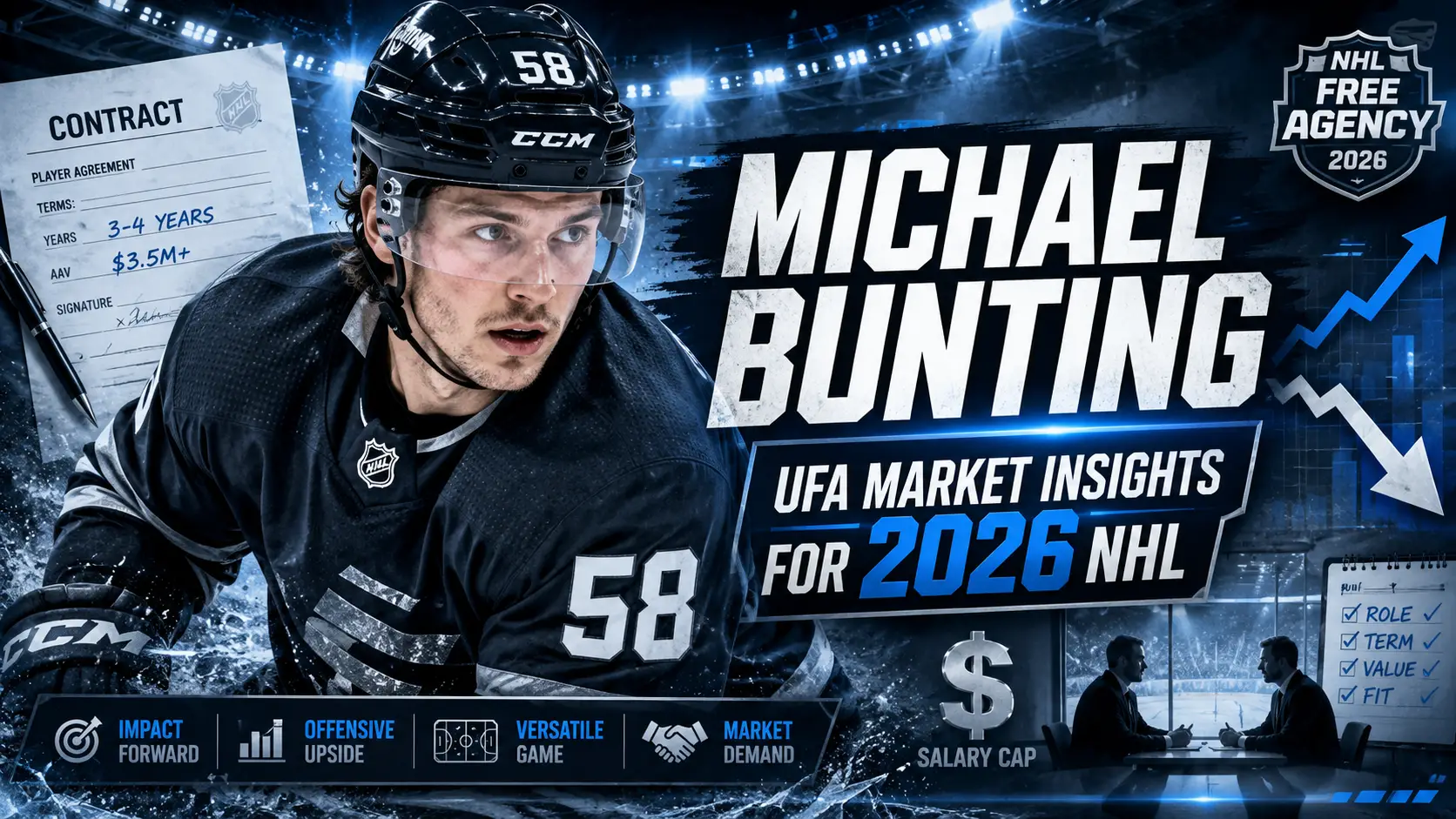
Evaluating unrestricted free agents in the National Hockey League requires a careful synthesis of counting statistics, underlying possession metrics, macroeconomic league conditions, and the intangible elements of a player’s on-ice identity. As the league transitions into the 2026-27 season, the free-agent market is being fundamentally reshaped by an unprecedented surge in the salary cap, which has been officially set at $104 million. Within this highly inflated economic environment, middle-six wingers who provide distinct tactical utility are positioned to command unique and potentially highly lucrative valuations. Michael Bunting, entering unrestricted free agency at 30 years old, represents one of the most fascinating case studies in this class.
A late bloomer who did not establish himself as a full-time NHL forward until the age of 26, Bunting has meticulously built a reputation as a highly effective agitator, a complementary top-six forechecker, and an analytical darling in terms of expected goals and high-danger scoring chances. However, his itinerant path over the past three seasons—moving from the Toronto Maple Leafs to the Carolina Hurricanes, Pittsburgh Penguins, Nashville Predators, and Dallas Stars—combined with a recent dip in raw offensive production, deeply complicates his market projection.
This report provides an exhaustive, multi-faceted analysis of Michael Bunting’s unrestricted free agent profile. By dissecting his unusual career trajectory, granular advanced performance metrics, unique penalty differential dynamics, and the shifting financial landscape of the NHL, this analysis projects his forthcoming contract. It identifies the franchises best positioned to acquire his services on the open market.
The Genesis of an Agitator: Developmental Arc and Delayed Arrival
To accurately understand Michael Bunting’s value on the open market and the specific psychological makeup of his game, it is essential to trace his developmental arc, which differs drastically from the typical highly touted NHL prospect. Born in Scarborough, Ontario, Bunting was not a prodigy who dominated junior hockey from a young age. His path to professional hockey was circuitous, involving stints in various lower-tier junior leagues before he ever reached the major junior level.
Bunting spent time in the South Saskatchewan Junior Hockey League (SSJHL), the Kootenay International Junior Hockey League (KIJHL), the Alberta Junior Hockey League (AJHL), and even the British Columbia Intercollegiate Hockey League (BCIHL) with the University of Victoria. This unconventional route instilled a survivalist, battling mentality into his playstyle. It was not until the 2013-14 season that he joined the Soo Greyhounds of the Ontario Hockey League (OHL). By his second OHL season, Bunting had emerged as a legitimate offensive threat, recording 37 goals and 74 points in 57 games while serving as an alternate captain.
This late surge in major junior production caught the attention of the Arizona Coyotes, who selected him in the fourth round, 117th overall, in the 2014 NHL Entry Draft. Upon turning professional in 2015, Bunting faced another protracted developmental period. He spent the better part of six seasons grinding in the American Hockey League (AHL), primarily with the Tucson Roadrunners, and even spent a brief seven-game stint in the ECHL with the Rapid City Rush. Between 2016 and 2020, Bunting amassed 205 points (85 goals and 120 assists) in 323 AHL games, slowly refining a gritty, net-front style of play while learning how to agitate and disrupt opposing defensive structures.
His breakthrough finally occurred during the truncated 2020-21 NHL season. The Coyotes called him up, and Bunting capitalized on the opportunity by scoring 10 goals and 3 assists for 13 points in just 21 games. While his performance was aided by a highly unsustainable 26.3% shooting percentage, it demonstrated an elite ability to navigate to the blue paint and finish high-danger chances in tight areas. This brief but explosive performance fundamentally altered his career trajectory, allowing him to enter Group 6 unrestricted free agency and test the open market for the first time.
The Toronto Peak: Ascending to the Top Six
In the summer of 2021, the Toronto Maple Leafs, operating under severe salary cap constraints and seeking to replace the physical, puck-retrieving elements lost by the departure of Zach Hyman, targeted Bunting. The Maple Leafs signed the Scarborough native to a highly efficient two-year contract with a $950,000 Average Annual Value (AAV). In Toronto, Bunting was cast into a highly coveted and specialized role: the forechecking, corner-battling left winger deployed alongside elite offensive talents Auston Matthews and Mitch Marner.
This deployment perfectly capitalized on Bunting’s primary strengths. He is not a natural puck transporter, nor does he possess elite transitional speed through the neutral zone. Still, he excels at establishing body position on forechecks, extending offensive zone possessions along the boards, and absorbing physical punishment in the low slot to create screens. During his two seasons in Toronto (2021-22 and 2022-23), Bunting posted the most prolific numbers of his career, establishing his identity as a premium complementary winger.
| Season | Team | GP | Goals | Assists | Points | +/- | PIM | SOG | S% | TOI/GP |
| 2021-22 | Toronto Maple Leafs | 79 | 23 | 40 | 63 | +27 | 80 | 175 | 13.1 | 15:33 |
| 2022-23 | Toronto Maple Leafs | 82 | 23 | 26 | 49 | +21 | 103 | 174 | 13.2 | 15:48 |
| Toronto Totals | 161 | 46 | 66 | 112 | +48 | 183 | 349 | 13.1 | 15:41 |
His 2021-22 campaign was historically significant. At 26 years old, he remained eligible for the Calder Memorial Trophy (awarded to the NHL’s Rookie of the Year) because he had not previously exceeded the rookie game thresholds. Bunting was named a finalist for the award and secured a spot on the NHL All-Rookie Team after leading all first-year players in points (63) and tying for second in goals (23). His advanced metrics during this season were equally dominant; Bunting ranked highly across the league in generating high-danger scoring chances and expected goals, largely because his puck-retrieval skills perfectly fed the shooting talents of Matthews.
Despite a slight regression in assist totals during the 2022-23 season (dropping from 40 to 26), Bunting maintained his 23-goal pace, proving his capability as a top-six complementary winger who could insulate highly skilled centers while contributing secondary offence. His ability to score greasy, net-front goals added a layer of variability to a Toronto offence that had previously struggled to penetrate the interior against rigid defensive structures.
The Trade Carousel: Adapting from Carolina to Dallas
Following the expiration of his $950,000 AAV contract in Toronto, Bunting sought a new agreement commensurate with back-to-back 23-goal seasons. Operating within a flat-cap environment in the 2023 offseason, he secured a three-year, $13.5 million contract ($4.5 million AAV) with the Carolina Hurricanes. Carolina’s front office and head coach Rod Brind’Amour targeted Bunting to inject a net-front presence and finishing ability into a roster that routinely dominated territorial possession metrics but notoriously struggled to convert expected goals into actual scoring during the postseason.
However, Bunting’s tenure in Carolina proved to be surprisingly brief, marking the beginning of a nomadic phase in his career. While he was reasonably productive for the Hurricanes—tallying 13 goals and 36 points in 60 games while playing roughly 15 minutes a night—he was utilized as a primary financial asset in the massive March 2024 trade deadline blockbuster that brought superstar Jake Guentzel to Carolina. Bunting, along with prospects Vasily Ponomarev, Ville Koivunen, Cruz Lucius, and conditional draft picks, was sent to the Pittsburgh Penguins.
The move to Pittsburgh reunited Bunting with Kyle Dubas, the former Toronto General Manager who had initially orchestrated his breakout contract with the Maple Leafs. In Pittsburgh, Bunting experienced an immediate late-season offensive surge, recording 6 goals and 13 assists for 19 points in just 21 games to finish the 2023-24 season, suggesting his style of play could seamlessly adapt to playing alongside generational talents like Evgeni Malkin and Sidney Crosby.
The subsequent two seasons required Bunting to transition into a reliable, albeit highly travelled, middle-six asset. In the 2024-25 season, he recorded a respectable 14 goals and 15 assists for 29 points in 58 games for Pittsburgh before being traded once again, this time to the Nashville Predators in a package involving Tommy Novak and Luke Schenn. In Nashville, he stabilized the middle six, putting up 9 points in 18 games to finish the year.
His 2025-26 season—the final year of his $4.5 million AAV contract—required him to adapt his game yet again within an evolving Western Conference landscape. Bunting posted 13 goals and 18 assists for 31 points in 61 games with Nashville. At the 2026 trade deadline, he was moved to the Dallas Stars, a team seeking veteran forward depth for a deep playoff run. With the Stars, Bunting’s role was significantly reduced in an incredibly deep offensive lineup. He averaged just 12:48 of ice time over 13 regular-season games, contributing 1 goal and 1 assist. A lower-body injury sidelined him late in the regular season, heavily limiting his postseason exposure to just one game in the first round against the Minnesota Wild, where he recorded a single assist in a series-ending Game 6 defeat.
Overall, Bunting concluded the 2025-26 regular season with 14 goals, 19 assists, and 33 points across 74 games, alongside a -24 rating and 126 shots on goal. While these counting stats represent a noticeable decline from his Toronto peak, a closer examination of his underlying metrics reveals a player who still heavily drives play in the offensive zone.
Advanced Analytics: Measuring the “Bunting Effect”
Traditional counting statistics, such as goals and assists, fail to encapsulate Michael Bunting’s full tactical utility. His value is best measured through advanced micro-stats, NHL puck-tracking data, and territorial control metrics. The data indicates that regardless of his linemates or the jersey he wears, Bunting consistently tilts the ice in favour of his team when deployed in a forechecking and possession-extending capacity.
NHL EDGE and Tracking Data
Using the NHL’s EDGE puck and player tracking system from the 2025-26 season, Bunting’s physical profile and zone time allocations offer critical insights into his playstyle and how he achieves his results.
| Category | Bunting’s Metric | NHL Percentile | NHL Forward Average |
| Max Skating Speed | 22.52 MPH | 65th | 22.17 MPH |
| Speed Bursts > 20 MPH | 76 | 60th | 75.2 |
| Hardest Shot | 86.40 MPH | 59th | 83.62 MPH |
| Offensive Zone Time (EV) | 44.6% | 96th | 42.0% |
| Defensive Zone Time (EV) | 36.7% | 89th (Inverse) | 40.1% |
| Shooting Percentage | 11.1% | <50th | 13.0% |
Data sourced from NHL EDGE for the 2025-26 Regular Season.
The standout metric from the NHL EDGE data is Bunting’s extraordinary offensive zone time. Spending 44.6% of his even-strength ice time in the offensive zone places him in the 96th percentile league-wide among forwards. This empirically confirms his archetype as a possession-extender. He is not a player who generates offence through sheer speed or devastating transition play—his top recorded speed of 22.52 MPH and his volume of high-speed bursts are merely slightly above average. Furthermore, his shot is not particularly lethal from a distance; his hardest recorded shot of the season clocked in at 86.40 MPH (59th percentile).
Instead, Bunting succeeds through spatial intelligence and body positioning. By establishing position below the hash marks, winning 50/50 board battles, and initiating the cycle game, he ensures that the puck remains 200 feet away from his own net, thereby suppressing the opposition’s shot attempts while maximizing his linemates’ offensive opportunities.
High-Danger Chances and Expected Goals (xG)
Bunting’s career is defined by his ability to generate offence from the inner slot. During his tenure in Toronto, particularly during the gruelling physical checking of the 2022 and 2023 playoffs, Bunting’s line dominated high-danger chance generation. According to Natural Stat Trick, Bunting was on the ice for 64% of the 5v5 high-danger chances (HDCF%) in the 2022 playoffs, and 63% in 2023.
This trend continued even as his raw point totals began to decline on different rosters. During his stint with the Pittsburgh Penguins, Bunting maintained a 45.45% HDCF% on a struggling team, ranking highly among the forwards on the roster in generating high-danger looks relative to his ice time (14.93 HDCF/60). In the 2025-26 season with the Nashville Predators, before the deadline trade, Bunting recorded an expected goals share (xG%) of 53.63%, paired with a highly respectable 1.66 points per 60 minutes at even strength.
The analytics confirm that Bunting operates exactly where modern NHL front offices want their supporting wingers to be: in the dirty areas. When deployed correctly, he acts as a primary catalyst for generating rebounds, creating visual screens for the opposing goaltender, and forcing defensive breakdowns in the low slot. He forces opposing defensemen to commit to physical coverage, thereby opening lateral passing lanes for the highly skilled centers he typically flanks.
The Penalty Differential Paradox: Agitation, Reputation, and Officiating
An exhaustive analysis of Michael Bunting must address the most polarizing and volatile aspect of his game: his extreme penalty differential. Bunting is a classic modern agitator, seamlessly combining physical confrontation with relentless verbal instigation during scrums. This hyper-aggressive style inherently leads to a high volume of penalties, both drawn and taken.
Historically, drawing penalties is one of the most underrated and analytically valuable skills in professional hockey. Providing a team with a high volume of power-play opportunities yields massive dividends, particularly for teams with elite man-advantage units. During the 2021-22 and 2022-23 seasons, Bunting was extraordinary at drawing penalties, consistently ranking at or near the top of the NHL in penalties drawn per 60 minutes. At one point during the 2021-22 season, Bunting was tied for first in the NHL in drawn penalties with Edmonton Oilers superstar Connor McDavid, illustrating just how often opposing defensemen were forced to restrain him illegally. His ability to draw cross-checks, hooks, and slashes in front of the net translated to immense hidden value, effectively contributing several expected goals to his team’s ledger over the course of a regular season.
However, the efficacy of this playstyle carries a steep psychological toll regarding on-ice officiating. By the end of the 2022-23 season, Bunting had developed a severe, negative reputation among NHL referees. The officials began to view his post-whistle antics and dramatic reactions to contact with extreme skepticism. Bunting was routinely penalized for embellishment and unsportsmanlike conduct, leading to a public feud in which former head coach Sheldon Keefe suggested that Bunting was being unfairly targeted and held to a different standard than the rest of the league.
The friction reached a critical boiling point when Bunting received a highly questionable 10-minute misconduct in a game against the Detroit Red Wings merely for moving an opponent’s stick after a whistle. Following the incident, Keefe told the media that General Manager Kyle Dubas would have a direct conversation with the league’s officiating department regarding the “raw deal” Bunting was receiving.
This “reputation tax” is a highly tangible factor for prospective front offices to consider in free agency. While Bunting is a master at getting under opponents’ skin, his tendency to embellish and argue calls occasionally puts his own team at a disadvantage. During the 2022-23 campaign, he amassed a staggering 103 penalty minutes. While his penalty differential was once vastly positive, it began to balance out as referees became increasingly reluctant to give him the benefit of the doubt.
Any team acquiring Bunting on the UFA market must accept this inherent volatility. A coaching staff will need to proactively manage Bunting’s emotions and ensure his agitation remains productive rather than detrimental, particularly in the postseason where special teams margins dictate the outcomes of tight series.
Macroeconomic Factors: The $104 Million Salary Cap Era
To accurately project Bunting’s next contract, one must thoroughly contextualize the macroeconomic state of the NHL. The 2026 offseason marks a historic and paradigm-shifting milestone for the league’s financial structure. Following several years of painful stagnation due to pandemic-related revenue shortfalls, the salary cap has entered a period of rapid, exponential growth.
In January 2025, the NHL and the National Hockey League Players’ Association (NHLPA) formalized an agreement guaranteeing significant, predictable cap increases over a three-year horizon. The cap ceiling evolved rapidly as follows:
- 2023-24 Season: $83.5 Million
- 2024-25 Season: $88.0 Million
- 2025-26 Season: $95.5 Million
- 2026-27 Season: $104.0 Million
- 2027-28 Season: $113.5 Million (Projected).
For the impending 2026-27 season, the upper limit officially sits at $104 million. Furthermore, the cap floor has risen to $76.9 million, the midpoint is set at $90.4 million, and the maximum individual player salary has expanded to $20.8 million.
This massive jump to a $104 million ceiling fundamentally alters the mathematical valuation of mid-tier unrestricted free agents. Contract values must be evaluated not by their absolute dollar amount, which feels inherently inflated compared to previous years, but by their percentage against the total cap.
When Bunting signed his three-year, $13.5 million contract with the Carolina Hurricanes in the summer of 2023, the $4.5 million AAV represented 5.38% of the $83.5 million salary cap.
If Bunting were to command 5.38% of the new $104 million cap in the summer of 2026, his AAV would mathematically equate to roughly $5.6 million. Conversely, if he signs a contract with a $4.5 million AAV in 2026, that cap hit represents just 4.32% of the team’s payroll—the equivalent of a $3.6 million contract in the tight 2023 economy.
This widespread inflation provides general managers with significantly more flexibility. An $8 million contract is no longer an anchor for a sub-elite player, and a $4 million contract has rapidly become the standard compensation for a reliable third-line forward who provides specialized utility. Furthermore, the rising cap floor ($76.9 million) forces rebuilding teams with an abundance of entry-level contracts to aggressively spend in free agency to reach the minimum payroll requirements. This dynamic inherently drives up the bidding for reliable veteran pieces like Bunting, as teams must spend money to remain compliant with league rules simply.
UFA Market Comparables and Contract Projections
Forecasting the unrestricted free agent market involves synthesizing a player’s recent production, chronological age, underlying analytical metrics, and the surrounding cap environment. At 30 years old, Bunting is likely seeking the final multi-year commitment of his professional career. However, his drop in raw counting stats—from 63 points in 2022 down to 33 points in 2026—prevents him from commanding a massive long-term premium based purely on offensive output.
Evolving-Hockey’s contract projection models, which serve as the industry standard for baseline estimates, provide a framework for evaluating players of this archetype. Considering his status as a 30-year-old winger with a 30-40 point baseline, strong expected goals metrics, and elite offensive zone deployment, the market comparables suggest a medium-term deal.
The primary comparables for Bunting include players like Jason Zucker, Tyler Bertuzzi, Max Domi, and Andre Burakovsky—wingers who blend secondary scoring with physical engagement and have successfully navigated short-to-medium term UFA deals in their late 20s or early 30s. Bertuzzi and Domi, in particular, are strong comparables, as they share Bunting’s chaotic style and have frequently bounced between top-six and middle-six roles while prioritizing term and stability in their negotiations.
The Term and AAV Outlook
The consensus among market analytics suggests Bunting fits into three distinct contractual structures depending on the acquiring team’s specific competitive window and financial latitude:
- The Stability Contract (3 to 4 Years): A contending team looking for a reliable, middle-six staple to ride out the remainder of his prime could offer term to lower the annual average value.
- Projection: 3 years x $3.75M to $4.25M AAV. (Total Value: $11.25M – $12.75M).
- The High-AAV Bridge (1 to 2 Years): A contending team tight on long-term commitments but desperate for immediate complementary scoring might overpay on a short-term deal to avoid cap restrictions in the 2028 landscape.
- Projection: 2 years x $4.75M to $5.25M AAV. (Total Value: $9.5M – $10.5M).
- The Floor-Reaching Premium (2 to 3 Years): A rebuilding team requiring veteran insulation and cap-floor compliance could offer a premium to attract him away from contenders.
- Projection: 3 years x $5.0M AAV. (Total Value: $15.0M).
Given that Bunting’s production dropped noticeably in 2025-26, it is highly unlikely he deeply exceeds his previous $4.5 million AAV on a multi-year deal, despite the inflated $104 million salary cap. The modern front office is increasingly wary of paying for past production, and 33 points does not traditionally command a raise. A pragmatic estimation places Bunting signing a two-year or three-year contract in the neighbourhood of $4.0 million to $4.25 million AAV. This represents excellent value for the acquiring team, absorbing roughly 3.8% to 4.0% of the total salary cap while securing a player who guarantees positive territorial control and playoff-style grit.
Strategic Team Fits and Lineup Integration
The UFA market is ultimately defined by necessity and systemic fit. Bunting’s ideal destination is a franchise that uses a heavy, cycle-based forechecking system or a team that needs an abrasive puck-retriever to play alongside a highly skilled, finesse-oriented center who needs physical insulation. Based on the projected 2026-27 salary cap space across the league, several teams emerge as highly logical destinations.
1. Toronto Maple Leafs
- Projected 2026-27 Cap Space: -$2,752,382 (Requires minor roster maneuvering).
- The Rationale: A reunion between Michael Bunting and the Toronto Maple Leafs is conceptually sound and emotionally resonant. Bunting achieved his absolute greatest NHL success in Toronto, thriving under the immense, suffocating media pressure and establishing deep, telepathic chemistry with Auston Matthews and Mitch Marner. The Maple Leafs consistently cycle through middle-six left wingers (experimenting with players like Tyler Bertuzzi, Max Domi, and Matthew Knies) in search of the optimal balance of skill and aggression on their top two lines.
- The Fit: While Toronto is currently operating in a slight cap deficit of $1.8 million entering the summer, standard front office mechanics (such as Long-Term Injured Reserve maneuvering or minor bottom-roster trades) can easily create the space necessary for a mid-tier signing. If Matthew Knies is elevated to a permanent top-line role, Bunting serves as the perfect top-nine depth piece, capable of sliding up to the first line during inevitable injury situations. Furthermore, his familiarity with the organization and status as a Scarborough native might prompt Bunting to accept a slight hometown discount to return to a Stanley Cup contender where his specific role is clearly defined.
2. Montreal Canadiens
- Projected 2026-27 Cap Space: $9,783,924.
- The Rationale: As the Canadiens transition from a prolonged rebuilding phase into a period of competitive ascendancy, they require hardened veteran insulation for their young core. Montreal possesses an abundance of highly skilled, youthful forwards but occasionally lacks the abrasive, playoff-style elements required to succeed in the heavy, physically punishing Atlantic Division.
- The Fit: Bunting represents precisely the archetype Montreal hoped to secure in previous long-term acquisitions (such as Josh Anderson) but with a significantly more efficient analytical profile and a lower cap hit. Bunting’s ability to draw penalties and create high-danger rebounds would massively benefit a young center like Kirby Dach or Nick Suzuki. With $11.5 million in cap space, Montreal can comfortably absorb a $4.0 million to $4.5 million cap hit on a two- or three-year deal without restricting future extensions for their internal core. Bunting is widely regarded as a “playoff signing” for a team like Montreal—a player whose true value manifests in tight, physical, checking-heavy postseason series where space is nonexistent.
3. Chicago Blackhawks
- Projected 2026-27 Cap Space: $9,077,093 (When Ryan Ellis is moved to season-ending IR).
- The Rationale: The Blackhawks remain in a critical phase of strategic roster construction surrounding their generational talent, Connor Bedard. While Chicago has ample cap space, their primary objective is acquiring players who can retrieve pucks, maintain offensive zone possession, and, most importantly, insulate Bedard from the physical rigours and targeted abuse of top-pairing defensive matchups.
- The Fit: Bunting is tailor-made for this exact role. He definitively proved in Toronto that he can thrive while deferring to an elite generational center, recognizing his job is to retrieve the puck and give it to the superstar. In Chicago, Bunting could operate directly on Bedard’s wing, engaging in vicious board battles, fetching loose pucks, and providing a permanent net-front screen for Bedard’s elite, deceptive shot. The Blackhawks have the financial latitude to offer Bunting a slight overpay (e.g., two years at $5.0 million AAV) to secure his services without jeopardizing their long-term cap health when their young stars eventually require extensions.
4. Nashville Predators
- Projected 2026-27 Cap Space: $7,670,444.
- The Rationale: Bunting spent a highly productive portion of the 2024-25 and 2025-26 seasons in Nashville before being moved at the deadline. In Nashville, he found excellent analytical success, generating an expected goals share (xG%) of 53.63% and functioning as a highly effective middle-six contributor who could slide onto the power play.
- The Fit: Nashville holds $8.7 million in space and requires middle-six wingers to supplement their offence as they look to retool around their veteran core. If Bunting desires stability after a chaotic three years of constant trades and relocations, re-signing in Nashville represents a logical, mutually beneficial outcome. General Manager Barry Trotz values the exact brand of relentless, physical hockey that Bunting brings to the ice, making the Predators a highly viable landing spot if the term is kept to two or three years.
5. Pittsburgh Penguins
- Projected 2026-27 Cap Space: $13,677,640.
- The Rationale: The Kyle Dubas connection cannot be understated in any evaluation of Bunting’s future. Dubas originally signed Bunting in Toronto and subsequently targeted him in the Guentzel trade in Pittsburgh. Pittsburgh is desperately clinging to the twilight of the Sidney Crosby and Evgeni Malkin era, requiring immediate, cost-effective wingers who can contribute instantly to one last playoff push.
- The Fit: During his brief 21-game stint with Pittsburgh in the 2023-24 season, Bunting posted nearly a point per game (19 points) and maintained elite high-danger chance generation metrics alongside Malkin. With $13.75 million in cap space, the Penguins have the clear financial means to bring Bunting back to Pennsylvania. Dubas acutely understands Bunting’s analytical value, his complicated relationship with the officials, and how to deploy him to maximize his chaotic, high-energy style of play.
Conclusion: The Final Market Verdict
As the 2026 unrestricted free agency market opens, Michael Bunting stands out as a highly unique, if somewhat polarizing, commodity. He is not a foundational franchise pillar to build around, nor is he an elite point-producer capable of driving a line entirely on his own. Instead, Bunting is an elite complementary asset—a tactical instrument specifically designed to retrieve pucks, disrupt defensive structures, draw penalties, and generate secondary offence in the high-danger areas of the ice.
The undeniable decline in his counting statistics during the 2025-26 season—recording just 33 points across 74 games with two different teams—will naturally depress his market value compared to his 63-point peak in Toronto. However, sophisticated front offices will look past the raw point totals. The NHL EDGE tracking data and Natural Stat Trick’s expected goal models emphatically confirm that Bunting remains a dominant force in extending offensive zone time (96th percentile) and driving high-danger chances when placed in a competent system.
Operating under a newly inflated $104 million salary cap, acquiring Bunting requires a relatively low percentage of overall team payroll. A projected contract of 2 to 3 years at roughly $4.0 million to $4.25 million AAV represents exceptional value for a contending team seeking depth or an ascending roster seeking veteran insulation. While a coaching staff must actively manage his penchant for drawing the ire of officials and taking poorly timed misconducts, the net positive of his on-ice territorial dominance heavily justifies the required emotional maintenance.
Whether returning to a massive media market like Toronto to provide top-nine grit, mentoring a generational talent in Chicago, or reuniting with Kyle Dubas in Pittsburgh, Michael Bunting is primed to secure a lucrative, mid-term contract from a franchise that deeply values the granular, physical, and analytical elements of modern playoff hockey.
Works cited
- NHL, NHLPA announce team payroll ranges for next 3 seasons, https://www.nhl.com/news/nhl-nhlpa-announce-team-payroll-ranges-for-next-3-seasons-through-2027-28
- NHL informs teams of 2026-27 salary cap and payroll range – Sportsnet.ca, https://www.sportsnet.ca/nhl/article/nhl-informs-teams-of-2026-27-salary-cap-and-payroll-range/
- [Friedman] NHL officially informs teams of the 2026-27 Salary cap and payroll range: Floor: $76.9M. Midpoint: $90.4M. Ceiling: $104M. Maximum salary: $20.8M: r/hockey – Reddit, https://www.reddit.com/r/hockey/comments/1t5ltkt/friedman_nhl_officially_informs_teams_of_the/
- Michael Bunting Profile: player info, stats, news, video – Sportsnet.ca, https://www.sportsnet.ca/hockey/nhl/players/michael-bunting/cc2294b3-b7ca-4c3f-93d4-2795f85b126f
- Michael Bunting – Stats, Contract, Salary & More – Elite Prospects, https://www.eliteprospects.com/player/245191/michael-bunting
- 9 Best Remaining UFAs in 2026 NHL Free Agency – The Hockey Writers, https://thehockeywriters.com/9-best-remaining-ufas-in-2026-nhl-free-agency/
- Latest On Michael Bunting – Pro Hockey Rumors, https://www.prohockeyrumors.com/2023/01/latest-on-michael-bunting.html
- A Trade a Day: The Hurricanes reel in a big fish to form one of the best 1st lines in team history – Cardiac Cane, https://cardiaccane.com/hurricanes-reel-in-big-fish-to-form-best-1st-lines-in-team-history-
- Michael Bunting – QuantHockey, https://www.quanthockey.com/hockey-stats/en/profile.php?player=31164
- Michael Bunting – Stats, Contract, Salary & More – Elite Prospects, https://www.eliteprospects.com/player/223258/michael-bunting
- Michael Bunting Stats And News | NHL.com, https://www.nhl.com/player/michael-bunting-8478047
- Making the case for a Michael Bunting reunion with the Maple Leafs, https://theleafsnation.com/news/toronto-maple-leafs-free-agency-michael-bunting-reunion
- Toronto Maple Leafs: Bunting’s Contract Hinges on Playoff Performance – Editor In Leaf, https://editorinleaf.com/2023/04/18/toronto-maple-leafs-bunting-playoffs/
- Maple Leafs’ Forwards Ranked for Overall Play – 2021-22 Season – The Hockey Writers, https://thehockeywriters.com/maple-leafs-forwards-ranked-overall-play-2021-22/
- Toronto Maple Leafs: Checking In on Ex-Leafs Around the NHL – Editor In Leaf, https://editorinleaf.com/2023/09/12/toronto-maple-leafs-ex-leafs/2/
- Three Takeaways: Maple Leafs blow out New Jersey with four goals in opening 15 minutes, https://mapleleafshotstove.com/2022/02/02/three-takeaways-toronto-maple-leafs-new-jersey-devils/
- Bunting says Leafs never offered him a contract this summer | Daily Hive | Offside, https://dailyhive.com/toronto/leafs-bunting-no-contract
- The 2022 NHL Awards — Who I voted for and why – Vancouver Is Awesome, https://www.vancouverisawesome.com/canucks-hockey/the-2022-nhl-awards-who-i-voted-for-and-why-5502557
- Bunting signs 3-year contract with Hurricanes – NHL.com, https://www.nhl.com/news/michael-bunting-to-sign-3-year-contract-with-carolina-hurricanes-344912662
- Warm Welcomes: Introducing the newest Cane Michael Bunting, https://cardiaccane.com/2023/09/29/introducing-cane-bunting/
- 2023-2024 NHL team preview: Carolina Hurricanes – Daily Faceoff, https://www.dailyfaceoff.com/news/2023-2024-nhl-team-preview-carolina-hurricanes
- CAROLINA HURRICANES – CANES PR, https://canespr.com/wp-content/uploads/2024/07/clips070124.pdf
- Stats for player Bunting, Michael #58 (LW) – Dallas Stars – 2026 Playoffs – Officepools, https://www.officepools.com/nhl/entity/player/6485
- Michael Bunting – EDGE Stats – NHL.com, https://www.nhl.com/nhl-edge/skaters/michael-bunting-8478047
- There is still one free agent the Montreal Canadiens should be targeting – A Winning Habit, https://awinninghabit.com/there-is-still-one-free-agent-the-montreal-canadiens-should-be-targeting
- Matthew Knies played himself into a full time roster spot in 2022-23 – The Leafs Nation, https://theleafsnation.com/news/matthew-knies-played-himself-full-time-roster-spot-2022-23
- On the ice for Total Goals Against : r/penguins – Reddit, https://www.reddit.com/r/penguins/comments/1gd3jfm/on_the_ice_for_total_goals_against/
- Is There a Problem With the Way Bunting is Officiated?, https://ublawsportsforum.com/2023/04/14/is-there-a-problem-with-the-way-bunting-is-officiated/
- His scoring is down, but Bunting continues to deliver value to Leafs – TSN, https://www.tsn.ca/nhl/his-scoring-is-down-but-bunting-continues-to-deliver-value-to-leafs-1.1887450
- Since Connor McDavid has stepped into the NHL, nobody has drawn as many penalties as Connor McDavid (lol with stats) : r/hockey – Reddit, https://www.reddit.com/r/hockey/comments/1i6rkwc/since_connor_mcdavid_has_stepped_into_the_nhl/
- Tuesday’s FTB: Bunting and the Refs – Pension Plan Puppets, https://www.pensionplanpuppets.com/tuesdays-ftb-bunting-and-the-refs/
- Tuesday’s FTB: Leafs in New Jersey, https://www.pensionplanpuppets.com/tuesdays-ftb-leafs-in-new-jersey/
- NHL salary cap estimates released for next three seasons; expected to surpass $100 million in 2026-27, https://www.dailyfaceoff.com/news/nhl-salary-cap-estimates-released-for-next-three-seasons-expected-to-surpass-100-million-in-2026-27
- NHL, NHLPA announce team payroll ranges for next 3 seasons, https://www.nhl.com/news/nhl-nhlpa-announce-team-payroll-ranges-for-next-3-seasons
- The 2026-27 NHL salary cap is OFFICIAL! How does it impact the Penguins? – YouTube, https://www.youtube.com/watch?v=Mx8hc166ZWQ
- NHL Sets Salary Cap For 2026-27 Season – Pro Hockey Rumors, https://www.prohockeyrumors.com/2026/05/nhl-sets-salary-cap-for-2026-27-season.html
- Contract Projections – Evolving-Hockey, https://evolving-hockey.com/stats/contract_projections/?_inputs_&con_season=%2220232024%22&con_team=%22All%22&con_pos=%22F%22&con_status=%22RFA%22&con_agent=%22Extension%22&con_period=%221%3A%20July%201st%20-%20July%2031st%22&con_signs_with=%22Same%20Team%22&con_8yr=%22On%22&dir_con=%22Contract%20Projection%20Tables%22&con_player=null&con_cap=%2288000000%22
- Revisiting Top 2023 NHL Free Agent Signings 1 Season Later – The Hockey Writers, https://thehockeywriters.com/revisiting-top-2023-nhl-free-agent-signings-1-season-later/
- TSN’s TradeCentre Blog: One day to go until the NHL trade deadline, https://www.tsn.ca/nhl/tradecentre/tsn-s-tradecentre-blog-one-day-to-go-until-the-nhl-trade-deadline-1.1925596
- CapWages | NHL Salary Cap Data, https://capwages.com/
- Could a Toronto Reunion be in the cards for former Leaf Michael Bunting?: Leafs Morning Take – The Leafs Nation, https://theleafsnation.com/news/could-a-toronto-reunion-be-in-the-cards-for-former-leaf-michael-bunting-leafs-morning-take
- Toronto Maple Leafs need William Nylander to prove he can drive second line – TSN, https://www.tsn.ca/nhl/toronto-maple-leafs-need-william-nylander-to-prove-he-can-drive-second-line-1.2181744
- Game Day Guide: Stars vs Mammoth | Dallas Stars – NHL.com, https://www.nhl.com/stars/news/game-day-guide-dallas-stars-vs-utah-mammoth-031626
- 2026 NHL Trade Deadline preview: Central Division – Daily Faceoff, https://www.dailyfaceoff.com/news/2026-nhl-trade-deadline-preview-central-division-breakdown-targets-assets-budget-blackhawks-avalanche-stars-wild-predators-blues-mammoth-jets
- 9 Best Remaining UFAs in 2026 NHL Free Agency – Yardbarker, https://www.yardbarker.com/nhl/articles/9_best_remaining_ufas_in_2026_nhl_free_agency/s1_16448_44024250


Leave a Reply