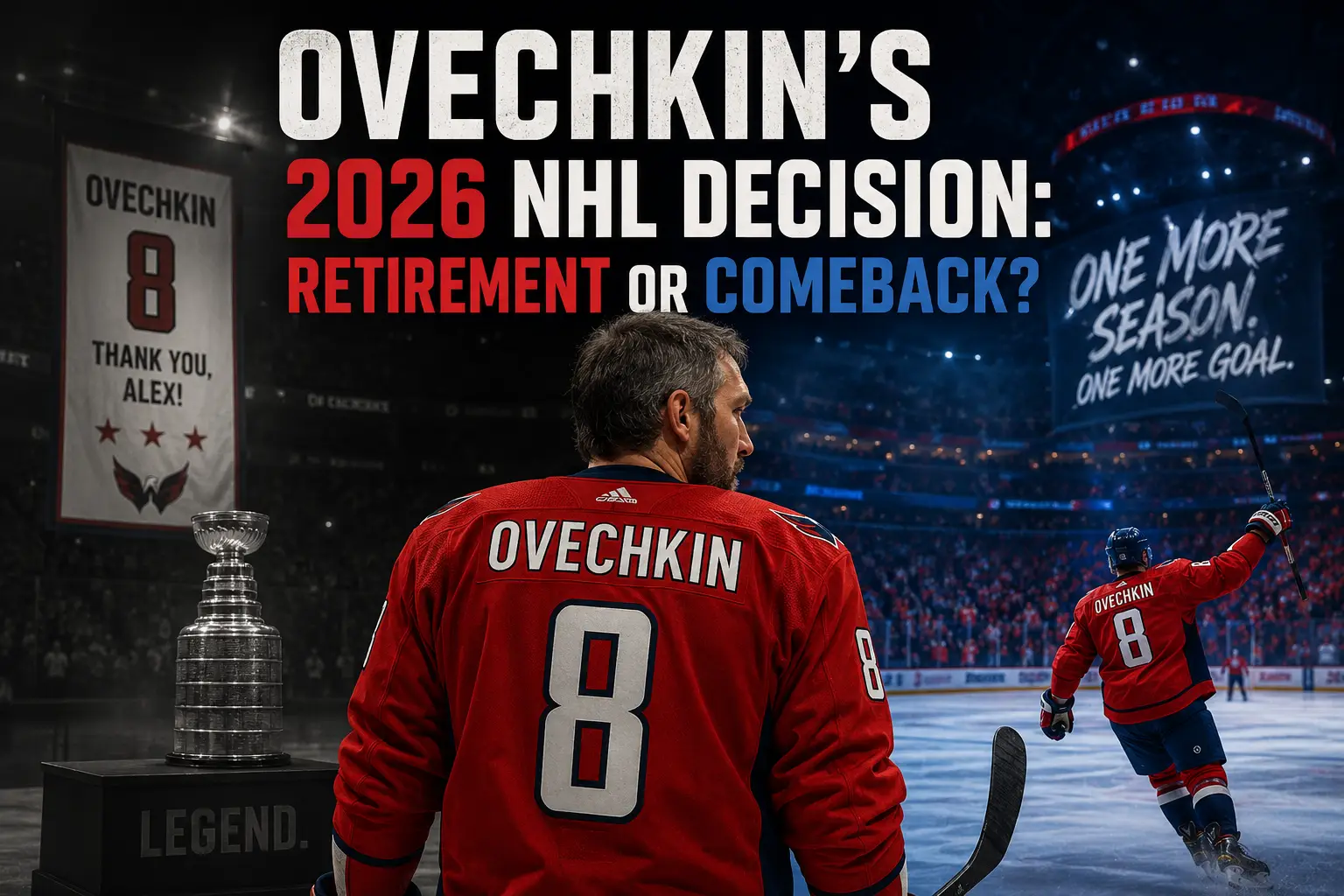
1. Executive Summary and the Historical Convergence in the 2026 Off-Season
As the National Hockey League enters the summer of the 2026 off-season, the sport faces one of the most significant and complex inflection points in its modern history. The central narrative dominating the league’s macroeconomic landscape, competitive balance, and marketing strategies is unrestricted free agency and the potential retirement of Alexander Mikhailovich Ovechkin.1 At forty years old, the Washington Capitals’ captain and the most prolific regular-season goal-scorer in the history of the National Hockey League has reached the formal expiration of his five-year, $47.5 million contract, an agreement that officially concludes when free agency opens on July 1, 2026.2 The international hockey community currently finds itself waiting on a singular decision that will not only dictate the competitive trajectory of the Washington Capitals franchise but will also determine the immediate marketing landscape of the NHL, the competitive balance of the Kontinental Hockey League (KHL) in Russia, and the final, definitive chapters of the sport’s most hallowed statistical record books.
The 2025-26 campaign was a season marked by historic milestones for Ovechkin, yet it culminated in collective disappointment for the Washington franchise. Ovechkin shattered Wayne Gretzky’s legendary, long-standing regular-season goal record of 894 in April 2025.3 Throughout the subsequent 2025-26 season, he continued to redefine the aging curve and biomechanical expectations for an elite professional athlete. Despite suffering a broken fibula early in the season’s training camp, he managed to play all 82 regular-season games, recording 32 goals and 32 assists for 64 points.3 However, despite this individual brilliance, the Capitals failed to qualify for the Stanley Cup Playoffs, finishing fourth in the highly competitive Metropolitan Division with a record of 43-30-9, accumulating 95 points in the standings.5
Consequently, Ovechkin’s off-season decision is not a simple, binary choice between returning to the Capitals or announcing his retirement. It is, instead, a highly complex calculus involving physiological durability, elite-level roster management and salary cap navigation, the newly ratified 2026 NHL Collective Bargaining Agreement (CBA) 7, intricate geopolitical considerations, deep-rooted family stability in the United States, and the structural delays of a multi-million-dollar real estate and hockey academy project located in Moscow.2 Furthermore, while the regular-season goal record has been secured, a secondary statistical milestone has emerged as a massive gravitational pull: Wayne Gretzky’s combined regular-season and playoff goal record of 1,016.8 Ovechkin currently sits at 1,006 combined goals, placing him agonizingly close to absolute, undisputed supremacy.8
This comprehensive research report provides an exhaustive, multi-dimensional analysis of the strategic pathways and options available to Alexander Ovechkin for the 2026-27 season. It systematically examines the contractual constraints imposed by the new CBA, dissects the strategic paradox facing the Washington Capitals’ front office regarding roster construction, evaluates the profound sociological drivers anchored by his family’s integration into the Washington area, and analyzes the logistical impacts of his legacy hockey academy in Russia. Ultimately, this report forecasts the most probable outcomes for the twilight of the player universally recognized as the “Great 8.”
2. The Statistical Imperative: The Architecture of the 1,017-Goal Mandate
To accurately assess the likelihood of Alexander Ovechkin’s return to the National Hockey League for a twenty-second professional season, one must first deeply analyze the statistical landscape he currently navigates. For several decades, Wayne Gretzky’s regular-season record of 894 goals was viewed by sports historians and statisticians as an untouchable monolith, a product of a high-scoring era that could never be replicated in the modern, structurally sound defensive systems of the contemporary NHL. Ovechkin completely dismantled that paradigm on April 6, 2025, by scoring his 895th career goal against goaltender Ilya Sorokin of the New York Islanders at UBS Arena, cementing his status as the undisputed regular-season king.3 However, the conquest of the regular-season record has merely shifted the goalposts to a much more comprehensive and universally binding metric: the all-time combined goals record, which aggregates both regular-season and Stanley Cup Playoff production.
2.1 The Mathematical Parameters of the Combined Goal Record
While Ovechkin has surpassed Gretzky in regular-season play, Gretzky’s unparalleled dominance in the postseason provides the Canadian icon with a slight edge in total pucks put into the net. Gretzky finished his illustrious career with an astonishing 122 playoff goals, alongside 894 regular-season goals, bringing his career total to 1,016.8 By contrast, Ovechkin, while dominant, has accumulated 77 career playoff goals in 161 postseason games.8
The mathematical equation defining Ovechkin’s remaining career target is stark and unyielding. Entering the summer of 2026, Ovechkin has secured 929 regular-season goals and 77 playoff goals, bringing his combined career total to 1,006 goals.8 Therefore, the differential required to tie Gretzky’s combined mark is exactly ten goals, and the requirement to take outright possession of the title as the most prolific goal-scorer in the history of North American professional hockey across all formats is eleven goals.
| Player | Regular Season Goals | Playoff Goals | Combined Total | Status |
| Wayne Gretzky | 894 | 122 | 1,016 | Retired 8 |
| Alexander Ovechkin | 929 | 77 | 1,006 | Active 8 |
| Gordie Howe | 801 | 68 | 869 | Retired 8 |
| Jaromir Jagr | 766 | 78 | 844 | Retired 8 |
2.2 Analyzing the 2025-26 Milestone Markers
Ovechkin’s 2025-26 season was a masterclass in sustained, relentless offensive production that allowed him to rapidly close the gap on the 1,016 threshold. At age forty, his output defied traditional biomechanical decline. During his 1,504th career game on November 5, 2025, he scored his 900th regular-season goal early in the second period of a 6-1 victory against the St. Louis Blues at Capital One Arena.3 The pursuit of the combined milestone accelerated in the latter half of the season. He recorded his 999th combined goal by driving toward the crease and redirecting a highly skilled shot over the shoulder of Ottawa Senators goaltender Linus Ullmark.9
The monumental 1,000th combined goal materialized on March 22, 2026, during an overtime loss to the Colorado Avalanche. In a sequence that has come to define his career, Dylan Strome delivered a precision pass from the corner to Ovechkin, who was stationed in his trademark “office” in the left faceoff circle. Ovechkin unleashed a wicked, patented one-timer on the power play that beat goaltender Mackenzie Blackwood over the right pad, marking his entry into the exclusive 1,000-goal club.3 He ultimately finished the year with thirty-two goals, establishing an NHL record by reaching the thirty-goal mark for the twentieth time in his twenty-one professional seasons.3
2.3 The Psychological Weight of Unfinished Business
The extreme proximity to the 1,017-goal milestone serves as a massive psychological anchor keeping Ovechkin tethered to the NHL. Elite professional athletes operating at the highest echelons of their respective sports are historically driven by absolute statistical finality. Leaving the NHL just eleven goals shy of securing the ultimate, undisputed scoring title—inclusive of both regular season and playoff metrics—would represent a historically unprecedented voluntary forfeiture of a major sporting milestone. Given that he scored thirty-two goals in the 2025-26 campaign while recovering from a broken leg 3, an eleven-goal target is entirely attainable within the first eight to ten weeks of a prospective 2026-27 season. This statistical reality virtually eliminates the probability of an immediate retirement or a premature defection to the KHL before the final milestone is achieved. The narrative of hockey history demands completion, and an eleven-goal deficit is too small a margin to abandon.
3. Biomechanical Durability and Tactical Deployment in the Twilight Years
The central risk assumed by the Washington Capitals—or any NHL franchise considering offering a multi-year deal to a player who will turn forty-one in September 2026—is the rapid, non-linear degradation of athletic performance that typically afflicts aging athletes. The modern National Hockey League is defined by blistering transitional speed, aggressive full-ice forechecking, and immense lateral mobility. These are areas where Ovechkin has undeniably slowed due to the natural physiological realities of aging.11
3.1 The Escalating Demands of Off-Season Preparation
Ovechkin has openly and candidly acknowledged the escalating physical toll required to simply maintain a baseline of NHL readiness. “In the summer, you have to work your ass off to get better and be in shape. When you’re 20, it’s no big thing. When you’re 40, it’s harder and harder,” he remarked during an extensive interview.11
Despite these admitted challenges, his biomechanical durability remains an absolute anomaly in the field of sports science. Early in the 2025-26 training camp in September 2025, Ovechkin suffered a significant lower-body injury, which tracking reports later identified as a fibula injury.4 In standard medical models and historical player comparisons, a fractured or severely injured fibula in a forty-year-old power forward could easily signal a season-ending or potentially career-threatening event. Instead, Ovechkin rehabilitated with astonishing rapidity. By late September 2025, he had already shed his non-contact jersey during practice and resumed skating with the top group alongside his primary centerman, Dylan Strome.14 He ultimately missed negligible regular-season time, suiting up for all eighty-two games of the gruelling regular-season schedule.3
3.2 Tactical Shielding and the Evolution of the “Office”
Ovechkin’s ability to score 32 goals and record 64 points in a full 82-game slate post-injury is closely tied to the highly specialized deployment strategies employed by the Capitals’ coaching staff. To understand his current utility, one must contrast it with his physical peak. In 2006, Ovechkin scored what is widely considered the greatest goal of the 21st century against the Phoenix Coyotes, where he was knocked to the ice, slid on his back, and somehow hooked the puck past the goaltender with one hand on his stick.15 That era of Ovechkin was defined by chaotic, high-speed, dynamic rushing attacks.
Today, his success is predicated on static efficiency. By shielding him from heavy defensive zone starts and funnelling the entirety of the offence through his positioning in the left circle on the power play, the coaching staff maximizes his lethal hand-eye coordination and shot velocity while minimizing the need for full-ice transitional sprints. As long as his core abdominal strength, rotational torque, and shooting mechanics remain completely intact, his offensive utility remains elite. This specialized deployment validates a multi-year extension purely on the basis of his power-play efficiency, transforming him from a dynamic rusher into the most lethal static artillery piece in the sport’s history.
4. The Washington Capitals’ Front Office Paradox: Navigating Contention and Rebuilding
If the statistical imperative and his physical durability dictate that Ovechkin return, the operational environment of the Washington Capitals will determine how and whether he returns to the District of Columbia. During his comprehensive end-of-season media availability, commonly referred to as Breakdown Day, on April 14, 2026, Ovechkin explicitly tied his future to the franchise’s competitive trajectory. He forcefully stated, “If I want to come back, it has to be a decision on, first of all, we’re going to make the playoffs, and we have to fight for a Cup. That’s probably the biggest thing. Otherwise, if you take different scenarios, like family-wise, health-wise, but team-wise, this is the most important thing for me”.6
This explicit mandate has placed Capitals General Manager Chris Patrick and President of Hockey Operations Brian MacLellan in a profound strategic paradox.
4.1 The Trade Deadline Contradiction
The front office’s behaviour leading up to the 2026 NHL Trade Deadline on March 6 directly contradicted Ovechkin’s timeline for immediate, win-now contention. The Capitals deliberately operated as sellers, trading away two of the longest-tenured and most reliable defensive cornerstones on the roster: top-pairing defenseman John Carlson, who was sent to the Anaheim Ducks, and primary checking-line center Nic Dowd, who was sent to the Vegas Golden Knights.6 The return for these veteran players centred on draft capital and future developmental assets, sending a clear signal to the league that the franchise was pivoting toward a structural rebuild rather than a final Stanley Cup push.6
Ovechkin did not hide his frustration regarding this philosophical shift. He publicly critiqued the strategy, noting that this was the third time in four seasons that Washington chose to liquidate veterans at the deadline rather than fortifying the roster. “We’ve been in a position like we’re selling. We’re not adding big pieces to help us go all the way,” Ovechkin lamented.6 The dichotomy is stark and highly problematic for negotiations: the team’s executive management is actively accumulating future capital by trading away aging core pieces, while the franchise’s most important player is demanding aggressive, immediate acquisitions to win a championship in the present.
4.2 Reconciling the Vision
For Ovechkin to confidently sign a new contract, he requires concrete assurances from Chris Patrick and Brian MacLellan that the liquidation of Carlson and Dowd was not a surrender, but rather a strategic reallocation of resources. Ovechkin has stated he intends to have serious conversations with Patrick to hear exactly what roster-strengthening moves they plan to make to elevate the team back into the upper echelon of the Eastern Conference.6 General Manager Chris Patrick has acknowledged this dynamic, stating that the team will be aggressive in trying to land a premier top-six forward during the off-season.17 The execution of this promise is the linchpin upon which Ovechkin’s return depends.
5. Capology: The 2026 Salary Cap Landscape and Roster Construction
Despite the friction caused by the deadline sell-off, the trades of Carlson and Dowd have generated significant macroeconomic flexibility for the Capitals. Heading into the summer of 2026, Washington holds substantial salary cap space, providing Chris Patrick with the financial ammunition required to fulfill Ovechkin’s mandate for immediate improvement.
5.1 Financial Architecture and Available Space
Prior to their first off-season maneuvers, the Capitals possessed a massive $36.5 million in available cap space.18 The team’s first significant move was re-signing trade-deadline acquisition Timothy Liljegren to a two-year contract extension. The right-handed shooting defenseman agreed to a deal worth $6.5 million in total, carrying an Average Annual Value (AAV) and cap hit of $3.25 million per season.18 Following the Liljegren signing, Washington is projected to have approximately $33.35 million in available cap space 18, or roughly $31.3 million depending on the final integration of Entry-Level Contracts and specific Long-Term Injured Reserve (LTIR) relief formulas analyzed by cap-tracking databases like PuckPedia and CapWages.19
This cap fluidity is relatively rare for a team that has spent a decade navigating the absolute ceiling of the salary limit. The space is further complicated by internal financial obligations to the team’s younger core. For instance, the Capitals are actively integrating Entry-Level Contracts, such as the two-year, $950,000 deal for highly touted forward Ryan Leonard, who joined the team after his college season ended and carries up to $1.5 million in potential performance bonuses.22 Furthermore, center Connor McMichael, who recently played out a bridge deal, is coming off a career year and holds arbitration rights; his next contract is projected to significantly increase his price tag.22 The team must also account for depth pieces like Sonny Milano, whose injury history complicates his long-term value.22
| Player / Asset | 2025-26 Status | Projected 2026-27 Cap Implication |
| John Carlson | Traded to Anaheim | Cleared significant cap space 6 |
| Nic Dowd | Traded to Vegas | Cleared cap space 6 |
| Timothy Liljegren | Re-signed (2 yrs) | -$3.25M AAV impact 18 |
| Ryan Leonard | Entry-Level Contract | -$950K (plus bonuses up to $1.5M) 22 |
| Connor McMichael | Arbitration Eligible | Significant AAV increase expected 22 |
| Total Available Space | N/A | ~$31.3M to $33.35M 18 |
5.2 The Market Context and Aggressive Acquisitions
With over $30 million to spend, the Capitals are positioned to be major players in the free-agent and trade markets. To understand the calibre of player Washington might pursue to appease Ovechkin, one must look at the broader league landscape. For example, the Vegas Golden Knights currently face cap constraints regarding star forward Pavel Dorofeyev, who is coming off consecutive thirty-five-goal seasons.23 Market analysts note that teams with cap space, like the New York Rangers or the Washington Capitals, could exploit this by offering Dorofeyev a highly lucrative offer sheet or executing a blockbuster trade.23 If Chris Patrick utilizes a portion of his $31.3 million to acquire a top-tier point producer of Dorofeyev’s calibre, it will provide the definitive signal to Ovechkin that the organization is fiercely committed to winning the Stanley Cup, thereby ensuring his signature on a contract extension.19
6. The 2026 NHL Collective Bargaining Agreement: Structural Constraints on a 35+ Icon
If Ovechkin decides that the Capitals have provided a sufficient roster to compete at the highest level, the next hurdle is the structural and mechanical reality of his new contract. The financial landscape of the NHL has shifted dramatically following the ratification of the new Collective Bargaining Agreement, which officially comes into effect on September 16, 2026, but strictly governs the formulation of all contracts signed during the summer free-agency period of 2026.7
6.1 The 35+ Contract Rules and Cap Mitigation
Ovechkin’s previous contract was a five-year deal worth $47.5 million, carrying a massive $9.5 million Average Annual Value (AAV).2 Entering his age-forty-one season, a similar financial commitment is mathematically, structurally, and strategically impossible for the Capitals.
Under the newly enacted 2026 NHL CBA, contracts signed by players aged 35 and older are subject to stringent structural requirements designed by the league to prevent historical salary cap circumvention.2 In previous eras, franchises would front-load multi-year contracts for aging players, paying massive real dollars in the first year while dropping the base salary to near league-minimum in the final years to artificially lower the AAV. The underlying assumption was always that the player would quietly retire before the contract ended, leaving the team with a “dead cap” penalty that was often mitigated through loopholes.
The new CBA eliminates this flexibility. Any multi-year deal for a 35+ player must feature a perfectly flat year-over-year salary structure.2 This means the player must earn the exact same base salary in year two as they do in year one. Furthermore, signing bonuses are strictly limited to the first year of the contract.2
6.2 The “Farewell Tour” Aversion: One Year vs. Two Years
The structural rigidity of the new CBA directly influences the term of Ovechkin’s potential extension. Local reports, notably from The Athletic’s Barry Svrluga, indicated that the Capitals front office was originally operating under the assumption that the only contract under consideration was a one-year deal for the 2026-27 season.17 This approach would structurally mirror the recent contract extension signed by Evgeni Malkin with the Pittsburgh Penguins. Malkin, another aging Russian icon, signed a one-year deal worth $5.5 million, with performance bonuses that could push the total to $9 million.19 Following his signing, Malkin took to Instagram to reassure his fanbase, stating, “Were you worried? Always a Penguin”.25
However, a one-year deal carries a severe psychological and logistical drawback for Ovechkin: the inevitable and highly distracting “Farewell Tour.” A singular year essentially guarantees that every road game becomes a de facto retirement ceremony, creating a media circus that Ovechkin vehemently opposes. Reports indicate he deeply admires how Wayne Gretzky executed a surprise retirement, avoiding a season-long spectacle.17
Consequently, Ovechkin has strongly hinted at his preference for a two-year deal. During his end-of-season press conference, he smiled and stated that his ideal conversation with GM Chris Patrick would be straightforward: “We want you for two more years. This is a contract. Sign it. Here we go”.6
A two-year structure, forced to be completely flat under the 2026 CBA (e.g., $5.5 million in Year One and $5.5 million in Year Two), serves a brilliant dual purpose. It protects the Capitals financially; if Ovechkin decides to retire after the first year, having secured his goals record, the flat structure ensures the team carries absolutely zero dead cap space into the subsequent season.2 Concurrently, it protects Ovechkin psychologically, allowing him to play the 2026-27 season without enduring constant retirement questions in all thirty-two NHL arenas, leaving him the quiet option to retire in the summer of 2027 or finish the deal in 2028.2
6.3 Contract Value Projections
Market analysts project that Ovechkin’s next contract will carry an AAV between $4.5 million and $6.0 million.2 This represents a nearly forty percent reduction from his previous $9.5 million cap hit. This reduction is not a reflection of diminished stature or capability, but rather a collaborative financial restructuring. By taking a lower AAV, Ovechkin directly facilitates the Capitals’ ability to spend their massive cap space on the very top-six forwards he is demanding they acquire.2
7. Coaching Contingencies: Spencer Carbery’s Dual-Track Preparation
The uncertainty surrounding Ovechkin’s timeline has created a unique tactical challenge for the Washington Capitals’ coaching staff. Head coach Spencer Carbery is operating in a state of suspended tactical animation. The entire strategic blueprint of the Washington Capitals’ offence has been fundamentally built around Ovechkin’s specific biomechanical strengths for two decades. During the 2025-26 season, Ovechkin averaged 17:27 of ice time per game—the fourth most among all Capitals forwards—and dominated power-play deployment, averaging a staggering league-high 4:29 of power-play ice time per game.26
Carbery recently acknowledged the difficulty of this transitional phase during an interview on The FAN Hockey Show. He emphasized that the organization is intentionally not pressuring their captain, stating, “we’ve tried to give O, especially early right now with the playoffs still going on, as much space as he needs. To be with his family, to be able to really take a minute to step back and reflect”.17
However, the reality of NHL coaching requires relentless preparation. Carbery noted that he is actively planning for two completely distinct scenarios.26 Constructing a power play with the greatest left-circle one-timer in history requires an entirely different zone entry, puck-circulation philosophy, and bumper-position alignment than constructing a power play without him. The organization has attempted to optimize this phase by hiring power-play specialist Ray Bennett as an assistant coach for the upcoming season, an acquisition clearly designed to maximize the efficiency of whatever time Ovechkin has left on the man advantage.17
8. Sociological and Familial Anchors: The “DC Kids” Phenomenon
Athletic decisions of this magnitude are rarely made in a sterile vacuum governed solely by analytics, cap space, and financial modelling. For Alexander Ovechkin, the sociological and familial environment is arguably the most potent factor tethering him to the Washington Capitals and preventing a premature departure to Russia.
8.1 The Family Dynamic
Ovechkin is married to Anastasia Shubskaya, a thirty-one-year-old Russian model and film producer.28 Shubskaya is a figure of considerable prominence in her own right; she is the daughter of the late, famed Russian actress and filmmaker Vera Glagoleva and businessman Kirill Shubsky, and she previously studied film at the New York Film Academy in Los Angeles.28 The couple, who met during the 2008 Beijing Olympics and married in a private civil ceremony in Russia in July 2016, have built a deep, exceptionally stable life in the Washington, D.C. metropolitan area over the past decade.28 Together, they are raising two sons: Sergei, aged seven, and Ilya, aged five.6
These formative years for his children are critical to the decision-making process. Sergei and Ilya have spent their entire lives in the United States and are deeply integrated into the local community. They are, fundamentally, “DC Kids” who have practically grown up inside the Capitals’ locker room and practice facilities.2 Ovechkin has noted that his children are actively lobbying for him to remain in the NHL. He shared that they repeatedly ask the same question as the media: “Daddy, are you staying or not?”.6 Ovechkin currently defers with a simple, “We’ll see,” but he elaborated on their heavy influence, stating, “They want me to come back because they love the city and they love the team and they love the boys”.6
8.2 The Stability of Extension
For an athlete who has consistently operated with his family as his primary “north star,” the children’s explicit, vocal enthusiasm for staying in Washington heavily tips the scales toward an extension.2 Furthermore, this familial anchor perfectly reinforces the logic of the two-year contract structure over a one-year deal. A two-year commitment provides his school-aged children with geographic and academic stability. Rather than facing the immense annual anxiety of living year to year on the precipice of a massive international relocation, a two-year commitment allows the family to stay comfortably planted in the Washington area while preparing for an eventual, structured transition.2 The unwavering support of his wife and kids is the foundational bedrock upon which all the hockey and financial elements are layered.6
9. The KHL Alternative and the Moscow Legacy Infrastructure Project
If Ovechkin eventually chooses to leave the NHL, his ultimate destination is not a mystery to anyone in the hockey world. A return to the Kontinental Hockey League (KHL) to play for his original club, Dynamo Moscow, has been a lifelong, publicly stated objective.1 KHL President and former NHL player Alexei Morozov has made it abundantly clear that the league’s doors are wide open for the prodigal son’s return, stating during the regular season, “If he decides to continue his career in the KHL, we’ll be delighted”.32
However, the timing of an immediate transition to Russia for the 2026-27 season is currently hindered by a massive, unexpected logistical bottleneck involving commercial real estate development in Moscow.
9.1 The International Hockey Academy
For the past several years, Ovechkin has been quietly developing a massive, state-of-the-art sports complex in his native Russia, officially known as the International Hockey Academy.2 Situated in the Mnevnikovskaya floodplain in Moscow, this three-hectare, 43,200-square-meter facility is a monumental infrastructural project.2 It is meticulously designed to house five separate ice rinks—including a highly unique rooftop outdoor rink—a ten-story hotel, a state-of-the-art medical center, and a comprehensive athletic rehabilitation wing.2
This academy represents Ovechkin’s primary post-career legacy. His explicit intention is to permanently relocate to Moscow to personally manage, oversee, and operate the facility once he formally retires from professional hockey in North America.2
9.2 The “Sleeper Factor”: Construction Delays Dictating NHL Tenure
According to highly placed sources within Russian hockey circles, Ovechkin’s master transition plan was originally timed to absolute perfection: his NHL contract would expire in the summer of 2026, and he would subsequently transition to Dynamo Moscow just as the International Hockey Academy held its highly anticipated grand opening, which was originally scheduled for April 1, 2026.2
However, severe global supply chain and local construction delays have completely disrupted this timeline. The academy is significantly behind schedule and did not open in the spring of 2026.2 This infrastructure delay acts as a massive “sleeper factor” in his current NHL contract negotiations. Returning to Moscow immediately would force Ovechkin to wait on construction logistics rather than stepping directly into his envisioned dual role as a KHL player and Academy executive.
Consequently, remaining in Washington for an additional one to two years perfectly bridges this logistical gap.2 A two-year NHL extension perfectly aligns his eventual exit from North America with the realistic completion date of the Moscow facility. By the time his NHL career theoretically concludes in 2028, his statistical records will be forever cemented, his children will be slightly older, and the Academy will be fully operational, allowing him to walk into his Moscow chapter exactly as he always planned.2
His deep connection to the broader international sports calendar was further evidenced during a recent high-profile interview with FONBET at the Russian Cup Superfinal at Luzhniki Stadium. While watching the soccer match between Spartak and Krasnodar, Ovechkin engaged with Russian soccer legends Vladislav Radimov, Dmitry Alenichev, and Andrey Tikhonov, discussing not only his hockey future but also his intense interest in the upcoming 2026 FIFA World Cup, which will be held across the USA, Canada, and Mexico in the summer of 2026.11 Remaining in North America allows him seamless access to these global events while he finishes his NHL tenure.
10. Strategic Forecast and Conclusion: The Timeline for July 2026
The resolution to this multifaceted puzzle will materialize in the very near future. Following the Capitals’ elimination from playoff contention, Ovechkin returned to Moscow for his traditional off-season routine, which includes invaluable family time and his annual beach-volleyball vacation in Turkey.19
During the aforementioned FONBET interview at the Russian Cup Superfinal, Ovechkin was pressed on exactly when he would make his final, definitive decision regarding his NHL future. He responded with absolute clarity, stating, “I haven’t decided yet… It’s no secret. What’s the secret? [I’ll have that decision] in July, I’m for sure”.11
This July target date creates a slight logistical friction with the Capitals’ front office. General Manager Chris Patrick has admitted that it would be highly “ideal” to know Ovechkin’s plans before the NHL Draft on June 26-27, as it would clearly dictate how the team utilizes its draft capital and its $31.3 million to $33.35 million in cap space in the open trade market.11 However, Patrick conceded the reality of the situation, noting that Ovechkin has “earned the right to do the process how he wants to,” and the organization will operate patiently, waiting for his signal.11
When synthesizing the statistical imperatives of trailing Wayne Gretzky by just ten combined goals, the financial structure and flat-salary mandates of the new 2026 CBA, the aggressive demands for immediate roster improvement, the profound sociological anchoring of his wife and children in Washington, and the logistical delays of the Moscow Academy, a highly probable and clear trajectory emerges for the off-season.
The Capitals will inevitably concede to their captain’s demands, utilizing a significant portion of their available cap space around the time of the June 26 NHL Draft to aggressively acquire a high-profile, top-six forward. This specific maneuver will satisfy Ovechkin’s strict prerequisite that the team is built to compete for the Stanley Cup rather than merely selling off assets for a long-term rebuild. Satisfied with these roster upgrades, Ovechkin will formally agree to terms with the Capitals in early July 2026.
To protect the team from dead-cap penalties under the new CBA and to shield himself from the psychological drain of a single-season “Farewell Tour,” Ovechkin will sign a two-year extension. The contract will feature a flat salary structure, likely carrying an AAV of $5.0 million to $5.5 million per season, expiring after the 2027-28 season. During the early months of the 2026-27 season, playing heavy power-play minutes under Spencer Carbery and Ray Bennett, Ovechkin will score the eleven goals necessary to surpass Wayne Gretzky’s combined regular-season and playoff record of 1,016 goals, permanently cementing his legacy as the greatest goal-scorer in hockey history. Upon the expiration of this final pact in the summer of 2028, with the International Hockey Academy finally complete, Ovechkin will retire from the NHL, return to Russia, and play a handful of ceremonial games for Dynamo Moscow to formally close out a generational athletic career.
Works cited
- Alexander Ovechkin – Wikipedia, accessed May 28, 2026, https://en.wikipedia.org/wiki/Alexander_Ovechkin
- Is Ovechkin Coming Back? His 2026-27 Contract Negotiations …, accessed May 28, 2026, https://www.foxessellfaster.com/blog/ovechkin-contract-2026-washington-capitals/
- Alex Ovechkin Stats And News | NHL.com, accessed May 28, 2026, https://www.nhl.com/capitals/player/alex-ovechkin-8471214
- Stats for player Ovechkin, Alex #8 (LW) – Washington Capitals – 2026 Playoffs – Officepools, accessed May 28, 2026, https://www.officepools.com/nhl/entity/player/3637
- 2025-26 Washington Capitals Roster, Stats, Injuries, Scores, Results, Shootouts, accessed May 28, 2026, https://www.hockey-reference.com/teams/WSH/2026.html
- Ovechkin says NHL future could hinge on Capitals’ chances to win Cup, accessed May 28, 2026, https://www.nhl.com/news/alex-ovechkin-future-could-be-determined-by-washington-capitals-stanley-cup-chances
- Collective Bargaining Agreement | The PA | NHLPA.com | The Home Of The Players, accessed May 28, 2026, https://www.nhlpa.com/cba/
- Skater Records – Most Goals, Career, Including Playoffs, accessed May 28, 2026, https://records.nhl.com/records/skater-records/goals/most-goals-career-including-playoffs
- Alex Ovechkin Scores 999th Combined Playoff, Regular-Season Goal – YouTube, accessed May 28, 2026, https://www.youtube.com/watch?v=QYmun4l7Ojc
- GOTTA SEE IT: Alexander Ovechkin Reaches 1,000 Combined Regular Season, Playoff Goals – YouTube, accessed May 28, 2026, https://www.youtube.com/watch?v=tQwacboggLc
- Capitals Captain Alex Ovechkin Says He’ll Have Decision On NHL Future In July In FONBET Interview, accessed May 28, 2026, https://thehockeynews.com/nhl/washington-capitals/players/capitals-captain-ovechkin-says-hell-have-decision-on-nhl-future-in-july-in-new-fonbet-interview
- NHL Status Report: Ovechkin practices with Capitals in noncontact jersey, accessed May 28, 2026, https://www.nhl.com/news/nhl-status-report-news-and-notes-september-27-2025
- Games Alex Ovechkin Has Missed – Capitals Outsider, accessed May 28, 2026, https://capitalsoutsider.com/alex-ovechkin-missed-games/
- Capitals’ Alex Ovechkin Takes Big Step in Recovery, accessed May 28, 2026, https://www.si.com/onsi/breakaway/news-feed-page/washington-capitals-alex-ovechkin-takes-big-step-recovery-2025
- The greatest goal of Ovechkin’s career and I don’t think it’s particularly close : r/caps – Reddit, accessed May 28, 2026, https://www.reddit.com/r/caps/comments/1pntxls/the_greatest_goal_of_ovechkins_career_and_i_dont/
- Alex Ovechkin’s Magical Goal From His Back Named Greatest Goal Of The 21st Century, accessed May 28, 2026, https://www.youtube.com/watch?v=bVQMeCewXhE
- Alex Ovechkin choosing between one-year contract and NHL retirement, likely won’t make decision before start of free agency: report, accessed May 28, 2026, https://russianmachineneverbreaks.com/2026/05/23/alex-ovechkin-one-year-contract-capitals-nhl-retirement-decision-after-free-agency/
- Timothy Liljegren signs two-year contract extension with Washington Capitals, accessed May 28, 2026, https://russianmachineneverbreaks.com/2026/05/20/timothy-liljegren-contract-washington-capitals-two-year-extension/
- Alex Ovechkin says he will decide on NHL future with Washington Capitals in July: ‘It’s not a secret’, accessed May 28, 2026, https://russianmachineneverbreaks.com/2026/05/27/alex-ovechkin-nhl-retirement-decision-july-washington-capitals/
- CapWages | NHL Salary Cap Data, accessed May 28, 2026, https://capwages.com/
- What’s the Deal with the Capitals Cap Hit? : r/hockey – Reddit, accessed May 28, 2026, https://www.reddit.com/r/hockey/comments/1fdm3uo/whats_the_deal_with_the_capitals_cap_hit/
- Salary Cap Deep Dive: Washington Capitals – Pro Hockey Rumors, accessed May 28, 2026, https://www.prohockeyrumors.com/2025/08/salary-cap-deep-dive-washington-capitals-9.html
- Golden Knights might give Rangers best chance to accelerate retool, but at a high cost, accessed May 28, 2026, https://bluelinestation.com/golden-knights-might-give-rangers-best-chance-to-accelerate-retool-but-at-a-high-cost-01ksn16k93f3
- NHL, NHLPA agree on 4-year extension to CBA, accessed May 28, 2026, https://www.nhl.com/news/nhl-nhlpa-agree-on-4-year-extension-to-cba
- Evgeni Malkin signs one-year contract extension with Pittsburgh Penguins: ‘Were you worried?’, accessed May 28, 2026, https://russianmachineneverbreaks.com/2026/05/26/evgeni-malkin-contract-pittsburgh-penguins-one-year-extension/
- Spencer Carbery on how he is preparing for next season with Alex Ovechkin’s future still up in the air: ‘I’m sort of planning for two different scenarios’ | RMNB, accessed May 28, 2026, https://russianmachineneverbreaks.com/2026/05/16/spencer-carbery-alex-ovechkin-capitals-future-preparing-next-season-scenarios/
- Grading the 2025-26 Capitals Defensemen & 2026 Draft Target: Tynan Lawrence, accessed May 28, 2026, https://thehockeywriters.substack.com/p/grading-the-2025-26-capitals-defensemen
- Get to Know Alex Ovechkin’s Wife, Anastasia Shubskaya – The Knot, accessed May 28, 2026, https://www.theknot.com/content/alex-ovechkin-relationship
- Who is Alex Ovechkin’s wife? What to know about Anastasia Shubskaya | FOX 5 DC, accessed May 28, 2026, https://www.fox5dc.com/news/who-is-alex-ovechkins-wife-what-know-about-anastasia-shubskaya
- Meet Alexander Ovechkin’s Russian model wife, Anastasia Shubskaya: from their Beijing meeting to how the NHL’s all-time top goalscorer, who President Vladimir Putin congratulated, popped the question | South China Morning Post, accessed May 28, 2026, https://www.scmp.com/magazines/style/entertainment/article/3305671/meet-alexander-ovechkins-russian-model-wife-anastasia-shubskaya-their-beijing-meeting-how-nhls-all
- Alex Ovechkin reiterates that he’d like to one day play for Dynamo Moscow again in the KHL: ‘Of course, I want to play maybe one or two games. We’ll see.’ | RMNB, accessed May 28, 2026, https://russianmachineneverbreaks.com/2025/11/16/alex-ovechkin-dynamo-moscow-khl-capitals-nhl-retirement/
- KHL President says league plans to discuss future plans with Alex …, accessed May 28, 2026, https://russianmachineneverbreaks.com/2026/02/10/khl-president-alex-ovechkin-future-plans-summer-nhl-capitals/
- Capitals will be patient while Ovechkin mulls future | NHL.com, accessed May 28, 2026, https://www.nhl.com/news/washington-will-be-patient-while-alex-ovechkin-considers-retirement


Leave a Reply