Executive Overview: The Paradigm Shift of 2026
The 2026 FIFA World Cup represents a monumental inflection point in the history of international football infrastructure, characterized by unprecedented logistical scale and structural modifications. Expanded from its traditional 32-team format to a 48-team behemoth, the 23rd edition of the tournament features 104 matches across 16 metropolitan venues in Canada, Mexico, and the United States.1 This tournament spans 39 days, commencing on June 11, 2026, at the Estadio Azteca in Mexico City with a fixture between Mexico and South Africa, and culminating on July 19 at MetLife Stadium in New Jersey.1 For the Canadian Men’s National Team (CANMNT), co-hosting this event constitutes far more than a ceremonial privilege; it is a profound organizational crucible. Having secured automatic qualification as co-hosts, Canada enters the tournament carrying the immense psychological weight of a domestic populace desperate to witness the nation’s first-ever victory at a senior men’s World Cup.1
Canada’s historical footprint at the FIFA World Cup is notably sparse. The nation has qualified for the tournament on only two prior occasions: a brief, scoreless appearance in Mexico in 1986, and a highly anticipated but ultimately point-less return to the global stage in Qatar in 2022.4 The 2022 campaign, while resulting in a group-stage exit and a 31st-place overall finish, served as a vital developmental milestone, exposing a talented but structurally naive generation of Canadian players to the unforgiving realities of elite international football.4 The lessons extracted from the deserts of Qatar have catalyzed a rigorous ideological and personnel evolution over the intervening four years.
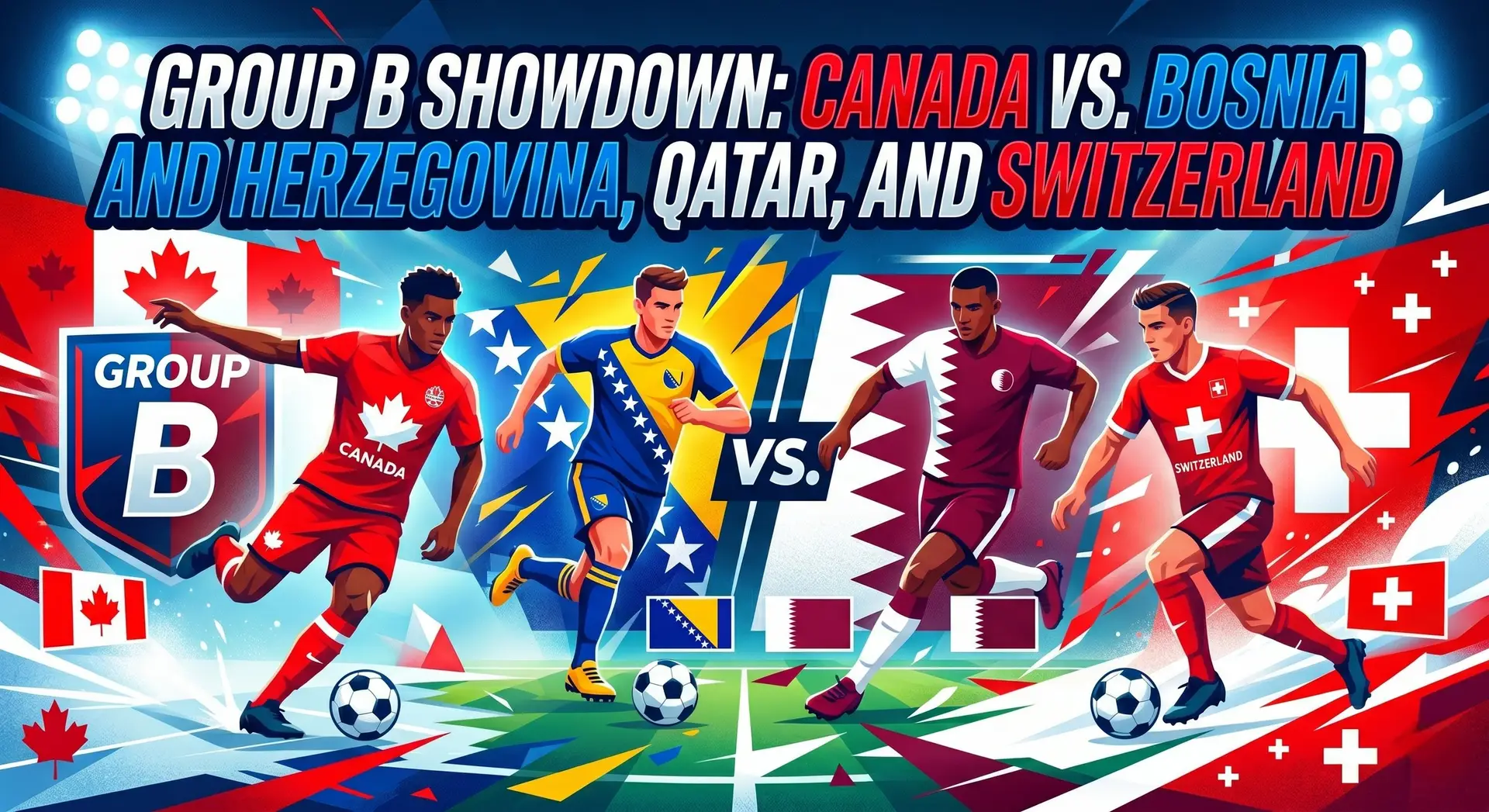
Drawn into Group B alongside Bosnia and Herzegovina, Qatar, and Switzerland, Canada faces a labyrinth of stylistic challenges.6 The campaign initiates in Toronto on June 12, 2026, against a fiercely resilient, defensively robust Bosnian side.6 Following this emotional opener, the logistical demands of the tournament necessitate a transcontinental relocation to the Pacific coast. At BC Place in Vancouver, Canada will confront a technically refined, possession-oriented Qatari squad managed by Julen Lopetegui on June 18, before concluding the group stage against Murat Yakin’s highly pragmatic, tournament-hardened Swiss machine on June 24.6 This comprehensive research report provides an exhaustive tactical, personnel, and strategic preview of Canada’s Group B trajectory, evaluating the complex variables that will dictate the host nation’s capacity to navigate the opening phase and secure advancement to the newly instituted Round of 32.1
The Ideological Evolution Under Jesse Marsch
The trajectory of the Canadian Men’s National Team shifted irrevocably in May 2024 with the appointment of Jesse Marsch as head coach.12 Recognizing that the emotionally driven, counter-attacking ethos that propelled Canada to the 2022 World Cup had reached its tactical ceiling against sophisticated global opposition, Canada Soccer engineered a deliberate pivot toward a highly systematized, modern footballing philosophy. Marsch, heavily influenced by his tenure within the Red Bull global football network, immediately began embedding a high-intensity, vertical, and pressing-oriented doctrine into the Canadian infrastructure.12
This tactical overhaul has not been without its growing pains, but the aggregate dividends as we enter the summer of 2026 are undeniable. Since assuming command, the 53-year-old American tactician has led the squad to a highly respectable record of 12 wins, 12 draws, and 5 losses across 29 matches, with a positive goal differential of 37 goals scored against 23 conceded.3 The most compelling evidence of this systemic maturation occurred at the 2024 Copa América, where Marsch guided Canada to a historic fourth-place finish in the nation’s debut appearance in South America’s premier international competition.3 This watershed achievement propelled the Canadian program to a record-high 26th in the FIFA global rankings by September 2025, an astonishing 24-place ascent from their position just a year and a half prior.3
In recognition of this sustained structural growth and to ensure uninterrupted strategic continuity through the upcoming tournament and beyond, Canada Soccer announced a four-year contract extension for Marsch on May 25, 2026, securing his leadership through the 2030 World Cup cycle.12 Crucially, the financial architecture supporting Marsch’s extension represents a novel approach to national team funding; the contract is majority-funded by a consortium of philanthropic donors and ownership groups. This consortium includes Vancouver Whitecaps FC ownership, the Carmie & Joey Saputo Foundation, Seth Boro and Jen Hamilton, the Adnani Family, and an anonymous donor, highlighting a unique harmonization of private enterprise and national sporting interests designed to elevate Canadian soccer to unprecedented heights.12
Marsch’s tactical blueprint relies on several non-negotiable principles that diverge sharply from previous Canadian iterations. First, the team operates with a narrow, hyper-aggressive central-pressing block, prioritizing the immediate denial of central passing lanes and using coordinated pressing triggers whenever the opposition circulates the ball into wide channels.14 Second, vertical transitions are paramount; upon recovering possession, prolonged lateral passing is eschewed in favour of rapid, vertical ball circulation designed to exploit mathematically disorganized defensive structures before they can reset.14 Third, to sustain the gruelling physical metrics required by this system, Marsch has systematically rotated aging veterans out of the player pool, prioritizing dual-national recruitment and integrating younger, highly athletic profiles capable of maintaining a relentless 90-minute press.13
Roster Architecture: Youth, Athleticism, and the Changing of the Guard
As of May 25, 2026, Jesse Marsch finalized a 32-man preliminary training camp roster, convening the squad in Charlotte, North Carolina, ahead of the mandatory 26-man roster submission deadline scheduled for Friday, May 29.17 This pre-tournament camp serves as the final crucible for tactical installation before the squad travels for crucial send-off friendlies against Uzbekistan on June 1 in Edmonton and the Republic of Ireland on June 5 in Montreal.7 The composition of this 32-man provisional squad underscores the ruthless modernization of the Canadian talent pool, highlighting a definitive break from the nostalgia of the 2022 qualification cycle.
The 32-Man Preliminary Camp and Roster Mechanics
The roster evaluation process in Charlotte involves intense scrutiny, with Marsch needing to make six cuts to finalize the official tournament squad, which will be unveiled during a primetime broadcast airing simultaneously on TSN, CTV, Crave, and RDS.7 In addition to the core 32 players, the technical staff invited several non-roster training players—including Nathaniel Abraham, Zayne Bruno, Tim Fortier, Maël Henry, Dylan Judelson, and Elijah Roche—to elevate the intensity of internal scrimmages and simulate opponent tactical frameworks.7
| Canada 32-Man Preliminary Training Camp Roster (May 2026) | Included Personnel |
| Goalkeepers | Maxime Crépeau, Dayne St. Clair, Owen Goodman 8 |
| Defenders | Zorhan Bassong, Moïse Bombito, Derek Cornelius, Alphonso Davies, Luc de Fougerolles, Alistair Johnston, Alfie Jones, Jamie Knight-Lebel, Richie Laryea, Ralph Priso, Niko Sigur, Joel Waterman 8 |
| Midfielders | Ali Ahmed, Tajon Buchanan, Mathieu Choinière, Stephen Eustáquio, Marcelo Flores, Ismaël Koné, Liam Millar, Jayden Nelson, Jonathan Osorio, Nathan-Dylan Saliba, Jacob Shaffelburg 7 |
| Forwards | Jonathan David, Promise David, Daniel Jebbison, Cyle Larin, Tani Oluwaseyi, Jacen Russell-Rowe 8 |
The Departure of the Qatar 2022 Veterans
The most striking element of the preliminary roster is the calculated exclusion of eleven active players who featured prominently at the 2022 FIFA World Cup in Qatar.18 This changing of the guard is emblematic of Marsch’s insistence on physical capacity over historical sentimentality. The most heavily debated omission is 38-year-old goalkeeper Milan Borjan.18 Borjan, who holds the national record with 66 caps for a goalkeeper and posted a career-best six clean sheets in a single season earlier in the cycle, started all three group stage games in Qatar.18 However, Marsch’s system necessitates a modern sweeper-keeper capable of operating far outside the penalty area to support a high defensive line, a profile that no longer aligns with Borjan’s attributes.18
Similarly, a vast swath of defensive and midfield experience has been jettisoned. Defenders Kamal Miller and Sam Adekugbe, long-standing pillars of the Canadian backline, were omitted.18 In the midfield, the technical staff bypassed Samuel Piette, Mark-Anthony Kaye, Liam Fraser, and David Wotherspoon, opting instead for midfielders with superior recovery speed and vertical passing metrics.18 The forward line also witnessed the departure of traditional target men Lucas Cavallini and Iké Ugbo, alongside veteran winger Junior Hoilett, fundamentally altering the physical profile of the attacking unit.18 Goalkeeper James Pantemis, despite strong club form for the Portland Timbers, was also left on the outside looking in, confirming the technical staff’s preference for younger, more pliable assets in the reserve roles.8
Positional Analysis and Club Form Variables
As the final 26-man roster is sculpted, the tactical viability of Canada’s starting XI will be dictated by the club form, injury status, and stylistic compatibility of the remaining core personnel.
The Goalkeeping Hierarchy: With the exclusions of Borjan and Pantemis, the battle for the starting goalkeeper position is effectively a two-man contest between Major League Soccer standouts Maxime Crépeau (Orlando City SC) and Dayne St. Clair (Inter Miami CF).8 Crépeau’s superior distribution under pressure and vocal organization likely grant him the edge in Marsch’s system, though St. Clair’s shot-stopping metrics are highly regarded. They are supported by 22-year-old newly naturalized prospect Owen Goodman, on loan at Barnsley FC from Crystal Palace, who represents the long-term future of the position but is unlikely to see tournament minutes.7
The Defensive Spine: The center-back pairing requires a delicate balance of aerial dominance and elite recovery speed to execute Marsch’s aggressive offside traps. Moïse Bombito (OGC Nice) and Derek Cornelius (Olympique de Marseille/Rangers) are the presumed starters, representing a formidable physical presence.8 Bombito recently missed Canada’s March friendlies while recovering from a fractured tibia, but has regained his fitness.23 The right-back position is firmly held by Alistair Johnston (Celtic FC), who returns to the fold following successful hamstring surgery.17 The depth across the backline features intriguing options such as Ralph Priso (Vancouver Whitecaps). Priso, a 23-year-old converted central midfielder, recently recorded a team-high passing accuracy of 94% and an elite top speed of 35.12 km/h in MLS play, offering Marsch a highly technical rotation option who fits the athletic paradigm perfectly.17 Additional depth is provided by English-based defenders Alfie Jones (Middlesbrough), Luc de Fougerolles (FCV Dender), and Jamie Knight-Lebel (Swindon Town).8
The Engine Room: The structural integrity of Canada’s midfield rests squarely on the shoulders of vice-captain Stephen Eustáquio.19 Operating as the deep-lying playmaker and primary transition initiator, Eustáquio’s club situation provides an interesting subtext to his tournament preparation. In early 2026, he joined LAFC on a six-month loan from FC Porto, making 14 appearances and navigating a deep-tissue hematoma that required treatment in Portugal.24 Eustáquio confirmed to reporters on May 22 that he will not remain in Major League Soccer, stating his intention to return to Porto immediately following the World Cup to fulfill the final year of his European contract.25 Eustáquio will be partnered by the dynamic Ismaël Koné (U.S. Sassuolo Calcio), whose box-to-box progression is vital for breaking opposition lines.7 The midfield rotation is bolstered by the creative inclusion of Toronto FC’s Jonathan Osorio, LAFC’s Mathieu Choinière, and the highly anticipated integration of younger talents like Ali Ahmed (Norwich City), Marcelo Flores (Tigres UANL), and Nathan-Dylan Saliba (R.S.C. Anderlecht).7
The Attacking Vanguard: The Canadian attack is heavily reliant on the dual threat of Jonathan David and Cyle Larin.8 Larin (Southampton) provides the archetypal target-man physicality, serving as the ultimate reference point for long clearances and central combination play.8 However, the ceiling of this Canadian team is inextricably linked to Jonathan David.19 David arrives at the World Cup following a complex 2025/2026 club season. After a high-profile free transfer to Juventus from LOSC Lille, David struggled to adapt to the tactical rigours of Serie A, recording 8 goals and 5 assists across 45 appearances in all competitions.28 Despite these domestic struggles, which have sparked transfer rumours linking him to Newcastle United, Aston Villa, and Leeds United, David’s tactical intelligence, false-nine dropping movements, and clinical finishing for the national team remain unparalleled.30 Providing auxiliary firepower off the bench will be players like Tani Oluwaseyi (Villarreal), Jacen Russell-Rowe (Toulouse), and the recovering Promise David (Royale Union Saint-Gilloise), who is rehabilitating from February hip surgery but is expected to be fit for the opening match.8
The Alphonso Davies Variable
The single most significant variable dictating Canada’s tactical approach—and a source of profound anxiety for the technical staff—is the physiological fragility of captain Alphonso Davies.23 The Bayern Munich superstar has endured a catastrophic 14-month period of physical setbacks. After suffering a severe ACL tear while on international duty in March 2025, Davies returned to the pitch for Bayern in December, only to suffer a muscle fiber tear in his right hamstring in February 2026.33 He missed Canada’s March friendlies against Iceland and Tunisia due to this strain, returned briefly to club action, and then suffered another debilitating hamstring injury during the second leg of the UEFA Champions League semi-final against Real Madrid on May 6, 2026.23
While Marsch included the 25-year-old left-back in the 32-man camp roster, Davies was absent from the initial Charlotte sessions, remaining in Germany to undergo intensive, localized treatment.23 Addressing the media, Marsch was starkly realistic about the captain’s availability for the tournament opener: “I think Alphonso will play in the World Cup… No, I don’t think he’ll be ready quite on June 12… but we’ll see”.33 Davies is tentatively scheduled to join the squad in his hometown of Edmonton on the eve of the June 1 friendly against Uzbekistan.33
The second-order implications of Davies’s absence are profound and multifaceted. Tactically, Davies provides Canada with unparalleled progressive carrying ability; his elite acceleration allows Canada to bypass opposition pressing structures via individual brilliance rather than complex passing networks. Furthermore, his presence creates an extreme width asymmetry on the left flank, forcing opposing right-backs to remain pinned deep in their own half. Without him, Marsch must engineer alternative ball-progression mechanisms. This likely involves relying heavily on the direct, vertical pace of Jacob Shaffelburg (LAFC) or Liam Millar (Hull City) on the left wing, while concurrently demanding greater offensive output and overlapping support from the right flank via Tajon Buchanan (Villarreal) and Alistair Johnston.8 The psychological impact of missing their talisman in front of a home crowd is a variable that Marsch’s sports psychology staff must actively mitigate.
Matchday 1: Canada vs. Bosnia and Herzegovina – The Collision of Emotion and Structure
Date: Friday, June 12, 2026 (3:00 PM Local Time)
Venue: BMO Field (Toronto Stadium), Toronto, Ontario
Tournament Implications: Group B Opener 6
Historical Context and Venue Dynamics
The opening fixture of Canada’s 2026 World Cup campaign carries an immense historical and psychological burden. Hosted at BMO Field in Toronto, which will operate at a specialized expanded capacity for the tournament, this event marks the first-ever men’s FIFA World Cup match contested on Canadian soil.6 Embodying the host city’s theme, “The World in a City,” the atmosphere will be overwhelmingly patriotic yet incredibly pressured.9 Statistically, securing three points in the opening fixture of a World Cup group stage is historically an absolute imperative for teams harbouring genuine aspirations of advancing to the knockout phases. The psychological pressure on the host nation will be palpable, establishing a highly emotional environment that Marsch’s relatively young squad must carefully manage against a deeply resilient European opponent.
Opponent Profile: The Bosnian Blueprint Under Sergej Barbarez
Ranked 65th globally by FIFA entering the summer, Bosnia and Herzegovina arrives in North America carrying the momentum of a historic and emotionally charged qualification campaign.38 Having failed to qualify for the World Cup since their debut appearance in Brazil in 2014, the “Zmajevi” (Dragons) secured their ticket to the 2026 tournament via the gruelling UEFA Playoff Path A.10 Under the astute, defensively minded guidance of head coach Sergej Barbarez, Bosnia defeated Wales in Cardiff via a penalty shootout before executing a monumental upset against the defending European champions and four-time world champions, Italy, prevailing 4-1 on penalties following a heavily contested 1-1 draw in the playoff final.10
Barbarez displayed his supreme confidence in his core group by becoming the first manager globally to finalize and announce his 26-man roster, completing the selection process weeks ahead of the FIFA deadline.41 This calculated decision ensured his squad could concentrate entirely on physical preparation and tactical assimilation without the distraction of media speculation or internal roster anxiety.45
The Bosnian squad is characterized by a fascinating blend of battle-hardened, late-career veterans executing their “last dance” and an accelerating youth movement that prioritizes physical robustness, aerial superiority, and extreme defensive rigidity.42
| Key Bosnian Personnel & Club Affiliation (2025/26) | Tactical Function under Sergej Barbarez |
| Nikola Vasilj (FC St. Pauli) 43 | Starting Goalkeeper, traditional shot-stopper |
| Sead Kolašinac (Atalanta BC) 40 | Aggressive Left-Back, physical overlapping |
| Amar Dedić (SL Benfica) 40 | Dynamic Right-Back, wide transition initiator |
| Ivan Šunjić (Pafos FC) 40 | Defensive Midfield anchor, central disruptor |
| Edin Džeko (Fenerbahçe) 10 | Captain, focal point, elite hold-up play |
| Ermedin Demirović (VfB Stuttgart) 40 | High-work-rate secondary striker, channel runner |
Tactical Matchups and Strategic Prognosis
Bosnia and Herzegovina operates predominantly in a structured, narrow 4-4-2 formation designed to limit space between the lines.40 The defence is anchored by the aggressive and highly experienced Sead Kolašinac (Atalanta BC) on the left and the highly promising Amar Dedić (SL Benfica) on the right.40 The central defensive partnership, featuring Nikola Katić (Schalke 04) and Tarik Muharemović (US Sassuolo), is aerially dominant and excels at defending crosses, though it can occasionally be vulnerable to rapid changes of pace and complex passing combinations on the ground.40
The midfield double-pivot, likely featuring the combative Ivan Šunjić (Pafos FC) alongside the technical Benjamin Tahirović (Bröndby IF) or Armin Gigović (BSC Young Boys), focuses exclusively on protecting the central zones.40 Upon recovering possession, they seek to launch rapid counter-attacks into the wide channels, where dynamic wingers like Esmir Bajraktarević—who famously scored the game-winning penalty against Italy—and Amar Memić (FC Viktoria Plzen) operate.10
However, the undeniable gravitational center of the Bosnian tactical universe remains 40-year-old striking legend Edin Džeko.10 With a staggering record of 73 goals for his country—55 more than any other player in the history of the Bosnian national team—Džeko’s hold-up play, elite spatial awareness in the penalty area, and aerial superiority remain world-class despite his significantly diminished mobility.10 He is seamlessly partnered by Ermedin Demirović, a relentless, high-intensity runner whose defensive work rate perfectly complements Džeko’s stationary, target-man role.40
The Key Strategic Battlegrounds:
- The Aerial Domination vs. Recovery Pace: Canada’s center-back pairing of Bombito and Cornelius must find a way to neutralize Džeko’s aerial gravity.18 Bosnia will intentionally look to bypass Canada’s aggressive midfield press by launching long, diagonal balls directly to Džeko’s chest or head, utilizing Demirović to relentlessly collect the ensuing second balls.40 Cornelius’s ability to compete physically with Džeko in the air, combined with Bombito’s recovery pace to sweep behind, will dictate the defensive rhythm of the game.
- Exploiting the Low Block without Davies: With Alphonso Davies highly unlikely to feature, Canada faces a severe challenge in breaking down Bosnia’s disciplined low block.33 Wide players like Shaffelburg or Buchanan will need to stretch the Bosnian defence horizontally.19 Because Dedić and Kolašinac are elite one-on-one defenders, Canada must rely on rapid, quick-touch combinations orchestrated by Jonathan David dropping into the half-spaces, rather than relying on isolated wide dribbling, to penetrate the final third.40
Prognosis: This match presents a classic clash of stylistic ideologies—Canada’s high-octane, vertical pressing system versus Bosnia’s disciplined, physical, and opportunistic counter-attacking block. If Canada can manage the emotional surge of the home crowd, score early, and force Bosnia to abandon their preferred low defensive posture, Marsch’s side possesses the transitional speed to exploit the ensuing gaps mercilessly. However, a prolonged 0-0 stalemate heavily favours the European qualifiers, who possess the set-piece mastery and dark-arts experience necessary to frustrate the hosts and snatch a narrow victory against the run of play.
The Transcontinental Shift: Logistical and Physiological Variables
Following the final whistle at BMO Field on June 12, the Canadian squad faces a unique logistical hurdle not experienced by teams based in a single region: a transcontinental flight across three time zones. Relocating from Toronto to Vancouver for Matchdays 2 and 3 introduces significant physiological variables into the tournament equation. The transition from the Eastern Time Zone to the Pacific Time Zone requires rapid adjustment to circadian rhythms, while the physical toll of a five-hour flight immediately following a high-intensity match compresses the crucial 72-hour recovery window.
Marsch and the Canadian sports science department must meticulously manage player load during this transition. Hydration protocols, sleep optimization strategies, and targeted muscular recovery for players like Eustáquio and Larin—who cover immense distances within the pressing system—will be paramount. Furthermore, adjusting to the artificial turf surface at BC Place, compared to the hybrid grass at BMO Field, introduces subtle changes in ball bounce mechanics and increased joint stress, variables that the technical staff must account for during tactical walk-throughs in British Columbia.6
Matchday 2: Canada vs. Qatar – A Study in Tactical Contrasts and Redemption
Date: Thursday, June 18, 2026 (3:00 PM Local Time)
Venue: BC Place, Vancouver, British Columbia
Tournament Implications: Group B Matchday 2 6
Historical Context and the Qatari Renaissance
By Matchday 2, the mathematical dynamics of Group B will have crystallized. For Qatar, this tournament is entirely defined by the pursuit of national sporting redemption. As the host nation of the 2022 World Cup, the “Maroons” crumbled under the immense pressure of the global spotlight, failing to secure a single point and becoming the worst-performing host nation in the competition’s history.5 Securing qualification for the 2026 tournament strictly on sporting merit—navigating the gruelling AFC qualification process rather than relying on host privileges—represents a profound psychological reset for the Gulf nation.5
Canada holds a distinct psychological edge over Qatar based on recent history, having soundly defeated the Maroons 2-0 in an international friendly in September 2022.22 In that encounter, Canada dominated possession and field position, securing victory via early goals from Cyle Larin and Jonathan David.22 However, the Qatari squad arriving in Vancouver in 2026 is fundamentally and structurally distinct from the fragile iteration Canada dismantled four years prior.
Opponent Profile: Julen Lopetegui’s Tactical Overhaul
Following a turbulent period of mixed results post-2022, the Qatar Football Association initiated a comprehensive strategic overhaul by appointing highly decorated Spanish manager Julen Lopetegui in May 2025.5 Lopetegui, whose prestigious resume includes tenures managing the Spanish National Team, Real Madrid, Sevilla (winning the UEFA Europa League), Wolverhampton Wanderers, and West Ham United, was brought to Doha specifically to instill European tactical rigor and defensive resilience into a talented but structurally undisciplined squad.5
Lopetegui quickly engineered a remarkable turnaround. Facing immense pressure in the decisive fourth round of the AFC qualifiers, Qatar secured their berth in North America via a dramatic, high-stakes 2-1 victory over the United Arab Emirates in Doha on October 14, 2025, with seasoned veterans Boualem Khoukhi and Pedro Miguel providing the decisive headed goals.49
The Qatari roster relies heavily on the profound domestic synergy generated by the Qatar Stars League, predominantly featuring players concentrated within powerhouse clubs like Al-Sadd SC and Al-Duhail SC.51 To prepare for the World Cup, Lopetegui established a rigorous 32-man extended training camp in Doha, placing a massive emphasis on increasing the physical thresholds of the players to match the aerobic demands of elite international opposition.52
| Key Qatari Personnel & Club Affiliation (2025/26) | Tactical Function under Julen Lopetegui |
| Meshaal Barsham (Al-Sadd SC) 51 | Starting Goalkeeper, proactive distribution |
| Pedro Miguel (Al-Sadd SC) 49 | Right-Back, overlapping threat, set-piece target |
| Boualem Khoukhi (Al-Sadd SC) 49 | Center-Back, defensive organizer |
| Abdulaziz Hatem (Al-Rayyan SC) 10 | Central Midfield anchor, tempo dictator |
| Akram Afif (Al-Sadd SC) 10 | Left Winger, primary creative hub, inverted runs |
| Almoez Ali (Al-Duhail SC) 10 | Central Striker, channel running, clinical finishing |
Tactical Matchups and Strategic Prognosis
Under Lopetegui’s meticulous tutelage, Qatar has transitioned into a highly disciplined, possession-oriented side that prioritizes ball retention and controlled build-up play from the back.49 They seek to control the tempo through a methodical, short-passing network orchestrated by Abdulaziz Hatem and Karim Boudiaf in the central midfield zones.10 Out of possession, they eschew a high press in favour of deploying a highly structured, compact mid-block designed to suffocate central passing lanes, forcing opponents to funnel the ball into wide areas where fullbacks Pedro Miguel and Sultan Al Brake initiate aggressive, coordinated traps against the touchline.49
The offensive focal point relies entirely on the dynamic interplay between Akram Afif’s creative unpredictability on the left wing and Almoez Ali’s intelligent off-the-ball runs in the central channel.10
The Key Strategic Battlegrounds:
- The Transition and Pressing Battle: Qatar’s deep desire to dominate possession and build meticulously from the back plays directly into the tactical strengths of Jesse Marsch’s philosophy.12 Canada’s system is explicitly designed to disrupt methodical build-up play through coordinated, high-intensity pressing.12 If Stephen Eustáquio and Ismaël Koné can successfully anticipate passes and dispossess Qatar’s midfield anchors in the middle third, Canada’s forwards will find themselves operating against an exposed, back-pedalling Qatari defensive line.8
- Containment of Akram Afif: Afif remains Qatar’s most potent, game-breaking offensive weapon.10 His ability to receive the ball wide, cut inside onto his favoured right foot, and deliver precise through-balls or shoot from distance will severely test Alistair Johnston.19 The right-sided center-back (likely Bombito) must be hyper-aware, prepared to detach from the central striker and provide immediate covering support to neutralize Afif’s inverted runs.19
Prognosis: Structurally and stylistically, this fixture represents Canada’s most favourable matchup in Group B. While Lopetegui has undoubtedly improved Qatar’s defensive resilience and tactical coherence, the Maroons historically struggle against opponents who impose an intense physical and athletic tempo that disrupts their passing rhythm.49 If Canada can maintain the integrity of their aggressive pressing triggers and avoid naive defensive lapses in transition when Afif gets on the ball, the hosts possess the necessary vertical firepower to overwhelm Qatar and secure three vital points in front of a raucous Vancouver crowd.
Matchday 3: Canada vs. Switzerland – The Litmus Test of Global Consistency
Date: Wednesday, June 24, 2026
Venue: BC Place, Vancouver, British Columbia
Tournament Implications: Group B Finale 7
Historical Context and the Weight of Experience
The concluding fixture of Group B pits Canada against the highest-pedigree, most tactically formidable opponent in the quadrant. Switzerland is the absolute model of international consistency, routinely navigating complex group stages and reaching the Round of 16 in the three previous World Cup cycles (2014, 2018, 2022).11 Depending heavily on the outcomes of the opening two matchdays, this fixture will likely serve either as a direct, winner-take-all shootout for the top spot in Group B, or an absolute survival test for Canada’s knockout stage qualification hopes.
The historical head-to-head record between the two nations is incredibly sparse, with Canada surprisingly securing a 3-1 victory over the Swiss in a friendly played in St. Gallen back in May 2002.11 However, contemporary data and squad evaluations provide a much clearer picture of the monumental challenge awaiting the Canadian hosts.
Opponent Profile: Murat Yakin’s Pragmatic Machine
Manager Murat Yakin leads a veteran, fiercely unified, and tactically sophisticated Swiss squad.54 Valuing absolute consistency and proven tournament mettle over experimental youth, Yakin’s 26-man roster features an astonishing 17 returning players who were part of the selection that competed in Qatar four years ago.57 Furthermore, multiple players bring experience from the 2024 European Championship in Germany. This unparalleled major tournament experience is arguably Switzerland’s greatest intangible asset; they are rarely overawed by the occasion, possessing a deep psychological fortitude developed through years of navigating high-stakes European and global competition.55
The spine of the Swiss team operates at the absolute zenith of European club football, featuring players accustomed to the elite pressure of the Champions League. Goalkeeper Gregor Kobel (Borussia Dortmund) is widely regarded as one of the premier shot-stoppers globally.54 The defence is imperiously marshalled by Manuel Akanji, who recently finalized a permanent €15 million transfer to Inter Milan following a highly successful loan spell from Manchester City, embedding himself as one of Serie A’s elite ball-playing center-backs.59
The midfield is commanded by the talismanic, combative captain Granit Xhaka. Xhaka, the nation’s most capped player with an incredible 144 appearances, arrives at the World Cup following a massive club transfer; on July 30, 2025, he returned to England, signing for newly promoted Premier League side Sunderland on a three-year contract for an initial fee of £13 million (plus £4 million in add-ons), immediately being named club captain for the 2025/26 season.57 Xhaka is flanked by relentless, highly intelligent engines such as Remo Freuler (Bologna) and Denis Zakaria (Monaco).56
| Key Swiss Personnel & Club Affiliation (2025/26) | Tactical Function under Murat Yakin |
| Gregor Kobel (Borussia Dortmund) 56 | Elite shot-stopping, command of penalty area |
| Manuel Akanji (Inter Milan) 56 | Primary defensive anchor, press-resistant build-up |
| Ricardo Rodríguez (Real Betis) 56 | Veteran full-back (136 caps), elite set-piece delivery |
| Granit Xhaka (Sunderland) 56 | Captain, central metronome, tempo manipulation |
| Remo Freuler (Bologna) 56 | Box-to-box disruption, supporting late runs into box |
| Breel Embolo (Rennes) 56 | Physical hold-up play, central attacking focal point |
Tactical Matchups and Strategic Prognosis
Yakin is a famously pragmatic tactician who eschews dogmatic philosophies, instead adapting his formation fluidly to exploit the opposition’s specific weaknesses.66 While he successfully operated within a 3-4-3 system during recent European Championships, he has signalled a move toward a more familiar 4-3-3 shape ahead of this summer’s tournament.66 Against Canada, a 4-3-3 is highly probable, intended specifically to establish overwhelming numerical superiority in the central midfield zone while allowing veteran fullbacks Ricardo Rodríguez (Real Betis) and Silvan Widmer (Mainz 05) to push forward aggressively and provide wide service.56
Switzerland excels at dictating the overarching tempo of a match.67 They are exceptionally comfortable circulating the ball under intense opposition pressure, utilizing Akanji’s elite vision and passing range to bypass the first line of an opposing press with ease.60 Granit Xhaka serves as the deep-lying orchestrator, dictating play with his extraordinary passing range, switching the point of attack, and manipulating the pitch’s spatial geometry to draw defenders out of position.56 In the final third, Switzerland relies on the immense physical imposition and back-to-goal hold-up play of Breel Embolo (Rennes), supported by the dynamic, pacy wide play of Dan Ndoye and Rubén Vargas (Sevilla), or the returning fitness of Zeki Amdouni (Burnley), who Yakin recently praised for his tactical comprehension despite limited club minutes.54
The Key Strategic Battlegrounds:
- The Midfield Chess Match: The outcome of this fixture will be determined almost entirely in the central third. Yakin will instruct Xhaka, Freuler, and potentially Djibril Sow to form a tight, numerically superior triangle designed to completely bypass and outmaneuver Canada’s double-pivot of Eustáquio and Koné.19 To counteract this, Canada’s forwards, particularly Jonathan David, must execute exhaustive defensive duties, dropping deep out of possession to suffocate Xhaka’s time on the ball.19 If Xhaka is allowed to face forward unpressured, he will systematically dismantle Canada’s high defensive line with precise, diagonal line-breaking passes into the paths of Ndoye and Vargas.64
- Bypassing the Akanji Conundrum: Executing a high press against Manuel Akanji is notoriously difficult and highly risky due to his press resistance and vision.61 Canada cannot afford to over-commit their pressing triggers against the Swiss backline, lest they be exposed by rapid vertical counters launched by a single Akanji pass. In response, Marsch may be forced to employ a more measured, passive mid-block—a stark, uncomfortable departure from his default Red Bull philosophy—attempting to draw Switzerland forward into the Canadian half before striking rapidly in transition.12
Prognosis: Switzerland is the definitive litmus test for Marsch’s modern Canadian project. The Europeans possess superior technical refinement across the starting XI, vastly more tournament experience, and the precise tactical discipline required to completely neutralize high-energy, emotion-driven pressing systems.55 To secure a positive result, Canada will require a performance of absolute tactical perfection, capitalizing on dead-ball situations and maximizing their highly limited transitional opportunities. Even securing a draw in this concluding fixture would be viewed as a monumental tactical victory for the host nation, potentially securing their path to the knockout rounds.
Overarching Group B Progression Scenarios and Strategic Calculus
The structural expansion of the 2026 World Cup profoundly alters the mathematical realities and risk-management strategies for group-stage progression. With 48 teams divided into 12 groups of four, the top two teams from each group automatically advance to the newly created Round of 32.1 Crucially, they will be joined by the eight best third-placed teams across the entire tournament.1
This expanded format severely diminishes the catastrophic penalty traditionally associated with a single group-stage defeat. Historically, in the unforgiving 32-team format, securing four points was often the absolute minimum threshold required for advancement. In the 2026 framework, securing merely three points—potentially achievable via a single, targeted victory over Qatar on Matchday 2—coupled with a tightly managed goal differential in narrow losses against Bosnia and Switzerland, may be mathematically sufficient to secure one of the eight third-place progression slots.1
However, tactical and medical decisions made early in the tournament have massive cascading effects on this mathematical calculus. The handling of Alphonso Davies’ severe hamstring injury is the clearest inflection point.33 If Marsch elects to rush Davies back prematurely for the emotionally charged opener against Bosnia on June 12, he risks severely aggravating the injury, potentially losing his world-class captain for the entirety of the tournament. Conversely, holding Davies in reserve for the critical matchups against Qatar and Switzerland requires the secondary tactical framework—relying heavily on players like Shaffelburg, Millar, and Johnston to provide width and progression—to succeed immediately under the immense pressure of an opening match at home.19 The medical staff’s assessment of Davies’ muscle fibres will arguably dictate Canada’s entire tournament strategy.
Final Outlook and Concluding Implications
The Canadian Men’s National Team enters the 2026 FIFA World Cup at a critical, defining juncture in its programmatic evolution. The sheer novelty of merely qualifying—a sentiment that undeniably permeated and somewhat softened the 2022 campaign in Qatar—has entirely evaporated.4 Operating as co-hosts on home soil, backed by unprecedented financial, corporate, and public support, the expectation is unequivocal: Canada must perform, and Canada must advance to the knockout stages.
Jesse Marsch has done exceptionally well to modernize the squad’s tactical identity in a remarkably short timeframe, shedding the aging, sentimental core of the Herdman era in favour of a hyper-athletic, pressing-oriented philosophy that has already proven capable of competing with global powers, as evidenced by the deep run at the 2024 Copa América.3 However, the specific dynamics of Group B present a labyrinth of conflicting stylistic challenges that cannot be solved with athleticism alone.
To succeed and advance, Canada must thread a delicate, highly complex tactical needle across three distinct fixtures. First, they must navigate the physical, low-block resilience of a highly motivated, Džeko-led Bosnia and Herzegovina side, likely without the progressive, game-breaking thrust of their injured captain, Alphonso Davies.33 Second, they must successfully impose their chaotic transitional tempo against Julen Lopetegui’s structurally sound, possession-heavy Qatari squad.5 Finally, they must exhibit immense defensive discipline and tactical maturity against Murat Yakin’s battle-tested, technically superior Swiss machine.56
The margin for error in international football is microscopic. If Jonathan David can rediscover his clinical finishing touch amidst his domestic club-level struggles at Juventus, if Stephen Eustáquio can maintain absolute control of the midfield tempo before his return to Porto, and if the center-back pairing can weather the aerial bombardment of European forwards, Canada possesses the intrinsic talent and tactical framework to secure the points necessary to advance.8
Ultimately, Canada’s 2026 campaign will be defined just as much by psychological fortitude as it is by tactical execution. Marsch has cultivated an environment of intensity, ambition, and fearlessness.14 If the squad can harness the immense, potentially overwhelming emotional energy of their home crowds at BMO Field and BC Place without succumbing to the associated pressure, the 2026 World Cup will serve not merely as a celebration of hosting, but as the exact moment the Canadian Men’s National Team definitively arrives as a sustainable, formidable, and highly competitive force on the global stage.
Works cited
- FIFA World Cup 2026 Schedule: Full Fixtures, Groups & Venues, accessed May 26, 2026, https://wpleague.in/matches/fifa-world-cup-2026-schedule/
- World Cup 2026 Fixtures: Full Schedule, Dates & Groups, accessed May 26, 2026, https://www.toffeeweb.com/world-cup-fixtures/
- Canada Soccer extends manager Jesse Marsch through 2030 FIFA World Cup, accessed May 26, 2026, https://www.sportsnet.ca/soccer/article/canada-soccer-extends-manager-jesse-marsch-through-2030-fifa-world-cup/
- Canada at the FIFA World Cup – Wikipedia, accessed May 26, 2026, https://en.wikipedia.org/wiki/Canada_at_the_FIFA_World_Cup
- Qatar at the FIFA World Cup: Team profile and history, accessed May 26, 2026, https://www.fifa.com/en/tournaments/mens/worldcup/canadamexicousa2026/articles/qatar-team-profile-history
- How to get tickets for the 2026 World Cup matches in Canada: Stadium information, match schedules for Toronto and Vancouver and more, accessed May 26, 2026, https://www.goal.com/en-us/news/how-to-get-tickets-for-the-2026-world-cup-matches-in-canada-information-on-stadiums-the-match-schedule-for-toronto-and-vancouver-host-cities-and-more/blt0192687cb9bbc74e
- CANMNT Charlotte Training Camp Squad Named Ahead of FIFA World Cup 2026™, accessed May 26, 2026, https://news.canadasoccer.com/canmnt-charlotte-training-camp-squad-named-ahead-of-fifa-world-cup-2026
- Canada call 11 MLS players for pre-World Cup camp, accessed May 26, 2026, https://www.mlssoccer.com/news/canada-call-11-mls-players-for-pre-world-cup-camp
- FIFA World Cup 2026™ Toronto, accessed May 26, 2026, https://www.toronto.ca/explore-enjoy/festivals-events/fifa-world-cup-26/
- Canada learn final World Cup opponent: Bosnia & Herzegovina join Group B | MLSSoccer.com, accessed May 26, 2026, https://www.mlssoccer.com/news/italy-bosnia-herzegovina-join-group-b-canada-lear-world-cup-opener-opponent
- Switzerland v Canada | World Cup | Match preview – FIFA, accessed May 26, 2026, https://www.fifa.com/en/tournaments/mens/worldcup/canadamexicousa2026/articles/switzerland-canada-preview-live-stream-team-news-tickets
- Canada extend Jesse Marsch through 2030 World Cup, accessed May 26, 2026, https://www.mlssoccer.com/news/canada-extend-jesse-marsch-through-2030-world-cup
- Jesse Marsch extended as Canada’s men’s soccer coach through 2030 World Cup, accessed May 26, 2026, https://www.cbc.ca/sports/soccer/jesse-marsch-extension-2030-9.7211952
- Canada Soccer Extends Jesse Marsch Through FIFA World Cup 2030™, accessed May 26, 2026, https://news.canadasoccer.com/canada-soccer-extends-jesse-marsch-through-fifa-world-cup-2030
- Canada Soccer extends men’s head coach Jesse Marsch through 2030 World Cup, accessed May 26, 2026, https://meadowlakenow.com/2026/05/25/canada-soccer-extends-mens-head-coach-jesse-marsch-through-2030-world-cup/
- Canada Soccer Announce Contract Extension for Jesse Marsch, accessed May 26, 2026, https://heavy.com/sports/soccer/jesse-marsch-extension-canada-soccer/
- Canada Names FIFA Men’s World Cup Training Roster, accessed May 26, 2026, https://northerntribune.ca/canada-2026-world-cup-training-roster/
- 11 players from 2022 FIFA World Cup team left off Canada’s roster, accessed May 26, 2026, https://dailyhive.com/vancouver/canada-roster-cuts-world-cup-training-camp
- Race for the Roster: Steven Caldwell’s final Canada squad for the …, accessed May 26, 2026, https://www.tsn.ca/soccer/article/race-for-the-roster-caldwells-final-squad/
- Sporting KC midfielder Zorhan Bassong named to Canada Men’s National Team for training camp, accessed May 26, 2026, https://www.sportingkc.com/news/sporting-kc-midfielder-zorhan-bassong-named-to-canada-men-s-national-team-for-training-camp
- Ralph Priso named to CANMNT Training Camp Squad ahead of FIFA World Cup 2026™, accessed May 26, 2026, https://www.whitecapsfc.com/news/priso-canmnt-training-camp
- Canada beats Qatar 2:0 in first international friendly game, accessed May 26, 2026, https://news.canadasoccer.com/canada-beats-qatar-20-in-first-international-friendly-game
- Injured captain Alphonso Davies named to Canada World Cup training camp roster, accessed May 26, 2026, https://www.sportsnet.ca/fifa-world-cup/article/injured-captain-alphonso-davies-named-to-canada-world-cup-training-camp-roster/
- LAFC Acquires Midfielder Stephen Eustáquio on Loan from Portuguese Club FC Porto, accessed May 26, 2026, https://www.lafc.com/news/lafc-acquires-midfielder-stephen-eustaquio-on-loan-from-portuguese-club-fc-porto
- Canada vice captain Stephen Eustaquio leaving LAFC before World Cup, accessed May 26, 2026, https://canadiansoccerdaily.com/2026/05/23/canada-vice-captain-stephen-eustaquio-leaving-lafc-before-world-cup/
- On loan from Porto – Eustaquio joins LAFC to become third most valuable player on the squad – Transfer Market, accessed May 26, 2026, https://www.transfermarkt.us/on-loan-from-porto-eustaquio-joins-lafc-to-become-third-most-valuable-player-on-the-squad/view/news/475142
- LAFC Acquires Midfielder Stephen Eustáquio on Loan from Portuguese Club FC Porto | Los Angeles Football Club : r/MLS – Reddit, accessed May 26, 2026, https://www.reddit.com/r/MLS/comments/1qxlpwt/lafc_acquires_midfielder_stephen_eust%C3%A1quio_on/
- Jonathan David joins Juventus, accessed May 26, 2026, https://www.juventus.com/en/news/articles/jonathan-david-joins-juventus
- Jonathan David – Wikipedia, accessed May 26, 2026, https://en.wikipedia.org/wiki/Jonathan_David
- Report: Newcastle United have the chance to sign Juventus star | OneFootball, accessed May 26, 2026, https://onefootball.com/fr/news/report-newcastle-united-have-the-chance-to-sign-juventus-star-42916830
- Profil Jonathan David: Bombers Milik Juventus Jadi Target Newcastle, Aston Villa dan Leeds United, accessed May 26, 2026, https://wow.tribunnews.com/superball/386586/profil-jonathan-david-bombers-milik-juventus-jadi-target-newcastle-aston-villa-dan-leeds-united
- Harvey Barnes told Newcastle United transfer truth as Jonathan David links return, accessed May 26, 2026, https://www.chroniclelive.co.uk/sport/football/football-news/harvey-barnes-told-newcastle-united-34010360
- Soccer-Davies likely to miss Canada’s World Cup opener with injury, says coach, accessed May 26, 2026, https://wtaq.com/2026/05/25/soccer-davies-likely-to-miss-canadas-world-cup-opener-with-injury-says-coach/
- Soccer-Davies likely to miss Canada’s World Cup opener with injury, says coach, accessed May 26, 2026, https://whtc.com/2026/05/25/soccer-davies-likely-to-miss-canadas-world-cup-opener-with-injury-says-coach/
- Injured Canadian captain Davies named to World Cup training camp roster, will join team on Sunday, accessed May 26, 2026, https://www.tsn.ca/soccer/fifa-world-cup/article/injured-canadian-captain-davies-named-to-world-cup-training-camp-roster/
- Injured Canadian captain named to World Cup training camp roster, accessed May 26, 2026, https://supersport.com/football/news/9dcf2977-2796-49f2-9c9d-708271436c99/injured-canadian-captain-named-to-world-cup-training-camp-roster
- Captain Alphonso Davies likely won’t play in Canada’s World Cup opener: coach | paNOW, accessed May 26, 2026, https://panow.com/2026/05/25/cp-newsalert-injured-canadian-captain-davies-named-to-world-cup-training-camp-roster/
- Canada v Bosnia & Herzegovina results, H2H stats | Football – Flashscore.com, accessed May 26, 2026, https://www.flashscore.com/match/football/bosnia-herzegovina-fqe7WYTr/canada-x4toKORL/
- Canada v Bosnia and Herzegovina | World Cup | Match Preview – FIFA, accessed May 26, 2026, https://www.fifa.com/en/tournaments/mens/worldcup/canadamexicousa2026/articles/canada-bosnia-and-herzegovina-live-stream-team-news-tickets
- Bosnia And Herzegovina Vs Italy World Cup Playoff Preview – Total Football Analysis, accessed May 26, 2026, https://totalfootballanalysis.com/match-analysis/tactical-preview/bosnia-herzegovina-italy-tactical-preview-world-cup-qualifier-analysis
- Sergej Barbarez’s Official Bosnia And Herzegovina Squad For The 2026 FIFA World Cup, accessed May 26, 2026, https://www.beinsports.com/en-us/soccer/fifa-world-cup-2026/articles/sergej-barbarez-s-official-bosnia-and-herzegovina-squad-for-the-2026-fifa-world-cup-2026-05-11
- Bosnia and Herzegovina World Cup 2026 squad: Sergej Barbarez’s final selection, accessed May 26, 2026, https://www.fourfourtwo.com/team/bosnia-world-cup-2026-squad
- Bosnia and Herzegovina squad | FIFA World Cup 2026, accessed May 26, 2026, https://www.fifa.com/en/tournaments/mens/worldcup/canadamexicousa2026/articles/bosnia-and-herzegovina-sergej-barbarez-names-squad
- Bosnia and Herzegovina at FIFA World Cup 2026: All players, full squad list, key stats and schedule – Olympics.com, accessed May 26, 2026, https://www.olympics.com/en/news/fifa-world-cup-2026-bosnia-herzegovina-players-squad-list-key-stats-schedule
- Bosnia and Herzegovina announces their squad for the 2026 FIFA World Cup. – Reddit, accessed May 26, 2026, https://www.reddit.com/r/soccer/comments/1ta1t74/bosnia_and_herzegovina_announces_their_squad_for/
- Bosnia-Herzegovina – Detailed squad 2026 – Transfermarkt, accessed May 26, 2026, https://www.transfermarkt.com/bosnia-e-herzegovina/kader/verein/3446
- Bosnia-Herzegovina World Cup 2026: Fixtures, key players and tactical analysis – Squawka, accessed May 26, 2026, https://www.squawka.com/en/news/world-cup/bosnia-herzegovina-world-cup-2026-fixtures-players-analysis/
- Canada v Qatar results, H2H stats | Football – Flashscore, accessed May 26, 2026, https://www.flashscore.com/match/football/canada-x4toKORL/qatar-zqzHL77i/
- Julen Lopetegui eyes World Cup redemption with Qatar – FIFA, accessed May 26, 2026, https://www.fifa.com/en/tournaments/mens/worldcup/canadamexicousa2026/articles/julen-lopetegui-qatar-redemption
- Julen Lopetegui – Wikipedia, accessed May 26, 2026, https://en.wikipedia.org/wiki/Julen_Lopetegui
- Qatar at FIFA World Cup 2026: All players, full squad list, key stats and schedule, accessed May 26, 2026, https://www.olympics.com/en/news/fifa-world-cup-2026-qatar-all-players-full-squad-list-key-stats-and-schedule
- Team Qatar step up preparations for FIFA World Cup 2026 – Qatar Olympic Committee, accessed May 26, 2026, https://www.olympic.qa/node/20054
- Qatar – Detailed squad 2026 – Transfermarkt, accessed May 26, 2026, https://www.transfermarkt.com/qatar/kader/verein/14162
- Switzerland squad announcement | FIFA World Cup 2026, accessed May 26, 2026, https://www.fifa.com/en/tournaments/mens/worldcup/canadamexicousa2026/articles/switzerland-squad-announcement-murat-yakin
- Switzerland World Cup 2026: Fixtures, key players and tactical analysis | Squawka | EN, accessed May 26, 2026, https://www.squawka.com/en/news/world-cup/switzerland-world-cup-2026-fixtures-players-analysis/
- Murat Yakin’s Official Switzerland Squad For The 2026 FIFA World Cup – beIN SPORTS, accessed May 26, 2026, https://www.beinsports.com/en-us/soccer/fifa-world-cup-2026/articles/murat-yakin-s-official-switzerland-squad-for-the-2026-fifa-world-cup-2026-05-20
- Switzerland boss Murat Yakins picks experience over youth in World Cup selection, accessed May 26, 2026, https://www.flashscore.com/news/soccer-world-cup-switzerland-boss-murat-yakins-picks-experience-over-youth-in-world-cup-selection/byjZBM7k/
- All about the Switzerland team for the 2026 World Cup. – Ticombo, accessed May 26, 2026, https://www.ticombo.com/en/world-cup-2026/teams/switzerland
- Manuel Akanji on €15m buy option for June 2026: “We will see…I hope Inter will buy me on permanent deal. I feel very good here. I will give my best and then we will see”. : r/soccer – Reddit, accessed May 26, 2026, https://www.reddit.com/r/soccer/comments/1on98ns/manuel_akanji_on_15m_buy_option_for_june_2026_we/
- Manuel Akanji – Wikipedia, accessed May 26, 2026, https://en.wikipedia.org/wiki/Manuel_Akanji
- Inter Milan make transfer decision on Man City loanee Akanji – SempreInter.com, accessed May 26, 2026, https://sempreinter.com/2026/01/01/inter-milan-transfer-decision-man-city-loanee-akanji/
- Fabrizio Romano: ⚫️ Manuel Akanji will be Inter player on permanent deal from Manchester City, all set to be formalised in May. €15m fee to Man City for the Swiss defender. : r/FCInterMilan – Reddit, accessed May 26, 2026, https://www.reddit.com/r/FCInterMilan/comments/1suog01/fabrizio_romano_manuel_akanji_will_be_inter/
- Granit Xhaka – Wikipedia, accessed May 26, 2026, https://en.wikipedia.org/wiki/Granit_Xhaka
- New signing Granit Xhaka confirmed as Sunderland captain for 2025/26 season, accessed May 26, 2026, https://www.flashscore.com/news/soccer-premier-league-new-signing-granit-xhaka-confirmed-as-sunderland-captain-for-2025-26-season/8IsbktCb/
- Premier League 2025-26 review: our writers’ best and worst of the season, accessed May 26, 2026, https://www.theguardian.com/football/2026/may/26/premier-league-2025-26-review-our-writers-best-and-worst-of-the-season
- Switzerland squad World Cup 2026: Which players will make it to the showpiece in USA, Mexico and Canada? – Goal.com, accessed May 26, 2026, https://www.goal.com/en-us/lists/switzerland-squad-world-cup-2026/bltf2af984bafb74a30
- Switzerland 2026 World Cup Preview: Nati Out to Surpass Historical Mediocrity, accessed May 26, 2026, https://www.si.com/soccer/switzerland-2026-world-cup-preview


Leave a Reply