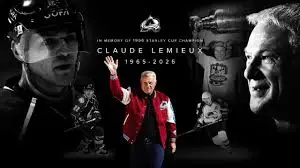
The National Hockey League (NHL) has long operated as a vast, dynamic theatre of contrasting athletic archetypes. Observers and analysts of the sport are accustomed to categorizing players into easily digestible roles: the elegant, visionary playmaker; the acrobatic, stoic goaltender; the bruising, strictly physical enforcer; and the opportunistic, hyper-focused goal-scorer. Rarely, however, does a single professional athlete embody multiple, often diametrically opposed, identities with the efficacy and historical endurance that Claude Percy Lemieux did. Known interchangeably across his twenty-one-season NHL career as a four-time Stanley Cup champion, a Conn Smythe Trophy winner, and one of the most viscerally reviled on-ice agitators in the history of North American professional sports, Lemieux carved out a legacy that fundamentally defies simplistic categorization.1
Following his sudden and tragic passing on May 28, 2026, at the age of 60, the global hockey community was left to grapple with the duality of a man who was viciously hated by his opponents yet unconditionally beloved and fiercely protected by his teammates.1 Lemieux’s professional trajectory is not merely a chronological timeline of statistical achievements, draft selections, and trades; it is a profound study in the psychological dimensions of high-stakes professional sports. His career offers a granular look into the tactical deployment of aggression, the limits of physiological endurance, and the evolution of the NHL’s systemic frameworks through the late twentieth and early twenty-first centuries.
This exhaustive analytical report provides a comprehensive examination of Claude Lemieux’s life, career, and enduring impact on ice hockey. Through a detailed deconstruction of his junior developmental years in Quebec, his dynastic NHL successes across three distinct decades, his central instigating role in the sport’s most notoriously violent rivalry, his highly improbable late-career comeback, and his subsequent white-collar transition into the lucrative business of hockey representation, a multifaceted portrait emerges. Lemieux was an athlete whose specific combination of elite skill, calculated malice, and unparalleled clutch performance is unlikely to ever be replicated in the modern, heavily sanitized era of professional hockey.
Origins in Quebec: The Forging of a Dual-Threat Identity
Claude Percy Lemieux was born on July 16, 1965, in the industrial town of Buckingham, Quebec, but he spent his formative years growing up in the municipality of Mont-Laurier, Quebec.1 The cultural environment of rural Quebec in the 1970s and 1980s was intensely hyper-focused on the sport of ice hockey, viewing it not just as a recreational pursuit but as a profound socioeconomic vehicle and a matter of distinct provincial pride. Within this crucible, Lemieux quickly developed a highly specialized style of play that married high-end offensive talent—typical of the Quebec developmental system—with a relentless, often profoundly abrasive physical edge that bordered on the theatrical.
Quebec Major Junior Hockey League (QMJHL) Dominance
Lemieux’s direct path to professional hockey was forged in the Quebec Major Junior Hockey League (QMJHL). Historically, the QMJHL has been renowned across the scouting world for producing highly skilled, offensively dynamic players who often required remedial instruction in defensive responsibilities and physical engagement. Lemieux, however, distinguished himself immediately by demonstrating that offensive skill did not have to come at the expense of physical intimidation; rather, he proved that the two could be symbiotic.
His junior career was peripatetic, spanning three different franchises over three seasons, yet his statistical output grew exponentially at each stop. He began his QMJHL tenure with the Trois-Rivières Draveurs during the 1982-83 season. As a seventeen-year-old, he posted 66 points (28 goals, 38 assists) while accumulating an astonishing 187 penalty minutes (PIM) in just 62 regular-season games.1 This unique statistical profile—averaging over a point per game while simultaneously spending the equivalent of more than three full games sitting in the penalty box—established the foundational blueprint for his entire professional identity.
The subsequent season saw an even greater synthesis of his dual-threat capabilities. Traded to the Verdun Juniors for the 1983-84 campaign, Lemieux recorded 86 points (41 goals, 45 assists) and an astonishing 227 PIM in merely 51 games.1 The absolute apex of his junior career, however, arrived during the 1984-85 season with the Verdun Junior Canadiens. Operating as the team captain and the undisputed emotional leader of the roster, Lemieux dominated the league across all phases of the game. He registered 124 points (58 goals, 66 assists) and 152 PIM in 52 regular-season games.1
| Season | Team (League) | Games Played | Goals | Assists | Points | Penalty Minutes |
| 1982-83 | Trois-Rivières Draveurs (QMJHL) | 62 | 28 | 38 | 66 | 187 |
| 1983-84 | Verdun Juniors (QMJHL) | 51 | 41 | 45 | 86 | 227 |
| 1984-85 | Verdun Junior Canadiens (QMJHL) | 52 | 58 | 66 | 124 | 152 |
Table 1: Claude Lemieux’s QMJHL Regular Season Statistical Progression.1
The underlying data indicate a linear, highly predictable progression in his offensive efficiency without a proportional decrease in his physical aggression. Lemieux shared the ice during these years with notable QMJHL talents such as Daniel Marois and Eric Legros, yet his specific gravitational pull on the game was unmatched.6 This dual-threat capability culminated in the 1985 QMJHL playoffs, where Lemieux led the entire league with 23 goals and 40 points in merely 14 postseason contests.1 This Herculean effort captured the President Cup for his franchise, secured a berth in the prestigious Memorial Cup, and earned Lemieux the Guy Lafleur Trophy as the most valuable player of the playoffs.1 These performances not only secured his eventual induction into the QMJHL Hall of Fame in 2005 but also broadcast a clear signal to NHL scouting departments: his abrasive, chaotic style was entirely translatable to the high-stakes, pressure-cooker environment of postseason hockey.7
International Pedigree: Validating Elite Skill Among Peers
A frequent criticism of physical agitators is that their reliance on intimidation masks a fundamental deficiency in their baseline hockey skill. Before establishing himself as a full-time, everyday NHL regular, Lemieux systematically dismantled this narrative by representing the Canadian national team on the highly structured, skill-intensive international stage. His success in these environments proved that he possessed an elite hockey intelligence capable of adapting to various tactical frameworks.
Lemieux made his first major international appearance as a member of the Canadian national junior team at the 1985 World Junior Championships held in Helsinki, Finland.1 The World Junior tournament is universally regarded as the premier showcase for teenage hockey talent. Lemieux did not merely serve as a physical deterrent; he also contributed significantly to the offensive ledger, registering three goals and two assists over six games.1 His performance was instrumental in helping Canada secure its second-ever World Junior gold medal, proving his utility in a short-tournament format where every shift carries massive analytical weight.1
He subsequently elevated his international profile by contributing to the senior Canadian national team’s victory in the 1987 Canada Cup.8 Playing alongside a roster populated by future Hall of Famers, Lemieux tallied two points in six games to capture another gold medal.1 Nearly a decade later, he would make his final appearance in international play when he was selected to the Team Canada roster for the 1996 World Cup of Hockey.1 In that tournament, Canada ultimately finished second to the United States, earning a silver medal, with Lemieux predictably leading the physical charge by amassing 19 penalty minutes in eight games.1
| Tournament | Year | Games Played | Goals | Assists | Points | PIM | Medal |
| World Junior Championships | 1985 | 6 | 3 | 2 | 5 | N/A | Gold |
| Canada Cup | 1987 | 6 | N/A | N/A | 2 | N/A | Gold |
| World Cup of Hockey | 1996 | 8 | N/A | N/A | N/A | 19 | Silver |
Table 2: Claude Lemieux’s Major International Tournament History.1 Note: Specific goal/assist breakdowns for the 1987 and 1996 tournaments are not fully detailed in the provided parameters, but point totals and PIM are indicative of his continued dual-threat role.
This international pedigree provides a crucial second-order insight into Lemieux’s overarching athletic value. Coaches at the national level—who have the luxury of selecting from the absolute pinnacle of the sport’s talent pool—repeatedly chose to include Lemieux. They recognized that his psychological warfare was not a gimmick, but a highly effective tactical tool that could be deployed to disrupt the rhythm of sophisticated European and American systems.
The Montreal Crucible: A Rookie Sensation and the Birth of a Clutch Identity
The Montreal Canadiens organization, viewing Lemieux as a prototypical power forward with local marketing appeal, selected him in the second round, 26th overall (the 5th pick of the second round), of the 1983 NHL Entry Draft.5 However, his integration into the professional ranks was methodical rather than immediate. He experienced brief developmental stints with the Canadiens and their American Hockey League (AHL) affiliates, including the Nova Scotia Voyageurs and the Sherbrooke Canadiens, between 1983 and 1986.1 During the 1985-86 AHL season with Sherbrooke, he posted a formidable 53 points and 145 PIM in 58 games, proving he was entirely overripe for the minor leagues.1
The 1986 Stanley Cup Run: Defying Developmental Logic
The true inflection point of Lemieux’s career, the moment that established his eternal reputation as a postseason savant, occurred during the 1986 Stanley Cup Playoffs. Having played only 10 regular-season games for the Montreal Canadiens during the 1985-86 NHL season (recording a modest one goal and two assists for three points, alongside 22 PIM), expectations for his postseason impact were understandably subdued.1 Standard developmental logic dictates that rookies, especially those with minimal regular-season experience, typically shrink under the suffocating pressure and increased physical violence of the NHL playoffs.
Lemieux fundamentally shattered this paradigm. He delivered a historically significant postseason performance, scoring a team-leading 10 goals—along with six assists for 16 points—in 20 playoff games.8 He also amassed 68 penalty minutes, ensuring his physical presence was felt on every shift.1 This offensive explosion helped propel the Canadiens to their 23rd Stanley Cup championship in franchise history.11
The defining, indelible moment of this championship run occurred on April 29, 1986, during Game 7 of the Adams Division Finals against the Hartford Whalers. In the sudden-death pressure of overtime, Lemieux scored the game-winning goal, permanently etching his name in the record books as the first rookie in NHL history to score an overtime goal in a Game 7.13
This singular event catalyzed his reputation as a player whose physiological and psychological baseline was actively elevated under immense external pressure. The statistical anomaly of scoring 10 times as many goals in the playoffs (10) as he did in the entire regular season (1) became a recurring, defining theme throughout his long career.1 It suggested a unique neurological profile where high-stakes environments reduced cognitive friction rather than increasing it, allowing his instinctive physical responses and predatory scoring touch to fully dominate.
Establishing the NHL Identity and Statistical Consistency
Following the 1986 championship, Lemieux became a permanent, highly productive fixture in the Canadiens’ everyday lineup. Over the next three seasons, he demonstrated remarkable consistency as a top-six goal-scorer. In the 1986-87 season, he tallied 27 goals and 26 assists for 53 points, along with 156 penalty minutes.4 He followed this with a career-best output in Montreal during the 1987-88 season, recording 31 goals, 30 assists, and 137 penalty minutes.4 The 1988-89 campaign yielded another 29 goals and 136 PIM.4
By achieving these metrics, Lemieux became only the sixth player in the storied, century-long history of the Montreal Canadiens franchise to begin his full-time career with three consecutive seasons of at least 20 goals.11 Furthermore, he routinely averaged well over 100 penalty minutes in his first seven full seasons, indicating that his offensive production was permanently inextricably linked to his abrasive, confrontational style.11 He became so notorious for his interactions with officials and off-ice personnel that reporters jokingly noted his “friendships” with penalty-box attendants in arenas across the league.12
Ideological Warfare: The Pat Burns Era and the Inevitable Departure
Despite his undeniable offensive reliability and his status as a hometown, Cup-winning hero, Lemieux’s tenure in Montreal became increasingly strained and ultimately untenable. The friction was not born of a lack of skill, but of a fundamental philosophical divergence regarding how the game of hockey ought to be played and perceived.
Lemieux’s on-ice methodology was characterized by relentless verbal agitation, drawing retaliatory penalties from opponents, and, most controversially, occasionally feigning or exaggerating injuries to solicit sympathetic calls from the officiating crew.15 This theatricality began to clash violently with the traditional, stoic, blue-collar hockey philosophy demanded by Montreal’s management, which prized honour and resilience above all else.
The tension reached a critical, explosive threshold following the hiring of head coach Pat Burns in 1988. Burns, a former police officer with a rigid, highly disciplined, and deeply traditional approach to the game, found Lemieux’s antics to be a source of profound embarrassment.15 Burns frequently disciplined Lemieux; for example, in October 1988, Burns suspended him for one game after he received an unsportsmanlike conduct penalty, misconduct, and a game misconduct after losing his temper in a heated argument with referee Bill McCreary.16 He was also fined an undisclosed amount by the team in February 1989 for related infractions.16
The ideological divide between the coach and the player reached its zenith during the 1989 Stanley Cup Final, when the Canadiens faced the Calgary Flames. During a game early in the series at the Saddledome, a highly publicized and deeply symbolic incident occurred. Lemieux was lying prone on the ice, ostensibly injured after a collision—a posture so common that prominent hockey writers joked Lemieux only played two positions: “right wing and prone”.15 As the Canadiens’ veteran athletic trainer, Gaetan Lefebvre, prepared to hop over the boards to assist the seemingly wounded player, Pat Burns physically grabbed the trainer and pulled him back onto the bench.15 Burns was sending a deliberate, unmistakable message to his team, the opponents, and the officials: he believed Lemieux was embellishing the injury, and he would not allow his medical staff to participate in the theatre.15
This incident transcended the boundaries of the ice rink and bled into the complex socio-political fabric of Quebec media. Rejean Tremblay, an outspoken sports columnist for La Presse, framed the conflict through a provocative, distinctly separatist lens. Tremblay argued that Burns, utilizing an Anglophone “police mentality,” was systematically picking on and humiliating a young, expressive Francophone star.15 This media narrative added immense external pressure to an already fractured locker room relationship.
Coupled with a noticeable dip in Lemieux’s offensive production during the 1989-90 season—where he managed only eight goals and 18 points in 39 games—his departure became a systemic inevitability.4 Recognizing that his career was stagnating within Burns’s doghouse, Lemieux actively petitioned Montreal General Manager Serge Savard for a trade. Lemieux later admitted, “I got very scared. I was after Mr. Savard almost every day on the phone trying to find out what was going on”.17 Finally, on September 4, 1990, just hours before the Canadiens boarded a flight for an exhibition tour of the Soviet Union, Savard executed a one-for-one trade, sending Lemieux to the New Jersey Devils in exchange for the highly talented but chronically injury-prone forward Sylvain Turgeon.1
The Meadowlands Renaissance: Systemic Harmony and the 1995 Conn Smythe
The trade to New Jersey represented both a geographical relocation and a profound philosophical liberation for Lemieux. The Devils, under the meticulous, iron-fisted stewardship of General Manager Lou Lamoriello, were in the process of constructing an organizational identity based on a suffocating, trap-oriented defensive structure, opportunistic counter-attack scoring, and punishing physical play. Lemieux’s aggressive tendencies, previously viewed as a liability and an embarrassment by Pat Burns in Montreal, were actively embraced and weaponized by the Devils’ coaching staff.
Offensive Apex in the Dead Puck Era
Lemieux experienced an immediate, explosive offensive renaissance upon arriving in the Meadowlands. Rejuvenated by a system that valued his disruptive capabilities, he scored 30 goals and 47 points in 78 games during his inaugural 1990-91 season with New Jersey.4 He was integrated into a loaded offensive roster that already featured established stars like Brendan Shanahan, Peter Stastny, Kirk Muller, and John MacLean.19
The following season, 1991-92, Lemieux recorded an NHL career-high 41 goals, adding 27 assists for 68 points.4 He continued this elite production in the 1992-93 campaign, securing another 30-goal season while registering a career-high 51 assists, culminating in a career-best 81 points.4 Crucially, throughout this period of peak offensive production, his physical edge never dulled; he consistently averaged well over 100 penalty minutes per season, hitting a staggering 155 PIM during his 81-point campaign.4 He had fully realized the dual-threat potential he first exhibited in the QMJHL, becoming one of the premier power forwards in a league that was rapidly transitioning into the highly physical, defence-first “Dead Puck” era.
The 1995 Playoffs: The Ultimate Validation
The 1994-95 NHL season was heavily truncated by a bitter labour lockout, resulting in a condensed 48-game schedule. Lemieux visibly struggled through the abbreviated regular season, managing a mere six goals and 19 points in 45 games while posting 86 penalty minutes.4 Observers and media critics reasonably hypothesized that the cumulative physical toll of his high-impact, crash-and-bang style was finally degrading his athletic capabilities as he approached his thirtieth birthday.
However, the ensuing 1995 Stanley Cup Playoffs provided a definitive, historic counter-narrative, completely obliterating any notion of his decline. Operating flawlessly within the Devils’ highly structured neutral-zone trap, Lemieux orchestrated one of the most dominant individual postseasons in modern NHL history. He became the undisputed vanguard of the New Jersey offence, scoring a league-leading 13 goals—more than double his entire regular-season output—in 20 playoff games.4
His clutch metrics during this championship run were practically unparalleled. In the Eastern Conference Finals against the heavily favoured Philadelphia Flyers, Lemieux delivered the fatal blow, scoring a critical third-period goal in Game 6 that extended the Devils’ lead to 4-1, officially putting a nail in the Flyers’ season and propelling New Jersey to its first-ever Stanley Cup Final appearance.20
In the Stanley Cup Final, the Devils entered as massive underdogs against the Detroit Red Wings, who had won the Presidents’ Trophy as the league’s top regular-season team and had comfortably dispatched the Dallas Stars, San Jose Sharks, and Chicago Blackhawks to reach the Final.20 Lemieux shattered the Red Wings’ aura of invincibility immediately. In Game 1, he scored a monumental third-period goal—assisted by Bob Carpenter and Scott Stevens—to give the Devils the lead and dictate the physical tone of the series.20
New Jersey never relinquished their momentum, shocking the hockey world by sweeping the mighty Red Wings in four games to capture the franchise’s first Stanley Cup.11 For his transcendent, tone-setting performance, Lemieux was overwhelmingly voted the winner of the Conn Smythe Trophy as the Most Valuable Player of the playoffs.1
Reflecting on the achievement, Lemieux—who had successfully managed to get under the skin of virtually every opponent he faced—expressed a rare moment of humbled awe: “I think it’s just unbelievable. I look at some of the names on this trophy and on the Stanley Cup, and it’s incredible. To be a part of the team that won the first Stanley Cup for the New Jersey Devils, who would have thought it? I played well”.12
The 1995 postseason cemented a vital third-order insight regarding Lemieux’s methodology. His agitation was not merely reactionary, nor was it mindless violence; it was a highly calculated, cognitive mechanism designed specifically to disrupt the opponent’s emotional regulation. By drawing the opposition into taking retaliatory penalties, or simply by distracting elite players from their tactical assignments out of sheer frustration, Lemieux engineered the very offensive voids that he subsequently capitalized upon. He weaponized annoyance.
The Relocation to Denver and the Cultivation of a Blood Feud
Despite his undeniable heroism in delivering a championship to New Jersey, the NHL’s unsentimental business mechanics intervened swiftly. In a highly complex, multi-team transaction executed on October 3, 1995—just prior to the commencement of the new season—the Devils traded Lemieux to the New York Islanders in exchange for veteran forward Steve Thomas.1 In a pre-arranged maneuver executed on the exact same day, the Islanders subsequently flipped Lemieux to the Colorado Avalanche (a franchise that had just relocated from Quebec City) in exchange for rugged winger Wendel Clark.1
Back-to-Back Championships: The Ultimate Mercenary
Lemieux seamlessly integrated into a remarkably talented Colorado Avalanche roster that already featured transcendent offensive talents like Joe Sakic and Peter Forsberg. Relieved of the burden of carrying the primary scoring load, Lemieux thrived as a complementary power forward. During the 1995-96 regular season, he produced an exceptional 39 goals and added 32 assists for 71 points in 79 games, while racking up 117 PIM.4
In the 1996 playoffs, Lemieux continued his historical postseason mastery. He contributed 12 points (five goals, seven assists) and 55 penalty minutes in 19 games, providing the critical physical insulation required to protect Sakic and Forsberg.4 His efforts helped the Avalanche secure their first Stanley Cup championship in their inaugural season in Denver.8 By hoisting the Cup with Colorado immediately following his victory with New Jersey, Lemieux achieved a rare historical milestone: he became only the 10th player in NHL history to win back-to-back Stanley Cups with two different franchises.1
The Kris Draper Hit: A Catalyst for War
While the 1996 championship added significantly to his legacy as an ultimate winner, the playoff run also generated the darkest, most scrutinized chapter of his entire professional life. During Game 6 of the 1996 Western Conference Finals, the Avalanche faced off against the Detroit Red Wings—the very team Lemieux had helped sweep in the Final the previous year.
During the course of the game, Lemieux delivered a sudden, vicious check from behind to Red Wings defensive forward Kris Draper near the players’ benches.1 The forceful impact drove Draper face-first into the unforgiving top edge of the boards, resulting in catastrophic, life-altering facial injuries. Draper suffered a severe concussion, a broken jaw, a broken nose, and shattered orbital and cheekbones.1 The trauma required extensive reconstructive facial surgery, and Draper’s jaw was wired shut for several weeks, forcing him to consume his meals through a straw.1
The hit was widely condemned as egregious and predatory, even by the highly permissive, inherently violent physical standards of 1990s hockey. The NHL’s disciplinary arm responded by suspending Lemieux for a mere two games.1 This punishment was instantly criticized by fans, sports media, and the entire Red Wings organization as grossly inadequate given the severity of Draper’s injuries.1 The inadequacy of the suspension bred a deep, festering resentment. Red Wings forward Dino Ciccarelli summarized the profound disgust felt throughout the league, famously stating to reporters after the handshake line that concluded the series, “I can’t believe I shook this guy’s friggin’ hand after the game. That pisses me right off”.1
The Anatomy of a Rivalry: “Fight Night at the Joe” and the “Turtle” Phenomenon
The immediate fallout from the Draper hit catalyzed what is almost universally considered the most intense, violent, and genuinely hateful rivalry in the modern history of the NHL.1 The Red Wings, feeling that institutional justice had fundamentally failed them, vowed to enact systemic retribution against Lemieux and the Avalanche organization.
The escalating tension simmered throughout the following season until it reached a terrifying, explosive climax on March 26, 1997, during a regular-season game at Joe Louis Arena in Detroit. This specific event was subsequently immortalized in hockey lore by various monikers: “Bloody Wednesday,” “Fight Night at the Joe,” and “Brawl in Hockeytown.”24 The game completely degenerated into a massive, uncontrolled on-ice melee that featured 18 separate fighting major penalties and a staggering 144 total penalty minutes.24
The absolute focal point of the violence was Lemieux. Red Wings enforcer Darren McCarty—who had explicitly vowed revenge for his teammate Draper—bypassed the other ongoing skirmishes, specifically targeted Lemieux, and unleashed a ferocious barrage of bare-knuckled punches.24 Recognizing the danger and opting for self-preservation, Lemieux famously dropped to his knees on the ice and covered his head with his gloves to protect himself from the onslaught.10
This defensive posture earned Lemieux the highly derisive, enduring nickname “The Turtle” among Red Wings fans and prominent hockey critics.10 The image of McCarty bludgeoning Lemieux while he was prone on the ice remains one of the most iconic, visceral, and polarizing photographs of the era.25 Prominent Canadian hockey broadcaster Don Cherry, a man who built his entire media empire on the glorification of old-school hockey violence, expressed profound disdain for Lemieux’s actions, stating on a national broadcast, “If that’s hockey what Claude Lemieux does, then I don’t want any part of it”.29 This quote signifies the extent to which Lemieux was ostracized even by the establishment that normally championed aggressive play.
An objective analysis of this sequence reveals a significant, league-wide shift in NHL team construction. The Avalanche-Red Wings blood feud forced general managers across the entire league to recognize that elite offensive skill alone was insufficient to survive the gruelling, attritional warfare of the Western Conference playoffs. Teams were forced to dedicate valuable roster spots to specialized enforcers specifically to protect their star players and physically police the ice—an organizational arms race that was directly accelerated by Lemieux’s hit on Draper and the subsequent retaliation.
Despite the intense scrutiny and physical targeting, Lemieux remained highly productive. He stayed with the Avalanche through the 1998-99 season, continuing to post solid offensive numbers, including a remarkable 13-goal playoff performance in 1997 while operating squarely in the eye of the media hurricane.1
The Journeyman Twilight: A Fourth Ring and the European Transition
As the turn of the millennium approached, Lemieux entered a phase of his career marked by veteran leadership and organizational movement. On November 3, 1999, the Colorado Avalanche orchestrated a major trade, sending Lemieux, along with Colorado’s 2000 first-round draft pick (which became David Hale) and a 2000 second-round draft pick (which became Matt DeMarchi), back to the New Jersey Devils.1 In exchange, the Avalanche received forward Brian Rolston and New Jersey’s 2000 second-round draft pick (Martin Samuelsson).1
The 2000 Championship: Cementing the Legacy
Returning to the Meadowlands, Lemieux seamlessly folded back into the Devils’ playoff machinery, which was now operating under a slightly more evolved, but still defensively rigorous, system. During the 2000 Stanley Cup Playoffs, he played a crucial, stabilizing veteran role in helping New Jersey secure its second championship, earning Lemieux his fourth personal Stanley Cup ring.1
This victory placed him in an incredibly elite, exclusive fraternity: he remains one of only 11 players in the expansive history of the NHL to win a Stanley Cup with at least three different franchises (Montreal in 1986, New Jersey in 1995 and 2000, and Colorado in 1996).1 This statistic underscores his immense value as the ultimate final piece of a championship puzzle—a player whom general managers specifically acquired to push competitive rosters over the final threshold.
| Franchise | Year | Result | Notable Contribution |
| Montreal Canadiens | 1986 | Stanley Cup Champion | 10 Playoff Goals (Game 7 OT Winner) |
| New Jersey Devils | 1995 | Stanley Cup Champion | 13 Playoff Goals (Conn Smythe Trophy) |
| Colorado Avalanche | 1996 | Stanley Cup Champion | 12 Playoff Points |
| New Jersey Devils | 2000 | Stanley Cup Champion | Veteran Leadership / Physical Presence |
Table 3: Claude Lemieux’s Stanley Cup Championship History.1
Twilight of the First Career
Following the 2000 championship, Lemieux entered the twilight of his NHL career. Operating as an unrestricted free agent, he signed with the Phoenix Coyotes on December 5, 2000.1 The magic, however, was beginning to wane. In the spring of 2001, for the first and only time in his entire 21-season NHL career, Lemieux’s team failed to qualify for the playoffs.1 He played parts of three seasons in Phoenix before being traded on January 16, 2003, to the Dallas Stars in exchange for Scott Pellerin and a 2004 fourth-round draft choice (Kevin Porter).1
Recognizing a steep decline in his physical capabilities and recovery time, Lemieux departed the NHL following the 2002-03 season. He briefly joined EV Zug of the Swiss Nationalliga A, exploring the European game before formally announcing his retirement as a professional player in 2003.1
The Unprecedented Comeback: Defying Physiology and Father Time
Following his initial retirement, Lemieux transitioned into the business and management side of the sport. In 2005, he was appointed President of the Phoenix RoadRunners, an ECHL minor-league affiliate, a position he maintained for two years until his resignation in 2007.1 During this hiatus from professional play, he also participated in the second season of the Spike TV reality show Pros vs. Joes in 2007, demonstrating that his competitive drive remained unextinguished.1
In September 2008, at the age of 43—more than five years after his last NHL appearance—Lemieux appeared on the French-language sports network RDS and publicly expressed a sincere interest in attempting a comeback to the NHL.1 Given the speed, youth, and physical demands of the post-lockout NHL, the announcement was met with widespread skepticism by the hockey establishment.
The 2008-2009 San Jose Sharks Run
The mechanics of Lemieux’s comeback highlight an extraordinary physiological resilience and an almost maniacal dedication to conditioning. To test his body, he began the 2008-09 season playing for the China Sharks in the Asia League Ice Hockey, shaking off half a decade of competitive rust in relative obscurity.1
Having proved to himself that he could still endure the physical toll, he returned to North America. On November 25, 2008, he signed a minor-league AHL contract with the Worcester Sharks. He played 14 games in the AHL, recording two goals and six points, proving he was capable of keeping pace with players half his age.1
Demonstrating that he still possessed the requisite pace and hockey IQ to compete at the absolute highest level, the San Jose Sharks—who were in the midst of a dominant regular season under head coach Todd McLellan—signed him to a two-way NHL contract on December 29, 2008.1 He initially cleared waivers to continue his conditioning in Worcester, but on January 19, 2009, he was officially recalled to the NHL roster.1
Lemieux played 18 regular-season games for the San Jose Sharks during the 2008-09 campaign. On February 19, 2009, he recorded the final point of his NHL career, assisting on a second-period goal by Milan Michalek against the Los Angeles Kings.1
Furthermore, the comeback allowed for a deeply symbolic, almost cinematic moment of closure. On February 25, 2009, Lemieux played a final game at Joe Louis Arena against the Detroit Red Wings. In a building that had once viewed him as public enemy number one, and where he had been severely beaten a decade prior, he took faceoffs directly against Kris Draper, completing a narrative circle that few athletes ever experience.31
The Sharks won the Presidents’ Trophy that season as the league’s top regular-season team. Lemieux appeared in one final playoff game before officially retiring from playing for the second and final time.1 In the same year he completed this remarkable comeback, Lemieux also became a naturalized U.S. citizen.1
Career Statistical Profile: The Anatomy of a Playoff Hero
A comprehensive review of Claude Lemieux’s final statistical profile reveals the stark dichotomy between his highly respectable regular-season consistency and his historical, transcendent postseason output.
| Phase | Games Played | Goals | Assists | Points | Penalty Minutes |
| Regular Season | 1,215 | 379 | 407 | 786 | 1,777 |
| Playoffs | 234 | 80 | 78 | 158 | N/A |
Table 4: Claude Lemieux’s Career NHL Statistical Profile, aggregated across 21 seasons.5
Lemieux ranks fourth all-time in NHL playoff games played (234), a testament to both his exceptional durability and his undeniable utility on championship-calibre rosters.1 More impressively, his 80 career playoff goals rank ninth all-time in NHL history.1 Within those 80 goals, an astounding 19 were registered as game-winning goals, mathematically validating his reputation as one of the preeminent clutch performers in the history of the sport.23
The data yields a vital insight regarding standard player evaluation metrics. Traditional scouting models heavily weight regular-season production as a primary predictor of playoff success. Lemieux fundamentally broke this model. His psychological makeup required the elevated stakes, localized intensity, and intense media scrutiny of the playoffs to trigger his optimal physiological state. He was a player whose internal operating system was uniquely calibrated for the crucible of the postseason environment.
Transition to the Boardroom: The 4Sports Hockey Agency Era
Following his final retirement in 2009, Lemieux defied expectations regarding the typical post-career trajectory of an NHL enforcer or agitator. Rather than fading into obscurity, purchasing a junior team, or pursuing a standard assistant coaching route, Lemieux leveraged his deep, intimate understanding of NHL front-office dynamics, contract structures, and human psychology to become a highly successful player agent.2
Lemieux joined 4Sports Hockey, a global sports management firm founded in 2006 and headquartered in Switzerland.34 The agency grew to operate in every major hockey market in Europe and North America, offering comprehensive training, development, and business management services.34 Operating alongside a distinguished executive team that included CEO Daniel Giger, co-owner Johan Finnström, and Manager of Hockey Finland Ville Koistinen, Lemieux rose to the prominent position of President of Hockey North America.35 He also worked alongside fellow Avalanche legend and Hall of Famer Peter Forsberg, providing an exceptional network of expertise to their clients.34
As an NHLPA-certified agent, Lemieux amassed an impressive portfolio of clients. He utilized the same shrewd, unyielding, and highly calculated negotiation tactics he once used to exploit defensemen on the ice to secure lucrative contracts in the boardroom. At the time of his passing, Lemieux had negotiated numerous active contracts and represented several elite NHL stars:
| Player | Position | NHL Franchise |
| Frederik Andersen | Goaltender | Carolina Hurricanes |
| Moritz Seider | Defenseman | Detroit Red Wings |
| Timo Meier | Forward | New Jersey Devils |
| Rasmus Andersson | Defenseman | Vegas Golden Knights |
| Hampus Lindholm | Defenseman | Boston Bruins |
| Felix Unger Sorum | Prospect | Carolina Hurricanes |
Table 5: Notable NHL Clients Represented by Claude Lemieux via 4Sports Hockey.27
The profound irony of Lemieux representing Moritz Seider, a franchise cornerstone defenseman for the Detroit Red Wings, was not lost on hockey historians. It brilliantly underscored the professional pragmatism that eventually superseded the bitter, violent rivalries of the 1990s. The boardroom required cold logic, and Lemieux proved highly capable of delivering it.
Bloodlines and Legacy: The Lemieux Family Tree
Lemieux’s influence on the modern game was not solely restricted to his agency work; it was also transmitted directly through his family bloodlines. He was survived by his wife, Deborah, whom he had met late at night at a Manhattan restaurant.33 Reflecting on their initial meeting, Deborah admitted she found him physically intimidating, noting, “She thought I was a mobster,” as Claude once recalled with a smile.38 However, she described her husband in stark contrast to his fearsome public persona, stating, “He’s a big old bear… People think he’s so tough. But he’s so easygoing”.38 Together, they raised four children: Brendan, Christopher, Michael, and a daughter.5
The hockey lineage extended throughout the family. Claude was the older brother of former NHL forward Jocelyn Lemieux, who was selected 10th overall by the St. Louis Blues in the 1986 NHL Draft and went on to enjoy a respectable professional career.5
Most notably, his son Brendan Lemieux—born in Denver during the Avalanche’s 1996 Cup run—carried the torch into the modern era.38 Selected in the second round of the 2014 NHL Draft by the Buffalo Sabres, Brendan modelled his playing style almost entirely on his father’s template.38 Brendan explicitly referred to Claude as his “biggest role model on and off the ice”.39 Brendan spent parts of ten seasons in the NHL, playing for the Winnipeg Jets, New York Rangers, Los Angeles Kings, Philadelphia Flyers, and Carolina Hurricanes, eagerly embracing the role of an agitator and pest on the lower offensive lines before transitioning to HC Davos in the Swiss National League in 2024.8 Lemieux served not just as a father, but as a tactical blueprint for Brendan’s navigation of the highly scrutinized modern NHL landscape.
Reconciliation: The “Unrivalled” Documentary and Psychological Closure
Time and distance frequently provide the necessary emotional context to heal seemingly irreparable athletic fractures. The blood feud between Lemieux and the Detroit Red Wings, specifically his highly personal conflict with Darren McCarty, remained a defining narrative of 1990s hockey. However, a profound shift in this dynamic occurred in the later years of Lemieux’s life.
In June 2022, ESPN released the E60 documentary Unrivalled, which offered a deep, retrospective examination of the Colorado-Detroit rivalry on its 25th anniversary.28 The documentary’s most powerful, resonant narrative tool was capturing live footage of Lemieux and McCarty sitting together at a sports bar in Royal Oak, Michigan.40
The footage revealed that the two men, who had engaged in one of the most famously violent spectacles in NHL history, had successfully forged a genuine, empathetic friendship in retirement.10 This reconciliation provided a striking, nuanced commentary on the nature of athletic combat. It illustrated that the hatred generated on the ice is often entirely contextual—a byproduct of extreme, pressurized competitive environments, tribal loyalty, and organizational mandates, rather than intrinsic personal malice. While other figures intimately involved in the rivalry, such as Kris Draper, explicitly maintained their refusal to forgive Lemieux for the initial hit, McCarty’s public reconciliation with his former nemesis allowed for a complex, humanizing reframing of Lemieux’s legacy.28 It demonstrated that even the deepest wounds of sports warfare can occasionally be salved by shared experience and mutual respect.
The Final Act: The Bell Centre Torch and the Tragic Conclusion
The final week of Claude Lemieux’s life was marked by a devastating, almost incomprehensible contrast between public adulation and profound private tragedy.
On Monday, May 25, 2026, Lemieux returned to the Bell Centre in Montreal, the sacred site of his earliest professional triumphs.2 Prior to Game 3 of the Eastern Conference Final between the Montreal Canadiens and the Carolina Hurricanes, Lemieux was introduced to a raucous, prolonged standing ovation from the Montreal faithful.2 He emerged from the arena tunnel holding the Canadiens’ famous ceremonial flaming torch aloft, a deeply symbolic gesture linking the franchise’s glorious, championship-laden past to its hopeful present.12
The event was deeply emotional and widely celebrated. Frederik Andersen, the Carolina Hurricanes goaltender and one of Lemieux’s closest clients, noted that Lemieux had contacted him prior to the game to share his excitement about the honour. Andersen remarked warmly to the media, “He’s like family. “27Observers, media members, and fans alike noted that Lemieux appeared highly energetic, visibly healthy, and genuinely moved by the crowd’s reception.45
However, just three days later, on Thursday, May 28, 2026, the NHL Alumni Association released a devastating statement announcing that Claude Lemieux had died at the age of 60.2 The official statement noted that he was “loved by his wife and four children,” and requested that the public respect the family’s privacy during the difficult time.45
Subsequent reporting by TMZ Sports and other outlets confirmed that Lemieux had died by suicide, having been found Thursday morning at a business owned by his family in Florida.1 The sudden, violent nature of his passing sent immediate shockwaves through the global hockey community. The jarring juxtaposition of his triumphant, smiling appearance at the Bell Centre on Monday and his death on Thursday starkly underscored the profound, often totally invisible psychological struggles that can afflict retired elite athletes, regardless of their outward success.
The Montreal Canadiens organization, represented by owner and CEO Geoff Molson, issued a statement mourning the loss of a “relentless, courageous, and tenacious player who led the team to the highest honors,” declaring it a “dark day for the Canadiens family and the entire hockey community”.13 Across the league, former teammates, current clients, and even former bitter rivals expressed their shock and heartbreak over the loss, with Darren McCarty notably reposting the NHL Alumni Association’s release accompanied by a broken heart emoji.10
Conclusion: A Complex, Enduring Legacy
The historical and analytical assessment of Claude Lemieux will forever remain an exercise in navigating deep contradictions. To the management, coaching staffs, and fans of the Montreal Canadiens, New Jersey Devils, and Colorado Avalanche, he is immortalized as the ultimate, indispensable mercenary—a player acquired specifically to win championships, a mandate he reliably and repeatedly fulfilled. His 80 playoff goals, four Stanley Cup rings spanning three decades, and 1995 Conn Smythe Trophy provide incontrovertible, empirical evidence of his elite status in the highest-leverage situations the sport can offer.
Conversely, to his numerous detractors—most notably the Detroit Red Wings organization and its fiercely loyal supporters—his legacy is permanently, irreparably stained by the catastrophic hit on Kris Draper and a long litany of abrasive, borderline, and occasionally cynical tactics designed to infuriate, distract, and injure.
However, a synthesized, objective analysis of his comprehensive career suggests that attempting to separate the champion from the agitator represents a fundamental misunderstanding of his unique utility. Claude Lemieux was successful precisely because he weaponized annoyance, fear, and frustration. He recognized, perhaps better than anyone of his generation, that the NHL playoffs are won as much in the fragile minds of the opponents as they are on the physical scoreboard. By willingly sacrificing his own popularity and embracing the role of the villain, he systematically dismantled the psychological equilibrium of the teams he faced, creating the tactical voids into which his own underappreciated, elite offensive brilliance could flow.
Furthermore, his highly successful second act as a high-powered player agent demonstrated a sophisticated, calculating intellect that entirely belied his brutish on-ice persona, proving his capacity to master the complex corporate environment of modern sports just as he had mastered the physical environment of the ice rink.
The tragic, sudden circumstances of his death in May 2026 add a deeply sombre, reflective footnote to a loud, chaotic, and undeniably triumphant life. Claude Lemieux remains a singular, unparalleled figure in NHL history: the ultimate villain to his enemies, the ultimate saviour to his teammates, and a player whose specific, highly volatile combination of skill, malice, intelligence, and clutch performance fundamentally altered the trajectory of the sport.
If you or anyone you know is going through a tough time, there is always someone ther to help you. Call or text a friend or family member. Talk to your medical professional. There is also the National Suicide Helpline that is available 24 hours a day 7 days a week in both Canada and USA. They can be reached by either calling or texting 9-8-8.
Works cited
- Claude Lemieux – Wikipedia, accessed May 28, 2026, https://en.wikipedia.org/wiki/Claude_Lemieux
- NHL Legend Claude Lemieux Dies At 60, accessed May 28, 2026, https://sportsradiokjr.iheart.com/content/2026-05-28-nhl-legend-claude-lemieux-dies-at-60/
- Claude Lemieux Died By Suicide, accessed May 28, 2026, https://www.tmz.com/2026/05/28/claude-lemieux-cause-of-death/
- Claude Lemieux (b.1965) Hockey Stats and Profile at hockeydb.com, accessed May 28, 2026, https://www.hockeydb.com/ihdb/stats/pdisplay.php?pid=3102
- Claude Lemieux – Stats, Contract, Salary & More – Elite Prospects, accessed May 28, 2026, https://www.eliteprospects.com/player/24783/claude-lemieux
- Verdun Junior Canadiens ‑ All‑Time QMJHL Leaders – QuantHockey, accessed May 28, 2026, https://www.quanthockey.com/qmjhl/en/teams/verdun-junior-canadiens-players-career-qmjhl-stats.html
- Four new inductees to QMJHL Hall of Fame – LHJMQ – Canadian Hockey League, accessed May 28, 2026, https://chl.ca/lhjmq/en/four-new-inductees-to-qmjhl-hall-of-fame/
- Hockey legend, 4-time Stanley Cup winner Claude Lemieux dies at 60, accessed May 28, 2026, https://montreal.citynews.ca/2026/05/28/claude-lemieux-nhl-dead-60-stanley-cup-winner/
- Claude Lemieux Booking Agent, Speaker Fees & Contact Info, accessed May 28, 2026, https://www.sportsspeakers360.com/speaker/claude-lemieux.php
- Claude Lemieux, former Red Wings nemesis, dies at 60 | FOX 2 Detroit, accessed May 28, 2026, https://www.fox2detroit.com/news/claude-lemieux-former-red-wings-nemesis-dies-60
- Claude Lemieux Stats And News | NHL.com, accessed May 28, 2026, https://www.nhl.com/player/claude-lemieux-8448772
- Claude Lemieux dies at 60; 4-time Stanley Cup champion | NHL.com, accessed May 28, 2026, https://www.nhl.com/news/claude-lemieux-dead-at-age-60
- The Canadiens are saddened to learn of the passing of Claude Lemieux, accessed May 28, 2026, https://www.nhl.com/canadiens/news/the-canadiens-are-saddened-to-learn-of-the-passing-of-claude-lemieux-may-28-2026
- April 29: Montreal’s Lemieux first rookie to score Game 7 OT goal | NHL.com, accessed May 28, 2026, https://www.nhl.com/news/this-date-in-nhl-history-april-29-280494754
- THE PAT BURNS SHOW – MitchMelnick.com, accessed May 28, 2026, https://www.mitchmelnick.com/sports/the-pat-burns-show/
- 1983 NHL Entry Draft — Claude Lemieux – Hockey Draft Central, accessed May 28, 2026, https://www.hockeydraftcentral.com/1983/83026.html
- TRADE MAKES LEMIEUX’S WISH COME TRUE | The Hockey News Archive, accessed May 28, 2026, https://archive.thehockeynews.com/issue/611945/23?t=TRADE%20MAKES%20LEMIEUX%E2%80%99S%20WISH%20COME%20TRUE
- Hockey legend, 4-time Stanley Cup winner Claude Lemieux dies at 60 – CityNews Ottawa, accessed May 28, 2026, https://ottawa.citynews.ca/2026/05/28/claude-lemieux-nhl-dead-60-stanley-cup-winner/
- Four-Time Cup Winner Claude Lemeiux Passes Away At Age 60, accessed May 28, 2026, https://www.prohockeyrumors.com/2026/05/four-time-cup-winner-claude-lemeiux-passes-away-at-age-60.html
- This Devils comeback story should be discussed as one of the best in NHL history, accessed May 28, 2026, https://pucksandpitchforks.com/this-devils-comeback-story-should-be-discussed-as-one-of-the-best-in-nhl-history
- 1995 Stanley Cup Final – Wikipedia, accessed May 28, 2026, https://en.wikipedia.org/wiki/1995_Stanley_Cup_Final
- Claude Lemieux Goal – Game 3, 1995 Stanley Cup Final Devils vs. Red Wings – YouTube, accessed May 28, 2026, https://www.youtube.com/watch?v=k2iFDSXsLzE
- Former NHL player Claude Lemieux passes away at age 60, accessed May 28, 2026, https://www.tsn.ca/nhl/article/former-nhl-player-claude-lemieux-passes-away-at-age-60/
- Colorado Avalanche–Detroit Red Wings brawl – Wikipedia, accessed May 28, 2026, https://en.wikipedia.org/wiki/Colorado_Avalanche%E2%80%93Detroit_Red_Wings_brawl
- Happy Turtle Day, Detroit! – Reddit, accessed May 28, 2026, https://www.reddit.com/r/Detroit/comments/b5qzt4/happy_turtle_day_detroit/
- Claude Lemieux, a feisty winger and a four-time Stanley Cup champion, dies at 60, accessed May 28, 2026, https://www.the-journal.com/articles/claude-lemieux-a-feisty-winger-and-a-four-time-stanley-cup-champion-dies-at-60/
- Claude Lemieux, 4-time Stanley Cup winner and agent for …, accessed May 28, 2026, https://nsjonline.com/article/2026/05/claude-lemieux-4-time-stanley-cup-winner-and-agent-for-hurricanes-andersen-dead-at-60/
- Unrivaled: ESPN E60 Relives, Examines Fierce Avalanche-Red Wings Rivalry Born 25 Years Ago, accessed May 28, 2026, https://espnpressroom.com/us/press-releases/2022/06/unrivaled-espn-e60-relives-examines-fierce-avalanche-red-wings-rivalry-born-25-years-ago/
- Claude Lemieux aka. “The Turtle” – YouTube, accessed May 28, 2026, https://www.youtube.com/watch?v=suiwcIIHKjg
- San Jose Sharks – Wikipedia, accessed May 28, 2026, https://en.wikipedia.org/wiki/San_Jose_Sharks
- 08/09 RS: SJ @ Det Highlights – 2/25/09 (Last Game vs C. Lemieux) – YouTube, accessed May 28, 2026, https://www.youtube.com/watch?v=FgxhVd-7WAg
- Four-time Stanley Cup champion dies days after opening Montreal-Carolina Game 3, accessed May 28, 2026, https://www.newsobserver.com/sports/nhl/carolina-hurricanes/article315924458.html
- Claude Lemieux cause of death update: What happened to 4-time Stanley Cup winner? First details, accessed May 28, 2026, https://www.hindustantimes.com/sports/us-sports/claude-lemieux-cause-of-death-update-what-happened-to-4-time-nhl-stanley-cup-winner-dies-dead-101779989236713.html
- 4sports Hockey, accessed May 28, 2026, https://4sportshockey.com/
- Team – 4sports Hockey, accessed May 28, 2026, https://4sportshockey.com/team
- Hockey Legend Dies Suddenly Just Days After Appearance: Claude Lemieux Was 60, accessed May 28, 2026, https://fanbuzz.com/nhl/hockey-legend-claude-lemieux/
- Claude Lemieux, a feisty winger and a four-time Stanley Cup champion with Devils, Avs and Canadiens, dies at 60 – Sentinel Colorado, accessed May 28, 2026, https://sentinelcolorado.com/sports/pro/claude-lemieux-a-feisty-winger-and-a-four-time-stanley-cup-champion-with-devils-avs-and-canadiens-dies-at-60/
- Claude Lemieux family: Who is NHL legend’s wife Deborah Lemieux? Details on their children, accessed May 28, 2026, https://www.hindustantimes.com/sports/us-sports/claude-lemieux-family-who-is-nhl-legends-wife-deborah-lemieux-details-on-their-children-101779989608440.html
- Brendan Lemieux – Wikipedia, accessed May 28, 2026, https://en.wikipedia.org/wiki/Brendan_Lemieux
- Revisiting UNRIVALED: How the ESPN Doc Re-Animates the …, accessed May 28, 2026, https://thehockeynews.com/detroit-red-wings/players/revisiting-unrivaled-how-the-espn-doc-re-animates-the-avalanche-red-wing-rivalry
- Revisiting UNRIVALED: How the ESPN Doc Re-Animates the Avalanche-Red Wing Rivalry, accessed May 28, 2026, https://thehockeynews.com/nhl/detroit-red-wings/players/revisiting-unrivaled-how-the-espn-doc-re-animates-the-avalanche-red-wing-rivalry
- From the Obstructed Seats :: Thoughts of the E60: Unrivaled – SportsBlog, accessed May 28, 2026, https://sportsblog.com/obstructedviewer/thoughts-of-the-e60-unrivaled/
- Four-time Stanley Cup champion Claude Lemieux passes away at …, accessed May 28, 2026, https://www.sportsnet.ca/nhl/article/four-time-stanley-cup-champion-claude-lemieux-passes-away-at-60/
- Four-time Stanley Cup champion Claude Lemieux passes away at age 60, accessed May 28, 2026, https://www.dailyfaceoff.com/news/claude-lemieux-dead-nhl-stanley-cup-conn-smythe-trophy-canadiens-devils-avalanche-coyotes-stars-sharks
- Claude Lemieux’s final video message to NHL fans before sudden death: ‘Looked fine…’, accessed May 28, 2026, https://www.hindustantimes.com/sports/us-sports/claude-lemieux-final-torch-video-message-to-nhl-fans-before-sudden-death-stanley-cup-winner-101779989821081.html
- Claude Lemieux, former Stanley Cup champ, dead at 60 | FOX 13 Tampa Bay, accessed May 28, 2026, https://www.fox13news.com/news/claude-lemieux-former-stanley-cup-champ-dead-60


Leave a Reply