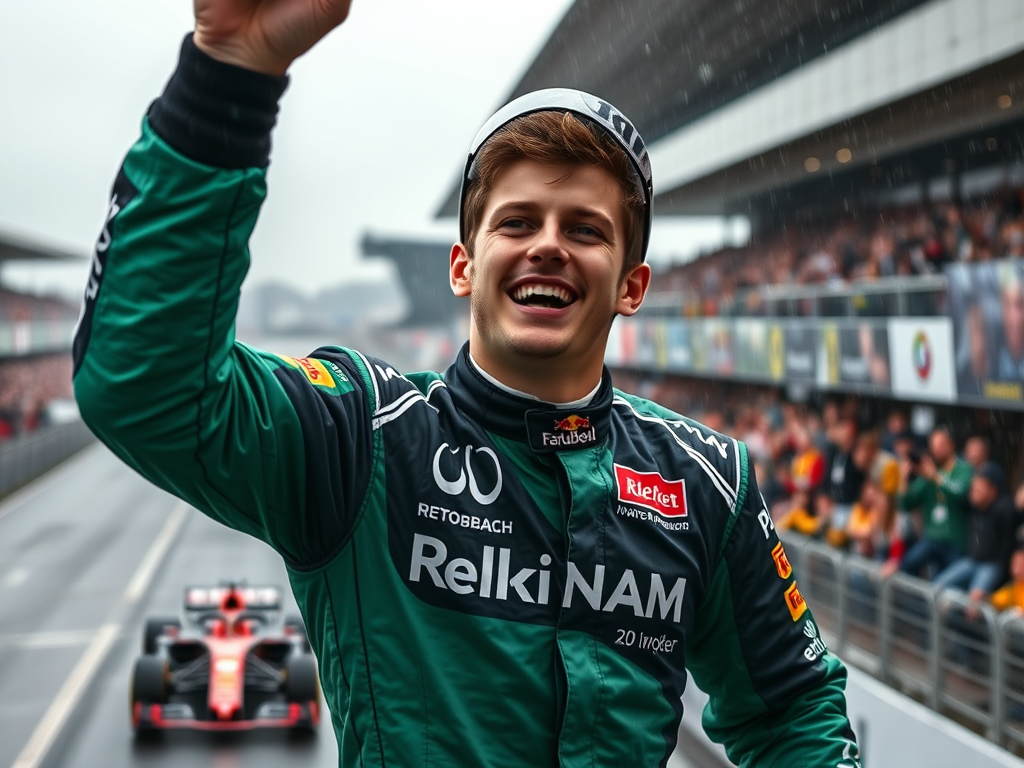
The air at Silverstone was thick with history and precipitation. A classic British summer day had delivered a chaotic, rain-soaked Grand Prix. It was a treacherous canvas where legacies are made or broken. As the race entered its frantic final laps, the roar from the grandstands was a complex symphony. It was a roar of hope for their seven-time world champion, Lewis Hamilton, who was charging hard in his Ferrari. But there was another sound mixed into it. It was a groundswell of support for an underdog. This sentimental favorite was in a striking green and black Kick Sauber and was holding Hamilton at bay. That driver was Nico Hülkenberg.
For 15 years, across 238 Grand Prix starts, this moment—a place on the Formula 1 podium—had eluded him. It was a statistical anomaly that had become an albatross, the most talked-about “curse” in modern motorsport. But on this day, at his 239th attempt, the narrative was being violently rewritten. Hülkenberg started a miserable 19th on the grid. He drove with the flawless precision of a veteran. He had the hunger of a rookie. He held off the relentless Ferrari, crossing the finish line in third place.
The radio message that crackled to life was not one of practiced celebration, but of raw, unadulterated shock and euphoria. “I don’t think I can comprehend what we’ve just done,” he exclaimed, his voice thick with emotion. “OH MY GOD!”. This was more than just a trophy. It was the shattering of a record that had defined a career. It silenced a question that had followed him for over a decade. It was the ultimate validation of a talent universally acknowledged. Until that moment, it was unrewarded by F1’s most visible metric of success. This is the story of a 15-year journey. The near-misses made the wait so agonizing. It describes the perfect, storm-lashed day at Silverstone when Nico Hülkenberg’s perseverance finally paid off.
Part I: The Pedigree of a Champion
To grasp Nico Hülkenberg’s long wait for a Formula 1 podium, one must first examine his junior career. It was so dominant that it seemed to guarantee meteoric success at the highest level. His ascent through the feeder series was not just successful. It was a relentless accumulation of championships. This marked him as one of the most prodigious talents of his generation.
The journey began in karting at the age of nine. By 2002, he was the German Junior Karting Champion. He followed this with the senior German Kart Championship in 2003. This early promise immediately attracted high-profile attention. Willi Weber, the legendary manager who guided Michael Schumacher’s career, took notice. He dubbed the young Hülkenberg an “unbelievable talent” and confidently predicted he would be ready for Formula 1 by 2008.
When Hülkenberg transitioned to single-seaters in 2005, he proved Weber right. He entered the German Formula BMW ADAC series and simply dominated, winning the championship comfortably in his debut season. This set a pattern that would define his pre-F1 career: arriving in a new category and winning, immediately.
Perhaps the most compelling evidence of his raw ability came during the 2006-07 A1 Grand Prix season. This event is known as the “World Cup of Motorsport.” The series pitted nations against each other using identical, powerful 550hp V8-powered cars. This created a level playing field for driver talent to shine. Hülkenberg represented Team Germany. Their squad had finished a lowly 15th in the previous season. He almost single-handedly won them the championship. He amassed a stunning nine victories in just 20 starts. This was a series record for wins. Neel Jani eventually surpassed it, but it took Jani 60 starts—three times as many races—to achieve ten wins. His performances were breathtaking displays of dominance. At Sepang, in treacherous wet conditions, he won the feature race by an incredible 43 seconds. He secured six victories consecutively. These included two “grand slams” (pole, both race wins, and both fastest laps) in New Zealand and Australia.
This extraordinary success in high-powered machinery did not slow his conventional climb. He moved to the highly competitive Formula 3 Euro Series. He won the prestigious non-championship Masters of Formula 3 race in 2007. Then he stormed to the overall series title in 2008.
The final step was the GP2 Series (now Formula 2), the direct feeder to F1. Driving for the elite ART Grand Prix team in 2009, he once again captured the championship in his rookie season. He clinched the title with two races still to go. In doing so, he joined an exclusive club of drivers who won the GP2/F2 title at their first attempt. This list includes names like Nico Rosberg, Lewis Hamilton, Charles Leclerc, George Russell, and Oscar Piastri. This group has produced multiple F1 world champions and race winners.
His junior record was, by any objective measure, flawless. He had conquered every significant championship on the ladder to Formula 1, often as a rookie and in spectacular fashion. This is the crucial context for his entire F1 career. The question was never whether Hülkenberg possessed the talent, speed, or composure to win at the highest level. His junior career was a resounding affirmation that he did. The dominance in A1GP, a series with powerful, identical cars and professional drivers, provided the clearest evidence. It showed mastery of high-powered machinery. This was in a competitive, equal-spec environment. This mastery directly challenged any later narrative that he might “crack under pressure.” The real paradox of his career is not why it took him so long to get a podium. Instead, the paradox is in why a driver with such an impeccable pedigree was unable to secure a seat. This seat was in a top-tier Formula 1 car.
Part II: The F1 Grind: A Career of Resilience and Respect
Nico Hülkenberg entered Formula 1 with Williams in 2010. Armed with a glittering junior résumé, the flashes of brilliance were immediate. He scored his first world championship points in just his third race, the Malaysian Grand Prix. However, the defining moment of his rookie season came at the penultimate round in Brazil. The conditions at Interlagos were treacherously damp and changing. He delivered a qualifying masterclass. He secured a stunning pole position by over a second. This was the first for the Williams team in five years. It was a performance that showcased the immense talent that his junior career had promised. It was an early and harsh lesson in the commercial realities that would shadow his career. Williams dropped him at the end of the season. They favored Pastor Maldonado, who brought significant sponsorship money to the team.
This setback began Hülkenberg’s long journey as one of the paddock’s most respected and resilient midfield generals. He spent 2011 as a reserve driver for Force India, a team that would become his spiritual home in F1. Promoted to a race seat for 2012, he quickly established his credentials. He consistently scored points and outperformed his highly-rated teammate, Paul di Resta.
A one-year move to Sauber in 2013 further burnished his reputation. In a difficult season for the Swiss team, Hülkenberg achieved results the car was not expected to reach. His most notable achievement was a brilliant fourth place at the Korean Grand Prix. There, he masterfully defended against the faster cars of Lewis Hamilton and Fernando Alonso.
He returned to Force India in 2014. He would spend three seasons alongside Sergio Pérez. Together, they formed one of the strongest midfield pairings on the grid. During this period, he helped the team become a consistent top-five contender in the constructors’ championship. He secured his best-ever drivers’ championship finishes of ninth in 2014. He repeated this achievement in 2016.
In 2017, he made a pivotal move to the Renault works team. This was a project aimed at returning the French manufacturer to the front of the grid. Hülkenberg was instrumental in this rebuilding phase. He scored the vast majority of the team’s points in 2017. In 2018, he achieved his career-best championship position of seventh. He finished as ‘best of the rest’ behind the drivers from the top three teams. He also decisively beat his new teammate, Carlos Sainz. Renault’s progress stalled in 2019. As a result, he was once again a victim of circumstance. He was replaced by Esteban Ocon for 2020 and left without a full-time drive.
His career could have ended there, but his reputation within the paddock ensured it didn’t. He became F1’s ultimate “super-sub” for the team now known as Racing Point and later Aston Martin. In 2020, he was called up at the last minute. He replaced a COVID-stricken Sergio Pérez for two races at Silverstone. In the second of these, the 70th Anniversary Grand Prix, he stunned the paddock by qualifying a remarkable third. This proved he had lost none of his one-lap pace. He again substituted for an unwell Sebastian Vettel at the start of the 2022 season.
These standout performances earned him a full-time return to the grid with the Haas F1 Team for 2023 and 2024. While fan reaction was initially mixed, many were disappointed to see Mick Schumacher lose the seat. However, Hülkenberg’s on-track delivery quickly won over any doubters. He consistently out-qualified his car and his teammate. In 2023, he scored nine of the team’s twelve total points. This demonstrated his undiminished value.
His career trajectory reveals a crucial truth about Formula 1. The public narrative is often dictated by wins and podiums. However, team principals value consistency, technical feedback, and a reliable benchmark. Hülkenberg was dropped multiple times, yet he was repeatedly rehired because he was a known, high-quality quantity. This internal paddock reputation was built over a decade of delivering for midfield teams. As a result, at 37 years old, he was hand-picked by Sauber. He was chosen to be the veteran foundation for their transition into the Audi works team from 2026 onwards. It is a “homecoming” to the team he drove for in 2013. He is seen not just as a driver, but as a team-builder.
| Year | Team | Engine | GP Starts | Best Finish | Pole Positions | Podiums | Championship Position | Points |
| 2010 | Williams | Cosworth | 19 | 6th | 1 | 0 | 14th | 22 |
| 2012 | Force India | Mercedes | 20 | 5th | 0 | 0 | 11th | 63 |
| 2013 | Sauber | Ferrari | 18 | 4th | 0 | 0 | 10th | 51 |
| 2014 | Force India | Mercedes | 19 | 5th | 0 | 0 | 9th | 96 |
| 2015 | Force India | Mercedes | 18 | 6th | 0 | 0 | 10th | 58 |
| 2016 | Force India | Mercedes | 21 | 4th | 0 | 0 | 9th | 72 |
| 2017 | Renault | Renault | 20 | 6th | 0 | 0 | 10th | 43 |
| 2018 | Renault | Renault | 21 | 5th | 0 | 0 | 7th | 69 |
| 2019 | Renault | Renault | 21 | 5th | 0 | 0 | 14th | 37 |
| 2020 | Racing Point | BWT Mercedes | 2 | 7th | 0 | 0 | 15th | 10 |
| 2022 | Aston Martin | Mercedes | 2 | 12th | 0 | 0 | 22nd | 0 |
| 2023 | Haas | Ferrari | 22 | 7th | 0 | 0 | 16th | 9 |
| 2024 | Haas | Ferrari | 24 | 7th | 0 | 0 | 11th | 41 |
| 2025 | Kick Sauber | Ferrari | 12 | 3rd | 0 | 1 | 9th* | 37* |
Data as of the 2025 British Grand Prix.
Part III: The Albatross: A Podium Denied
Hülkenberg was consistent and commanded respect. Yet, his F1 career was defined by one persistent, glaring omission: a podium finish. The statistic for “most Grand Prix starts without a podium” was a constant burden on him. The narrative intensified with each near-miss. This “curse” was not just a number. It was a collection of specific, often heartbreaking moments. A top-three finish was tantalizingly close, but it was snatched away by bad luck, ill-timed incidents, or rare driver error.
The most painful and iconic of these “what if” moments came at the 2012 Brazilian Grand Prix. In his first season with Force India, Hülkenberg produced a drive for the ages in chaotic, wet-dry conditions. Starting from sixth on the grid, he skillfully handled the slippery track. He overtook Jenson Button’s leading McLaren on lap 18. This maneuver allowed him to take the lead of a Grand Prix for the first time. He proceeded to build a commanding advantage, at one point leading by over 40 seconds. A victory seemed not just possible, but probable. However, a safety car intervention completely erased his hard-earned lead. After the restart, he lost the lead to Lewis Hamilton but remained in the fight. Then, on lap 54, he attempted to retake P1. His car slid on the damp track. He collided with Hamilton, taking the McLaren driver out of the race. Hülkenberg was handed a drive-through penalty for the incident and ultimately finished fifth. Years later, he would admit the memory still stung. “I’m leading and I watched it all over again and my heart was bleeding,” he said after watching a replay. “Yeah, that was the day… That was one of the special drives from the history books.” He acknowledged that a victory that day could have fundamentally changed the trajectory of his entire career.
Seven years later, fate offered another opportunity in similarly chaotic conditions. This time, it was at his home race, the 2019 German Grand Prix. Driving for Renault, Hülkenberg excelled in the wet. He made shrewd strategy calls. These calls saw him run as high as second place. As the race settled, he was running in a strong fourth position. He was on course for his best-ever F1 result. That elusive podium was within reach. But then, disaster struck. At the treacherous final corner, he encountered a notoriously slippery drag strip surface in the run-off area. He lost control and slid into the barriers. His race was over in an instant. It was a section of track that had already claimed Ferrari’s Charles Leclerc and would catch out others. “It’s hard to swallow,” he said afterward. “I’m sorry for the team, because we deserved this… It’s one of those days where you have to make it stick, and I’m just gutted with how it ended”.
These were not the only close calls. He finished a brilliant fourth for Sauber at the 2013 Korean Grand Prix. He held off world champions Hamilton and Alonso in faster cars through sheer defensive skill. He also finished fourth at the 2016 Belgian Grand Prix for Force India. Each of these strong results, while impressive, only served to reinforce the narrative. The “podium curse” became a self-perpetuating story, a label that was easy for media and fans to apply. This created a powerful confirmation bias. Any mistake made in a high-pressure situation was no longer viewed in isolation. Instead, it was seen as another chapter in the legend of the curse. This narrative was public and unfair. It may have subtly influenced decision-makers at top teams. They might have been wary of signing a driver with an “unlucky” tag. This feeling persisted regardless of his underlying talent. The curse was more than a statistic; it was a brand he couldn’t seem to shake.
Part IV: A Champion Elsewhere: The Le Mans Interlude
In the midst of his Formula 1 journey, a unique opportunity in 2015 provided the most definitive counter-argument. It opposed any notion that Nico Hülkenberg lacked the ability to win at the highest level. On a weekend away from his Force India duties, he entered the world’s most famous endurance race. This race was the 24 Hours of Le Mans with the Porsche factory team. He astonishingly won it on his first attempt.
The opportunity itself was born of circumstance. Porsche wanted to return to the top class of endurance racing. They initially targeted Fernando Alonso for their third car entry. However, the deal was vetoed by McLaren’s engine partner, Honda. Hülkenberg was a self-professed Porsche fan. He proactively reached out to the team. With the blessing of his F1 boss Vijay Mallya, a deal was struck. He became the first active F1 driver to compete at Le Mans since 2009. He was also the first to win the event in 24 years.
Paired with Nick Tandy and Earl Bamber, Hülkenberg was part of the #19 “third car” crew. These two drivers came from Porsche’s GT racing ranks. This crew was not considered the team’s main hope for victory. After a challenging warm-up race at Spa, they finished a distant sixth. Consequently, expectations for the Le Mans rookie were modest. “I didn’t think I would come here and rock ‘n’ roll this race,” Hülkenberg admitted, acknowledging the immense challenge.
However, as the grueling 24-hour race unfolded, the #19 Porsche 919 Hybrid came alive. During the critical night-time stints, Hülkenberg’s pace was exceptional, helping to close a significant gap to the leading cars. The team, free from the pressure of being the primary entry, executed a flawless race. As the sun rose over the Circuit de la Sarthe, their car had taken a lead it would not relinquish. In a poignant tribute to his contribution, the team honored Hülkenberg by letting him drive the final stint. He took the checkered flag and soaked in the applause of the 260,000-strong crowd.
“We won it on merit, we won it on pace,” he stated, emphasizing the legitimacy of their victory. At the time, he called it “the greatest achievement of my career”. The win sent ripples through the F1 paddock, injecting new vitality into his career and earning him immense respect. Fernando Alonso had been so close to taking that seat himself. He later admitted to feeling a sense of jealousy over Hülkenberg’s triumph.
The Le Mans victory serves as a perfect control experiment in the analysis of Hülkenberg’s career. It effectively isolated the crucial variable of machinery. For once, he was not in a midfield car fighting for scraps. Instead, he was in a front-running, winning machine from a top-tier works team. This was the sportscar equivalent of a Mercedes or Ferrari in F1. His performance proved that, with the right equipment, he could succeed. He had the talent necessary to win one of the most prestigious and demanding races. He also showed the speed and composure required. It was not just a memorable side-story. It was the most compelling piece of evidence. His long F1 podium drought was a function of circumstance, not a fundamental flaw in the driver.
Part V: The Perfect Storm: A Masterclass in the Rain
All the “what ifs” and “near-misses” of Nico Hülkenberg’s career disappeared. It happened on July 6, 2025, in a torrent of English rain. The 2025 British Grand Prix would become the day the curse was not just broken. It was emphatically smashed through a combination of masterful driving. Flawless strategy and the chaotic opportunities that only a wet race at Silverstone can provide contributed to this outcome.
The weekend had started as a disaster. A poor qualifying session saw Hülkenberg line up a lowly 19th on the grid for Kick Sauber. The team’s C45 challenger had shown improvement with a recent upgrade package. However, it was still firmly a midfield car. A points finish seemed a distant fantasy, and a podium was even more unlikely.
But as the lights went out, the race descended into chaos. The rain created a treacherous track surface. It caught out numerous drivers, including rookies. Even the reigning world champion, Max Verstappen, spun out of contention for the win. It was a day for survival, and Hülkenberg, drawing on 15 years of experience, was in his element. While others faltered, he and the Sauber pit wall executed a strategic masterclass. They made perfectly timed calls to switch to fresh intermediate tyres as the rain intensified. Later, they made a crucial decision to pit for slicks one lap later than their key rivals. This move gained them vital seconds.
Hülkenberg himself drove an immaculate, error-free race. He described it as a “survival fight,” carefully navigating the treacherous conditions while others spun or crashed. He climbed through the order, and as the race entered its final phase, the impossible began to look possible. Hülkenberg had a series of perfectly executed pit stops. He made on-track moves, including a decisive pass on Lance Stroll. These actions promoted him to third place.
This set the stage for the final, nerve-wracking showdown. Behind him, Lewis Hamilton, in a faster Ferrari and roared on by his home crowd, was relentlessly closing the gap. The pressure was immense. This was the exact scenario where, in the past, hope had turned to heartbreak. But this time was different. Hülkenberg held firm, his defense unwavering. In the closing laps, his slick tyres came into their optimal window. He not only held off Hamilton but also began to pull a small gap. This secured his position. He would later cheekily apologize to the British fans, declaring, “Sorry guys, but it’s also my day!”.
He crossed the line to finish third, behind the dominant McLaren duo of Lando Norris and Oscar Piastri. Sauber achieved their first podium since Kamui Kobayashi’s third-place finish at the 2012 Japanese Grand Prix. This marked a 13-year wait for the Hinwil-based team. Hülkenberg set a record for the most starts before a first podium at 239. The unenviable title was then passed back to another former Force India driver, Adrian Sutil.
This podium was not a stroke of luck. It was a synthesis of his entire career. It required the wet-weather mastery he first displayed with his pole position in Brazil back in 2010. It demanded the resilience honed through years of fighting in the midfield. It called for the flawless execution that was painfully absent in Germany in 2019. The performance depended on the trust between an experienced driver and a team. On this day, the team made all the right calls. It was the moment when all the disparate, positive elements of his long and varied career finally came together. This convergence formed a perfect storm. It was the ultimate earned result.
Part VI: A Paddock United in Joy
In the hyper-competitive, zero-sum world of Formula 1, it is rare for the entire paddock to unite. They seldom celebrate genuinely for a rival’s success. Nico Hülkenberg’s maiden podium at Silverstone was one of those moments. The joy and respect from his fiercest competitors poured out. This was perhaps the most telling indicator of his unique standing within the sport.
The congratulations began the moment he entered parc fermé. Max Verstappen had a frustrating race of his own. Still, he was one of the first to approach Hülkenberg. He shook his hand and offered a warm embrace. “Yeah, fantastic. I’m really happy for him,” Verstappen said later, noting their long history. “We go way back, you know, from karting days when we were teens. I think we have a lot of respect… a great human being”.
The sport’s other titans echoed the sentiment. Fernando Alonso, a two-time world champion, was effusive in his praise. “Super happy for him,” Alonso stated. “One of the best drivers on the grid that never had the opportunity to have a proper car underneath. I’m very, very truly happy for him”.
Perhaps the most insightful praise came from those who knew him best—his former teammates. Carlos Sainz, who partnered Hülkenberg at Renault in 2018, dismissed the podium-less record as an irrelevance. “Honestly, people kept cursing him. He didn’t have any podiums. For me, it was completely irrelevant,” Sainz declared. “For me, he’s always been a top-five driver on the grid. Every time he’s been in F1, his level of talent is incredible. His race execution is incredible… I’m glad he has his podium now to shut up everyone that doubted him”.
Even the man he battled to the line, Lewis Hamilton, was gracious in defeat. Hamilton’s remarkable streak of Silverstone podiums came to an end. He praised his rival: “Credit to Nico on his first podium, he drove a strong race”. Oscar Piastri shared the podium with him. He went as far as to call Hülkenberg’s result “the highlight of the day”.
The joy was not confined to the drivers. The Kick Sauber team erupted in celebration, chanting “Nico! Nico! Nico!” as he returned to the garage. His new team principal, Jonathan Wheatley, described the performance as “one of the best I’ve seen of any driver ever”. Fans on social media and at the track were ecstatic. Many called it the “moment of the season.” They expressed pure, unadulterated happiness for a driver who has long been a fan favorite.
This universal reaction reveals a deeper truth about Hülkenberg’s legacy. In Formula 1, a driver’s worth is ultimately measured by more than just statistics and trophies. The endorsements from the sport’s absolute elite are genuine, unsolicited, and detailed. These very people know best. Their praise demonstrates the immense professional respect he commands. They never considered the “curse” as a true measure of his talent. They always recognized the quality that numbers obscured. The celebration at Silverstone, therefore, was not just about a third-place finish. It was about the entire sport rejoicing the moment. At last, the public result aligned with their long-held private and professional esteem for the man and the driver.
Conclusion: A Legacy Redefined, A Future with Audi
A single drive in the English rain did more than earn Nico Hülkenberg a trophy. It fundamentally redefined his Formula 1 legacy. For fifteen years, the narrative was one of unfulfilled potential, defined by the sport’s most unwanted record. After 239 starts, that story is no more. He is no longer “the driver with the most starts without a podium.” He is now “the driver who demonstrated the ultimate perseverance.” He will forever be the one who claimed a podium after 239 starts. The narrative has shifted from one of perceived failure to one of undeniable resilience. As Hülkenberg himself joked with relief, “That thing has been put to bed. I will never have that question again which is the best news of today for me”.
This achievement is not a career-capping epilogue. Instead, it serves as a powerful catalyst for the most critical phase of his career yet. Hülkenberg is not winding down; he is building up. His move back to Sauber for 2025 was strategic. It positions him as the veteran leader. He is tasked with laying the foundations for the full-fledged Audi works team entry in 2026. This podium is a resounding validation of Audi’s faith in him. It proves to the board in Germany. It shows the engineers in Hinwil. It also demonstrates to the entire F1 paddock that their lead driver is still operating at an elite level. He approaches his 38th birthday. He is capable of delivering extraordinary results when an opportunity presents itself.
The Silverstone podium energizes the entire Sauber-Audi project. It offers tangible proof. On their day, with the right strategy and a flawless drive, they can compete at the sharp end. It changes the team’s “building year” into a year with a landmark achievement. This boosts morale and attracts further talent to the ambitious project. For Nico Hülkenberg, the longest wait in Formula 1 history is finally over. And in a career defined by patience, this breakthrough may have just been the prelude to his most rewarding chapter.


Leave a Reply