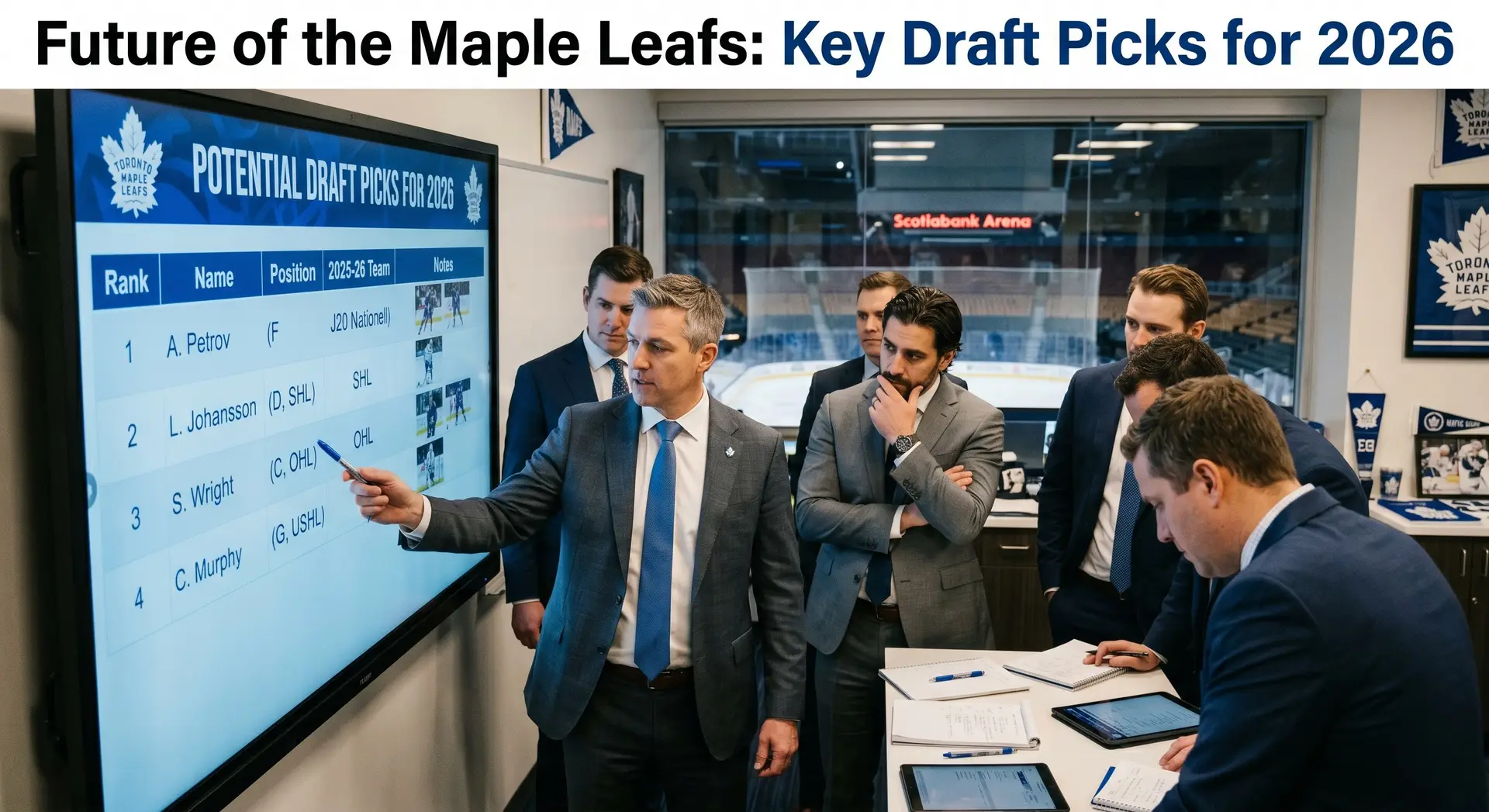
The victory of the Toronto Maple Leafs in the 2026 NHL Draft Lottery represents a seminal moment for the franchise, occurring precisely a decade after the organization selected Auston Matthews first overall in 2016.1 Under the leadership of the newly appointed General Manager John Chayka and Senior Executive Advisor Mats Sundin, the Maple Leafs find themselves at a crossroads that transcends mere talent acquisition.2 While Gavin McKenna, the Penn State winger and unanimous North American top seed, is the widely projected selection, the strategic landscape of the 2026 class is populated by a diverse array of prospects whose stylistic profiles might better align with the long-term structural requirements of the roster.2 The decision to potentially bypass a talent of McKenna’s pedigree necessitates a deep inquiry into the high-floor utility of international skaters like Ivar Stenberg and the franchise-defining potential of a top-tier defensive trio comprising Chase Reid, Keaton Verhoeff, and Carson Carels.1 As the organization navigates a post-Mitch Marner environment—following his departure to the Vegas Golden Knights—the necessity of identifying a player who can either replicate elite playmaking or fundamentally stabilize the defensive corps has never been more acute.2
The 2026 lottery win was far from a certainty; the Maple Leafs entered the draw with an 8.5 percent probability, the fifth-best odds available.1 This stroke of luck was essential not just for the talent it provides, but for organizational preservation. Had the selection fallen outside the top five, it would have converted to the Boston Bruins as the final piece of the trade that brought Brandon Carlo to Toronto in exchange for Fraser Minten.4 Retaining this pick allows Chayka and Sundin a “monumental opportunity” to chart a new course for a franchise that finished 28th in the league during a tumultuous 2025-26 campaign.1 The internal debate now centers on whether to follow the consensus of public scouting or to utilize Chayka’s preference for “hockey sense and competitiveness” to select a player who addresses structural deficiencies in the roster.5
The Case for Ivar Stenberg: A Paradigm of Professional Readiness
In the evaluation of the 2026 draft class, Ivar Stenberg of Frölunda HC has emerged as the most compelling alternative to Gavin McKenna for the top selection.6 While McKenna possesses the flashy and fun attributes associated with a top-tier North American prospect, Stenberg represents a philosophical shift toward a more complete, professional style of play that excels against men in the Swedish Hockey League.6 Stenberg’s 2025-26 campaign was nothing short of historic; he recorded 33 points in 43 games, the most by an 18-year-old SHL player since the Sedin twins in 1998-99.1 This level of production in a Tier-1 professional league suggests a floor that scouts describe as “absolutely bonkers,” as there is truly no area of the game where he struggles.8
Stenberg’s performance at the international level further bolsters his candidacy. His gold-medal performance with Sweden at the World Juniors showcased a player who reads the game at a level second only to McKenna, but with a significantly more developed off-puck game.8 Scouts often draw comparisons to Tim Stützle due to his blend of speed, first-step quickness, and balance.9 Unlike many young offensive dynamos, Stenberg possesses a “heavier” and more “dangerous” shot than McKenna, and he demonstrates a consistent willingness to get to the net and drive the cycle.6
Comparative Performance Metrics: International and North American Skater Profiles
| Player | Team | League | Height | Weight | GP | G | A | TP |
| Gavin McKenna | Penn State | NCAA | 5’11” | 170 | 35 | 15 | 36 | 51 |
| Ivar Stenberg | Frölunda HC | SHL | 5’11” | 183 | 43 | 11 | 22 | 33 |
| Alberts Smits | Jukurit | Liiga | 6’3″ | 205 | 38 | 6 | 7 | 13 |
| Viggo Björck | Djurgårdens IF | SHL | 5’9″ | 177 | 42 | 6 | 9 | 15 |
| Caleb Malhotra | Brantford | OHL | 6’2″ | 182 | 67 | 29 | 55 | 84 |
| Ryan Roobroeck | Niagara | OHL | 6’2″ | 209 | 49 | 30 | 28 | 58 |
| J.P. Hurlbert | Kamloops | WHL | 6’0″ | 183 | 68 | 42 | 55 | 97 |
The data indicates that while North American skaters like J.P. Hurlbert and Caleb Malhotra put up gaudy numbers in junior hockey, Stenberg’s 33 points in the SHL carry a higher conversion value due to the quality of competition.1 For the Toronto Maple Leafs, Stenberg offers a “plug-and-play” solution. His ability to manipulate passing lanes and use his puck skills to pull pucks around defenders mirrors some of the playmaking elements lost when Mitch Marner departed, but Stenberg adds a layer of “terrorizing grit” and defensive awareness that McKenna is still developing.6
The second-order insight here involves the “pro-readiness” gap. McKenna, while dominant at Penn State with 51 points in 35 games, is still adjusting to the physical demands of the NCAA and needs to “bulk up” to handle NHL contact.2 Stenberg is already navigating the physical demands of professional hockey, managing the cycle and forecheck against seasoned veterans.7 For a Maple Leafs team looking to maximize the remaining prime years of Matthews and William Nylander, Stenberg offers a solution that could theoretically sign and play in the NHL as early as the 2026-27 season.2
Architecting the Blue Line: The Defensive Trio at the Top
While the 2026 draft is often framed as a battle between two elite wingers, John Chayka has explicitly stated a strategic interest in “building through the back end”.2 This suggests that the organization is deeply evaluating the five defensemen currently projected as franchise-defining talents.1 The most prominent names in this category are Chase Reid, Keaton Verhoeff, and Carson Carels, each of whom offers a unique solution to Toronto’s long-standing defensive needs.8
Chase Reid: The Modern Power-Play General
Chase Reid of the Sault Ste. Marie Greyhounds is increasingly viewed by scouts as a legitimate candidate for the first overall pick.8 Standing 6’2″, Reid is a “take-charge” defenseman who dictates the pace of the game through elite hockey sense and effortless mobility.9 His performance at the World Juniors and the OHL USA Prospects Challenge solidified his reputation as a defender who can “quarterback a power play” and transition the puck with precision.8
Reid’s statistical profile in the OHL—18 goals and 48 points in 45 games—places him in an elite tier of offensive production for a defenseman.10 His recovery speed and ability to transition from offence to defence make him a “safe” bet for top-pairing minutes in the NHL, with comparisons frequently drawn to Jake Sanderson.9 For the Maple Leafs, Reid represents a long-term successor to Morgan Rielly, a player who can lead the rush while maintaining superior gap control.9 The organization has notably lacked a right-handed defenseman with Reid’s combination of skating and vision, and his impending move to Michigan State suggests a player who will be refined in a high-intensity collegiate environment.8
Keaton Verhoeff: The Physical Pillar
If the Maple Leafs prioritize size and “clogging up the middle,” Keaton Verhoeff of the University of North Dakota becomes the primary target.8 At 6’4″ and 212 pounds, Verhoeff is already a physical force in the NCAA, playing 16-20 minutes a night for a Frozen Four team.8 His scouting report highlights a high floor and a comparison to John Carlson, noting his ability to hit hard while maintaining the ability to make high-end passes in the offensive zone.8
The strategic appeal of Verhoeff lies in his “physical stabilizer” role.9 In the pressure-cooker environment of the Toronto market, a defenseman who takes up massive amounts of space and clears the front of the net is often valued more highly than a pure puck-mover.8 However, scouts have noted a need for improved top-end speed to ensure he can handle elite NHL rushers.8 The third-order insight regarding Verhoeff involves the “NCAA jump”—by moving from the WHL to the NCAA early, he has demonstrated an advanced ability to adapt to higher levels of competition, a trait highly valued by an analytical mind like Chayka.3
Carson Carels: The “Built Like a Tank” All-Arounder
Carson Carels of the Prince George Cougars is perhaps the most underrated of the top defensive prospects.8 Built “like a tank,” Carels is described as a “farm kid” with a physique and defensive awareness that make him one of the best defenders in the entire CHL.8 His 73 points in 58 games are staggering for a defenseman, yet he maintains a “physical stabilizer” identity that draws comparisons to Charlie McAvoy.9
| Top Defenseman Comparison | Player | Team | Height | Weight | Style | NHL Comparable |
| Consensus Tier | Chase Reid | Sault Ste. Marie | 6’2″ | 188 | Mobile Puck-Mover | Jake Sanderson |
| Power Tier | Keaton Verhoeff | North Dakota | 6’4″ | 208 | Defensive Pillar | John Carlson |
| All-Around Tier | Carson Carels | Prince George | 6’2″ | 202 | Two-Way Force | Charlie McAvoy |
| Offensive Tier | Xavier Villeneuve | Blainville-Boisbriand | 5’11” | 162 | Dynamic Creator | Lane Hutson |
| International Tier | Alberts Smits | Jukurit | 6’3″ | 205 | Modern Pro Style | Zach Werenski |
Carels offers a “unique all-around” package, combining offensive talent with a sound defensive base.9 If the Maple Leafs believe their forward core is sufficient with Matthews, Nylander, and Knies, then selecting a McAvoy-style defender like Carels could be the “philosophical shift” required to win in the playoffs.2 His ability to play big minutes and be deployed in all situations makes him a potential top-pairing defenseman who drives offence while maintaining a physical element.9
Culture and Continuity: The Caleb Malhotra Option
A particularly intriguing prospect for the Toronto Maple Leafs is Caleb Malhotra of the Brantford Bulldogs.14 As the son of former Maple Leafs assistant coach and NHL veteran Manny Malhotra, Caleb brings an intrinsic understanding of the “pro-style game” and a “nonstop motor” that is highly coveted by the organization.9 Malhotra is a complete center who can “do a little bit of everything,” including scoring at a high rate—84 points in 67 games—while maintaining elite defensive detail.10
Malhotra’s rise in the 2026 rankings is attributed to his “matchup minutes” and conditioning.9 He is a player who “knows how to create and finish offensively” but prioritizes a 200-foot responsibility that makes him an ideal middle-six center at the NHL level with top-six upside.9 Some mock drafts suggest that if the Leafs were to trade down, or if they prioritize “culture-building” over raw skill, Malhotra is the “safest high-ceiling” forward in the class.15 The sentimental connection to Toronto, combined with his high-end work habits, makes him a candidate who would “sell jerseys” and “get fans to love the team again” in a way similar to McKenna, but with a more grounded, defensive-minded aesthetic.2
The tactical implication of drafting Malhotra is to stabilize the center-ice position. While Auston Matthews remains the undisputed 1C, the aging of John Tavares—who is projected to drop to a third-line role by the 2026-27 season—creates a vacuum in the middle six.13 Malhotra’s ability to win races and battles, and his intelligence in transition, would allow the Maple Leafs to maintain a high level of play even as their veteran stars begin to decline.16
The McKenna Risk Profile: Assessing the “Red Flags”
To understand why the Maple Leafs might pass on Gavin McKenna, one must look beyond his 51-point freshman season at Penn State.8 While he is the “most exciting player in this draft class,” several factors complicate his projection as a franchise cornerstone in a market as volatile as Toronto.2
First, McKenna’s off-ice environment became a point of discussion in the months leading up to the draft. On January 31, 2026, McKenna was involved in an altercation at a bar near the Penn State campus, where a jaw was allegedly broken; while felony assault charges against McKenna were dropped after video surveillance was inspected, the incident cast a shadow over his draft year.18 More recently, on May 8, 2026, reports surfaced that his mother, Krystal McKenna, was charged with furnishing liquor to minors in connection with the same incident.18 For a “new management group” led by Chayka and Sundin, the desire to avoid early-career distractions might lead them toward a “safer” or more “disciplined” profile like Ivar Stenberg or Caleb Malhotra.2
Second, there is the “he’s not big” argument and concerns regarding his intensity away from the puck.8 While his 5’11”, 170-pound frame is standard for a modern winger, McKenna can occasionally “float in coverage” and lacks urgency through the next phase of the play after making an initial move.8 Scouts have noted that he assumes others will handle defensive responsibilities, a trait that could prove disastrous in a playoff system under a coach like Craig Berube.17 If the Maple Leafs believe that their current core already possesses enough “pure skill” but lacks the “two-way detail” to win in May and June, passing on McKenna becomes a pragmatic choice rather than a talent-based one.3
Elite Traits and Undersized Dynamos: The Case for Viggo Björck
For a management group that values “elite traits,” Viggo Björck of Djurgårdens IF represents a fascinating alternative.16 Despite standing just 5’9″, Björck has “proved doubters wrong” by becoming an offensive juggernaut at the junior levels and showcasing a complete game against men in the SHL.12 His scouting report highlights a lower body that allows him to protect the puck “like Crosby,” and a relentless motor that never stops working.20
Björck’s statistical resume is among the best in the draft: he holds the Sweden U18 and U20 scoring records and played significant minutes for Sweden’s gold-medal-winning World Junior squad at age 17.20 His ability to play both center and wing, combined with his “super powerful” skating and puck-protection skills, makes him a “low-risk, high-reward” selection.19 For Toronto, Björck could provide the “nonstop energy” and “awareness” required to supplement Matthews and Nylander, potentially serving as a modern-day Brayden Point or Zach Benson.19
| Trait Comparison | Gavin McKenna | Ivar Stenberg | Viggo Björck |
| Vision & Playmaking | Elite | Crafty / High Level | Poise / Elite Vision |
| Shooting & Scoring | Accurate / Pinpoint | Heavy / Dangerous | Deceptive / Accurate |
| Off-Puck Game | Work in Progress | Elite Two-Way | Nonstop Motor |
| Physicality | Not Big / Low Intensity | Strong Cycle / Balance | Crosby-like Protection |
| Professional Experience | NCAA Freshman | SHL Veteran | SHL Professional |
Natural Finishers: The Ryan Roobroeck Conundrum
If the Maple Leafs decide they simply need a pure goal-scorer to fill the void left by Marner—and eventually John Tavares—Ryan Roobroeck of the Niagara IceDogs is the most prolific option.22 Roobroeck is a “natural goal scorer” with a power forward’s body (6’2″, 209 lbs) and one of the best shots in the OHL.22 He recently became the all-time leader in goals for the London Jr. Knights program and led Niagara with 87 points in 64 games.23
However, the “complications” in Roobroeck’s profile are significant. His physical engagement is described as “wildly inconsistent,” and his skating pace can “lag” because his stride power needs work.22 Scouts worry that his peers have caught up to his physical advantages, and he now runs the risk of following the career path of Michael Dal Colle unless he makes major adjustments to his strength and conditioning.22 For the Maple Leafs, Roobroeck represents a “high-risk” choice at first overall. While he could consistently score 30 goals in the NHL, the lack of a “high-pace” game might make him a liability in a top-six that needs to push the tempo.22
Organizational Strategy: The Chayka-Sundin Paradigm
The hiring of John Chayka as General Manager and Mats Sundin as Senior Executive Advisor has introduced a new level of “diligence” to Toronto’s draft process.4 Chayka has noted that while “fastest and most skilled” is the ideal, he specifically values “hockey sense and competitiveness” when forced to make a trade-off.5 This philosophy may lead the organization toward players who have already proven their ability to compete at high levels under pressure.
Chayka and Sundin have also inherited a prospect pool that features promise in players like Easton Cowan and Ben Danford, but lacks a “tier-one” anchor.4 The decision at #1 overall is “monumental” because it will define the Chayka-Sundin era.1 Sundin has spoken highly of the “strong draft” and the potential of international skaters like Stenberg, suggesting that the team is not wedded to the North American consensus.4
Roster Needs and Projections (May 2026)
By May 2026, the Maple Leafs roster will be top-heavy and in need of specific reinforcements. Auston Matthews remains the centrepiece, but the departure of Mitch Marner has left a critical gap on the right wing and on the first power-play unit.2 The defensive corps, led by Morgan Rielly and Oliver Ekman-Larsson, is aging, and the team lacks a high-end, young, right-handed defenseman to anchor the top pair.2
| Position | Starter (2026-27) | Projecting the 2026 Pick |
| Center | Auston Matthews | Caleb Malhotra (Potential 2C/3C) |
| LW | Matthew Knies | Gavin McKenna (Potential 1LW) |
| RW | William Nylander | Ivar Stenberg (Potential 1RW/2RW) |
| LD | Morgan Rielly | Carson Carels (Potential Top Pair) |
| RD | Troy Stecher / Jake McCabe | Chase Reid (Potential Top Pair) |
| G | Joseph Woll | — |
The tactical choice for Chayka is whether to draft for the “Matthews timeline” (a player who helps win now, like Stenberg) or for the “organizational legacy” (a player who builds the future, like Reid or Carels).25 There is value in taking one of the top wingers (McKenna or Stenberg) because they are both expected to sign and play in the NHL immediately, whereas the top defensemen and Caleb Malhotra might require more development time.2
Potential Trade Scenarios: Maximizing the Asset
Given the high value of the #1 overall pick in 2026, the Maple Leafs could also consider a “trade-down” or a “blockbuster” move to accelerate their transition.11 One hypothetical scenario involves trading the top pick—or even Auston Matthews himself—to the San Jose Sharks to acquire multiple high-level assets.11 In a scenario where Toronto moves Matthews, they would theoretically receive the #2 overall pick in 2026, a 2027 1st rounder, and defenseman Sam Dickinson.11
Holding both the #1 and #2 overall picks would allow the Maple Leafs to select both Gavin McKenna and Chase Reid, effectively jump-starting a “full rebuild” with two elite cornerstones.11 Even without such a massive trade, the “trade value” of the #1 pick is immense; analytically-minded teams often find that “trading down” for multiple 1st-rounders provides a higher probability of long-term success than a single elite selection.26
Global Sleepers: The Rise of Alberts Smits and Oliver Suvanto
If the Maple Leafs decide to look past the “top five” consensus, several European prospects offer “homerun” potential. Alberts Smits, a 6’3″ Latvian defenseman playing for Jukurit in Liiga, has risen significantly on draft boards.10 Smits is a modern two-way defender who excels at “gaining and maintaining possession” and getting the puck into desirable locations.7 He is often compared to Zach Werenski for his skating and hockey sense.9
Oliver Suvanto, a 6’3″ center from Tappara, is another international name with a “high ceiling”.10 While his production in Liiga (11 points in 48 games) is modest compared to Stenberg, his “pro-style” frame and ability to manage the physical demands of professional hockey at a young age make him an attractive option for a team that values “structural integrity” over raw point totals.10
Analysis of Draft Board Value Tiers
The 2026 draft class is characterized by a “Tier 1” of two elite wingers and a “Tier 2” of five franchise-defining defensemen.1 For the Toronto Maple Leafs, the decision is not just about which player is “best,” but which “tier” they wish to invest in.
- Tier 1: High-Impact Wingers (McKenna, Stenberg) – These players offer the quickest path to replacing the offensive production lost with Mitch Marner’s departure.2
- Tier 2: Foundation Defensemen (Reid, Verhoeff, Carels, Smits) – These players offer the structural stability that the Maple Leafs have lacked for a decade. Investing here requires patience but potentially offers a higher “championship ceiling”.28
- Tier 3: Competitive Centers (Malhotra, Björck, Lawrence) – These prospects address the aging depth at center and provide the “two-way detail” required for playoff success.16
The Decision-Making Mechanism: Chayka’s Advanced Analytics
Under John Chayka, the Maple Leafs are expected to utilize a 14-category data-tracking system (10 offensive, 4 defensive) to evaluate prospects at even strength.16 This system places less emphasis on “skating mechanics” and “size” and more on “how you operate when time/space is condensed”.16 This analytical lens may favour a player like Viggo Björck, whose “small-area skill and agility” and “response under pressure” are among the best in the class, despite his 5’9″ stature.16
Conversely, the data might punish a player like Ryan Roobroeck, whose “transition efficiency” and “defensive transition” are among the worst at the top of the draft.7 Chayka has noted that he is “always open to everything,” but there is “always a lot of diligence when you are drafting first overall to make sure you nail it”.5
Conclusions and Long-Term Outlook
The selection made by the Toronto Maple Leafs on June 26, 2026, will be a defining moment for the John Chayka and Mats Sundin era.4 While the pull of Gavin McKenna’s “star power” and “playmaking” is undeniable, the organization must weigh those attributes against the “professional readiness” of Ivar Stenberg and the “back-end” stability offered by Chase Reid or Carson Carels.2
The “red flags” in McKenna’s profile—including his defensive lapses and the distractions surrounding his family and a bar altercation—provide the necessary rationale for a “philosophical shift”.6 If the Maple Leafs believe they can win with the “Ice in his veins” of Stenberg or the “Crosby-like” puck protection of Björck, they will be making a decision based on “deep analysis” rather than “fan expectation”.2 Ultimately, the goal is to provide Auston Matthews and Matthew Knies with a teammate who can “carry play” and “take some of the burden off” while ensuring the team remains defensively sound in high-stakes environments.2 The 2026 draft represents the first step in building a team that can “win in a lot of different ways” and finally fulfill the potential of its elite core.2
Works cited
- Maple Leafs win Draft Lottery, will have choice of McKenna or Stenberg at No. 1 | NHL.com, accessed May 11, 2026, https://www.nhl.com/news/toronto-maple-leafs-win-2026-nhl-draft-lottery
- NHL draft experts unanimously predict Leafs will select Gavin …, accessed May 11, 2026, https://theleafsnation.com/news/nhl-draft-experts-unanimously-predict-leafs-will-select-gavin-mckenna-at-first-overall
- Toronto Maple Leafs win the lottery for the No. 1 pick in the 2026 NHL draft, accessed May 11, 2026, https://apnews.com/article/maple-leafs-nhl-draft-lottery-241c71feece28fc1916bde242a401255
- Maple Leafs’ John Chayka, Mats Sundin preview Gavin McKenna, Ivar Stenberg after winning 1st overall pick, accessed May 11, 2026, https://theleafsnation.com/news/maple-leafs-john-chayka-mats-sundin-preview-gavin-mckenna-ivar-stenberg-1st-overall-pick
- John Chayka on the Maple Leafs winning the first-overall pick: “Just elated… A meaningful step and a monumental type of opportunity”, accessed May 11, 2026, https://mapleleafshotstove.com/2026/05/06/john-chayka-on-the-maple-leafs-winning-the-first-overall-pick/
- Weighing The Toronto Maple Leafs’ Draft Options Between Gavin …, accessed May 11, 2026, https://thehockeynews.com/news/latest-news/weighing-the-toronto-maple-leafs-draft-options-between-gavin-mckenna-and-ivar-stenberg
- The April 2026 NHL Draft Rankings – Scouching, accessed May 11, 2026, https://www.scouching.ca/the-blog/april-rankings-2026
- 2026 NHL Draft Rankings: McKenna leads pre-U-18 World …, accessed May 11, 2026, https://www.dailyfaceoff.com/news/2026-nhl-draft-rankings-april-steven-ellis-gavin-mckenna-ivar-stenberg-u-18-world-championship
- Central Scouting analyzes top prospects for 2026 NHL Draft, accessed May 11, 2026, https://www.nhl.com/news/central-scouting-analyzes-top-prospects-for-2026-nhl-draft
- CAM’S CONSENSUS 2026 – NHL Draft Ranking – Elite Prospects, accessed May 11, 2026, https://www.eliteprospects.com/draft-center/cam-s-consensus
- 2026 NHL Draft Top-5 Scenarios: Maple Leafs Land McKenna, Reid …, accessed May 11, 2026, https://thehockeywriters.com/2026-nhl-draft-top-5-scenarios-maple-leafs-land-mckenna-reid-with-first-two-picks/
- 2026 NHL Draft Rankings: Ferrari’s February Top 64 Has Stenberg Above McKenna, accessed May 11, 2026, https://thehockeynews.com/news/latest-news/2026-nhl-draft-rankings-stenberg-stays-above-mckenna-in-ferrari-s-february-top-64
- Way too early 2026–27 Toronto Maple Leafs lineup predictions – 6IX ON ICE, accessed May 11, 2026, https://6ixonice.com/2026/04/05/way-too-early-2026-27-toronto-maple-leafs-lineup-predictions/
- 2026 Draft Prospects Rankings – NHL.com, accessed May 11, 2026, https://www.nhl.com/draft/prospects
- NHL Mock Draft 2026: McKenna To The Maple Leafs, Top 16 Picks …, accessed May 11, 2026, https://www.flohockey.tv/articles/15882080-nhl-mock-draft-2026-mckenna-to-the-maple-leafs-top-16-picks-broken-down
- 2026 Midseason NHL Draft Rankings: Top 50 – Expected Buffalo -, accessed May 11, 2026, https://www.expectedbuffalo.com/2026-midseason-nhl-draft-rankings-top-50/
- Midseason 2026 NHL Draft Rankings – Smaht Scouting, accessed May 11, 2026, https://smahtscouting.com/2026/02/27/midseason-2026-nhl-draft-rankings/
- NHL Rumours: McKenna’s Mother Charged, Playoff Marner & Wallstedt Bounceback, accessed May 11, 2026, https://www.yardbarker.com/nhl/articles/nhl_rumours_mckennas_mother_charged_playoff_marner_wallstedt_bounceback/s1_16448_43824026
- Viggo Bjorck – 2026 NHL Draft Prospect Profile – The Hockey Writers …, accessed May 11, 2026, https://thehockeywriters.com/viggo-bjorck-2026-nhl-draft-prospect-profile/
- The Case for Viggo Bjorck at 3rd : r/canucks – Reddit, accessed May 11, 2026, https://www.reddit.com/r/canucks/comments/1sduwew/the_case_for_viggo_bjorck_at_3rd/
- Viggo Björck 2026 NHL Draft Profile – The Win Column, accessed May 11, 2026, https://thewincolumn.ca/2026/04/08/viggo-bjorck-2026-nhl-draft-profile/
- 2026 NHL DRAFT: DETAILED SCOUTING REPORT – Ryan …, accessed May 11, 2026, https://www.mckeenshockey.com/nhl-blog/2026-nhl-draft-detailed-scouting-report-ryan-roobroeck-c-lw-niagara-ice-dogs-ohl/
- Top 2026 NHL Draft prospect Ryan Roobroeck is a “natural goal scorer” – McKeen’s Hockey, accessed May 11, 2026, https://www.mckeenshockey.com/nhl-blog/2026-nhl-draft-ryan-roobroeck-natural-goalscorer/
- Maple Leafs have ‘monumental type of opportunity’ after winning NHL Draft Lottery, accessed May 11, 2026, https://www.nhl.com/news/toronto-maple-leafs-have-huge-opportunity-after-winning-draft-lottery
- With Chayka hired and the first-overall pick secured, all the attention turns to Matthews and Berube’s futures, accessed May 11, 2026, https://mapleleafshotstove.com/2026/05/08/with-chayka-hired-and-first-overall-secured-all-the-attention-turns-to-matthews-and-berubes-futures/
- Check this chart out… 2026 NFL draft pick value chart. : r/NYGiants – Reddit, accessed May 11, 2026, https://www.reddit.com/r/NYGiants/comments/1sg8o33/check_this_chart_out_2026_nfl_draft_pick_value/
- How To Value The 1.01 In 2026 Dynasty Rookie Drafts: Sell High With A Shallow Class?, accessed May 11, 2026, https://www.fantasylife.com/articles/dynasty/how-to-value-the-101-in-2026-dynasty-rookie-drafts-sell-high
- 2026 NHL Draft Top 100 Rankings Big Board With Tiers : r/BlueJackets – Reddit, accessed May 11, 2026, https://www.reddit.com/r/BlueJackets/comments/1t9hdlp/2026_nhl_draft_top_100_rankings_big_board_with/
- Why are forwards prioritized in draft picks? : r/hockey – Reddit, accessed May 11, 2026, https://www.reddit.com/r/hockey/comments/1t9801i/why_are_forwards_prioritized_in_draft_picks/


Leave a Reply