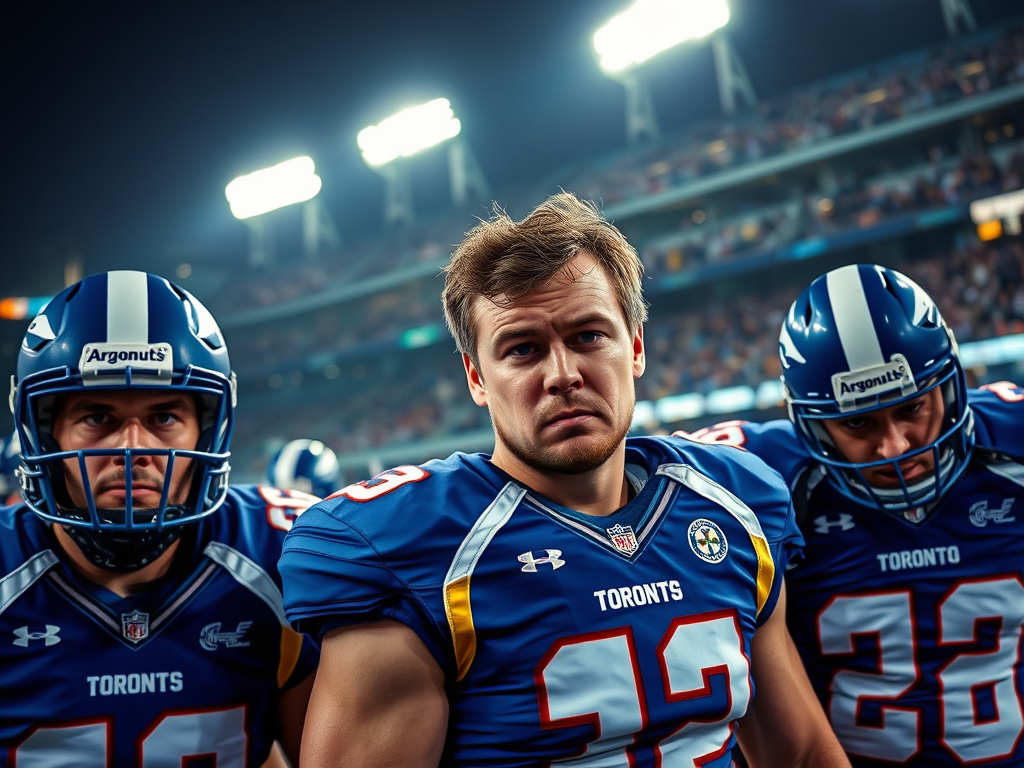
The fall from the Canadian Football League’s summit has been swift and brutal for the Toronto Argonauts. The defending champions find themselves in a state of crisis. This comes less than a year after hoisting their record 19th Grey Cup. The team started the 2025 season with a dismal 1-4 record. They are now at the bottom of a weak East Division. The swagger of a champion has vanished. It has been replaced with a palpable sense of frustration. This frustration emanates from the players, the coaching staff, and a bewildered fanbase. The on-field product has significantly declined. The once-dominant team now suffers from a porous defense. The offense is plagued by turnovers. Special teams are fatally inconsistent.
The statistical reality is stark. Through five weeks, the Argonauts have surrendered a league-high 163 points. They possess a point differential of -35, which is the worst in the East Division. While a championship hangover might explain a sluggish start, the Argonauts’ issues run far deeper than simple complacency. This team is grappling with a crisis of identity. It is caused by critical offseason personnel changes. Injuries to key leaders have worsened the problem. It is further compounded by schematic inflexibility and a startling lack of on-field discipline. This report will dissect each failure point. It will diagnose the root causes of the 1-4 record. The report will outline the necessary adjustments required for a potential, though difficult, path back to contention.
| Week | Opponent | Score | Result | Key Takeaway |
| 1 | at Montreal Alouettes | 10-28 | Loss | Offense stifled, 3 turnovers, and held to 276 total yards. |
| 2 | vs. Calgary Stampeders | 19-29 | Loss | Inability to finish drives; defense allows 388 yards. |
| 3 | vs. Saskatchewan Roughriders | 32-39 | Loss | Game lost on a 99-yard kickoff return TD with 23 seconds left. |
| 4 | at Ottawa Redblacks | 29-16 | Win | Defense and special teams score two TDs to secure the lone victory. |
| 5 | vs. Hamilton Tiger-Cats | 38-51 | Loss | Complete defensive collapse; secondary and special teams coverage exposed. |
An Offense Out of Sync: The Arbuckle Conundrum
The Argonauts’ offense, operating without injured 2024 Grey Cup MVP Chad Kelly, presents a confounding paradox. With backup Nick Arbuckle in charge, the team leads the CFL in passing yards. However, this statistical output has been largely hollow. It is undermined by a league-leading number of turnovers and an inability to sustain drives when it matters most. This dysfunction is not solely the quarterback’s burden. It results from a systemic failure rooted in a crumbling offensive line. A one-dimensional strategic approach has made the team predictable and fragile.
The Collapsing Pocket: The Root of All Evil
The primary driver of Toronto’s offensive struggles is the consistent failure of its offensive line. In the first four weeks of the season, Nick Arbuckle was sacked a CFL-high 12 times. This number reflects a fundamental breakdown in protection. This reality validates the serious concerns raised in the preseason. Pro Football Focus (PFF) analysis pointed to “uncertainty on the left side” as a major question mark. It specifically highlighted the projected starters: left tackle George Moore, who posted a dismal 46.0 PFF grade in limited 2024 action, and left guard Anthony Vandal, whose 61.8 grade ranked just 36th among all CFL offensive linemen. An injury to veteran center Darius Ciraco has worsened the situation. He was a stabilizing force, allowing just 20 total pressures and earning a standout 78.1 pass-blocking grade in 2023.
This constant pressure is more than just a statistic; it is a game-plan killer. It forces Arbuckle, a pocket passer who lacks Kelly’s mobility, to speed up his internal clock and rush his progressions. This directly correlates to his league-leading seven interceptions and two fumbles. The offensive line’s inability to create a clean pocket prevents deeper routes from developing. It limits the playbook. This creates a perpetual state of offensive inefficiency. The causal chain is clear. Poor offensive line play leads to sacks and pressure. This, in turn, leads to turnovers and stalled drives.
One-Dimensional Attack: A Ground Game Gone Missing
Compounding the protection issues is the complete abandonment of a rushing attack. Through Week 4, the Argos ranked last in the league in rushing, averaging a paltry 46.5 yards per game. The team’s leading active rusher is their embattled quarterback, while running back Kevin Brown is averaging just 2.1 yards per carry on 18 attempts. This is a shocking and self-inflicted reversal from the team’s 2024 identity. They led the CFL with 159 rushing first downs. The team was powered by running back Ka’Deem Carey, who was unceremoniously released in the offseason.
The decision to part with a running back who had the third-best rushing grade in the league in 2024 (92.4) and led the CFL in missed tackles forced (63) appears to be a monumental strategic miscalculation by the front office. Opposing defenses can disregard play-action without a credible run threat. They can send pass rushers with impunity. This further exposes the already-struggling offensive line. This has forced Toronto into a predictable, pass-heavy scheme, with over 72% of their offensive snaps being passing plays. They have jettisoned a proven, successful identity for one that their current personnel are ill-equipped to execute.
Silver Linings: The Emergence of a Receiving Duo
Despite the chaos, there are bright spots. Second-year receiver Kevin Mital is in the midst of a breakout campaign. He has demonstrated remarkable reliability. He caught 27 of 29 targets thrown his way. He has established himself as a top-10 receiver in the league by yardage. His 104-yard performance in the Week 5 shootout against Hamilton was a highlight. His commitment to blocking has earned praise from his quarterback. Alongside him, veteran Damonte Coxie has been a consistent force, leading the team with 406 receiving yards and providing big-play ability, as seen on a 45-yard bomb from Arbuckle against the Tiger-Cats. The production of Mital and Coxie proves that elite talent exists at the skill positions. Their success
in spite of the offensive dysfunction, their performance is a testament to their individual abilities. It offers a glimmer of hope. If the protection issues are solved, this offense has the weapons to be explosive.
| Opponent | Comp/Att | Yards | TDs | INTs | Fumbles | Sacks Taken |
| @ Montreal | 20/32 | 271 | 0 | 2 | 1 | 2 |
| vs. Calgary | 21/30 | 309 | 0 | 2 | 0 | 4 |
| vs. Saskatchewan | 28/34 | 330 | 3 | 1 | 1 | 3 |
| @ Ottawa | 18/25 | 269 | 1 | 1 | 0 | 3 |
| vs. Hamilton | 35/49 | 339 | 2 | 1 | 0 | 3 |
| Total | 122/170 | 1,449 | 7 | 7 | 2 | 15 |
Note: Sack data compiled from multiple sources and reports through Week 5. Sources:
A Championship Defense in Tatters
If the offense is inconsistent, the defense has been consistently dreadful. The 2025 Argonauts defense is a pale imitation of its championship predecessors. The unit was hollowed out by massive offseason departures. It is crippled by injuries to its remaining leaders. The defense is also exposed by predictable and ineffective coaching schemes. The unit gave up 96 points in their first three games. They showed signs of life in their Week 4 win over Ottawa. However, they completely disintegrated in a 51-38 home loss to Hamilton in Week 5.
Exposed and Exploited: The Secondary’s Schematic Failures
The loss to the Tiger-Cats was a defensive catastrophe that laid bare the unit’s fundamental flaws. Hamilton quarterback Bo Levi Mitchell is a future Hall of Famer. He looked rejuvenated as he threw for 332 yards and five touchdowns. He turned back the clock with a masterful performance. His primary target, Kenny Lawler, had a career night, torching the Argos secondary for 207 yards and three spectacular touchdowns.
The post-game commentary from the victors was a damning indictment of the Argonauts’ defensive game plan. It was coordinated by co-defensive coordinators Kevin Eiben and Jason Shivers. Lawler dismissed Toronto’s scheme as a “typical CFL defence.” He noted that he was consistently left in single coverage with a corner in his face. There was also a safety over the top. Mitchell confirmed that Hamilton’s game plan was to attack this predictable look. He stated that leaving Lawler “one-on-one multiple times” was “not a good decision” by Toronto’s staff. This was not merely a case of players failing to execute; it was a fundamental failure of coaching strategy. The defensive staff failed to identify and adjust to the opponent’s primary weapon, allowing him to single-handedly dismantle their defense. The team struggled to make in-game adjustments. They failed to bracket or double-team Lawler. This struggle points to a critical lack of preparation and schematic flexibility.
The Missing Pressure: A Rebuilt Line Comes Up Empty
The secondary’s struggles are inextricably linked to the defensive line’s inability to generate a consistent pass rush. This was PFF’s biggest pre-season concern for the Argonauts. They lost their entire starting defensive line from the 2024 Grey Cup team. In total, seven defensive starters from that championship unit departed in the offseason. General Manager Michael Clemons tried to rebuild the unit with veterans like Anthony Lanier II. He also added draft picks like Jeremiah Ojo and Paris Shand. However, the new group has failed to create the disruptive pressure necessary for a CFL defense to succeed. Without pressure, quarterbacks like Mitchell have ample time. They wait for routes to develop. This allows them to pick apart a secondary that cannot be expected to hold its coverage indefinitely. The two problems—a porous secondary and a non-existent pass rush—are symbiotic, creating a cycle of defensive failure.
The Walking Wounded: Leadership on the Sidelines
This defensive overhaul has been compounded by injuries to the few remaining veteran leaders. The defense has been playing without star linebacker Wynton McManis. Key defensive end Derek Parish is also absent. Both players are on the injured list. In the preseason, McManis was identified as a cornerstone of the defense. He is a crucial piece of their championship experience. Losing him is not just about losing an All-Star talent. It means losing the on-field general. He makes the calls and organizes the unit. His absence creates a leadership vacuum. This forces younger, less experienced players like Isaac Darkangelo into larger roles. It strains the entire defensive structure. This makes it even more susceptible to the kind of breakdowns seen against Hamilton.
| Metric | Hamilton Tiger-Cats | Toronto Argonauts |
| Points Scored/Allowed | 51 | 38 |
| Total Net Offence | 415 yards | 339 yards |
| Passing Yards | 332 yards | 339 yards |
| Rushing Yards | 102 yards | 21 yards |
| Opponent TD Passes | 5 | 2 |
| Turnovers Forced | 1 (Interception) | 0 |
Source: https://www.cfl.ca/2025/07/05/recap-hamilton-51-toronto-38/
Special Teams: A Game of Russian Roulette
The performance of the Argonauts’ special teams unit is a perfect microcosm of the team’s broader dysfunction. The unit possesses elite, game-breaking talent. This talent is capable of single-handedly winning a game. However, it also suffers from catastrophic breakdowns in discipline and execution. These breakdowns have single-handedly lost them games. This volatility makes every kickoff and punt a high-stakes gamble.
The highs have been spectacular. In the team’s lone victory against Ottawa, rookie safety Derek Slywka was the hero, scoring two touchdowns. His 120-yard return of a blocked field goal was a momentum-swinging play that secured the win. Prolific returner Janarion Grant also remains a constant threat. His kickoff return touchdown against Hamilton was a brilliant reverse-field run. It briefly gave the Argos life.
However, the lows have been devastating and decisive. In Week 3, the Argos had battled back to take a 32-31 lead over Saskatchewan with just 23 seconds remaining. They seemed poised for victory. Then Mario Alford fielded the ensuing kickoff and returned it 99 yards for a touchdown. This walk-off score handed Toronto a gut-wrenching 39-32 loss. Two weeks later, the scenario repeated itself. The Argos had scored to pull within 12 points of Hamilton with seven minutes left. Isaiah Wooden then took the kickoff 86 yards for a touchdown. This extinguished any hope of a comeback and sealed the 51-38 defeat.
This wild inconsistency points directly to a failure in coaching and preparation under Special Teams Coordinator Mickey Donovan. While individual brilliance can create positive plays, there are repeated failures in coverage schemes. Tackling discipline on kick returns is also a fundamental, systemic issue. A championship-caliber team cannot afford a unit with unpredictable performance. It could decide whether they win or lose on any given play. It signals a deeper problem with focus and discipline that permeates the entire roster.
The View from the Sideline: Coaching on the Hot Seat
Head Coach Ryan Dinwiddie is facing the first true crisis of his tenure. He also serves as the offensive coordinator. His typically composed demeanor has cracked under the pressure of the 1-4 start. His coaching staff’s schemes are failing to produce results on either side of the ball. After the Week 3 loss to Saskatchewan, Dinwiddie was visibly frustrated. He did not mince words. He blasted the team for “bone-headed mistakes” and costly penalties. He even went so far as to threaten that “heads will roll”. He has since reiterated his frustration with the team’s inability to play a complete “full 60” minutes of football.
This is more than just a coach venting. Dinwiddie, as the offensive play-caller, creates the one-dimensional, pass-heavy attack. It has sputtered due to protection issues and turnovers. Eiben and Shivers, his defensive coordinators, could not adapt in the loss to Hamilton. They failed to modify their “typical” scheme to stop the opponent’s best player. The failure to adapt, on both offense and defense, is a direct reflection of the entire coaching hierarchy.
Looming over this entire situation is the eventual return of Chad Kelly. Dinwiddie has publicly supported Arbuckle. However, there is an implicit understanding throughout the league. Kelly’s return is seen as the team’s best hope for a turnaround. This places immense pressure on the coaching staff. Can they keep the team afloat and competitive until their MVP returns? More importantly, can they fix the offensive line? Can they address the defensive scheme? Will they instill discipline in the special teams? They need to build a system in which Kelly can succeed. This stretch of games is the ultimate test of Dinwiddie’s leadership. Having enjoyed immense success with a talented, veteran-laden roster, he must now prove he can lead through adversity. He has to adapt his strategies to fit the personnel he has, not the personnel he wishes he had. The team’s response coming out of the bye week will be a referendum on his ability to navigate this crisis.
The Bye Week Reckoning and the Gauntlet Ahead
The Toronto Argonauts arrive at their Week 6 bye not just for rest and recovery. It is also a moment of profound reckoning. The 1-4 start is the result of a systemic breakdown. A broken offensive line has neutered the offense. A predictable and porous defense has been repeatedly exposed. Fatally inconsistent special teams have snatched defeat from the jaws of victory. The path forward is narrow and treacherous, but it is not without precedent.
The blueprint for a turnaround was written by the 2011 BC Lions. That team was led by legendary coach Wally Buono. They started the season 0-5. Then they orchestrated one of the most remarkable comebacks in CFL history. They finished 11-7 and won the Grey Cup at home. The Lions’ turnaround was sparked by factors the Argos can hope to replicate. They need to stabilize the quarterback position. Additionally, they should empower their All-Star level talent to take over games. The bye week must serve as Toronto’s reset button. It is a chance to simplify schemes on both sides of the ball. Their best players, like Mital, Coxie, and the hopefully returning defensive leaders, need to play fast. They must be able to make plays without overthinking. Chad Kelly’s return needs careful management. He should be seen as the catalyst to galvanize the entire organization. This is similar to how Travis Lulay’s MOP-caliber performance energized BC in 2011.
This historical precedent provides a tangible roadmap, not just a vague hope. The coaching staff must use this time to implement the lessons from that historic comeback. However, the schedule offers no quarter. The weakness of the East Division provides a lifeline. It offers a potential playoff berth. The Argos emerge from their bye to face a brutal three-game gauntlet. This includes a road trip to Montreal to face the Alouettes. It is followed by a home-and-home series against the perennially powerful Winnipeg Blue Bombers.
This brings the 2025 season to its ultimate crossroads. Do the Argonauts have the coaching acumen to make drastic schematic changes? Do they have the player leadership to instill the discipline that has been so sorely lacking? And do they have the collective will to follow the 2011 blueprint back to contention? The coming weeks will provide the answer. They will determine whether this season becomes a story of resilience or a cautionary tale. It will show how quickly a championship foundation can crumble.


Leave a Reply