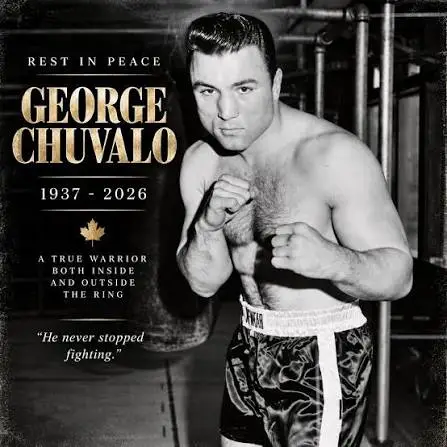
In the violent crucible of heavyweight boxing’s golden era, no prizefighter possessed a physical constitution more impervious to destruction than George Chuvalo. Across a gruelling twenty-two-year professional career spanning ninety-three bouts, the five-time Canadian heavyweight champion stood toe-to-toe with the most lethal punchers in the history of the sport—including George Foreman, Joe Frazier, Floyd Patterson, Cleveland Williams, and Muhammad Ali. Chuvalo absorbed tens of thousands of concussive blows without ever allowing his knees to touch the canvas. He never fell; he was never knocked off his feet; he never took a backward step. While his contemporaries were defined by offensive speed or knockout power, Chuvalo’s legacy was forged through an unyielding, granite durability that redefined the limits of human resilience.
Chuvalo’s international standing was permanently established across twenty-seven ferocious rounds contested against Muhammad Ali. Their encounters—first at Toronto’s Maple Leaf Gardens in 1966 and later at Vancouver’s Pacific Coliseum in 1972—pitted the dazzling, kinetic artistry of the world’s most gifted fighter against an immovable force. Ali was forced to push his physical limits to survive the Canadian’s punishing infighting, enduring internal trauma that sent the champion directly to the hospital. Yet what began as an improvised championship showdown evolved over the next half-century into a deep and genuine brotherhood. Bound by mutual respect and shared combat, the two heavyweight icons remained close friends until Ali’s death in 2016.
Outside the ring, Chuvalo was confronted by personal heartbreak far more devastating than any blows traded in the ring. Following his retirement from boxing, a wave of domestic tragedy struck his family: three of his sons died from drug overdoses and suicide, followed by the suicide of his grief-stricken wife, Lynne. Where such suffering would have shattered most, Chuvalo channelled his grief into a nationwide crusade against youth addiction. Touring schools and youth detention facilities for decades, he transformed his personal grief into a mission of prevention, establishing himself not only as a sporting icon, but as one of Canada’s most enduring figures of moral courage.
Biomechanics of an Iron Chin and the Golden Era Crucible
Born Jure Čuvalo on September 12, 1937, to Croatian immigrant parents, Chuvalo grew up in Toronto’s rugged, working-class industrial neighbourhood of the Junction. His childhood environment provided an unyielding foundation for a prizefighter: his father spent years labouring on the slaughterhouse floor at Canada Packers, while his mother plucked poultry for a penny a bird. Chuvalo took to boxing as an adolescent, developing an unusually muscular 198-pound physique by age fifteen. By eighteen, he had won the Canadian national amateur heavyweight championship and turned professional in 1956, beginning a career that coincided with the most competitive era in heavyweight history.
Boxing analysts and sports historians have often examined the structural mechanics behind Chuvalo’s reputation for having the greatest chin in combat sports. Standing six feet tall and fighting between 212 and 222 pounds, Chuvalo possessed a short, unusually thick neck anchored by broad, heavily muscled trapezius shoulders. This anatomical build effectively dissipated rotational kinetic energy, preventing incoming blows from violently twisting his cervical spine and severing the brainstem signals that cause loss of consciousness. Defensively, Chuvalo advanced behind a tight, classic peek-a-boo guard, tucking his chin firmly against his collarbone while rolling with punches and driving relentlessly into his opponent’s chest.
That physical durability was repeatedly tested against the division’s fiercest punchers. In February 1965, Chuvalo squared off against former heavyweight champion Floyd Patterson at Madison Square Garden in an encounter that The Ring magazine named the Fight of the Year. In 1967, Joe Frazier unloaded his trademark left hook across four bruising rounds, fracturing Chuvalo’s right orbital bone. Chuvalo absorbed the punishment on his feet, never dropping to the canvas, and the referee ultimately stopped the fight solely because of severe facial damage.
In August 1970, Chuvalo faced an undefeated, twenty-one-year-old George Foreman. Foreman, who entered the contest 21-0 and had knocked out nineteen opponents, battered Chuvalo with dozens of unanswered, heavy combinations. Chuvalo did not go down. When referee Arthur Mercante stepped in during the third round to halt the bout, Chuvalo remained standing and immediately protested the stoppage. Foreman later admitted that he entered the bout anxious over Chuvalo’s legendary durability, expressing relief when the referee intervened. Across 93 bouts, ending with a record of 73 wins (64 by knockout), 18 losses, and 2 draws, Chuvalo never once touched the canvas.
Fifteen Rounds at Maple Leaf Gardens in 1966
The first encounter between Chuvalo and Muhammad Ali originated during an intense clash of geopolitics, racial strife, and athletic controversy. In early 1966, the twenty-four-year-old Ali—the reigning undisputed world heavyweight champion—was reclassified 1-A by the Louisville draft board, making him eligible for the military draft during the escalating Vietnam War. Ali refused military service on religious and moral grounds, telling reporters: “I ain’t got no quarrel with them Viet Cong. No Viet Cong ever called me n*****.”
The domestic backlash was instantaneous. Political officials, civic groups, and state athletic commissions denounced Ali’s stance. A scheduled title defence against WBA titlist Ernie Terrell at the Chicago Amphitheatre on March 29 was abruptly derailed when the Illinois State Athletic Commission summoned Ali to apologize for his remarks. Ali stood firm, prompting Illinois Attorney General William G. Clark to declare the proposed fight illegal, which caused municipal venues across the United States to shut their doors to the champion.
Promoter Bob Arum worked with Canadian promoter Irv Ungerman to salvage the bout by relocating it to Toronto’s Maple Leaf Gardens. When Terrell withdrew from the contest over promotional disputes with only weeks remaining, organizers approached Chuvalo, who stepped up to challenge for the world heavyweight title on seventeen days’ notice.
On March 29, 1966, a crowd of 13,540 packed Maple Leaf Gardens. The stylistic contrast was striking. Ali brought unmatched perimeter movement, blazing combinations, and fluid footwork. Chuvalo brought continuous forward pressure, an impervious guard, and devastating inside infighting. Rather than chasing Ali around the ring, Chuvalo cut off angles, trapped the champion against the ropes, and pressed his forehead firmly into Ali’s sternum to eliminate punching leverage. From that inside position, Chuvalo hammered Ali’s ribs, hips, and kidneys with clubbing hooks.
Ali fired crisp combinations to Chuvalo’s jaw and temple, but the Canadian absorbed the blows and continued pressing forward. For fifteen continuous rounds, Ali was forced into high-output, taxing physical exertion. Ali swept the official scorecards to win a unanimous decision, retaining his WBC and Ring magazine belts, but the physical price he paid inside the ring was severe.
Directly after the final bell, Ali’s corner transported him to a local hospital for urgent medical evaluation after he began urinating blood from deep kidney bruising sustained during Chuvalo’s infighting. Chuvalo, by contrast, washed the superficial cuts from his face, put on a tailored suit, and went out dancing with his wife, Lynne. The contrasting scenes sparked one of boxing’s legendary quips:
“When it was all over, he was the guy who went to the hospital because he was pissing blood. Me? I went dancing with my wife. No question, I got the best of that deal.”
In the dressing room, Ali offered an enduring assessment of his challenger, calling Chuvalo “the toughest guy I ever fought.”
Quantitative Breakdown of the Ali vs. Chuvalo Championship Series
The two historic meetings between George Chuvalo and Muhammad Ali highlight the evolving tactical approaches and physical adjustments both men made across their twenty-seven championship rounds:
| Parameter | Ali vs. Chuvalo I (Toronto) | Ali vs. Chuvalo II (Vancouver) |
|---|---|---|
| Date and Venue | March 29, 1966 – Maple Leaf Gardens, Toronto, Ontario | May 1, 1972 – Pacific Coliseum, Vancouver, British Columbia |
| Purse Allocation | Ali: $90,000; Chuvalo: $35,000–$49,000 | Ali: $500,000; Chuvalo: $65,000 |
| Championship Stakes | WBC, NYSAC, and The Ring Heavyweight Titles | NABF Heavyweight Championship |
| Training Preparation | Chuvalo accepted the fight on 17 days’ notice | Chuvalo conducted a complete 8-week scheduled camp |
| Tale of the Tape Ages | Ali: 24 years, 2 months; Chuvalo: 28 years, 6 months | Ali: 30 years, 3 months; Chuvalo: 34 years, 7 months |
| Weigh-in Measurements | Ali: 214.5 lbs; Chuvalo: 216.0 lbs | Ali: 217.5 lbs; Chuvalo: 221.0 lbs |
| Scheduled Distance | 15 Rounds (Went full 15-round distance) | 12 Rounds (Went full 12-round distance) |
| Official Judges’ Decision | Ali won by Unanimous Decision (AP scorecard: 13–2) | Ali won by Unanimous Decision (59–51, 60–46, 58–51) |
| Ali Offensive Profile | High-cadence perimeter dancing, rapid flurries, lateral jabs | Static combination punching, sharp counter-rights off ropes |
| Chuvalo Defensive Tactics | Head-to-chest smothering, inside hooks to torso and hips | High peek-a-boo guard, overhand right counters, inside hooks |
| Post-Fight Outcome | Ali hospitalized for kidney trauma; Chuvalo uninjured | Both men finished upright; Chuvalo’s no-knockdown record held |
The 1972 Vancouver Rematch at Pacific Coliseum
Six years after their Toronto brawl, the two men met again on Canadian soil. By May 1972, the landscape of heavyweight boxing had shifted dramatically. Ali had spent over three years exiled from boxing in the prime of his youth after being stripped of his titles for refusing the draft. After the United States Supreme Court unanimously overturned his conviction in 1971, Ali returned to active competition and suffered his first professional defeat against Joe Frazier in the “Fight of the Century”. Now thirty years old and holding the NABF heavyweight belt, Ali was rebuilding his path toward regaining the undisputed world championship.
Leading into the rematch at Vancouver’s Pacific Coliseum, Ali focused his promotional rhetoric on a clear objective: becoming the first man in history to knock George Chuvalo to the canvas. Speaking to reporters, Ali was direct:
“I’m not gonna let it be said there was ever a heavyweight that didn’t fall. They have pictures showing my heels. Jack Johnson fell, Jack Dempsey fell, Sugar Ray Robinson fell, Joe Frazier fell, and George Chuvalo is gonna fall.”
Chuvalo, thirty-four years old and entering the ring at a sturdy 221 pounds, remained unfazed. Benefiting from a full training camp rather than the short seventeen-day window of 1966, he observed that his tactical maturity compensated for any lost youth: “I’m a better fighter than I was in 1966 and he’s not as good a fighter as he was then.”
When the opening bell sounded in Vancouver, Ali found Chuvalo’s durability as solid as ever. While Ali had lost some of the lightning foot speed that characterized his mid-twenties, his hand speed and combination punching were sharp and accurate. He landed heavy, flush combinations that repeatedly snapped Chuvalo’s head back.
Chuvalo absorbed the impact, held his ground, and countered to Ali’s body and ribs. In the middle rounds, Chuvalo caught Ali with solid overhand rights and sweeping left hooks that forced the former champion to halt his offence and step out of range. Ali took a clear twelve-round unanimous decision, with the judges scoring the contest 59–51, 60–46, and 58–51. Yet Ali’s pre-fight promise of a knockdown went unfulfilled: Chuvalo was still standing at the final bell, his record of never being knocked down intact.
After the bout, Ali praised the Canadian’s durability once more: “I thought I could drop him, but I couldn’t. He took all my best shots, and he hurt me with a couple of hard rights and a hook.”
A Fifty-Year Brotherhood Forged in Ring Combat
The twenty-seven rounds that Muhammad Ali and George Chuvalo shared in the ring established a personal relationship that lasted half a century. In a sport where bitter rivalries often linger long past retirement, the connection between Ali and Chuvalo grew into a lasting bond marked by genuine affection and loyalty.
Chuvalo noted that outside the ring, the theatrical hostility used to sell tickets vanished entirely. When they spoke by phone or met in person, they held to an unspoken rule: they never discussed or argued about their two bouts. “You try to kill each other in the ring, and when something like this happens you feel a great amount of sympathy, of empathy for your former opponent,” Chuvalo explained. “We fought 27 rounds together, and after that we became pretty good buddies… I think if we weren’t fighters we would be buddies anyway. Our personalities meshed in the right way. I always felt good when I saw him.”
Their public reunions drew widespread warmth from sports fans. In October 2002, both fighters appeared at Toronto’s SkyDome before a Toronto Argonauts football game for an advance screening of the National Film Board documentary The Last Round: Chuvalo vs. Ali, directed by Joseph Blasioli and written by Stephen Brunt. The event also served as a fundraiser for Parkinson’s disease research, the neurological condition that had slowed Ali’s speech and motor skills. Greeting his old rival, whose silver hair remained famously thick, Ali gently ran his hand over Chuvalo’s head and joked: “George, you have some pretty hair.”
I remember being at that game with my brother and our father. We waited outside the hotel at the SkyDome in a large crowd and caught a glimpse of Muhammad Ali. It was a memorable moment, for sure. I wish I still had the poster given out at the game to fans in attendance.

In 2012, Chuvalo travelled to Las Vegas to attend Ali’s milestone seventieth birthday gala, marking their final in-person gathering. When Ali died on June 3, 2016, at age seventy-four, Chuvalo mourned the passing of his long-time friend. Speaking from Toronto, Chuvalo reflected on what their shared history meant to him:
“He was a good guy, a friend of mine and I was a friend of his, and when you lose a friend, it’s tough… In retrospect, I realize how important he was to me, and I think I made a difference in his life, to some degree. I admired him probably more than anyone else that I ever fought.”
Domestic Tragedy and the Humanitarian Crusade Against Addiction
Despite absorbing heavy punishment from the greatest punchers of his generation, nothing in the ring compared to the domestic heartbreak that struck Chuvalo’s family in retirement. During the 1980s and 1990s, heroin devastated his household. Chuvalo and his wife, Lynne, raised five children—Mitchell, Steven, Georgie Lee, Jesse, and Vanessa—in their home in west-end Toronto.
The losses began with their youngest son, Jesse. Following a severe motorcycle accident in 1984 that caused chronic knee pain, Jesse was introduced to heroin at a party to help cope with his discomfort. Addiction developed quickly, and Jesse eventually introduced his older brothers, Steven and Georgie Lee, to the drug. On February 18, 1985, unable to break free from his dependency, twenty-year-old Jesse Chuvalo committed suicide in his bedroom.
Georgie Lee and Steven slid into worsening addiction and petty theft, eventually serving prison sentences for pharmacy robberies. On October 31, 1993, just four weeks after being released from prison, thirty-year-old Georgie Lee died of an accidental heroin overdose in a Toronto flophouse. The loss of a second child overwhelmed their mother. Two days after Georgie Lee’s funeral, Chuvalo came home to find forty-nine-year-old Lynne dead in her bed from a fatal overdose of prescription medication. She was found holding a Bible and the urn containing Jesse’s ashes, leaving behind a short note on a grocery receipt: “I looked for love and couldn’t find any.” The compounded trauma left Chuvalo bedridden with grief for weeks.
The tragedies were still not over. Despite repeated intervention and support from his father, Steven struggled with continuous relapse. On August 17, 1996, less than two weeks after completing a prison sentence, thirty-five-year-old Steven Chuvalo was found dead of an overdose in his sister Vanessa’s apartment.
Faced with unimaginable grief, Chuvalo resolved to fight back the only way he knew how. Refusing to retreat into silence, he established the George Chuvalo Fight Against Drugs Foundation. Over the next two decades, Chuvalo travelled across Canada visiting secondary schools, youth correctional centers, and community halls, speaking directly to more than one hundred thousand young people about the realities of drug use.
His presentations were direct and unsparing. Chuvalo would play segments from a 1995 CBC The Fifth Estate documentary that showed his late son Steven speaking openly about his addiction, before stepping to the podium to explain that Steven had died shortly after the footage was filmed. He avoided dry lectures, choosing instead to describe the physical decay, the prison terms, the loss of dignity, and the lasting pain left behind for surviving parents and siblings. By sharing his family’s private tragedy so publicly, Chuvalo helped guide countless young people away from dangerous choices, turning personal sorrow into meaningful community service.
The Cultural Pantheon of a Relentless Canadian Icon
George Chuvalo occupied a unique space in Canadian athletic culture. In a country where sports identity has long been defined by ice hockey, Chuvalo stood out as an enduring national archetype of grit, stubborn courage, and unshakeable resolve.
His contributions both inside and outside the ropes earned him Canada’s top civilian and athletic recognitions. He was inducted into the Canadian Sports Hall of Fame in 1990, the Ontario Sports Hall of Fame in 1995, and the Canadian Boxing Hall of Fame in 1998. In 1998, he was invested as a Member of the Order of Canada (C.M.), the country’s highest civilian honour, and received a star on Canada’s Walk of Fame in 2005. In 2013, the City of Toronto awarded him the Key to the City, while his childhood neighbourhood honoured his legacy by opening the George Chuvalo Community Centre in the Junction.
In his final years, the accumulated physical wear of his boxing career and life’s hardships took their toll, leading to advanced dementia and full-time care. On September 12, 2026, George Chuvalo died on his eighty-ninth birthday, leaving behind an indelible mark on Canadian sports history. Across the country, sports figures, civic leaders, and everyday citizens paid tribute to “Canada’s greatest boxing warrior.”
George Chuvalo’s legacy transcends the remarkable fact that he went twenty-seven rounds with Muhammad Ali without ever being knocked down. Those ring battles proved his physical toughness, but his true strength was revealed in how he carried himself outside the ropes. Confronted by profound domestic tragedy, he stepped forward and dedicated his remaining years to protecting future generations. He took life’s heaviest blows on his feet, never backing down, leaving behind a lasting model of dignity, courage, and perseverance.
Works cited
1. Meet George Chuvalo: The Heavyweight Boxer Who Never Got, https://www.grunge.com/1151067/meet-george-chuvalo-the-heavyweight-boxer-who-never-got-knocked-down/
2. Canadian boxing legend George Chuvalo dead at 89 years old, https://www.mmacrossfire.com/2026/09/12/canadian-boxing-legend-george-chuvalo-dead-at-89-years-old/
3. Canadian boxing great George Chuvalo dead at 89: reports, https://vancouver.citynews.ca/2026/09/12/canadian-boxing-great-george-chuvalo-dead-at-89-reports/
4. George Chuvalo – Rockburn Presents – CPAC.ca, https://www.cpac.ca/rockburn-presents/episode/george-chuvalo?id=aff03d11-8369-4702-8bda-d867ffc38396
5. George Chuvalo – BoxRec, https://boxrec.com/wiki/index.php/George_Chuvalo
6. TIL that retired pro boxer George Chuvalo was never knocked down, https://www.reddit.com/r/todayilearned/comments/yck13c/til_that_retired_pro_boxer_george_chuvalo_was/
7. Ali vs. Chuvalo: Brutality, beauty mingled in truly epic brawl – CBC, https://www.cbc.ca/sportslongform/entry/ali-vs-chuvalo-brutality-beauty-mingled-in-truly-epic-brawl
8. George Chuvalo – Wikipedia, https://en.wikipedia.org/wiki/George_Chuvalo
9. The Canadian Who Faced Down Ali | Hazlitt, https://hazlitt.net/longreads/canadian-who-faced-down-ali
10. Muhammad Ali’s legacy: George Chuvalo reflects on his … – CBC, https://www.cbc.ca/news/canada/george-chuvalo-muhammad-ali-1.3628744
11. Muhammad Ali vs. George Chuvalo – Wikipedia, https://en.wikipedia.org/wiki/Muhammad_Ali_vs._George_Chuvalo
12. Muhammad Ali vs. George Chuvalo II – Wikipedia, https://en.wikipedia.org/wiki/Muhammad_Ali_vs._George_Chuvalo_II
13. The Last Round: Chuvalo vs. Ali – Blu-ray Authority, https://blurayauthority.com/standard-dvd/the-last-round-chuvalo-vs-ali/
14. The Greatest Chin In History: George Chuvalo, https://canadaehx.com/2020/06/13/the-greatest-chin-in-history-george-chuvalo/
15. Ali vs. Chuvalo: Friendship forged in the ring – YouTube, https://www.youtube.com/watch?v=fmvahC_KXF8
16. Muhammad Ali vs Canadian, George Chuvalo, at Toronto’s Maple, https://www.facebook.com/theflyervaults/videos/muhammad-ali-vs-canadian-george-chuvalo-at-torontos-maple-leaf-gardens-in-1966/2574145265941717/
17. George Chuvalo—the Man Who Fought Ali, Frazier, and Foreman, https://www.vice.com/en/article/george-chuvalothe-man-who-fought-ali-frazier-and-foremanis-still-fighting/
18. Our Lady Peace Helps Boxing Legend Knock Sense Into Kids, https://www.samaritanmag.com/our-lady-peace-helps-boxing-legend-knock-sense-kids
19. TOP 10 QUOTES BY GEORGE CHUVALO – A-Z Quotes, https://www.azquotes.com/author/36769-George_Chuvalo
20. Muhammad Ali vs George Chuvalo : r/Boxing – Reddit, https://www.reddit.com/r/Boxing/comments/mwa483/muhammad_ali_vs_george_chuvalo/
21. Heavyweight Showdown, Joe Frazier vs George Chuvalo Highlights., https://www.youtube.com/watch?v=KXIH7ZSuQkw
22. George Foreman Says He Felt Dick Sadler Was “Moving Me Too, https://www.boxing247.com/boxing-news/george-foreman-chuvalo/265410
23. On This Day in 1970 Just 21 years old, George Foreman continued, https://www.facebook.com/btrboxingpodcast/videos/-on-this-day-in-1970just-21-years-old-george-foreman-continued-his-rapid-rise-th/1085289180819301/
24. Muhammad Ali’s fight at Maple Leaf Gardens in 1966 (VIDEO), https://dailyhive.com/toronto/muhammad-ali-fight-maple-leaf-gardens-toronto-1966
25. Bouts with granite-chinned George Chuvalo were Ali’s Canadian, https://www.barrietoday.com/local-news/bouts-with-granite-chinned-george-chuvalo-were-alis-canadian-legacy-310713
26. Muhammad Ali talking about Toronto while sitting at Sully’s gym on, https://www.facebook.com/oldtoronto/posts/muhammad-ali-talking-about-toronto-while-sitting-at-sullys-gym-on-ossington-in-1/942323981827301/
27. Muhammad Ali up close and personal from inside the boxing fraternity, https://www.theguardian.com/sport/2016/jun/05/muhammad-ali-boxing-fighters-verdicts
28. Bout with the great Ali 50 years ago made Chuvalo a Canadian hero, https://calgary.citynews.ca/2016/03/24/bout-with-the-great-ali-50-years-ago-made-chuvalo-a-canadian-hero/
29. Vancouver’s connection to Muhammad Ali | Daily Hive | Offside, https://dailyhive.com/vancouver/muhammad-ali-vancouver-pacific-coliseum
30. Vancouver remembers Muhammad Ali | CBC News, https://www.cbc.ca/news/canada/british-columbia/remembering-muhammad-ali-in-vancouver-1.3616953
31. Muhammad Ali vs George Chuvalo II | HIGHLIGHTS Boxing Fight, https://www.youtube.com/watch?v=JcniB0ASX6Y
32. The Last Round: Chuvalo vs. Ali – Wikipedia, https://en.wikipedia.org/wiki/The_Last_Round:_Chuvalo_vs._Ali
33. George Chuvalo (Profile) | The Canadian Encyclopedia, https://thecanadianencyclopedia.ca/en/article/george-chuvalo-profile
34. Memoir: boxing champ George Chuvalo describes his … – Toronto Life, https://torontolife.com/city/george-chuvalo-memoir/
35. George Chuvalo | The Canadian Encyclopedia, https://thecanadianencyclopedia.ca/en/article/george-chuvalo
36. Legendary Canadian boxer George Chuvalo dies at 89 | Toronto Sun, https://torontosun.com/sports/other-sports/legendary-canadian-boxer-george-chuvalo-dies-on-89th-birthday
37. Canadian boxing legend George Chuvalo has died, https://www.cp24.com/news/sports/2026/09/13/canadian-boxing-legend-george-chuvalo-has-died/



Leave a Reply