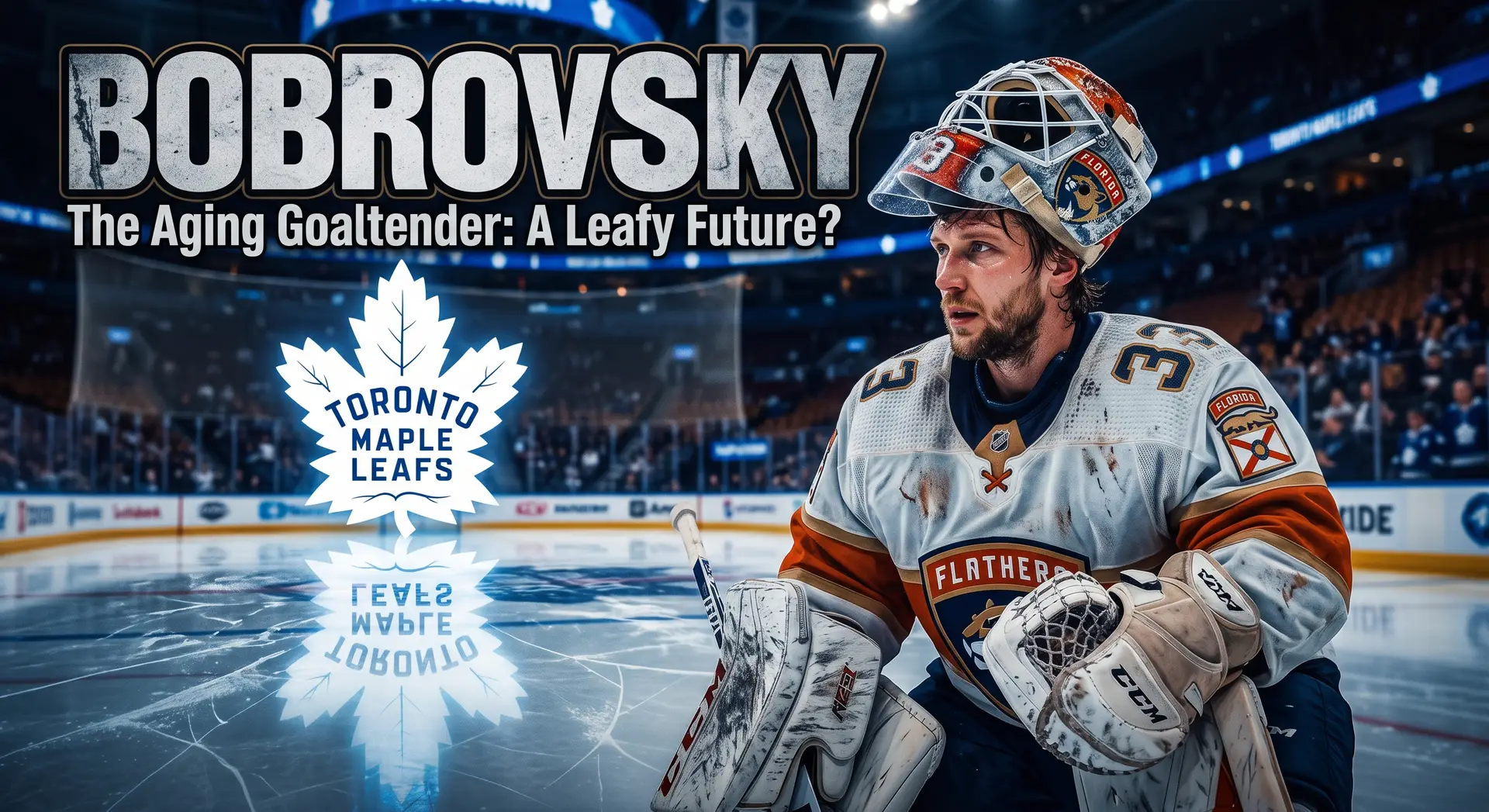
Introduction to a High-Stakes Acquisition
On July 1, 2026, the Toronto Maple Leafs executed a transaction that fundamentally altered the franchise’s trajectory. The Bobrovsky Maple Leafs story is now one of the defining goaltending questions for Toronto’s 2026-27 season. a transaction that fundamentally altered the franchise’s trajectory, signing two-time Stanley Cup-winning goaltender Sergei Bobrovsky to a three-year, $21 million contract. Carrying an average annual value of $7 million, the contract ties a significant portion of the organization’s salary cap to a player who will turn 38 years old before the puck drops on the 2026-27 season.
The acquisition presents a polarizing dichotomy for professional hockey analysts and sports scientists alike. On one hand, Bobrovsky arrives with an undeniable championship pedigree. He was the foundational piece of the Florida Panthers’ back-to-back Stanley Cup championships in 2024 and 2025, defeating the Edmonton Oilers in both iterations and cementing his legacy with a stellar 32-15 record, a 2.26 goals-against average, and a .910 save percentage across 47 playoff games in that span. By contrast, Bobrovsky’s most recent regular season (2025-26) was marked by a severe statistical collapse. Playing 52 games for an injury-riddled Panthers squad that ultimately missed the postseason, Bobrovsky posted a 27-23-1 record with an alarming .877 save percentage and a 3.07 goals-against average.
Evaluating a 37-year-old goaltender requires a multidisciplinary approach. Goaltending is a position intrinsically linked to extreme biomechanical stress, relying on lateral explosiveness, structural hip flexibility, and rapid fast-twitch muscle response. As athletes approach their late thirties, these physical tools inevitably degrade. This report provides an exhaustive examination of how National Hockey League goaltenders age, drawing on historical statistical curves, markerless motion-capture biomechanics research, and precedents from goaltenders who played past age 37. By synthesizing these disciplines, this analysis will deconstruct Bobrovsky’s recent statistical anomalies, evaluate the Toronto Maple Leafs’ ecosystem, and project his viability as a starting goaltender during the critical final years of the Auston Matthews contention window.
The Statistical Aging Curve of NHL Goaltenders
To properly assess the risk profile of the Bobrovsky contract, one must first establish the baseline trajectory of an aging NHL goaltender. A pervasive misconception in hockey evaluation is that goaltenders, like certain defensemen, improve with age and experience due to enhanced situational awareness. Modern hockey analytics categorically refute this. Goaltender performance does not improve with age; rather, it follows a steady, predictable decline that accelerates rapidly once a player enters their mid-thirties.
Traditional aging curves in hockey have historically been flawed because of survivorship bias. If an analyst merely averages the save percentages of all active 37-year-old goaltenders and compares that figure to the average of all 25-year-old goaltenders, the older cohort will often appear statistically superior. This statistical illusion occurs because the 37-year-old cohort consists exclusively of elite, Hall-of-Fame-caliber talents who have survived in the league, whereas the 25-year-old cohort is diluted by fringe NHL players and career backups who will soon be relegated to minor leagues.
To isolate the true effect of biological aging, analysts utilize a year-to-year paired methodology pioneered in the early days of modern hockey analytics. By directly comparing a specific goaltender’s performance in Year 1 to that same goaltender’s performance in Year 2, and then averaging that differential across hundreds of paired goalie seasons, analysts reveal a highly accurate aging curve. This data must also be adjusted relative to the league-wide average save percentage for the respective seasons to account for scoring-environment fluctuations, such as the league-wide save percentage dropping from .915 in 2016 to below .905 in recent years.
Research evaluating over 800 goaltender seasons demonstrates that, setting aside dramatic statistical anomalies, netminder efficiency consistently regresses compared to overall league standards with each passing season. While skater point production often peaks around age 24, plateaus until age 29, and begins a slow decline in the early thirties, goaltender regression begins subtly as early as age 24 or 25. By age 30, the decline becomes noticeably steeper, and by the mid-thirties, goaltenders typically begin to break down both mechanically and statistically.
When modelling goaltenders’ decline past age 35, the analytics community debates between two mathematical fits: a quadratic curve and a linear curve. The quadratic model predicts an accelerating drop-off, often described as a statistical cliff. Under this model, the year-over-year change in save percentage (SV%) relative to the league average drops exponentially. The mathematical projection indicates a drop of -0.005 at age 36, -0.006 at age 37, -0.007 at age 38, and -0.009 by age 40. For a hypothetical goaltender posting a highly elite .920 save percentage at age 35, the quadratic model projects a collapse to .909 by age 37, and a completely unplayable .885 by age 40.
Conversely, the linear model, while slightly less perfectly fit to historical data (value drops by .04), is often viewed as more realistic because it accounts for the gradual, rather than sudden, loss of physical tools in elite athletes. In the linear model, the decline is a steady -0.004 to -0.005 per year from age 35 onward. Under this projection, a .920 goaltender at age 35 degrades to a .912 goaltender by age 37, and a .898 goaltender by age 40.
Applying these models to Sergei Bobrovsky provides critical context. During his age-35 season (2023-24), Bobrovsky posted a .915 save percentage over 58 games and won the Stanley Cup. A strict application of the linear aging curve would project him to operate around a .907 save percentage by his age-37 season. Instead, his metrics plummeted to .877 in 2025-26. This severe underperformance suggests his decline is either following a more aggressive quadratic cliff or is the byproduct of temporary environmental and biomechanical fatigue after deep playoff runs. To determine which is more likely, one must examine the historical precedents of goaltenders who played deep into their thirties.
Historical Precedents of the Thirty-Seven Plus Goaltending Club
To contextualize Bobrovsky’s potential in a Toronto Maple Leafs uniform, we must examine the historical precedents of goaltenders who maintained starting roles at age 37 and beyond. The data indicates that surviving in the National Hockey League at this age is a rarity reserved for the position’s absolute elite, specifically those who rank highly in the all-time save percentage and wins leaderboards.
The following table highlights the age-37-and-beyond seasons of several Hall of Fame or otherwise elite goaltenders, providing a benchmark for what constitutes success in the twilight of a goaltending career.
| Goaltender | Age 37 Season | GP | SV% | GAA | Style and Career Trajectory |
| Dominik Hasek | 2001-02 | 65 | .915 | 2.17 | Unorthodox and flexible; maintained elite status into 40s. |
| Martin Brodeur | 2009-10 | 77 | .916 | 2.24 | Hybrid style; high-volume workhorse protected by defensive structure. |
| Roberto Luongo | 2016-17 | 40 | .915 | 2.68 | Modern Butterfly; highly positional, battled significant hip injuries. |
| Marc-Andre Fleury | 2021-22 | 56 | .908 | 2.90 | Athletic; experienced a sharp statistical dip approaching age 40. |
| Tim Thomas | 2011-12 | 59 | .920 | 2.36 | Battlefly; extreme late peak and unprecedented statistical anomaly. |
| Ed Belfour | 2002-03 | 62 | .922 | 2.26 | Stand-up/Hybrid; elite franchise success immediately post-signing. |
The Toronto Maple Leafs franchise possesses a unique historical relationship with aging goaltenders. The legendary Turk Broda, who won five Stanley Cups with the franchise, played effectively until age 38. Johnny Bower, the face of Toronto’s 1960s dynasty, won Stanley Cups in his late thirties and early forties, ultimately playing 475 games for the franchise and maintaining a career .922 save percentage in an era with vastly different goaltending mechanics.
However, the most glaring modern historical parallel to Sergei Bobrovsky is Ed Belfour. In the summer of 2002, Toronto signed a 37-year-old Belfour to replace Curtis Joseph. Like Bobrovsky, Belfour arrived with a Stanley Cup pedigree (won in 1999 with the Dallas Stars) but faced intense skepticism about his age and a statistical dip in his final season in Dallas, where he posted an .895 save percentage in 60 games.
Belfour then defied the aging curve upon arriving in Toronto. In his age-37 season (2002-03), he posted a 37-20-5 record with a .922 save percentage, earning a Vezina Trophy nomination and finishing fourth among all starting goaltenders in save percentage. He followed this up at age 38 with a .918 save percentage in 59 games, cementing his legacy with 93 wins over 170 games for the franchise. Belfour’s late-career success in Toronto relied on impeccable positioning, dominant puck-handling ability that mitigated the team’s defensive zone time, and a conscious reduction in his reliance on pure athleticism.
Dominik Hasek and Tim Thomas represent statistical anomalies that defy traditional aging models. Hasek holds the highest career save percentage in NHL history (.922) for goaltenders with over 500 games played, and he maintained a save percentage above .920 well into his late thirties and early forties. His success stemmed from a completely unorthodox, flexible style that confused shooters and relied on unparalleled hockey intelligence rather than standard, repeatable butterfly mechanics.
Tim Thomas is perhaps the most unique case study in late-career surges. Thomas peaked at age 36 and 37. In the 2010-11 season, at age 36, he broke the NHL record for save percentage (.938) and led the Boston Bruins to a Stanley Cup with a .940 playoff save percentage. At age 37, he posted a .920 save percentage over 59 games. Thomas’s “battlefly” style was highly aggressive, chaotic, and physically taxing, making his late-career peak a profound deviation from sports science norms.
Elite goaltenders more typically follow the gradual decline seen in Martin Brodeur, Roberto Luongo, and Marc-Andre Fleury. Brodeur played 77 games at age 37 (2009-10) with a highly respectable .916 save percentage. However, Brodeur’s physical load was significantly lighter than modern goaltenders’ because the New Jersey Devils’ neutral zone trap defence suppressed high-danger chances and total shot volume; Brodeur faced 40 or more shots just 19 times in his entire 1,266-game career. By age 40, Brodeur’s save percentage had dipped to .901, perfectly aligning with the linear aging curve.
Roberto Luongo transitioned into his late thirties as a highly technical, positional goaltender. At age 37, injuries limited him to 40 games, though he maintained a .915 save percentage. Luongo’s underlying metrics showed that while his high-danger save percentage dipped slightly as his physical tools slowed, his elite positioning allowed him to post dominant numbers against low- and medium-danger shots, including a .980 save percentage against low-danger shots during his late-career resurgence.
Marc-Andre Fleury presents a cautionary tale of modern athletic goaltending in the late thirties. Fleury remained viable through age 37, but as he approached age 40, his numbers collapsed below the league average. In the 2023-24 season, he posted a .895 save percentage, followed by a .899 the next season, and a .897 over 24 appearances by early 2025. Fleury’s heavy reliance on lateral explosiveness left him vulnerable when his fast-twitch muscle fibres inevitably slowed.
For Sergei Bobrovsky, the path to success at age 37 and beyond relies less on the athletic anomalies of Hasek and Thomas, and more on adopting the positional mastery of Belfour and Luongo. However, Bobrovsky’s foundational style—rooted deeply in the modern butterfly—introduces unique biomechanical challenges that his predecessors did not face to the same degree.
The Biomechanical Toll: Hips, Groins, and the Modern Butterfly
Evaluating a 37-year-old modern goaltender cannot be purely statistical; it must incorporate the biomechanics of the position. The evolution and widespread adoption of the butterfly style have fundamentally altered the physical demands on NHL goaltenders, creating an epidemic of hip and groin injuries.
The butterfly posture forces the hip joints and groin muscles into extreme, unnatural ranges of motion. When a goaltender drops to the ice to seal the lower half of the net, they undergo severe internal hip rotation while the legs abduct out to the sides. According to sports biomechanics research at Dalhousie University, the force of dropping into the butterfly is roughly two times a goaltender’s body weight. For a 200-pound goaltender, this translates to 400 pounds of force impacting the knees and transmitting upward through the femur directly into the hip joint on every single drop. In a modern NHL game, a starting goaltender may drop into the butterfly over 100 times, multiplying the joint’s microscopic trauma.
The repetitive loading of the hip joint at these extreme ranges of motion leads to morphological variations, specifically cam and pincer morphologies, which alter the structural fit between the femoral head and the acetabulum. This results in Femoroacetabular Impingement Syndrome (FAIS), a condition ubiquitous among elite goaltenders. FAIS acts as a cumulative overuse injury, leading to labral tears and severe groin pain.
Advanced markerless motion capture studies using Theia3D have revealed distinct hip movement patterns in goaltenders. Research indicates that early-specialized (ES) goaltenders exhibit greater hip internal rotation and abduction at lower flexion angles, but significantly reduced internal rotation and abduction at higher flexion angles compared to non-early specialized goaltenders. This suggests that elite goaltenders subconsciously develop movement strategies to minimize combined flexion and internal rotation, effectively adopting advantageous hip control strategies to avoid the abnormal hip contact mechanics that trigger pain from FAIS or labral tears.
As goaltenders age into their late thirties, the cumulative cartilage degradation associated with FAIS restricts their ability to achieve the extreme hip internal rotation required to flare their pads and effectively seal the five-hole. Furthermore, the loss of hip abduction limits their lateral push power. When a goaltender can no longer generate explosive power from their inside edges due to structural blockage, their ability to track pucks side-to-side and cover high-danger chances evaporates.
Sergei Bobrovsky’s Biomechanical Evolution
Sergei Bobrovsky’s career trajectory is a fascinating case study in biomechanical adaptation. His survival to age 37 as a starting NHL goaltender is not an accident of genetics; it is the result of a deliberate, radical overhaul of his technique and off-ice conditioning.
Early in his career with the Philadelphia Flyers and Columbus Blue Jackets, Bobrovsky was categorized as a reactive, highly athletic goaltender. His stance was aggressive: he played far out at the top of his crease, with his hands positioned outward and his elbows elevated. He relied heavily on explosive, muscular activation to make cross-crease desperation saves. While this earned him two Vezina Trophies (2013 and 2017) and established him as one of the elite goaltenders of his generation, it also placed catastrophic stress on his groin and hips. Between 2013 and 2016, Bobrovsky suffered multiple debilitating soft-tissue injuries that threatened to derail his career prematurely.
Recognizing the biomechanical unsustainability of his approach, Bobrovsky began working closely with Finnish goalie coach Hannu Nykvist and movement coach Sami Karjalainen in 2015. His on-ice game underwent a structural revolution. He retreated slightly into his crease, sacrificing initial angle depth to reduce the lateral distance required to cover backdoor passes44. He lowered his elbows and brought his hands tighter to his torso, allowing for a more compact core rotation when tracking pucks. He transitioned from a “goalie of motion” to a “goalie of rhythm,” relying on precise, economical edge work to guide his chest to the puck rather than explosive, flailing athleticism.
To combat the degradation of his hips off the ice, Bobrovsky integrated Eastern martial arts—specifically elements of Tai Chi and the Korean martial art han mu du—into his daily routine. His pre-game and practice warmups, famously known in goaltending circles as the “Bobrovsky Shuffle,” focus on low-impact, meditative edge work.
Bobrovsky begins his routine by slowly circling the rink, feeling his skate edges cut into the ice. This is followed by extreme, held C-cuts, balancing on a single skate in slow motion, mimicking compulsory figure skating patterns. He tucks his stick under his arm and rotates his blocker and glove arms to loosen the shoulder capsules. He frequently drops into half-kneeling lateral pushes and full splits, sliding on his inner edges to activate his adductors, hip extensors, and torso stabilizers under controlled, light resistance rather than game-speed trauma. This routine lets him sync his neurological pathways with his musculature, ensuring his hips are maximally lubricated and his edges are perfectly calibrated before facing high-velocity shots.
This meticulous preservation of his biomechanics is the primary reason the Toronto Maple Leafs’ front office felt confident offering him a three-year contract at age 37. Bobrovsky’s body is a highly maintained machine. However, as the 2025-26 statistics show, even the most rigorous maintenance cannot entirely halt the biological aging process under extreme fatigue.
Deconstructing the 2025-26 Statistical Collapse
The paramount concern surrounding Bobrovsky’s arrival in Toronto is his performance during the 2025-26 season. After consecutive gruelling Stanley Cup runs with the Florida Panthers, Bobrovsky’s regular-season statistics suffered a severe decline.
| Metric | 2023-24 Season | 2024-25 Season | 2025-26 Season |
| Games Played | 58 | 54 | 52 |
| Wins | 36 | 33 | 27 |
| Save Percentage (SV%) | .915 | .906 | .877 |
| Goals Against Average (GAA) | 2.37 | 2.44 | 3.07 |
| Shutouts | 6 | 5 | 4 |
A .877 save percentage over a 52-game sample size is a massive liability in the modern NHL. To determine whether this is a permanent biomechanical breakdown (the quadratic cliff) or an environmental anomaly driven by exhaustion, one must examine the underlying shot data and playoff logs.
Advanced metrics reveal exactly where Bobrovsky failed in 2025-26. According to NHL EDGE stats and tracking data, Bobrovsky’s high-danger save percentage plummeted to .758, well below the NHL average of .811, marking his worst performance in the puck-tracking era. Furthermore, his mid-range save percentage dropped to .885, also ranking in the bottom 50th percentile of the league. By comparison, during the 2024-25 regular season, he was tied for eighth in the league in even-strength save percentage (.918) and ranked second in high-danger save percentage during the 2024 playoffs (.843).
The drastic drop in high-danger save percentage is the ultimate red flag for an aging goaltender. High-danger chances—typically resulting from slot passes, rebounds, and cross-crease plays—require rapid lateral explosiveness and the ability to instantly flare the pads while maintaining a tall torso. When a goaltender’s hips degrade, their reaction time to cross-ice passes slows by fractions of a second, and their physical reach in the butterfly narrows. A .758 high-danger save percentage suggests that Bobrovsky was consistently beaten laterally, either due to physical fatigue from the cumulative toll of back-to-back Cup runs, or a permanent loss of fast-twitch response.
Context regarding fatigue is critical to this evaluation. The sheer volume of hockey Bobrovsky played between ages 35 and 37 is virtually unprecedented in the modern era. The table below illustrates the gruelling nature of his 2025 playoff run alone, during which he played 23 high-intensity games en route to his second Stanley Cup.
| Opponent | Games | Bobrovsky SV% | Bobrovsky GAA | Outcome |
| Tampa Bay (Round 1) | 5 | .897 – 1.000 (range) | ~2.00 | Series Win (4-1) |
| Toronto (Round 2) | 7 | .800 – 1.000 (range) | ~2.50 | Series Win (4-3) |
| Carolina (Round 3) | 4 | .870 – 1.000 (range) | ~1.50 | Series Win (4-0) |
| Edmonton (Final) | 7 | .857 – .970 (range) | ~2.20 | Series Win (4-3) |
Over the 2023-24 and 2024-25 seasons combined, Bobrovsky played 112 regular-season games and nearly 50 additional high-stress playoff games. In 2025-26, behind a structurally depleted and equally exhausted Florida Panthers defence, he still logged 52 appearances. The Maple Leafs’ front office, led by General Manager John Chayka, is operating under the hypothesis that Bobrovsky’s .877 season was a product of acute physical and mental exhaustion, rather than terminal decline. By reducing his workload in Toronto, they believe his underlying metrics will rebound to elite levels.
The Toronto Maple Leafs’ Ecosystem and Tandem Dynamics
Sergei Bobrovsky’s viability in a Toronto Maple Leafs uniform during the 2026-27 season hinges entirely on ecosystem management. The days of Bobrovsky playing 60 to 65 games are over; his success relies on structural defensive support and strict workload division.
To insulate Bobrovsky, the Maple Leafs have constructed a traditional starter/backup (1A/1B) tandem, pairing him with his former Florida teammate, Anthony Stolarz. Stolarz provides a fascinating safety net. At 32, Stolarz carries a $3.75 million cap hit and has shown flashes of elite underlying metrics. During the 2023-24 season, serving as Bobrovsky’s backup in Florida, Stolarz posted an exceptional .925 save percentage and a 2.03 GAA in 27 games, operating as one of the league’s premier 1B goaltenders.
However, in his second season in Toronto (2025-26), Stolarz struggled with injuries and inconsistency, posting a 10-10-3 record, a .893 save percentage, and a 3.28 GAA in 26 appearances. Despite these recent struggles, the tandem gives the Maple Leafs two massive, technically sound goaltenders who know each other’s routines.
The ideal workload division for the 2026-27 season would cap Bobrovsky at 40 to 45 starts, with Stolarz handling 35 to 40 games. This structured division is paramount; it gives Bobrovsky the recovery time between starts to maintain his flexibility routine, reduce joint trauma, and prevent the hip inflammation that ruins lateral mobility.
The media has persistently speculated that the Maple Leafs could trade Stolarz to clear roughly $3 million in cap space and upgrade the roster elsewhere. Such a move carries immense risk. If the Leafs trade Stolarz, they would be forced to rely on unproven young goaltender Artur Akhtyamov. Elevating inexperienced rookies exponentially increases the risk of overworking the 38-year-old Bobrovsky, potentially triggering the catastrophic quadratic aging cliff.
A goaltender’s statistics are deeply tethered to the defensive environment in front of him. In the 2026 offseason, Toronto took steps to alter its blue line, acquiring defensemen like Darren Raddysh and reuniting Bobrovsky with his former Florida teammate Oliver Ekman-Larsson, while relying on veterans Morgan Rielly and Jake McCabe. GM John Chayka noted that adding depth and a heavier, more defensively responsible roster was paramount to supporting the goaltending. If Toronto’s defensive scheme can suppress cross-ice passes and limit high-danger odd-man rushes, Bobrovsky’s diminished lateral speed will be masked. However, if the Leafs play a loose, transition-heavy style that forces Bobrovsky into frequent lateral desperation saves, his .758 high-danger save percentage from 2025-26 will likely repeat itself.
Salary Cap Implications and the Auston Matthews Window
The most critical lens for the Bobrovsky signing is the NHL salary cap. The Maple Leafs are navigating the absolute peak of the Auston Matthews contention window, making a three-year, $7 million AAV commitment to a 37-year-old goaltender an immense financial gamble.
Because Bobrovsky signed the contract after the age of 35, the deal is governed by the NHL’s strict 35+ contract rules. These rules were designed to prevent teams from artificially lowering cap hits by back-loading contracts for retiring players, but they carry severe penalties for contracts that age poorly:
- No Buyout Relief: If Bobrovsky’s performance collapses entirely, buying out his contract provides the Maple Leafs with zero salary cap relief. The full $7 million AAV remains anchored to the books.
- Burial Penalties: Assigning Bobrovsky to the American Hockey League (AHL) would provide only minimal, capped relief, leaving the vast majority of the $7 million cap hit on the NHL roster.
- No-Movement Clause (NMC): Bobrovsky has a full NMC, giving him full control over his location and making him untradeable without his explicit consent.
The contract also includes heavy signing bonuses in Years 2 and 3, making it essentially buyout-proof financially and structurally.
The timing of the Bobrovsky contract is highly precarious. The $7 million cap hit runs through the end of the 2028-29 season. Crucially, the 2027-28 season represents the final year of Auston Matthews’ current four-year contract, which carries a $13.25 million cap hit.
Projections for the NHL salary cap suggest an increase to roughly $113 million by 2027-28, and up to $123 million by 2028-29. With the cap rising exponentially, Matthews will be eligible to sign an extension as early as July 1, 2027, with industry projections suggesting his next AAV could enter the unprecedented $25 million territory.
If Bobrovsky returns to his 2024 championship form, the $7 million cap hit is a bargain for a proven, stabilizing presence during Matthews’ prime. However, if Bobrovsky’s .877 save percentage is the new baseline, the Maple Leafs will be forced to negotiate a record-breaking extension with their franchise center while simultaneously suffering a $7 million dead-weight cap anchor. This limits the front office’s ability to allocate funds toward a top-four defenseman or top-six forward depth, effectively suffocating the championship window they attempted to pry open.
Synthesis and Outlook for the 2026-27 Season
The Toronto Maple Leafs’ acquisition of Sergei Bobrovsky is a high-variance maneuver driven by the allure of championship pedigree and the immediate need for crease stability following years of playoff disappointment.
Historically, the odds are stacked against goaltenders operating at elite levels at age 37 and 38. The statistical aging curves mandate a decline, and the biomechanical realities of the modern butterfly style virtually guarantee hip and groin degradation through Femoroacetabular Impingement Syndrome. Bobrovsky’s 2025-26 statistics—particularly his collapse in high-danger save percentage to .758—serve as glaring warning signs that his fast-twitch reflexes and lateral mobility have eroded under the immense weight of 160-plus games played over a 24-month span.
Yet, Bobrovsky cannot be entirely dismissed by the aging curves. His meticulous, martial-arts-driven off-ice routine suggests an athlete who has actively managed his biomechanical decline better than almost any of his peers. If the Maple Leafs deploy him strategically—strictly limiting his starts to roughly 40 games, utilizing Anthony Stolarz effectively, and establishing a rigorous defensive structure that limits lateral seam passes—Bobrovsky possesses the intelligence and positional mastery to replicate the late-career success of Ed Belfour in Toronto.
Ultimately, the 2026-27 season will be defined by load management and structural insulation. If injuries or trades force Bobrovsky to carry the team, the quadratic aging cliff will likely claim another victim. But if the Maple Leafs can protect him structurally and physically, preserving his hips for the postseason, his experience and pedigree may provide exactly the goaltending required to propel the Auston Matthews core toward a championship. The $21 million risk is locked in; the ecosystem built around it will determine the reward.
Works cited
- Bobrovsky signs 3-year contract with Maple Leafs – NHL.com, https://www.nhl.com/news/topic/free-agency/sergei-bobrovsky-signs-three-year-contract-with-toronto-maple-leafs
- Sergei Bobrovsky agrees to three-year, $21M deal with Maple Leafs, https://www.sportsnet.ca/nhl/article/sergei-bobrovsky-agrees-to-three-year-21m-deal-with-maple-leafs/
- Sergei Bobrovsky has signed a three-year contract with the Toronto, https://www.reddit.com/r/hockey/comments/1ukt7mt/sergei_bobrovsky_has_signed_a_threeyear_contract/
- Sergei Bobrovsky’s contract carries a cap risk the Maple Leafs can’t, https://www.hockeypatrol.com/nhl-team/toronto-maple-leafs/sergei-bobrovsky-s-contract-carries-a-cap-risk-the-maple-leafs-can-t-easily-escape
- Sergei Bobrovsky Stats And News | NHL.com, https://www.nhl.com/mapleleafs/player/sergei-bobrovsky-8475683
- Sergei Bobrovsky | NHL Goaltender Career & Stats | InGoal Magazine, https://ingoalmag.com/goaltenders/sergei-bobrovsky/
- Sergei Bobrovsky Stats, Height, Weight, Position, Title, https://www.hockey-reference.com/players/b/bobrose01.html
- The Perceived Demands of Ice Hockey Goaltending Movements on, https://pmc.ncbi.nlm.nih.gov/articles/PMC8647250/
- Butterfly posture getting closer look from teams due to injury impact, https://www.nhl.com/news/unmasked-closer-look-at-butterfly-stance-for-nhl-goalies
- How well do goalies age? A look at a goalie aging curve., https://hockey-graphs.com/2014/03/21/how-well-do-goalies-age-a-look-at-a-goalie-aging-curve/
- Associations Between Early Specialization and Ice Hockey … – jospt, https://www.jospt.org/doi/10.2519/josptopen.2024.0069
- Three Old Goalies Breaking the Curve – The Hockey Writers, https://thehockeywriters.com/3-old-goalies-breaking-the-curve/
- How goalies age, and the survivorship bias problem, https://theleafsnation.com/news/goalie-aging-survivorship-bias
- The perception of Marc-Andre Fleury and what it means for his, https://www.knightsonice.com/marc-andre-fleury-perception-contract-extension-vegas-golden-knights/
- Examining the Decline of Save Percentage in the NHL, https://www.stat.cmu.edu/cmsac/sure/2023/showcase/hockey_saves/report.html
- The NHL forward scoring rate aging curve is brutal. Players peak, https://www.reddit.com/r/hockey/comments/1rl648a/the_nhl_forward_scoring_rate_aging_curve_is/
- The Hockey Aging Curve – Medium, https://medium.com/@mattdesfosses/the-hockey-aging-curve-b0f33b91d1e4
- Goaltender Records – Highest Save Percentage, Career (Minimum, https://records.nhl.com/records/goaltender-records/save-percentage-players-who-debuted-in-1955-56-or-later/highest-save-percentage-career
- NHL Goalies ‑ All-Time Save Percentage Leaders – QuantHockey, https://www.quanthockey.com/nhl/records/nhl-goalies-all-time-save-percentage-leaders.html
- Dominik Hašek – Wikipedia, https://en.wikipedia.org/wiki/Dominik_Ha%C5%A1ek
- NHL & WHA Career Leaders and Records for Save Percentage, https://www.hockey-reference.com/leaders/save_pct_career.html
- Martin Brodeur Stats And News | NHL.com, https://www.nhl.com/player/martin-brodeur-8455710
- Roberto Luongo: News, Stats, Game Logs | RotoWire, https://www.rotowire.com/hockey/player/roberto-luongo-1035
- Marc-Andre Fleury | NHL Goaltender Career & Stats | InGoal Magazine, https://ingoalmag.com/goaltenders/marc-andre-fleury/
- Marc-Andre Fleury, Pittsburgh Penguins, G – News, Stats, Bio, https://www.cbssports.com/nhl/players/433210/marc-andre-fleury/
- Tim Thomas Stats, Height, Weight, Position, Title, https://www.hockey-reference.com/players/t/thomati01.html
- Ed Belfour Stats, Draft & Profile | prospuck, https://prospuck.com/players/ed-belfour
- Toronto Maple Leafs ‑ Goalies All‑Time NHL Leaders – QuantHockey, https://www.quanthockey.com/nhl/teams/toronto-maple-leafs-goalies-career-nhl-stats.html
- Toronto Maple Leafs – Goaltender Records – NHL Records, https://records.nhl.com/tor/records/goaltender-records/seasons-and-games/most-games-played-career
- Toronto Maple Leafs Top 5: Best Goaltenders of All Time, https://theleafsnation.com/news/toronto-maple-leafs-top-5-best-goaltenders-of-all-time
- This is massive for the Leafs to get a goaltender of this … – Facebook, https://www.facebook.com/sportsnet/posts/this-is-massive-for-the-leafs-to-get-a-goaltender-of-this-calibrethe-hockey-cent/1605025080990285/
- Toronto Maple Leafs: Ed Belfour, #5 Goalie on the List – Editor In Leaf, https://editorinleaf.com/2017/08/17/toronto-maple-leafs-ed-belfour-5-goalie/
- Induction Showcase – Ed Belfour – Hockey Hall of Fame, https://www.hhof.com/induction_archives/ind11Belfour.shtml
- Ed Belfour – Wikipedia, https://en.wikipedia.org/wiki/Ed_Belfour
- Who Has The Highest Save Percentage Among Goalies … – StatMuse, https://www.statmuse.com/nhl/ask/who-has-the-highest-save-percentage-among-goalies-with-at-least-500-games-played-in-nhl-history
- Tim Thomas (ice hockey, born 1974) – Wikipedia, https://en.wikipedia.org/wiki/Tim_Thomas_(ice_hockey,_born_1974)
- Where would you rank Tim Thomas all-time when it comes to Bruins, https://www.facebook.com/WEEI/posts/where-would-you-rank-tim-thomas-all-time-when-it-comes-to-bruins-goaltenders/728916189277475/
- “I’m following in the footsteps of Tim Thomas here.” – Facebook, https://www.facebook.com/sportsnet/posts/im-following-in-the-footsteps-of-tim-thomas-here/10154783451266496/
- Am I the only one who thinks Martin Broduer is overrated – Reddit, https://www.reddit.com/r/hockey/comments/9q6919/am_i_the_only_one_who_thinks_martin_broduer_is/
- Martin Brodeur Stats, Height, Weight, Position, Title, https://www.hockey-reference.com/players/b/brodema01.html
- Fleury, Marc-Andre #29 (G) – – NHL 2026/2027 Regular Season, https://www.officepools.com/nhl/entity/player/3341
- Early Specialization in Ice Hockey Goaltenders, https://www.theiamarkerless.com/blog/ice-hockey-goalie-hip-biomechanics-theia3d
- Bobrovsky’s unique routine key to success for Panthers in Stanley, https://www.nhl.com/panthers/news/panthers-sergei-bobrovsky-unique-routine-key-to-success-x1924
- Sergei Bobrovsky’s Mastering of the Modern Crease – Goalie Guru, https://goalieguru.ca/sergei-bobrovskys-mastering-of-the-modern-crease/
- EOTW: The Bobrovsky Shuffle – Goalie Training Pro, https://www.goalietrainingpro.com/goalies/eotw-the-bobrovsky-shuffle/
- Steve Shields Goalie – Bobrovsky Shuffle – YouTube, https://www.youtube.com/watch?v=_ouZCgxnrBE
- NHL EDGE stats: Bobrovsky solidifies Maple Leafs’ Stanley Cup, https://www.nhl.com/news/topic/fantasy/nhl-edge-stats-outlook-sergei-bobrovsky-toronto-maple-leafs-2026-27
- Sergei Bobrovsky – EDGE Stats – NHL.com, https://www.nhl.com/nhl-edge/goalies/sergei-bobrovsky-8475683
- Sergei Bobrovosky Playoff Stats This Season | StatMuse, https://www.statmuse.com/nhl/ask/sergei-bobrovosky-playoff-stats-this-season
- Maple Leafs sign Sergei Bobrovsky to 3-year deal reportedly worth, https://theleafsnation.com/news/report-toronto-maple-leafs-sergei-bobrovsky-3-year-deal-7-million-annually
- A pre-camp projection of the Maple Leafs’ opening night roster, https://theleafsnation.com/news/pre-camp-projection-toronto-maple-leafs-opening-night-roster
- Maple Leafs could pursue even more goaltending depth after, https://editorinleaf.com/maple-leafs-could-pursue-even-more-goaltending-depth-after-signing-sergei-bobrovsky
- Previewing the Maple Leafs’ 2025-26 Depth Chart: Center and, https://mapleleafshotstove.com/2025/08/26/previewing-the-maple-leafs-2025-26-depth-chart-center-and-goaltending/
- Anthony Stolarz Stats And News | NHL.com, https://www.nhl.com/mapleleafs/player/anthony-stolarz-8476932
- Toronto Maple Leafs Predicted to Trade 6-Foot-6 Goalie in Intriguing, https://heavy.com/sports/nhl/toronto-maple-leafs/anthony-stolarz-predicted-trade-intriguing-move/
- Florida Panthers @ NHL – Goalies 2023‑2024 Stats, https://www.quanthockey.com/nhl/teams/florida-panthers-goalies-2023-24-nhl-stats.html
- 2023-24 Florida Panthers Roster and Statistics, https://www.hockey-reference.com/teams/FLA/2024.html
- Stats for player Stolarz, Anthony #41 (G) – 2025/2026 Regular Season, https://www.officepools.com/nhl/entity/player/2025/regular/5734
- Leafs Goalies 2025 2026 – StatMuse, https://www.statmuse.com/nhl/ask/leafs-goalies-2025-2026
- Google Sports Data, https://support.google.com/knowledgepanel/answer/9787176
- Next season will be the third year of Auston Matthews … – Facebook, https://www.facebook.com/thehockeynews/posts/next-season-will-be-the-third-year-of-auston-matthews-four-year-contract-he-earn/1360876906081294/
- Auston Matthews’ next Maple Leafs contract suddenly enters $25M, https://www.hockeypatrol.com/nhl-team/toronto-maple-leafs/auston-matthews-next-maple-leafs-contract-suddenly-enters-25m-territory-after-new-nhl-cap-projection
- Auston Matthews’ next Maple Leafs contract suddenly… – Hockey, https://mapleleafsaggr.com/stories/241705/auston-matthews-next-maple-leafs-contract-suddenly-enters-25m-territory-after-new-nhl-cap-projection


Leave a Reply