I. Introduction: The Dawn of a Golden Age
The image of the Swiss national team after their 1-0 overtime loss to the United States was not one of defeat. It showed resilience. Their strength was evident. This followed the gold medal game of the 2025 IIHF World Championship. It was one of profound arrival. Just one year before, they were in a similar position. They had battled host Czechia and suffered a hard-fought 2-0 loss in the 2024 final. These back-to-back silver medals were forged in the crucible of the world’s most intense annual hockey tournament. They represent more than just heartbreaking finishes. They are the definitive announcement of a new power on the international stage. For decades, Swiss hockey has been characterized by disciplined play, surprising upsets, and a respectable but ultimately non-threatening presence. That era is over. The 2026 Winter Olympics in Milano Cortina will see the return of National Hockey League (NHL) players. It marks their first appearance since 2014. For Switzerland, the timing could not be more perfect.
The Nati have been elevated from a perennial quarterfinalist to a legitimate medal contender. This transformation is due to a golden generation of talent reaching its athletic prime. They have a world-class goaltender. There is also a decade of programmatic stability. Their ascent is shown by their rise to a historic high of second in the IIHF World Rankings. This position reflects their sustained excellence against the globe’s best. This achievement is not just a fleeting moment. It is the result of a long-term strategy. This strategy has produced a roster with unprecedented top-end talent.
This preview will argue that the Swiss team poised to compete in 2026 is the strongest in the nation’s history. The team is built around a core of elite NHL superstars. It is supported by high-caliber professionals from Europe’s strongest domestic league. A goaltender, who has proven he can steal games on any stage, backstops them. While the traditional powers of Canada, the United States, and Sweden will enter as favorites, Switzerland has exceptional skill. Their team chemistry is unique. Their strong belief makes them the most dangerous dark horse in the tournament. The championship window for this specific group of players is open. The 2026 Games represent the apex of their opportunity. They aim to turn silver into the ultimate prize.
II. The Beijing Anomaly: A Tale of Two Rosters
To appreciate the potential of the 2026 Swiss Olympic team, one must first examine their past. This means addressing and contextualizing their performance at the 2022 Winter Olympics in Beijing. On paper, the result was a profound disappointment. The team finished eighth. They failed to win a single game in the preliminary round and bowed out in the qualification playoff. They fell 1-0 in a tight defensive struggle against the Russian Olympic Committee. They were defeated 5-3 by an upstart Danish squad. They also lost a 2-1 heartbreaker in a shootout to Czechia.
However, the 2022 tournament must be viewed not as a predictive failure, but as a crucial control experiment. The NHL decided not to participate. As a result, the Swiss roster was composed entirely of players from European leagues. The vast majority hailed from their own domestic National League (NL). The team featured respected veterans like the indefatigable Andres Ambühl. It also included former NHL defenseman Raphael Diaz. However, it was fundamentally a different squad from the one that has since reached consecutive World Championship finals.
The contrast is stark and illuminating. The 2022 Olympic team had the same highly regarded head coach, Patrick Fischer. They also had a similar core of European-based players. This was shared with the silver-medal-winning 2024 and 2025 World Championship teams. The single, glaring variable between these squads was the absence or presence of Switzerland’s NHL contingent. In 2022, without their top stars, the team struggled to generate offense and finished last in their group. In 2024 and 2025, the program saw the infusion of players. These players included Roman Josi, Nico Hischier, Kevin Fiala, and Timo Meier. This transformed the team into a powerhouse. It dominated group play and battled for gold until the final buzzer.
The results show a dramatic divergence. They isolate the NHL players as the primary driver of Switzerland’s elevation. The team has moved from a competitive, hard-working team to a truly elite, medal-winning force. The Beijing experience inadvertently proved the strength of the Swiss domestic program. It provides a robust and professional foundation. However, the top-tier, game-breaking talent honed in the NHL makes them a threat to the world’s best. Therefore, the 2022 results should be largely dismissed when forecasting for 2026. They only serve to underscore the monumental and transformative impact of the players who are set to return.
III. The NHL Brigade: An Elite Core Unmatched in Swiss History
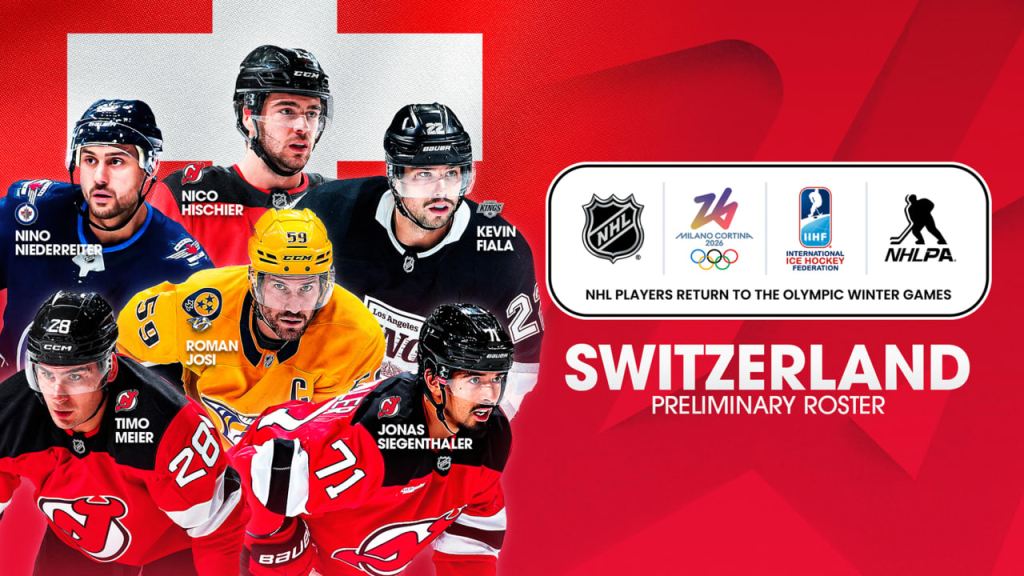
The foundation of Switzerland’s medal hopes for 2026 rests on a group of NHL players. These players represent the most talented and accomplished generation in the nation’s history. This is not a team with one or two token stars. It is a lineup featuring elite players at key positions. Many of these players are in the absolute prime of their careers. The Swiss Ice Hockey Federation confirmed this reality by naming six NHLers as the first players on its preliminary roster. This signals that the team’s identity will be forged around this core.
The Quarterback: Roman Josi
Roman Josi is at the heart of the Swiss defense. He is the longtime captain of the Nashville Predators. Josi is also one of the premier offensive defensemen in the world. Josi is more than just the team’s best defender; he is its on-ice engine and power-play quarterback. He won the Norris Trophy in 2020 as the NHL’s top defenseman. His offensive dynamism from the blue line is unmatched by most countries. With 724 points in 962 career NHL games, his ability to transport the puck is elite. He creates scoring chances. He runs a power play with excellence. His value was on full display at the 2024 World Championship, where he was named the tournament’s Top Defender. In Milano Cortina, Josi will be the workhorse. He will log heavy minutes in all situations. He will serve as the catalyst for the Swiss attack.
The Offensive Triumvirate
Leading the forward group is a trio of dynamic, high-impact scorers. They provide Switzerland with a legitimate top line. This line is capable of competing with any in the tournament.
- Nico Hischier (New Jersey Devils): Hischier is the captain of both the Devils and the 2024 national team. He has grown from a promising first-overall draft pick. He is now one of the NHL’s elite two-way centers. His defensive responsibility provides a crucial anchor for his line, allowing his more offensively-minded wingers to flourish. Yet, his own offensive game has exploded, evidenced by a career-high 35 goals in the 2024-25 season. His established chemistry with Devils teammate Timo Meier is a significant built-in advantage for the Swiss.
- Kevin Fiala (Los Angeles Kings): Fiala is arguably the most purely skilled and creative offensive player on the roster. He is a game-breaker. He recorded a career-best 35 goals in 2024-25. He has established himself as a consistent scoring threat for the past six NHL seasons. His performance at the 2024 World Championship was electrifying. He earned the tournament’s Most Valuable Player award. This showcased his ability to dominate on the international stage.
- Timo Meier (New Jersey Devils): Meier adds power and physicality. This dimension perfectly complements the skill of Hischier and Fiala. He has scored 20 goals in seven NHL seasons. He is a high-volume shooter. He excels in the tough areas of the ice. His size (6’1″, 220 lbs) combined with his scoring touch makes him a nightmare for opposing defenses. He is also a formidable presence on the power play.
The Supporting Stars
Beyond the headline names, Switzerland boasts a supporting cast of established NHL regulars who provide critical depth and versatility.
- Nino Niederreiter (Winnipeg Jets): Nino Niederreiter has played in the NHL for 15 years. He is a prototypical power forward with a proven scoring record. He has amassed 240 goals in his career. He provides a valuable net-front presence on the power play. He also brings a wealth of experience from nine World Championships and the 2014 Sochi Olympics.
- Jonas Siegenthaler (New Jersey Devils): The perfect defensive complement to Roman Josi, Siegenthaler is a pure shutdown defenseman. His value lies not in points. It is in his ability to neutralize the opposition’s top forwards. He can block shots and anchor the penalty kill. This defensive stability allows Josi the freedom to activate offensively, creating a balanced and highly effective top pairing.
- J.J. Moser (Tampa Bay Lightning): Moser represents the next wave of Swiss talent. He has developed into a reliable, mobile, and intelligent defenseman. He has carved out a regular role in the NHL. His smooth skating will be vital for a Swiss defense. His calm puck management will help them transition the puck quickly.
- Pius Suter (St. Louis Blues): A highly versatile and defensively responsible forward, Suter is the ideal middle-six center for a tournament team. His strong defensive analytics at the NHL level make him a trustworthy player. He can be relied upon in critical defensive situations and on the penalty kill. He also provides secondary scoring.
This collection of players is not merely a group of talented individuals; their skills are remarkably synergistic. The team has a true number-one offensive defenseman, Josi. They also have a premier two-way center, Hischier. Additionally, there is a diverse array of scoring threats with Fiala’s skill, Meier’s power, and Niederreiter’s net-front game. They have a perfect balance of offensive and defensive specialists on the blue line. This complementarity is inherent. It is bolstered by pre-existing chemistry among the three Devils players. This gives Switzerland a cohesive and dangerous core. It is arguably the best in its history.
IV. The European Contingent: Depth, Experience, and Goaltending Supremacy
The NHL brigade provides the star power. However, Switzerland’s legitimate claim to a medal rests just as heavily on the strength of its European-based professionals. Most critically, it relies on its goaltending. The high quality of the domestic National League (NL) has created a deep talent pool. This pool provides the national team with a supporting cast. This cast is far superior to that of many rival nations.
The single most important player for Switzerland’s Olympic hopes may be goaltender Leonardo Genoni. The veteran from EV Zug is the team’s undisputed number one. His recent international performances have been nothing short of spectacular. At the 2025 World Championship, he was named the tournament’s Most Valuable Player after posting a stunning 0.99 goals-against average and a .953 save percentage across seven games. This was no anomaly. Even at the 2022 Olympics, behind a much weaker, non-NHL roster, Genoni was sensational, recording a 1.13 GAA and a .961 save percentage. He can perform at a world-class level, no matter which team is in front of him. This ability gives Switzerland a chance to win any game against any opponent. He is the ultimate equalizer. Providing capable backup will likely be Akira Schmid, who has valuable NHL experience with the New Jersey Devils.
Anchoring the skater group from Europe is the legendary Andres Ambühl. By the time of the Milano Cortina Games, he will be 42 years old. The HC Davos forward is expected to compete in his sixth Olympic tournament. This is a remarkable testament to his longevity and enduring effectiveness. His leadership and experience are immeasurable assets in the dressing room and on the ice.
The offensive depth is bolstered by a number of former NHL players who have become dominant forces in the NL. Denis Malgin and Sven Andrighetto, both of the ZSC Lions, provide potent secondary scoring. They are comfortable on the big ice surface. Malgin, in particular, has been a near point-per-game player for Switzerland in recent World Championships. He has proven he can produce against top international competition. On defense, veterans like
Dean Kukan and Christian Marti bring years of professional experience. They have had stints in the NHL. They round out the blue line with steady, reliable play.
The strength of this European contingent is a direct result of the economic power of the Swiss National League. The NL is one of the highest-paying leagues in the world outside of North America. It provides a “soft landing” for Swiss players who may be on the bubble of the NHL. Players like Malgin and Kukan do not need to grind in the American Hockey League. Nor do they need to scatter to other European leagues. Instead, they can return home to a highly competitive environment. They are well-compensated in this setting. This repatriation of talent enriches the domestic league. It also keeps these high-level players fully integrated within the national team system under Coach Fischer. This results in a stronger, more cohesive bottom-six forward group. It also produces a third defensive pairing better than many rivals can boast. This is a critical advantage in the tight, grueling games that define Olympic hockey.
V. Forging the Roster: A Projection for Milano Cortina
Assembling the final 25-man roster will be a challenging task for Patrick Fischer and his staff. This task is a testament to the newfound depth of the Swiss talent pool. The core of the team is already set. It is built around the six initially named NHL stars. Other locks include J.J. Moser, Pius Suter, and Leonardo Genoni. The remaining spots will be a fierce competition between established NL veterans and a small group of emerging prospects.
The most intriguing prospect with a legitimate chance to crack the 2026 roster is defenseman Lian Bichsel. Bichsel was a first-round draft pick of the Dallas Stars in 2022. He brings a rare combination of size (6’6″, 227 lbs) and defensive acumen. His shutdown potential is significant. His physical presence could be invaluable for a team. Such a team will need to contain the high-powered offenses of Canada and the United States. A strong 2025-26 professional season could see him force his way onto the final roster, likely in a third-pairing role. The Swiss junior system continues to produce talent. This is evident in the U20 rosters and CHL Import Draft selections. However, other prospects are likely a cycle away from Olympic consideration.
Recent international rosters provide insights into player performance and projected roles. As a result, the following is a potential 25-man roster for the 2026 Winter Olympics.
| Position | Left | Center | Right |
| Line 1 | Kevin Fiala | Nico Hischier | Timo Meier |
| Line 2 | Nino Niederreiter | Pius Suter | Philipp Kurashev |
| Line 3 | Sven Andrighetto | Denis Malgin | Gregory Hofmann |
| Line 4 | Christoph Bertschy | Gaetan Haas | Andres Ambühl |
| Extras | Damien Riat | Calvin Thürkauf | |
| Pair 1 | Roman Josi | Jonas Siegenthaler | |
| Pair 2 | J.J. Moser | Dean Kukan | |
| Pair 3 | Lian Bichsel | Michael Fora | |
| Extras | Christian Marti | Andrea Glauser | |
| Starter | Leonardo Genoni | ||
| Backup | Akira Schmid | ||
| Third | Reto Berra |
This projected lineup showcases Switzerland’s strengths. The top six forwards are all current NHL players, providing two potent scoring lines. The bottom six is filled with experienced, high-level European professionals who understand the international game. The defense is balanced. An elite offensive driver (Josi) is paired with a pure shutdown defender (Siegenthaler). There is also a mobile second pair (Moser, Kukan). Finally, a physical, defensive third pair (Bichsel, Fora) adds to the lineup. And in net, they have one of the best international goaltenders of the past decade.
VI. The Patrick Fischer Effect: Culture, System, and a Decade of Progress
Behind every successful team is a guiding force, and for Switzerland, that force has been head coach Patrick Fischer. His tenure, which began in December 2015, represents a period of unprecedented stability and success for the national program. The world of international coaching is often volatile. Fischer’s leadership for nearly a decade has enabled him to implement a consistent system. More importantly, he has cultivated a powerful team culture.
Fischer’s record speaks for itself. He has been the architect of all of Switzerland’s modern triumphs. He led the team to silver medals at the IIHF World Championships in 2018. They also achieved silver medals in 2024 and 2025. He was an assistant coach on the 2013 squad. The team broke a 60-year medal drought by earning a silver medal. This track record demonstrates a clear ability to get the most out of his players on the biggest stages.
Perhaps Fischer’s most significant achievement has been creating a “family-first” culture. This approach has fostered remarkable buy-in from the country’s top players. Many mid-tier hockey nations have a historical challenge. They struggle to convince their NHL stars to commit to the grueling World Championship tournament. This happens after a long NHL season. Under Fischer, however, Swiss players like Josi, Hischier, Fiala, and Meier have consistently shown willingness. They are enthusiastic to represent their country whenever available.
This is not merely a matter of patriotism. It is a testament to the positive environment Fischer and his staff have built. They have built a professional environment. This consistent participation has had a profound compounding effect. It allows the core of the team to build chemistry. The team can refine tactical systems. They forge a collective identity year after year. Consequently, when the Olympics arrive, the Swiss are not assembling a disparate group of all-stars for the first time. They are activating a well-oiled machine. It is a cohesive unit with established relationships. They have a deep-seated belief in their system and each other. This cultural continuity is a direct result of Fischer’s masterful long-term program management. It provides a significant competitive advantage over teams that may only unite their best talent once every four years.
VII. Conclusion: The Path to the Podium
The Swiss Men’s National Ice Hockey Team is approaching a historic crossroads. The 2026 Winter Olympics in Milano Cortina are near. The elements for a medal-winning performance are firmly in place. A golden generation of NHL talent is performing at its peak. A Norris Trophy-winning defenseman will lead the charge. There is a world-class, MVP-caliber goaltender capable of stealing any game. A stable, proven coaching staff has fostered a culture of commitment and belief. The back-to-back silver medals at the World Championships were not a culmination. They were a clear and undeniable warning shot to the rest of the hockey world.
However, the path to the Olympic podium is fraught with challenges. The primary question facing the Swiss will be their depth scoring. While their top-six forward group can trade chances with anyone, the bottom-six consists mainly of European-based players. They will need to prove they can consistently contribute. This must be done against full-strength Olympic rosters from Canada, the United States, Sweden, and Finland. This is a test far more rigorous than the World Championships.
Furthermore, the team must navigate a new psychological landscape. For years, Switzerland has thrived as the underdog, a disciplined and dangerous team capable of a shocking upset. In Milano Cortina, they will arrive with genuine expectations for the first time. How this group handles the immense pressure of being a legitimate medal contender will be crucial. It is on the world’s biggest sporting stage. This will be a critical factor in their success.
Despite these hurdles, the conclusion is clear: Switzerland is a bona fide medal threat. Capturing gold against the sheer depth of a nation like Canada is a monumental task. However, this Swiss team has all the necessary ingredients to win a knockout game against any opponent. They have a unique combination of elite high-end skill. Their foundational goaltending is outstanding. Programmatic cohesion completes their strengths. This combination makes them perfectly built for a short, high-stakes tournament. A bronze medal is a realistic and achievable goal. Returning to the gold medal game for a third consecutive major tournament would surprise no one. The 2026 Olympics provide the greatest opportunity in Swiss hockey history. It is a chance to finally turn silver into gold. They can cement their place among the world’s elite.

 ScortonBoy17.ca
Leave a comment