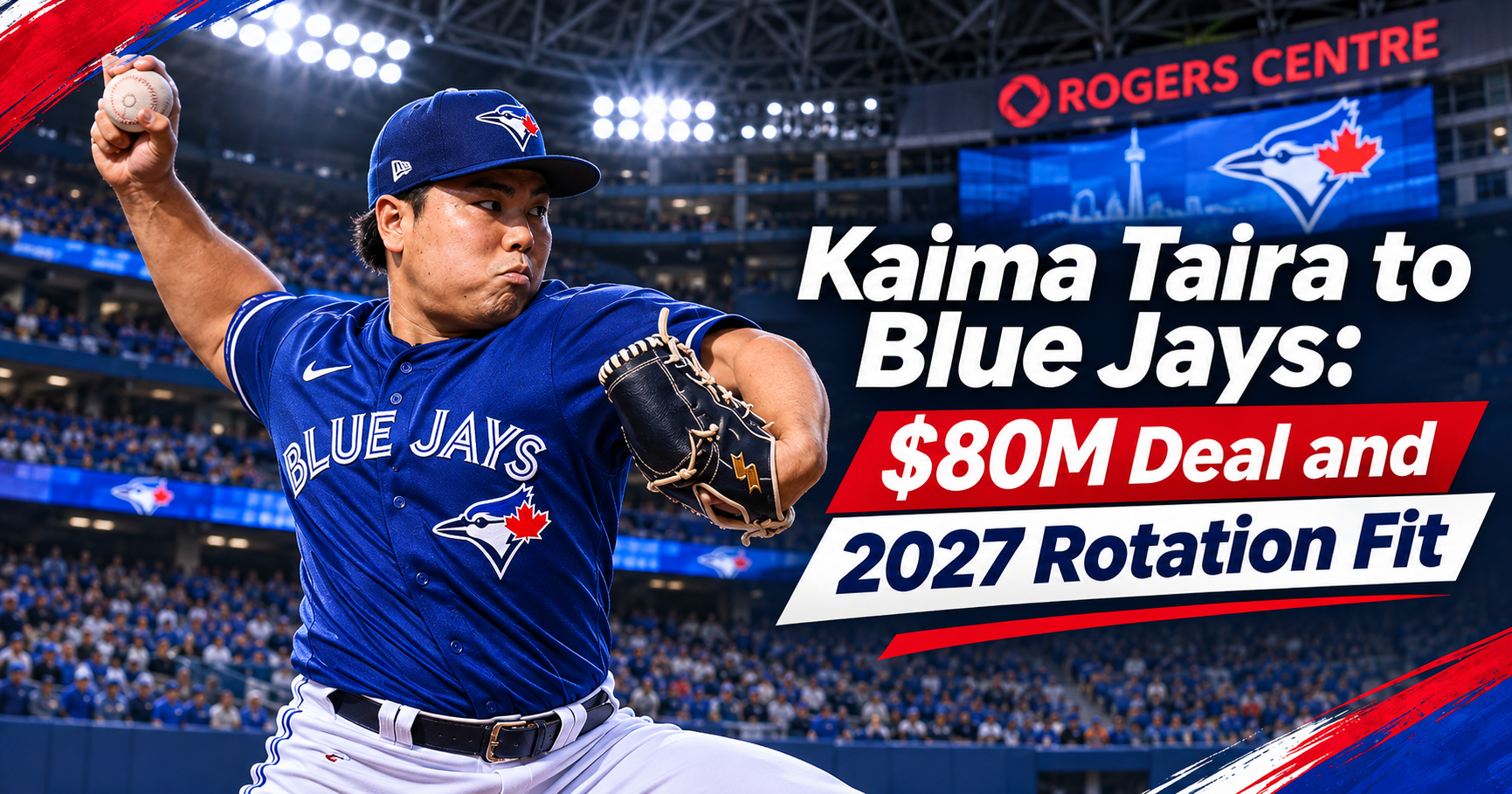
With their reported five-year, $80 million agreement with Japanese right-hander Kaima Taira on November 24, the Toronto Blue Jays are bringing one of baseball’s rarest biomechanical weapons into a starting rotation badly in need of swing-and-miss upside. Standing 5-foot-8 and carrying a dense, weight-room-forged 209-to-220-pound frame, the 27-year-old looks nothing like a prototype major league starter. Yet he arrives in Toronto as Nippon Professional Baseball’s reigning ERA champion (1.36 across 146 innings for the Saitama Seibu Lions in 2026) and arguably the most data-driven pitcher ever to come over via the posting system.
What Taira gives Toronto is not Cy Young certainty—his limited starting track record, a 2024 right forearm flexor strain, and conservative MLB translation projections make this a genuine high-wire wager. Instead, he brings an outlier skill set that directly addresses the leaks in Toronto’s 2026 starting staff: upper-90s heat launched from a sub-5-foot release point, an unusually deep seven-to-eight-pitch repertoire, plus command, and an elevated ground-ball rate that plays directly into Toronto’s elite defence and MLB-leading catcher framing.
Paired with ace Dylan Cease, hard-throwing José Soriano, and towering second-year starter Trey Yesavage, Taira represents both a tactical weapon and a philosophical pivot. After tumbling from a Game 7 World Series appearance in 2025 to a 79–83 last-place finish in the American League East in 2026—and falling short on top free-agent starters Tarik Skubal, Trevor Rogers, and Freddy Peralta—Toronto declined to settle for a safe, low-ceiling innings-eater. By betting on Taira, general manager Ross Atkins is trading conventional rotation floors for uncomfortable, high-ceiling upside—even if maximizing him will require rethinking how a five-day rotation works.
Inside the Deal: Why $80 Million Buys High-Upside Optionality
Toronto’s pursuit of Taira came together rapidly after the Mets topped the Blue Jays’ reported nine-year, $420 million bid for Skubal with a record $450 million contract, and after Rogers (Cubs) and Peralta (Orioles) signed within two days of each other. Negotiating with agent Scott Boras just ahead of Major League Baseball’s December 1 collective bargaining agreement expiration and expected lockout, the Blue Jays structured a contract that stretches guaranteed years in exchange for a manageable annual luxury-tax hit while handing Taira a prime-age opt-out.
| Contract Component | Agreed Blue Jays Terms | Market Context & Pre-Signing Projections |
| Base Guarantee & Length | 5 years, $80 million (2027–2031) | MLB Trade Rumours projected 4 yrs, $ 72 M (18M AAV); Keith Law (The Athletic) projected 3 yrs, 54M(18M AAV) |
| Luxury Tax (CBT) AAV | $16.0 million per season | Raises Toronto’s projected 2027 CBT payroll near $250M (down from $317 M in 2026); FanGraphs estimates ~ $267.1M total 2027 payroll |
| Signing Bonus | $5.0 million | Delivers upfront cash ahead of a potential 2027 work stoppage |
| Posting Fee (Seibu Lions) | $13.875 million | Standard MLB–NPB tier formula: 20% of first 25M(5.0M) + 17.5% of next 25M(4.375M) + 15% of final 30M(4.5M) |
| Total Financial Outlay | $93.875 million | Roughly 21% of the $450M the Mets committed to Tarik Skubal |
| Player Opt-Out | After Year 3 (following 2029 season) | Let’s Taira re-enter free agency after his age-29 season; Toronto could recoup a draft pick if the qualifying offer survives the next CBA |
That third-year opt-out introduces classic free-agent asymmetry, and Toronto’s willingness to absorb it underscores how urgently the rotation needed impact arms. If Taira settles in as a mid-to-frontline starter, the Blue Jays get three prime seasons (ages 27 through 29) at $16 million per year—a clear bargain in a market where frontline starters command $25 million to $30 million annually. If he opts out after 2029, Toronto will have extracted substantial surplus value. Conversely, if Taira opts in for 2030 and 2031, it likely means injuries or a bullpen move capped his ceiling, leaving Toronto carrying $32 million over those final two years. Still, because Taira already holds an elite closer’s résumé as a built-in floor, the downside carries far less dead-money risk than a standard mid-tier starter deal.
The Physics of a 5-Foot-8 Outlier: Release Height, Extension, and Flat-Plane Heat
The first thing anyone notices about Kaima Taira is his silhouette. Listed at 5-foot-8 and 209 to 220 pounds—the product of intensive offseason strength training—evaluators have described him as “a cannonball on the mound” or “built like a tank,” drawing visual comparisons to catcher Alejandro Kirk’s compact center of gravity and former Blue Jays starter Marcus Stroman (5-foot-7). Unlike traditional undersized pitchers who survive on sinkers and guile, however, Taira pitches like a power ace. His four-seam fastball averaged 95.8 mph in 2026, sat at 96 mph or higher in eight of his final ten NPB starts, and regularly touches 99 to 100 mph deep into outings.
Generating triple-digit velocity from a 5-foot-8 frame is no accident. The Japan Times profiled Taira as “Japanese baseball’s most data-driven pitcher,” noting that he blends an engineer’s mindset with an ace’s competitiveness—studying ground force, back-leg drive angles, and velocity mechanics at Belluna Dome while sharing pitching breakdowns on his personal YouTube channel. That explosive lower-half push allows him to release the ball 6.8 feet in front of the rubber—well beyond the 6.5-foot MLB four-seam average and even farther down the mound than 6-foot-4 Freddy Peralta (6.6 feet)—while releasing from an ultra-low 4.94-foot vertical height.

That release geometry explains why Taira’s heater gets swings and misses even though scouting reports note it lacks classic, towering vertical “ride”. When a 96-to-99 mph fastball leaves a hand under five feet off the ground and 6.8 feet closer to home plate, it travels on an unusually flat vertical approach angle (VAA). To hitters calibrated for steeper downward trajectories, the pitch appears to “take off” above the barrel. According to 2026 NPB Enterprise pitch-tracking data reported by MLB.com, Taira’s four-seamer produced a 27% whiff rate, comfortably beating the roughly 22% MLB four-seam average.
Just as compelling is the cultural fit between Taira’s curiosity and Toronto’s pitching department, led by Pete Walker and Sam Greene. The Blue Jays will not have to sell Taira on biomechanics, pitch-shape modelling, or Statcast adjustments—he already builds his craft around them.
Decoding the Eight-Pitch Toolbox: How Taira Neutralizes Both Sides of the Plate
While the fastball grabs headlines, the breadth of Taira’s secondary repertoire is what separates him from recent NPB starters who have struggled to navigate major league lineups multiple times through the order. Depending on whether tracking outlets split his tighter slider from his wider sweeper, Taira works with seven to eight distinct pitches: a four-seam fastball, sinker, cutter, slider, sweeper, changeup, splitter, and curveball.
Rather than leaning on one signature secondary and hoping it holds up against opposite-handed bats, Taira deploys two distinct two-strike attack plans depending on batter handedness, anchored by a splitter and command profile that both earn plus (60-grade) marks on FanGraphs’ 20-to-80 scouting scale.

Within that mix, Taira’s low-90s cutter deserves particular attention against AL East lineups. While FanGraphs assigns the cutter an average 50 grade, other scouting evaluations are far more bullish—Blue Jays Nation grades it a 60-grade putaway pitch, and Just Baseball calls it arguably his best offering. The 2026 results explain why: because left-handed hitters fared better against his four-seamer, Taira leaned on the cutter as an in-zone bridge between his heater and breaking balls, holding opponents to a .165 batting average with just one extra-base hit all season. Paired with a low-to-mid-80s splitter that drops vertically for whiffs (29% two-strike usage against lefties) and a harder, armside-running changeup that steals strikes for weak contact, he enters MLB with a credible blueprint for neutralizing left-handed power.
At the same time, spring training in Dunedin may involve some selective pruning. MLB.com noted that Toronto’s pitching staff could look to narrow or refine Taira’s usage once camp opens. Sprinkling in a 40-grade get-me-over curveball or occasional sinker can steal early strikes in NPB, where hitters often sit on patterns, but against aggressive MLB sluggers, consolidating volume around his four-seamer, cutter, splitter, and slider/sweeper core could sharpen his strikeout efficiency.
From Relief Record-Breaker to NPB ERA King: Tracing the Career Arc
The central fault line among evaluators this winter—whether Taira is a legitimate mid-rotation starter or a high-leverage reliever in disguise—stems directly from his history as a winding role player with the Saitama Seibu Lions. Selected in the fourth round of the 2017 NPB draft out of Yaeyama Commercial High School in Okinawa, Taira debuted in 2019 at age 19 and quickly became Japan’s most overpowering reliever. He captured 2020 Pacific League Rookie of the Year honours with a 1.87 ERA and 33 holds, set an NPB record with 39 consecutive scoreless mound appearances in 2021 while becoming the first Pacific League pitcher to record both 20 holds and 20 saves in the same season, and pitched on Team Japan’s gold-medal squad at the Tokyo Olympics.
His transition to starting, however, took an unusual detour—spanning a strong 2023 debut in the rotation, an injury-shortened 2024 campaign, reported usage disagreements with Lions management that pushed him back to the closer role for 31 saves in 2025, and a triumphant return to the rotation in 2026.

Across 592.0 first-team NPB innings over eight seasons, Taira went 37–24 with a 1.78 ERA, 620 strikeouts (9.4 K/9), and a 1.091 WHIP (or a 1.85 ERA and 676 strikeouts over 633.2 innings when including farm-team appearances). What stood out in his 2026 return to the rotation was genuine skill growth: he trimmed his walk rate for a third straight year to 7.9% (2.77 BB/9), nudged his ground-ball rate up to 48.5% (from 46.2% in 2023), and surrendered just four home runs in 146 innings (0.25 HR/9)—giving up only five homers total across his last three NPB seasons.
At the same time, his 2026 surface stats warrant realistic calibration. Taira’s 1.36 ERA meaningfully outperformed his 2.28 FIP and 2.83 xFIP, aided by a lofty 86.3% left-on-base rate and a .245 BABIP. A 2.28 FIP paired with a 16.9% K-BB differential (24.8% strikeout rate minus 7.9% walk rate) and a 0.959 WHIP still marks him as one of NPB’s premier arms, but it profiles more realistically as a strong mid-rotation MLB starter than a sub-2.00 phenom.
How Taira Fits Toronto’s 2027 Rotation—and Creates an AL East Visual Nightmare
To see why Toronto aggressively targeted Taira, look back at what unravelled during the 2026 campaign. Offensively, the Blue Jays hit a wall—finishing 30th in Major League Baseball in runs per game (4.00), home runs (152), and isolated power (.134) despite Kazuma Okamoto’s breakout power campaign at third base (33 home runs entering the final day of the season). Upgrading the lineup remains essential, which is why Toronto keeps getting linked to bats like Seiya Suzuki, Jazz Chisholm Jr., Brandon Lowe, and Randy Arozarena.
Behind the scenes, however, the starting rotation endured an injury-ravaged collapse. Tommy John surgeries knocked out Bowden Francis (February 11) and José Berríos (May 20). KBO import Cody Ponce missed nearly the entire season with a knee injury (one start, 2.1 innings). Rookie Trey Yesavage missed time and logged 97.2 innings. Toronto traded impending free agent Kevin Gausman at the deadline for center fielder Brett Bateman, while Max Scherzer and Shane Bieber reached free agency. By year’s end, Blue Jays starters ranked 28th in MLB in innings pitched (749.1), 27th in walk rate (9.5%), and 25th in ground-ball rate (39.1%), leaning heavily on a standout bullpen (3.58 ERA, 7th) that absorbed the third-largest relief workload in the majors (686.2 IP).
Taira’s profile directly counters those exact 2026 weaknesses—bringing stronger command, more ground balls, and dynamic stuff to a reshaped 2027 staff:
| Projected Slot | Pitcher (Age) | Throws | 2026 Performance Snapshot | 2027 Role & Health Context |
| SP1 | Dylan Cease (30) | R | 2.40 ERA, 169.0 IP, 239 SO, 78 BB (29 GS) | Clear ace; managed late-2026 shoulder inflammation |
| SP2 / SP3 | José Soriano (28) | R | 3.91 ERA, 177.1 IP, 169 SO, 73 BB (32 GS overall; 5.30 ERA in 10 TOR starts) | High-stuff ground-baller coming off a heavy 2026 workload |
| SP2 / SP3 | Trey Yesavage (23) | R | 3.69 ERA, 97.2 IP, 97 SO, 47 BB (20 GS) | Electric young upside; MLB’s highest qualifying starter release point (7.06 ft) |
| SP4 | Kaima Taira (27) | R | 1.36 ERA, 146.0 IP, 141 SO, 45 BB (23 G / 22 GS, NPB) | Low-slot power outlier (4.94 ft release); adapting to MLB schedule |
| SP5 | Cody Ponce (32) | R | 3.86 ERA, 2.1 IP, 3 SO (1 GS) | Returning from knee injury; competes with Spencer Arrighetti & Spencer Miles |
| Mid-Season IL | Bowden Francis (30) & José Berríos (32) | R / R | Both underwent 2026 Tommy John surgery | Francis questionable for Opening Day; Berríos out 12–18 months from May 2026 |
Even more intriguing than the individual names is the geometric whiplash Toronto can now inflict across a three-game series against division rivals. According to MLB.com, Trey Yesavage’s 7.06-foot vertical release height was the highest among qualifying MLB starters in 2026, firing downhill from a steep over-the-top slot. Kaima Taira releases from 4.94 feet—more than two full feet lower—and both starters pass the baton to a late-inning bullpen featuring extreme submariner Tyler Rogers (1.77 ERA entering the final day of 2026) and All-Star closer Louis Varland (1.27 ERA).

Toronto’s defensive ecosystem makes this landing spot even more favourable. Behind the plate, the Blue Jays led all of Major League Baseball in catcher framing (11.3 runs, 1st), catcher Fielding Run Value (28 FRV, 1st), and catcher Defensive Runs Saved (22 DRS, 1st) in 2026, anchored by Alejandro Kirk (11 FRV, 6 DRS). A pitcher who elevates a flat-VAA fastball at the top of the zone while living near the bottom rail with a 60-grade splitter and low-90s cutter stands to extract real margin from elite receiving.
In the field behind him, Toronto finished 2nd in MLB in overall Fielding Run Value (45 to 46 FRV depending on tracking system) and 6th in DRS (51), placing five players on the 2026 AL Gold Glove finalist ballot, headlined by shortstop Andrés Giménez and augmented by August call-up Brett Bateman (4 FRV, 6 DRS in center field). That range pairs naturally with Taira’s 48.5% ground-ball rate. Ironically, Toronto’s most glaring defensive soft spot in 2026 was its pitching staff, which committed an MLB-high 20 errors and tied for third-worst in pitcher DRS (-7), making Taira’s well-regarded mound athleticism and fielding poise a quietly meaningful upgrade.
Even the ballpark and clubhouse context line up constructively. Post-renovation Rogers Centre has settled into a relatively neutral-to-modestly-hitter-friendly park—Statcast graded its 2026 single-year home run park factor at 95 (100 Hits, 101 Strikeouts) and its 2024–2026 rolling park factor at 101, while Baseball-Reference’s multi-year run factor runs slightly higher at 106. Given Taira’s track record of suppressing home runs, Rogers Centre’s 328-foot foul lines should not overwhelm him. In the clubhouse, teaming up with fellow Japanese star Kazuma Okamoto gives him a built-in peer as he adjusts to MLB travel and routines.
One obvious roster gap still lingers: Toronto’s projected 2027 rotation is currently 100% right-handed. That handedness imbalance explains why Sportsnet and other outlets report the Blue Jays are still scouring the market for another starter, tracking free-agent lefty Foster Griffin (3.60 ERA in 172.2 innings in 2026) alongside potential trade fits like Texas southpaw MacKenzie Gore.
The Reality Check: Projections, the Tatsuya Imai Caution, and the Six-Man Solution
Any clear-eyed evaluation of Kaima Taira has to wrestle with the caveats. FanGraphs stamps him as a 50 FV player (a solid major league regular or mid-rotation arm), and Steamer’s early 2027 MLB projection sets a grounded baseline: 153.0 IP, 4.37 ERA, 4.27 FIP, 7.75 K/9, 3.54 BB/9, and 1.5 WAR. Public projection systems apply steep translation haircuts to NPB imports to account for MLB’s harder contact, tighter strike zones, and different baseball—and recent transitions show why caution is warranted.
The most instructive cautionary tale pitched right next to Taira in Saitama. Former Seibu Lions teammate Tatsuya Imai—who threw the first eight innings of an April 18, 2025 combined no-hitter that Taira closed out—signed a three-year, $54 million deal with Houston ahead of 2026 and stumbled to a 4.93 ERA and 1.42 WHIP across 76.2 innings (15 starts, 8 relief outings), interrupted by an April injured-list stint for right arm fatigue. Combine Imai’s early turbulence with Roki Sasaki’s own uneven transition to MLB, and it is easy to see why some front offices tread carefully around NPB pitching imports.
Still, Taira’s underlying traits give him a cleaner bridge than Imai had. With the Astros, Imai relied overwhelmingly on a two-pitch fastball-slider diet (roughly 89% combined usage) and brought a lengthier history of erratic control. Taira arrives with a significantly deeper pitch mix, consistently tighter strike-throwing, and a repeatable, lower-half-driven delivery.
The bigger risk is durability under a major-league starter’s workload. Taira has never made more than 23 starts or thrown more than 150.0 innings in an NPB season, where starters typically pitch once per week. Medical history adds another layer: in May 2024, he missed three months with a right forearm flexor digitorum superficialis muscle strain, and he briefly experienced right upper-arm discomfort on May 3, 2026, before rebounding to finish the season strong. Notably, biomechanical studies cited by Asian Baseballers caution against blaming his 5-foot-8 stature outright, noting a 2024 injury-prediction study that found pitch characteristics more predictive of injury than height and a 2025 study associating larger, heavier frames with greater elbow torque. Even so, a past flexor-muscle strain combined with an uncharted MLB innings jump demands deliberate workload management.
Fortunately, Toronto’s 2027 roster is uniquely positioned to accommodate that ramp-up. Taira is far from the only Blue Jays starter who benefits from extra rest: Dylan Cease dealt with late-2026 shoulder inflammation, Trey Yesavage has yet to clear 100 MLB innings, José Soriano is coming off a heavy 177.1-inning workload, Cody Ponce missed nearly all of 2026, and Bowden Francis and José Berríos are working back from Tommy John surgery. Rolling out a flexible six-man rotation—or weaving in spot starts from Spencer Arrighetti, Spencer Miles, or Jake Bloss around early-season off-days—allows Toronto to preserve Taira’s weekly rhythm while keeping the entire rotation fresher for a playoff push.
The Verdict: A High-Wire Bet Worth Making
Kaima Taira does not single-handedly lift the Toronto Blue Jays back to the World Series. A club that finished last in baseball in scoring still has urgent lineup business to do and would benefit from adding a left-handed starter to balance an all-righty rotation. Nor should anyone expect Taira’s 1.36 NPB ERA to carry over to the American League East; Steamer’s 4.37 ERA projection and Tatsuya Imai’s bumpy 2026 debut offer healthy reminders that adapting to major-league hitters and schedules takes time.
Within the realities of the 2026–27 pitching market, however, Toronto’s $80 million commitment is sharp, imaginative, and aligned with where pitching development is headed. For $16 million per year on the luxury-tax ledger, the Blue Jays added an analytically fluent, 27-year-old power arm whose 4.94-foot release height and 6.8-foot extension place his fastball in an exclusive fraternity alongside Chris Sale and Zack Wheeler. Even in the downside scenario where workload constraints steer him back to the bullpen, he brings a 31-save closer’s floor. And if Toronto’s pitching staff helps him sharpen his best five offerings inside a smartly paced six-man rotation, the Blue Jays won’t simply have patched a hole—they will have introduced one of the most uncomfortable at-bats in the American League East.
Works cited
- Blue Jays Commit Five Years to One of Baseball’s Most Fascinating Pitchers, https://www.si.com/mlb/bluejays/kaima-taira-fascinating-pitcher-five-year-contract-blue-jays
- This international star is bringing a unique pitch to MLB, https://www.mlb.com/news/kaima-taira-bringing-unique-fastball-to-mlb
- https://www.mlb.com/news/kaima-taira-profile-blue-jays
- https://www.mlbtraderumors.com/2026/11/blue-jays-to-sign-kaima-taira.html
- Kaima Taira Japanese Leagues Statistics – Baseball-Reference.com, https://www.baseball-reference.com/register/player.fcgi?id=taira-000kai
- https://www.justbaseball.com/international-baseball/evaluating-2026-27-npb-free-agent-class/
- Kaima Taira uses data and science in pursuit of pitching perfection, https://www.japantimes.co.jp/sports/2026/09/14/baseball/japanese-baseball/kaima-taira-npb-data/
- Japan’s Next Wave of MLB Talent: Who are Teruaki Sato, Kaima Taira, and Hiromi Itoh?, https://www.nbcsports.com/mlb/news/japans-next-wave-of-mlb-talent-who-are-teruaki-sato-kaima-taira-and-hiromi-itoh
- Kaima Taira NPB Stats, Scouting Report | P – FanGraphs, https://www.fangraphs.com/players/kaima-taira/sa3062990/stats/pitching
- https://www.asianbaseballers.com/2026/11/teruaki-sato-kaima-taira-hiromi-itoh-mlb-posting.html
- Toronto Blue Jays Stats | FanGraphs Baseball, https://www.fangraphs.com/teams/blue-jays
- https://bluejaysnation.com/news/toronto-blue-jays-performed-defensively-2026
- Blue Jays signing 5-foot-8 NPB pitcher Kaima Taira after striking out on Tarik Skubal, other FA targets, https://www.newsbreak.com/cbs-sports-1740733/5027453080504-blue-jays-signing-5-foot-8-npb-pitcher-kaima-taira-after-striking-out-on-tarik-skubal-other-fa-targets
- Kaima Taira Signs With Blue Jays: Five Years, $80 Million With Opt-Out, https://www.fantasyalarm.com/articles/mlb/MLB-Transactions/kaima-taira-signs-blue-jays-five-year-80-million-contract/199279
- 2026 Toronto Blue Jays season – Wikipedia, https://en.wikipedia.org/wiki/2026_Toronto_Blue_Jays_season
- 2026 Toronto Blue Jays Team Preview – Justin Oreskovich, https://www.justinoreskovich.com/assets/pdf/2026_Blue%20Jays_Preview.pdf
- Tarik Skubal agrees to record $450 million, 9-year contract with New York Mets, AP source says, https://apnews.com/article/tarik-skubal-new-york-mets-contract-f4cd370e5bc2e048f7e823b4bb5bf008
- Players reject MLB’s international draft proposal; ask for higher bonus pools, aid to small markets, https://apnews.com/article/mlb-lockout-international-draft-09456eeb1503e0b180af2268a5b827c1
- Cubs Have Been In Discussions with Japanese Free Agent Pitcher, https://edge.sportsmockery.com/chicago-cubs/cubs-have-been-in-discussions-with-japanese-free-agent-pitcher-kaima-taira
- https://www.fangraphs.com/roster-resource/depth-charts/blue-jays
- 2026-27 Top 50 Free Agents With Predictions – MLB Trade Rumors, https://www.mlbtraderumors.com/2026/11/2026-27-top-50-free-agents-with-predictions.html
- Ranking The Top 10 Starting Pitching Options If The Blue Jays Whiff, https://www.si.com/mlb/bluejays/onsi/ranking-the-top-10-starting-pitching-options-if-the-blue-jays-whiff-on-tarik-skubal
- [Taira] Kaima Taira has a YouTube channel, where he posts vlogs, https://www.reddit.com/r/Torontobluejays/comments/1y4u36v/taira_kaima_taira_has_a_youtube_channel_where_he/
- The Blue Jays’ New 5’8″ 100 MPH Free Agent Signing | Kaima Taira, https://www.youtube.com/shorts/K6g6V_1aBXU
- Six players who’ve meant the most to Blue Jays’ 2026 season, https://bluejaysnation.com/news/six-players-meant-most-toronto-blue-jays-2026-season
- https://bluejaysnation.com/news/analyzing-kaima-tairas-fit-with-the-toronto-blue-jays
- Blue Jays can still target Rangers’ MacKenzie Gore and Corey Seager after Kaima Taira signing, https://jaysjournal.com/blue-jays-can-fix-two-holes-with-a-mackenzie-gore-and-corey-seager-trade
- Kaima Taira – Wikipedia, https://en.wikipedia.org/wiki/Kaima_Taira
- Google Sports Data, https://support.google.com/knowledgepanel/answer/9787176
- Should The Angels Pursue Japanese Ace Kaima Taira via the Posting System?, https://www.si.com/mlb/angels/onsi/should-the-angels-pursue-japanese-ace-kaima-taira-via-the-posting-system-01m5dr1cyegv
- MLB Rumors: Blue Jays Linked to Rival Infielder After Kaima Taira’s Signing, https://www.essentiallysports.com/mlb-rumors-blue-jays-linked-to-rival-infielder-after-kaima-tairas-signing/
- Toronto Blue Jays News, Schedule, Stats and Roster, https://sportsdata.usatoday.com/baseball/mlb/teams/toronto-blue-jays/238
- Reds vs Blue Jays scout report, Sep 27 – x9Lab, https://www.edgereportdaily.com/mlb/cincinnati-reds-vs-toronto-blue-jays-2026-09-27/scout-report
- 3 Blue Jays Deserve All-Star Spots—They Might Surprise You, https://www.si.com/mlb/bluejays/onsi/3-blue-jays-deserve-all-star-spots-they-might-surprise-you
- ‘Insanely busy’ Toronto Blue Jays pivot to Adrian Morejon, Kaima Taira, https://www.tsn.ca/mlb/article/report-insanely-busy-blue-jays-pivot-to-morejon-taira/
- Projecting the Toronto Blue Jays 2027 Starting Rotation, https://www.si.com/mlb/bluejays/onsi/projecting-toronto-blue-jays-2027-starting-rotation
- Vladimir Guerrero Jr and 4 other Blue Jays named AL Gold Glove, https://www.bluejaysinsider.com/mlb-team/toronto-blue-jays/vladimir-guerrero-jr-and-4-other-blue-jays-named-al-gold-glove-finalists
- [Official] Kaima Taira (Saitama Seibu Lions) | Player Directory, https://pacificleague.com/en/player/518051
- Statcast Venue Park Factors | baseballsavant.com – MLB.com, https://baseballsavant.mlb.com/leaderboard/statcast-venue?venueId=14
- Statcast Park Factors | baseballsavant.com – MLB.com, https://baseballsavant.mlb.com/leaderboard/statcast-park-factors
- 2026 Toronto Blue Jays Statistics – Baseball-Reference.com, https://www.baseball-reference.com/teams/TOR/2026.shtml
- Rogers Centre Guide: Capacity, Seating Chart, Parking, and more, https://www.mlb.com/news/featured/rogers-centre-guide-capacity-seating-chart-parking-and-more
- Griffin, Gausman emerging as names to watch in Blue Jays’ search for starter, https://www.sportsnet.ca/mlb/article/griffin-gausman-emerging-as-names-to-watch-in-blue-jays-search-for-starter/
- Tatsuya Imai Stats, Age, Position, Height, Weight, Fantasy & News, https://www.mlb.com/player/tatsuya-imai-837227
- Tatsuya Imai Stats, Age, Position, Height, Weight, Fantasy & News, https://www.milb.com/player/tatsuya-imai-837227
- Tatsuya Imai Game Log – FanGraphs, https://www.fangraphs.com/players/tatsuya-imai/37124/game-log?position=P
- Kaima Taira Expected To Be Posted For MLB Teams This Offseason, https://www.mlbtraderumors.com/2026/09/kaima-taira-expected-to-be-posted-for-mlb-teams-this-offseason.html


Leave a Reply