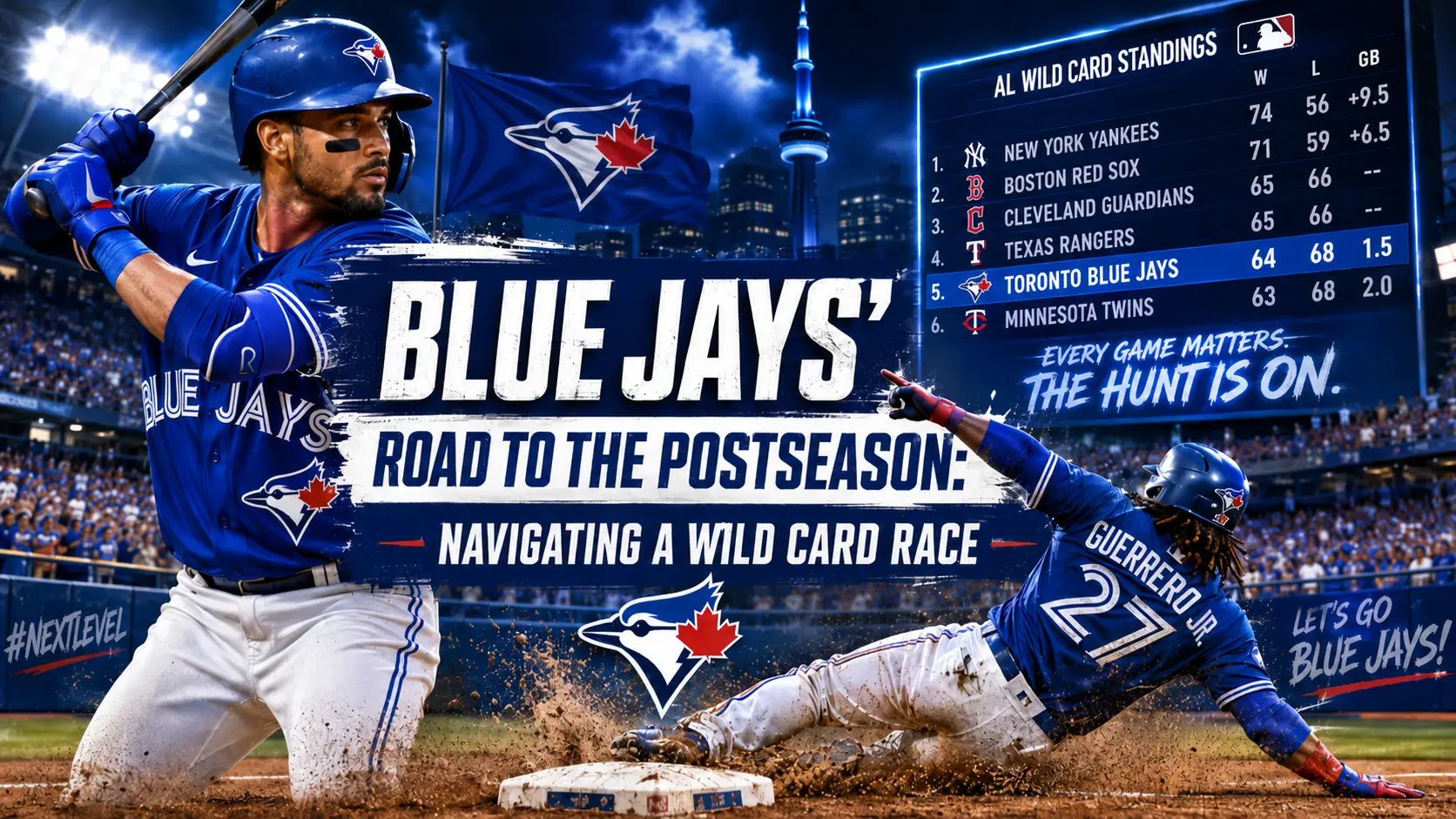
As the 2026 Major League Baseball season enters its final stretch, the Toronto Blue Jays find themselves navigating one of the most mathematically bizarre and highly congested American League postseason races in modern history. As of August 24, 2026, the Blue Jays are 64-68 after a gruelling road trip that ended in a series loss to the New York Yankees. In a traditional season, a ballclub sitting four games below the .500 mark in late August would be definitively categorized as a seller, with its focus shifted entirely toward minor-league player development and offseason payroll flexibility. However, the expansion of the MLB playoff format to encompass three Wild Card berths, combined with widespread mediocrity across the American League’s middle tier, has kept Toronto’s October aspirations fully viable.
The Blue Jays currently sit in fourth place in the American League East, trailing the division-leading Tampa Bay Rays (77-53) by a practically insurmountable 14.0 games. Yet, in the Wild Card race, Toronto is positioned a mere 1.5 games behind the final playoff spot, entangled in a cluster of six different franchises all hovering at or below the .500 threshold.
This exhaustive research report previews the Toronto Blue Jays’ final 30 games of the 2026 season. By evaluating complex roster reconfigurations at the trade deadline, profound offensive anomalies within the core lineup, starting rotation dynamics, high-leverage bullpen exhaustion, the strategic implementation of the newly adopted Automated Ball-Strike (ABS) Challenge System, and the mathematical calculus required to secure a playoff berth, this analysis outlines the exact operational pathway Toronto must navigate to ensure October baseball at the Rogers Centre.
The American League Wild Card Landscape: A Race Defined by Attrition
To properly contextualize the Blue Jays’ position, we must examine the broader structural realities of the 2026 American League. The standings reflect a severe lack of separation among the contenders, turning the final five weeks of the season into a battle of attrition rather than a showcase of elite dominance.
Current American League Wild Card Standings (As of August 24, 2026)
| Playoff Status | Team | W-L | Win % | Games Behind (WC) | Run Differential | Last 10 Games |
| WC 1 | New York Yankees | 74-56 | .569 | +9.5 | +100 | 6-4 |
| WC 2 | Boston Red Sox | 71-59 | .546 | +6.5 | +99 | 7-3 |
| WC 3 | Texas Rangers | 65-66 | .496 | — | -46 | 5-5 |
| Outside | Cleveland Guardians | 65-66 | .496 | — | -9 | 6-4 |
| Outside | Toronto Blue Jays | 64-68 | .485 | 1.5 | -55 | 5-5 |
| Outside | Minnesota Twins | 63-68 | .481 | 2.0 | -54 | 4-6 |
| Outside | Baltimore Orioles | 63-68 | .481 | 2.0 | -35 | 5-5 |
| Outside | Seattle Mariners | 62-69 | .473 | 3.0 | -61 | 6-4 |
| Outside | Detroit Tigers | 61-69 | .469 | 3.5 | +73 | 2-8 |
Data compiled from aggregated MLB standings. Minor discrepancies in public tracking depend on whether late West Coast games are included, but the macro-level clustering remains identical.
The data indicates an unprecedented bottleneck. The Texas Rangers and Cleveland Guardians nominally share the final playoff position despite both holding losing records of 65-669. Toronto, at 64-68, is mathematically intertwined with five other franchises that are struggling to sustain consistent winning streaks.
The most concerning metric for the Blue Jays is their underlying run differential. Toronto currently posts a -55 run differential, having scored 521 runs while surrendering 576 across their first 132 games. Among the teams legitimately competing for the final American League Wild Card spot, only the Seattle Mariners (-61) possess a worse aggregate run differential. Pythagorean win-loss expectation formulas—which calculate a team’s theoretical, luck-neutral record based on the ratio of runs scored to runs allowed—suggest that the Blue Jays should currently possess a 60-72 record.
The Blue Jays’ four-win overperformance suggests two underlying phenomena. First, the bullpen has won high-leverage, one-run games at a rate that typically signals unsustainability; second, the team has suffered several disproportionate blowout losses that have severely skewed their aggregate run data. Despite these foundational weaknesses, the Blue Jays recently mounted a seven-game winning streak before their stumble in New York, proving the roster has the ceiling to string together victories when starting pitching and situational hitting align.
The 2026 Trade Deadline Pivot: Hybrid Retooling
General Manager Ross Atkins executed a highly complex and somewhat polarizing strategy at the 2026 MLB Trade Deadline. Rather than definitively classifying the organization as a traditional “buyer” or a “seller,” the front office engineered a hybrid retooling phase. The Blue Jays traded away key veterans on expiring contracts while simultaneously acquiring controllable major-league talent capable of contributing to both the current playoff push and the 2027 campaign.
The Daulton Varsho and Kevin Gausman Departures
The most emotionally resonant departure was that of center fielder Daulton Varsho, who was traded to the Houston Astros in exchange for starting pitcher Spencer Arrighetti. Varsho, an elite defensive outfielder who won a Gold Glove for Toronto in 2024, was a pending unrestricted free agent. Despite his defensive metrics, Varsho’s offensive production in 2026 had plummeted significantly. By the time of the trade, he had managed only seven home runs and a .682 OPS, alongside noticeable regressions in his sprint speed (dropping from the 77th to the 50th percentile league-wide) and his defensive range (dropping from the 95th to the 86th percentile). Moving Varsho let Toronto avoid the dilemma of issuing a costly qualifying offer in the winter, instead converting his expiring value into a controllable pitching asset.
Similarly, the Blue Jays moved veteran starter Kevin Gausman to the Chicago Cubs, shedding the remainder of his salary while opening a rotation spot for younger, highly leveraged arms.
Incoming Assets: Arrighetti, Soriano, and Smith
In return for the veteran sell-off, the Blue Jays acquired right-handed starters Spencer Arrighetti (from Houston) and José Soriano (from the Los Angeles Angels), along with infielder Josh Smith (from the Texas Rangers in exchange for pitching prospect Adam Macko).
Arrighetti brings vital club control through the 2029 season. Although his surface-level ERA has hovered around 4.60 to 4.73, his underlying metrics demonstrate a high capacity to spin the baseball and limit hard contact, ranking in the 94th percentile in hard-hit percentage avoidance (30.6%). After battling Morton’s neuroma—a painful nerve irritation in the foot—that placed him on the 15-day injured list, Arrighetti was activated on August 21, throwing 3.1 innings of three-run ball against the Yankees. He provides critical rotation depth that keeps the team from resorting to exhausting “bullpen days” down the stretch.
The acquisition of José Soriano is arguably the most impactful deadline maneuver in the American League. Arriving with a devastating sinker/curveball mix, Soriano posted a 9-6 record with a 3.29 ERA and 1.25 WHIP across 123 innings prior to the trade. Under club control for two additional seasons beyond 2026, Soriano is effectively outperforming the departed Kevin Gausman. His sinker usage (27.6%) induces weak groundballs, while his curveball operates as an elite put-away pitch, generating 52 strikeouts on its own.
Pitching Dynamics: Rotation Reliability and Bullpen Exhaustion
If the Toronto Blue Jays are to play at a 97-win pace over the final 30 games—a mathematical necessity to secure a playoff berth—the pitching staff must bear the overwhelming majority of the burden.
The Starting Rotation Hierarchy
The starting rotation is anchored by the sheer dominance of Dylan Cease. Acquired in a previous transaction, Cease has established himself as one of the premier strikeout artists in Major League Baseball in 2026.
| Pitcher | Games Started | Innings Pitched | W-L | ERA | Strikeouts | K/9 |
| Dylan Cease | 23 | 137.2 | 7-5 | 2.42 | 201 | 13.03 |
| Shane Bieber | 11 | 55.2 | 5-2 | 4.53 | 44 | 7.11 |
| Max Scherzer | 11 | 45.0 | 1-6 | 7.40 | 32 | 6.40 |
| José Soriano* | 3 | 16.1 | 1-0 | 2.75 | 9 | 4.96 |
| Spencer Arrighetti* | 18 | 91.1 | 7-6 | 4.73 | 91 | 8.97 |
Note: Soriano and Arrighetti’s statistics reflect a combination of their overall season stats and early tenure with Toronto following the trade deadline.
Cease holds a 7-5 record, a brilliant 2.42 ERA, and a staggering 201 strikeouts, for an elite 13.03 K/9 ratio. Cease’s ability to consistently pitch deep into games while neutralizing opposing lineups makes him the ultimate “stopper” for losing streaks.
Behind Cease and Soriano, Manager John Schneider must delicately navigate the veteran presence of Shane Bieber and Max Scherzer. Bieber’s 2026 campaign has been a story of resilience. Following a catastrophic outing earlier in the summer against Washington (where he surrendered eight earned runs and walked six batters in less than an inning), Bieber has reinvented his command. He recently threw seven innings of one-run ball against the Tampa Bay Rays on August 20, securing a crucial victory that kept Toronto’s playoff hopes alive.
Conversely, the veteran right-hander Max Scherzer is enduring the severe physical toll of a lengthy career. Scherzer has a 1-6 record and a highly concerning 7.40 ERA over 11 starts. In his most recent start on August 19 against Tampa Bay, he surrendered seven earned runs on five hits and three walks over just four innings.
Strategic alignment will be paramount over the next five weeks. Baseball analysts suggest Schneider must use upcoming off-days to intentionally separate Scherzer, Bieber, and Arrighetti in the starting order. Because these three starters are more prone to early exits and high pitch counts than Cease and Soriano, stacking them consecutively exposes the bullpen to catastrophic fatigue. Spreading them out ensures that a reliable innings-eater is never more than a day away.
High-Leverage Relief and the “Full Send” Mentality
The Blue Jays’ bullpen is currently operating on fumes. After 41 games in a compressed 42-day stretch earlier in August, Manager John Schneider explicitly said long-term sustainability was “out the window,” declaring a “full send” approach to reliever usage.
The high-leverage hierarchy relies heavily on closer Louis Varland, alongside setup men Tyler Rogers, Braydon Fisher, and Mason Fluharty.
Tyler Rogers, signed to a three-year, $37 million contract in the 2025 offseason, offers a uniquely disruptive profile. Utilizing an extreme submarine arm angle where his knuckles nearly graze the dirt, Rogers throws a sinker that averages just 83.5 mph but features nearly 53 inches of vertical break. This extreme variance in release height and velocity creates major mechanical problems for opposing batters, resulting in an elite 56.6% groundball rate and placing him in the 100th percentile for barrel-percentage avoidance.
However, the sheer volume of usage points to dangerous fatigue levels. Fluharty leads the pitching staff with 67 appearances, while Fisher has logged 61. This exhaustion showed up over the recent weekend in the Bronx, when the bullpen surrendered 10 earned runs across 11.2 innings, inflating their weekend ERA to 7.71.
To absorb innings and protect the high-leverage core, the front office claimed veteran Paul Sewald off waivers from the Arizona Diamondbacks on August 12. Although Sewald possesses 110 career saves, his 2026 campaign has been marred by an immense vulnerability to the home run ball, posting a 6.23 ERA in Arizona before being designated for assignment. Toronto’s pitching lab is trying to deploy Sewald in calculated mid-leverage situations rather than exposing him to the ninth inning, hoping his elite historical strikeout metrics and adjusted fastball usage can stabilize the middle frames.
Offensive Inefficiencies: The RISP Crisis and Power Outages
The Toronto Blue Jays’ lineup stands in stark contrast to the high-octane offences of previous iterations of the franchise. While the team ranks adequately in raw counting stats such as total hits, their situational hitting has been disastrous, heavily contributing to their negative run differential.
The Runners in Scoring Position (RISP) Dilemma
The Blue Jays are statistically the worst team in Major League Baseball when hitting with runners in scoring position. Entering the late-August stretch, Toronto ranked dead last in MLB in OPS (.667) and wRC+ (82) with RISP, while also sitting in the bottom five in batting average (.236) and home runs hit in such scenarios. The weekend series against the Yankees perfectly encapsulated this failing, as the team went a combined 6-for-41 (.146) with RISP across three games.
This systemic failure can be directly traced to the regression of the team’s core veterans. George Springer has experienced a catastrophic drop in situational production; his OPS with RISP has plummeted from .999 in 2025 to a meagre .526 in 2026—a differential of 473 points. When the primary run-producers fail to execute, it places an insurmountable strain on the pitching staff to maintain flawless margins.
The Bizarre Case of Vladimir Guerrero Jr.
No player exemplifies the Blue Jays’ offensive frustrations more than Vladimir Guerrero Jr. The 27-year-old first baseman, currently operating under a historic 14-year, $500 million contract extension that runs through 2039, is enduring a mathematically baffling power outage. Guerrero recently crossed the 365-day threshold without hitting a single regular-season home run at the Rogers Centre. While he hit a postseason home run at home in October 2025, his 2026 regular-season profile features only seven total home runs—all of which have occurred on the road.
Guerrero’s underlying exit velocities remain elite (frequently registering balls hit over 108 mph), but his launch angles have severely flattened, resulting in an abundance of scorched ground balls rather than extra-base hits. Furthermore, Guerrero is currently attempting to regain his rhythm after a terrifying collision at third base with George Lombard Jr. in mid-August, which resulted in a concussion, temporary memory loss of the event, and a stint on the 7-day injured list. Upon his return to the lineup on August 22, Guerrero has struggled to find his timing, going 0-for-4 in the series finale against the Yankees and leaving multiple runners stranded. If Toronto is to orchestrate a miraculous September run, the franchise requires Guerrero to instantly transition from a slumping contact hitter back into a fearsome power threat.
The Emergence of Kazuma Okamoto
The singular offensive bright spot has been the arrival of Japanese rookie Kazuma Okamoto. Signed to a four-year, $60 million contract in the offseason, the 30-year-old former Yomiuri Giant has immediately translated his Nippon Professional Baseball (NPB) power to the Major Leagues. While his batting average sits at a modest .230, Okamoto leads the team with 26 home runs and 74 RBIs, recently breaking the Blue Jays’ all-time rookie home run record. Okamoto’s propensity to generate instant offence via the long ball has frequently bypassed the team’s RISP struggles entirely, allowing the Blue Jays to score without relying on sequenced, station-to-station hitting.
Utility players have also contributed significantly. Ernie Clement leads the team with a .286 batting average and 29 doubles, providing excellent defence alongside Andrés Giménez. However, the bottom of the order remains perilously thin, with Myles Straw (.213) and the recently returned Davis Schneider (.142) struggling to provide consistent turnover for the top of the lineup.
Strategic Implications of the 2026 ABS Challenge System
A critical variable in the 2026 playoff race is the league-wide implementation of the Automated Ball-Strike (ABS) Challenge System. First tested extensively in the minor leagues, the system allows the batter, pitcher, or catcher to challenge a home-plate umpire’s ball/strike call using Hawk-Eye tracking technology. Teams are allotted two challenges per game, with a successful challenge retaining the team’s count. If a game enters extra innings without a team having challenges remaining, they are granted an additional challenge per inning.
The introduction of ABS has fundamentally altered catcher valuation and late-inning strategy. The Blue Jays possess a distinct advantage in this domain due to the presence of catcher Alejandro Kirk. Despite a broken thumb earlier in the year that temporarily derailed his offence (currently hitting .283 with 7 HRs), Kirk remains one of the sport’s premier pitch-framers. Statistics from Baseball Savant indicate that Kirk converts nearly 49.8% of non-swing borderline pitches into called strikes, leading the league in Catcher Framing Runs.
Because the ABS system operates on a challenge basis rather than a fully automated strike zone on every pitch, traditional pitch framing remains highly lucrative. Umpires still make the initial call. Therefore, Kirk can continue to “steal” strikes for the Toronto pitching staff on the margins, relying on opposing batters to hesitate or exhaust their challenges. Furthermore, Manager John Schneider has implemented strict internal guardrails regarding who is authorized to initiate a challenge. Because emotions often cloud judgment (e.g., a batter desperately challenging a strike three call to avoid an out), the green light to challenge rests almost exclusively with Kirk and Davis Schneider, both of whom possess elite, objective understandings of the strike zone.
Kirk’s philosophy is explicitly conservative: he intentionally hoards challenges for high-leverage situations in the seventh, eighth, and ninth innings, ensuring that a blown call in a critical moment can be immediately rectified without wasting the team’s allotment on low-leverage pitches in the early frames. In a tight postseason race where a single run dictates the outcome, maximizing ABS efficiency provides a quantifiable edge.
Home/Road Splits, Stadium Experience, and Attendance
To fully understand the Blue Jays’ 2026 performance, one must analyze their extreme disparity between venues. The team has played league-average baseball at the Rogers Centre, posting a 33-33 record. At home, their offence surges, carrying a .794 OPS and averaging 5.21 runs per game. Conversely, they have been thoroughly dominated on the road, holding a 31-35 record with a dismal .654 OPS and averaging just 3.38 runs per game. The offence completely evaporates when travelling. With 15 of their final 30 games taking place away from Toronto, resolving this disparity is an existential imperative.
Despite the team’s sub-500 record, fan engagement remains robust. Following massive multi-year renovations to the Rogers Centre that modernized the fan experience, attendance figures are surging. Through their first 30 home games of the season, the Blue Jays averaged 40,491 spectators per game, drawing over 1.2 million fans—the highest average attendance in Major League Baseball at that point in the season. Projections indicate the club could finish the year with a total attendance of 3.32 million, the franchise’s highest mark since the 2016 playoff run.
This high attendance is supported by robust transit infrastructure, which the organization heavily promotes. Partnerships with GO Transit and the UP Express provide direct, high-frequency service to Union Station (a 10-minute walk from the Rogers Centre), significantly reducing traffic congestion and enabling suburban fans to reliably attend weekday and weekend games. However, the transit system has flaws; during a late-season extra-innings game, miscommunications about TTC and GO Transit departure times led to commuter chaos, underscoring the logistical strain of supporting 40,000 fans nightly.
The Final 30 Games: Schedule Breakdown and Tiebreakers
Despite the heavy statistical baggage of a -55 run differential and an inconsistent offence, the mathematical reality of the Toronto Blue Jays’ schedule presents a monumental opportunity.
As of August 24, the Blue Jays have no remaining games against an opponent with a winning record. This statistical anomaly provides a massive runway for a late-season surge. The 30 remaining games are distributed as follows:
| Dates | Opponent | Current Record | Location |
| August 25-27 | Kansas City Royals | 58-74 | Home |
| August 28-30 | Seattle Mariners | 62-69 | Home |
| September 1-3 | Cleveland Guardians | 65-66 | Away |
| September 4-6 | Kansas City Royals | 58-74 | Away |
| September 7-9 | Athletics | 51-80 | Away (Sacramento) |
| September 11-13 | Baltimore Orioles | 63-68 | Home |
| September 14-16 | Detroit Tigers | 61-69 | Home |
| September 18-20 | Texas Rangers | 65-66 | Away |
| September 21-23 | Baltimore Orioles | 63-68 | Away |
| September 25-27 | Cincinnati Reds | 62-69 | Home |
Data aggregated from MLB schedule releases.
The collective winning percentage of Toronto’s remaining opponents sits around .464, representing one of the easiest remaining strengths of schedule in Major League Baseball. However, the schedule is entirely composed of “four-point swings”—games played directly against teams they are battling for the Wild Card spot (Mariners, Guardians, Tigers, Rangers, and Orioles).
The Crucial Role of MLB Tiebreaker Rules
Because MLB eliminated the “Game 163” one-game playoff format in 2022, all ties in the standings at the end of the 162-game season are resolved strictly via mathematical tiebreakers.
The sequence of MLB tiebreaker rules is as follows:
- Head-to-Head Record: The win-loss record between the tied teams.
- Intradivision Record: The team’s winning percentage within its own division (e.g., AL East games for Toronto).
- Intraleague Record: The team’s winning percentage against all teams within the American League.
- Last Half of Intraleague Games: Winning percentage in AL games played after the All-Star break.
This tiebreaker sequence makes the Blue Jays’ upcoming schedule infinitely more important. Toronto has already lost the season series to the Texas Rangers and the Minnesota Twins. Consequently, if they finish tied with either of those clubs at the end of September, the Blue Jays will lose the tiebreaker and miss the playoffs. Conversely, Toronto maintains control of its destiny against the Guardians, Mariners, and Orioles. Sweeping or winning the remaining series against these clubs is a mandatory prerequisite for October baseball.
Predictive Win Targets and Postseason Math
The ultimate question for the Toronto Blue Jays is: What exact record is required to secure the third American League Wild Card berth?
In standard seasons, securing a Wild Card spot requires roughly 88 to 90 wins. However, 2026 is an extreme outlier. Predictive models, including FanGraphs’ ZiPS and Steamer, overwhelmingly suggest that, because middle-tier American League teams are projected to win far fewer games, the threshold for the final playoff spot will plummet to roughly 83 or 84 wins. Historically, the lowest win total to ever secure an AL Wild Card was 85 wins by the 2017 Minnesota Twins—a record that is highly likely to be broken this year.
The Mathematical Threshold
If the benchmark to guarantee a playoff spot is 84 wins, the Blue Jays (currently at 64 wins) must play at a 20-10 (.667) pace over their final 30 games. If the benchmark falls to 83 wins, the target is a 19-11 (.633) finish.
Given the sheer volume of games against sub-500 opponents, a 19-11 run is not only feasible but entirely expected for a roster featuring Dylan Cease, Vladimir Guerrero Jr., and a heavily fortified high-leverage bullpen. FanGraphs currently gives Toronto a 16.9% to 21.4% probability of making the playoffs, leading the pack of outside contenders largely because of their favourable strength of schedule.
The 2027 Horizon: Payroll, Free Agency, and the Proposed Salary Cap
While the immediate focus is on the final 30 games, the front office must simultaneously navigate a perilous financial horizon. The 2026 offseason looms large, not just for the Blue Jays, but for all of Major League Baseball.
Reports indicate that MLB owners may push for a hard salary cap of $245.3 million and a payroll floor of $171.2 million in the upcoming collective bargaining negotiations, threatening a lockout before the 2027 season. If a hard cap is implemented, the Blue Jays—currently operating with a luxury tax payroll exceeding $317 million and a base payroll of roughly $286 million—would be forced to drastically shed salary.
The club already has an estimated $210 million committed to players under contract for 2027, driven primarily by Guerrero’s massive $40.2 million annual salary and George Springer’s $24.1 million hit. This financial pressure is compounded by the pending free agency of several key contributors, including Shane Bieber, Jameson Taillon, and Daulton Varsho (who was preemptively traded to avoid this exact scenario).
General Manager Ross Atkins has publicly maintained that ownership remains committed to fielding a championship-calibre payroll, but the realities of the upcoming CBA negotiations cast a long shadow over the franchise’s long-term competitive window.
Conclusion
The 2026 Toronto Blue Jays are a fascinating statistical paradox. They possess a negative run differential, an offence that historically fails with runners in scoring position, and a severely overworked bullpen. Yet, through a combination of elite starting pitching at the top of the rotation, a mathematically collapsed American League Wild Card race, and a front office that effectively acquired high-upside reinforcements at the trade deadline without sacrificing the core, they remain fully alive in the playoff hunt.
Over the final 30 games, the margin for error is nonexistent. Manager John Schneider must execute flawless workload management, intentionally separating his volatile starters to protect his high-leverage relievers. The offence cannot solely rely on the solo home runs of Kazuma Okamoto; it requires an immediate, MVP-caliber resurgence from Vladimir Guerrero Jr. Furthermore, Alejandro Kirk’s mastery of the ABS Challenge System must be weaponized in late-inning, high-leverage defensive stands to steal outs on the margins.
The mathematical mandate is clear: Toronto must secure 19 to 20 wins over their final 30 games to hit the 83-84 win threshold. Because they do not face a single team currently above .500 for the remainder of the season, the schedule provides the exact runway needed to accomplish this feat. If the Blue Jays can dominate head-to-head matchups against their direct wild-card competitors, leverage their elite pitching, and capitalize on their highly favourable schedule, October baseball at the Rogers Centre remains a highly probable reality.
Works cited
- 2026 Toronto Blue Jays Schedule – Baseball-Reference.com, https://www.baseball-reference.com/teams/TOR/2026-schedule-scores.shtml
- Instant Reaction: Blue Jays fall short of Yankees in series finale in the Bronx, https://bluejaysnation.com/news/instant-reaction-toronto-blue-jays-fall-short-of-new-york-yankees-in-series-finale-to-end-road-trip-in-the-bronx
- Panorama rumbo a la postemporada 2026 de la MLB en Liga Americana y Liga Nacional, https://as.com/us/mlb/panorama-rumbo-a-la-postemporada-2026-de-la-mlb-en-liga-americana-y-liga-nacional-f202608-n/
- The AL Wild Card Mess Is Competitive Balance, and It’s Not Pretty, https://blogs.fangraphs.com/the-al-wild-card-mess-is-competitive-balance-and-its-not-pretty/
- Looking at Blue Jays’ potential pathway to claiming final AL wild, https://bluejaysnation.com/news/looking-toronto-blue-jays-potential-pathway-claiming-final-al-wild-card-seed
- 2026 Blue Jays Standings and Record – Toronto – MLB.com, https://www.mlb.com/bluejays/standings
- 2026 MLB Standings: Division – FOX Sports, https://www.foxsports.com/mlb/standings
- 2026 Blue Jays Standings and Record: Wild Card – Toronto – MLB.com, https://www.mlb.com/bluejays/standings/wild-card
- 2026 MLB Standings: Wild Card – FOX Sports, https://www.foxsports.com/mlb/standings?type=wild+card
- Wild Card – 2026 Athletics Standings and Record – MLB.com, https://www.mlb.com/athletics/standings/wild-card
- 2026 MLB Baseball Standings – Wild Card – CBS Sports, https://www.cbssports.com/mlb/standings/wild-card/
- MLB Standings – Major League Baseball – TSN, https://www.tsn.ca/mlb/standings/
- 2026 Toronto Blue Jays Statistics – Baseball-Reference.com, https://www.baseball-reference.com/teams/TOR/2026.shtml
- How concerning are the Blue Jays home and road splits?, https://jaysjournal.com/how-concerning-are-the-blue-jays-home-and-road-splits-01jyezfjxw3j
- AL Wild Card standings by remaining strength of schedule, https://fansided.com/mlb/al-wild-card-standings-remaining-strength-schedule
- Blue Jays Trade Daulton Varsho to the Astros for Spencer Arrighetti, https://www.si.com/mlb/bluejays/onsi/blue-jays-trade-daulton-varsho-astros-spencer-arrighetti
- Surveying the Blue Jays’ organizational talent base after the trade, https://www.sportsnet.ca/mlb/article/surveying-the-blue-jays-organizational-talent-base-after-the-trade-deadline/
- Blue Jays trade Daulton Varsho to Astros for Spencer Arrighetti, https://www.sportsnet.ca/mlb/article/report-blue-jays-trade-daulton-varsho-to-astros-for-spencer-arrighetti/
- Houston finally gets its outfielder in Daulton Varsho; Blue Jays, https://www.cbssports.com/mlb/news/astros-trade-grades-daulton-varsho-spencer-arrighetti-blue-jays/
- How the Blue Jays’ Trade Deadline Improved the Current Team, https://www.si.com/mlb/bluejays/onsi/how-blue-jays-trade-deadline-improved-current-team
- Google Sports Data, https://support.google.com/knowledgepanel/answer/9787176
- Arrighetti moves off Blue Jays’ 15-day injured list; Schneider recalled from triple-A, https://cfjctoday.com/2026/08/21/arrighetti-moves-off-blue-jays-15-day-injured-list-schneider-recalled-from-triple-a/
- Blue Jays Trade Daulton Varsho To Astros For Spencer Arrighetti, https://www.mlbtraderumors.com/2026/08/blue-jays-trade-daulton-varsho-astros-spencer-arrighetti.html
- Jays must take full advantage of favourable schedule – TSN, https://www.tsn.ca/mlb/article/jays-must-take-full-advantage-of-favourable-schedule/
- Yankees vs. Blue Jays: Injury Report, Updates & Probable Starters – Aug. 23, https://www.bleachernation.com/stats-and-news/2026/08/22/yankees-vs-blue-jays-injury-report-updates-probable-starters-aug-23/
- Blue Jays new look rotation could surprise and lead Toronto to a, https://jaysjournal.com/blue-jays-new-look-rotation-could-surprise-and-lead-toronto-to-a-strong-finish-in-2026
- Blue Jays Reveal Probable Starters for Huge Series vs Rays, https://www.si.com/mlb/bluejays/onsi/blue-jays-reveal-probable-starters-huge-series-vs-rays
- 2026 Toronto Blue Jays Pitching Stats – Baseball Almanac, https://www.baseball-almanac.com/teamstats/pitching.php?y=2026&t=TOR
- 2026 American League Pitching Leaders | Baseball-Reference.com, https://www.baseball-reference.com/leagues/AL/2026-pitching-leaders.shtml
- Jays’ struggles with runners in scoring position continues in series, https://www.tsn.ca/mlb/article/jays-struggles-with-runners-in-scoring-position-continues-in-series-loss-to-yankees/
- Paul Sewald claimed off waivers by Blue Jays – MLB.com, https://www.mlb.com/news/paul-sewald-claimed-off-waivers-by-blue-jays
- Blue Jays: An analytical overview of reliever Tyler Rogers, https://bluejaysnation.com/news/blue-jays-an-analytical-overview-of-reliever-tyler-rogers
- Blue Jays claim ex-D-Backs closer Sewald – TSN, https://www.tsn.ca/mlb/article/report-jays-claim-ex-d-backs-closer-sewald/
- Fantasy Baseball Relief Pitcher Roundup: 8/16, https://pitcherlist.com/fantasy-baseball-relief-pitcher-roundup-8-16/
- The Blue Jays’ big bats are hurting them with runners in scoring, https://jaysjournal.com/the-blue-jays-big-bats-are-hurting-them-with-runners-in-scoring-position
- Vladimir Guerrero Jr. vs Fernando Tatis Jr. net worth comparison in 2026: Inside MLB’s young stars’ career earnings, endorsements, investments and lifestyle, https://timesofindia.indiatimes.com/sports/mlb/news/vladimir-guerrero-jr-vs-fernando-tatis-jr-net-worth-comparison-in-2026-inside-mlbs-young-stars-career-earnings-endorsements-investments-and-lifestyle/articleshow/133421882.cms
- Un año de sequía en Toronto para Vladdy Guerrero JR, https://as.com/us/mlb/un-ano-de-sequia-en-toronto-para-vladdy-guerrero-jr-f202608-n/
- Vladimir Guerrero Jr. acelera su regreso con los Blue Jays tras superar una conmoción, https://as.com/us/mlb/vladimir-guerrero-jr-acelera-su-regreso-con-los-blue-jays-tras-superar-una-conmocion-f202608-n/
- Kazuma Okamoto Stats, Age, Position, Height, Weight … – MLB.com, https://www.mlb.com/player/kazuma-okamoto-672960
- Blue Jays have been aggressive off-season spenders. Will a … – CBC, https://www.cbc.ca/news/canada/blue-jays-spending-2026-playoff-ambitions-9.7037047
- Kazuma Okamoto sets the Blue Jays ROOKIE HOME … – YouTube, https://www.youtube.com/watch?v=sAzPCtkG6sA
- Kazuma Okamoto – Player Info, News & Stats – TSN, https://www.tsn.ca/mlb/player/kazuma-okamoto/862093/
- Toronto Blue Jays Stats and Team Leaders 2026 – CBS Sports, https://www.cbssports.com/mlb/teams/tor/toronto-blue-jays/stats/
- Former Guardians help Blue Jays defeat Cleveland in series opener, https://www.mlb.com/news/former-guardians-help-blue-jays-defeat-cleveland-in-series-opener
- MLB Rules & Game Structure: A Complete Guide – CoverSports, https://coversports.com/resources/field-guides/mlb-rules-game-structure
- ABS Challenge Dashboard | baseballsavant.com – MLB.com, https://baseballsavant.mlb.com/abs
- Alejandro Kirk won’t be a fan of the latest news on automatic strike, https://jaysjournal.com/blue-jays-alejandro-kirk-won-t-be-a-fan-of-the-latest-news-on-automatic-strike-zone-tests
- [Codify] Alejandro Kirk leads MLB catchers in pitch framing runs this, https://www.reddit.com/r/Torontobluejays/comments/1c7heqo/codify_alejandro_kirk_leads_mlb_catchers_in_pitch/
- Blue Jays take first reps with ABS Challenge System set to change, https://www.sportsnet.ca/mlb/article/blue-jays-take-first-reps-with-abs-challenge-system-set-to-change-the-game/
- Schneider, Kirk to lead the way for Blue Jays to challenge umpire, https://www.cbc.ca/news/canada/toronto/jays-automated-ball-strike-challenges-9.7103278
- Wild Blue Jays attendance numbers show fans are ready for another, https://jaysjournal.com/wild-blue-jays-attendance-numbers-show-fans-are-ready-for-another-world-series-run
- Where the Toronto Blue Jays rank in MLB attendance this season, https://www.blogto.com/sports_play/2026/05/toronto-blue-jays-mlb-attendance-ranking/
- GO to the Toronto Blue Jays Game – GO Transit, https://www.gotransit.com/en/partners-and-promotions/event-take-go-to-the-blue-jays
- GO to Rogers Centre – GO Transit, https://www.gotransit.com/en/partners-and-promotions/promo-go-to-the-rogers-centre
- Getting to the Jays game using GO Transit and UP – Metrolinx, https://www.metrolinx.com/en/discover/getting-to-the-jays-game-using-go-transit-and-up
- TTC, Metrolinx defend transit confusion after Toronto Blue Jays loss, https://globalnews.ca/news/11508883/toronto-blue-jays-transit-chaos/
- Toronto Blue Jays 2026 Schedule Breakdown, Including Opening, https://www.si.com/mlb/bluejays/onsi/news/toronto-blue-jays-2026-schedule-breakdown-opening-day-opponent
- More meaningful baseball awaits Blue Jays despite series loss to Yankees, https://toronto.citynews.ca/2026/08/23/more-meaningful-baseball-awaits-blue-jays-despite-series-loss-to-yankees/
- Major League Baseball tie-breaking procedures – Wikipedia, https://en.wikipedia.org/wiki/Major_League_Baseball_tie-breaking_procedures
- MLB Playoff Format 2026: Teams, Seeding & Rounds – Gamebook, https://gamebook.co/guides/mlb-playoff-format-2026
- List of Major League Baseball tie-breakers – Wikipedia, https://en.wikipedia.org/wiki/List_of_Major_League_Baseball_tie-breakers
- How to determine playoff tiebreakers – MLB.com, https://www.mlb.com/news/mlb-playoff-tiebreaker-rules
- Assessing how many wins the Blue Jays will need to make the playoffs, https://jaysjournal.com/assessing-how-many-wins-the-blue-jays-will-need-to-make-the-playoffs
- MLB’s proposed salary cap could create a major Blue Jays’ problem, https://jaysjournal.com/mlb-s-proposed-salary-cap-could-create-a-major-blue-jays-problem
- 2026 Roster & Payroll Breakdown: How Do The Jays Fill the Holes?, https://www.reddit.com/r/Torontobluejays/comments/1onzoxz/2026_roster_payroll_breakdown_how_do_the_jays/
- Blue Jays Will Have to Substantially Increase Payroll to Accomplish, https://www.si.com/mlb/bluejays/onsi/news/blue-jays-will-have-substantially-increase-payroll-accomplish-offseason-goals


Leave a Reply