Executive Summary
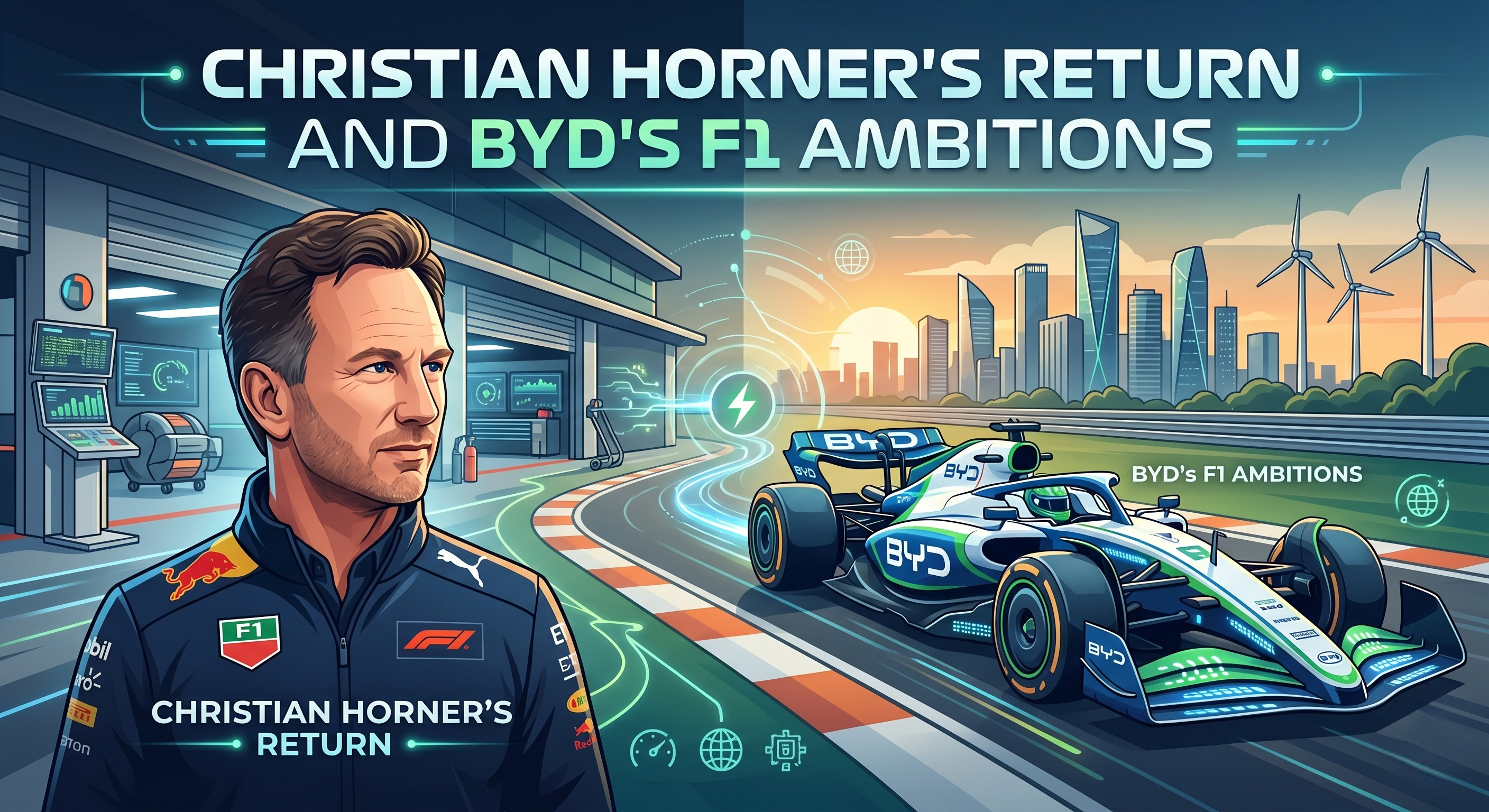
The landscape of the FIA Formula 1 World Championship has entered an unprecedented period of commercial and technological transformation. Following the ratification of the Ninth Concorde Agreement, which governs the sport from 2026 through 2030, and the formal admission of Cadillac as the grid’s 11th constructor, the commercial limits and franchise valuations of the sport are being tested on a historic scale.1 Concurrently, the transition to the 2026 technical regulations—characterized by a paradigm shift toward a 50/50 power split between internal combustion and advanced electrical energy—has redefined the engineering entry requirements for global automotive manufacturers.4 Against this macroeconomic and regulatory backdrop, one of the most consequential strategic alignments in modern motorsport history is quietly taking shape: exploratory discussions between the Chinese electric vehicle (EV) powerhouse BYD and former Red Bull Racing Team Principal Christian Horner regarding the establishment of a 12th Formula 1 team.6
The proposition of a BYD-backed entry under Horner’s stewardship represents a convergence of mutual necessities. BYD, despite overtaking competitors to become the world’s leading manufacturer of electric vehicles, faces severe domestic financial headwinds in early 2026, necessitating aggressive global brand expansion.9 Simultaneously, Horner, having been dismissed from his two-decade tenure at Red Bull Racing in July 2025, possesses the operational blueprint, political capital, and free agency required to build a championship-contending organization from the ground up.4
This exhaustive research report delivers a forensic analysis of this potential partnership. It examines the historical context of Horner’s operational capabilities and his subsequent shift toward equity ownership.6 It scrutinizes the strategic imperatives driving BYD’s interest in motorsport, contextualized against the macroeconomic price wars devastating profit margins within the Chinese automotive sector.10 Furthermore, the analysis explores the immense geopolitical machinations between the expansionist Fédération Internationale de l’Automobile (FIA) and the protectionist Formula One Management (FOM), alongside the potential acquisition of stranded manufacturing assets—specifically the remnants of Renault’s Viry-Châtillon engine facility—as a mechanism to accelerate BYD’s internal combustion engine (ICE) development.7 The synthesis of these factors reveals a highly complex, financially staggering, yet strategically viable pathway for the creation of Formula 1’s next automotive superpower.
The Architect’s Ascent: Christian Horner’s Two-Decade Legacy
To properly contextualize the immense strategic value that Christian Horner presents to a prospective automotive entrant like BYD, one must first analyze the historical foundation of his operational expertise. Launching a brand-new Formula 1 team requires leadership capable of building a winning organizational structure from the ground up, a feat that is historically fraught with failure for large corporate entities.4 Horner’s entire professional trajectory is defined by this specific capability.
Horner’s origins in motorsport began behind the wheel. After a karting career where he notably competed against Sophie Kumpen (the mother of Max Verstappen), he progressed through the junior single-seater ranks, eventually competing in the British Formula 3 championship and Formula 3000.4 It was during his time driving for the Arden team in 1997 that he established a pivotal relationship with Dr. Helmut Marko, a connection that would eventually define the modern era of Formula 1.4 Recognizing that his absolute ceiling as a driver had been reached, Horner made the highly pragmatic decision to transition into team management, taking over the operational reins of the Arden team and achieving immediate success in the early 2000s.4
His entry into the Formula 1 paddock materialized in 2005. Following Red Bull’s acquisition of the failing Jaguar Racing outfit, Helmut Marko appointed Horner as the Team Principal of the newly formed Red Bull Racing, making him the youngest team principal in Formula 1 history at the time.4 What followed was a masterclass in organizational engineering. Under Horner’s leadership, Red Bull Racing transformed from an energy-drink-backed marketing exercise into a dominant, championship-winning force that systematically defeated established automotive brands like Ferrari, McLaren, and Mercedes-Benz.4
A critical component of this success was Horner’s proven ability to identify, recruit, and shield elite technical talent from corporate interference. The most notable example was his successful campaign to lure star aerodynamicist Adrian Newey from McLaren, a move that yielded the team’s first podium in Monaco in 2006 and laid the foundation for future dominance.4 During the Sebastian Vettel era (2010-2013), Horner became the youngest team principal to oversee four consecutive World Drivers’ and Constructors’ Championships.4
Following a difficult transition into the V6 turbo-hybrid era starting in 2014, marked by a strained relationship with engine supplier Renault, Horner and Marko orchestrated a high-risk strategic pivot.4 They ruthlessly promoted a young Max Verstappen in 2016 and eventually cast Renault aside to partner with Honda in 2019.4 This partnership culminated in a bitter, season-long political and on-track war with Mercedes in 2021, resulting in Verstappen’s first World Championship.4 Red Bull subsequently mastered the 2022 ground-effect aerodynamic regulations, allowing Verstappen to secure consecutive titles through 2023.4 In total, under Horner’s two-decade stewardship, Red Bull Racing secured 124 Grand Prix victories, eight Drivers’ Championships, and six Constructors’ Championships, while reportedly generating more than $3 billion in commercial revenue through global partnerships.12 This empirical track record makes Horner the most attractive free-agent executive in global motorsport.
The Fall of a Dynasty: Internal Politics and the July 2025 Dismissal
The dissolution of Horner’s relationship with Red Bull Racing was not born of competitive failure, but rather a protracted deterioration of internal political alignment and cultural friction. In July 2025, Red Bull GmbH released a sudden and definitive statement announcing that Christian Horner had been relieved of his operational duties with immediate effect, concluding the longest-serving team principal tenure on the grid.4 Oliver Mintzlaff, the CEO of Corporate Projects and Investments at Red Bull, publicly thanked Horner for his “exceptional work over the last 20 years,” and announced that Laurent Mekies, the former Racing Bulls team boss, would take over as the CEO of Red Bull Racing.13
The roots of this spectacular dismissal can be traced back through several layers of internal conflict. The initial fracture occurred during the 2024 winter break, when a female colleague alleged that Horner had engaged in inappropriate behaviour.4 Red Bull initiated an independent legal investigation, and following an extensive interview process in London, Red Bull GmbH released a statement ahead of the 2024 Bahrain Grand Prix, officially clearing Horner of all allegations.4 However, the investigation triggered a massive public relations crisis and exposed deep rifts between the Austrian and Thai ownership factions of the Red Bull parent company, creating a year and a half of internal turmoil.4
Beyond the personal allegations, Horner’s relentless pursuit of absolute operational autonomy ultimately alienated the corporate board. This was most visibly demonstrated during the collapsed negotiations with Porsche. Prior to finalizing their proprietary Red Bull Powertrains project, Red Bull was in advanced discussions to sell a 51% stake in the racing team to the German automotive giant.19 Horner was reportedly instrumental in scuttling this near-finalized deal, arguing vehemently to the late Dietrich Mateschitz that a Porsche takeover would introduce stifling corporate bureaucracy and fundamentally “cramp the style” of the agile racing team.19 While this preserved Red Bull’s independence, it angered factions within the Austrian ownership side who maintained a strong relationship with Porsche’s CEO and had already begun celebrating the massive financial windfall the partnership would have brought.19
When the team’s on-track performance began to spiral downward in 2024 and 2025, the Austrian board, no longer willing to tolerate Horner’s consolidation of power, seized the opportunity.17 Following a difficult race at the 2025 British Grand Prix, where Max Verstappen struggled in changeable conditions, the board executed Horner’s dismissal just three days later.17 Horner departed with an exit settlement reportedly valued at $100 million, which included a strict non-compete clause (gardening leave) that kept him entirely sidelined from the sport until its expiration on May 8, 2026.7
The Interim Strategy: Oakley Capital and the Alpine Rejection
Upon the expiration of his non-compete clause in May 2026, Horner emerged into the Formula 1 market not as an executive seeking employment, but as an investor seeking equity. The fundamental lesson Horner internalized from his dismissal at Red Bull was the vulnerability of salaried employment, regardless of past success. His overarching objective for his next venture is to secure a permanent ownership or shareholding stake within a team—a structural reality that was never open to him at Red Bull GmbH.6
To facilitate this transition from employee to stakeholder, Horner embarked on a highly strategic interim venture in partnership with Oakley Capital.12 Oakley Capital is a leading private equity investor, and Horner joined the firm in a specialized advisory role focusing on investments in premium sports.12 Horner publicly praised the firm’s founder, Peter Dubens, expressing admiration for Oakley’s approach to building “ambitious, founder-led businesses”.12 This partnership is critical; it provides Horner with the institutional financial backing and private equity architecture required to mount a serious bid for a Formula 1 franchise.
Horner maintained his visibility within the Liberty Media ecosystem during this period, embarking on a carefully curated media tour. He was photographed in the paddock at the MotoGP round in Jerez, Spain, assessing the two-wheeled championship that Liberty Media had recently acquired.15 Shortly thereafter, he made a high-profile appearance at the Monaco Formula E round, conversing in the paddock while wearing sunglasses and projecting an image of relaxed confidence.12
Behind the scenes, Horner was actively pursuing an acquisition. His initial target was the Alpine F1 Team. The Enstone-based squad, owned by the Renault Group, had sold a 24% minority stake to an investor group led by Otro Capital.6 Horner assembled a consortium, backed by his own capital and likely institutional support, to buy out Otro Capital’s 24% stake, which would have granted him immediate entry and significant leverage within an existing constructor.6
However, this pathway was severely disrupted by external corporate interference. Mercedes-Benz threw its considerable political and financial weight into the ring, positioning itself as a competing suitor for the Alpine shares.6 The paddock consensus heavily favored the Mercedes bid receiving the green light from Alpine’s parent company, effectively boxing Horner out of the transaction.8 Furthermore, alternative avenues were closed off; speculation linking Horner to a leadership role at Ferrari was extinguished when the Italian marque handed current team principal Fred Vasseur a contract extension, and rumours regarding a move to Aston Martin were derailed by reports that Adrian Newey was entirely opposed to working under Horner again.6 With the acquisition of existing midfield assets proving politically untenable, Horner’s options contracted, leaving only the most ambitious, high-risk pathway available: launching a brand-new 12th team.6
The Macroeconomic Catalyst: BYD’s Financial Realities in 2026
To understand why a Chinese electric vehicle manufacturer is seriously evaluating a billion-dollar entry into Formula 1, one must analyze the severe macroeconomic pressures confronting BYD Auto Company Limited in early 2026. Founded in 1995 purely as a battery technology company, BYD has experienced a meteoric rise, evolving into the third-largest car manufacturer globally and recently overtaking Tesla as the world’s leading producer of electric vehicles.4 Boasting a market valuation of $125 billion, BYD’s corporate scale is immense.7 However, the company is currently facing an existential crisis regarding its domestic profit margins.
The Q1 2026 financial disclosures for the Chinese automotive sector revealed a staggering contraction. On April 28, 2026, BYD released its quarterly financial report, confirming that its net profit plunged 55% year-over-year to $594 million attributable to shareholders.10 Concurrently, BYD’s total Q1 revenue contracted by 11.82% to approximately $21.97 billion, while basic earnings per share plummeted by 56.89% to 0.4480 yuan.10
| BYD Q1 2026 Key Financial Indicators | Value | Year-over-Year Change | Source |
| Total Quarterly Revenue | $21.97 Billion | – 11.82% | 10 |
| Net Profit (Attributable to Shareholders) | $594 Million | – 55.00% | 10 |
| Basic Earnings Per Share (EPS) | 0.4480 Yuan | – 56.89% | 11 |
This financial deterioration is the direct consequence of a brutal domestic price war within the Chinese market. The phasing out of long-standing government support policies and tax incentives for New Energy Vehicles (NEVs) dealt a severe blow to consumer demand at the start of the year.11 Furthermore, domestic competition has reached a boiling point. Rival manufacturers like Geely reported a 15% year-over-year profit increase (generating over $1.2 billion for the quarter), largely driven by aggressive sales tactics and the introduction of next-generation fast-charging architectures that have made older EV models instantly obsolete in the eyes of Chinese consumers.10 Analysts noted that BYD’s current models, such as the Dolphin, Seal, and Atto 3, are still utilizing older charging technologies, causing domestic buyers to delay purchases until BYD’s next-generation platforms launch in late 2026 or 2027.26
Faced with collapsing domestic margins, BYD’s executive board understands that global expansion is no longer a luxury; it is a matter of corporate survival.14 The company has made massive investments to build new manufacturing plants and dealer networks in Europe and Latin America to escape the Chinese price war and tap into higher-margin Western economies.9 To support this, BYD has engaged in aggressive global sports marketing, securing a sponsorship deal with Italian football club Inter Milan and partnering with Manchester City as their official automotive partner, leveraging the global audience of the English Premier League.28
However, static football sponsorships are insufficient to prove technological superiority to skeptical Western consumers. BYD requires a dynamic, high-stakes platform to demonstrate the efficacy of its engineering. Formula 1, with its rapidly expanding global audience, booming social media presence, and immense growth in the United States under Liberty Media, represents the ultimate marketing and research crucible.4 As BYD’s Executive Vice President Stella Li articulated, the company is actively discussing Formula 1 because it presents a “real opportunity to test our technology” and tap into a sport defined by “passion and culture “”.14 Consequently, while spending hundreds of millions of dollars on a racing team during a period of profit decline seems counterintuitive, BYD views Formula 1 as critical, long-term strategic infrastructure designed to permanently elevate thebrand’ss global prestige and accelerate international sales.14
The Technological Pivot: 2026 Power Unit Regulations
The primary technical catalyst making a BYD Formula 1 entry viable is the imminent overhaul of the FIA Technical Regulations, scheduled to take effect for the 2026 World Championship season.5 Formula 1 is standing on the precipice of a massive identity shift, moving away from purely combustion-dominated performance toward a framework that heavily prioritizes electrical energy recovery and deployment.4
Under the outgoing regulatory cycle, the 1.6-litre turbocharged V6 power units generated approximately 550 to 560 kW (roughly 750 to 765 bhp) from the internal combustion engine (ICE) alone, with the electrical systems contributing only about 20% of the total vehicle power.4 The 2026 regulations mandate a radical departure, enforcing a strict 50/50 power split between traditional internal combustion and electric energy.4
The ICE will see its maximum power output significantly detuned, dropping to approximately 400 kW (545 bhp).4 To compensate for this loss, the reliance on the Motor Generator Unit – Kinetic (MGU-K) will increase exponentially. The new MGU-K will be nearly three times as powerful as its predecessor, tasked with delivering a massive 350 kW (477 bhp) directly to the rear wheels, up from the previous limit of 120 kW (163 bhp).4
Crucially, the FIA has entirely deleted the highly complex and notoriously expensive Motor Generator Unit – Heat (MGU-H) from the power unit architecture.5 The MGU-H was historically the greatest barrier to entry for new manufacturers, as it required mastering the harvesting of thermal energy from the exhaust turbine to eliminate turbo lag—a highly specialized technology with little relevance to consumer road cars. With its removal, the 2026 cars must rely entirely on the MGU-K to recover energy. The recovery rate will double, with the system permitted to harvest up to 8.5 megajoules per lap while the car is braking, coasting, and even while the driver is actively applying the throttle.4
| 2026 FIA Formula 1 Power Unit Specifications | Regulatory Value | Source |
| ICE Maximum Power Output | ~400 kW (545 bhp) | 4 |
| MGU-K Maximum Power Output | 350 kW (477 bhp) | 4 |
| Maximum Energy Recovery per Lap | 8.5 MJ to 9 MJ | 4 |
| Energy Stored Outside Single ERS | Maximum 300 kJ | 32 |
| Maximum delta State of Charge (SoC) | 4 MJ | 32 |
| Maximum Fuel Energy Flow limit | 3000 MJ/h | 32 |
The management of this energy will be dictated by severe fuel flow restrictions. Article 5.4.4 of the FIA 2026 Power Unit Technical Regulations dictates that below 10,500 rpm, the fuel energy flow must strictly adhere to the following formula:

This mathematical constraint ensures that teams cannot simply burn fuel to generate power; they must rely on highly sophisticated electrical deployment.32 The introduction of a driver-controlled””Boost Butto””—which triggers a change in power settings for attacking or defending based on the stored state of charge—will place an unprecedented premium on battery thermal management and energy deployment software.5
This regulatory environment aligns perfectly withBYD’ss core corporate competencies. As an industry leader in EV technology and the creator of the advanced”Blade Battery” BYD possesses immense, real-world expertise in managing rapid electrical discharge, mitigating thermal runaway, and optimizing software for hybrid drivetrains.4 While the regulations remain a hybrid formula rather than fully electric, the 50% reliance on the MGU-K provides a direct avenue for BYD to showcase its battery engineering on a global stage, proving that their technology can withstand the most extreme operating parameters in global motorsport.4
However, this technological alignment carries a long-term risk. FOM CEO Stefano Domenicali has recently hinted at a major potential pivot for the 2031 regulatory cycle. Noting that the “attention on full-electric in the automotive industry has gone out,” Domenicali suggested that, to reduce the extreme weight and high cost of cars, the FIA might look to reduce the size of the battery in the future, leaning more heavily on internal combustion engines powered by 100% sustainable fuels.33 For a pure EV manufacturer like BYD, a future reduction in electrical relevance could undermine the entire marketing justification for their Formula 1 program, requiring them to extract maximum commercial value during the 2026-2030 Concorde window.33
The Viry-Châtillon Acquisition Hypothesis: Solving the Combustion Dilemma
While the 2026 regulations heavily favour electrical expertise, Formula 1 remains fundamentally reliant on the internal combustion engine for half of its total power output.4 This presents an acute vulnerability for BYD. Because the company manufactures exclusively electric and plug-in hybrid vehicles, it possesses virtually no direct institutional expertise in designing and manufacturing the bespoke, high-revving 1.6-liter turbocharged V6 combustion engines required for Formula 1.4 Attempting to build an ICE from scratch within a two-year timeframe would almost certainly result in a power unit that is competitively””dead on arrival”” echoing the disastrous early struggles of Honda in 2015.4BYD’ss only viable paths are to become a customer of an existing engine supplier—which defeats the purpose of showcasing their own engineering—or to acquire existing ICE intellectual property.4
In a stroke of extraordinary geopolitical timing, a premier internal combustion facility has just been abandoned by its parent company, creating a perfect acquisition target for BYD. In late 2024, the Renault Group, under the direction of CEO Luca de Meo and executive advisor Flavio Briatore, made the highly controversial decision to abandon its works engine program.34 The historic Viry-Châtillon facility, located just outside Paris, which had been designing and building championship-winning Formula 1 engines since the introduction of the Renault turbo in the late 1970s, was ordered to cease all F1 power unit operations at the conclusion of the 2025 season.36 To ensure the Alpine F1 Team remained competitive, Briatore orchestrated a multi-year deal for Alpine to become a customer of Mercedes-AMG High Performance Powertrains from 2026 until at least 2030, an arrangement he bluntly described as the “only one plan” to save the struggling team.34
The closure of Viry-Châtillon’s F1 division triggered massive industrial and political fallout in France. Initially, Renault management attempted to placate the hundreds of highly skilled engineers by promising to transform the facility into a ” HypertechAlpine ” center.16 This new division was supposed to focus on developing an Alpine supercar, advancing battery technology, and supporting World Endurance Championship (WEC) and Formula E programs.16 However, by early 2026, it became apparent that these promises were hollow. Jean-Marie Vilain, the mayor of Viry-Châtillon, revealed that Renault’s new CEO, Francois Provost, was actively scrapping the Hypertech plans, effectively leaving the workforce stranded.16 Vilain publicly condemned the Renault Group for””lies and betrayal”” expressing shock at the total disrespect shown toward the employees and urging the French state (which owns a 15% stake in Renault) to intervene.16 The engineers within the factory were reportedly furious, feeling their decades of expertise were being thoughtlessly discarded.39
This chaotic industrial abandonment provides BYD with a silver bullet for its combustion dilemma. Reports have already strongly linked the Chinese manufacturer to an interest in acquiring the Viry-Châtillon facility.15 By purchasing the physical infrastructure—including state-of-the-art engine dynamometers, manufacturing tooling, and the intellectual property of Renault’s partially developed 2026 power unit—BYD can instantly bypass the steepest segment of the internal combustion learning curve. More importantly, by acquiring the facility, BYD would absorb hundreds of deeply experienced, disenfranchised French combustion engineers who are highly motivated to prove Renault management wrong.
Combining French internal-combustion heritage with BYD’s leading Chinese battery and software technology would create an incredibly potent, multinational power unit. If this hybrid engine operation is then paired with a brand-new, UK-based chassis facility managed under the proven operational leadership of Christian Horner, BYD would possess all the structural components necessary to operate as a tier-one works constructor.
Franchise Economics: The Concorde Agreement and the $600 Million Barrier
While the engineering and operational pathways exist, the ultimate barrier to BYD’s entry as a 12th team is the strict commercial and legal requirements of Formula 1. The sport is governed by the Concorde Agreement, a complex unilateral contract that binds the commercial rights holder (Formula One Management), the governing body (the FIA), and the participating teams, outlining their racing responsibilities and the distribution of media and prize revenues.1
In March 2025, Formula 1 and the FIA announced that all 11 teams—including the newly approved Cadillac operation—had officially signed the Ninth Concorde Agreement, securing the sport’s commercial and governance structures for the 2026 to 2030 seasons.1 This new agreement represents the culmination of Liberty Media’s effort to transform Formula 1 from a volatile, bilaterally negotiated series into a stable, highly professionalized franchise model akin to major American sports leagues.2
Under this model, the teams are immensely profitable. In 2024, Formula 1 generated an estimated $2.34 billion in total revenue, resulting in a profit of approximately $1.28 billion after costs.43 Under the revenue-sharing terms, the teams received approximately 54% of this income, equating to a collective payout of around $1.26 billion.43 Because this prize pool is divided based on championship finishing position (with the winner historically receiving roughly 14% and the 10th place team receiving 6%), the incumbent teams are violently opposed to any grid expansion that dilutes their financial share.40 Adding a 12th team means slicing the same financial pie into 12 pieces rather than 11.
To mitigate this loss of revenue for the existing teams, the previous 2021-2025 Concorde Agreement introduced an””anti-dilution fe”” set at a flat $200 million for any new entrant.40 This fee acted as an insurance policy, designed to reimburse the incumbent teams for their reduced prize money over a projected five-year period until the new entry theoretically grew the sport’s overall revenue enough to become cost-neutral.40 However, as the enterprise value of F1 teams exploded in recent years, team principals argued that $200 million was vastly inadequate.44 James Vowles, Team Principal of Williams, was highly vocal about the financial losses his team would incur, insisting that FOM must secure adequate compensation to protect existing franchises.45
When the General Motors-backed Cadillac bid was finally approved to join the grid in 2026, the cost of admission had escalated drastically. Cadillac was required to pay a negotiated anti-dilution fee of $450 million to the existing teams.1 For any prospective 12th team entering under the new 2026-2030 Concorde Agreement, the financial threshold is projected to be significantly higher. The new agreement incorporates a dynamic fee-calculation process, and there is widespread consensus among the existing teams that the barrier for a 12th entrant should be raised to at least $600 million to reflect the sport’s rapid growth.43
| Evolution of the Formula 1 Anti-Dilution Entry Fee | Financial Value | Contextual Status | Source |
| 2021-2025 Concorde Agreement | $200 Million | Initial baseline fee established to protect the 10 incumbent teams. | 40 |
| Cadillac Entry Approval (for 2026) | $450 Million | Negotiated settlement required for the admission of the 11th constructor. | 1 |
| 2026-2030 Concorde Agreement | $600 Million+ | Projected minimum threshold dynamically calculated for a 12th constructor. | 43 |
This financial reality forces BYD into a massive strategic commitment. The day-one capital expenditure to launch a 12th team would rapidly approach $1 billion, accounting for the $600 million entry fee, the potential acquisition of the Viry-Châtillon facility, the construction of a UK chassis base, and the operational budget required to recruit hundreds of aerodynamicists.14 For a company that just reported a 55% drop in quarterly profits, authorizing a $1 billion expenditure on a European racing project represents an extreme level of corporate aggression.10 However, if the BYD board views this not as a discretionary sporting expense, but as a mandatory global marketing infrastructure necessary to survive the Chinese automotive price wars, the investment can be rationalized.14
Geopolitical Frictions: FOM Protectionism vs. FIA Expansionism
Even if BYD is willing to deploy $1 billion, its entry is not guaranteed. They must navigate a highly complex, ongoing geopolitical power struggle between the sport’s two governing entities: the FIA and FOM.
The FIA, led by President Mohammed Ben Sulayem, operates as the regulatory and sporting governing body. Ben Sulayem has maintained a highly expansionist posture, consistently advocating for a larger grid to promote global diversity and sporting fairness.2 He has publicly declared that it has been his “dream for the last two years that the big countries should have a presence in F1.”9 Having successfully championed the American General Motors bid, Ben Sulayem explicitly stated that the “next step is to welcome a Chinese manufacturer.”9 He has assured interested parties that if a legitimate Chinese bid is submitted, he will advocate strongly on their behalf because it is essential for sustaining the long-term business of the sport.7
Conversely, Formula One Management (FOM), operating under the commercial mandate of Liberty Media, serves as the commercial rights holder and fiercely protects the financial dividends of the incumbent teams.2 FOM CEO Stefano Domenicali has maintained a highly protectionist stance regarding grid expansion. Domenicali has repeatedly emphasized that the championship i” “logistically at the lim”t” with 11 teams.7 He has poured cold water on rampant expansion speculation, insisting that FOM will only evaluate a 12th bid if it is o” “great significan”e” and can definitively prove that it will add more overarching value to the sport than it subtracts from the currenteams’s’ prize pool.7
This tension creates a severe bottleneck. BYD cannot simply buy its way in; it must present a flawless, undeniable business case to FOM, demonstrating that its presence will drastically increase viewership and commercial revenue in Asian markets, thereby growing the overall pie for all teams. It is within this specific political friction that Christia Horner’s involvement is paramount. Horner has spent two decades mastering the political theatre of the Formula 1 paddock. He maintains direct, regular contact with both Domenicali and Ben Sulayem.7 Because of his established track record of generating billions in commercial value at Red Bull, Horner possesses the unique political fluency required to appease thFIA’s’s sporting requirements while simultaneously convincing Domenicali and the 11 Team Principals that a BYD entry is a financially accretive proposition.7
The Cannes Summit and the Logistics of a 12th Team
The theoretical alignment between Horner’s political capital and BYD’s financial resources materialized into concrete strategic planning during the 2026 Cannes Film Festival. Horner travelled to the south of France in May 2026, officially appearing as a guest of BYD at their ‘Build YouDreams’ film awards initiative.7 During this high-profile event, Horner was photographed with BYD’s CEO Wang Chuanfu and held extensive discussions with Executive Vice President Stella Li.6
Sources characterized the encounter as two days of “solid meeting”, during which Horner and Li explicitly discussed the structural parameters and logistics of what a potential Formula 1 partnership would entail.6 While BYD is not expected to launch an immediate, formalized bid in the coming weeks, the meetings established a clear mutual interest.8 Both parties reportedly recognize the immense potential of moving forward together, witHorner’s’s advisory presence serving to significantly acceleratBYD’s’s internal planning timelines.8
For Horner, the appeal of a 12th team over acquiring a minority stake (such as the 24% Otro Capital holding in Alpine) is profound.6 Attempting to impose an agile, aggressive racing culture onto a legacy organization fraught with existing corporate bureaucracy often leads to failure. A 12th team represents a blank canvas. Backed by BYD’s billions, Horner would have the total autonomy to design the organizational chart, select the geographical location of the UK chassis facility, acquire the Viry-Châtillon assets on his own terms, and handpick every senior technical director, effectively recreating the ideal conditions of his early Red Bull tenure, but this time, with his own name on the equity cap table.6
Conclusion
The exploratory discussions between Christian Horner and the BYD Auto Company Limited represent a highly credible, structurally sound response to the macroeconomic and regulatory trends currently redefining global motorsport. The expiration oHorner’s’s non-compete clause in May 2026 has released thsport’s’s most successful modern architect into the free market, actively seeking equity, total operational autonomy, and an opportunity for ultimate legacy building.6 Simultaneously, BYD has reached a critical inflection point where a severe domestic contraction in China forces them to pursue aggressive, high-profile global marketing platforms to survive an escalating EV price war.10
The introduction of the 2026 FIA technical regulations, with its 50% reliance on a 350 kW electrical energy recovery system, creates the perfect technological pretext for an EV manufacturer to enter the sport and validate its proprietary battery architecture on a global stage.4 Should BYD successfully deploy its vast capital to acquire the stranded internal combustion assets and personnel of Renault’s Viry-Châtillon facility, they would systematically solve the greatest engineering hurdle facing any new automotive entrant.15
However, the realization of this partnership depends entirely on overcoming monumental commercial barriers. The projected $600 million anti-dilution fee mandated by the 2026-2030 Concorde Agreement establishes a staggering initial cost of entry.43 Authorizing a total program expenditure exceeding $1 billion during a quarter where the company suffered a 55% profit decline will require immense conviction and risk tolerance from BYD’s executive board.10 Furthermore, overcoming the deeply entrenched protectionist instincts of FOM and the incumbent teams will require Horner to leverage the entirety of his accumulated political capital.7
Ultimately, if BYD decides that Formula 1 marketing exposure is a non-negotiable requirement for its global expansion, and if Horner can successfully navigate the labyrinthine entry process mandated by the Concorde Agreement, the establishment of a 12th team under this partnership would fundamentally alter the geopolitical and commercial balance of the World Championship. It would introduce massive Chinese capital and technological prowess to the grid, provide Christian Horner with the ultimate platform for redemption post-Red Bull, and validate the FIA’s vision of a truly globalized grid. The meetings in Cannes serve as the critical genesis of this disruption; the outcome will dictate the shape of Formula 1 for the next decade.
Works cited
- Concorde Agreement – Wikipedia, accessed May 21, 2026, https://en.wikipedia.org/wiki/Concorde_Agreement
- FIA, Formula 1 Group and all 11 race teams officially sign the ninth Concorde Agreement, securing strength and stability for the sport in pivotal five-year agreement, accessed May 21, 2026, https://www.fia.com/news/fia-formula-1-group-and-all-11-race-teams-officially-sign-ninth-concorde-agreement-securing
- Potential new F1 teams: the most recent bids to join grand prix grid – Motor Sport Magazine, accessed May 21, 2026, https://www.motorsportmagazine.com/articles/single-seaters/f1/which-new-teams-are-bidding-to-join-f1-from-andretti-to-hitech/
- Horner a natural pick foBYD’s’s F1 ambitions – GPblog, accessed May 21, 2026, https://www.gpblog.com/en/column/byd-and-formula-1-why-christian-horner-could-lead-a-shock-12th-team
- 2026 REGULATIONS EXPLAINED: All you need to know abouF1’s’s new power units, accessed May 21, 2026, https://www.formula1.com/en/latest/article/2026-regulations-explained-all-you-need-to-know-about-f1s-new-power-units.14jfv7a36905uDJDdNyfQd
- Christian Horner in ‘serious discussions’ over possible F1 return …, accessed May 21, 2026, https://racingnews365.com/christian-horner-in-serious-discussions-over-possible-f1-return
- ChristiaHorner’s’s next F1 move could involve a $125bn car giant, accessed May 21, 2026, https://www.planetf1.com/news/christian-horner-byd-f1-return-chinese-team-speculation
- Report: Horner targets F1 return with BYD, 10 months after Red Bull sacking, accessed May 21, 2026, https://www.tsn.ca/motorsports/formula-1/article/report-horner-targets-f1-return-with-byd-10-months-after-red-bull-sacking-n1-48826861/
- BYD examining F1 entry as Chinese giant eyes motorsport – Grandprix.com, accessed May 21, 2026, https://www.grandprix.com/news/byd-examining-f1-entry-as-chinese-giant-eyes-motorsport.html
- Tesla Rivals Geely, BYD Report Double-Digit Profit Decline In First Quarter 2026 Amid Revenue Shortfall, – Benzinga, accessed May 21, 2026, https://www.benzinga.com/markets/tech/26/04/52119188/tesla-rivals-geely-byd-report-double-digit-profit-decline-in-first-quarter-2026-amid-revenue-shortfall-foreign-exchange-volatility
- BYD Q1 profit plunges 55% on early-year slow season in China – CnEVPost, accessed May 21, 2026, https://cnevpost.com/2026/04/28/byd-reports-drop-in-q1-2026-net-profit/
- ChristiaHorner’s’s next move revealed as ex-Red Bull boss lands sports role, accessed May 21, 2026, https://www.planetf1.com/news/christian-horner-comeback-latest-red-bull-oakley-capital-role
- Horner to exit Red Bull with immediate effect with Mekies taking over as CEO – F1, accessed May 21, 2026, https://www.formula1.com/en/latest/article/horner-to-exit-red-bull-with-immediate-effect-as-mekies-takes-over-as-ceo.4Rd4H69v5sIkhPF0XCbf7
- BYD’s’s F1 ambitions under threat as Chinese market struggles, now …, accessed May 21, 2026, https://thejudge13.com/2026/05/21/byds-f1-ambitions-under-threat-as-chinese-market-struggles-now-horner-link-emerges/
- Horner resurfaces as BYD links gather momentum – Grandprix.com, accessed May 21, 2026, https://www.grandprix.com/news/horner-resurfaces-as-byd-links-gather-momentum.html
- Renault slammed fo” “lies and betray”l” as Fsite’s’s future looks bleak – Motorsport.com, accessed May 21, 2026, https://www.motorsport.com/f1/news/renault-slammed-for-lies-and-betrayal-as-f1-sites-future-looks-bleak/10796249/
- Mark Hughes analysis: Why Red Bull sacked Christian Horner …, accessed May 21, 2026, https://www.motorsportmagazine.com/articles/single-seaters/f1/mark-hughes-analysis-why-red-bull-sacked-christian-horner/
- Was Horner sacked because Max has already signed with Mercedes, or to prevent him from doing soI’m’m leaning toward the former. : r/RedBullRacing – Reddit, accessed May 21, 2026, https://www.reddit.com/r/RedBullRacing/comments/1lvepbx/was_horner_sacked_because_max_has_already_signed/
- The Porsche factor behind ChristiaHorner’s’s departure from Red Bull – Reddit, accessed May 21, 2026, https://www.reddit.com/r/RedBullRacing/comments/1ly0twi/the_porsche_factor_behind_christian_horners/
- Christian Horner embarks on new chapter after Red Bull departure, accessed May 21, 2026, https://www.gpblog.com/en/breaking-news/christian-horner-lands-new-role-following-red-bull-departure
- Former Red Bull boss Horner works with Oakley, a private equity investor., accessed May 21, 2026, https://www.marinelink.com/blogs/blog/former-red-bull-boss-horner-works-with-oakley-a-private-equity-104815
- Christian Horner F1 return saga continues as BYD links emerge | Crash.net, accessed May 21, 2026, https://www.crash.net/f1/news/1095700/1/christian-horner-f1-return-saga-continues-byd-links-emerge
- Christian Horner explains Monaco E-Prix visit after Red Bull F1 exit, accessed May 21, 2026, https://www.motorsport.com/formula-e/news/christian-horner-explains-monaco-e-prix-visit-after-red-bull-f1-exit/10822070/
- Christian Horner F1 comeback speculation grows after BYD shock – GPFans.com, accessed May 21, 2026, https://www.gpfans.com/us/f1-news/1083870/christian-horner-f1-comeback-rumours-byd-appearance-cannes-film-festival/
- Christian Horner reportedly partners up with BYD for audacious F1 bid, accessed May 21, 2026, https://www.motorsportweek.com/2026/05/19/christian-horner-reportedly-partners-up-with-byd-for-audacious-f1-bid/
- Financial Times – BYD profits drop by more than half as Chinese sales slow – Reddit, accessed May 21, 2026, https://www.reddit.com/r/BYD/comments/1tgd32h/financial_times_byd_profits_drop_by_more_than
- BYD’s’s Q1 Profit Plunges 55%… But The Real Story Is Bigger – YouTube, accessed May 21, 2026, https://www.youtube.com/watch?v=sHsmojnQaSk
- BYD in talks with Christian Horner over entering F1 – Financial Times, accessed May 21, 2026, https://www.ft.com/content/729f5012-d4d4-49b9-81ab-3263b8604dd1?syn-25a6b1a6=1
- BYD weighs Formula 1 role as 2026 rules shift toward electric power – Car News China, accessed May 21, 2026, https://carnewschina.com/2026/04/28/byd-weighs-formula-1-role-as-2026-rules-shift-toward-electric-power/
- 2026 Formula 1 Regulations Overview|Features|F1|Honda Global Corporate Website, accessed May 21, 2026, https://global.honda/en/F1/features/2026_Commentary/regulations/
- Formula 1 Gives V6 Engines More Power After Hybrid Rules Spark Racing Fears – Autoblog, accessed May 21, 2026, https://www.autoblog.com/news/formula-1-gives-v6-engines-more-power-after-hybrid-rules-spark-racing-fears
- 2026 FORMULA 1 POWER UNIT TECHNICAL REGULATIONS – FIA, accessed May 21, 2026, https://www.fia.com/sites/default/files/fia_2026_formula_1_technical_regulations_pu_-_issue_3_-_2023-06-20.pdf
- F1 hints at major engine rules pivot for 2031 – what we know, accessed May 21, 2026, https://www.the-race.com/formula-1/f1-hints-at-major-engine-rules-pivot-for-2031-wh/
- Alpine announces Mercedes F1 engine deal for 2026 and beyond – Motorsport.com, accessed May 21, 2026, https://www.motorsport.com/f1/news/alpine-announces-mercedes-f1-engine-deal-for-2026-and-beyond/10672363/
- Will sacrificing works status help Alpine move forward? – RACER, accessed May 21, 2026, https://racer.com/2026/01/26/will-sacrificing-works-status-help-alpine-move-forwards-
- Alpine confirm they are to shut down works engine programme at the end of 2025 – F1, accessed May 21, 2026, https://www.formula1.com/en/latest/article/alpine-confirm-they-are-to-shut-down-works-engine-programme-at-the-end-of.2Bcubn03U8oaIOMFVggZDl
- Goodbye to Viry-Chatillôn: Renault exits F1 – Auto Action, accessed May 21, 2026, https://autoaction.com.au/2025/12/25/goodbye-to-viry-chatillon-renault-exits-f1
- Alpine confirms Mercedes engine and gearbox deal from 2026 | Epartrade, accessed May 21, 2026, https://www.epartrade.com/industry-news/alpine-confirms-mercedes-engine-and-gearbox-deal-from-2026-a8b4d79b
- 2026 is the first season without a Renault engine on the grid since 2000. Only the Ferrari engine won more F1 world championships more than Renault. : r/formula1 – Reddit, accessed May 21, 2026, https://www.reddit.com/r/formula1/comments/1r4nlw4/2026_is_the_first_season_without_a_renault_engine/
- Key change to F1 anti-dilution fee – Speedcafe.com, accessed May 21, 2026, https://speedcafe.com/key-change-to-f1-anti-dilution-fee/
- Formula 1, the FIA and all 11 teams confirm signing of 2026 Concorde Governance Agreement, accessed May 21, 2026, https://www.formula1.com/en/latest/article/formula-1-the-fia-and-all-11-teams-confirm-signing-of-2026-concorde.79MABMiuGyslBK1107y7Ig
- 2026 Concorde Agreement signed by F1, the FIA and 11 teams : r/formula1 – Reddit, accessed May 21, 2026, https://www.reddit.com/r/formula1/comments/1pkw3hq/2026_concorde_agreement_signed_by_f1_the_fia_and/
- The latest moves iF1’s’s behind the scenes power battle – The Race, accessed May 21, 2026, https://www.the-race.com/formula-1/the-latest-moves-f1-behind-the-scenes-power-battle/
- Vowles calls for ‘correct’ F1 anti-dilution fee for GM entry – F1i.com, accessed May 21, 2026, https://f1i.com/news/526078-vowles-calls-for-correct-f1-anti-dilution-fee-for-gm-entry.html
- F1 mus” “put forward correct propos”l” for Cadillac anti-dilution fee – Vowles, accessed May 21, 2026, https://www.motorsport.com/f1/news/f1-must-put-forward-correct-proposal-for-cadillac-anti-dilution-fee-vowles/10677608/
- [Thomas Maher] F1 has confirmed all 11 teams have signed up to the new 2026 Concorde Agreement, and say all stakeholders have seen significant growth and positive benefits. : r/formula1 – Reddit, accessed May 21, 2026, https://www.reddit.com/r/formula1/comments/1jc966e/thomas_maher_f1_has_confirmed_all_11_teams_have/
- Rivals pushing to triple Andretti F1 entry fee to $600m – Autosport, accessed May 21, 2026, https://www.autosport.com/f1/news/rivals-pushing-to-triple-andretti-f1-entry-fee-to-600m/10436870/
- F1 discussing new team $600 million dilution fund formula – Reddit, accessed May 21, 2026, https://www.reddit.com/r/formula1/comments/1d0703w/f1_discussing_new_team_600_million_dilution_fund/
- Horner linked with Chinese F1 hopeful BYD, accessed May 21, 2026, https://www.pitpass.com/82612/Horner-linked-with-Chinese-F1-hopeful-BYD
- Major Chinese manufacturer confirms F1 talks – RacingNews365, accessed May 21, 2026, https://racingnews365.com/major-chinese-manufacturer-confirms-f1-talks


Leave a Reply