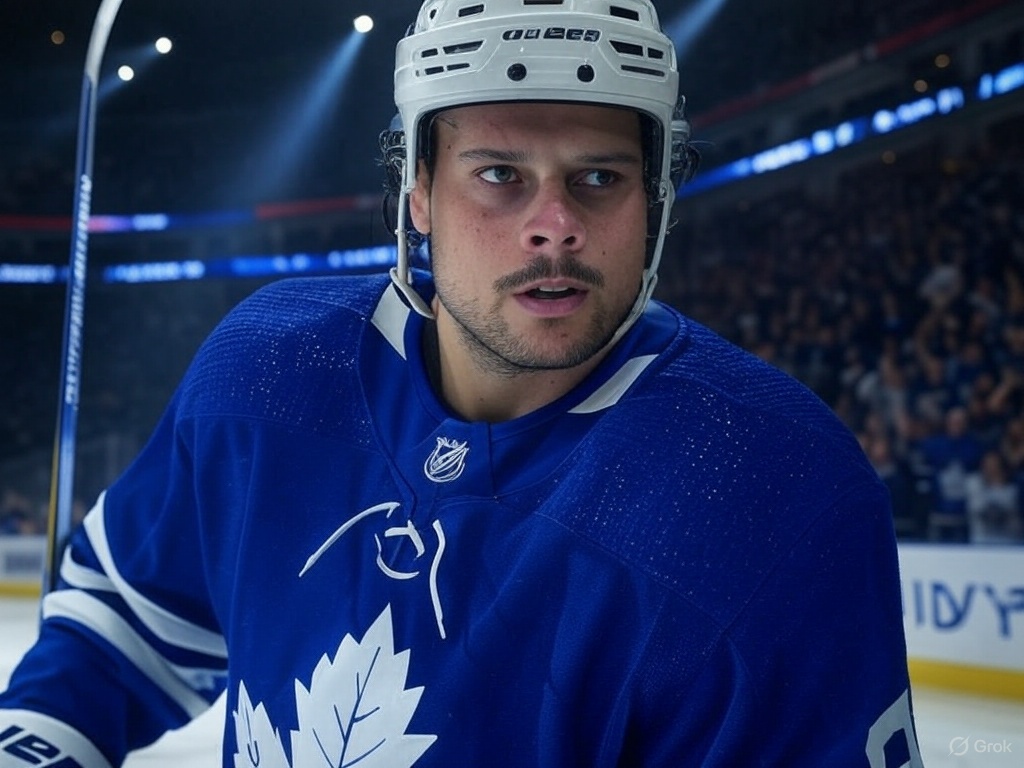
The echoes of Alex Ovechkin’s historic 895th goal are still reverberating through the hockey world. It was the shot that finally eclipsed Wayne Gretzky’s seemingly untouchable mark. For years, “The Gr8 Chase” captivated fans. It was a relentless pursuit. It culminated in a new name atop the NHL’s all-time goal-scoring list. Yet, almost as soon as one summit is reached, the eyes of the sporting world instinctively shift. They scan the horizon for the next potential climber. Enter Auston Matthews.
The Toronto Maple Leafs captain is a generational goal-scoring talent. His name is inevitably the first mentioned when pondering the seemingly impossible. Could anyone eventually challenge Ovechkin’s final tally? Ovechkin continues to add to his record. It is likely that he will push it beyond the 900-goal threshold. The question hangs in the air. Does Matthews possess the tools with his prodigious scoring rate and elite skill set? Crucially, does he have the time and durability to embark on a similar multi-decade quest? This analysis examines the numbers and projections. It considers the challenges. It also reviews expert opinions about the potential for another historic chase.
Ovechkin’s Reign: Setting the New Standard
On April 6, 2025, Alex Ovechkin fired a power-play shot past Ilya Sorokin. He scored his 895th career goal in his 1,487th NHL game. This fittingly matched the number of games Wayne Gretzky played to amass his 894 goals. This monumental achievement ended Gretzky’s 31-year reign as the NHL’s goal king. Ovechkin’s journey to the top was built on remarkable consistency and durability. He holds the NHL record for most 40-goal seasons with fourteen. He also shares the record for most 50-goal campaigns (nine) with Gretzky and Mike Bossy. Even in his late 30s, Ovechkin continued to defy typical aging curves. He scored 42 goals in just 61 games during his record-breaking 2024-25 season.
The question now becomes: where does the record finally settle? Ovechkin, 39 at the time of breaking the record, has one year remaining on his contract after the 2024-25 season. He has hinted at returning to Russia post-NHL. However, his drive suggests he could play beyond his current deal. His physical capability also supports this possibility. Experts and teammates anticipate he will push the record comfortably past 900 goals. Some even speculate about the possibility of reaching 1,000 goals, however remote, if he plays several more years. Projections before he broke the record gave him a strong chance of hitting 895 within the 2024-25 season. Given his pace (42 goals in 61 games that season ), adding another 5-10 goals before season’s end seemed plausible. This could push the initial target for Matthews closer to, or even past, the 900 mark. For the purpose of this discussion, we’ll consider the challenge as surpassing a benchmark of at least 900 goals.
Matthews Enters the Arena: The Challenger’s Profile
Auston Matthews, born September 17, 1997, stands as the most likely candidate to potentially challenge Ovechkin’s eventual record. As of mid-April 2025, the 27-year-old Maple Leafs captain reflected stats through 63 games of the 2024-25 season. He had amassed 398 goals. He achieved this in 625 career NHL games. Drafted 1st overall in 2016, Matthews quickly became an elite scorer. He won the Calder Trophy as rookie of the year. He also won multiple Maurice “Rocket” Richard Trophies as the league’s top goal-scorer. His scoring prowess is undeniable, but the mountain he eyes is immense. .
The Pace Race: Early Career Trajectories
Comparing the early careers of two generational scorers provides crucial context for the chase ahead. While raw totals offer one perspective, goals-per-game rates provide deeper understanding. Comparisons at similar games played milestones offer more insight, especially when accounting for external factors like lockouts and injuries.
A Tale of Nine Seasons
A direct comparison of their first nine NHL seasons reveals fascinating nuances:
| Player | Season Year(s) | GP | Goals (G) | Cumulative Goals | Cumulative GP | Cumulative G/GP |
|---|---|---|---|---|---|---|
| Alex Ovechkin | 2005-06 | 81 | 52 | 52 | 81 | 0.64 |
| 2006-07 | 82 | 46 | 98 | 163 | 0.60 | |
| 2007-08 | 82 | 65 | 163 | 245 | 0.67 | |
| 2008-09 | 79 | 56 | 219 | 324 | 0.68 | |
| 2009-10 | 72 | 50 | 269 | 396 | 0.68 | |
| 2010-11 | 79 | 32 | 301 | 475 | 0.63 | |
| 2011-12 | 78 | 38 | 339 | 553 | 0.61 | |
| 2012-13 (Lockout) | 48 | 32 | 371 | 601 | 0.62 | |
| 2013-14 | 78 | 51 | 422 | 679 | 0.62 | |
| Auston Matthews | 2016-17 | 82 | 40 | 40 | 82 | 0.49 |
| 2017-18 | 62 | 34 | 74 | 144 | 0.51 | |
| 2018-19 | 68 | 37 | 111 | 212 | 0.52 | |
| 2019-20 | 70 | 47 | 158 | 282 | 0.56 | |
| 2020-21 (COVID) | 52 | 41 | 199 | 334 | 0.60 | |
| 2021-22 | 73 | 60 | 259 | 407 | 0.64 | |
| 2022-23 | 74 | 40 | 299 | 481 | 0.62 | |
| 2023-24 | 81 | 69 | 368 | 562 | 0.65 | |
| 2024-25 (partial) | 63 | 30 | 398 | 625 | 0.64 |
After nine seasons, Ovechkin held a lead in cumulative goals (422 vs. 398), having played more games (679 vs. 625). However, Matthews concluded his ninth season (albeit partial) with a slightly higher cumulative goals-per-game average (0.64) compared to Ovechkin’s mark after nine full seasons (0.62). This suggests superior scoring efficiency for Matthews during the games he played.
Similar Games Played Checkpoints
Comparing directly at similar game milestones reinforces Matthews’ slight edge in early-career scoring rate. At the 623-game mark, Matthews had scored 398 goals, whereas Ovechkin had tallied 391 goals in his first 623 contests. Matthews reached 359 goals in his first 553 games. He outpaced Ovechkin’s 339 goals over the same number of games.
The Lockout vs. Injury Factor
These comparisons, however, require crucial context. Ovechkin’s early totals, particularly his games played count, were significantly impacted by league stoppages. What would have been his rookie season (2004-05) was lost entirely due to a lockout. He also lost nearly half of the 2012-13 season to another lockout. Add in COVID-shortened seasons, and Ovechkin missed substantial prime scoring opportunities due to factors beyond his control.
Conversely, Matthews’ lower games played total stems primarily from injuries. He has dealt with shoulder, wrist, knee, and other upper-body issues, missing significant time in multiple seasons. While his goals-per-game rate (0.64 career average through April 2025 ) reflects elite efficiency when healthy – ranking among the highest in NHL history – his availability has been less consistent than Ovechkin’s. This distinction is critical. Ovechkin lost potential goals due to external league issues. Matthews’ primary challenge is internal. He needs to maintain his health to stay on the ice. The latter represents a more persistent and unpredictable threat to a long-term record chase.
The Crystal Ball: Projecting Matthews’ Path to the Summit
Ovechkin’s record is established at 895 goals and is likely climbing towards or past 900. Matthews is at 398 goals as of April 2025. He needs approximately 500 more goals. This would allow him to enter the conversation. The mathematical path is daunting. It requires not just elite scoring. It also demands unprecedented longevity and resilience. These qualities counter the inevitable decline associated with aging.
The Mathematical Challenge
Statistical projections paint a picture of the immense task ahead:
- Games Needed: At his career 0.64 goals-per-game pace, Matthews would require roughly 778 additional games played to score the 498 goals needed to reach 896.
- Seasons Needed (Ideal): Based on a full 82-game season, playing 778 games translates to approximately 9.5 more seasons. This would put him near the record around age 37.
- Seasons Needed (Realistic): However, Matthews has averaged roughly 69-70 games per season over his first nine years due to injuries and shortened seasons (625 GP / 9 seasons ≈ 69.4 GP/season). At that rate of participation, playing the required 778 games would take just over 11 more seasons. This would push the potential timeline into his late 30s (early 2036-37 season).
- Benchmark Pace: Reaching 900 goals generally requires averaging 45 goals per season for 20 total seasons. Matthews’ average over his first nine seasons is approximately 44.2 goals (398 G / 9 seasons). Maintaining this near-benchmark pace for another 11+ seasons, well into his late 30s, is the core challenge. Some projections suggest he could pass Ovechkin’s current mark by age 37 if his pace holds.
The Aging Curve Conundrum
The biggest unknown in any long-term projection is the aging curve. Historically, even elite NHL scorers see a decline in production, often starting around age 30. Alex Ovechkin stands as a remarkable exception. His ability to maintain elite goal production well into his late 30s is almost unprecedented. His goals-per-game rate saw only a minor dip (~8%) from his early career compared to Gretzky’s significant drop-off (~56%).
Can Matthews replicate this defiance of time? Experts consistently point to longevity as the most significant hurdle. Matthews relies heavily on hockey IQ, an elite release, and positioning rather than pure speed. His game might theoretically age well. However, the physical demands of the NHL over two decades take a toll on everyone. Ovechkin’s longevity isn’t just about skill; it’s about a unique physical resilience.
The Compounding Effect of Missed Games
The mathematical projections assume consistent participation, which Matthews’ history contradicts. Every game missed is more than just a lost opportunity to score. It pushes the finish line further into the future. Needing to play ~778 more games becomes significantly harder if he continues to miss 10-15% of each season. Playing those games later means playing them deeper into his 30s. This is precisely when the aging curve typically takes hold. Scoring becomes more difficult during this time. Therefore, missed games create a compounding problem. They reduce goals scored in the present. At the same time, they increase the difficulty of scoring the remaining goals in the future due to age. Minimizing time lost to injury is nearly as critical for Matthews as maintaining his scoring rate itself.
The Gauntlet: Challenges Facing Matthews
Beyond the sheer numbers and the battle against time, several specific challenges stand between Matthews and Ovechkin’s record.
The Durability Question: Ovechkin’s Iron Man vs. Matthews’ Maintenance
This is arguably the most critical factor. Ovechkin’s career has been defined by remarkable durability. Before fracturing his fibula in his record-breaking season, he had missed only 35 games. This was due to injury across nearly two decades. He played in at least 79 games for 12 of his first 14 full seasons. These numbers exclude the lockout and COVID years. He absorbed punishment while rarely missing time.
Matthews’ track record presents a stark contrast. His injury list includes significant time missed for shoulder, wrist, knee, and various upper-body ailments, plus illnesses. He has completed a full 82-game season only once and played 75+ games just twice in his nine seasons. Experts consistently identify this disparity in health and longevity as the single biggest obstacle for Matthews in this chase. Ovechkin isn’t just a great scorer; he’s arguably the most durable elite scorer the game has ever seen.
Maintaining Consistency: Avoiding the Slumps
Matthews has demonstrated incredible goal-scoring consistency when healthy. He has led the NHL in goals since his debut. However, even he is not immune to fluctuations. The start of the 2024-25 season was challenging. He scored 30 goals in 63 games, which was a pace below his peak years. This decline was potentially linked to recovering from or managing injuries. Reaching Ovechkin’s mark requires consistent elite production for well over another decade. Players must avoid prolonged slumps that can derail long-term pursuits. Ovechkin’s relentless drive and ability to score even during perceived “down” periods were key to his success.
Supporting Cast & Team Dynamics: The Marner Effect?
Linemate quality and team context also play a role. Ovechkin benefited from a long-term partnership with Nicklas Backstrom, who assisted on 279 of his goals. Matthews frequently plays alongside Mitch Marner, an elite playmaker. This pairing, however, features a clear passer (Marner) and a clear shooter (Matthews). Some analysts question if this predictability makes them easier to defend. This is particularly true in the playoffs, where scoring has sometimes dried up for Toronto’s stars. Interestingly, in limited samples without Marner, Matthews’ points-per-game have actually increased. His assist numbers have also risen. This suggests an ability to adapt his game. Furthermore, the long-term competitiveness of the Maple Leafs is a factor. Ovechkin spent his career on a Washington team that was consistently a playoff contender, providing ample offensive opportunities. Matthews will need Toronto to remain a strong offensive environment for the next decade or more.
The Scoring Environment: Riding the Wave?
League-wide scoring trends are not static. Ovechkin scored prolifically through some of the NHL’s lower-scoring eras, particularly compared to Gretzky’s prime. In recent years, scoring has trended upwards across the league. This higher-octane environment could potentially benefit Matthews’ chase compared to the tighter-checking eras Ovechkin navigated early on. Adjusted goal metrics consider era effects. These metrics actually place Ovechkin significantly ahead of Gretzky. This underscores the difficulty of the environment Ovechkin often played in. Factors like power-play opportunities and effectiveness play a role in influencing goal totals. Ovechkin is the all-time power-play goal leader. Additionally, how teams manage leads, known as “score effects,” also plays a crucial role. These factors could shift over the next decade.
Ultimately, while consistency, linemates, and league trends all matter, they orbit the central issue of health. Matthews’ ability to stay on the ice is the lynchpin. It directly impacts his ability to maintain consistency. It also affects his ability to build chemistry over full seasons. Furthermore, it influences his capacity to capitalize on any favorable scoring trends long enough to make the ~500-goal climb. His injury history makes the required 11+ year projection incredibly precarious. Without replicating Ovechkin’s “indestructible” nature , the other factors become secondary.
Different Weapons, Same Target: A Stylistic Comparison
While both Ovechkin and Matthews are generational goal-scorers, their methods differ significantly.
Ovechkin: The Power Forward Personified
Ovechkin embodies the modern power forward scorer. His game is built on physicality, a relentless motor, and an overwhelming shot. His signature weapon is the booming one-timer. It is typically unleashed from the top of the left face-off circle, known as the “Ovi Spot.” It is especially lethal on the power play. A staggering percentage of his career goals have come from this area. He combines this with immense shot volume. He consistently ranks among the league leaders in shots on goal. Additionally, he possesses elite shot velocity.
Matthews: The Surgical Sniper
Matthews presents a different profile. He possesses size and strength. His game is less predicated on brute force. It relies more on elite hockey IQ and subtle positioning. He arguably has the most deceptive and dangerous shot arsenal in the league. His primary weapon is a lightning-quick, heavy wrist shot and snap shot. They are often released with minimal wind-up. This makes it incredibly difficult for goalies to track. He scores effectively from mid-range areas. He also possesses the skill to score in diverse ways. He can do this through traffic, with tip-ins, using his backhand, or by finding soft spots in coverage. He has also significantly developed his defensive game, becoming a true 200-foot player.
Style and Longevity
Does Matthews’ more “surgical” style lend itself better to longevity than Ovechkin’s physically demanding approach? Theoretically, a game less reliant on absorbing and delivering high-impact collisions might reduce wear and tear over a 20-year span. However, this hypothesis is complicated by reality. Matthews has already suffered numerous injuries, many unrelated to heavy physical battles (wrist, knee issues). Conversely, Ovechkin’s unique physical constitution allowed him to withstand the rigors of his power game for two decades. Therefore, Matthews’ style could theoretically be less taxing. However, his specific injury history suggests durability is more about individual resilience than style alone. Ovechkin’s ability to endure remains the outlier. This makes any assumption that Matthews will automatically benefit from a “less physical” style speculative at best.
The Expert Verdict: Is the Chase Realistic?
Ovechkin broke the record. As soon as this happened, the speculation about Matthews began. This illustrates the natural cycle of record pursuits in sports. It also cements Matthews’ status as the premier scorer of his generation. But what do the experts, and Matthews himself, think about the feasibility of this next chase?
The Chorus of Caution (Including Matthews Himself)
The overwhelming sentiment is one of extreme caution. Wayne Gretzky himself, upon Ovechkin breaking his record, mused, “I’m not sure who’s going to get more goals than that”. Matthews often avoids the conversation. He emphasizes the immense distance still to cover. He states he shouldn’t even be in the discussion yet.
Experts echo this, invariably pointing to health and longevity as the monumental hurdles. The sheer scale of needing roughly 500 more goals is difficult to comprehend. This requires elite production for another 11-plus seasons. He would need to continue well into his late 30s.
The Case for Possibility
Despite the long odds, there’s a reason Matthews is the focus. Many experts concede that if anyone currently playing has a shot, it’s him. Teammate Matthew Knies voiced belief, suggesting “‘3-4’ could do it”.
The arguments for possibility rest on his statistical foundation:
- Superior Early Pace: His goals-per-game rate and goals scored at similar games-played milestones exceed Ovechkin’s early numbers.
- Elite Talent: Multiple Rocket Richard trophies and seasons of 60 and 69 goals demonstrate his peak scoring ability.
- Scoring Environment: The current, higher-scoring NHL may provide a more favorable backdrop than parts of Ovechkin’s career.
Conclusion: A Marathon Measured in Decades and Durability
Auston Matthews has the talent of a generation. He has demonstrated the scoring efficiency required to be mentioned alongside Alex Ovechkin and the all-time goals record. His early-career pace, on a per-game basis, even slightly surpasses that of the current record holder.
The journey from ~400 goals to over 900 is a marathon measured in decades. Its successful navigation depends overwhelmingly on factors beyond pure skill. These include unprecedented durability and a defiance of the typical aging curve. Ovechkin’s record is as much a testament to his physical resilience as his lethal shot. Matthews, while stylistically different, has already faced numerous injury setbacks that Ovechkin largely avoided.
To realistically challenge Ovechkin’s final mark, Matthews must maintain his elite scoring average. He also needs to stay healthy and productive deep into his 30s. This means replicating the career trajectory of one of hockey’s most unique physical specimens. The current scoring environment might offer a slight tailwind. However, any missed games make the task exponentially harder due to their compounding effect.
Is it possible? Statistically, the door remains slightly ajar. Realistically, the odds are long. Achieving success requires a combination of peak performance and sustained health. It may also need a touch of luck over the next 10-15 years. For now, as Matthews himself suggests, the focus should remain on appreciating Ovechkin’s historic accomplishment. The chase for the next record is a compelling storyline for the future. However, its realization depends more on unpredictable health and time variables than on projection models. It will be fascinating to watch unfold, even if the summit remains shrouded in the distance.


 ScortonBoy17.ca
Leave a comment