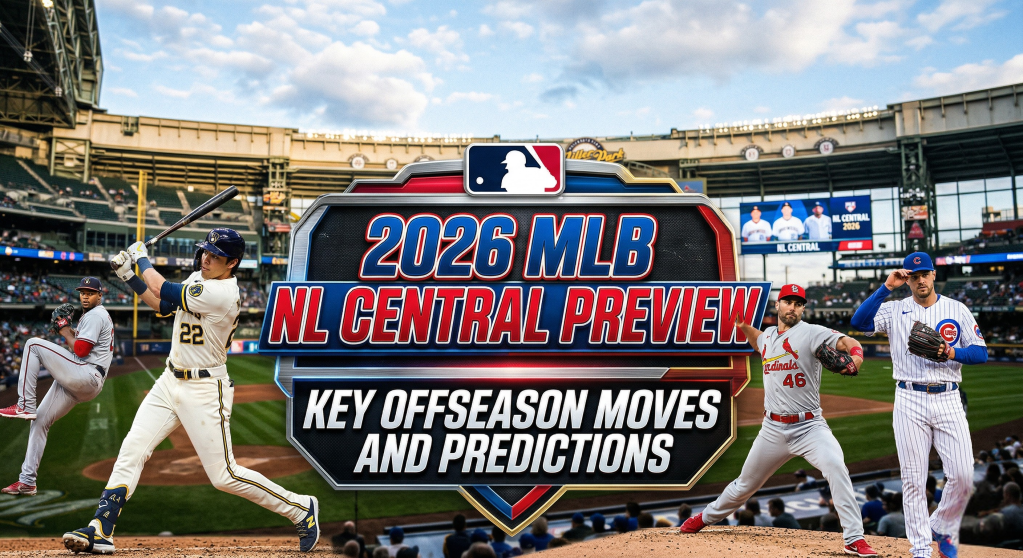
The 2026 Major League Baseball season marks a turning point for the National League Central. This division has historically balanced traditional rivalries with avant-garde front-office strategies. The 2025 campaign was defined by the Milwaukee Brewers’ regular-season dominance. It also featured the Los Angeles Dodgers’ ninth World Series title. Now, the landscape of the Central has shifted toward a state of high-velocity transition.1 The 2025 season concluded with the Brewers leading the standings with 97 wins. Following them was a resurgent Chicago Cubs squad with 92 victories. Meanwhile, the Cincinnati Reds and St. Louis Cardinals navigated varying degrees of competitive volatility.3 However, as the league moves into 2026, high-profile free agency departures have tested the structural integrity of these rosters. Aggressive trades have further challenged them. Moreover, a generational wave of pitching talent has emerged in Pittsburgh.
The division now operates under the newly implemented Automated Ball-Strike (ABS) challenge system. This technological revolution promises to redefine the strategic interactions between pitchers, catchers, and hitters.4 The Cubs have fortified their infield by acquiring Alex Bregman in a blockbuster move. The Pittsburgh Pirates have ended their rebuilding phase with reigning Cy Young winner Paul Skenes. The division’s competitive equilibrium is now at its most volatile in a decade.6 The following analysis provides a comprehensive look at the five-member clubs. It covers their offseason maneuvers, tactical shifts, and projected trajectories for the 162-game marathon ahead.
Retrospective Analysis: The 2025 Division Landscape
To understand the 2026 season, one must examine the cascading effects of the 2025 standings. The Milwaukee Brewers entered 2025 as a team in transition. They exceeded all expectations by finishing with the best record in the National League.2 Their success relied on a top-tier rotation led by Freddy Peralta. Additionally, their high-leverage bullpen consistently outperformed Pythagorean expectations.9 Conversely, the Chicago Cubs finished just five games back. This deficit was largely due to early-season injuries to key members of the rotation. An inconsistent bullpen also faltered in high-leverage October situations.3
The Cincinnati Reds delivered the most significant statistical anomaly of 2025. They finished with 83 wins despite a young core. This young core saw considerable performance fluctuations.11 The Pittsburgh Pirates established the division’s most important individual narrative. Despite a 71-91 record, they highlighted Paul Skenes’s ascent. Paul Skenes became the first rookie in decades to win the Cy Young Award. He also led the league in one-run losses.3 The St. Louis Cardinals’ 78-win season prompted a total organizational reset. This led to the departure of franchise icons. The team chose a long-term development model under Chaim Bloom.12
| Team | 2025 W-L | GB | RS | RA | Run Diff |
| Milwaukee Brewers | 97-65 | — | 795 | 640 | +155 |
| Chicago Cubs | 92-70 | 5.0 | 780 | 690 | +90 |
| Cincinnati Reds | 83-79 | 14.0 | 740 | 735 | +5 |
| St. Louis Cardinals | 78-84 | 19.0 | 710 | 755 | -45 |
| Pittsburgh Pirates | 71-91 | 26.0 | 660 | 760 | -100 |
Chicago Cubs: The Pursuit of Divisional Hegemony
The Chicago Cubs enter the 2026 season with an “urgency rating” of one. This indicates a front office that believes the foundational work of its competitive window is largely complete.12 The organization finished the 2025 season with 92 wins. They then prioritized elite veteran leadership. They also focused on rotation depth to bridge the gap with Milwaukee.2 The strategy’s core was the signing of third baseman Alex Bregman. He agreed to a five-year, $175 million contract.6 Bregman replaces rookie Matt Shaw at the hot corner. He provides a championship pedigree. His disciplined plate approach is intended to stabilize the heart of the order during high-stakes divisional play.10
Infield Configurations and the Tactical Pivot of Matt Shaw
The acquisition of Bregman created an immediate surplus of high-level infield talent. Manager Pat Murphy had to innovate with roster construction. He replaced Craig Counsell after Counsell moved into a front-office advisory role.13 While Bregman anchors third base, the middle infield remains anchored by Gold Glove winners Dansby Swanson and Nico Hoerner.13 Matt Shaw has emerged as a versatile offensive threat. This emergence has necessitated a transition for the youngster. He has moved into a “super-utility” role, spending time at multiple positions during Spring Training. This maximizes lineup flexibility.10 This tactical shift mirrors successful models. Organizations employ these models where defensive versatility optimizes matchup exploitation. This optimization occurs without sacrificing offensive output.
| Position | Projected Starter | 2025 bWAR | Primary Backup/Utility |
| First Base | Michael Busch | 2.8 | Tyler Austin |
| Second Base | Nico Hoerner | 3.5 | Matt Shaw |
| Shortstop | Dansby Swanson | 3.3 | Matt Shaw |
| Third Base | Alex Bregman | 4.2 | Matt Shaw |
| Catcher | Carson Kelly | 2.1 | Miguel Amaya |
| Designated Hitter | Moises Ballesteros | Rookie | Michael Busch |
The catching situation has stabilized around Carson Kelly. He is coming off a career-best 2025 season. In this season, he emerged as a primary offensive contributor in the bottom half of the order.13 The Cubs’ offensive strategy centers on high-contact rates and elite baserunning. Pete Crow-Armstrong is projected to advance significantly. He is expected to become a premier speed threat in center field after recording a 6.0 bWAR season in 2025.13
Rotation Depth and the Cabrera Acquisition
While the offence received the headlines, the Cubs’ most significant structural improvement may be in the starting rotation. The Cubs traded top prospect Owen Caissie to the Miami Marlins. In return, they received right-hander Edward Cabrera. This reflects a shift from prospect hoarding to active contention.10 Cabrera joins a rotation affected by injuries in 2025. Justin Steele’s prolonged absence due to elbow issues notably impacted the team.10 The 2026 Cubs’ rotation is built on the philosophy of “waves of depth.” Matthew Boyd has been named the Opening Day starter, but the unit’s strength lies in its 3-through-7 options.10
| Rotation Slot | Pitcher | Age | 2026 Role/Status |
| 1 | Matthew Boyd | 35.1 | Opening Day Starter |
| 2 | Cade Horton | 24.6 | Breakout Ace Candidate |
| 3 | Edward Cabrera | 27.9 | High-Upside Acquisition |
| 4 | Shota Imanaga | 32.5 | Veteran Stability |
| 5 | Colin Rea | 35.7 | Back-end Reliability |
| Depth | Justin Steele | 30.8 | Expected Return May/June |
| Depth | Jameson Taillon | 34.4 | Veteran Depth |
| Depth | Javier Assad | 28.6 | Swingman/Long Relief |
This depth is crucial for a team that struggled with Shota Imanaga’s intermittent absences in 2025.10. The bullpen has been revamped. The additions of Phil Maton, Hunter Harvey, and Hoby Milner give the coaching staff multiple options for late-inning leverage.12 Maton, in particular, has been identified as a potential secondary closer. This is in case Daniel Palencia experiences the volatility common among young high-velocity arms.10
Milwaukee Brewers: Sustainability Through Innovation
The Milwaukee Brewers entered the 2025-2026 offseason as the defending division champions. They had posted the best record in the National League a year ago.2 Despite this success, the organization adhered to its long-standing philosophy of “talent cycling.” They traded away ace Freddy Peralta to the New York Mets. This was to maximize his value before he reached free agency.6 This move initially drew skepticism. However, the Brewers’ front office, led by Matt Arnold, has a proven track record. They maintain competitive parity through internal development. They also succeed with low-cost acquisitions.6
The Rotation Post-Peralta and the Woodruff Return
The Brewers’ rotation for 2026 is younger and more volatile than in previous years. Brandon Woodruff returns on a one-year, $22 million deal via the qualifying offer. He provides a veteran anchor, though his full health remains a lingering question mark heading into April.18 The Peralta trade netted the Brewers’ top pitching prospect, Brandon Sproat. He is expected to debut in the 2026 rotation. Sproat will join other high-ceiling arms like Jacob Misiorowski.6
| Projected Starter | Acquisition/Path | 2026 Outlook |
| Chad Patrick | Internal Development | Projected Opening Day Starter |
| Jacob Misiorowski | Top Prospect | High Strikeout Potential |
| Brandon Woodruff | Free Agent (Re-signed) | Rebound Candidate |
| Kyle Harrison | Trade (from BOS) | Mid-Rotation Stability |
| Brandon Sproat | Trade (from NYM) | High-Upside Rookie |
The injury to Quinn Priester (wrist) has further thinned the early-season depth. This situation forces the Brewers to rely on Chad Patrick to lead the staff.18 The Brewers take a calculated risk with this “light” rotation depth. They believe their bullpen and pitching lab can elevate unheralded arms into productive roles. This is evident from the acquisition of left-hander Angel Zerpa from Kansas City.12 The Brewers added relief arm Sammy Peralta to their 40-man roster. They also added outfielder Akil Baddoo. These additions bolster the bench and middle-relief depth.13
The Youth Core: Jackson Chourio and Jesus Made
Offensively, the Brewers remain centred on Jackson Chourio, who has solidified himself as a cornerstone after two consecutive 20-20 seasons.13 The lineup is designed around athleticism and defensive versatility, with Brice Turang and Joey Ortiz providing elite middle-infield defence.13 Turang, the 2024 Platinum Glove winner, continues to be a central figure in the team’s defensive identity.13
A major storyline for 2026 is the rapid ascent of shortstop Jesus Made. Ranked as the No. 3 prospect in baseball, Made reached Double-A as an 18-year-old and earned a non-roster invitation to big-league camp.22 Some evaluators now suggest Made could impact the Major League roster by late 2026. This is a change from the initial projection of a mid-2027 debut. He may potentially follow the aggressive promotion path laid out by Chourio.22 The third base position remains a concern following the trade of Caleb Durbin to Boston.11 The Brewers signed Luis Rengifo to a one-year contract. This move is meant to bridge the gap. However, the long-term solution likely resides in the farm system with Made or other developing infielders.21
Cincinnati Reds: The Terry Francona Era
The Cincinnati Reds enter 2026 with a sense of “unfinished business” after an 83-win season in 2025.3 The organization made a significant non-player move. They hired Terry Francona to lead a young, dynamic roster.11 Francona is known for maximizing undervalued talent. This ability fits a Reds team with arguably the highest athletic ceiling in the National League Central.11 The offseason was relatively quiet on the player front. The team re-signed Emilio Pagan. They also added veteran bullpen arms like Pierce Johnson and Caleb Ferguson.12
Coping with the Hunter Greene Setback
The Reds’ 2026 outlook was dampened by the news. Star pitcher Hunter Greene underwent surgery to remove bone chips. He will be sidelined until at least July.11 This loss deprives the Reds of their hardest thrower. It also deprives them of their most recognizable ace during the critical first half of the season. In his absence, the rotation relies on a quartet of young, productive arms. They must bridge the gap to maintain a .500 winning percentage.18
| Pitcher | 2025 Performance | 2026 Role |
| Andrew Abbott | 3.85 ERA | Mid-Rotation Stabilizer |
| Nick Lodolo | 10.2 K/9 | High-Upside Starter |
| Brady Singer | 185.0 IP | Veteran Workhorse |
| Chase Burns | Rookie | Strikeout Specialist |
| Rhett Lowder | Injury Return | Back-end Reliability |
The staff includes impressive rookie Chase Burns, who is expected to provide an immediate strikeout boost.18 The loss of Zack Littell to free agency further complicates the innings-eating requirement of this staff. This situation puts immense pressure on Rhett Lowder. He needs to rebound from a 2025 season lost to forearm issues.18 The Reds have one of the most unheralded rosters in baseball. Francona’s skill in managing a pitching staff despite such a significant injury will define their season.11
Offensive Consistency and the Eugenio Suárez Reunion
Elly De La Cruz continues to headline the Reds’ offence. His combination of power and speed remains a “five-tool” anomaly in the division.14 However, the team struggled with consistency at the plate in 2025, leading to an offseason focus on veteran reinforcements. The Reds re-signed Eugenio Suárez to a one-year, $15 million deal. They aim to provide a middle-of-the-order power bat and a familiar veteran presence.6
The infield defence saw a major upgrade with the acquisition of Ke’Bryan Hayes from Pittsburgh in late 2025. This move allows the Reds to be more aggressive with their defensive positioning.12
| Batter | Position | Projected OPS | Note |
| TJ Friedl | CF | .765 | Leadoff Sparkplug |
| Elly De La Cruz | SS | .820 | Elite Speed/Power |
| William Contreras | C | .790 | Middle-of-Order Anchor |
| Eugenio Suárez | 3B/DH | .750 | Veteran Power Source |
| Spencer Steer | UT | .775 | Versatile Contributor |
The Reds also have significant depth in the minors. Players like Edwin Arroyo and Christian Encarnacion-Strand were recently optioned. They remain a phone call away should the offensive struggles of 2025 resurface.23
Pittsburgh Pirates: The Paul Skenes Phenomenon
For the first time in nearly a decade, there is genuine “excitement” in Pittsburgh.6 This optimism comes from the historic 2025 season of Paul Skenes. He won the National League Cy Young Award. He achieved this after posting a 1.97 ERA and 251 strikeouts in over 200 innings.7 Skenes is widely considered the most dominant pitcher in the sport. The Pirates have spent the 2025-2026 offseason attempting to professionalize the roster around him. They aim to avoid another season of wasted quality starts.7
Building Around an Elite Rotation
The Pirates’ strategy involved a heavy infusion of veteran bats. This was done to support a rotation that already features Skenes, Mitch Keller, and Jared Jones.7 The front office added Ryan O’Hearn, Brandon Lowe, and Marcell Ozuna. They aimed to strengthen an offence described as “anemic” in 2025.6 The team signed Jose Urquidy to a short-term deal. He provides a playoff-tested pitcher to fill out the rotation. This ensures that the team has a reliable arm for the fourth and fifth spots.18
| Pitcher | 2025 Context | 2026 Projection |
| Paul Skenes | 1.97 ERA, 251 K | Cy Young Favorite / 200+ IP |
| Mitch Keller | 4.10 ERA, 180 IP | Veteran Infield Anchor |
| Bubba Chandler | MLB Debut | High-Upside Starter |
| Braxton Ashcraft | Fully Healthy | Rebound Candidate |
| José Urquidy | Free Agent | Postseason Experience |
The Pirates led the league in one-run losses with 35 in 2025. They hope to reverse this statistic through a more potent lineup. Their bullpen will be sturdier, anchored by veterans like Ryan O’Hearn who bring consistent 800+ OPS potential.7
The Konnor Griffin Hype Train
The most significant addition may come from within. Konnor Griffin, the No. 1 prospect in all of baseball, is “knocking on the MLB doorstep” at age 19.22 Griffin, a 6-foot-3 shortstop/outfielder with elite speed and power, slashed .337/.418/.542 in Double-A to close out 2025.22 Unlike previous Pirates regimes known for service-time manipulation, active discussions are happening about Griffin making the Opening Day roster. This move could be supported by a pre-debut contract extension. It would be similar to the one signed by Jackson Chourio in Milwaukee.22
Griffin’s ceiling is truly unlimited. He is projected as a candidate for 25 home runs. He could achieve 40 stolen bases if he plays a full season.26 The Pirates have quietly assembled an exciting group of young players and prospects. This includes Bubba Chandler and Braxton Ashcraft. They could become the “Cinderella story” of the 2026 season.7
St. Louis Cardinals: The Chaim Bloom Blueprint
The St. Louis Cardinals are starting a “new chapter” with Chaim Bloom as their leader. They chose to enter a full-scale rebuild. This decision led to the departure of the team’s most iconic veterans.12 After a disappointing 78-84 finish in 2025, the Cardinals made significant changes. They “cleaned house” by trading Sonny Gray and Willson Contreras to Boston. They also traded Nolan Arenado to the Arizona Diamondbacks for a haul of prospects.12 Dustin May was the lone major addition of the offseason. He is a high-upside acquisition. He is meant to provide a glimpse of elite talent while the younger arms develop.12
Rebuilding with Young Anchors
The 2026 Cardinals are a team defined by “young anchors” rather than veteran superstars. The development of Masyn Winn, Jordan Walker, and Nolan Gorman has become the focus. Additionally, there is anticipation with the arrival of top prospect JJ Wetherholt.11 Wetherholt, the No. 5 prospect in MLB, is expected to play a major role in the 2026 infield. He might start at second base due to Winn’s presence at shortstop.22 Wetherholt’s “advanced hit tool” and.931 OPS in the minors make him a preseason favorite for NL Rookie of the Year.24
| Young Anchor | Position | 2025 Stat/Note | 2026 Outlook |
| Masyn Winn | SS | Defensive Elite | Franchise Shortstop |
| JJ Wetherholt | 2B | .931 OPS (MiLB) | Rookie of the Year Favourite |
| Nolan Gorman | 2B/3B | 25 HR | Power Threat |
| Jordan Walker | OF | .275 AVG | Breakout Candidate |
The Cardinals finalized Oliver Marmol’s coaching staff for 2026. They retained Dusty Blake as the pitching coach. They also added new members, like Casey Chenoweth and Kyle Driscoll, to modernize their hitting and pitching strategies.27
The Pitching Deficit
While the offensive future looks promising, analysts describe the Cardinals’ 2026 pitching staff as being in “absolute shambles”.11 The team lost Miles Mikolas to free agency. They also traded Sonny Gray. As a result, the rotation lacks a true front-line starter. They are hoping that Dustin May can return to form. The Cardinals will need their starters to eat innings to stay competitive. The rotation’s lack of depth could heavily tax the bullpen.11 Projection systems are remarkably pessimistic for St. Louis, with win totals set as low as 66 (PECOTA) or 69.5 (BetMGM).9
| Rotation Slot | Pitcher | 2026 Context |
| 1 | Matthew Liberatore | Seeking to establish ACE status |
| 2 | Dustin May | High-upside injury return |
| 3 | Michael McGreevy | Innings eater |
| 4 | Andre Pallante | Versatile arm |
| 5 | Kyle Leahy | Depth option |
Technological Disruption: The ABS Challenge System
The 2026 season marks the official debut of the Automated Ball-Strike (ABS) challenge system in Major League Baseball. This change will have a disproportionate impact on the National League Central’s pitching-heavy landscape.4 Under this system, each team begins the game with two challenges. These challenges can be used to review ball-and-strike calls. They are reviewed via a replay graphic displayed on the scoreboard.4
This change introduces several layers of strategic complexity:
- Catcher Value Migration: Historically, teams like the Brewers and Cubs have prioritized “framing” catchers. These catchers can steal strikes for their pitchers. The ABS system reduces the value of framing. It increases the importance of a catcher’s offensive output and blocking ability. A challenge can now overturn a “stolen” strike.4
- Pitcher Profiles: High-velocity pitchers live on the edges of the zone. Paul Skenes or Hunter Greene may benefit from the tracking technology’s objective accuracy. The system aims to eliminate human error on borderline calls. These calls are increasingly common as average pitch velocities continue to rise.4
- Managerial Game Theory: Managers must decide when to “burn” their challenges. A missed call in the first inning might be tempting. However, saving a challenge for a high-leverage late-inning situation could be the difference between a win and a loss.4
Additional rule changes for 2026 include stricter enforcement of the coach’s box positioning. They also establish new guidelines preventing runners from deliberately initiating contact to draw obstruction calls. Both modifications aim to clarify on-field behaviour and maintain the integrity of the game’s flow.4
2026 Divisional Projections and Betting Narratives
The betting markets and statistical models for 2026 highlight a division with a clear favourite but significant room for volatility. The Chicago Cubs enter as the consensus favourites. Their odds of winning the division range from +110 to +115. Major sportsbooks like FanDuel and BetMGM offer these odds.8 The Milwaukee Brewers, despite winning 97 games in 2025, are seen as the secondary threat. This is primarily due to the loss of Freddy Peralta and the reliance on young rotation depth.8
| Team | Current Odds (BetMGM) | FanDuel Odds | Win Total (O/U) |
| Chicago Cubs | +110 | +110 | 88.5 |
| Milwaukee Brewers | +240 | +230 | 84.5 |
| Cincinnati Reds | +500 | +500 | 80.5 |
| Pittsburgh Pirates | +600 | +600 | 78.5 |
| St. Louis Cardinals | +3000 | +3000 | 69.5 |
Statistical models like PECOTA and FanGraphs suggest a tighter race than the betting odds might indicate. PECOTA is particularly bullish on the Cubs, projecting 89 wins. FanGraphs foresees a more competitive landscape. They project the Pirates for 82 wins—significantly higher than their betting over/under of 78.5.2 The ‘offseason overhaul’ in Pittsburgh is undervalued by the market. The potential impact of Konnor Griffin is also being undervalued.7
Causal Dynamics: How Offseason Moves Shift the Division
The strategic decisions made during the 2025-2026 offseason have created a ripple effect that will define the divisional race. The Cubs committed to Alex Bregman in direct response. Their goal was to close the five-game gap with the Brewers in 2025. By adding Bregman’s.With 850+ OPS potential and veteran leadership, the Cubs have stabilized a position—third base—that had been a persistent problem.10
Similarly, the Brewers’ trade of Freddy Peralta to the Mets was a calculated move to maximize organizational sustainability. It thins their 2026 rotation. However, it brings in Brandon Sproat. His triple-digit heat and high ceiling fit the Brewers’ long-term developmental window.6 This strategy of “talent cycling” has allowed Milwaukee to remain competitive for five of the last six years. It places immense pressure on their “pitching lab.” They need to transform unheralded arms into mid-rotation contributors.8
In Pittsburgh, the decision to sign Ryan O’Hearn and trade for Brandon Lowe signals an end to the “waiting period.” The front office recognized that Skenes’ generational talent required immediate offensive support to translate quality starts into wins.6 The Pirates’ success in 2026 will show if a small-market team can successfully “bridge” a rebuild. This involves veteran acquisitions and high-upside rookies.7
Future Outlook: Beyond the 2026 Horizon
The 162-game 2026 schedule marks the beginning of a decade. This period will feature high-stakes competition in the National League Central. The Cubs’ window is firmly open, supported by a top-tier farm system and a newly signed superstar in Bregman.2 The Pirates are poised to become the division’s new perennial power. This relies on the performance of Skenes and potentially Griffin. Their success depends on their pitching depth holding up.7
The Cincinnati Reds, under the mastership of Terry Francona, are the division’s wild card. If Hunter Greene returns in July, the Reds could easily surpass their 80.5 win projection. If the young core takes a collective step forward, they could also challenge for a Wild Card spot.11 For the Cardinals, 2026 is about the process. They are focused on establishing a new culture. The team is evaluating whether their young anchors can form the basis of the next “Cardinal Way”.11
Technological advancement (ABS) is converging with generational pitching (Skenes). High-profile veterans (Bregman) add to this convergence. These factors ensure that the 2026 National League Central will be one of the most compelling divisions in baseball. The race to the finish line in October will likely be determined by team depth. The Cubs’ seven-man rotation might withstand the rigours of the seven-month marathon. Alternatively, the Brewers’ bullpen lab might handle it better.10
The expected outcome for the 2026 season favours the Chicago Cubs. Their balanced roster and financial commitment have positioned them as the team to beat.2 However, the National League Central is volatile and talent-rich. The only certainty is the “worst-to-first” potential of teams like the Pirates. Additionally, the “underrated” nature of the Reds and Brewers will provide a season-long drama, defying early-season predictions.11
Works cited
- 2025 Major League Baseball season – Wikipedia, accessed March 23, 2026, https://en.wikipedia.org/wiki/2025_Major_League_Baseball_season
- PECOTA 2026 MLB projected standings and playoff odds, accessed March 23, 2026, https://www.mlb.com/news/pecota-2026-mlb-projected-standings-and-playoff-odds
- 2026 MLB Playoff Odds – Division – ATC | FanGraphs Baseball, accessed March 23, 2026, https://www.fangraphs.com/standings/playoff-odds/atc/div
- MLB 2026 rule changes that baseball fans need to know – SPOTV NOW, accessed March 23, 2026, https://www.spotvnow.com/read/mlb-2026-rule-changes-that-baseball-fans-need-to-know/
- 2026 MLB season preview articles, accessed March 23, 2026, https://www.mlb.com/news/2026-mlb-season-preview-articles
- 5 Biggest Offseason Moves in NL Central – Bradenton Today, accessed March 23, 2026, https://nationaltoday.com/us/fl/bradenton/news/2026/02/16/5-biggest-offseason-moves-in-nl-central/
- Tanner Jennings’ 10 Bold Predictions for the 2026 MLB Season | Pitcher List, accessed March 23, 2026, https://pitcherlist.com/tanner-jennings-10-bold-predictions-for-the-2026-mlb-season/
- NL Central Odds 2026: Cubs Enter as Favorites – BetMGM, accessed March 23, 2026, https://sports.betmgm.com/en/blog/mlb/national-league-central-odds-bm23/
- MLB Win Totals 2026: Over/Under Odds & Predictions – BetMGM, accessed March 23, 2026, https://sports.betmgm.com/en/blog/mlb/mlb-win-totals-odds-predictions-bm23/
- How the Chicago Cubs are Actually Building Their 2026 Roster – Sports Illustrated, accessed March 23, 2026, https://www.si.com/mlb/cubs/onsi/how-the-chicago-cubs-are-actually-building-their-2026-roster
- 2026 MLB Season Win Total Over/Unders: NL Central, accessed March 23, 2026, https://www.canadasportsbetting.ca/news/mlb/2026-mlb-season-win-total-projections-picks-nl-central/
- Offseason updates for Brewers, Cubs, Pirates, Cardinals, Reds – TSN, accessed March 23, 2026, https://www.tsn.ca/mlb/article/offseason-updates-for-brewers-cubs-pirates-cardinals-reds-n1-47599562/
- Comparing the Brewers and Cubs 2026 lineups after the Alex Bregman signing, accessed March 23, 2026, https://reviewingthebrew.com/comparing-the-brewers-and-cubs-2026-lineups-after-the-alex-bregman-signing-01keqxgpeegz
- Top 10 Best Players in the NL Central for the 2026 MLB Season, accessed March 23, 2026, https://www.justbaseball.com/mlb/top-10-best-players-nl-central-2026/
- NL Central preview: Cubs going for title with Brewers, Reds and Pirates lurking, accessed March 23, 2026, https://www.observer-reporter.com/sports/pro_sports/pirates/2026/mar/19/cubs-going-for-title-with-brewers-reds-and-pirates-lurking/
- Pro Baseball: 2026 NL Central Champion Predictions & Odd… | Polymarket, accessed March 23, 2026, https://polymarket.com/event/pro-baseball-2026-nl-central-champion
- 2026 MLB Futures Market Odds, Analysis, Best Bets & Predictions, accessed March 23, 2026, https://www.lineups.com/betting/2026-mlb-futures-market-odds-analysis-best-bets-predictions/
- Predicting 2026 Starting Rotations: NL Central Edition – Sportsnaut, accessed March 23, 2026, https://sportsnaut.com/mlb/predicting-2026-starting-rotations-nl-central-edition
- MLB World Series odds for 2026 season: How and where to bet on Fall Classic, accessed March 23, 2026, https://www.cbssports.com/betting/news/world-series-odds/
- 2026 MLB Free Agents – Spotrac.com, accessed March 23, 2026, https://www.spotrac.com/mlb/free-agents
- 2026 Milwaukee Brewers Depth Chart | RosterResource | FanGraphs Baseball, accessed March 23, 2026, https://www.fangraphs.com/roster-resource/depth-charts/brewers
- The top prospect from each NL Central organization heading into the 2026 season, accessed March 23, 2026, https://reviewingthebrew.com/the-top-prospect-from-each-nl-central-organization-heading-into-the-2026-season-01kjjbj9beeh
- 2026 Cincinnati Reds Depth Chart | RosterResource | FanGraphs …, accessed March 23, 2026, https://www.fangraphs.com/roster-resource/depth-charts/reds
- 2026 MLB Rookie of the Year candidates: Ranking the top newcomers in the AL and NL, accessed March 23, 2026, https://seatgeek.com/blog/mlb-rookie-of-the-year-candidates-ranking-the-top-newcomers-in-the-al-and-nl
- 2026 MLB Prospect Rankings: Top 100 players headlined by Konnor Griffin, Leo De Vries, accessed March 23, 2026, https://www.nbcsports.com/fantasy/baseball/news/2026-mlb-prospect-rankings-top-100-players-headlined-by-konnor-griffin-leo-de-vries
- Bold Predictions for Rookies in 2026 Fantasy Baseball During Spring Training, accessed March 23, 2026, https://athlonsports.com/fantasy/bold-predictions-rookies-2026-fantasy-baseball
- Cardinals finalize Marmol’s coaching staff for ’26 – MLB.com, accessed March 23, 2026, https://www.mlb.com/news/cardinals-2026-mlb-coaching-staff
- MLB 2026 Futures Odds: World Series & Division Winners – FanDuel Sportsbook, accessed March 23, 2026, https://sportsbook.fanduel.com/navigation/mlb?tab=nl-wild-card
- A first-time champ, a massive trade and more bold predictions for ’26 – MLB.com, accessed March 23, 2026, https://www.mlb.com/news/bold-predictions-2026-season

 ScortonBoy17.ca
Leave a comment