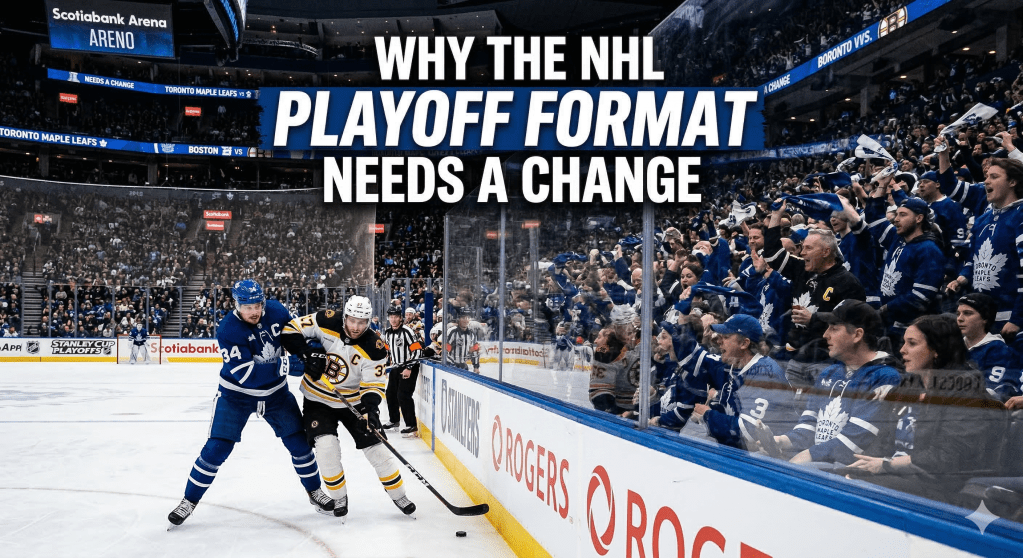
The architecture of the National Hockey League (NHL) Stanley Cup Playoffs is renowned. It has long been regarded as one of the most gruelling and prestigious gauntlets. The playoffs are esteemed in professional sports. However, this tournament’s structural evolution has reached a critical juncture. The current divisional-based bracket system is increasingly viewed as an impediment to competitive fairness. It also threatens the long-term health of the league’s commercial product. Since implementing the current format in the 2013-14 season, the NHL has chosen regional proximity over merit-based seeding. They have created manufactured rivalries instead of following the principles of the 1-versus-8 conference era.1 This analysis examines the historical, economic, and competitive factors that necessitate a return to a conference-wide seeding model. The current system penalizes elite regular-season performance. It diminishes the stakes of the postseason as it progresses toward the Stanley Cup Final.
The Historical Continuum of Postseason Innovation
The NHL has a history of experimenting with playoff structures. This approach helps accommodate expansion and shifting media landscapes. The transition from the “Original Six” era to the current 32-team league required a series of structural compromises. These compromises have often balanced owners’ concerns about travel and gate revenue. They also addressed fans’ desire for a fair competitive ladder.
The Challenge Era and Early Formalization
In the league’s nascent stages, the Stanley Cup was a challenge trophy. The format for its acquisition was often determined through ad-hoc negotiations between competing clubs.4 There was no centralized authority to dictate a formal playoff bracket. The regular-season champion frequently received the title by default. As the league stabilized in the 1920s, a more formal structure emerged. By the 1928-29 season, the league was split into Canadian and American divisions. The first-place teams played each other in a best-of-five series. The second- and third-place teams engaged in a total-goals series for the right to advance.5 This early format highlighted the importance of divisional alignment. It primarily aimed to ensure a representative from both geographic regions reached the final.
Expansion and the Birth of Geographic Clusters
The league’s size doubled during the 1967 expansion—from six teams to twelve. This expansion necessitated a return to a divisional split. The split managed the sudden geographic sprawl of franchises into markets like Los Angeles, Oakland, and St. Louis.5 The resulting East and West Divisions ensured a guaranteed path to the final for the Western franchises. This design shielded them from the established powerhouses of the Original Six in the East. This strategy was commercially successful in establishing new markets. However, it often led to lopsided finals. The veteran Eastern teams were frequently superior to their Western counterparts.
By 1974, with the league expanding to eighteen teams across four divisions, the NHL introduced a preliminary round. This round pooled second- and third-place teams from all divisions. Teams were ranked 1 through 8 based on points, regardless of their specific divisional finish.5 This was a landmark moment in the league’s history. It represented an early attempt to inject meritocracy into the postseason. The winners of this preliminary round would join the four division winners. They would then advance to a quarterfinal round. In this round, all eight teams were again ranked 1 through 8 by record.5 This system ensured that the best-performing teams were rewarded throughout the year. They received favourable matchups and home-ice advantage. This principle remains at the heart of the current debate.
The 1-16 Experiment and the Return to Divisions
One of the most radical departures in NHL history happened in the 1979-80 season. This occurred following the merger with the World Hockey Association (WHA). The NHL had 21 teams. They pooled all sixteen qualifying teams into a single ranking from 1 to 16.6 This format ignored conference and divisional boundaries entirely. It allowed the first seed to play the sixteenth. The second seed played the fifteenth, and so on. This was the ultimate expression of competitive fairness. However, the logistics made it untenable. Owners faced staggering travel costs. They also lost regional rivalries in the early rounds.6
The league reverted to a strict divisional format in 1981-82. In this format, the top four teams in each of the four divisions competed against one another. They played within their own cluster for the first two rounds.8 This era produced some of the most legendary rivalries in hockey history. Notable examples include the “Battle of Alberta” and the intense clashes between the Montreal Canadiens and Quebec Nordiques. However, it also highlighted the “death trap” phenomenon. Two of the league’s top teams often faced each other early. They were frequently forced into elimination in the opening round because they shared a division. This change eventually led to the 1993 transition. The league adopted the 1-through-8 conference seeding system. This governed the league for twenty years. It is the format many current players and executives wish to reinstate.9
Mechanics of the Modern Bracket: A Departure from Merit
The current NHL playoff format started in the 2013-14 season. It represents a return to a divisional-centric model. This model has the added complexity of wildcard spots.1 The league is split into two conferences, each containing two divisions. The top three teams in each division qualify automatically for the playoffs, accounting for twelve of the sixteen berths. The final four spots are awarded to the two teams in each conference. These teams have the highest remaining point totals, regardless of their division.1
The Fixed Bracket and Seeding Anomalies
A defining feature of the current system is the fixed bracket. The modern bracket is static. This is unlike the 1993-2013 era. During that time, the league reseeded teams after each round to ensure the highest-ranked remaining seed played the lowest-ranked one.1 This design aimed to replicate the “bracket challenge” marketing success of the NCAA basketball tournament. It allowed fans to project a team’s path through the final rounds. 3
| Round | Matchup 1 | Matchup 2 |
| First Round | Division Winner (1st) vs. Wildcard (Lower) | Division Winner (2nd) vs. Wildcard (Higher) |
| First Round | Division 2nd Place vs. Division 3rd Place | N/A |
| Second Round | Winner of (DW1 vs. WC) vs. Winner of (Div 2 vs. 3) | Divisional Champion |
While this creates predictability for marketing purposes, it frequently leads to competitive anomalies. The bracket forces the second- and third-place teams in a division to play one another. This means the league’s second- and third-best teams overall (by points) can be eliminated in the first round. This can happen if they reside in the same division.10 This “segmenting” of the league creates a situation. The gruelling 82-game march is supposed to establish a team’s worth. However, it is partially devalued by the luck of the draw.17
The Central and Atlantic Division Paradox
The most egregious examples of structural unfairness have occurred in the Central and Atlantic divisions over the last several seasons. In the Central Division, cyclical talent imbalances have appeared. These imbalances have created a situation. The three best teams are all situated in a single division in the Western Conference.16 In the 2025-26 season, for instance, the Colorado Avalanche, Dallas Stars, and Minnesota Wild were on pace. These paces would have seen them lead any other division in the NHL.16 Under the current rules, the Stars and Wild faced each other in an elimination match in the first round. This was destined to happen. A lesser team in the Pacific Division would face a weaker wildcard opponent. This situation allows for an easier path to the conference final.16
In the Eastern Conference, the Atlantic Division often features top teams. These include the Toronto Maple Leafs, Tampa Bay Lightning, and Boston Bruins.3 The bracket’s structural rigidity creates a “gauntlet” for these teams. They must eliminate one another in the first two rounds. The “survivor” often enters the Conference Final exhausted. Their level of competition far exceeds what their opponent faced in the Metropolitan Division bracket.3
The “Rivalry Fallacy” and the Psychological Cost of Repetition
The Commissioner, Gary Bettman, and the NHL’s executive leadership primarily justify the current format. They focus on generating regional rivalries. The league believes that repeated, high-stakes matchups between neighbours are key. Examples include the “Battle of Florida” and the repeated clashes between the Edmonton Oilers and Los Angeles Kings. These matchups are seen as the most effective way to grow the game and attract casual viewers.2 However, evidence suggests that this approach may be backfiring. The reasons include “rivalry fatigue” and the predictability of postseason paths.
The Stagnation of “Scheduled” Rivalries
A rivalry is most potent when it feels organic and when the stakes are at their absolute highest. When the league structure essentially “schedules” the same first-round matchup year after year, the novelty fades. The matchup loses its special status.2 The Los Angeles Kings and Edmonton Oilers have faced each other in the first round for several consecutive years. Kings fans have described this recurring encounter as a “nightmare” rather than an exciting rivalry.18 The Oilers have dominated the series. This domination has removed variation. As a result, the outcome feels inevitable rather than dramatic.
Under the 1-versus-8 format, these matchups occurred less frequently, which made them feel like significant events when they did happen. The old system fostered rivalries between teams in different divisions. This included the late-1990s battles between the Colorado Avalanche and Detroit Red Wings. It also involved matchups between the Edmonton Oilers and Dallas Stars.21 These rivalries were built on merit. Frequent postseason meetings at different stages of the tournament reinforced them. This added layers of history. These layers are often missing from the current “forced” divisional clashes.21
The Devaluation of Regular Season Achievement
The current format has a significant psychological impact. It affects players’ motivation and fans’ engagement during the regular season. In a 1-versus-8 system with reseeding, every point in the standings is critical. It directly impacts a team’s potential opponent. It also influences their home-ice advantage through all three conference rounds.8 Fans can engage in “scoreboard watching” across the entire conference. A win by a team in another division could still shift their favourite team’s playoff seeding.8
In the current divisional system, however, the standings often become static by mid-season. The second- and third-place teams in a division may have a significant lead over the fourth-place team. Despite this lead, they cannot catch the first-place team. The gap is too large. Consequently, these teams are essentially “locked” into their first-round matchup months before the playoffs begin.8 This creates a period of “dead air” in the regular season. During this time, the games have no tangible impact on a team’s postseason fate. This lack of incentive can lead to “load management.” Teams rest star players because the marginal benefit of an extra win is non-existent. The NHL has historically avoided this trend, but is now increasingly vulnerable to it. 24
Economic Realities and the Broadcast Dilemma
The National Hockey League is a commercial entity that relies heavily on television revenue and postseason gate receipts. The current format has provided some short-term ratings boosts in the first round. However, a longitudinal analysis of viewership trends shows that the divisional bracket could harm the league’s long-term economic health.
The First-Round Ratings Spike
The league’s defence of the divisional format often centres on the record-breaking television ratings from the opening round. By front-loading the playoffs with high-market, regional matchups, the league captures immediate attention. The 2024 first-round series between the Boston Bruins and Toronto Maple Leafs was a significant example. Nearly 9 million viewers in North America watched Game 7.25 This “sugar high” of early ratings attracts broadcast partners like ESPN, TNT, and Sportsnet. It provides a concentrated burst of high-engagement content.25
| Year | Format | 1st Round Ratings (Avg Viewers) | Conference Final Ratings (Avg Viewers) |
| 2022 | Divisional | 768,000 26 | 2,140,000 27 |
| 2024 | Divisional | 934,000 25 | 1,570,000 28 |
| 2025 | Divisional | 886,000 29 | 1,530,000 28 |
The Late-Round Viewership Decay
While the first round remains strong, there is a documented decline in viewership as the playoffs reach their supposed climax. In 2025, U.S. television ratings for the Conference Finals fell by double digits.28 Part of this decline can be attributed to major-market teams being eliminated early in the tournament. The divisional “meat grinder” plays a significant role in this phenomenon.28 If the Toronto Maple Leafs, New York Rangers, and Boston Bruins are eliminated early, viewership declines. The viewer pool for the Conference Finals shrinks significantly. This has a noticeable impact on potential viewership.28
Under a 1-versus-8 system with reseeding, these major-market teams would be more likely to advance further in the tournament. They would face lower-seeded opponents in the opening rounds as a reward for their regular-season excellence.2 This approach would keep high-interest matchups for the third and fourth rounds. It would maintain national interest for a longer time. This strategy could potentially lead to higher overall revenues from broadcast rights and sponsorships.2
Logistics, Travel, and Environmental Stewardship
The 1-versus-8 system faces criticism due to travel logistics. This is especially true for Western Conference teams.1 The NHL’s geography poses inherent difficulties. Teams in the Pacific time zone are often thousands of miles away from their Central counterparts.
The Travel Burden in the Western Conference
The divisional format was specifically designed to minimize cross-time-zone travel in the early rounds.1 The league wants to make sure players are less tired. They do this by keeping the first two rounds within the Pacific or Central clusters. They also ensure more favourable start times for local television audiences.1 In 2025-26, the Edmonton Oilers travelled over 54,000 miles during the regular season. This is a staggering figure. It highlights why travel management remains a priority for the Board of Governors.31
However, the modern reality of professional hockey travel has evolved significantly since the 1980s. Teams travel exclusively on private charter flights, and the 2-2-1-1-1 series format allows for significant rest between games.1 Additionally, the wildcard system already leads to substantial travel. A team from one division may cross over to play the leader of the other division.1 Critics argue that the difference for elite athletes between a two-hour flight and a four-hour flight is marginal. They believe it does not justify sacrificing competitive integrity.16
Environmental Impact and Sustainability
The league’s focus on travel also has an environmental dimension. In an era of increased corporate responsibility, the NHL has committed to reducing its carbon footprint. In recent years, the league has begun purchasing carbon offsets to mitigate emissions from air travel during the playoffs.32 In the first round alone, the league offsets more than 465 metric tons of CO2.32
A 1-versus-8 system might marginally increase travel distance in some scenarios. However, the league has already demonstrated that it has the infrastructure to manage these environmental costs.32 The 2020-21 “all-Canadian” division was a natural experiment in travel reduction. Teams played exclusively within their own geographic region to avoid cross-border travel during the pandemic.33 While minimizing travel, it became evident that sacrificing variety for logistics harms competitiveness. 23
The Star Power Dilemma: Player and Executive Perspectives
The debate over the playoff format is not merely an academic exercise. It is a point of significant contention. This debate involves the league’s most influential stakeholders.
The Player Mandate for Fairness
Professional athletes are inherently competitive and believe in the sanctity of merit-based rewards. Cale Makar is one of the league’s most prominent young stars. He has stated emphatically that “all the players want back to 1 to 8.”10 Veterans like Sidney Crosby echo this sentiment. He believes the regular season’s difficulties should be rewarded with a clear competitive advantage in the postseason.13
From a player’s perspective, the current format is not just unfair; it is physically detrimental. Facing another top-five team in the first round is punishing. It heightens the risk of early injury. It also leads to exhaustion in the tournament.19 The “reward” for a 110-point season should be a series against an 85-point wildcard team. It should not be a seven-game war against another 108-point contender.13
The Institutional Resistance of the Commissioner
Despite the outcry from players and fans, Commissioner Gary Bettman remains remarkably firm in his defence of the current system. Bettman gave “emphatic” refusals in multiple press conferences between 2024 and 2026. He will not consider a return to the 1-versus-8 format.9 Bettman argues that the “playoffs have started already” during the regular season. This is because teams are fighting for divisional positioning. He maintains that “best teams have to play the best teams eventually”.3
This institutional resistance arises from the belief that the current format is “working very well.” It is thought to create late-season drama and ensure a competitive series.36 However, this perspective often ignores the long-term qualitative damage to the product. It disregards issues like the stagnation of rivalries and the lopsidedness of the later rounds.2
Comparative Analysis of Seeding Models
To evaluate the potential impact of a change, it is necessary to compare the existing matchups against the proposed alternatives. This comparison shows that some matchups remain constant. However, a conference-seeding model significantly improves the tournament’s overall “fairness.”
2025 Hypothetical Eastern Conference Matchups
A comparison of the Eastern Conference in 2025 reveals that a 1-versus-8 model offers a more varied opening round. This format is also more merit-based.
| Seeding | Current Divisional Format | Hypothetical 1-versus-8 |
| 1st vs. 8th | Washington vs. Montreal | Washington vs. Montreal |
| 2nd vs. 7th | Toronto vs. Ottawa (A2 vs. A3) | Toronto vs. New Jersey |
| 3rd vs. 6th | Carolina vs. New Jersey (M1 vs. WC) | Tampa Bay vs. Ottawa |
| 4th vs. 5th | Florida vs. Tampa Bay (A1 vs. WC) | Carolina vs. Florida |
In this scenario, the “Battle of Florida” between the Panthers and Lightning would have shifted to a 3-vs-6 matchup. It could have also been a 4-vs-5 matchup under the old system. Perhaps it would have occurred in a later round. This would preserve the excitement of the rivalry for a higher-stakes environment.40 The 1-versus-8 format is crucial. It avoids teams from the same division facing off every single year. The seeding fluctuates based on points accumulated across the entire conference.3
The Impact of Reseeding
The elimination of reseeding in the current format is arguably as detrimental as the divisional qualification itself.4 Reseeding ensures that a high-seeded team that takes care of its business in the first round is not “punished.” The punishment occurs in the second round. This happens when they play another elite team because of a fixed bracket path. 13 The current system mandates a matchup between the top two teams in a division. They must face each other in the second round if they win their first-round series. This is mandatory even if a lower-seeded “upset” team is available in another part of the bracket.1 Bringing back reseeding would restore the logic that the better regular-season record should always yield the theoretically easier opponent.11
Potential Reform Pathways and Future Outlook
The National Hockey League is approaching a period of significant negotiation. Gary Bettman turns 74 in June. There are no official statements yet. However, in early 2025, rumours suggested that the NHL is planning for his retirement in the next couple of years. This presents an opportunity for players to push for structural changes to the postseason.9
The Hybrid 1-8 Proposal
A frequently discussed compromise is a hybrid model. It maintains the current division-based qualification. It also implements conference-based seeding once the sixteen teams are set.40 In this scenario, the top three teams in each division make the playoffs. Two wildcards also advance. This ensures that divisional races remain relevant for qualification purposes. However, the teams are then ranked 1 through 8 by points for the actual matchups.40 Eliminating regional “death traps” is a goal. At the same time, it respects the geographic clusters that owners value for broadcast and travel purposes.40
The Implementation of a 3-2-1 Points System
Another proposed reform involves changing the regular-season points system to better differentiate team performance. Adopting a 3-2-1 system would incentivize teams to win in regulation. This system awards three points for a regulation win, two for an overtime/shootout win, and one for an overtime loss. It would likely lead to a greater spread in the standings.22 This could naturally alleviate some of the seeding anomalies. It would do so by more clearly separating the elite teams from the wildcard contenders. However, it does not address the fundamental issue of the divisional bracket itself.22
The Challenge of Play-In Expansion
The NBA and MLB have successfully implemented “play-in” tournaments. However, the NHL has shown little interest in expanding the postseason field.36 Commissioner Bettman has argued that the NHL regular season already acts like a play-in tournament. This is due to the races’ closeness.14 Furthermore, expanding the playoffs would require a further shortening of the regular season. Alternatively, it could mean extending the postseason into July. Both of these options face significant logistical and cultural hurdles.7 Most hockey stakeholders agree that fixing the structure of the existing sixteen-team tournament is the priority. They believe this is more important than expanding it.36
Conclusion: The Imperative for a Merit-Based Future
The National Hockey League is at a crossroads. It struggles to reconcile its commitment to manufactured regional rivalries with the fundamental athletic principle of merit-based competition. The current divisional-based bracket system is commercially successful in the short term. However, it has created systemic inequities. These inequities penalize the league’s most successful franchises. They also diminish the value of the 82-game regular-season product.2
A return to the 1-versus-8 conference seeding model is essential for the continued growth of the sport. The adoption of a hybrid seeding model should restore the principle of reseeding to maintain the sport’s integrity. By rewarding regular-season excellence with a fair and progressive postseason path, the NHL can revitalize its narrative. This approach also reduces player fatigue in the early rounds. It ensures that its most compelling matchups occur when national interest and television viewership are at their peak.3 The voices of the league’s greatest stars highlight a crucial point. The general managers express frustration. The fanbase overwhelmingly prefers a change. They all agree that the era of the divisional “gauntlet” has outlived its usefulness. The NHL should return to conference-wide seeding. This change is crucial. It ensures the Stanley Cup is contested fairly. It remains the most fairly contested trophy in professional sports.
Works cited
- How Does the NHL Playoffs Work? NHL Postseason Explained – Elite Prospects, accessed March 16, 2026, https://www.eliteprospects.com/page/how-does-the-nhl-playoffs-work-nhl-postseason-explained
- Why the NHL playoff format needs urgent change now | NHL News – The Times of India, accessed March 16, 2026, https://timesofindia.indiatimes.com/sports/nhl/news/why-the-nhl-playoff-format-needs-urgent-change-now/articleshow/121496846.cms
- NHL’s divisional playoff format stinks – and it’s time to move on – Daily Faceoff, accessed March 16, 2026, https://www.dailyfaceoff.com/news/nhl-should-change-divisional-stanley-cup-playoff-format-1-vs-8
- Stanley Cup playoffs – Wikipedia, accessed March 16, 2026, https://en.wikipedia.org/wiki/Stanley_Cup_playoffs
- All-Time Playoff Formats | NHL Records, accessed March 16, 2026, https://records.nhl.com/history/playoff-formats
- Stanley Cup | Playoff Format – Hockeycentral, accessed March 16, 2026, http://www.hockeycentral.co.uk/stanleycup/stanleycup/Playoff-Format.php
- Will the NhL ever go back to old playoff seeding? – Reddit, accessed March 16, 2026, https://www.reddit.com/r/nhl/comments/1kqho3h/will_the_nhl_ever_go_back_to_old_playoff_seeding/
- 1 vs 8 playoff seeding VS Divisional Playoff seeding : r/nhl – Reddit, accessed March 16, 2026, https://www.reddit.com/r/nhl/comments/1jscrz6/1_vs_8_playoff_seeding_vs_divisional_playoff/
- What fans and players miss most about the NHL’s old playoff format, accessed March 16, 2026, https://puckprose.com/what-fans-and-players-miss-most-about-the-nhl-s-old-playoff-format-01jw5kpw6a19
- Cale Makar wants to change the NHL Playoffs: Is No. 1 vs. No. 8 …, accessed March 16, 2026, https://oilersnation.com/news/nhl-playoffs-old-format-better-current-format
- NHL Stanley Cup Playoffs: Format, Teams, Rules & Changes Through the Years, accessed March 16, 2026, https://www.si.com/nhl/nhl-stanley-cup-playoffs-format-teams-rules-changes-through-the-years
- Playoff Format | NHL.com, accessed March 16, 2026, https://www.nhl.com/info/standings-info/playoff-format
- Crosby prefers 1-8 playoff format: ‘Teams should be rewarded’ | theScore.com, accessed March 16, 2026, https://www.thescore.com/nhl/news/2405080
- Bettman: No plans to change playoff format or extend overtime – theScore.com, accessed March 16, 2026, https://www.thescore.com/nhl/news/3246253
- NHL formally adopts 24-team playoff format, announces altered draft lottery | CBC Sports, accessed March 16, 2026, https://www.cbc.ca/sports/hockey/nhl/gary-bettman-newser-nhl-playoff-format-1.5585260
- It’s time to give the NHL’s playoff format a serious rethink – TSN, accessed March 16, 2026, https://www.tsn.ca/nhl/article/its-time-to-give-the-nhls-playoff-format-a-serious-rethink
- It’s time to give the NHL’s playoff format a serious rethink – TSN, accessed March 16, 2026, https://www.tsn.ca/nhl/article/its-time-to-give-the-nhls-playoff-format-a-serious-rethink/
- The NHL is ignoring its biggest stars in the 1 through 8 playoff debate – Blue Line Station, accessed March 16, 2026, https://bluelinestation.com/the-nhl-is-ignoring-its-biggest-stars-in-the-1-through-8-playoff-debate-01kkcr759szc
- The Playoff Format is broken and needs to change. : r/wildhockey – Reddit, accessed March 16, 2026, https://www.reddit.com/r/wildhockey/comments/1rs5tr1/the_playoff_format_is_broken_and_needs_to_change/
- Bill Guerin calls out NHL playoff format as Wild brace for brutal first-round matchup, accessed March 16, 2026, https://gonepuckwild.com/bill-guerin-calls-out-nhl-playoff-format-wild-brace-brutal-first-round-matchup
- [Yost] It’s time to give the NHL’s playoff format a serious rethink : r/hockey – Reddit, accessed March 16, 2026, https://www.reddit.com/r/hockey/comments/1qb4ph3/yost_its_time_to_give_the_nhls_playoff_format_a/
- Stuck on repeat: NHL’s playoff format keeps delivering déjà vu matchups – The Guardian, accessed March 16, 2026, https://www.theguardian.com/sport/2025/apr/18/nhl-playoffs-preview-repeat-matchups
- In 2013/2014, the NHL moved away from the 1-8 seeding in each conference. What seed would each of the conference winners been in the years since then? With the regular season often being seen as unimportant, have higher seeds even done better at all? A look at the Finals year by year. : – Reddit, accessed March 16, 2026, https://www.reddit.com/r/hockey/comments/1jeh610/in_20132014_the_nhl_moved_away_from_the_18/
- Change the NHL playoff format back to 1 – 8 : r/wildhockey – Reddit, accessed March 16, 2026, https://www.reddit.com/r/wildhockey/comments/1rn17t5/change_the_nhl_playoff_format_back_to_1_8/
- 1st round of Stanley Cup Playoffs draws record ratings across North America | NHL.com, accessed March 16, 2026, https://www.nhl.com/news/1st-round-of-nhl-postseason-draws-record-tv-ratings
- 2022 Stanley Cup Playoffs ratings off to historic start with ESPN, Turner | NHL.com, accessed March 16, 2026, https://www.nhl.com/news/nhl-postseason-television-ratings-off-to-historic-start-334152170
- Stanley Cup playoff viewership hits cable record, but down slightly from ’19, accessed March 16, 2026, https://www.sportsmediawatch.com/2022/06/stanley-cup-playoff-ratings-viewership-espn-tnt-tbs-cable-broadcast/
- NHL conference finals both down double-digits in U.S. – Sports Media Watch, accessed March 16, 2026, https://www.sportsmediawatch.com/2025/05/nhl-conference-final-viewership-down-double-digits/
- NHL Playoffs TV Ratings Down Big in U.S. but Surging in Canada – Front Office Sports, accessed March 16, 2026, https://frontofficesports.com/nhl-playoffs-tv-ratings-down-big-in-u-s-as-conference-finals-begin/
- The current playoff format is bad; it would be better if teams could pick their opponents : r/hockey – Reddit, accessed March 16, 2026, https://www.reddit.com/r/hockey/comments/1pp9xic/the_current_playoff_format_is_bad_it_would_be/
- NHL Travel Miles Breakdown for 2025-26 Season – Reddit, accessed March 16, 2026, https://www.reddit.com/r/nhl/comments/1mhwi30/nhl_travel_miles_breakdown_for_202526_season/
- NHL to purchase carbon offsets to counter Stanley Cup Playoff air travel, accessed March 16, 2026, https://www.nhl.com/news/nhl-celebrates-earth-day-purchasing-carbon-offsets-306945688
- Planes, Buses, and COVID Tests: How the NHL Playoffs Are Spotlighting America’s Dumb Border Rules – Reason Magazine, accessed March 16, 2026, https://reason.com/2022/05/05/planes-buses-and-covid-tests-how-the-nhl-playoffs-are-spotlighting-americas-dumb-border-testing-rules/
- Federal government grants NHL playoffs travel exemption, accessed March 16, 2026, https://www.tsn.ca/nhl/federal-government-grants-nhl-playoffs-travel-exemption-1.1650515
- Bettman weighs in on playoff format, 2026 All-Star game and the Trump/Putin USA-Russia talks – TSN, accessed March 16, 2026, https://www.tsn.ca/nhl/gary-bettman-weighs-in-on-playoff-format-2026-all-star-game-and-trump-s-usa-russia-proposal-1.2273310
- Gary Bettman Calls Out His Doubters With Bold Statement on the NHL Playoff Format, accessed March 16, 2026, https://www.yardbarker.com/nhl/articles/gary_bettman_calls_out_his_doubters_with_bold_statement_on_the_nhl_playoff_format/s1_17636_42286852
- Playoff Division: Is It Time to Change the NHL’s Post-Season Format? – The Hockey News, accessed March 16, 2026, https://thehockeynews.com/news/news/playoff-division-is-it-time-to-change-the-nhls-post-season-format
- GMs decide no major changes needed with NHL in ‘really good place’, accessed March 16, 2026, https://www.nhl.com/news/nhl-general-managers-after-meetings-decide-no-major-changes-needed-342271894
- NHL ‘in a good place,’ Bettman says; GM meetings conclude, accessed March 16, 2026, https://www.nhl.com/news/nhl-commissioner-gary-bettman-says-league-is-in-a-good-place
- I Fixed the NHL Play-Off Format – Medium, accessed March 16, 2026, https://medium.com/@parkersm359/i-fixed-the-nhl-play-off-format-1811fe31186b

 ScortonBoy17.ca
Leave a comment