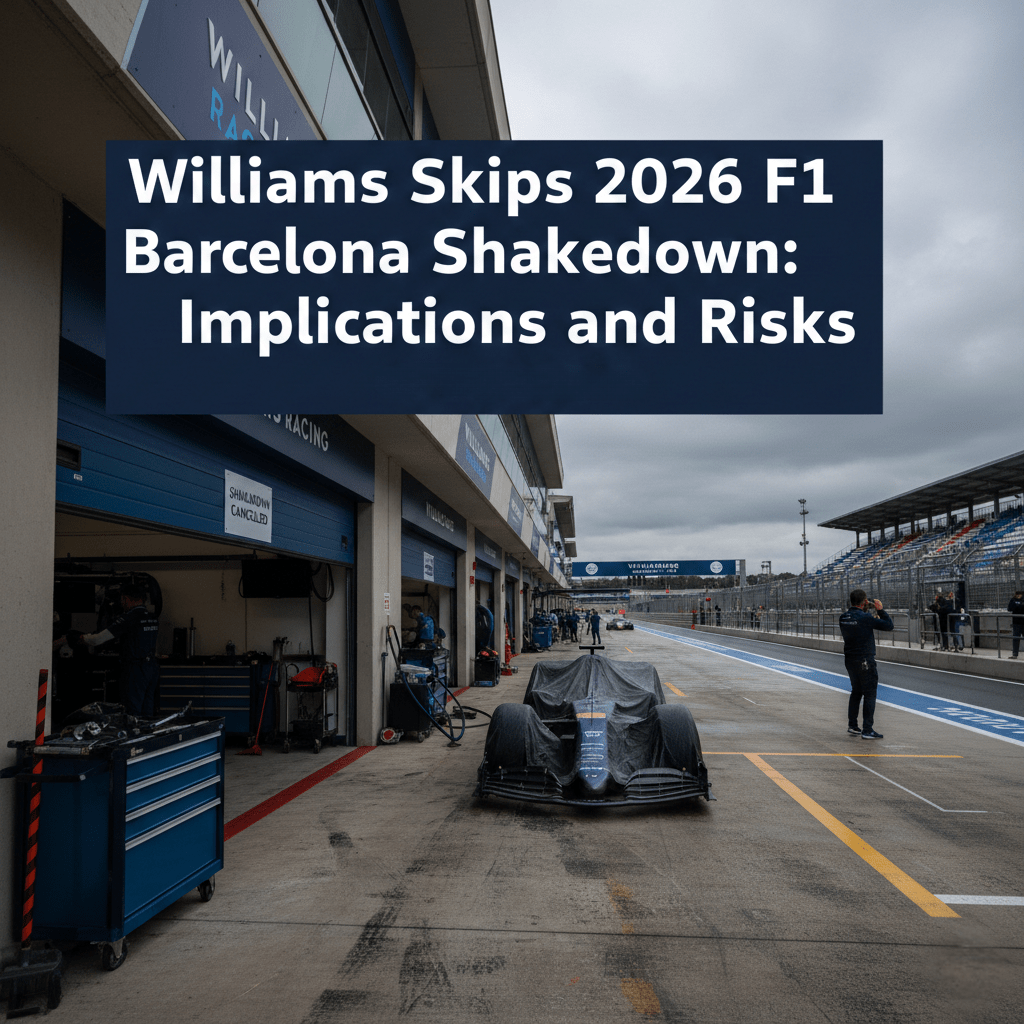
The 2026 Formula 1 season marks a paradigm shift in the sport’s technological and competitive architecture. This shift is characterized by the simultaneous overhaul of power unit and aerodynamic regulations.1 For a historic constructor like Williams, the transition was a critical opportunity. It allowed them to reclaim a front-row position. They utilized a “clean sheet” design approach. This approach bypassed the incremental development cycles of the previous era.3 However, Williams would miss the entire five-day private shakedown at the Circuit de Barcelona-Catalonia. This announcement was made on January 23, 2026. It was a major disruption to their trajectory.6 This report examines the root causes of the FW48 programme delays. It discusses the technical implications of missing the initial systems validation. Additionally, it covers the broader risks associated with the 2026 regulatory reset.
The 2026 Technical Landscape: Complexity and Convergence
The 2026 regulations focus on the “nimble car” concept. This aims to improve racing through reduced vehicle dimensions and weight.2 The wheelbase has been shortened from 3600 mm to 3400 mm. Additionally, the width has been reduced from 2000 mm to 1900 mm.1 At the same time, the minimum weight has dropped by 30 kg to 770 kg. This change forces teams to achieve extreme efficiency in material use.1 These chassis changes incorporate a power unit that shifts to a near 50/50 split. This split is between internal combustion and electric power. The MGU-K output is increasing nearly threefold from 120 kW to 350 kW.2
The introduction of active aerodynamics adds a new layer of dynamic complexity. Both front and rear wings feature movable elements to switch between high-downforce “Z-mode” and low-drag “X-mode.” This complexity did not exist in the 2022-2025 era.1 DRS was a binary tool for overtaking. In contrast, active aero in 2026 is integral to the car’s basic lap-time capability. It is available to all drivers on every lap.2 Validating the synchronization of these wings is paramount. Any imbalance during high-speed transitions could lead to catastrophic aerodynamic instability.14
| Technical Parameter | 2022-2025 Specification | 2026 Specification | Delta |
| Max Wheelbase | 3600 mm | 3400 mm | -200 mm 1 |
| Overall Width | 2000 mm | 1900 mm | -100 mm 2 |
| Min Weight | 798 kg | 770 kg | -28 kg 1 |
| Front Tire Width | 305 mm | 280 mm | -25 mm 9 |
| Rear Tire Width | 405 mm | 375 mm | -30 mm 9 |
| MGU-K Peak Power | 120 kW | 350 kW | +230 kW 1 |
| MGU-H | Included | Removed | N/A 1 |
| Fuel Flow | Mass Flow Limited | Energy Flow Limited | N/A 17 |
The move to 100% advanced sustainable fuels adds complexity to the development of internal combustion engines (ICEs). Manufacturers must optimize combustion for non-food biomass components. These components need to meet stringent greenhouse gas thresholds.11 For a customer team like Williams, integrating these complex systems into a smaller chassis is significant. Williams uses the Mercedes power unit. This task is of the highest order.10
Root Causes of the Williams FW48 Delays
The official statement from Williams cited general “delays in the FW48 programme.” This was mentioned as the primary reason for withdrawing from the Barcelona shakedown.6 However, technical reports and industry analysis suggest more specific structural and organizational hurdles.21 A recurring narrative indicates that the FW48 failed several mandatory FIA crash tests. These failures specifically relate to the side impact structures and the roll hoop.21 Under the 2026 rules, the roll hoop test loads have increased. They have risen from 141 kN to 167 kN. Additionally, the load requirement has jumped from 16 G to 20 G.9 Failing these tests late in the production cycle requires redesigning the carbon fibre layups. It also necessitates remanufacturing the main survival cell. This process can take weeks and inevitably displaces the car’s track debut.5
Furthermore, Williams has faced a persistent shortage of spare parts. This issue notably hampered their 2024 campaign. No third chassis was available early in the season.23 James Vowles made efforts to modernize the Grove facility. However, the transition to the 2026 regulations has stretched the manufacturing capacity to its breaking point.18 Paddock reports suggest that Williams could have potentially participated in the shakedown using “mule-type” nose cones or temporary components. These components were to pass basic homologation. However, Vowles opted against this. He prioritized completing the “maximum performance” specification car.23
| Risk Factor | Potential Impact | Reported Status at Williams |
| Crash Test Failure | Prevents on-track running; necessitates chassis rework 5 | Reported failure of roll hoop/impact tests 21 |
| Parts Shortage | Limits mileage; prevents racing if car is damaged 23 | Continuing issues with spare chassis/parts volume 23 |
| Weight Target | Performance loss; potential for structural fragility 14 | Unconfirmed reports of being over the 770 kg limit 14 |
| Regulatory Non-compliance | Risk of disqualification; requires late redesign 14 | Queries on specific part clarifications pending FIA review 14 |
Organizational debt also remains a factor. Vowles has explicitly stated that Williams still lacks the infrastructure and industrial capacity of top-tier teams like Mercedes or Ferrari.18 The team finished an impressive fifth in the 2025 Constructors’ Championship. The shift to 2026 represents a “ratcheting position.” In this position, the team cannot afford to go backwards.19 They decided to miss Barcelona entirely. Instead of arriving on day three or four, this suggests a fundamental interruption in the car build. This was not resolvable within the shakedown window.14
The Functional Necessity of the Shakedown
The Barcelona event ran from January 26 to January 30. It was designed as a private, behind-closed-doors shakedown. This allowed all eleven teams, including newcomers like Cadillac, to establish baselines of reliability.26 Unlike filming days, when teams are restricted to promotional tires, the Barcelona test provides freedom. Teams can run freely without mileage restrictions. This event provides the flexibility to test extensively. Teams are allowed to use standard race compounds.28 Teams must operate only one car. They can do so for up to 3 days within the 5-day window.
The loss of this track time is critical because the 2026 power units are incredibly sensitive to thermal management.10 The removal of the MGU-H has intensified the role of the MGU-K. It must handle massive kinetic energy recovery—up to 8.5 MJ per lap. This requirement places extreme stress on the energy store’s cooling system.16 A shakedown is the first opportunity. It allows us to observe the internal airflow within the sidepods. We can check whether it matches the wind tunnel’s predicted cooling performance.14 For Williams, arriving in Bahrain on February 11 without this validation will be challenging. They will likely spend the first few sessions of official testing on basic troubleshooting. This includes cooling and hydraulic leaks. They will be unable to explore the car’s performance envelope.14
| System to Validate | Importance in 2026 | Risk of Missing Shakedown |
| MGU-K Thermal Management | 350 kW output; 8.5 MJ recovery 10 | High risk of energy store overheating/failure 14 |
| Active Aero Sync | Maintains balance during X-mode/Z-mode transitions 1 | Aerodynamic instability; potential for high-speed spins 14 |
| Manual Override System | Key overtaking tool; 350 kW burst 9 | Software calibration issues; incorrect energy deployment 15 |
| Narrow Tire Interaction | Smaller contact patch; different thermal profile 1 | Lack of data on tire degradation and mechanical grip 22 |
| 100% Sustainable Fuel | New combustion characteristics and knock profiles 11 | Risk of engine detonation or reduced power output 33 |
The shakedown also serves as a critical check for sensor calibration.33 F1 teams utilize advanced knock sensors to monitor engine performance. Bosch often provides these sensors. They operate at high frequencies, up to 30 kHz, in an F1 ICE.33 These sensors must be calibrated to ensure compliance with FIA technical regulations 5.15.11 and SSPUC – 18.4.1.33. Without on-track running, Williams cannot verify their sensor mounting torques. These torques are specified up to 20 Nm. They also cannot confirm if vibration dampening is sufficient to survive the 1.6 Litre V6’s operating environment.33
Aerodynamic Correlation: Simulation vs. Track Reality
The 2026 aerodynamic rules represent a departure from the ground-effect-heavy focus of the 2022-2025 era.10 The floors are now flatter. There is a reduced reliance on underbody Venturi tunnels. There is an increased focus on overall car efficiency and drag reduction.2 The target is a 55% reduction in drag. There is also a 30% reduction in downforce. This aims to minimize “dirty air” and allow cars to follow each other more closely.9
Williams’ absence from Barcelona is particularly damaging because of the need to correlate “active” aerodynamic data.14 In previous eras, a car’s aero map was relatively static. In 2026, the car changes its shape multiple times per lap.15 CFD and wind tunnel testing are powerful tools. However, they often struggle to capture the complex “vortex shedding” from the front wing endplates. This happens as they interact with the narrower 2026 tires in a dynamic environment.35 The new “in-wash” front wing philosophy directs air toward the car’s floor, not outward. It is highly sensitive to ride height and yaw.35 By missing the shakedown, Williams lacks real-world confirmation that their “X-mode” streamlines reattach to the bodywork as predicted. This could lead to a car that is “fickle” and difficult to drive.16
| Aero Feature | 2026 Change | Correlation Challenge |
| Front Wing | Narrower by 100 mm; max 3 elements 9 | managing the transition from outwash to inwash 36 |
| Rear Wing | 3 elements; removal of lower beam wing 9 | High suction region interaction with the larger diffuser 12 |
| Active Elements | Movable front and rear flaps 1 | Shift in aerodynamic center of pressure during actuation 14 |
| Wheel Wake Boards | New boards ahead of sidepods 9 | Managing turbulence from rotating front wheels without “eyebrow” winglets 10 |
The team’s reliance on “Virtual Track Testing” (VTT) is an attempt to mitigate this loss.6 VTT involves running the physical car on a dynamic rig. This includes a rolling road where the car’s suspension, powertrain, and electronics are put through specific lap profiles.23 VTT can validate the car’s “mechanical and aerodynamic elements running in harmony.” However, it cannot replicate the non-linear changes in air pressure. A car experiences these changes when travelling through a real corner at 250 km/h.23 As Gary Anderson has noted, missing the shakedown is a “major blow.” It forces Williams to use the limited official test days in Bahrain for basic validation. This is instead of performance optimization.14
The Power Unit Frontier: Mercedes and the Compression Ratio Controversy
Williams’ competitiveness is tied to the performance of the Mercedes AMG High Performance Powertrain.18 Reports from January 2026 suggest that Mercedes has found a significant performance advantage. This was achieved through a “loophole” in the compression ratio regulations.8 The technical regulations (specifically C5.4.3) stipulate a maximum geometric compression ratio of 16.0:1 for the 2026 engines, a reduction from the 18.0:1 used in the previous era.41 However, the rules specify that this ratio is measured at “ambient temperature” with the engine disassembled.41
Rival manufacturers—Ferrari, Audi, and Honda—have raised complaints with the FIA. They claim that Mercedes has designed combustion chambers that expand at high temperatures. Potentially, Red Bull Powertrains may also be involved. This design allows them to run at a higher compression ratio. This can be as high as 18:1 when the engine is operating on track.41 This “motoren-trick” could yield a performance gain of up to 0.3 seconds per lap.41 A key meeting was held on January 22, 2026, to discuss this issue. However, any rule change requires the support of the majority of manufacturers. As a result, the current measurement procedure remains in place for the short term.42
For Williams, this means they likely have access to a very powerful engine. However, it is technologically “extreme.” This makes it potentially more prone to reliability issues if not integrated perfectly.8 The higher compression ratios increase combustion pressure and vibration. This can lead to bearing failures in the MGU-K shaft. This problem has historically plagued F1 manufacturers during regulation transitions.34 By missing the shakedown, Williams has no data on how this “high-compression” engine interacts with their specific cooling layout. They also lack information on how it affects the chassis vibration profile.14
Driver Adaptation and Human Capital Risks
The absence from Barcelona is a significant setback for Alex Albon and Carlos Sainz.44 Sainz moved to Williams in 2025, aiming for the 2026 regulations. The lost mileage results in only three days of total track time for him in the FW48. This will be before the first race in Melbourne on March 8.7 The 2026 cars require a much higher degree of “driver-operated” control over energy systems.1 Drivers must now manage:
- Manual Override System (MOS): Choosing when to deploy the 350 kW burst to attack or defend.1
- Active Aero Actuation: Switching between X-mode and Z-mode while managing braking points and corner entry speeds.1
- Brake-by-Wire Adaptation: Managing the massive increase in MGU-K torque during braking, which can significantly affect the car’s entry stability.2
- Recharge Management: Utilizing “lift-off” regeneration or “super clipping” to replenish the energy store throughout the race.1
By missing the shakedown, Albon and Sainz lose the opportunity to build the “muscle memory” they need. This “muscle memory” is required to operate these systems in a low-risk environment.22 Albon has remained optimistic. He stated, “These things can happen when you are pushing the limits.” However, the lack of seat time puts them at a disadvantage compared to rivals. These rivals have already begun to correlate simulator feedback with real-world steering feel and pedal pressure.24
| Driver | 2025 WCC Performance | 2026 Prep Profile | Risk Assessment |
| Alex Albon | Consistent point-scorer; leader at Grove 25 | testing ideas in sim since early 2025 3 | High; needs to confirm sim correlation early in Bahrain 27 |
| Carlos Sainz | Two podiums in 2025; technical authority 18 | First major reg change with Williams 7 | High; limited time to adapt to new “active” controls 22 |
The 2026 cars are expected to return to “turbo lag” scenarios. This is due to the removal of the MGU-H. It previously used exhaust heat to keep the turbocharger spinning.10 Drivers will need to adjust their throttle application on corner exit to compensate for the delay in power delivery.17 Learning these nuances is a primary goal of early shakedowns. Williams will now be forced to perform this “learning” during the critical performance-testing phases in Bahrain.17
Historical Precedents and Comparative Analysis
The decision to skip the Barcelona shakedown brings back memories of Williams’ 2019 season. During that year, the FW42 missed the first two days of testing due to production delays.8 That delay was a “low point” for the team. It led to the departure of Technical Director Paddy Lowe. During the season, Williams finished last with only a single point.3 Although the financial stability under Dorilton Capital is far greater now, there is greater financial stability under Dorilton Capital. However, there is concern about the operational parallel to 2019.39 Missing an entire week of testing suggests a “fundamental issue” rather than a minor logistical setback.5
In contrast, most of Williams’ direct rivals are attending the Barcelona event.7 McLaren and Ferrari announced they would miss the first day to maximize development time. They are still scheduled to run on the remaining days.25 Even Aston Martin, which reportedly faced delays with their front nose-cone crash test. They also had to deal with Honda engine tweaks. Despite these issues, they are expected to hit the track by Wednesday of the shakedown week.23 Williams is the only team to skip the event entirely. This decision places them as the outlier in the paddock. It raises serious questions about their readiness for the season opener.14
| Team | Barcelona Attendance | Strategy | Infrastructure Advantage |
| Mercedes | Full (3 Days) 28 | Early shakedown at Silverstone 28 | Top-tier; in-house PU manufacturing 18 |
| Ferrari | 2 of 3 Days 7 | Fiorano shakedown completed 28 | Works team; close to minimum weight 5 |
| Aston Martin | 1-2 Days 50 | Adrian Newey “last moment” development 23 | New factory; Works Honda deal 51 |
| Haas | Full (3 Days) 24 | Fiorano shakedown completed 24 | Ferrari customer; lean operation 53 |
| Williams | 0 Days 6 | Purely virtual mitigation (VTT) 6 | Undergoing modernization; customer team 18 |
James Vowles has defended the team’s position. He argued that “we’ve stretched the organization to the point where we can’t go to Barcelona.” He also framed it as a reminder that Williams is not yet at a “championship level.”23 The 2026 season was explicitly touted as the year Williams would begin that ascent. This early setback is a significant psychological blow. It also represents an operational blow.5
Risk Mitigation: The Role of Virtual Track Testing
Williams’ primary tool for bridging the gap will be Virtual Track Testing (VTT).6 This is an advanced rig-based program. The real FW48 car and engine are hooked up to a rolling road dynamometer.23 Unlike a standard simulator, a driver interacts with a digital car. VTT, however, involves running the physical hardware, including the car, engine, gearbox, and electronics, in a controlled environment.23
The advantages of VTT include:
- Powertrain Mapping: Engineers can map the power unit’s energy deployment and recovery without risking on-track accidents.27
- Cooling Simulation: The rig lacks the complexity of ambient airflow. However, it can push the car’s internal cooling circuits to their limits.14
- Software Validation: The complicated active aero and Manual Override System software can undergo stress testing. This step identifies “bugs” before they cause issues on a real circuit.15
- Hardware Endurance: The gearbox and suspension mounting points can be monitored for unwanted vibrations using high-performance sensors.23
However, the “virtual wind tunnel” cannot replace the track.15 In 2026, the car’s aerodynamics are no longer “fixed.” They now depend on real-time decisions about traffic. These include energy state and tire condition.15 AI and simulation models built during the 2022-2025 era are largely obsolete because the underlying physics—ground-effect tunnels vs. flat floors—has changed.15 A model trained on the “old world” can confidently predict the wrong thing. This makes real-world track telemetry the only true way to “re-learn” the car’s behavior.15 Williams is essentially entering the season with a “map” that has not been verified by actually driving the roads.15
Strategic Outlook and Melbourne Implications
The impact of missing the Barcelona shakedown will be most visible during the Australian Grand Prix on March 8.8 Williams will have to arrive in Melbourne with a car that is “green” in terms of track mileage.14 If the FW48 suffers from reliability issues during the two Bahrain tests (Feb 11-13 and Feb 18-20), Albon and Sainz will lose track time. The issues could cause them to miss valuable testing entirely. They may be forced to enter the first race without having completed a single qualifying-style lap or full race distance.22
Furthermore, the “Manual Override System” adds a tactical layer to the racing that could penalize teams with less data.1 If the lead car’s electrical deployment tapers off at 290 km/h and the chasing car gets an extra 0.5 MJ of energy, teams must be extremely precise in how they manage their battery state-of-charge over a 58-lap race.9 Rivals with shakedown data will have a head start. They will better understand the “energy recovery and deployment patterns.” These patterns shift significantly under the 2026 architecture.15
James Vowles has emphasized that Williams is on a “journey.” He has asked fans to “trust the process” and downplayed expectations for 2026. He is focusing on laying the groundwork for championship contention in later years.18 The team finished fifth in 2025. Falling below that position in 2026 would indicate a failure of the early commitment strategy.5 The Barcelona withdrawal is the first major “stress test” of Williams’ new era. The team is currently operating on the back foot.5
Conclusions and Technical Summary
The 2026 regulatory shift is the most disruptive in Formula 1 history. It demands excellence in power unit integration. Teams must focus on active aerodynamics and weight management.1 Williams decided to skip the Barcelona shakedown. This move is calculated but high-risk, driven by delays in the FW48 build program. These delays are likely worsened by failed FIA crash tests and infrastructure bottlenecks.6 Virtual Track Testing (VTT) offers a sophisticated mitigation strategy. However, it cannot replicate the dynamic aerodynamic correlation. It also cannot match the driver’s sensory feedback of on-track running.15
The team now faces an abbreviated testing schedule in Bahrain. They must validate the 350 kW MGU-K system. The team needs to calibrate the active wing X-mode/Z-mode transitions. They must also adapt to the unique knock profiles of 100% sustainable fuel.10 The Mercedes power unit potentially holds a “compression ratio” advantage. Therefore, the ceiling for the FW48 remains high. However, the floor has been lowered due to insufficient early validation.8 The success of Williams’ 2026 campaign now depends entirely on a flawless execution in Bahrain. Any further technical setbacks will likely result in a repeat of the 2019 “recovery” season. These setbacks would undermine the strategic gains made during the Vowles era.5
Works cited
- F1 2026 Regulations – Terminology Update | Formula One World Championship Limited, accessed January 25, 2026, https://corp.formula1.com/f1-2026-regulations-terminology-update/
- The 2026 Formula 1®Regulations : A New Era of Cars, Power and Racing, accessed January 25, 2026, https://www.f1lasvegasgp.com/2026/01/new-era-of-cars-power-and-racing/
- Williams to miss opening F1 preseason test after ‘delays’ getting new car ready, accessed January 25, 2026, https://www.kens5.com/article/syndication/associatedpress/williams-to-miss-opening-f1-preseason-test-after-delays-getting-new-car-ready/616-c3b5dfc5-a14a-48a1-868b-a14970f1d616
- Why Williams doesn’t expect F1 2026 to define its next steps – Autosport, accessed January 25, 2026, https://www.autosport.com/f1/news/why-williams-doesnt-see-f1-2026-as-an-acid-test/10789333/
- F1: Williams to miss Barcelona testing in devastating blow – Last Word On Sports, accessed January 25, 2026, https://lastwordonsports.com/motorsports/2026/01/23/f1-williams-to-miss-barcelona-testing-in-devastating-blow/
- Williams announce they will not take part in Barcelona Shakedown – F1, accessed January 25, 2026, https://www.formula1.com/en/latest/article/williams-announce-they-will-not-take-part-in-barcelona-shakedown.2IQ6c7Rrg1pI5Q1HXREyzV
- Carlos Sainz responds as Williams set to miss Barcelona shakedown test – PlanetF1, accessed January 25, 2026, https://www.planetf1.com/news/carlos-sainz-response-williams-barcelona-shakedown-test
- Williams Releases Statement Over Critical Barcelona F1 Testing …, accessed January 25, 2026, https://www.si.com/onsi/f1/news/williams-releases-statement-over-critical-barcelona-f1-testing-rumors
- FIA Announces Details of 2026 Formula 1 Technical Regulations …, accessed January 25, 2026, https://www.racecar-engineering.com/articles/f1/fia-announces-details-of-2026-formula-1-technical-regulations/
- Explaining F1’s new 2026 regulations: What’s new and what it means – McLaren, accessed January 25, 2026, https://www.mclaren.com/racing/formula-1/2026/explaining-f1s-new-2026-regulations/
- F1 2026’s new engine rules explained – The Race, accessed January 25, 2026, https://www.the-race.com/formula-1/f1-2026-new-power-unit-engine-rules-explained/
- What’s New in Formula 1 for 2026? | Atlassian Williams F1 Team, accessed January 25, 2026, https://www.williamsf1.com/articles/71e25d7a-d0f1-4488-a749-f1eb611f0ec6/whats-new-in-f1-for-2026
- Everything you need to know about the new F1 rules for 2026, accessed January 25, 2026, https://www.formula1.com/en/latest/article/everything-you-need-to-know-about-the-new-f1-rules-for-2026.48bv0VTxhIlhrQXmxercXk
- Gary Anderson’s verdict on how teams should use first 2026 test …, accessed January 25, 2026, https://www.the-race.com/formula-1/how-f1-teams-should-tackle-first-2026-test-barcelona/
- When the Data Breaks – What F1’s 2026 Reset Teaches Us About AI Models (and Why It Matters for Small Businesses), accessed January 25, 2026, https://www.merciaai.com/post/when-the-data-breaks-what-f1-s-2026-reset-teaches-us-about-ai-models-and-why-it-matters-for-small
- The Road to 2026 | The tip of the iceberg – F1’s new era and regulation changes explained, accessed January 25, 2026, https://www.astonmartinf1.com/en-GB/news/feature/the-road-to-2026-f1s-new-era-and-regulations-explained
- F1: Understanding The 2026 Engine Regulations – Last Word On Sports, accessed January 25, 2026, https://lastwordonsports.com/motorsports/2024/03/16/f1-understanding-the-2026-engine-regulations/
- James Vowles explains why Williams will likely not fight at the front in 2026, accessed January 25, 2026, https://www.motorsportweek.com/2026/01/11/james-vowles-explains-why-williams-will-likely-not-fight-at-the-front-in-2026/
- Williams F1 – Vowles focuses on laying the groundwork, accessed January 25, 2026, https://www.f1network.net/main/williams-f1/s107/st208105/vowles-focuses-on-laying-the-groundwork
- Team Statement, accessed January 25, 2026, https://www.williamsf1.com/articles/6560b37e-5707-4239-a681-790e30167206/team-statement-230126
- Williams make shock call to miss first F1 2026 test after ‘delays’ in car development, accessed January 25, 2026, https://ca.news.yahoo.com/williams-shock-call-miss-first-131035645.html
- F1: Williams Will Miss the Barcelona Shakedown – autoevolution, accessed January 25, 2026, https://www.autoevolution.com/news/f1-williams-will-miss-the-barcelona-shakedown-264521.html
- Another team joins Williams in missing Barcelona test, accessed January 25, 2026, https://thejudge13.com/2026/01/24/another-team-joins-williams-in-missing-barcelona-test/
- Alex Albon sees positives in Williams missing Barcelona test …, accessed January 25, 2026, https://www.motorsportweek.com/2026/01/24/alex-albon-sees-positives-in-williams-missing-barcelona-test/
- Williams to miss opening F1 2026 test amid FW48 delays | Crash.net, accessed January 25, 2026, https://www.crash.net/f1/news/1088628/1/williams-miss-opening-f1-2026-test-amid-fw48-delays
- Williams’ new car not ready for pre-season Barcelona test – SuperSport, accessed January 25, 2026, https://supersport.com/football/general/news/818fd9ec-c90f-4a4d-974c-f2a6ac6425bd/williams-new-car-not-ready-for-pre-season-barcelona-test
- What we know about major Williams setback with 2026 car – The Race, accessed January 25, 2026, https://www.the-race.com/formula-1/williams-missing-first-f1-2026-test-setback-what-we-know/
- EXPLAINED: How the Barcelona Shakedown will work – F1, accessed January 25, 2026, https://www.formula1.com/en/latest/article/explained-how-the-barcelona-shakedown-will-work.5oGVmo25OyEhyVR9RbiREo
- Everything you need to know about F1 2026 pre-season testing – Silverstone, accessed January 25, 2026, https://www.silverstone.co.uk/news/everything-you-need-know-about-f1-2026-pre-season-testing
- What happens during an F1 shakedown or filming day? – Motor Sport Magazine, accessed January 25, 2026, https://www.motorsportmagazine.com/articles/single-seaters/f1/what-happens-during-an-f1-shakedown-or-filming-day/
- Shakedown vs preseason testing : r/formula1 – Reddit, accessed January 25, 2026, https://www.reddit.com/r/formula1/comments/1it9ipx/shakedown_vs_preseason_testing/
- 2026 REGULATIONS EXPLAINED: All you need to know about F1’s new power units, accessed January 25, 2026, https://www.formula1.com/en/latest/article/2026-regulations-explained-all-you-need-to-know-about-f1s-new-power-units.14jfv7a36905uDJDdNyfQd
- Racing Ahead – Innovative Knock Sensor Calibration Solution For F1 Race Car Team, accessed January 25, 2026, https://metrology.news/racing-ahead-innovative-knock-sensor-calibration-solution-for-f1-race-car-team/
- Evolution of Hybrid Technologies (MGU-H, MGU-K) – 2015 to 2022 – Honda Global, accessed January 25, 2026, https://global.honda/en/tech/motorsports/Formula-1/Powertrain_MGU-H_MGU-K/
- What we’ve learned from exclusive CFD analysis of the 2026 Formula 1 car – Raceteq, accessed January 25, 2026, https://www.raceteq.com/articles/2025/06/cfd-aero-analysis-of-2026-formula-1-car
- Formula 1 Regulation Impacts: Comparisons between SF-23 and Potential 2026 Front Wing Design | by Andy Ding | Medium, accessed January 25, 2026, https://medium.com/@heyandyding/the-impact-of-formula-1-regulation-changes-comparisons-between-sf-23-and-projected-2026-front-b5a6bd18a8e2
- [F1] It’s all change in 2026! Here’s the key technical information as we head into a new generation… : r/formula1 – Reddit, accessed January 25, 2026, https://www.reddit.com/r/formula1/comments/1powb62/f1_its_all_change_in_2026_heres_the_key_technical/
- F1 2026 aero regulations in focus part 1 – ‘Back to the Future’ – Motorsport Technology, accessed January 25, 2026, https://motorsport.tech/formula-1/f1-2026-aero-regulations-in-focus-part-1-back-to-the-future
- Williams pulls out of Barcelona F1 test amid FW48 delays!, accessed January 25, 2026, https://f1i.com/news/557895-williams-pulls-out-of-barcelona-f1-test-amid-fw48-delays.html
- Mercedes Engine Trick LEAKED: Cheating Allegations! ❌, accessed January 25, 2026, https://www.youtube.com/watch?v=P4H7NqC14JY
- Mercedes and Red Bull can use their 2026 engine. The FIA has admitted that the combustion chambers of their respective engines are legal if, during tests carried out at room temperature, a compression ratio of 16:1 is measured. It doesn’t matter if, when heated, the resulting value is higher. : r/ – Reddit, accessed January 25, 2026, https://www.reddit.com/r/F1Discussions/comments/1pvga6k/mercedes_and_red_bull_can_use_their_2026_engine/
- The four-year war to break F1’s new engine rules… and meeting that’ll declare a world title favourite – Fox Sports, accessed January 25, 2026, https://www.foxsports.com.au/motorsport/formula-one/we-would-never-accept-that-battle-lines-drawn-in-f1-rules-row-ahead-of-crunch-meeting/news-story/e47d0b2825aac00dd5fa2c8f617a4838
- What’s been agreed at key F1 engine loophole meeting – The Race, accessed January 25, 2026, https://www.the-race.com/formula-1/what-has-been-agreed-f1-2026-engine-meeting-compression-ratio/
- Williams skips 2026 Barcelona test amid shock F1 car delay, accessed January 25, 2026, https://www.motorsport.com/f1/news/williams-skips-barcelona-test-as-2026-f1-car-is-late/10792268/
- F1 team explains decision to skip 2026 pre-season test | The Independent, accessed January 25, 2026, https://www.independent.co.uk/bulletin/sport/f1-williams-miss-pre-season-testing-b2906470.html
- Williams to miss F1 preseason test with 2026 car not ready – Field Level Media, accessed January 25, 2026, https://fieldlevelmedia.com/formula-1/williams-to-miss-f1-preseason-test-with-2026-car-not-ready/
- What is an F1 car shakedown and how are teams restricted? – RacingNews365, accessed January 25, 2026, https://racingnews365.com/what-is-an-f1-car-shakedown-and-how-are-teams-restricted
- James Vowles: ‘We’re on the right journey – trust the process’ | Atlassian Williams F1 Team, accessed January 25, 2026, https://www.williamsf1.com/articles/cf41649f-738c-464c-a16c-4d8857d2c39a/james-vowles-we-are-on-the-right-journey-trust-the-process
- Formula 1 Simulator Guide: Your Roadmap for 2026 – Gamer Gear Direct, accessed January 25, 2026, https://gamergeardirect.com.au/blogs/resources/formula-1-simulator
- Aston Martin AMR26 set for delayed start to Barcelona test, accessed January 25, 2026, https://www.planetf1.com/news/aston-martin-to-miss-first-day-f1-2026-test-barcelona
- Aston Martin set to face key F1 delay ahead of Barcelona pre-season test, accessed January 25, 2026, https://racingnews365.com/aston-martin-set-to-face-key-f1-delay-ahead-of-barcelona-pre-season-test
- What really happened with Ferrari’s shakedown stoppage, accessed January 25, 2026, https://www.the-race.com/formula-1/ferrari-sf26-fiorano-shakedown-stoppage-explained/
- Every team is hoping to improve with the new regulations in 2026. Since they can’t all be right, who do you think will be wrong? : r/formula1 – Reddit, accessed January 25, 2026, https://www.reddit.com/r/formula1/comments/1p5otda/every_team_is_hoping_to_improve_with_the_new/
- 2026 FORMULA 1 TECHNICAL REGULATIONS – FIA, accessed January 25, 2026, https://www.fia.com/sites/default/files/fia_2026_formula_1_technical_regulations_issue_8_-_2024-06-24.pdf

 ScortonBoy17.ca
Leave a comment