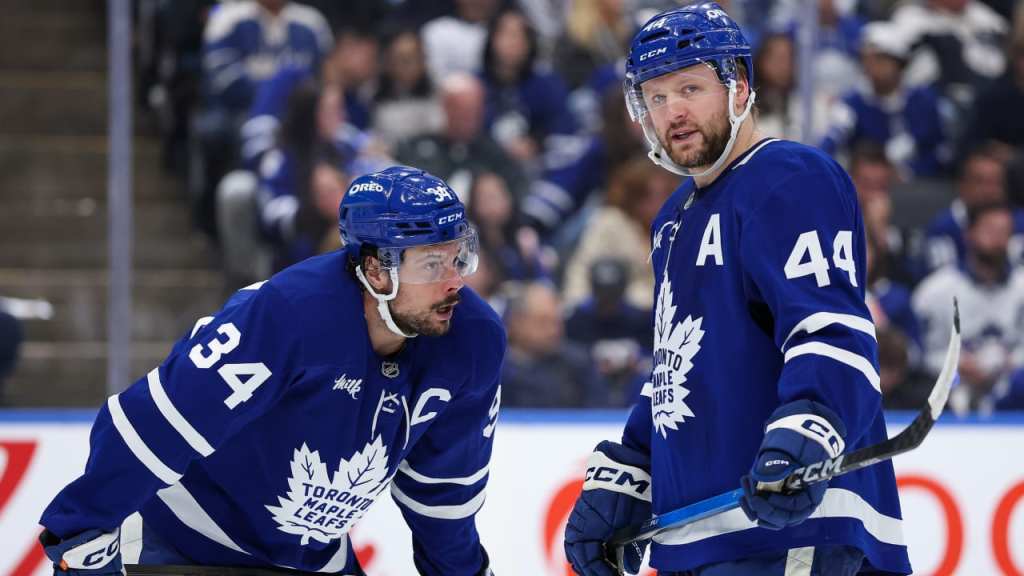
A palpable tension hangs over Scotiabank Arena, thicker than the autumn chill. Nine games into the 2025-26 NHL season, the Toronto Maple Leafs sit at a perfectly mediocre 4-4-1. For a franchise that entered the year with Stanley Cup-or-bust expectations, a .500 record feels less like a slow start and more like a significant underachievement. This season was meant to be different. It was marked by the franchise-altering offseason trade of Mitch Marner. This move was designed to shatter a stagnant core and forge a new, grittier identity. The early returns, however, suggest this transition is proving far more turbulent than anticipated. The Maple Leafs’ struggles are not the result of bad luck or a temporary slump. Instead, they reflect three critical, interconnected issues. First, there’s a catastrophic failure in goaltending. Second, the power play, once elite, has collapsed systemically. Finally, there’s an inherent friction. This arises as a high-skill roster adapts to the demanding, defense-first “Berube Blueprint” in the post-Marner era.
The Statistical Contradiction: An Offense That Scores and a Defense That Bleeds
At first glance, the Maple Leafs’ early-season statistics present a jarring contradiction. The team’s offense is firing, ranking 5th in the NHL with 31 goals, an average of 3.44 per game. Yet, this offensive prowess is being completely negated by porous defensive play and goaltending. Toronto has surrendered 33 goals, ranking a dismal 26th in the league with an average of 3.67 goals against per contest. This is not a team unable to compete. It is a team that cannot protect a lead or, more fundamentally, keep the puck out of its own net.
Any narrative suggesting this record is merely a product of bad luck is quickly dispelled by the numbers. The team’s PDO is a metric that combines team shooting percentage and save percentage at 5-on-5. It tends to regress to 1.000 over time and sits at 99.8 (or.998). This figure is remarkably close to the neutral baseline. It indicates that the Leafs’ 4-4-1 record is a fair and accurate reflection of their performance. They are earning exactly what they deserve.
Deeper analytics at 5-on-5 paint an even more confounding picture. The team’s Corsi For percentage (CF%), which measures the share of total shot attempts, is 49.6%, meaning they are generating nearly as many shot attempts as they are allowing. Furthermore, their Expected Goals For (xGF) of 19.5 is almost identical to their Expected Goals Against (xGA) of 19.4. These underlying metrics suggest a team playing even and competitive hockey at 5-on-5. This makes their negative goal differential all the more alarming.
The key to understanding this paradox lies within the composition of their PDO. The near-1.000 total is deceptive because its components are at opposite ends of the spectrum. The Maple Leafs’ 5-on-5 shooting percentage is an excellent 9.9%, well above the league average of 8.4%, demonstrating that their skilled forwards are finishing their chances at an elite rate. However, this is being completely nullified by a disastrous 5-on-5 save percentage of .899, a figure that is dramatically below the league average of .916. The problem is not the team’s process, which the possession and expected goals metrics show is sound. The issue is a catastrophic failure of execution in the most critical position on the ice.
| Metric | Toronto Maple Leafs | NHL League Average |
| Record | 4-4-1 | 4-3-1 |
| Points % | .500 | .558 |
| Goals For/Game (GF/G) | 3.44 | 3.00 |
| Goals Against/Game (GA/G) | 3.67 | 3.00 |
| Power Play % (PP%) | 13.04% | 21.14% |
| Penalty Kill % (PK%) | 80.00% | 78.86% |
| Team Save % (SV%) | .873 | .891 |
| 5v5 Corsi For % (CF%) | 49.6% | 50.8% (approx.) |
Life After Marner: Assessing the New-Look Forward Group
While the team struggles for consistency, the offensive production that is working is being driven by two seasoned veterans. William Nylander has been electric. He leads the team with 14 points. He is also tied for the league lead with 11 assists through his first eight games. At 35 years old, alternate captain John Tavares is defying his age. He is tied with Auston Matthews for the team lead with five goals. He sits second in team scoring with 12 points. Their line, which has frequently included newcomer Matias Maccelli, has been Toronto’s most reliable and potent offensive unit.
In contrast, captain Auston Matthews has had a relatively muted start by his Hart Trophy-winning standards. While he has potted five goals, his eight points in nine games is a slower pace than expected. Most concerning is that only one of his points has come on the power play. This is a significant change. He has built a career as one of the league’s most lethal threats. His prowess is particularly notable on the man advantage. The preseason narrative is gaining traction in public discourse. It suggests he might struggle to produce without the elite playmaking of his long-time winger, Mitch Marner.
The players acquired in the wake of the Marner trade were not meant to be point-for-point replacements. They were selected to fit head coach Craig Berube’s vision of a bigger, heavier, and more tenacious team. Their integration has been a work in progress.
- Matias Maccelli: Maccelli was brought in as a high-upside playmaker. He has struggled to find his footing. He has managed just three points (two goals, one assist) in nine games. His time in Utah was challenging. People viewed him as a reclamation project. He had the potential to regain the form that saw him post 57 points in 2023-24. He has scored in his last few games. However, his overall impact has been limited. He has yet to solidify a role in the top six.
- Nicolas Roy: Roy was acquired to be a defensively sound third-line center. He has also had a quiet start with just three points in nine games. His value is expected to come from his two-way intelligence and relentless forechecking. However, he has not yet consistently imposed his will on the game.
- Dakota Joshua: Joshua was added for his imposing size (6-foot-3, 218 pounds) and physicality. He has contributed three points in his role. Joshua fulfills his role as a bruising, energy-driving forward. His performance is largely in line with what is expected from a bottom-six player tasked with wearing down opponents.
The departure of Marner did more than just remove 102 points from the lineup; it created a significant “playmaking deficit”. Marner was the team’s primary puck distributor. He was an elite transition player. He created space and chances for others, particularly on the top line and power play. The new acquisitions are north-south, physical players or projects, not elite creators. This situation has placed an immense creative burden on William Nylander. This is evident in his 11 assists. His assist tally more than triples the next-highest forward’s total. This heavy reliance on a single player makes the offense dangerously one-dimensional. If Nylander’s production slows down, the team’s ability to generate high-quality scoring chances could decline. He has already missed one game due to a lower-body injury.
The Five-Alarm Fire: Goaltending and Defensive Structure Under Siege
The single greatest factor in the Maple Leafs’ disappointing start has been the collapse of their goaltending. Anthony Stolarz and Joseph Woll were a formidable strength last season. However, they have now become the team’s most glaring liability. Stolarz, coming off a career year where he posted a.926 save percentage, has struggled mightily as the de facto starter. Through seven appearances, he holds a 2-4-1 record with a troubling 3.31 goals-against average (GAA) and a.885 save percentage (SV%). His frustration became public after a recent loss. He openly questioned the team’s compete level. This is a rare and telling move for a goaltender.
The situation is compounded by the absence of Joseph Woll. He is on injured reserve for personal reasons. He returned to the team recently and will resume team activities and on-ice participation to return to the lineup. Woll appeared in 42 games last season and was a crucial part of the team’s success. His absence has thrust Stolarz into a workload he may not be suited for. The team is also forced to rely on Cayden Primeau, a waiver claim made just before the season began. Primeau has secured two wins in his two starts. However, his individual numbers have been equally poor, with a 3.46 GAA and an.875 SV%.
While the goaltenders have faltered, the defensive unit is not without blame. The 5-on-5 analytics suggest they are not being consistently dominated. However, the eye test and game results reveal a group prone to critical breakdowns and lapses in concentration. This is evidenced by the two shorthanded goals they have already allowed. The defense corps was built to be a physical, shutdown unit. Injuries to key players like Chris Tanev (upper body, IR) have disrupted chemistry. These injuries have forced others into larger roles.
This combination of poor goaltending and defensive inconsistency has created a crisis of confidence. Subpar goaltending creates a negative feedback loop. Defenders begin to play with hesitation. They fear that any minor mistake will end up in the back of their net. This tentative play leads to sagging coverage and over-commitment, which ironically generates more high-danger chances against. Stolarz’s public comments are directed at his teammates. They are also symptoms of a goaltender feeling immense pressure. He lacks the timely, confidence-building saves needed to stabilize his own game. This fragile ecosystem is built on the trust between a defense and its goalie. It appears to be on the verge of collapse.
| Goaltender | GP | W-L-OTL | GAA | SV% |
| Anthony Stolarz | 7 | 2-4-1 | 3.31 | .885 |
| Cayden Primeau | 2 | 2-0-0 | 3.46 | .875 |
Power Outage: The Collapse of an Elite Power Play
Perhaps the most shocking development of the young season has been the complete failure of the Maple Leafs’ power play. A unit that has been a perennial top-10 force in the league—converting at a 24.8% clip in 2024-25, good for 9th overall—has become one of the NHL’s worst. Through nine games, the Leafs have scored just three times on 23 opportunities, a dismal 13.04% success rate that is draining the team of crucial offense.
A deeper look at the tactical execution reveals several root causes for this decline. The team has abandoned the one-timer, a staple of its past success. Last season, nearly a quarter (24.7%) of their power-play shot attempts were one-timers; this season, that figure has plummeted to just 16.2%. Auston Matthews scored nine of his power-play goals via the one-timer last year. However, he has yet to score one this season. This hesitation has led to a decrease in overall shot volume. Shot attempts per two minutes of power-play time have fallen from 3.87 to 3.33. The issue is compounded by a failure to recover rebounds. This stifles second-chance opportunities. It also prevents the team from sustaining pressure in the offensive zone.
Coach Berube has preached “directness.” He urges his players to funnel more pucks to the net. This strategy creates chaos and broken plays. He has experimented with personnel. He moved Morgan Rielly back to the top unit’s blue line in place of Oliver Ekman-Larsson. However, nothing has sparked the unit to life.
This struggle is a microcosm of the team’s larger identity crisis. The previous power play was a high-skill, precision-based system built around Marner’s elite vision and Matthews’s world-class shot. Berube’s philosophy demands a grittier, net-front, rebound-focused attack. The players appear caught in the middle, executing neither strategy effectively. Their hesitation to unleash the one-timers of the old system is evident. They have not fully committed to the chaos of the new one. This combination has resulted in a passive, predictable, and profoundly ineffective unit. It is a clear example of tactical paralysis born from a team caught between two conflicting identities.
The Berube Blueprint: A Painful but Necessary Transition
Craig Berube was hired with a clear mandate. He needs to instill accountability, toughness, and defensive conscience. This roster has notoriously lacked these qualities in critical moments. Known for his firm, blunt, and honest approach, Berube’s job is to transform the team’s culture. The pressure of this transition is already showing. The coach has been openly critical of his top players, stating after one loss, “It’s obviously not good enough… I’m getting tired of it, to be honest with you”. This public display of frustration signals that the introductory grace period is over.
Despite the friction, there are signs that the message is beginning to resonate. In their recent win over Buffalo, the team played a more structured and purposeful physical game. They finished checks with intent. They did not run around aimlessly. Berube has also shown a willingness to reward players who buy into his system. Notably, he gave veteran John Tavares key minutes in overtime. This is a role Tavares rarely saw in previous years.
The wild swings in performance can be observed in their matches. They achieved a structured 2-1 overtime victory against the Rangers. However, they suffered a sloppy 5-2 loss to the Devils. These swings serve as a barometer of the team’s adoption of this new system. The inconsistency is not random; it is a direct reflection of a team-wide battle with old habits. When the players are engaged, physical, and structurally sound, they demonstrate the ability to compete with and beat good teams. When they revert to a high-risk, offense-only mindset, their defensive flaws and poor goaltending are ruthlessly exposed. Each game has become a referendum on their cultural transformation.
The Path Forward: A Three-Point Plan for Recovery
The season is far from lost, but a course correction is urgently needed. The path back to contention requires immediate action on three fronts.
- Stabilize the Crease and Recommit to Structure: The absolute first priority is to achieve league-average goaltending. This begins with simplifying the defensive game in front of the net. The team must eliminate the high-risk cross-seam passes and defensive-zone breakdowns that are leaving their goalies exposed. They need to embrace a low-event, structured style of hockey until Joseph Woll returns or Anthony Stolarz rediscovers his confidence. They cannot outscore their problems with sub-.900 goaltending.
- Deconstruct and Rebuild the Man Advantage: The power play requires a complete philosophical overhaul. The players and coaches must commit to a single identity. Given Berube’s system, this means establishing a permanent net-front presence. This is a role suited for Matthew Knies or Dakota Joshua. Their task is to create screens and recover rebounds. This would simplify the objective. Empower Matthews as the primary shooter. Get pucks to the net and win the battles in the dirty areas.
- Demand Universal Buy-In to the Blueprint: The final and most crucial step rests on accountability. The team’s ultimate success depends on every player committing completely and consistently to Berube’s two-way, high-effort system. This commitment is especially critical from the stars. Players who cheat for offense must see their ice time reduced. Those who coast on the backcheck must also see reduced ice time. These measures apply regardless of their salary or status. The leadership group—Matthews, Tavares, and Rielly—must be the ones to visibly and consistently lead this charge on the ice.
Conclusion: A Season at the Crossroads
The first nine games of the 2025-26 season have revealed a Toronto Maple Leafs team in transition. This change is both difficult and painful. They have shed the skin of the “Core Four” era. However, they have not yet settled into their new identity as a tough, structured, Berube-led team. Their immense offensive talent remains. Fundamental flaws in the game’s most critical areas are currently undermining it. The remainder of the season will be a test not of their skill, which is undeniable. It will test their collective will to embrace a more demanding, and perhaps less glamorous, path. This path leads to becoming a true Stanley Cup contender.

 ScortonBoy17.ca
Leave a comment