The 2026 Milano Cortina Winter Olympics represent a watershed moment for German ice hockey. For the first time since 2014, the National Hockey League will send its stars back to the Olympic stage. This return coincides with the competitive peak of Germany’s most talented generation of players in history. This is not merely another tournament for the
DEB-Team; it marks the culmination of a decade-long surge in development. This transformation has turned the nation from a respectable competitor into a legitimate global threat. The team is poised to challenge the world’s traditional powers for a place on the podium.
The foundation for this ambition was forged in the crucible of recent international success. The stunning silver medal at the 2018 Pyeongchang Olympics was achieved without any NHL players. It demonstrated the program’s depth and tactical discipline. This was followed by another silver medal at the 2023 IIHF World Championship. The tournament featured a handful of NHLers. However, it was driven by a core of European-based professionals. These achievements established a resilient, winning culture under the guidance of Head Coach Harold Kreis. This culture will form the bedrock of the 2026 squad.
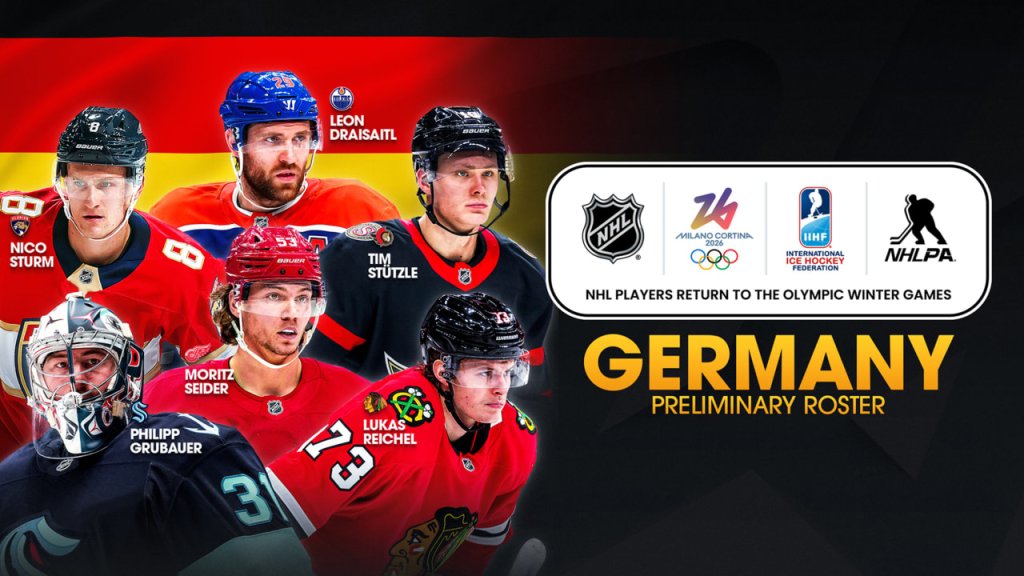
The German Ice Hockey Federation’s statement of intent was clear and decisive. In June 2025, it named the first six players to its preliminary roster. These players are Leon Draisaitl, Tim Stützle, Moritz Seider, Philipp Grubauer, Nico Sturm, and Lukas Reichel. These NHL stars are not merely late additions to a pre-existing team. They are the high-octane engine. The entire Olympic machine will be built around them. Their presence elevates Germany from a potential spoiler to a team with genuine medal aspirations.
The 2026 German Olympic team will be a formidable hybrid force. It blends the world-class, game-breaking skill of its NHL elite. The team also integrates the proven chemistry, defensive structure, and tournament experience of its European professional core. This report provides a detailed projection of the final 25-man squad poised to make history in Italy.
The Forwards (14): A Potent Mix of Elite Firepower and Tactical Discipline
The German forward group is defined by its two distinct, yet complementary, tiers. The top of the lineup features a concentration of elite NHL talent. This concentration is unprecedented in the nation’s history. The bottom half is composed of disciplined, intelligent professionals. These players are veterans of Germany’s recent international triumphs. This structure provides both explosive scoring potential and tactical reliability.
The Locks: The NHL Vanguard (6)
- Leon Draisaitl (C/LW, Edmonton Oilers): He is the team’s undisputed offensive centerpiece. Draisaitl is also one of the premier players in the world. Draisaitl is a former winner of the Hart Trophy (MVP). He has also won the Art Ross Trophy (scoring title) and Ted Lindsay Award. He is a transformative talent. He is coming off a 2024-25 season. He scored 52 goals and 106 points. He remains one of the NHL’s most lethal offensive weapons. His versatility to dominate as a center or play wing provides immense tactical flexibility. He will be the engine of Germany’s top power-play unit.
- Tim Stützle (C/LW, Ottawa Senators): A dynamic, high-speed playmaker who has blossomed into a franchise cornerstone for the Senators. He led his team with 79 points in the 2024-25 season and made his Stanley Cup Playoff debut. By the 2026 Games, he will be 24 years old and in his athletic prime. He will be perfectly positioned to drive a potent second line. He will give Germany a secondary scoring punch it has never before possessed. His history reflects his excellence playing for Germany. His dominant performance as captain at the 2021 World Junior Championship highlights his readiness for the Olympic stage.
- JJ Peterka (RW/LW, Utah Mammoth): A breakout star whose game is built on explosive speed and a formidable shot. Peterka joined the newly formed Utah Mammoth after a trade. He is coming off a career-best season with 68 points in 77 games. His consistent year-over-year improvement has made him an ideal top-six winger. He can complement the playmaking abilities of either Draisaitl or Stützle. He was a key member of the 2023 silver medal-winning World Championship team. At the 2024 tournament, he led Germany in scoring.
- Nico Sturm (C, Minnesota Wild): The quintessential third-line center for a best-on-best tournament. Sturm, a two-time Stanley Cup champion (2022 with Colorado, 2025 with Florida), brings elite defensive responsibility. He excels in penalty-killing prowess. He also has a commanding presence in the faceoff circle, where he won 58.77% of his draws in 2024-25. His winning pedigree and shutdown capabilities will be critical in neutralizing opposing top lines.
- Lukas Reichel (LW/C, Chicago Blackhawks): A highly skilled and creative forward with first-round offensive talent. His NHL production has been modest. He posted a career-high 22 points in 70 games in 2024-25. However, his skill set is exceptionally well-suited to the larger international ice surface. Reichel has consistently produced points for Germany at multiple World Championships. He will provide secondary scoring from a middle-six role.
- Dominik Kahun (C/LW, Lausanne HC): Though now a star in Switzerland’s National League, Kahun has valuable experience. He brings 186 games of NHL experience. He is an intelligent and versatile playmaker. He is also a trusted veteran of both the 2018 Olympic and 2023 World Championship silver medal teams. His established chemistry with the European core is evident. He has a proven ability to perform in international competition. These qualities make him a lock for a top-nine role.
The European Elite: Proven International Performers (4)
- Leonhard Pföderl (RW, Eisbären Berlin): He is a pure goal-scorer. Pföderl is also one of the most consistent offensive threats in the Deutsche Eishockey Liga (DEL). Pföderl was a member of the 2018 Olympic silver medal team. He has remained a fixture on the national team. He contributed to the 2025 World Championship squad. His finishing ability makes him a valuable winger in the middle-six and a key component of the second power-play unit.
- Yasin Ehliz (LW, EHC Red Bull München): He is a tenacious and energetic two-way winger. He embodies the hard-working identity of the national team. Ehliz is another veteran of the 2018 and 2023 silver medal campaigns, valued for his relentless forechecking and defensive responsibility. He provides leadership and is a player the coaching staff trusts implicitly in all situations.
- Frederik Tiffels (LW, Eisbären Berlin): A fleet-footed winger whose primary asset is his elite skating. Tiffels was part of the 2023 silver medal team and has been a mainstay in the national program for years. His speed is a major weapon on the larger Olympic ice surface. This makes him an ideal energy player for the bottom-six. He can push the pace and create chances in transition.
- Wojciech Stachowiak (C/LW, ERC Ingolstadt): He is a versatile forward. He is defensively responsible. Stachowiak has cemented his place on the national team over the past three seasons. Stachowiak played a key role in the 2023 silver medal run. He has been a reliable presence at the 2024 and 2025 World Championships. His emergence provides valuable depth at center and a trustworthy two-way game for the fourth line.
The Role Players & Final Selections (4)
- Marc Michaelis (C/LW, Adler Mannheim): Marc Michaelis is a smart and adaptable forward. He has brief NHL experience. He has also become a trusted member of the national team. Michaelis can play both center and wing. He contributes on the penalty kill. He offers the coaching staff valuable tactical flexibility as the 13th forward.
- Maximilian Kastner (LW, EHC Red Bull München): A gritty, defensive-minded forward who excels in a checking role. Kastner is a regular on recent World Championship teams. His value lies in his physicality and penalty-killing acumen. His ability to wear down opponents makes him a strong candidate for a fourth-line energy spot.
- Joshua Samanski (C/LW, Straubing Tigers): He is a young, big-bodied forward. Standing at 6-foot-3, he offers a different physical dimension to the group. His significant development earned him a spot on the 2025 World Championship team. His size and versatility make him a compelling option for the 14th forward position. He is particularly effective as a net-front presence.
- Justin Schütz (F, Adler Mannheim): He is a speedy winger. He was part of the 2023 silver medal team. He also joined the 2025 World Championship squad. He competes directly with players like Tiffels. The role is defined by speed and relentless forechecking. He provides excellent depth and energy.
The construction of this forward group is a clear execution of a “stars and system” model. There is a distinct separation between the top-six NHL talent. They will be tasked with generating the bulk of the offense. The bottom-eight European-based players were selected for their deep familiarity with Coach Kreis’s system. They are valued for their defensive reliability and specialized roles. This team is not built on four interchangeable scoring lines. It is a strategically designed unit with two elite offensive lines. It also includes two highly disciplined, tactical shutdown and energy lines. This clear purpose enables the coaching staff to deploy its talent efficiently. The NHL stars receive offensive zone starts and power-play time to score. Meanwhile, the European core handles difficult defensive matchups and protects leads.
The Blue Line (8): Building the Fortress Around Moritz Seider
Germany’s defense corps will be built around one of the best young blueliners in the world. It will be supported by a mix of North American-developed prospects. Additionally, reliable veterans from the DEL will provide support. The group’s success will depend on playing a structured game. It must be disciplined to limit chances and transition the puck efficiently. This will allow skilled forwards to excel.
The Cornerstone
- Moritz Seider (D, Detroit Red Wings): A true number-one, all-situations defenseman and the anchor of the German blue line. Seider was the winner of the 2021-22 Calder Trophy as the NHL’s rookie of the year. He logs massive minutes against top competition. He averages over 25 minutes per game in the 2024-25 season. He is a physical force, the quarterback of the top power-play unit, and the team’s most important defensive player. At 24 years old, he will be in his absolute prime. He will rank among the best defensemen in the entire Olympic tournament.
The Next Wave: North American Development Pipeline
- Maksymilian Szuber (D, Utah Mammoth/AHL): He is a large, mobile defenseman. He has developed his two-way game effectively in the American Hockey League. In 2024-25, he posted 32 points in 65 games with the Tucson Roadrunners. Szuber has been a member of the last two World Championship teams, indicating the coaching staff’s trust in his abilities. His experience on North American ice makes him well-prepared to face NHL-level competition. He is projected as a solid second-pairing defenseman.
The Veterans: The DEL’s Defensive Stalwarts
- Jonas Müller (D, Eisbären Berlin): He is a foundational piece of Germany’s recent success. Jonas was also a key member of the 2018 Olympic silver medal team. Müller is known for his steady, reliable defensive game and leadership qualities. He provides a calming presence on the back end and will be a staple on the top penalty-killing unit.
- Kai Wissmann (D, Eisbären Berlin): Wissmann is a towering defenseman at 6-foot-4. He brings essential size to the blue line. His physical edge is notable. He has formed a strong and familiar partnership with Jonas Müller for both their club team and the national team. His defensive reach and shutdown capabilities make him a valuable asset against skilled opponents.
- Fabio Wagner (D, ERC Ingolstadt): He is a dependable, minute-eating defenseman. He has been a fixture for Germany at the 2022 Olympics and multiple World Championships. Wagner is a trusted veteran. He plays a simple, smart, and effective game. This makes him a likely candidate for a third-pairing role. He is also suitable for penalty-killing duties.
Rounding Out the Corps: Mobility and Depth
- Leon Hüttl (D, ERC Ingolstadt): A younger, mobile, right-shot defenseman who has become a regular on the national team. He complements more traditional stay-at-home partners stylistically by moving the puck up the ice. This ability positions him as a strong candidate for the third pairing.
- Lukas Kälble (D, Adler Mannheim): He is a solid, all-around defenseman. He has delivered consistent performances for Germany at the last two World Championships. He provides reliable depth and can step into the lineup seamlessly, making him an ideal choice as the 7th defenseman.
- Leon Gawanke (D, Adler Mannheim): An offensive-minded defenseman with a powerful shot and extensive AHL experience. His defensive play can be inconsistent. However, his offensive upside, particularly on the power play, makes him a compelling option as the 8th defenseman. He is a potential specialist for offensive-zone situations.
In the Crease (3): A Trio of Talent and Trust
Germany enters the tournament with one of the most stable and clearly defined goaltending hierarchies. This trio offers a perfect blend. It includes NHL starting experience, elite European reliability, and high-end future potential. This blend provides a significant advantage. It eliminates any potential for a distracting “goalie controversy.”
The Number One: Philipp Grubauer’s Net
- Philipp Grubauer (G, Seattle Kraken): The undisputed starter and Germany’s most accomplished goaltender of his generation. Grubauer is a Stanley Cup winner with the Washington Capitals in 2018. He holds the record for the most wins by a Germany-born goalie in NHL history. Despite a challenging 2024-25 season statistically, with a 3.49 goals-against average and an.875 save percentage, his extensive experience and track record of performing in high-pressure games make him the clear choice. His selection among the first six players named to the roster shows the federation’s full confidence in him. They regard him as their number one choice.
The Trusted Backup: The Case for Mathias Niederberger
- Mathias Niederberger (G, EHC Red Bull München): The most reliable and decorated goaltender in the DEL. Niederberger has been Germany’s go-to netminder at numerous World Championships. He was the starting goalie for the 2022 Olympic team in Beijing. His strong play in the DEL, including a.906 save percentage in 2024-25, showcases his talent. His vast international experience makes him the perfect, steady number two. He can be trusted to step in and perform if called upon.
The Goalie of the Future: Arno Tiefensee’s Ascent
- Arno Tiefensee (G, Adler Mannheim/Dallas Stars): The undisputed goalie of the future for Germany. After a stellar 2024-25 season with Adler Mannheim, where he posted a 19-10-3 record with a .912 save percentage and a 2.27 goals-against average, he earned an entry-level contract with the Dallas Stars. At just 23 years old, he has already served as the third goalie at the World Championships. He represents the next wave of German goaltending. He is the logical choice for the third goaltender spot, an investment that allows him to gain invaluable Olympic experience.
The Bubble: The Agonizing Final Cuts
The increasing depth of German hockey means that several deserving players will be on the outside looking in. These difficult decisions highlight the program’s remarkable progress.
Veteran leaders like Patrick Hager (EHC Red Bull München) and Moritz Müller (Kölner Haie) have contributed significantly to the national team. Their influence has been immense. They have played a significant role. Their leadership has been invaluable. They have served incredibly well. They have captained past medal-winning squads. By 2026, Hager will be 37. Müller will be 39. Their potential exclusion would signal a necessary generational shift towards younger, faster players.
In North America, forward prospect Julian Lutz (Tucson Roadrunners) is highly regarded. However, his development in the AHL suggests he may need more time to be ready for an Olympic role. This is compared to more established European professionals. Similarly, emerging CHL talents like forward
David Lewandowski (Saskatoon Blades) and defenseman Carlos Händel (Halifax Mooseheads) are the future of the program. However, the 2026 Olympics likely comes too soon for them to unseat established veterans.
The Final Roster: Assembling the German Machine
The following tables present the projected 25-man roster and a potential lineup, illustrating the strategic deployment of Germany’s talent.
Table 1: Projected 25-Man Roster for the 2026 Olympic Winter Games
| Position | Player Name | 2024-25 Club | Projected Role |
| Forwards (14) | |||
| LW | Tim Stützle | Ottawa Senators (NHL) | 1st Line Playmaker, PP1 |
| C | Leon Draisaitl | Edmonton Oilers (NHL) | 1st Line Center, PP1 QB |
| RW | JJ Peterka | Utah Mammoth (NHL) | 1st Line Scorer, PP1 |
| LW | Lukas Reichel | Chicago Blackhawks (NHL) | 2nd Line Scoring Winger, PP2 |
| C | Dominik Kahun | Lausanne HC (NL) | 2nd Line Playmaker, PP2 |
| RW | Leonhard Pföderl | Eisbären Berlin (DEL) | 2nd Line Finisher, PP2 |
| LW | Yasin Ehliz | EHC Red Bull München (DEL) | 3rd Line Two-Way Winger |
| C | Nico Sturm | Minnesota Wild (NHL) | 3rd Line Shutdown Center, PK1 |
| RW | Frederik Tiffels | Eisbären Berlin (DEL) | 3rd Line Energy/Speed |
| LW | Maximilian Kastner | EHC Red Bull München (DEL) | 4th Line Checker, PK2 |
| C | Wojciech Stachowiak | ERC Ingolstadt (DEL) | 4th Line Center, PK2 |
| RW | Joshua Samanski | Straubing Tigers (DEL) | 4th Line Big Body/Net Front |
| F | Marc Michaelis | Adler Mannheim (DEL) | 13th Forward (Versatile) |
| F | Justin Schütz | Adler Mannheim (DEL) | 14th Forward (Speed/Depth) |
| Defensemen (8) | |||
| D | Moritz Seider | Detroit Red Wings (NHL) | 1st Pair, All-Situations #1 D |
| D | Jonas Müller | Eisbären Berlin (DEL) | 1st Pair, Shutdown D, PK1 |
| D | Maksymilian Szuber | Tucson Roadrunners (AHL) | 2nd Pair, Two-Way D |
| D | Kai Wissmann | Eisbären Berlin (DEL) | 2nd Pair, Defensive D, PK1 |
| D | Fabio Wagner | ERC Ingolstadt (DEL) | 3rd Pair, Veteran Presence, PK2 |
| D | Leon Hüttl | ERC Ingolstadt (DEL) | 3rd Pair, Puck-Mover |
| D | Lukas Kälble | Adler Mannheim (DEL) | 7th Defenseman |
| D | Leon Gawanke | Adler Mannheim (DEL) | 8th Defenseman, PP Specialist |
| Goaltenders (3) | |||
| G | Philipp Grubauer | Seattle Kraken (NHL) | Starting Goaltender |
| G | Mathias Niederberger | EHC Red Bull München (DEL) | Backup Goaltender |
| G | Arno Tiefensee | Adler Mannheim (DEL) | 3rd Goaltender/Future Starter |
Table 2: Projected Line Combinations and Special Teams
| Unit | Left | Center | Right |
| Line 1 | Tim Stützle | Leon Draisaitl | JJ Peterka |
| Line 2 | Lukas Reichel | Dominik Kahun | Leonhard Pföderl |
| Line 3 | Yasin Ehliz | Nico Sturm | Frederik Tiffels |
| Line 4 | Maximilian Kastner | Wojciech Stachowiak | Joshua Samanski |
| Extras | Marc Michaelis, Justin Schütz | ||
| D-Pair 1 | Jonas Müller (L) | Moritz Seider (R) | |
| D-Pair 2 | Maksymilian Szuber (L) | Kai Wissmann (R) | |
| D-Pair 3 | Fabio Wagner (L) | Leon Hüttl (R) | |
| Extras | Lukas Kälble (L), Leon Gawanke (R) | ||
| PP Unit 1 | Stützle | Draisaitl (bumper) | Peterka |
| Seider (point) | Reichel (net front) | ||
| PK Unit 1 | Sturm | Kastner | J. Müller |
| Goalies | Starter: Philipp Grubauer | Backup: Mathias Niederberger | Third: Arno Tiefensee |
Conclusion: From Dark Horse to Legitimate Contender
Germany will arrive in Milano Cortina with a roster unlike any it has ever assembled. The team’s strengths are unprecedented. They possess elite, high-end talent capable of breaking a game open at any moment in Draisaitl, Stützle, and Seider. Their goaltending is stable and clearly defined, led by an experienced NHL starter. The coaching staff implements a cohesive system. They have already guided a core of these players to international success.
Potential challenges remain. The defensive depth beyond Seider is solid but lacks another elite puck-mover, making an injury to him a catastrophic possibility. The team will be heavily reliant on its top two lines for offense. They might be neutralized by top defensive pairings of nations like Canada or the USA. It is uncertain if the bottom six can consistently produce.
Despite these challenges, Germany enters the 2026 Olympics not as a sentimental underdog, but as a genuine medal threat. Their unique blend of superstar power and disciplined structure makes them a difficult matchup for any opponent. While winning gold would require a perfect tournament, a podium finish is a realistic and achievable goal. A semi-final appearance would reinforce Germany’s potential. Performing competitively in the medal rounds would establish their status. It would highlight them as a rising and sustainable power in the international hockey world.

 ScortonBoy17.ca
Leave a comment