Introduction: The One Who Built It All
In the annals of modern professional wrestling, few careers are as unique as Allen Neal Jones. He is known globally as AJ Styles. While many legends have their legacies tied to one promotion, Styles created a different path. He built Hall of Fame-worthy careers in three separate, globally recognized companies. These include Total Nonstop Action Wrestling (TNA), New Japan Pro-Wrestling (NJPW), and World Wrestling Entertainment (WWE). His journey represents a fundamental challenge to the long-held, WWE-centric model of superstardom. He was not a product of a developmental system, meticulously crafted to fit a corporate mold. Instead, he arrived at each destination as a fully-formed icon. He was a journeyman who became the master of every house he entered. This forced the industry’s largest players to acknowledge a world beyond their own creative walls.
His trajectory can be charted through three distinct, dominant eras. The first era is his time as the foundational “cornerstone” of TNA, where he gave a fledgling promotion its identity. The second era is his reign as the rebellious gaijin (foreigner) leader of the Bullet Club in NJPW. This transformed the faction into a global phenomenon. The final era is his arrival in WWE, where he was immediately recognized as a main-event talent. He would go on to “build SmackDown Live” into the company’s premier brand. Through it all, two traits have remained constant. There is an unparalleled consistency between the ropes. Additionally, there is a remarkable adaptability to any style, opponent, or continent. These traits cement a legacy that is, in every sense of the word, phenomenal.
Chapter I: Forged in Georgia, Crowned in the X-Division
From Hardship to the Squared Circle
AJ Styles’s story starts in the harsh reality of a difficult childhood. It does not begin under the bright lights of an arena. Allen Neal Jones was born on June 2, 1977. He entered the world at Marine Corps Base Camp Lejeune in North Carolina. He then spent his formative years in Gainesville, Georgia. These years were marked by poverty. He also experienced the presence of an abusive, alcoholic father. The family’s financial struggles were so severe that they could not afford cable television. This was a cruel irony for a boy whose childhood passion was professional wrestling. It was a world he could only imagine. This upbringing, however, instilled a resilience and work ethic that would become the bedrock of his career. He found an outlet in amateur wrestling at Johnson High School. His natural aptitude blossomed there. He became a two-time state wrestling champion and earned a partial wrestling scholarship to Anderson University in South Carolina. It was this legitimate athletic foundation that would later allow him to blend high-flying spectacle with credible, mat-based offense.
The Early Grind
Encouraged by friends, Jones entered a professional wrestling school, debuting in 1998. His initial foray was a far cry from his future stardom; he wrestled as a masked character named “Mr. Olympia” for the Georgia-based National Championship Wrestling (NCW). To support his dream, he took on side jobs. He mowed lawns and drove an ambulance. This was a testament to his unwavering dedication in the face of meager paydays. In December 1999, NCW merged with NWA Georgia. During this time, he was renamed AJ Styles. This moniker would follow him to global fame. His talent quickly garnered attention from larger promotions. He briefly wrestled as “Air Styles” in 2001. This was during the final days of World Championship Wrestling (WCW). He was part of a tag team called Air Raid. Following WCW’s closure, he appeared a couple of times for the World Wrestling Federation (WWF, now WWE). This was between 2001 and 2002. He made a pivotal decision that would define the next 14 years of his career. He declined a developmental contract offer from the industry giant. Instead, he chose to bet on himself and forge his own path.
The Cornerstone of a New Promotion
That path led him directly to the front door of a new, ambitious promotion: NWA: Total Nonstop Action (TNA). From its very inception in 2002, Styles was positioned as a central figure. He is widely described as “the cornerstone of the company since its inception.” He earned this title by participating in the first-ever match in TNA history. He immediately became the face of its most exciting division. His early career shows that he followed a pattern of being a foundational figure. He was not just a wrestler in TNA. He was an architect of its identity. He was the one chosen to implement the company’s most innovative concepts. He received its highest honors. These acts gave them their initial prestige and defined what they represented. This role as a pioneer is a critical, and often undervalued, part of his legacy.
The X-Division: “It’s Not About Weight Limits, It’s About No Limits”
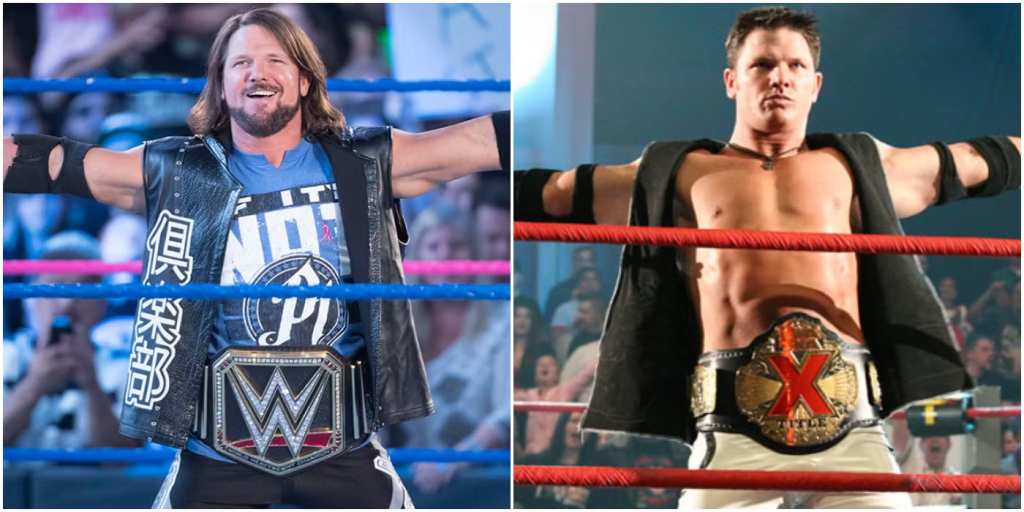
TNA’s signature innovation was the X-Division, a direct challenge to the traditional, size-focused presentation of American wrestling. The division was marketed with the slogan, “It’s not about weight limits, it’s about no limits.” It blended the fast-paced, high-risk styles of cruiserweight wrestling and lucha libre. This was combined with unparalleled athleticism. AJ Styles, with his breathtaking aerial maneuvers and crisp technical prowess, became the living embodiment of this philosophy. He was crowned the inaugural TNA X-Division Champion and would go on to hold the title six times. His dominance in the division was unmatched. This success in the division was remarkable. He also succeeded in main events. These achievements made him the first wrestler to achieve the TNA Triple Crown. He also achieved the Grand Slam championships. This achievement cemented his status as “Mr. TNA”.
Chapter II: The Unbreakable Trinity – A TNA Masterpiece
The Rivalry that Defined a Company
Styles was the face of the X-Division. His legacy there was immortalized through a legendary three-way rivalry with Christopher Daniels and Samoa Joe. This feud is consistently cited as the creative and in-ring zenith of TNA’s golden era. The story began as a heated rivalry between Styles and Daniels throughout 2005. This was a classic babyface-versus-heel dynamic. It pitted the beloved “cornerstone” against a villain driven by jealousy. The dynamic exploded with the arrival of the undefeated, menacing “Samoan Submission Machine,” Samoa Joe. His sheer force of will elevated the conflict. He brought a unique blend of power and agility that made the conflict truly special.
Deconstructing a Five-Star Classic
The rivalry reached its apex in the main event of the TNA Unbreakable pay-per-view on September 11, 2005. The X-Division Championship was defended in the final match of the night. This move made a profound philosophical statement for the company. It was a declaration that in-ring work rate and innovation were as valuable as any heavyweight title bout. The match between Styles, Daniels, and Joe was not just a classic. It was a masterpiece. It is the only TNA match that has ever received a prestigious 5-star rating. Dave Meltzer of the Wrestling Observer Newsletter gave it this honor.
The match’s brilliance lay in its perfect narrative structure. It featured three perfectly defined characters. Joe was the unstoppable monster, a powerhouse who moved like a cruiserweight. Daniels was the cunning and opportunistic pest. Styles was the resilient, battling babyface heart of the division. For nearly 23 minutes, they crafted a symphony of “balls-to-the-wall chaos.” The performance was lauded for its breathtaking pace. It featured flawless execution. The passionate commentary of Mike Tenay and Don West elevated the experience. Iconic moments are seared into the memories of fans. Daniels monkey-flipped Styles from the corner into a waiting Samoa Joe. Joe catches him in a powerbomb. Styles reverses the powerbomb into a hurricanrana on Joe. Joe launches his nearly 300-pound frame over the top rope with a twisting dive. Styles showcases his incredible strength by lifting Joe for a Torture Rack. The chemistry was natural. Styles mentioned that a significant portion of the match was improvised after a missed spot early on. The finish was as intelligent as the action preceding it. Joe was temporarily taken out on the floor. Styles reversed Daniels’ signature Angel’s Wings finisher into a bridging pin for the victory. This conclusion reinforced the story that these three competitors were so evenly matched. Only a split-second, surprise counter could decide the outcome.
The Aftermath and Legacy
The feud would continue through various permutations. This included a classic Ultimate X match at Destination X 2006. However, the Unbreakable contest remains the benchmark. The match is credited by a generation of fans as a significant eye-opener to wrestling beyond WWE. It is widely considered one of the greatest three-way matches in history. Its influence is undeniable, setting a template for the fast-paced, action-heavy style that has become prevalent in modern wrestling. However, a crucial element that made the original special was the deep-seated psychology and character work. This aspect gave meaning to the spectacle. Some argue this nuance is lost when others attempt to replicate the style without the substance.
Chapter III: The Gaijin Rebel – A New Japan Dynasty
Rebirth in the Far East
After more than a decade as the heart and soul of TNA, Styles’s journey took an unexpected turn. The company asked him to take a significant pay cut, during an acrimonious contract dispute. He then departed the company he helped build. He felt disrespected and decided to bet on himself. He took his talents to the international stage. In March 2014, he signed with New Japan Pro-Wrestling. This move proved to be a masterstroke. It transformed him from a celebrated domestic star into a bona fide global icon. This transformation made him a far more valuable commodity than if he had remained in TNA.
Leading the Bullet Club
Styles made his NJPW debut at the Invasion Attack 2014 event with an immediate, shocking impact. He attacked the reigning IWGP Heavyweight Champion, Kazuchika Okada. Then, he revealed himself as the newest member and de facto leader of the popular, villainous gaijin faction, Bullet Club. He took over from the group’s founder, Prince Devitt, who would become Finn Bálor in WWE. His established main-event credibility instantly elevated the faction’s global profile. Styles often downplayed the official “leader” title. He insisted the group’s ethos was one of rebellion with no single master. However, his role as the faction’s top heavyweight contender was undeniable.
Capturing the IWGP Heavyweight Championship
In a demonstration of NJPW’s immense faith, Styles faced Okada at Wrestling Dontaku 2014. He defeated Okada for the IWGP Heavyweight Championship in his very first singles match with the promotion. This stunning victory made him only the fifth foreigner in history to hold the prestigious title. It “put him on the map immediately” in Japan. It also sent shockwaves through the wrestling world. He had two reigns as IWGP Champion. These reigns brought NJPW’s top prize to the Bullet Club. This achievement cemented the faction’s status as the most dominant force in the company.
A New In-Ring Style
His time in Japan saw a marked evolution in his in-ring work. Styles moved away from the purely high-flying style of his TNA X-Division days. He adopted a more grounded, aggressive, and psychology-driven approach. He became a master storyteller, turning a “fairly regular moveset into something special” through masterful match construction. NJPW’s booking received praise. It effectively made a star who didn’t speak the language compelling. This was achieved through the universal language of in-ring narrative. He had matches against Japanese legends like Minoru Suzuki, Okada, Hiroshi Tanahashi, and Shinsuke Nakamura. Their classic at Wrestle Kingdom 10 is particularly noteworthy. These matches are considered some of the best of the modern era.
The End of an Era
Styles’s NJPW run concluded as dramatically as it began. On January 5, 2016, the night after Wrestle Kingdom 10, the members of Bullet Club viciously turned on him. In an iconic moment, Kenny Omega seized the leadership of the group. He delivered a final, definitive beatdown that wrote Styles out of the company. This set the stage for Styles’s long-awaited arrival in WWE.
Chapter IV: The House That AJ Styles Built
The Shocking Debut
On January 24, 2016, the wrestling world’s longest-held “what if” was finally answered. At the Royal Rumble, the countdown clock hit zero for the third entrant. Then, the words “I Am Phenomenal” flashed across the screen. The eruption from the crowd was deafening. It was a cathartic explosion of joy and disbelief. This came from fans who had waited over a decade to see AJ Styles in a WWE ring. Then-champion Roman Reigns, the man in the ring, had a genuinely confused expression on his face. This perfectly mirrored the shock felt by millions watching worldwide. It was one of the most memorable debuts in the company’s history.
Legitimacy Through a Rivalry
Styles’s first year in WWE is often described as magical. Styles began with an initial program with Roman Reigns for the WWE Championship. This program produced a stellar Extreme Rules match. Styles then transitioned into a career-defining feud with John Cena, the face of the company. The rivalry was artfully portrayed as a clash of philosophies. Cena was seen as the ultimate WWE creation and a 15-year franchise player. Meanwhile, Styles was depicted as the ultimate outsider who had conquered every other major promotion on the planet. Their clash at SummerSlam 2016 became an instant classic. The result sent a clear message. Styles defeated Cena cleanly in the middle of the ring. At the time, this feat had been accomplished by only a handful of wrestlers in the previous decade. The storytelling in the match was superb. Cena’s facial expressions showed the story of a champion. He had thrown everything he had at an opponent. For the first time, Cena found it wasn’t enough. Cena left his “Never Give Up” armband in the center of the ring after the match. This was a powerful, symbolic passing of the torch. It legitimized Styles as a top-tier superstar in the eyes of the WWE Universe.
The Champ That Runs the Camp
Following his monumental victory over Cena, Styles quickly captured the WWE Championship. His ascent coincided with the 2016 WWE brand split, which saw SmackDown Live re-established as a separate entity. Historically viewed as the “B-show,” SmackDown was in need of an identity and a star to build around. Styles became that star. As the show’s champion and anchor, his consistently excellent main events and compelling character work elevated the entire brand. For a sustained period, fans and critics widely considered SmackDown Live superior. It was seen as better than its flagship counterpart, Monday Night Raw. This transformation was not just a typical heel boast; it was a reflection of reality. Styles was the workhorse champion. He provided the blue brand with critical acclaim and fan investment. The brand had lacked this for years. He fundamentally altered the power dynamic between WWE’s two main shows. This led to his famous, and accurate, catchphrase: “SmackDown is the house that AJ Styles built”.
A Historic Reign
His second reign with the WWE Championship was particularly noteworthy, lasting an incredible 371 days. This historic run made him the longest-reigning WWE Champion in SmackDown history at that time. He defended the title against a who’s-who of WWE’s best. He would later add the United States and Intercontinental Championships to his resume, becoming a WWE Grand Slam Champion. This achievement made him one of only two men to become a Grand Slam Champion in both TNA and WWE. Along with Kurt Angle, this is a truly unique accomplishment. It speaks to his longevity and versatility.
Chapter V: The Art of the Phenomenal
A Chameleon in the Ring
The foundation of AJ Styles’s unprecedented success is his mastery of the craft of professional wrestling. He is often described as a “chameleon.” He possesses the rare ability to seamlessly adapt his style to any opponent. He can also adapt to any environment. This versatility has allowed him to produce classic matches against high-flyers, technicians, and powerhouses across three decades. While his early career was defined by spectacular, high-risk acrobatics, he consciously evolved his style over time. This was not merely a consequence of aging but a deliberate professional strategy. He reduced the frequency of death-defying moves like the “Spiral Tap.” He focused more on in-ring psychology and storytelling. This strategy preserved his body. It ensured a longevity that has allowed him to perform at an elite level well into his late 40s.
The Arsenal
Styles’s offense is built around three distinct and credible finishing maneuvers. This gives him multiple paths to victory in any given match.
- The Styles Clash: This belly-to-back inverted mat slam is his most iconic move. Its origin is surprisingly humble, inspired by watching his brother-in-law playfully fail at a powerbomb on a trampoline. The move gained a legitimate air of danger after a few opponents took the bump incorrectly. In the world of wrestling, this only served to make it a more protected and believable match-ender.
- The Phenomenal Forearm: A spectacular springboard forearm smash. This move is celebrated for its cinematic quality. It often looks like a highlight reel clip in motion. It became a staple of his WWE arsenal. This was due in part to initial management concerns over the perceived risk of the Styles Clash. It is also a perfect finisher for larger opponents who are more difficult to set up for his other moves.
- The Calf Crusher: This calf slicer submission hold adds a crucial technical dimension to his game. It provides a non-impact way to end a match. This fits perfectly into stories where he has systematically targeted an opponent’s leg. It reinforces his reputation as a complete wrestler.
The Art of the Sell
An often-underappreciated element of Styles’s genius is his selling—the art of making an opponent’s offense look impactful and devastating. He masters believable selling by conveying pain and exhaustion. He achieves this without resorting to the “hokey” overselling that can take an audience out of a match. He adapts his selling style for a powerhouse like Brock Lesnar. For a technical wizard like Daniel Bryan, he uses a different technique. This enhances realism and drama in his matches. This makes him one of the most generous and effective storytellers in the ring.
The Shawn Michaels Comparison
Due to his consistent excellence, Styles is frequently compared to WWE Hall of Famer Shawn Michaels. His longevity and mastery of in-ring storytelling contribute to this comparison. The Undertaker has stated that Styles is “on the same level as Shawn Michaels.” He represents the “highest work level” of his generation. Fellow legend Kurt Angle went a step further, suggesting that Styles might be even more athletic than Michaels. Michaels is often praised for his superior charisma and promo ability. However, many peers and fans argue that Styles is the more polished and versatile in-ring performer.
Conclusion: A Legacy Cemented Across Continents
The Journeyman GOAT
AJ Styles’s career has shattered the modern mold of a wrestling superstar. He is not a “WWE guy.” He is not a “TNA guy.” He is not a “New Japan guy.” He is a transcendent talent who belongs to the entire wrestling world. He has reached the pinnacle of every major promotion he has competed in. This achievement is unparalleled by any of his contemporaries. His accolades are remarkable. He was named “Wrestler of the Decade” for the 2010s by Pro Wrestling Illustrated. These honors place him in the most elite company in the sport’s history. His journey mirrors the globalization of the wrestling industry. His stardom was built across multiple territories in a connected world. The industry’s biggest player had to adapt to him, not the other way around. He is the ultimate avatar for the modern era of professional wrestling.
The Torch Bearer
Now firmly in the veteran stage of his career, Styles is embracing his new role. He focuses on elevating the next generation of talent. This transition was perfectly encapsulated by his emotional, full-circle return to TNA at Slammiversary 2025. There, after an 11-year absence, he stood in the ring. He publicly endorsed the new X-Division Champion, Leon Slater, as “the future”. The moment was thick with symbolism. The man who built the X-Division and served as its inaugural champion was passing the torch to its youngest-ever titleholder. This act bridged the past and future of the promotion he helped create.
A Hall of Fame Future
It is a foregone conclusion that AJ Styles will be inducted into multiple wrestling halls of fame. In a move characteristic of his professionalism, he has stated that he wants to wait. He plans to wait until his in-ring career is officially over before accepting such honors. He views it as a sign of respect to his current commitments.
Final Assessment
The career of AJ Styles is a masterclass in talent, resilience, and evolution. He defied the odds of a difficult childhood. He bet on himself when the industry leader came calling too early. He built an entire promotion on his back. He reinvented himself on another continent. Then he conquered the one place he was never supposed to succeed. He showed that world-class talent could transcend promotional borders. This achievement forever changed the landscape for wrestlers who dare to walk their own path. His legacy is not just a collection of five-star matches and world championships. It is a testament to a journey that was simply phenomenal. It remains so to this day.
| Promotion | Championship | Reign # | Date Won | Days Held |
| NWA-TNA | NWA World Heavyweight Championship | 1st | June 11, 2003 | 126 |
| NWA-TNA | NWA World Heavyweight Championship | 2nd | April 21, 2004 | 28 |
| NWA-TNA | NWA World Heavyweight Championship | 3rd | May 15, 2005 | 40 |
| TNA | TNA World Heavyweight Championship | 1st | September 20, 2009 | 211 |
| TNA | TNA World Heavyweight Championship | 2nd | October 20, 2013 | 110 |
| NJPW | IWGP Heavyweight Championship | 1st | May 3, 2014 | 163 |
| NJPW | IWGP Heavyweight Championship | 2nd | February 11, 2015 | 144 |
| WWE | WWE Championship | 1st | September 11, 2016 | 140 |
| WWE | WWE Championship | 2nd | November 7, 2017 | 371 |

 ScortonBoy17.ca
Leave a comment