I. Introduction: Everything is Bigger in Texas, Including the Stakes
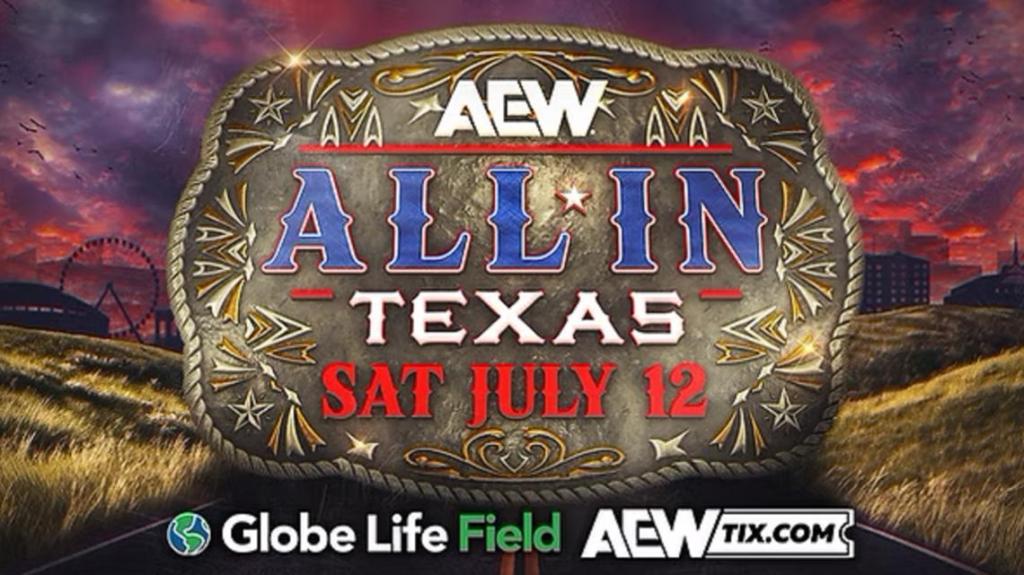
On Saturday, July 12, 2025, All Elite Wrestling rode into Arlington, Texas, for its flagship event, All In. By doing so, it planted its flag deep in the heart of one of professional wrestling’s most sacred territories. Held inside the climate-controlled confines of Globe Life Field, this was not just the third annual installment of AEW’s biggest show but a series of significant firsts: the first
All In was held on American soil. It was the first-ever professional wrestling event at the stadium. This was also AEW’s first pay-per-view in the Lone Star State. The move from London’s Wembley Stadium was necessitated by a scheduling conflict with the band Coldplay. This presented both a challenge and a monumental opportunity.
The event was a resounding commercial triumph long before the first bell rang. A near-sellout crowd of 25,671 fans filled the ballpark. They represented 94% of the configured capacity. This generated a gate that made it the largest for any non-WWE wrestling event in North America since 1999. It eclipsed a long-standing record held by World Championship Wrestling (WCW). This impressive attendance, with tickets starting at an accessible $38.60, demonstrated AEW’s powerful draw and its ability to establish a major event foothold in a new market.
However, All In: Texas did not occur in a vacuum. It unfolded under the most intense competitive pressure AEW has faced to date. WWE executed a clear and aggressive counter-programming strategy. They scheduled three of their own premium live events for the same weekend. The events included NXT Great American Bash, Saturday Night’s Main Event, and the all-women’s show, Evolution. This move had the reported backing of parent company TKO. It was a deliberate attempt to “control the conversation.” WWE wanted to ensure they had the “last word of the night.” In response, AEW made a proactive strategic shift. They moved their main broadcast to a unique afternoon start time of 2 p.m. Central Time. This allowed them to carve out their own space in a crowded weekend.
A forced venue change occurred. The event made a historic debut in a wrestling hotbed. A direct, multi-pronged assault from its chief competitor also took place. This transformed All In: Texas from a simple pay-per-view into a crucial strategic proving ground. The event’s success couldn’t just be measured by match quality. It became a referendum on the company’s resilience. It assessed brand strength and market power as well. By drawing a massive and passionate crowd, AEW generated significant buzz amidst deliberate opposition. It didn’t just put on a show. It made a powerful statement about its place in the wrestling world. It proved it could not only survive but thrive on enemy turf, turning a logistical challenge into a landmark victory.
II. The Main Event Trilogy: A Symphony of Storytelling
AEW presented All In: Texas with a “triple main event.” It was a marketing flourish. This description accurately captured the show’s narrative structure. The final three matches of the night were not merely high-profile bouts. They were distinct pillars of storytelling with philosophical differences. Together, they painted a comprehensive picture of what AEW is and what it strives to be. This trilogy featured a cathartic, lore-heavy war for the company’s soul. It included a complex chapter in a generational rivalry. It also showcased a star-making clash for divisional supremacy. This was a masterclass in layered, long-term booking.
Part 1: The Heart of AEW – ‘Hangman’ Adam Page’s Cathartic, Bloody Coronation
The night reached its peak with a story central to All Elite Wrestling’s heart since its inception. This is the journey of “Hangman” Adam Page. His Texas Death Match against Jon Moxley for the AEW World Championship marked the end. It was a final chapter filled with brutality. The match concluded a years-long saga of violence, self-doubt, and redemption. The narrative was framed as a battle for the very soul of the company. On one side stood Page. He was the redeemed cowboy and a flawed yet relatable hero. He had won the Owen Hart Cup to earn this shot. On the other was Moxley. He was the marauding, nihilistic champion. Moxley held the title hostage in a briefcase. He openly loathed the “crybaby crap” and emotional vulnerability that Page represented.
The Texas Death Match stipulation ensured the conflict would be resolved only through absolute punishment. The violence was immediate and visceral, escalating with each passing minute. Within moments, Page was stabbing Moxley with a fork, and Moxley soon retaliated by grating Page’s face with barbed wire. The canvas became a gallery of pain, featuring broken glass, mangled steel chairs, a bodyslam onto a barbed wire chair, and, most horrifically, a bed of nails introduced by Moxley’s allies. The match was a grueling 35-minute war, a callback to their previous violent encounters, designed to serve as a definitive conclusion.
What elevated the match from a simple brawl to an epic was its climactic, interwoven finale—an “AEW-vengers Assemble” moment that served as a reward for the dedicated viewer. Just as Moxley and his Death Riders seemed poised to finally extinguish Page’s hope, the story threads of the past year converged. Will Ospreay, an ally of Page, attempted to intervene but was brutally taken out by Claudio Castagnoli and Wheeler Yuta. Then, in a moment of pure triumph, Bryan Danielson and Darby Allin—two of Moxley’s most prominent past victims—made their dramatic returns. Danielson appeared to fight off the Death Riders, while Allin descended spectacularly from the rafters of Globe Life Field to seek his revenge. Yet, the most pivotal intervention came from the most complex character in the equation: Swerve Strickland. Despite his own intensely bloody history with Page, Swerve emerged to save his rival, handing him the very chain that had been a symbol of their past animosity. Page wrapped the chain around Moxley’s neck, hung him over the top rope, and choked him into submission to finally reclaim the AEW World Championship.
This victory was more than a title change; it was a moment of profound narrative catharsis. Page, the anxious millennial cowboy, was solidified as the definitive main character of AEW. His speech to the live crowd was full of emotion. It was not aired. He simply stated, “Tonight, I am happy.” This provided a deeply resonant and satisfying conclusion to his long, arduous journey. The structure of this main event was a deliberate and bold rejection of simplistic booking. What some might dismiss as “overbooking” was, in fact, a feature, not a bug. The returns of Danielson and Allin were not just surprise pops; they were narrative justice. Swerve’s intervention was not a simple alliance. It was a complex character moment about choosing the lesser of two evils. It elevated the stakes to a philosophical war for the company’s direction. This maximalist approach transformed the match into a rich and rewarding tapestry. It celebrated the idea that in AEW, history matters. Storylines are interconnected. A hero’s victory is often a collective triumph.
Part 2: A Generational Rivalry Reborn – Okada, Omega, and the Price of Victory
In the penultimate match of the night, AEW presented the fifth singles encounter. It was between two men known for modern wrestling excellence. These men are Kenny Omega and Kazuchika Okada. Their legendary series of matches in New Japan Pro-Wrestling is credited with changing the perception of in-ring artistry. It was also an indirect catalyst for the formation of AEW itself. This bout, their first one-on-one in an AEW ring, carried the immense weight of that history. There were added stakes of unifying Omega’s International Championship and Okada’s Continental Championship. This was to crown the inaugural AEW Unified Champion.
The build-up masterfully blended their past with their present. It leaned heavily on the legacy of their NJPW wars. A new, deeply personal AEW-specific angle was introduced. Okada, now a villain aligned with the nefarious Don Callis Family, targeted Omega’s abdomen relentlessly. This was the site of his recent, career-threatening surgery for diverticulitis. This provided a clear and compelling in-ring story for the 30-plus minute contest. The match was a high-quality affair, but it was intentionally and strategically different from their previous epics. The psychology relied on Okada’s cruel and methodical attack on Omega’s vulnerability. This strategy defined the early-to-mid portions of the match.
The critical turning point, and the moment that defined this chapter of their rivalry, came late in the match. After a valiant comeback, Omega finally connected with his ultimate weapon. It was the “One-Winged Angel.” No one had ever kicked out from this move. As referee Bryce Remsburg went down for the count, Don Callis leaped to his feet. He had been on commentary. He yanked the referee out of the ring and prevented the pinfall. He robbed Omega of a certain victory. This interference was followed by another distraction from Rocky Romero. Rocky was neutralized by Omega’s friend Kota Ibushi. This created the opening for Okada to hit a final, decisive Rainmaker. This move secured the victory and made him the first-ever AEW Unified Champion.
The controversial, interference-laden finish was a source of debate among fans, many of whom expected another “pure,” clean wrestling classic. However, this was a deliberate and intelligent creative choice. It was a clear statement. This legendary rivalry was not presented as a standalone nostalgia act. Nor was it a simple exhibition match. AEW had the heel manager make the deciding factor. This firmly embedded the feud within AEW’s own narrative universe. In this universe, outside interference and faction warfare are key story drivers. The “Don Callis element” was not an unfortunate bug; it was the central feature of the story being told. This finish accomplishes multiple goals. It protects Omega in defeat. It gives him a legitimate grievance. It immediately creates the justification for a future rematch where he will demand a clean fight. Most importantly, it establishes that the new Unified Championship is not a trophy celebrating past glories. Instead, it is a top-tier prize to be contested under the current rules and storylines of All Elite Wrestling.
Part 3: The Pinnacle of the Division – ‘Timeless’ Toni Storm’s Star-Making Defense
The third main event of the evening was billed as the biggest women’s match in All Elite Wrestling history. This claim was made without hyperbole. The reigning and defending AEW Women’s World Champion, the delightfully bizarre and dominant “Timeless” Toni Storm, competed. She faced the globally recognized superstar and reigning TBS Champion, Mercedes Moné. Moné had remained undefeated in singles competition since her arrival in AEW. She earned this championship opportunity by winning the prestigious Owen Hart Foundation Tournament. This set the stage for a blockbuster confrontation of two of the world’s best.
What unfolded was an intense, physically grueling, and emotionally charged war that stole the show. The match began with tight, technical grappling before escalating into a dramatic story of attrition. The in-ring psychology was superb. Moné methodically targeted Storm’s arm through joint manipulation and submission attempts. Storm absorbed incredible amounts of punishment. This included a bloodied nose from a mid-match strike. A stunning sunset flip powerbomb from Moné onto the arena floor was also part of the action. The drama intensified as both women executed their primary finishing maneuvers. Storm’s “Storm Zero” and Moné’s “Moné Maker” were executed with precision. Amazingly, their opponents kicked out, which sent the Globe Life Field crowd into a frenzy.
In the contest’s breathtaking climax, with both competitors exhausted and battered, Storm summoned one last burst of strength. She hauled Moné to the top turnbuckle. She delivered a spectacular, earth-shaking “Avalanche Storm Zero,” a super version of her finisher. This secured the clean and decisive pinfall victory. The result was monumental. Toni Storm retained her championship in a certified classic. She also handed the “CEO” Mercedes Moné her first singles loss in AEW. This ended her undefeated streak.
Storm’s clean and definitive victory over a star of Moné’s caliber represents a significant evolution in AEW’s booking philosophy. It reflects a supremely confident approach within its women’s division. The conventional path would have been to capitalize on Moné’s mainstream star power by giving her the championship immediately. AEW, however, chose a more patient and ultimately more rewarding route. By having their established, character-driven champion win decisively, they elevated Toni Storm to an entirely new level of credibility. She is no longer just an entertaining sideshow. She is now a legitimate, main-event-level champion. She can, and did, defeat one of the best wrestlers on the planet. This outcome also enriches Moné’s character. It gives her a new, tangible goal. She wants to avenge her first defeat and overcome the one woman she could not conquer. This result shows a commitment to long-term storytelling. It reflects a belief in the strength of AEW’s own characters. They can be built to a level equal to, or greater than, any incoming star.
III. The Power Play: Swerve & Ospreay Topple the EVP Era
Will Ospreay and Swerve Strickland teamed up in a match many considered a potential show-stealer. They faced The Young Bucks in a match with career-altering implications for everyone involved. The bout was the culmination of a months-long storyline. It centered on Matthew and Nicholas Jackson’s abuse of their on-screen power as Executive Vice Presidents. Many fans had grown weary of this narrative. Ospreay and Strickland, two of AEW’s most popular stars, formed a powerful alliance. Although sometimes tenuous, this alliance was forged in mutual respect. They shared the goal of ending the Bucks’ tyrannical reign.
The stakes could not have been higher. A dueling stipulation guaranteed a dramatic shift in the company’s landscape, regardless of the outcome. If The Young Bucks were to lose, they would be stripped of their EVP titles. Conversely, if Swerve and Ospreay were defeated, they would face a ban. They would be barred from challenging for the AEW World Championship for an entire year. This high-stakes agreement created the perfect environment. The match was a spectacle. It was also a technical masterpiece. The entrances alone signaled a main-event feel: Will Ospreay emerged with an
Assassin’s Creed-themed presentation complete with ninjas. Swerve Strickland was sung to the ring by the talented JoJo Offerman, the widow of Windham Rotunda aka Bray Wyatt. The Young Bucks made their way down the ramp carried in a boat through a sea of fans.
The match itself was a certified tag team classic. It was lauded for its “state of the art action.” The spots were perfectly executed. The in-ring storytelling was compelling, focusing on the stark contrast between the two teams. The Young Bucks utilized their lifelong chemistry. They showcased their seamless tandem offense. Meanwhile, Ospreay and Strickland, two elite singles competitors, had to learn and grow as a unit throughout the match. As the bout progressed, their bond visibly strengthened. It culminated in a decisive and visually stunning finish. They hit a tandem House Call and Hidden Blade on Nick Jackson. This allowed Swerve to secure the pinfall.
The outcome was a multi-faceted narrative reset for All Elite Wrestling. With the victory, Swerve and Ospreay officially ended the EVP era of The Young Bucks in the world of kayfabe. This development was met with widespread approval. This was a strategically booked pivot point that simultaneously resolved an unpopular storyline while launching multiple new ones. By removing the EVP titles, the booking frees Matthew and Nicholas Jackson from the one-dimensional authority figure roles. It allows for a character refresh. This will likely begin with a storyline hiatus. Then, there will be a re-energized return.
Crucially, the victory keeps two of AEW’s hottest babyface stars, Swerve and Ospreay, in the immediate World Title picture. A new champion in Hangman Page means the company needs fresh, credible challengers. Sidelining these two for a full year would have severely hampered creative momentum. Furthermore, the match solidified the “BruvHouse” team of Swerve and Ospreay. They emerged as a new, top-tier babyface force in the tag team division. It also planted the seeds for their eventual, highly anticipated singles feud. This feud will now be enriched by the history of this shared triumph. It was a masterclass in narrative efficiency, closing one chapter while opening several more exciting ones.
IV. Shuffling the Deck: Surprises, Turns, and Triumphs on the Undercard
The triple main event delivered on its promise. The strength of All In: Texas was bolstered by a deep and eventful undercard. This undercard featured shocking turns, emotional victories, and significant storyline developments.
An Unexpected Feel-Good Moment: Dustin Rhodes Captures TNT Gold
The night took an unfortunate turn before it even began. It was announced that the scheduled TNT Championship match between champion Adam Cole and challenger Kyle Fletcher was off. During the pay-per-view, Cole addressed the Globe Life Field crowd in a heartfelt and emotional segment. He confirmed that he was not medically cleared to compete due to health issues. As a result, he would be vacating the title indefinitely. What could have been a momentum-killing crisis for the show was expertly pivoted into one of its most powerful moments. A fatal four-way match was immediately created for the vacant championship. It featured the original challenger, Kyle Fletcher. The match also included Daniel Garcia, Sammy Guevara, and Texas’s own legendary veteran, Dustin Rhodes. A wave of pure emotion swept through the arena. The 56-year-old Rhodes capitalized on the chaos. He caught Daniel Garcia with a surprise small package to win the match. This victory marked his first-ever championship in All Elite Wrestling. It was a masterful piece of creative problem-solving. It turned a negative into a legacy-affirming, feel-good moment. This perfectly complemented the event’s “Texas pride” sub-theme. It generated immense goodwill from the live audience.
The Future is Now: MJF and Athena Punch Their Tickets
Two Casino Gauntlet matches served as highly efficient vehicles for showcasing roster depth and establishing new top contenders. Maxwell Jacob Friedman (MJF) won the Men’s Casino Gauntlet. He entered at #2. MJF stayed true to his opportunistic character by lurking. He ultimately stole the pinfall from Mark Briscoe. This made him the new #1 contender for Hangman Page’s AEW World Championship. The match was a whirlwind of action and surprises. It featured the return of Juice Robinson and The Gunns. There were special appearances from international stars like Kota Ibushi, Ricochet, and Místico.
The Women’s Casino Gauntlet provided another powerful hometown moment. Garland, Texas native and reigning ROH Women’s Champion Athena outlasted a field of competitors. She earned a future shot at the AEW Women’s World Championship. Her victory came after she eliminated Mina Shirakawa. A surprise appearance from Japanese star Syuri also featured in the match. These gauntlet matches were perfectly booked to achieve multiple goals. They established clear and credible future title programs. They reinforced key character traits. They delivered exciting, unpredictable action for the fans.
Betrayal and a Save: Chaos in the Tag Team Division
The AEW World Tag Team Championship match saw the dominant duo of The Hurt Syndicate, Bobby Lashley and Shelton Benjamin, successfully defend their titles in a chaotic triple-threat against the high-flying JetSpeed and the villainous Patriarchy. However, the match itself was largely overshadowed by the explosive angle that followed. After Lashley secured the pin on Christian Cage, Cage’s young protégé, Nick Wayne, shockingly turned on his mentor and father-figure, laying him out and preparing to deliver a devastating “Conchairto”. This heinous act prompted the dramatic return of Cope (formerly known as Edge), who stormed the ring to save his lifelong friend and rival, Christian Cage. Cope cleared the ring of not only Wayne but also FTR, who had become involved in the beatdown, creating a stunning visual and a major storyline catalyst. This segment effectively used the undercard to launch what promises to be a marquee, non-title program, likely pitting a reunited Edge & Christian against FTR, demonstrating a commitment to building significant stories up and down the card.
V. The Zero Hour: An Authentic Ode to Texas Wrestling
The All In: Texas: Zero Hour pre-show set a powerful and authentic tone for the evening. This was done by paying deep respect to the region’s rich wrestling history even before the main card began. The highlight of the two-hour kickoff was an eight-man tag team match. A team billed as the “Sons of Texas” faced the formidable Shane Taylor Promotions. It was comprised of Texas natives Dustin Rhodes and Sammy Guevara, alongside Ross and Marshall Von Erich.
The inclusion of the Von Erich brothers was notable. It was far more than a simple cameo. It served as a direct and heartfelt homage to North Texas wrestling royalty. Ross and Marshall went to the ring with their legendary father, Kevin Von Erich. He is the last surviving member of the iconic Von Erich brothers. Kevin is a figure of immense historical importance in the territory. The crowd’s connection to the family was strong. The arena erupted late in the match. Kevin himself stepped into the ring to confront Shane Taylor Promotions’ enforcer, Anthony Ogogo. In that nostalgic and emotional moment, Kevin Von Erich applied his world-famous Iron Claw. The Arlington faithful responded with a thunderous ovation. The grandsons of Dusty Rhodes were present at ringside. Wyatt and Wayne Rhodes wanted to ensure no harm came to the legend. This bridged two of wrestling’s most famous families.
This segment was a masterclass in leveraging regional history to forge an immediate and genuine bond with the live audience. AEW clearly understood the importance of honoring Texas’s past to achieve success in this region. This act of respect is a core tenet of the AEW brand. AEW often seeks to weave wrestling’s rich tapestry into its modern product. AEW began the night with a powerful and positive moment. This moment was historically significant. It set a celebratory and authentic tone that resonated throughout the entire event.
VI. Production, Presentation, and Atmosphere: A True Stadium Spectacle
AEW’s commitment to making All In its signature, WrestleMania-level event was evident in every aspect. This dedication was reflected in both the show’s production and presentation. The company successfully scaled its operations to create a true stadium spectacle that felt both grand and intimate.
The stage constructed inside Globe Life Field was described as “colossal” and “massive.” It served as a fitting backdrop for the company’s biggest show of the year. Extensive LED video screens flanked a giant entranceway. A long ramp extended to the ring. The set was designed to give the event a major stadium feel. This visually reinforced its importance. This grand setup was utilized for several special entrances. One such entrance was Will Ospreay’s ninja-accompanied arrival. Another was The Young Bucks’ boat ride. These added to the night’s unique pageantry.
The choice of venue itself was a crucial logistical decision. Globe Life Field’s retractable roof ensured a comfortable indoor environment for the event. The climate was controlled, with temperatures holding steady around 72 degrees Fahrenheit. This was a vital consideration given the sweltering July heat in Arlington. It guaranteed a pleasant experience for the thousands of fans in attendance. It also prevented weather from becoming a factor in the in-ring performances.
Ultimately, it was the atmosphere created by the near-sellout crowd of over 25,000 that elevated the show. The audience was described as “rabid.” They were also called “passionate.” Their enthusiasm was “electric” from the Zero Hour pre-show through the final moments of the almost six-hour main card. The sustained energy provided a palpable soundtrack to the broadcast, amplifying every near-fall, surprise return, and title victory. In online discussions, first-time attendees spoke of “feeling the energy.” They experienced a genuine connection with the thousands of fellow fans around them. This was a testament to the collective experience AEW cultivated. This investment in large-scale production, combined with the organic energy of a massive and engaged audience, successfully cemented
All In as a can’t-miss spectacle on the annual wrestling calendar.
VII. Conclusion & Final Verdict: A Landmark Event with a Bold Vision
AEW All In: Texas was far more than a collection of excellent matches. It was narratively dense and creatively ambitious. It was also a commercially triumphant statement event. The company successfully navigated significant external pressures from its main competitor. It adeptly handled unforeseen internal challenges, such as a major injury to a champion. These actions delivered a show that will be remembered as a pivotal moment in the company’s six-year history.
The event was defined by a clear and confident booking philosophy that permeated the entire card. First and foremost was the commitment to rewarding long-term viewership. The main event was a masterwork of interwoven storylines. It paid off years of character development. The culmination of faction warfare came in a single, cathartic moment. This approach values the intelligence and dedication of the audience, trusting them to follow complex narratives. Secondly, the show demonstrated a powerful belief in its own established talent. “Hangman” Adam Page and “Timeless” Toni Storm had clean, decisive victories in their respective main events. These were bold statements. They were elevated to the highest echelon of the sport. This proved that AEW can create top-tier stars on its own terms. Thirdly, the event showcased a deep respect for wrestling history. Legends like the Von Erich family and veterans like Dustin Rhodes were involved. These figures helped create authentic, emotional moments that resonated deeply with the Texas crowd. Finally, the booking was strategically brilliant. It used the undercard to efficiently resolve old storylines. It also launched multiple new, exciting programs for the future.
The show’s grand finale was a chaotic and violent Texas Death Match. It was not just a great match. It perfectly encapsulated the company’s identity. It provided a cathartic moment with its deliberate and layered “chaos.” This company-defining event solidified AEW’s core hero. It also reset the championship landscape. From a commercial standpoint, filling a stadium in the face of direct, aggressive counter-programming was a monumental achievement. Creatively, the show delivered a series of high-quality matches that advanced characters and storylines in meaningful ways. Narratively, it was one of the most cohesive and satisfying pay-per-views in recent memory.
All In: Texas was a landmark success. The show felt epic in its scale. It was deeply personal in its storytelling. This is a rare combination in modern professional wrestling. It stands as a powerful blueprint for the company’s future. It is also a strong contender for the best pay-per-view in AEW’s history.
AEW All In: Texas – Complete Event Results
| Match | Stipulation(s) | Winner(s) | Loser(s) | Key Notes & Aftermath |
| Zero Hour: Sons of Texas (Dustin Rhodes, Sammy Guevara, Marshall & Ross Von Erich) vs. Shane Taylor Promotions | Eight-Man Tag Team Match | Sons of Texas | Shane Taylor Promotions | Kevin Von Erich applied the Iron Claw on Anthony Ogogo to a massive crowd reaction. Dustin Rhodes pinned Shawn Dean for the win. |
| Zero Hour: Big Boom AJ & The Conglomeration vs. The Don Callis Family | Eight-Man Tag Team Match | Big Boom AJ & The Conglomeration | The Don Callis Family | Social media stars “The Costco Guys” (Big Boom AJ and his son, Big Justice) made an appearance. AJ pinned Rocky Romero after a Power Boom. |
| Zero Hour: FTR vs. The Outrunners | Tag Team Match | FTR | The Outrunners | FTR won via a dirty pin, with Dax Harwood using the ropes for leverage. |
| The Opps vs. Death Riders & Gabe Kidd | AEW World Trios Championship | The Opps (retained) | Death Riders & Gabe Kidd | Samoa Joe pinned Wheeler Yuta after a Muscle Buster to retain the titles in the main card opener. |
| Men’s Casino Gauntlet | Winner receives a future AEW World Championship match | MJF | Mark Briscoe, Ricochet, Konosuke Takeshita, Brody King, Bandido, Místico, Josh Alexander, Kota Ibushi, Max Caster, Juice Robinson, The Gunns, Anthony Bowens, Roderick Strong | MJF entered at #2 and stole the pin on Roderick Strong after Mark Briscoe hit the Jay Driller. Juice Robinson and The Gunns made their return. |
| 4-Way Match for the Vacant TNT Championship | Fatal Four-Way Match | Dustin Rhodes | Daniel Garcia, Kyle Fletcher, Sammy Guevara | Adam Cole vacated the title due to injury. Dustin Rhodes won his first AEW title by pinning Daniel Garcia with a small package. |
| Swerve Strickland & Will Ospreay vs. The Young Bucks | If Young Bucks lose, they are stripped of EVP titles. If Swerve/Ospreay lose, they cannot challenge for the World Title for one year. | Swerve Strickland & Will Ospreay | The Young Bucks | Swerve pinned Nick Jackson after a tandem House Call/Hidden Blade. The Young Bucks are no longer EVPs. |
| Women’s Casino Gauntlet | Winner receives a future AEW Women’s World Championship match | Athena | Kris Statlander, Megan Bayne, Thunder Rosa, Mina Shirakawa, Syuri, Willow Nightingale, and others | Hometown hero Athena won by last eliminating Mina Shirakawa. The match featured a surprise appearance from Japanese star Syuri. |
| The Hurt Syndicate vs. JetSpeed vs. The Patriarchy | AEW World Tag Team Championship | The Hurt Syndicate (retained) | JetSpeed, The Patriarchy | Bobby Lashley pinned Christian Cage after a Spear. Post-match, Nick Wayne turned on Cage, leading to Cope’s return to make the save. |
| “Timeless” Toni Storm vs. Mercedes Moné | AEW Women’s World Championship | “Timeless” Toni Storm (retained) | Mercedes Moné | Storm won via pinfall after an Avalanche Storm Zero, handing Moné her first singles loss in AEW. |
| Kazuchika Okada vs. Kenny Omega | Winner Takes All for the inaugural AEW Unified Championship | Kazuchika Okada | Kenny Omega | Okada pinned Omega after a Rainmaker following interference from Don Callis. Okada became the first-ever AEW Unified Champion. |
| “Hangman” Adam Page vs. Jon Moxley | Texas Death Match for the AEW World Championship | “Hangman” Adam Page | Jon Moxley | Page won via submission after choking Moxley with a chain. The match featured returns from Bryan Danielson and Darby Allin, and interference from Swerve Strickland. |
Final Grade: B+ I would have given it an A+ but it was just so long. With the pre-show included it was an almost 8 hour show in total. I had to switch to watching the event on my tablet while I prepared dinner. Then, I made the dinner and cooked dinner. Finally, I ate dinner. And after all that, the show still went on for almost 2 hours.

 ScortonBoy17.ca
Leave a comment