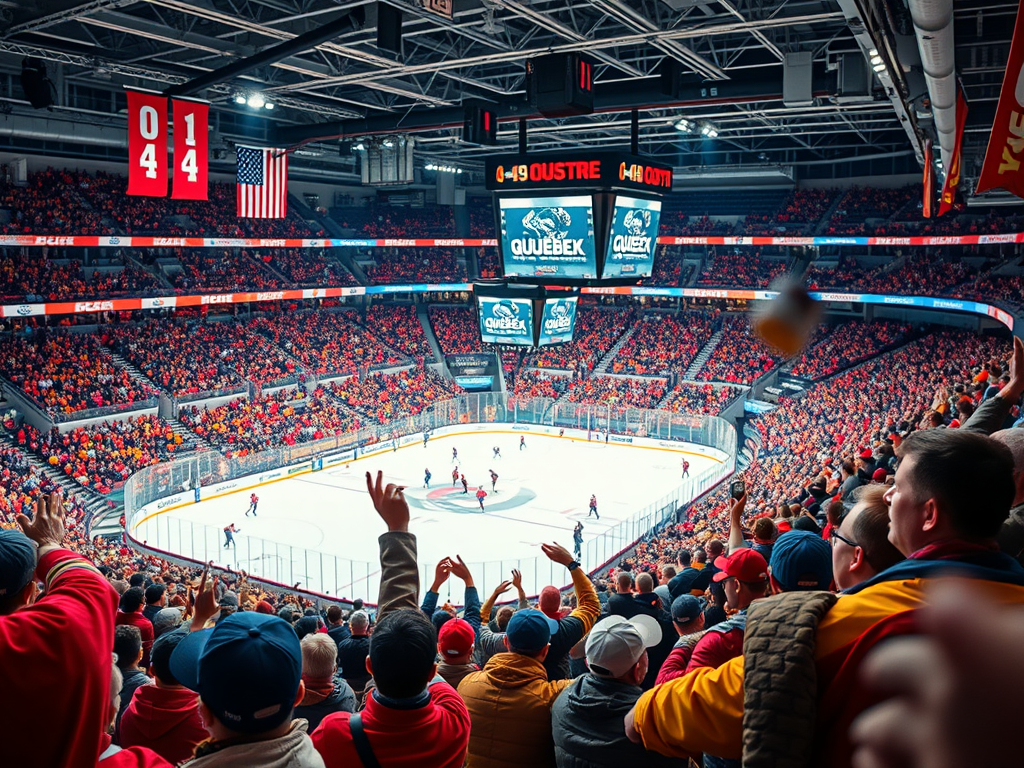
I. The Lingering Echo of the Nordiques: Why Quebec City’s NHL Dream Refuses to Die
The departure of the Quebec Nordiques in 1995 left an indelible mark on Quebec City. It created a wound that nearly three decades of passionate hope and calculated efforts have yet to fully heal. Understanding why that relocation happened is essential. It is imperative for comprehending the challenges and opportunities that lie ahead in any potential NHL return.
- A. The Heartbreak of 1995: Understanding the Nordiques’ Departure The Nordiques’ relocation to Colorado was not due to a single misstep. Various issues led to their move. They were reborn as the Avalanche. A confluence of debilitating factors was responsible. The Colisée Pepsi was aging and was a primary issue. Despite renovations, it no longer met modern NHL standards. It particularly lacked revenue-generating luxury suites. This infrastructure deficit was compounded by severe financial pressures. Quebec City was, and remains, one of the NHL’s smallest markets. In the pre-salary cap era, escalating player salaries, coupled with a struggling Canadian dollar, made financial viability a precarious proposition. Facing these mounting economic challenges, then-owner Marcel Aubut sought financial assistance from Quebec’s provincial government. Premier Jacques Parizeau’s government declined the bailout request. Subsidizing a hockey club paying multi-million dollar salaries proved unpopular with the public. This denial was the final blow. Aubut was forced to sell the team to COMSAT Entertainment Group. The franchise was promptly moved to Denver. The issues merged into a significant problem. An outdated facility and difficult economic conditions contributed to this. These included a small market, a weak Canadian currency, and no salary cap to control player costs. The lack of governmental appetite for a bailout worsened the situation. The pain of this departure was intense. It grew when the relocated Colorado Avalanche achieved immediate success. They won two Stanley Cups in their early years in Denver. This rapid success for the former Nordiques was a constant and painful reminder of what might have been. It fueled an enduring desire within Quebec City to reclaim its lost NHL glory.
- B. “La Fièvre du Hockey”: The Enduring Passion in La Vieille Capitale The Nordiques may have been lost. However, the passion for hockey in Quebec City remains strong. Residents are dedicated to the sport. “La Vieille Capitale” is, by all accounts, a city obsessed with hockey. This “fièvre du hockey” is vividly demonstrated by the fervent support. Fans show their passion through the Quebec Maritimes Junior Hockey League’s (QMJHL) Quebec Remparts. The team consistently draws impressive crowds. They even set QMJHL attendance records at the modern Videotron Centre. One game attracted 18,259 fans. The Remparts’ average attendance grew significantly. Their attendance rivals some NHL teams. It underscores the market’s deep-seated enthusiasm for high-level hockey. This passion leads to a consistent public demand for the NHL’s return. Various fan polls and surveys have echoed this sentiment over the years. For example, in 2017, NHL players participated in a survey. A significant majority, 21 out of 31 polled, favored Quebec City as the next destination for league expansion. Similarly, public opinion polls have indicated strong Canadian support for an NHL team to return to Quebec City. However, this undeniable passion, while a clear asset, might be viewed with a degree of caution by the NHL. The league’s strategic focus has been on cultivating new fans. Recent expansion efforts have concentrated on untapped or underserved markets. These efforts focus primarily on the United States. There is a debate among league circles about adding a team in Quebec City. It might not significantly grow the overall NHL fanbase. Instead, it could reallocate existing allegiances. This might impact nearby franchises like the Montreal Canadiens. This view is different. It contrasts with the objective of tapping into fresh demographics and media markets. This approach drives much of the NHL’s current expansion philosophy.
II. The Modern Colosseum: Videotron Centre – A Beacon of NHL Hope?
Quebec City took significant steps to address one of the critical failures that led to the Nordiques’ departure. It armed itself with a state-of-the-art arena, the Videotron Centre. This facility stands as a tangible symbol of the city’s NHL aspirations.
- A. Built for the Big Leagues: Arena Specifications and NHL Readiness The Videotron Centre opened its doors in September 2015. It was conceived and constructed with the explicit intention of housing an NHL franchise. The $370 million facility was publicly funded by the municipal and provincial governments, a significant investment demonstrating serious commitment. With a hockey seating capacity of 18,259, it aligns with modern NHL venue standards. Its design and amenities are comparable to established NHL arenas. Examples include PPG Paints Arena in Pittsburgh and Rogers Place in Edmonton. The facility includes a television studio and crucial luxury suites, the lack of which plagued the old Colisée. Architects from Populous are renowned for sports venue design. They described the Videotron Centre as “absolutely a hockey-first design.” The intention is to secure an NHL franchise in the near future. It features a steep seating bowl to bring fans “on top of the ice.” Building an NHL-ready arena before securing a team was a bold move. It was a proactive strategy. This approach has been described as a “Field of Dreams” gambit. It effectively removed a major historical impediment. However, this substantial public investment was made in anticipation of an NHL tenant. It also creates considerable pressure on political leaders. Business leaders find themselves under pressure to deliver on that vision. They need to ensure a return on the public’s financial commitment.
- B. Quebecor’s Home Ice: Operator and Naming Rights Holder. Quebecor Media is a subsidiary of the telecommunications and media giant Quebecor Inc. It plays a pivotal role in the Videotron Centre’s operations. The company operates the arena and also holds its lucrative naming rights. This relationship is further solidified by a clause in their management agreement. The value of this deal is structured to increase if an NHL franchise takes up residence in the Videotron Centre. This provides a direct and substantial financial benefit for Quebecor. It motivates them to actively pursue and secure an NHL team for the venue. Quebecor has an entrenched position as the arena operator. It is also the naming rights holder. They are a major media player through TVA Sports. This creates a uniquely integrated potential ownership structure. This deep integration could be perceived as a significant strength, offering synergies and a unified local front. Conversely, the NHL often prefers to see a broad and diversified base of local corporate support for its franchises. An over-reliance on a single entity, however powerful, might raise questions for the league. These questions concern the overall depth of the corporate market. Other concerns are potential risks if the entity’s strategic priorities were to shift or if their financial fortunes changed.
III. The Billion-Dollar Equation: Economic Viability in a Modern NHL
Beyond passion and infrastructure, the cold, hard numbers of economic viability are paramount in the NHL’s decision-making process. For Quebec City, this presents a complex equation.
- A. Market Size: Passionate but Petite Quebec City is a fervent hockey culture. However, it remains one of the NHL’s smallest potential markets. The metropolitan population is typically cited in the range of 800,000 to 850,000. It would likely be the league’s second-smallest market in Canada, ahead of only Winnipeg. This relatively small population base is a consistent point of concern for the league. Proponents counter this by highlighting the market’s exceptionally high hockey avidity, which some analyses suggest is comparable to established U.S. NHL markets like Buffalo or Washington D.C. in terms of dedicated fans. The aforementioned success of the QMJHL’s Remparts in drawing large crowds further supports this argument. NHL Commissioner Gary Bettman has raised concerns publicly. He questioned whether the economics of Quebec City make sense. He also questioned whether those of Eastern Quebec support an NHL franchise long-term. The return of the NHL to Winnipeg was successful. This success shows that a smaller Canadian market can support a team. This is true under the right conditions. These conditions include a salary cap and revenue sharing, which were absent during the Nordiques’ original tenure. However, the NHL’s broader strategic direction appears to favor larger, often untapped, U.S. markets. Cities like Houston and Atlanta have significantly larger populations and corporate bases. They represent greater potential for television revenue growth. They also offer expansive corporate partnerships. This aligns more closely with the league’s current expansion philosophy. Quebec City is, in many ways, swimming against this prevailing strategic current.
- B. The Corporate Coffers: Securing Sponsorship and Suites Securing sponsorship and suites is critical for the NHL. The depth and sustainability of corporate support within a market are important factors. This extends beyond ticket sales to include long-term commitments for luxury suites, arena advertising, and team sponsorships. Quebec City has a diversified economy. Additionally, it has a notable spectator sports market valued at over $953 million for the province. However, this value is spread across all sports and regions. The concentration of large corporate headquarters within Quebec City itself is less significant than in major U.S. metropolitan areas currently under NHL consideration. For instance, Houston is home to 26 Fortune 500 companies, and the Atlanta metro area hosts 27 Fortune 1000 headquarters. Lists of companies based in Quebec City and the broader province of Quebec show a range of businesses. However, it is crucial to consider the scale of major national and international corporations with substantial marketing budgets headquartered locally. Economists have noted that Quebec City’s per-capita income has grown. It can likely support robust ticket sales. However, securing corporate sponsorships will require a more concerted effort. Filling luxury suites will also need a more challenging effort compared to larger, more corporate-dense markets. The NHL typically looks for a broad base of corporate support, not reliance on a single “anchor tenant.” Beyond Quebecor, it is crucial to assess the visibility of other major corporate players in Quebec City. These players must be prepared to make multi-million dollar, multi-year commitments to an NHL team. This assessment is important for the league’s evaluation of long-term financial stability.
- C. The Loonie’s Lament: The Ever-Present Canadian Dollar Challenge. The fluctuating value of the Canadian dollar (CAD) relative to the U.S. dollar (USD) is an enduring challenge for all Canadian NHL franchises. Player salaries are paid in USD, and a significant portion of league-wide revenues (like U.S. national broadcast deals) are also USD-denominated. Canadian teams, however, earn a substantial part of their local revenues in CAD. Consequently, a weaker Canadian dollar inflates operational costs, particularly player payroll, for these teams. This currency dynamic contributed to the Nordiques’ financial struggles in 1995. It remains a significant concern for the NHL. This is especially true when evaluating smaller Canadian markets. Recent international trade tensions and general economic uncertainty can heighten these concerns. This is highlighted by discussions around potential tariffs and their impact on the Canadian economy. By extension, these issues can affect its sports franchises. Anonymous NHL players have even voiced concerns about expanding to another Canadian market specifically because of the Canadian dollar’s status. The value of the Canadian dollar is an external economic variable. It is largely outside the direct control of a potential Quebec City franchise. It is also beyond the control of the NHL itself. This inherent volatility introduces an additional layer of financial risk for any Canadian bid. For a market already perceived as small, a strong underlying local revenue model is essential. Ownership must also be robust enough to absorb potential currency-related losses. This will assure the league of long-term stability. To understand Quebec City’s bid, the table below provides a comparison. It compares Quebec City with other recent or potential NHL expansion and relocation markets.
Table 1: Comparative Snapshot: Quebec City vs. Select NHL Expansion/Relocation Markets
| Feature | Quebec City | Las Vegas (Expansion) | Seattle (Expansion) | Utah (Relocation from AZ) | Houston (Potential) | Atlanta (Potential) |
|---|---|---|---|---|---|---|
| Metro Population (approx.) | 0.8-0.85 million | ~2.3 million | ~4.0 million | ~1.2 million (Salt Lake City) | ~7.5 million | ~6.3 million |
| Corporate Presence (Fortune 500/1000 HQs in Metro) | Limited large HQs | 7 (Fortune 1000) | 15 (Fortune 1000) | 2 (Fortune 1000) | 26 (Fortune 500) | 16 (Fortune 500), 27 (F1000) |
| Arena Status (at time of bid/move) | NHL-ready (Videotron Centre, built 2015) | New arena built (T-Mobile Arena) | Major renovation (Climate Pledge Arena) | Existing NBA arena (Delta Center) | Existing NBA arena (Toyota Center) | Proposed new arena |
| Expansion/Relocation Year | N/A | 2017 | 2021 | 2024 | N/A | N/A |
| Expansion Fee Paid | Bid $500M in 2015 | $500 million | $650 million | N/A (Relocation) | Est. $1B+ | Est. $1B+ |
IV. Courting the League: The NHL’s Gauntlet for Quebec City
Successfully navigating the NHL’s expansion or relocation process is a formidable undertaking. It demands immense financial resources. There must also be strategic alignment with league priorities. Additionally, a measure of patience is required.
- A. The Price of Admission: The Skyrocketing Expansion Fee The cost of entry into the NHL has escalated dramatically. In 2000, when the Columbus Blue Jackets and Minnesota Wild joined the league, the expansion fee was $80 million. By 2017, when the Vegas Golden Knights were admitted, this fee had soared to $500 million. The Seattle Kraken paid an even steeper price of $650 million to join in 2021. More recently, there is speculation about potential future expansion. It suggests that the entry fee could reach $1 billion. Some NHL executives even cite figures as high as $2 billion. Quebecor’s 2015 bid was based on a $500 million fee. However, any new attempt would face a significantly higher financial threshold. An NHL executive explained that a group must pay a $2 billion expansion fee. This is required for a team to return to Quebec City. Until then, it is a “non-starter.” This escalating fee serves multiple purposes for the NHL. It is a substantial revenue windfall for the existing team owners, who share the proceeds. It also acts as a significant barrier to entry, filtering out less serious or undercapitalized bidders. Furthermore, the high fee underscores the perceived and increasing value of an NHL franchise. For Quebec City, any prospective ownership group must have exceptionally deep financial reserves. These reserves must far exceed what was required in their previous bid. This financial reality inherently narrows the field of potential candidates.
- B. Bettman’s Playbook: League Priorities and Expansion Philosophy NHL Commissioner Gary Bettman has consistently articulated a vision for league growth. His plan prioritizes expansion into the United States. The focus is on large, and sometimes non-traditional, hockey markets. While he has acknowledged Quebec City’s passionate fanbase and its NHL-ready arena, he has raised concerns. He is worried about the market’s long-term economic sustainability. He also notes its relatively small size. The league generally favors stable, private ownership groups. It is cautious about markets that rely heavily on government subsidies. Additionally, it is wary of markets facing significant economic headwinds, such as the volatility of the Canadian dollar. Relocation of struggling franchises is an option. However, it is often viewed as a measure of last resort. Strategic expansion into new territories is preferred for growth. Commissioner Bettman’s public statements regarding Quebec City are typically carefully calibrated. He rarely closes the door entirely. He consistently emphasizes U.S. markets. The economic hurdles for Quebec suggest that the city is not currently a priority target for proactive expansion. For Quebec City to gain serious consideration, it needs to present a strong economic case. This case must align with the NHL’s interests. Alternatively, Quebec could become the most viable option if a relocation opportunity arises. Quebec City’s 2015 bid was “deferred,” and Las Vegas was accepted. This happened despite Quebec having a strong application. This indicates that it did not fit the league’s strategic template at that time.
- C. The Balancing Act: Conference Alignment and Geographical Realities The NHL aims to maintain a balance. It seeks to balance the number of teams within its Eastern and Western Conferences. This is important for competitive fairness and logistical efficiency. Adding a new team in Quebec City, located in the Eastern Time Zone, could worsen any existing imbalance. This issue is particularly relevant if the league has 32 or 34 teams. It is mainly considering additions in the Western or Central time zones. The addition of the Vegas Golden Knights (Pacific Division) helped to balance the conferences. The Seattle Kraken (Pacific Division) further solidified this balance. Future expansion efforts might focus on candidates in Western or Central time zones. This would be the case if the league wants to add only one or two teams. The league had noted this concern when it deferred Quebec City’s 2015 bid. It cited “geographical imbalance” as one of the factors. Discussions about potentially expanding to 35 or 36 teams often occur. These discussions focus on guaranteeing an even number of teams in each conference. Ensuring an even number of teams within each division also plays a crucial role. Conference alignment, therefore, is not merely a logistical puzzle. It can function as a significant hurdle for expansion candidates. This hurdle is often understated. Unless the NHL considers a larger, multi-team expansion that requires broader realignment, Quebec City’s eastern location could be a disadvantage. This happens if the league’s immediate priority is adding teams further west. This makes Quebec’s path dependent on its own merits. It also depends on the NHL’s broader structural needs. The league’s strategic objectives at any given time are also influential.
V. The Power Players: Who Could Wield the Nordiques Banner?
The question of who would own a potential Quebec City NHL franchise is central to its prospects. One name consistently dominates this conversation.
- A. Primary Contender: Quebecor and Pierre Karl Péladeau Quebecor Inc. is a Montreal-based telecommunications and media conglomerate. Its President and CEO is Pierre Karl Péladeau. They are the most prominent figures in Quebec City’s NHL aspirations.
- The 2015 Bid Revisited: In July 2015, Quebecor formally submitted an expansion application to the NHL. Pierre Dion was the CEO leading the company at that time. Péladeau provided strong backing for this move. They signaled their intent to bring the Nordiques back. This bid was accompanied by a required $10 million down payment, of which $2 million was non-refundable. The proposed expansion fee at the time was $500 million. Las Vegas heavily publicized its successful season ticket drive. It secured over 13,200 deposits. Quebec City also conducted a season ticket pledge campaign as part of a “model submission.” The NHL “deferred” Quebec City’s bid due to concerns about market size. They were also worried about the Canadian dollar’s volatility and conference imbalance. Meanwhile, a franchise was awarded to Las Vegas.
- Financial Muscle and Media Synergies: Quebecor is a formidable corporate entity with significant financial resources. In 2024, the company reported annual revenue of $5.64 billion CAD. For the fiscal year ending December 31, 2022, its net income was $596.7 million CAD. A key asset in its portfolio is TVA Sports, which holds the NHL’s French-language national broadcast rights in Canada. This ownership presents obvious synergies for an NHL team in Quebec City, potentially integrating broadcast, promotion, and team operations. However, this relationship also introduces complexities. Péladeau himself has recently voiced concerns about the escalating costs of NHL broadcast rights. He questions the financial sustainability of TVA Sports in competing for these rights in the future. This concern arises given the league’s new multi-billion dollar agreement with Rogers Communications. It will necessitate a new sublicensing deal for French-language rights post-2026.
- Péladeau: The Passionate, Political Figurehead: Pierre Karl Péladeau has a long-standing passion for returning NHL hockey to Quebec City. He has publicly stated this passion many times. His commitment is widely acknowledged. However, his past role as leader of the Parti Québécois is significant in the NHL context. This political party advocates for Quebec sovereignty. It is frequently discussed. The NHL values stability as a business. It is inherently wary of political movements that could lead to economic uncertainty. These include impacts on the Canadian dollar or cross-border business relations. Some political commentators and analysts think Péladeau’s sovereignist past directly impacts Quebec City’s NHL chances. They suggest that NHL owners, particularly those in the U.S., might be hesitant. Péladeau and his supporters argue that his business acumen and dedication to hockey should be the primary considerations. Former Quebec City Mayor Régis Labeaume once commented that “Mr. Bettman is a businessman. The Quebec sovereignty project will not bother him”. Péladeau recently acquired the Montreal Alouettes of the Canadian Football League. Some observers view his successful operation of the team as a savvy strategic move. It demonstrates his capabilities as a successful sports franchise owner. This move might cultivate a more favorable image for him within professional sports league circles. Péladeau represents a central paradox for Quebec City’s NHL aspirations. His financial capacity through Quebecor and his undeniable passion are tremendous assets. Yet, his political history casts a long shadow. The traditionally risk-averse NHL Board of Governors may find this unsettling. The league prioritizes stability. Any association with movements perceived as potentially disruptive could concern owners. These owners must approve any expansion or relocation. Thus, Péladeau’s involvement is both a powerful engine for the bid and a potential source of apprehension for the league.
- B. Exploring Alternative Ownership Horizons Quebecor and Péladeau are the most visible and seemingly most viable candidates. Still, the possibility of other ownership consortiums or private investors cannot be entirely dismissed. However, no other prominent groups have publicly emerged with concrete NHL ambitions for Quebec City. The province of Quebec is home to various private equity and investment firms. Montreal, in particular, has firms such as Invico Capital Corporation and W Investments. However, these firms are generally diversified. They have not publicly expressed specific interest. They have not demonstrated the capacity to lead a multi-billion dollar NHL franchise acquisition and operation. Their existence points to available capital within the region. However, an NHL team demands more than just general financial acumen. It is a highly specialized and uniquely high-profile investment. Community ownership models are unlikely to gain traction with the NHL. This is unlike the NFL’s Green Bay Packers or some European sports clubs. The league’s structure and bylaws favor clear, singular points of ownership accountability and deep private capital reserves. An early analysis suggested the NHL would likely oppose the integration of a cooperatively owned franchise. There are no publicly visible, credible alternative ownership groups having the requisite immense capital. No one shows NHL-specific interest. This situation effectively makes Quebecor the primary, if not sole, serious contender for any near-term Quebec City NHL bid. This situation gives Quebecor significant leverage in local discussions. However, it also concentrates the risk. It ties the city’s fortunes heavily to one organization and its leadership. The following table provides a profile of Quebecor as the primary potential ownership group.
Table 2: Profile of Primary Potential Ownership: Quebecor
| Aspect | Details |
|---|---|
| Leader(s) | Pierre Karl Péladeau (President & CEO, Quebecor Inc.) |
| Key Entity | Quebecor Inc. |
| Estimated Financial Capacity/Revenue | 2024 Annual Revenue: $5.64B CAD. 2022 Net Income: $596.7M CAD. |
| Past NHL Bid Experience | Submitted formal $500M expansion bid in 2015; bid was “deferred” by NHL. |
| Arena Control | Quebecor Media operates and holds naming rights for Videotron Centre. Management deal value increases with NHL tenant. |
| Media Assets | Owns TVA Sports, NHL’s French-language national broadcaster in Canada. |
| Perceived Strengths | Deep local roots, significant financial backing, established media synergies, control of NHL-ready arena, Péladeau’s strong personal commitment. |
| Perceived Challenges/Risks | Péladeau’s past political affiliations are with the sovereigntist movement. This creates potential NHL owner apprehension. There is an over-reliance on a single major corporate entity. Potential financial pressures on TVA Sports could affect overall strategy. |
VI. The X-Factors: Igniting Public Passion and Securing Political Will
Beyond the boardroom and balance sheets, public enthusiasm plays a significant role in the narrative of any NHL bid. Political determination also significantly influences this narrative.
- A. The Voice of the People: Public Support and Enthusiasm The depth of public support for an NHL team’s return to Quebec City is undeniable. People in Quebec City are eager to see an NHL team return. Their enthusiasm is evident everywhere. It has been a consistent feature of the post-1995 landscape. This passion is not just anecdotal. A 2017 survey conducted by USA Today Sports among 31 high-profile NHL players found that 21 (67.7%) chose Quebec City as the venue the league should next embrace for expansion. Broader public opinion also reflects this desire. Angus Reid Public Opinion conducted a poll. It showed that 57% of all Canadians supported having an NHL team in Quebec City. Canadians across different demographics shared this belief. Angus Reid Public Opinion conducted a poll. It showed that 57% of all Canadians supported having an NHL team in Quebec City. Canadians across different demographics shared this belief. An even higher 75% of self-described hockey fans supported this idea. However, the same poll showed Canadians’ opposition to using federal funds to move an NHL team to a Canadian city. This passionate support is a significant asset. It creates a vibrant potential fanbase and a compelling atmosphere. However, it must translate into tangible financial commitments. These commitments must meet the NHL’s stringent criteria. Passionate fans fill seats and buy merchandise. However, the league primarily evaluates the potential of a robust ownership group. This group must afford the massive expansion fee. It must sustain long-term operations, backed by substantial corporate support. Public enthusiasm is a necessary foundation. However, on its own, it is not enough to secure an NHL franchise in the modern, multi-billion dollar sports landscape.
- B. The Provincial Push: Quebec Government’s Role and Incentives The Government of Quebec has shown strong support for bringing an NHL team back to the provincial capital. The government has taken notable actions. This push has been particularly evident under the leadership of Premier François Legault. The premier has been active and vocal in advocating for this cause. This support has not been limited to rhetoric; it has manifested in concrete financial commitments. Most notably, the provincial government was a key partner in funding the $370 million Videotron Centre. More recently, in 2023, Legault’s government announced a subsidy of between $5 million and $7 million. This subsidy aims to bring the Los Angeles Kings to Quebec City. They plan to host two NHL pre-season games in October 2024. Premier Legault explicitly stated that this investment was meant to showcase the city. It was intended to highlight its “world-class arena” and enthusiastic fanbase to the NHL. He expressed hope that Commissioner Bettman would attend. Legault also believed it would advance the cause of the Nordiques’ return. The reasoning was that “the people of Quebec City would like to have a hockey team.” Additionally, these events are seen as an investment in leisure and regional promotion. However, the use of public funds for pre-season games has faced considerable criticism. Opposition parties and some segments of the public argue it is an inappropriate allocation of taxpayer money. They highlight concerns, especially during times of economic pressure and ongoing negotiations with public sector unions. The government was instrumental in building the arena. Now, backing is being used to attract NHL attention. However, the league itself generally prefers franchises that are financially self-sustaining through private enterprise. Some within the NHL might view overt and continuous government subsidies as a potential indicator of underlying market weakness. They may also perceive it as a risk of future political interference. This presents a delicate balance for Quebec: leveraging governmental support to demonstrate commitment without creating a perception of dependency.
- C. The City’s Commitment: Municipal Backing The City of Quebec has also played a crucial role. This is primarily through its partnership in co-funding the Videotron Centre. The arena is jointly owned by Quebecor and the Quebec City Council. Current Quebec City Mayor Bruno Marchand has also articulated support for attracting major sporting events to the city. He mentions events such as the Canada Games. He cites the significant economic benefits. There is also tourism impact and opportunities for local athlete development. These statements aren’t directly focused on an NHL franchise. They do show that the municipality is willing to invest in sports infrastructure and high-profile events. The city’s financial contribution to the arena was a foundational step. Ongoing municipal support for sports and major events creates a positive environment. However, acquiring and operating an NHL franchise involves potential billion-dollar expansion fees. It also requires substantial annual operating budgets. This far exceeds typical municipal sports investments. The municipality provides the local environment, essential services, and some infrastructural support. The provincial government handles the primary financial and strategic heavy lifting in any NHL bid. Most critically, this involves the private ownership group.
VII. Charting the Course: Overcoming Hurdles on the Road to the NHL
The path to regaining an NHL franchise is laden with significant obstacles. Acknowledging these challenges is the first step in devising strategies to overcome them.
- A. Key Challenges Revisited: We acknowledge the obstacles. Several recurring themes highlight the hurdles Quebec City faces:These challenges are not isolated. They are often interconnected and can compound one another. For instance, a smaller market size makes it inherently more difficult to absorb the financial impact of Canadian dollar fluctuations. It also makes the prospect of a billion-dollar expansion fee even more daunting. Similarly, any perceived political risks associated with the primary ownership candidate might further incline the NHL towards its U.S.-centric expansion strategy. Addressing one issue effectively often requires a holistic approach that considers its impact on others.
- B. Strategic Imperatives: What Must Be Done? To navigate these obstacles, a multi-faceted strategy is essential. Quebec City cannot simply rely on its historical hockey legacy or passionate fanbase. It needs to construct a “Quebec City Plus” narrative. This involves presenting itself as “Quebec City, the passionate hockey market.” It also includes an innovative and resilient financial model. Additionally, it features a uniquely broad and committed corporate coalition. Moreover, it proposes a convincing strategy that de-risks the Canadian dollar issue for the league. The bid must offer compelling advantages. These advantages must actively offset its inherent challenges. These include its smaller market size and currency exposure. The following scorecard offers a summary of Quebec City’s current standing against key criteria for an NHL franchise: Table 3: Quebec City NHL Bid Scorecard
| Criteria | Status/Assessment for Quebec City |
|---|---|
| NHL-Caliber Arena | Achieved. Videotron Centre is modern and meets NHL standards. |
| Committed Ownership Group (Financial Capacity & NHL Approval) | Strong Prospect with Caveats. Quebecor/Péladeau have financial capacity and desire , but NHL approval hinges on overcoming fee and political perceptions. |
| Demonstrable Market Viability (Corporate Support, Fan Base) | Mixed. Passionate fanbase is a plus. Corporate support depth beyond Quebecor is a key NHL concern. Smallest/second-smallest market. |
| Favorable Economic Conditions (CAD Stability/Mitigation Plan) | Significant Hurdle. Canadian dollar volatility is an ongoing risk. A specific mitigation plan needs to be convincing. |
| NHL Strategic Fit (Conference, Growth Priorities) | Challenging. Eastern location can create imbalance. NHL currently prioritizes larger U.S. markets for growth. |
| Strong Provincial/Municipal Support | Achieved/Strong. Both levels of government have provided significant financial support for arena and events. |
VIII. Conclusion: The Nordiques’ Next Chapter – Dream or Destiny?
The dream of the Nordiques’ return to Quebec City is strong. It is sustained by a rich hockey heritage and an unwavering local passion. However, the path back to the National Hockey League is fraught with substantial economic challenges. Strategic and political challenges also exist. These challenges demand a realistic and multifaceted approach.
- A. A Realistic Appraisal of Quebec City’s NHL Chances Quebec City possesses significant assets in its quest. It has a devoted fanbase that consistently supports hockey at high levels. There is a modern, NHL-ready arena in the Videotron Centre. The city also boasts a committed potential local ownership group in Quebecor, led by the financially capable Pierre Karl Péladeau. These are crucial building blocks. However, the hurdles are formidable. The NHL’s expansion fee has reached astronomical levels. It is potentially $1 billion to $2 billion. This figure tests the limits of even well-capitalized bidders. Concerns about Quebec City’s relatively small market size remain central to the NHL’s calculus. There are also questions about the capacity of its corporate base to provide sustained, broad support. The inherent volatility of the Canadian dollar adds another layer of financial risk. Furthermore, the NHL’s prevailing expansion strategy continues to focus on penetrating and growing the game in large U.S. markets, making Quebec City an outlier in current league priorities. The conservative NHL Board of Governors will likely scrutinize the political history associated with the primary ownership candidate. Some may overstate its significance, but it is nonetheless a factor to consider. Given these realities, securing an NHL team via expansion is exceedingly difficult for Quebec City. This is true in the current landscape. Another possible route is the relocation of an existing Eastern Conference franchise. This path is still challenging. It would only be feasible should such an opportunity arise. Even then, Quebec City would likely face competition from other aspiring markets.
- B. The Final Puck Drop: What It Will Ultimately Take For the Nordiques’ fleur-de-lis to once again grace NHL ice in Quebec City, several factors need to align. The team needs an ownership group with significant wealth to emerge. This group must meet the league’s financial demands and gain the NHL Board of Governors’ approval. Addressing concerns about stability, market economics, or political optics is crucial. These factors must confluence in a precise and possibly fortuitous way. An ownership group with the immense wealth required to meet the league’s financial demands must emerge. It should also solidify its position. This group must gain the unequivocal approval of the NHL’s Board of Governors. They need to address any lingering concerns about stability, market economics, or political optics. The broader economic climate will play a role. The Canadian dollar’s strength and stability are significant factors. A truly compelling bid would need to present robust strategies to mitigate these external financial risks. Most importantly, there must be a strategic opening within the NHL’s plans. This could be a shift in its expansion philosophy, prioritizing passionate but smaller Canadian markets. Alternatively, there must be a suitable relocation candidate available to make Quebec City the most attractive option. The city’s unwavering desire and its supporters’ dedication are constants. This desire is proof of Quebec’s deep connection to hockey. However, the NHL operates on the pragmatic realities of business. Bridging the gap between heartfelt aspiration and the league’s stringent financial and strategic requirements is the ultimate challenge. Regaining an NHL team for Quebec City is a marathon. It demands sustained effort and significant long-term financial commitment. Astute strategic patience is required, along with favorable timing and circumstance. The journey has been long. The path ahead remains steep. Yet, for a city that lives and breathes hockey, the dream of the Nordiques’ return remains a powerful, driving force.

 ScortonBoy17.ca
Leave a comment