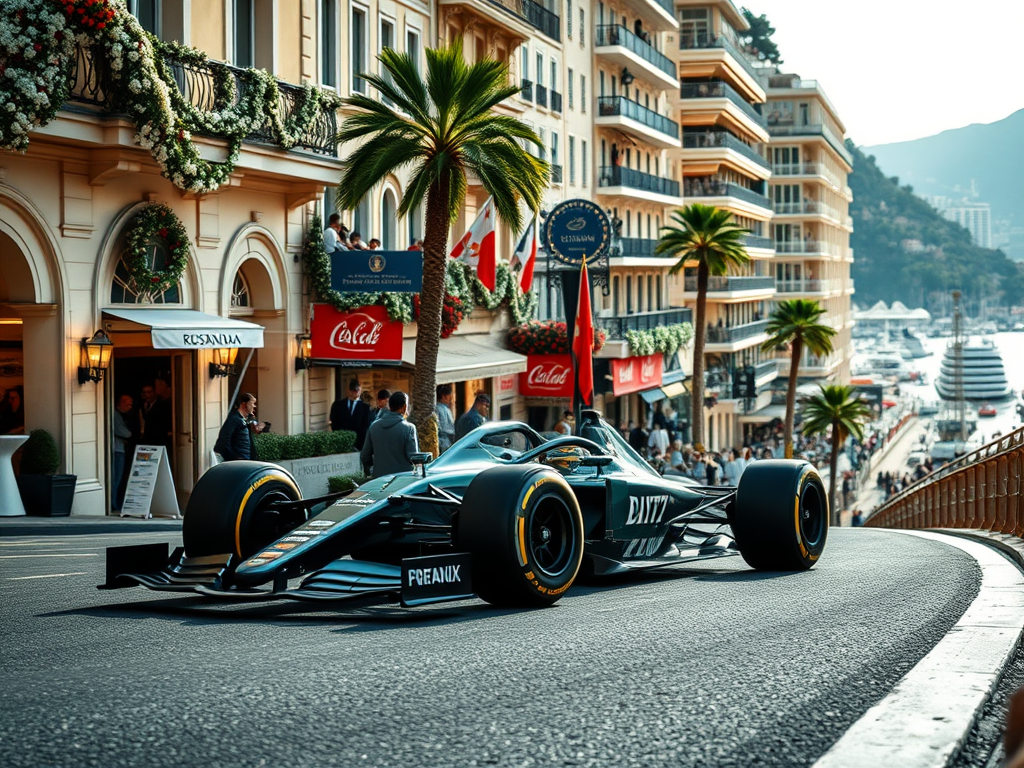
The Gilded Cage: Monaco’s Promise and Peril
The Monaco Grand Prix, often lauded as the “jewel in F1’s crown” , has long captivated audiences. Its appeal lies in its unparalleled blend of glamour, history, and high-stakes drama. The glittering harbour draws admiration. The proximity of the barriers adds a thrilling challenge. The audacity is unparalleled. Drivers thread a modern Formula 1 car through narrow, unforgiving streets. It creates an unmatched aura on the calendar. Yet, this circuit presents a persistent paradox. It is iconic, yet notoriously difficult for overtaking. As a result, the race itself frequently descends into a high-speed procession. For years, the Saturday qualifying session has been seen as the highlight. The Sunday race is largely determined by starting grid positions. This ongoing challenge is how to make the race at Monaco as compelling as its illustrious image. It has led Formula 1 and its governing body, the FIA, to make numerous attempts to inject more on-track excitement.
Entering the 2025 season, a new regulatory gambit was introduced specifically for the Monaco event. It was a mandatory two-stop race. This was achieved by requiring each driver to use three different sets of tires. This marked a major change from the usual strategic approach at Monte Carlo. The goal was to disrupt the existing order. It aimed to create more dynamic racing scenarios. The intention, as stated, was “improving the sporting spectacle” , a clear admission of the long-standing issues. However, the recurring nature of these attempts to “fix” Monaco with rule changes points to a deeper, perhaps irreconcilable, conflict. The historic layout of the Principality’s streets is fundamentally at odds with the characteristics of modern Formula 1 cars. It also clashes with contemporary racing ideals. The 2024 Monaco Grand Prix saw an early red flag. This effectively allowed many drivers to complete the race without a live pit stop. This led to a particularly stagnant affair. It likely served as a direct catalyst for this bolder 2025 intervention. This suggests the 2025 rule was less a holistic solution. It was more a reaction to a specific, recent problem. This pattern often overlooks broader consequences.
This analysis will argue that the 2025 Monaco Grand Prix regulations did not deliver the desired improvements in racing spectacle. Instead, they actively exacerbated existing problems. The rules introduced new, detrimental forms of gamesmanship, ultimately proving to be a significant misstep. Trying repeatedly to “manufacture” excitement at Monaco through such specific rules could undermine the sport’s perceived authenticity. This is especially concerning at its most iconic venue. Constantly tweaking rules for one event can lead to the perception that results are less about pure sporting merit. They may appear more about rule-induced variables. This could potentially damage the long-term integrity of the Monaco Grand Prix. The event might be viewed more as an artificial show than a genuine sporting contest.
The Two-Stop Gambit: What Were The Rules and What Did They Hope to Achieve?
The regulatory framework for the 2025 Monaco Grand Prix centered on a key change to tire usage. Pirelli and the FIA mandated each driver to use at least three different sets of slick tires during the race. During these stints, drivers had to utilize at least two different slick tire compounds. In a dry race without red-flag interruptions, no “free” tire change was possible. This requirement effectively translated into a mandatory two-pit-stop strategy for every competitor. The available tire compounds for the weekend included Pirelli’s softest trio. The new C6 served as the soft tire. The C5 was designated as the medium tire. The C4 was used as the hard tire. This specific mandate responded directly to events like the 2024 race. In that race, an early red flag allowed many to bypass in-race pit stops altogether.
The stated objectives behind this rule change were clear. The aim was to diversify race strategies and inject an element of “extra jeopardy.” This would prevent the all-too-common Monaco procession. It is often characterized by a single pit stop or, in unusual circumstances, none at all. The FIA explicitly stated the aim was “diversifying race strategies.” The primary intent was improving the sporting spectacle of this Race given the notable difficulty in overtaking. The hope was that forcing multiple stops would create more variables. Different pit stop timings could lead to cars on different tire strategies interacting on track. This interaction may potentially create battles during pit stop phases. Additionally, cars running in clean air on fresher tires could make inroads. The regulation was seen as a way to add “strategic intrigue.” It aimed to avoid a repeat of the 2024 scenario. That year, the race became static after early tire changes under a red flag.
However, the rule’s conception seems to have been a direct reaction to the 2024 Monaco GP’s specific circumstances. It was almost like a targeted response. This was not a comprehensive solution to the circuit’s deep-seated racing challenges. This reactive approach often risks overlooking potential unintended consequences. By mandating a specific number of stops, the FIA inadvertently shifted the strategic calculus. Traditionally, Monaco strategy involved a critical decision. Teams had to decide whether to make a single optimal stop. Alternatively, they could gamble on a safety car or red flag. Forcing two stops removed much of this “will they/won’t they” intrigue. On a circuit where track position is sacrosanct, overtaking is nearly impossible. Losing track position for a second mandatory stop becomes an enormous penalty. Consequently, teams were naturally incentivized to find ways to minimize the impact of these forced stops. This made teams focus on “how to game the system.” They focused on this rather than on pure race pace. They also moved away from traditional strategic gambles. This fundamentally altered the nature of strategic thinking. It changed it in a way that did not necessarily foster better racing. The “strategic intrigue” quickly devolved into a contest of manipulating the mandatory stops.
A Procession with Extra Pitstops: The Unfolding of the 2025 Monaco GP
The 2025 Monaco Grand Prix saw Lando Norris deliver a commanding performance for McLaren. He converted his pole position into a cherished victory. He managed the race adeptly from the front. He held off a persistent Charles Leclerc in the Ferrari. Norris’s teammate Oscar Piastri secured the final podium spot. Max Verstappen, the reigning champion, brought his Red Bull home in fourth. Norris’s win, his first in the Principality and McLaren’s first there since 2008, was undoubtedly a popular result. Yet, despite the victor’s joy, a crucial question remained. Did the race itself, under the much-vaunted new regulations, deliver the promised spectacle? Did it live up to the intentions of its architects?
The statistics paint a stark and familiar picture of Monaco’s on-track action, or lack thereof. The new regulations, designed to spice up the racing, demonstrably failed to do so. Across the 78 laps of the Grand Prix, there was reportedly only one legitimate on-track overtake. Lance Stroll managed to pass Nico Hulkenberg for 15th place on the very final lap. This solitary pass underscores the futility of the rule change in addressing the core issue. This fact is further reinforced because the top four drivers on the starting grid finished in the same order. The field was also significantly strung out. Only five cars finished on the lead lap. Only two cars, Leclerc and Piastri, stayed within 20 seconds of the race winner, Norris. This was by the time the chequered flag was waved. These figures are damning evidence of the regulations’ inability to generate closer racing or more on-track battles.
The overall character of the race was, depressingly, another Monaco procession. There were more pit stops than usual due to the new mandate. However, these stops did little to alter the competitive order significantly at the sharp end of the field. They also failed to create genuine, sustained overtaking opportunities. The “excitement,” such as it was, seemed largely confined to the timing screens. It was more about strategy boards and commentary box discussions about pit windows than thrilling on-track duels. As one report noted, the rule had “little overall impact on the results.” It affected only a few cases of teams seemingly slowing down one car to benefit a teammate. Someone remarked bluntly. “The most exciting aspect of Sunday’s F1 Monaco Grand Prix was counting each team’s pit stops.” More pit stops did occur compared to a typical Monaco race. Yet, this increase did not make it the “must-see event” that was hoped for. The regulations, by forcing pit stops without addressing the fundamental overtaking problem, merely added a layer of logistical complexity. The “action” was effectively displaced from the track, where true racing happens, to the pit lane and the strategists’ computers. The TV graphic that mattered most during the race showed the mandatory stop information. This was a clear indicator of where the limited intrigue lay. The failure to change the processional nature of the race is clear. Fans may understandably become more cynical after the new rules were hyped before the race. If such “fixes” consistently fail to deliver, it prompts more radical solutions for Monaco. There are even calls questioning its place on the calendar. Some question whether the event can offer a compelling race beyond its historical charm.
The Unintended Spectacle: Gamesmanship, “Mario Kart” Tactics, and an “Ugly Race”
The 2025 Monaco Grand Prix regulations faced strong criticism. They failed to promote exciting racing. Instead, they actively fostered a spectacle of deliberate gamesmanship and race manipulation. This goes against Formula 1’s claim as the pinnacle of motorsport. The primary negative consequence was a “slow-down farce.” Teams instructed one of their drivers to drastically reduce their pace. This was sometimes by as much as four to six seconds a lap. Teams used this tactic to create an artificial pit stop window for their leading teammate. It allowed that driver to make their mandatory stop. The driver could then re-join the track without losing position to rivals, or even to the slowing sister car. Teams like Racing Bulls and Williams cynically exploited the rules. Liam Lawson appeared to back up the pack to aid Isack Hadjar. Williams employed similar tactics with Alex Albon and Carlos Sainz. Sainz himself indicated that Lawson (Racing Bulls) initiated this strategy, prompting a reactive approach from Williams. Crucially, because the regulations mandated two stops, these “go-slow” tactics were used twice by some teams during the race. This doubled down on the negative spectacle. Williams team boss James Vowles tellingly commented during the race. He said, “This isn’t how I like to go racing.” However, he acknowledged it’s what the rules have created.
Max Verstappen’s approach with his Red Bull was a strategic move. It was born from the peculiarities of the rules and the track. He deliberately stayed out longer on his penultimate tire set. He delayed his second mandatory pit stop until the very last lap of the race. The rationale behind this unusual strategy was a gamble on a late-race red flag or safety car. Such an event could have allowed a “free” tire change under neutral conditions. This might have vaulted him into a winning position. At the very least, it could have significantly improved his outcome with fresh tires for a restart. Although this gamble did not work out, it demonstrated the influence of the mandatory stops. They led teams towards speculative strategies. Monaco’s unique propensity for incidents contributed to this. During this period, Verstappen led on track due to his delayed stop. This also backed up the true race leaders, Norris and Leclerc, at times. It further influenced the race dynamic. As Norris later commented, “Now opportunities arise by luck. You wait for a red flag. You wait for a safety car.”
The verdict from the cockpit was scathing. Drivers used strong language to convey their disgust and frustration. They were upset with the on-track reality created by the regulations. Carlos Sainz described the race as “manipulated.” He stated that the new rule “backfired.” He lamented, “It’s not the way I like to race.” His Williams teammate, Alex Albon, shared these feelings. He called it an “ugly race” and admitted they “put on a bad show for everyone.” Albon even apologized to the fans. Max Verstappen, known for his bluntness, compared the situation to “Mario Kart.” This was a harsh critique for a sport that values elite skill and competition. George Russell was equally critical. He highlighted the absurdity of the situation. He suggested one “can put an F2 car out there.” They’ve got a chance of holding up an F1 car. This was due to the ease of driving significantly off the pace. These raw, unfiltered reactions from the sport’s primary participants underscore the profoundly negative impact of the regulations. The rules inadvertently created a scenario. Not racing – driving deliberately slowly – became a viable strategy. In some instances, it was even an optimal strategy. This represents a perversion of motorsport’s core tenets, where speed and competition should be paramount. The widespread use of such “manipulative” tactics, coupled with drivers’ open apologies, significantly damages Formula 1’s image. It suggests a system where rules can be poorly designed for a specific context. As a result, they compel participants into unsporting but legal behavior. This risks alienating fans who tune in expecting genuine, hard-fought competition.
“This Isn’t Racing”: Voices of Discontent from the Paddock
Drivers and team principals shared significant concerns about the 2025 Monaco Grand Prix’s regulatory framework. Their discontent resonated loudly throughout the paddock. They were worried about the impact on the sport’s integrity and entertainment value. Race winner Lando Norris was particularly vocal in his critique. He argued that the rule change was a clear attempt at “manufactured racing.” He contended that it primarily “givens opportunities by luck.” This includes waiting for a red flag and waiting for a safety car. It does not reward the “most deserved winner” based on skill and performance. Norris passionately asserted that Formula 1 “should not turn into just a show.” It must remain a genuine “sport” where the focus is on “who can race the best.” Additionally, attention should be on “who can qualify the best.” In the post-race FIA press conference, he elaborated on the race rules. He said they made the race “a lot more scary for me.” He felt that “they’re not made for us to enjoy it more… They’re made for the fans. They’re made to provide more entertainment for the viewers.” Max Verstappen concurred with the rule’s impact. He believed it “didn’t do anything” to improve the racing for the front-runners. This reinforced his “Mario Kart” analogy. Championship leader Oscar Piastri also voiced unease. He asked if a victory could result from a lucky late red flag. He questioned whether this truly reflects what Formula 1 wants as a defining outcome. The drivers clearly distinguish between “sport” and “show.” They suggest that the regulations prioritized artificial entertainment over genuine competition. This is a potentially perilous direction for F1’s credibility.
Team principals offered a mixed, though predominantly skeptical, assessment. McLaren’s Andrea Stella acknowledged the race was “interesting in terms of how many scenarios needed to be considered.” He crucially pointed out, “The main limitation remains the fact that you cannot overtake.” He expressed doubt that simply imposing a set number of pit stops could resolve this fundamental issue. Toto Wolff of Mercedes was more blunt. He stated, “We tried something. We tried an experiment with two-stop. It didn’t change anything in the outcome.” Wolff also suggested a new strategy for Formula 1. He proposed a rule to prevent teams from using one car to deliberately back up the field. This tactic advantages a teammate, as prominently displayed by Racing Bulls and Williams. However, Ferrari’s Frederic Vasseur countered that such a rule would be “impossible” to police effectively. This disagreement highlights a significant challenge. Teams cannot agree on what constitutes fair play. They also struggle to enforce rules against unintended consequences. This complicates the FIA’s task of crafting effective and universally accepted regulations, especially for unique circuits like Monaco. James Vowles of Williams had already conceded during the race. He said the go-slow tactics were a direct result of what “the rules have created”. A few figures like Red Bull’s Christian Horner and McLaren’s Zak Brown offered mildly more positive interpretations. They suggested the race was “strategically more interesting” or “much more exciting than the usual Monaco.” However, these comments were often qualified by acknowledging the persistent overtaking problem.
The following table summarizes key reactions from drivers and team principals:
Table 1: Key Driver & Team Principal Reactions to the 2025 Monaco GP Regulations
| Name (Driver/Team Principal) | Team | Key Quote Summarizing Stance on Regulations |
|---|---|---|
| Lando Norris (Driver) | McLaren | “Manufactured racing,” gives “opportunity by luck,” not for “most deserved winner.” Rules are “for the fans.” |
| Max Verstappen (Driver) | Red Bull Racing | “Up front, it didn’t do anything.” Likened to “Mario Kart.” |
| Oscar Piastri (Driver) | McLaren | “At the front, I don’t think it changed a whole lot.” Questioned if luck-based wins are desirable. |
| Carlos Sainz (Driver) | Williams | Race was “manipulated,” rule “backfired,” “not the way I like to race.” |
| Alex Albon (Driver) | Williams | “Ugly race,” “put on a bad show for everyone.” |
| George Russell (Driver) | Mercedes | Rule “did not work at all.” |
| Andrea Stella (Team Principal) | McLaren | “Interesting in terms of scenarios” but “main limitation remains… you cannot overtake.” |
| Toto Wolff (Team Principal) | Mercedes | “Experiment… didn’t change anything in the outcome.” Many fans “didn’t enjoy the spectacle.” |
| Frederic Vasseur (Team Principal) | Ferrari | Rule against backing up would be “impossible” to police. |
| James Vowles (Team Principal) | Williams | “This isn’t how I like to go racing but that’s what the rules have created.” |
| Christian Horner (Team Principal) | Red Bull Racing | “Strategically more interesting” but “fundamental problem is you cannot overtake here.” |
| Zak Brown (Team Principal) | McLaren | “Much more exciting than the usual Monaco.” |
The Pundits’ Post-Mortem: A Near-Universal Condemnation
The critical voices from within the Formula 1 paddock were numerous. They were largely echoed by motorsport journalists and pundits. These analyses painted a grim picture of the 2025 Monaco Grand Prix regulations. The sentiment among many was disappointment. They concluded that the experimental rule change was a clear failure. It failed to enhance the spectacle. In several respects, it actively detracted from it. It even made it more artificial. Terms like “backfired” appeared frequently in headlines and commentary. The phrases “rule change fails to have desired impact” and “two-stop rule fails miserably” were common expressions as well. One outlet noted that while more pit stops occurred, it didn’t significantly impact the race’s status as a must-see event. It is always billed as a must-see event.
Jenson Button, a former Formula 1 World Champion and Monaco Grand Prix winner, offered particularly sharp insights. His perspectives carry considerable weight. He highlighted the absurdity of the on-track tactics. He noted how teams “using one driver to help another and going six seconds a lap slower… looked a bit silly”. Button also pointed to George Russell’s attempt to cut the chicane to gain an advantage. He did this before receiving an inevitable penalty. This action is an example of actions that “make a mockery of it”. Button acknowledged that Monaco “needed something”. He appreciated the attempt to innovate. However, he concluded unequivocally that “it hasn’t worked”. He stated that “further tweaks are needed”. His perspective, as someone who has experienced the unique challenges of Monaco firsthand, lent significant credibility to the widespread criticism.
Were there any silver linings? A few isolated comments offered a marginally more positive spin, or at least an alternative interpretation. McLaren CEO Zak Brown said that the race was “much more exciting.” Red Bull Team Principal Christian Horner also felt this way about the usual Monaco. They believed it was “strategically more interesting.” Some motorsport writers credited the new rules with preventing the “dull procession.” This was seen in 2024 after an early red flag. This event allowed for a no-stop race for many. They thought the rules rewarded strategically astute teams. Even if the tactics employed were “debatable” from a sporting perspective, they saw some merit. However, these mildly positive takes often included an admission. The fundamental problem of overtaking at Monaco remained entirely unaddressed. The “interest” often stemmed from the controversial gamesmanship rather than genuine on-track battles. This reveals a tension. There is a desperate appreciation for any deviation from a standard Monaco procession. At the same time, there is a condemnation of the nature of that deviation when it involves unsporting tactics. “Different” does not inherently mean “better.” For many, the cure offered by the 2025 rules was worse than the disease. At the very least, it introduced a fresh set of undesirable symptoms. Even these “positive” comments from figures like Horner were heavily qualified. There was an immediate return to the core overtaking problem: “The fundamental problem is you cannot overtake here.” This indicates that no amount of pit stop regulation tinkering can truly “fix” Monaco. The track’s fundamental layout must be addressed, as well as the unsuitability of current cars for its confines. This points to a systemic issue far beyond this specific rule.
Monaco’s Conundrum: Is It the Rules, the Track, or Both?
The enduring debate surrounding the Monaco Grand Prix inevitably circles back to a fundamental question. Is the lack of exciting racing primarily the fault of the rules? Is it due to the track itself? Or is it an unfortunate combination of both? The 2025 edition, with its controversial regulations, brought this question into sharper focus. The unyielding asphalt of the Circuit de Monaco presents an intrinsic challenge. The track is extremely narrow and almost completely lacks runoff areas. It has a series of tight, unforgiving corners. There’s also a scarcity of genuine overtaking opportunities. These are well-documented characteristics that have defined it for decades. These inherent difficulties are significantly exacerbated by modern Formula 1 cars. Their sheer size makes close-quarters racing difficult. Their aerodynamic complexity and reliance on downforce for performance also complicate overtaking maneuvers. This makes racing on such a constricted circuit exceptionally difficult, if not impossible. George Russell noted that, under certain conditions, a faster F1 car could be held up by an F2 car. This observation graphically illustrates the point. Max Verstappen was blunt, saying, “You can’t race here.” McLaren’s Andrea Stella echoed this sentiment. He referred to the inability to overtake as a “structural limitation” heavily influenced by “the size of the car.”
A look at historical data confirms Monaco’s status as an outlier in terms of on-track action. The circuit consistently records the lowest number of overtakes on the Formula 1 calendar. One report cites an average of just 10 overtakes per race over the last decade. The 2025 Grand Prix, with its solitary legitimate pass for 15th place , starkly underperformed even by these low standards. For comparison, the 2024 race reportedly saw 17 overtakes according to one source. Another source mentioned there were as few as four overtakes. The rain-affected 2023 edition featured 22 passes.
Table 2: Monaco GP Overtaking Statistics – A Comparative Look
| Year | Number of Overtakes | Key Race Conditions |
|---|---|---|
| 2025 | 1 (legitimate) | Dry, Mandatory Two-Stop Rule |
| 2024 | 4 to 17 (reported) | Dry |
| 2023 | 22 | Wet |
| Average | ~10 | Mixed conditions over the last decade |
This data provides clear evidence. The 2025 regulations failed to positively impact this crucial metric of race excitement. The interplay between flawed rules and an inherently challenging track creates a perfect storm for a poor spectacle. The 2025 rules were demonstrably ill-conceived for the Monaco context. They led to negative unintended consequences. However, they were an attempt to solve a problem deeply embedded in the circuit’s DNA. The failure was perhaps in not fully anticipating how these specific regulations would interact with these specific, unyielding track characteristics. The consistent inability to significantly boost overtaking at Monaco is evident. Various regulatory attempts have been made, but they suggest Formula 1 might be approaching an inflection point. The sport may have to either accept Monaco for what it largely is. It’s a unique historical event where qualifying prowess is paramount. The race often becomes a strategic procession. Alternatively, they could consider more drastic and likely controversial changes to the track or the fundamental format of the event. The Monaco “conundrum” is, in many ways, a microcosm of a larger challenge facing F1. F1 must balance the preservation of heritage and iconic venues. It must also meet the demands of modern sporting entertainment and the characteristics of current-generation cars. The events of Monaco 2025 could warn other historic tracks. This cautionary tale shows the importance of harmonizing car design and rule-making with circuit-specific realities.
Beyond the Blame Game: Can Monaco Be Saved for a True Racing Spectacle?
Acknowledging the comprehensive failure of the 2025 regulations at the Monaco Grand Prix is the first step. The more challenging task is determining a viable path forward. It must be stated upfront that there are no easy fixes for Monaco. The circuit has physical constraints within the Principality. It also possesses immense historical significance. Additionally, its contractual obligations, as Monaco holds a contract with Formula 1 through 2031, make radical alterations difficult. The status quo is particularly untenable after the 2025 debacle. This is evident for those who believe a Grand Prix should offer compelling wheel-to-wheel action.
The spectrum of potential solutions ranges from incremental tweaks to more radical rethinkings. Among the less disruptive ideas, refining pit stop regulations continues to be discussed. Jenson Button suggested mandating pit stops within specific timeframes. This approach aims to prevent the “yo-yo effect” of extreme pace management. It also addresses strategic backing-up. The idea of introducing rules to penalize extreme “backing up” tactics has been suggested. Ferrari’s Frederic Vasseur pointed out potential difficulties in enforcing such a rule. A frequently voiced fan suggestion involves banning tire changes under red flag conditions. This would ensure that mandatory stops always occur under green flag racing. Tire compound allocations can be altered. Alternatively, mandating higher degradation tires specifically for Monaco could force more strategic divergence.
More radical concepts have also entered the discourse. Carlos Sainz quipped about allowing “joker laps.” These are designated shortcuts a driver could use a limited number of times. This suggestion was also echoed by some fans as a way to introduce overtaking opportunities or strategic gambles. There are calls to fundamentally alter the event’s structure. Some propose awarding separate points for qualifying. Others suggest transforming the Monaco weekend into a unique format. This could involve sprint races. Alternatively, different competitive elements could be introduced to play to the circuit’s strengths. This would avoid exposing its weaknesses as a traditional racing venue. One fan suggested a drastic measure. They proposed removing wings from the cars for the Monaco race. This would reduce speeds and potentially improve close racing. The sheer variety of these proposed solutions is evident. They range from minor adjustments to complete overhauls. This underscores the depth of dissatisfaction with Monaco’s current racing product. There is also a widespread belief that simple fixes are insufficient.
The elephant in the room remains the potential for track modifications and the impact of future car designs. The debate over altering the Monaco circuit layout has been ongoing for years. Ideas include extending the track before the tunnel or widening key sections. However, little tangible progress has been achieved due to the immense logistical and financial challenges. More immediate hope lies with the 2026 Formula 1 car regulations. These regulations are expected to introduce cars that are smaller. They will also be narrower. McLaren’s Andrea Stella, among others, has expressed hope that these new dimensions might naturally alleviate some of Monaco’s overtaking difficulties. Passing could become possible even if a car is significantly faster.
Conclusion: A Call for Courageous Innovation
The 2025 Monaco Grand Prix, with its highly anticipated two-stop regulation, stands as a stark reminder. Well-intentioned rule changes can spectacularly backfire. This is especially true if not holistically considered within the unique context of a circuit like Monte Carlo. Instead of enhancing the spectacle, the regulations fostered an environment of cynical gamesmanship. They led to “manipulated” racing. There was widespread frustration among drivers, teams, pundits, and fans alike. The dream of a more dynamic and unpredictable Monaco remained unfulfilled, replaced by a procession punctuated by strategically enforced slow-downs.
Formula 1 and the FIA must learn crucial lessons from this misstep. Preserving the rich heritage and undeniable glamour of the Monaco Grand Prix is a valid objective. However, it cannot come at the perpetual cost of sporting integrity. Genuine fan engagement derived from on-track competition must also be preserved. The Monaco dilemma forces F1 to confront a significant question. What is the primary purpose of a Grand Prix? Is it about history and atmosphere, or is it about thrilling wheel-to-wheel racing? At this iconic venue, these two aspects appear increasingly in conflict.
A sustainable future for the Monaco Grand Prix requires courageous solutions. We need innovative and meticulously considered approaches. This is essential to make it a true racing spectacle. It should not be just a social event with a qualifying session attached. This may involve a combination of carefully crafted, context-specific regulations. We need to seriously re-evaluate track modification possibilities, even if they are challenging. We also need to rely on future car designs to be more conducive to the circuit’s confines. It is clear that superficial gimmicks are not the answer. They risk further eroding the credibility of one of motorsport’s most storied events. The future of racing in the Principality depends on a bolder, more intelligent approach.

 ScortonBoy17.ca
Leave a comment