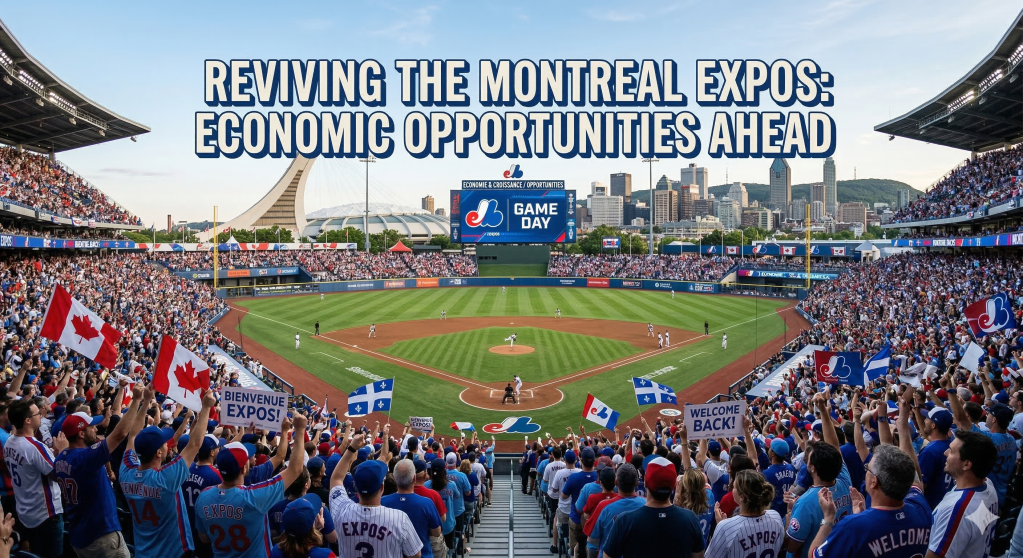
The departure of the Montreal Expos in 2004 remains a seminal moment in the history of North American professional sports. It represents a complex intersection of economic volatility, infrastructure failure, and shifting league paradigms. For thirty-six seasons, the franchise was affectionately known as “Nos Amours.” It served as a cultural bridge between the traditional American pastime and Quebec’s distinct bilingual identity.1 While the team’s relocation to Washington, D.C., was initially seen as an inevitable consequence of a failing market, later analysis revealed a different story. Shifting economic conditions suggest that transient factors, rather than fundamental market deficiencies, drove the narrative of Montreal’s failure.3 Major League Baseball (MLB) is entering a new era of expansion. The goal is a thirty-two-team league by the end of Commissioner Rob Manfred’s tenure in 2029. The case for Montreal’s return has shifted from nostalgia to a strong economic argument.5
The Historiography of Baseball in Montreal: A Legacy of Integration and Innovation
The foundation of Montreal as a premier baseball market predates the formation of the Expos by several decades. The city’s history with the sport is tied closely to the Montreal Royals. They were the Triple-A affiliate of the Brooklyn Dodgers and played at Delorimier Stadium.2 The most significant chapter in this history happened in 1946. Montreal served as the testing ground for the integration of professional baseball. Jackie Robinson’s debut with the Royals was not merely a sports milestone. It was a social milestone as well. The city warmly embraced Robinson. He famously led the team to a Little World Series championship. This established Montreal as a sophisticated, tolerant, and deeply engaged baseball community.2 During this era, the Royals frequently attracted crowds exceeding 20,000 fans. This demonstrated that even at the minor league level, the city possessed the demographic weight to support high-level competition.4
MLB awarded an expansion franchise to Montreal in 1968. The team’s initial home at Jarry Park became an iconic symbol of the sport’s internationalization. The park began humbly as an amateur venue with only 3,000 seats. Municipal authorities and the ownership group led by Charles Bronfman—the fifth-richest man in Canada at the time—invested $3 million Canadian. This investment upgraded the facility to nearly 30,000 seats for the 1969 season.1 The “Jarry Park era” was defined by an intimate, idiosyncratic atmosphere that fostered a generation of lifelong fans. The transition to the Olympic Stadium in 1977 aimed to modernize the franchise. During the late 1970s and early 1980s, the Expos drew huge crowds. They frequently outdrew traditional American markets, becoming a dominant force in National League attendance.4
| Historical Attendance and Milestone Comparison | Period/Year | Context and Outcome |
| Montreal Royals (AAA) | 1940s-1950s | Regularly drew 20,000+ fans, a testing ground for Jackie Robinson. |
| Jarry Park Upgrades | 1968-1969 | $3M investment to expand capacity from 3,000 to 28,456. |
| Olympic Stadium Transition | 1977 | Move to a 55,000+ seat multi-purpose venue. |
| MLB Peak Attendance | Early 1980s | Led the National League in attendance multiple years. |
| The 1994 MLB Strike | 1994 | Best record in baseball (74-40) before season cancellation. |
The trajectory of the franchise was irrevocably altered by the 1994 MLB strike. At the time of the work stoppage, the Expos had the best record in Major League Baseball. They were the favourites to bring the World Series trophy to Canada.8 The psychological impact of the strike cannot be overstated. It deprived a historically talented roster—featuring future Hall of Famers like Pedro Martinez and Larry Walker—of a postseason run. This led to a “fire sale” of talent, jading the fan base.4 The ensuing decade of decline was not due to a lack of interest. Instead, it was a reaction to an ownership structure. They seemed unwilling to invest in the product on the field.3
Structural Failures and the Economic Rationale for the 2004 Departure
The narrative that Montreal “stopped caring” about baseball is challenged. The specific economic and structural conditions of the late 1990s and early 2000s provide this challenge. The Conference Board of Canada later concluded that an uneven economic playing field drove the Expos’ departure. Stadium issues also contributed, rather than fan apathy.3 Several causal factors converged to create a “perfect storm” for relocation.
First, the Olympic Stadium itself became a significant liability. Originally built for the 1976 Summer Olympics, the venue was fundamentally flawed for baseball. The stadium’s location in the city’s east end was far from the central business district and nightlife. This made it a difficult destination for weekday games.4 Mechanical failures with the retractable roof occurred in 1991. Falling concrete also posed a problem. These issues forced the team to play games on the road. As a result, they scared away a portion of the fan base.4 Second, the ownership instability under Claude Brochu and later Jeffrey Loria created a perception of a “lame duck” franchise. Loria decided to pull the team from English-language radio in 2000. This alienated the city’s Anglophone population. It also signalled a lack of commitment to the market.4
Furthermore, the macroeconomic environment of 2004 was radically different from today. The Canadian dollar was significantly weaker. It reached historic lows, making it difficult for Canadian teams to pay player salaries. These salaries are denominated in U.S. dollars.3 Major League Baseball also lacked the robust revenue-sharing and media centralization mechanisms that currently protect small-market teams. In 2002, the league took over the franchise. It effectively managed the team toward relocation. During a 2003 wildcard race, they even prevented them from calling up players.4 This period of “quasi-ownership” by the league further suppressed local interest. Fans found it increasingly painful to support a team already being prepared for its move to Washington.4
Montreal’s 2026 Socio-Economic Profile: A Growth-Oriented Market
Over the past two decades since the Expos’ departure, Montreal has evolved significantly. It has become a global economic hub. Its demographics exceed those of many current MLB markets. With a metropolitan population of approximately 4.38 million, Montreal is currently the largest city in North America without an MLB franchise.11 This population base provides a massive audience for ticket sales, merchandise, and local broadcasting rights. In comparison, Milwaukee, the smallest current MLB market, has a metro population of only 1.56 million—less than 40% of Montreal’s size.12
The city’s corporate ecosystem has also matured. Montreal ranks third in Canada for head-office density, housing 98 of the country’s 800 largest companies.3 This is essential for a modern franchise. Corporate sponsorships, luxury suite leases, and premium season ticket packages often provide the baseline revenue. They help weather the ups and downs of a 162-game season. Some experts, such as Concordia University economist Moshe Lander, remain skeptical. They doubt there is a “clear billionaire owner” ready to incur early losses. However, the city’s business community is willing to form collective investment groups to distribute risk.14
| Economic and Demographic Comparison (2025-2026) | Montreal, QC | Nashville, TN | Salt Lake City, UT | Milwaukee, WI |
| Metro Population | 4.38 Million | 2.05 Million | 1.27 Million | 1.56 Million |
| GDP Growth (2022) | 2.7% | 1.9% | 2.8% | 1.4% (est) |
| Corporate HQ Density | 98 (Top 800) | Moderate | Moderate | Low |
| Major Teams (NHL/NFL/NBA) | 1 (NHL) | 2 (NFL, NHL) | 2 (NBA, NHL) | 2 (MLB, NBA) |
The economy in Montreal and the broader Quebec region is entering a period of stabilization. Economic forecasts for 2026 suggest this development despite global trade uncertainties. While per-capita GDP has faced headwinds, the “appetite for entertainment” among Montrealers remains high.3 CF Montréal in Major League Soccer demonstrates the market’s ability to support multiple professional sports. The success of other local franchises shows this as well. The Montreal Alouettes in the Canadian Football League also highlight this capacity.17 Additionally, the “creator economy” is rising in the city. Digital platforms provide new avenues for fan engagement. These opportunities were non-existent during the original Expos era.19
Infrastructure Revolution: The Peel Basin and the Modern Urban Stadium
The centrepiece of Montreal’s return effort is a reimagined stadium infrastructure that directly addresses the Olympic Stadium’s failures. The proposed project at the Peel Basin is led by Stephen Bronfman and his Claridge Investment Group. It represents a shift toward the “urban ballpark” model. This model has been successful in cities like San Francisco and Denver.20 The Peel Basin site is located on the Lachine Canal south of downtown. It offers proximity to the central business district. It is also close to the vibrant Griffintown neighborhood.20
A key advantage of the Peel Basin site is its connectivity. Building a new station for the Réseau Express Métropolitain (REM) would enhance transit options. Montreal’s automated light rail system would offer direct access to fans across the metropolitan area.20 Bronfman envisions a stadium focused on “eco-responsibility.” It features an open-air design with heated floors. This design avoids a costly and aesthetically sterile dome.15 This design would embrace the Montreal summer while ensuring fan comfort during the early spring and late autumn months.
| Peel Basin Stadium Project Specifications | Detail | Strategic Rationale |
| Proposed Capacity | 32,000 – 35,000 seats | Optimized for scarcity and atmosphere; avoids empty-seat perception. |
| Transit Hub | REM Station on-site | Reduces dependence on cars; avoids “heat island” parking lots. |
| Design Philosophy | Open-air, “Green” stadium | Geothermal energy, rainwater composting, and urban integration. |
| Land Requirement | ~1 Million Sq. Ft. | Mixed-use development including social housing and business. |
| Visual Identity | Waterfront site | Iconic views of the skyline and the Farine Five Roses sign. |
The stadium project is not without political hurdles. Local community groups have voiced opposition. Action-Gardien, among others, is advocating for social housing in the Bridge-Bonaventure sector instead of a professional sports venue.22 The developers have proposed a mixed-use approach. It incorporates affordable housing alongside the stadium. Developers argue that the project would act as a catalyst for billions of dollars in urban development.22 The provincial government has shown “openness” to the proposal. They require proof that the public will see a return on investment. This must happen without direct subsidies for the team purchase.25
Demonstrating Market Demand: The Exhibition Game Evidence
The interest Montrealers have shown in professional baseball is one of the most compelling data points for MLB. This remains true even in the absence of a local team. From 2014 until 2019, the city hosted a series of MLB exhibition games at the Olympic Stadium. These games primarily feature the Toronto Blue Jays. These events had consistently shattered attendance expectations, demonstrating that the market for baseball remains robust.
In 2014, a two-game series between the Blue Jays and the New York Mets drew over 96,000 fans. This included a “delirious” crowd of 50,299 for the second game.9 In the following year, the Blue Jays returned to face the Cincinnati Reds. They again drew over 96,000 people over two days.27 These figures are particularly significant. They took place at a venue that fans notoriously dislike. The games did not count in the standings. Commissioner Rob Manfred noted that Montreal “successfully passed the first test” by demonstrating such massive interest.27 The Blue Jays have not returned since before COVID-19, and it’s a shame.
Digital engagement metrics and social media surveys took place in late 2025 and early 2026. They indicate an “overwhelmingly positive” sentiment toward a return.14 Fans who followed the team in the past want to share the Expos experience with their children. This shows a multigenerational demand. Such demand could sustain the team for decades.28 Ash Karbasfrooshan’s “Project Peanut” survey also revealed significant interest among private equity investors. They view the Montreal market as an “undervalued stock.”14
I personally attended a game on August 30, 2004, against the Chicago Cubs. Other than the hard time finding the way to Olympic Stadium, it was a great experience. The Chicago Cubs won that game 5-2 with starting pitching from Hall of Famer Greg Maddux. That Cubs team included players like Sammy Sosa, Nomar Garciaparra, and Moises Alou. LaTroy Hawkins got the save on that day. Tony Batista was on the Expos roster. It was cool to see him. I had watched games in person when he was with the Toronto Blue Jays as well.
The Changing Economics of MLB: Media, Expansion, and the 2028 Window
The return to Montreal is not merely a local initiative. It is increasingly aligned with Major League Baseball’s global strategic goals. Commissioner Manfred has signalled that expansion to 32 teams is a priority. This expansion aims to balance league scheduling. It also intends to unlock new revenue streams.6 The financial incentives for the league are staggering. Expansion fees are tentatively set at approximately $2.1-$2.2 billion per team.30 The capital generated from this expansion would benefit the existing thirty owners. Each team would receive an immediate influx of roughly $140 million.30
Moreover, the league’s media landscape is undergoing a fundamental transformation. MLB is centralizing its television production and distribution model, moving away from the struggling Regional Sports Network (RSN) system.32 The league aims to launch a national streaming package by 2028. This launch will coincide with the end of major national broadcast contracts.32 A Montreal franchise would be a highly attractive component of such a package. Montreal is a bilingual market with a unique cultural footprint. It offers MLB a “gateway” to French-speaking markets in Europe and Africa. Additionally, it provides access to a significant digital audience in Mexico and Latin America.14
| MLB Expansion and Media Timeline | Year | Strategic Milestone |
| RSN Model Realignment | 2025-2026 | MLB centralizes production for teams like the Tigers and Cardinals. |
| Collective Bargaining (CBA) | 2026 | Negotiations on salary cap and expansion provisions. |
| Request for Proposals (RFP) | Q2 2026 | Anticipated formal opening of the expansion bid process. |
| National Streaming Launch | 2028 | New media rights package covering all 32 teams. |
| Commissioner Retirement | 2029 | Manfred plans to have the expansion cities selected before departure. |
The surge in Canadian interest in baseball is evident. The Toronto Blue Jays’ record-breaking viewership during their 2025 postseason run highlights this interest. This surge has further buoyed the case for a second Canadian team.33 Game 1 of the 2025 World Series averaged 7 million viewers in Canada. This level of penetration is typically reserved for the NFL in the United States.33 Manfred has acknowledged that this “overwhelming success story” makes adding a second Canadian franchise a “realistic possibility”.33
Comparative Competitive Matrix: Why Montreal Stands Out
While several U.S. cities are vying for an expansion franchise, Montreal has unique advantages. These advantages set it apart from Nashville, Salt Lake City, and Austin. Nashville is often cited as a favourite. This is due to its booming population and cultural vibrancy. Furthermore, 69% of MLB players support it as an ideal location.35 Salt Lake City, led by the Miller family, offers a “shovel-ready” stadium plan and a proven sports market.6 However, Montreal has a sheer market size. It also boasts an established identity as a “Major League city.” These factors provide a level of security that smaller markets cannot match.
A composite scorecard for expansion candidates highlights Montreal’s high infrastructure and media reach scores. It faces slightly higher political risks regarding stadium funding than the privately funded Austin bid.37 Montreal’s 4.38 million residents represent more than double the population of Nashville (2.05 million) and triple that of Salt Lake City (1.27 million).12 Today, data-driven valuations impact potential revenue projections. As a result, Montreal’s revenue “ceiling” is significantly higher than that of its U.S. competitors.
| Expansion Candidate Scorecard (2025-2026) | Montreal | Nashville | Salt Lake City | Austin | Portland |
| Media Market Rank | High (N/A) | 26th (U.S.) | 27th (U.S.) | 35th (U.S.) | 23rd (U.S.) |
| Ownership Readiness | Moderate | High | Very High | Moderate | Moderate |
| Stadium Readiness | Proposed | Proposed | High | Private Site | Proposed |
| Population Score | 10/10 | 6/10 | 4/10 | 7/10 | 8/10 |
| Overall Score (Weighted) | 7.6 | 8.8 | 8.6 | 9.4 | 7.9 |
The comparative analysis suggests a Montreal-Nashville or Montreal-Salt Lake City combination. If MLB aims for geographic balance, they should place one team in the East. Another team should be in the West. This arrangement is the most logical outcome.6 Montreal would offer a natural rivalry for the Toronto Blue Jays. It would also rival the Boston Red Sox. This creates a “perfect rivalry in Canada”. It would drive viewership and engagement across the country.5
Ownership Dynamics and the “Project Peanut” Vision
The success of a returned franchise hinges on a modern ownership philosophy. The failures of the Jeffrey Loria era have taught local investors important lessons. They understand that a team must be managed as a community institution. It should not be treated as a personal asset. Stephen Bronfman’s involvement is a vital link to the franchise’s glory days. However, his current strategy as a “matchmaker” for a broader investment group is more sustainable.14 The group includes some of Quebec’s most successful executives. Alain Bouchard from Couche-Tard and Eric Boyko from Stingray are notable examples. They bring significant capital and operational expertise.15
Furthermore, the “Project Peanut” initiative spearheaded by Ash Karbasfrooshan introduces a digital-first approach to the Expos’ revival.19 This vision reframes the team not just as a sports property, but as a digital content hub. By integrating the team with platforms like WatchMojo, the new Expos could leverage this reach in Mexico. WatchMojo has a global distribution engine. They have massive subscriber bases in the U.S., which amplifies their presence. This approach aligns with the shift toward direct-to-consumer streaming and provides a hedge against volatility in traditional RSNs.
The internal likelihood of funding for these groups is high. It is reported to be as high as 80-90%. Private-equity firms are showing renewed interest in Montreal as a sports market.14 The challenge remains a “competitive process.” Bronfman noted that Montreal must prove it is ready to meet the billions in expansion and stadium costs.13
Cultural and International Significance
The return of Major League Baseball to Montreal would be more than an economic expansion. It would be a cultural restoration. The Expos are a “nostalgia item” whose brand resonates far beyond the city limits.10 The team’s logo remains part of the collective memory of the sport. Its history, including legends like Gary Carter, Andre Dawson, and Tim Raines, is also remembered.8
From an international perspective, Montreal offers MLB a unique opportunity to grow the game in the Francophonie. The league is preparing for the 2028 Olympics in Los Angeles. MLB players are expected to participate. Having a high-profile international franchise in a bilingual city would bolster the sport’s global image.5 Montreal is closely connected to French-speaking countries. Its large immigrant populations from baseball-rich nations in Latin America and the Caribbean enhance this connection. This makes Montreal a natural incubator for international talent and fans.14
| Cultural Impact Metrics | Factor | Implication for MLB |
| Global Brand Value | High nostalgia for Expos | Immediate merchandise and licensing revenue. |
| International Reach | Gateway to French-speaking markets | Expands MLB broadcast footprint into Europe/Africa. |
| Diversity Engagement | Large Latin American/Caribbean pop | Strong organic link to the sport’s core demographics. |
| Olympic Synergy | LA 2028 | Montreal as a host for international exhibition/qualifying rounds. |
The return of the Expos would also resolve the “orphaned” status of Canadian baseball fans outside of Toronto. Since 2004, the Blue Jays have been the only option for Canadian fans, but the “Blue Jays vs. Expos” rivalry was historically one of the most exciting aspects of the Canadian sports calendar.5 Bringing back this rivalry would benefit both teams. It would also enhance the league as a whole by deepening the national conversation about the sport.
Conclusions and the Path Forward
The evidence comes from economic forecasts, infrastructure plans, and market demand metrics. These suggest that Montreal is not only a viable market for Major League Baseball. It is also a necessary one for the league’s next phase of growth. The city has moved past the transient failures of 2004. The economic landscape of 2026 is uniquely suited to support a modern, digitally-integrated franchise.
The path forward requires three critical components:
- A Finalized Private-Public Stadium Agreement: Developers have committed to minimizing public risk. A firm plan for the Peel Basin is essential. This plan must satisfy community housing needs and municipal zoning.22
- Stable, Diversified Ownership: The transition from individual passion projects to institutional and collective investment models will offer financial resilience. Such models will support a thirty-year commitment.14
- League Approval and Realignment: MLB must follow through on its expansion timeline. It can use the 2028 media rights window as the catalyst for awarding new franchises.7
Montreal is a “Major League city” whose baseball DNA remains intact.10 With a metropolitan population of 4.38 million, a new urban stadium is on the horizon. An ownership group is ready to leverage the digital economy. The return of the Expos is no longer a question of “if,” but “when.” The evidence is clear. To ensure the health of the game and the growth of the business, baseball needs to return to Montreal.
The Expos need to return because Youppi looks better in Expos Gear!

Works cited
- Montreal Expos team ownership history – Society for American …, accessed March 17, 2026, https://sabr.org/bioproj/topic/montreal-expos-team-ownership-history/
- Bring MLB back to Mtl – Montreal Baseball Project, accessed March 17, 2026, https://montrealbaseballproject.com/en/about/
- Expos’ failure due to MLB’s economic imbalance: study | CBC Sports, accessed March 17, 2026, https://www.cbc.ca/sports/baseball/expos-failure-due-to-mlb-s-economic-imbalance-study-1.1092260
- Real Reasons why Expos Fans Stopped showing Up – ExposNation, accessed March 17, 2026, https://exposnation.com/en/real-reasons-why-expos-fans-stopped-showing-up/
- MLB commissioner: Canada is ‘viable’ expansion candidate – SportsPro, accessed March 17, 2026, https://www.sportspro.com/news/decision-makers/mlb-canada-expansion-manfred-cba-la28-gambling-october-2025/
- MLB views Salt Lake City as one of the ‘strongest’ expansion options, baseball insider says, accessed March 17, 2026, https://www.ksl.com/article/51350026/mlb-views-salt-lake-city-as-one-of-the-strongest-expansion-options-baseball-insider-says
- When will MLB expand again? – Baseball Expansion, accessed March 17, 2026, https://www.baseballexpansion.com/when-will-mlb-expand-again
- What Happened to the Montreal Expos? – The Washington Beer Blog, accessed March 17, 2026, https://washingtonbeerblog.com/what-happened-to-the-montreal-expos/
- Game 2: 1994 Expos Honoured at Olympic Stadium – Montreal Baseball Project, accessed March 17, 2026, https://montrealbaseballproject.com/en/1994-expos-olympic-stadium/
- How Did the Expos Get to Washington? Explaining Their Strange Ownership Swap, accessed March 17, 2026, https://www.si.com/mlb/how-did-the-expos-get-to-washington-explaining-their-strange-ownership-swap
- Montreal Baseball Project, accessed March 17, 2026, https://montrealbaseballproject.com/
- MLB expansion: Breaking down eight possible locations for new baseball teams, from population to local clubs – CBS Sports, accessed March 17, 2026, https://www.cbssports.com/mlb/news/mlb-expansion-breaking-down-eight-possible-locations-for-new-baseball-teams-from-population-to-local-clubs/
- Bring Baseball Back to Montreal – The Fordham Ram, accessed March 17, 2026, https://thefordhamram.com/sports/bring-baseball-back-to-montreal/
- Montreal fans, entrepreneurs explore bringing MLB Expos back to city | Globalnews.ca, accessed March 17, 2026, https://globalnews.ca/news/11564234/montreal-fans-mlb-expos/
- Stephen Bronfman will present his vision for a baseball stadium at the Peel Basin, accessed March 17, 2026, https://montreal.citynews.ca/2019/10/03/stephen-bronfman-will-present-his-vision-for-a-baseball-stadium-at-the-peel-basin/
- Beyond the forecast: Six themes for Canada’s economy in 2026 – RBC Economics, accessed March 17, 2026, https://www.rbc.com/en/economics/canadian-analysis/featured-analysis/insights/beyond-the-forecast-six-themes-for-canadas-economy-in-2026/
- CF Montréal and BMO renew partnership until 2032, accessed March 17, 2026, https://en.cfmontreal.com/news/cf-montreal-and-bmo-renew-partnership-until-2032
- Montréal’s sports teams and major sporting events score big in 2026, accessed March 17, 2026, https://www.mtl.org/en/experience/sports-teams-major-events
- People & Competition: The Expos & Les Nordiques, accessed March 17, 2026, https://contextisking.com/2025/12/07/people-competition-the-expos-les-nordiques/
- Peel Basin: The Site of the Future Montreal Baseball Stadium …, accessed March 17, 2026, https://exposnation.com/en/peel-basin-the-site-of-the-future-montreal-baseball-stadium/
- new Montreal ballpark, accessed March 17, 2026, https://ballparkdigest.com/new-montreal-ballpark/
- Bronfman presents vision for Peel Basin at public consultation office, including baseball stadium – Montreal | Globalnews.ca, accessed March 17, 2026, https://globalnews.ca/news/5986207/bronfman-to-present-vision-for-peel-basin-at-public-consultation-office-could-include-baseball-stadium/
- Stephen Bronfman wants to build ‘eco-friendly’ stadium for return of Expos | CBC News, accessed March 17, 2026, https://www.cbc.ca/news/canada/montreal/stephen-bronfman-eco-friendly-stadium-1.5308669
- No baseball stadium plans for Peel Basin for now, developer says – Montreal – Global News, accessed March 17, 2026, https://globalnews.ca/news/7508017/peel-basin-baseball-stadium/
- Quebec, Montreal governments welcome proposal for new baseball stadium – Sportsnet, accessed March 17, 2026, https://www.sportsnet.ca/baseball/mlb/quebec-montreal-governments-welcome-proposal-new-baseball-stadium/
- Montreal draws 96000+ for two MLB exhibition games, accessed March 17, 2026, https://groundskeeper.mlblogs.com/montreal-draws-96000-for-two-mlb-exhibition-games-15f76d3e25c3
- 96000 fans show their love of baseball at Montreal exhibition games, accessed March 17, 2026, https://montrealgazette.com/sports/baseball/96000-fans-show-their-love-of-baseball-at-weekend-blue-jays-exhibition-games
- Survey Results Gauging Fan Interest in Montreal for the Return of MLB & the Montreal Expos – By Ashkan Karbasfrooshan, accessed March 17, 2026, https://contextisking.com/2026/03/08/survey-results-gauging-fan-interest-in-montreal-for-the-return-of-mlb-the-montreal-expos/
- Manfred: MLB Has Talked Expansion, In-Season Tournament, Split Season | FOX Sports, accessed March 17, 2026, https://www.foxsports.com/stories/mlb/manfred-mlb-has-talked-expansion-in-season-tournament-split-season
- Report: Portland, Nashville, Salt Lake City Facing a Historic MLB Expansion Fees, accessed March 17, 2026, https://sportsnaut.com/mlb/mlb-expansion-fee-cost
- MLB Commissioner Floats $2.2 Billion Expansion Fee – Front Office Sports, accessed March 17, 2026, https://frontofficesports.com/mlb-commish-floats-2-2b-expansion-fee/
- MLB’s media path to 2028 features centralizing today and consolidating tomorrow, accessed March 17, 2026, https://www.sportsbusinessjournal.com/Articles/2026/02/13/mlbs-media-path-to-2028-features-centralizing-today-and-consolidating-tomorrow/
- Canada Could Get MLB Expansion Team, Manfred Says – Front Office Sports, accessed March 17, 2026, https://frontofficesports.com/canada-mlb-expansion-team-manfred/
- Has Blue Jays viewership nudged MLB toward Canadian expansion? – Insider Sport, accessed March 17, 2026, https://insidersport.com/2025/10/28/has-blue-jays-viewership-nudged-mlb-toward-canadian-expansion/
- MLB expansion: A look at the frontrunners and their appeal – Sportcal, accessed March 17, 2026, https://www.sportcal.com/analyst-comment/mlb-expansion-a-look-at-the-frontrunners-and-their-appeal/
- MLB Expansion Plans: Possible Cities & Teams | DIRECTV Insider, accessed March 17, 2026, https://www.directv.com/insider/mlb-expansion/
- MLB Expansion: 2025 Everything-Guide – The Austin Baseball Commission, accessed March 17, 2026, https://www.atxmlb.com/mlb-expansion-updates/mlb-expansion-2025-deep-dive
- Montreal group still working on bringing MLB presence back to the city – TSN, accessed March 17, 2026, https://www.tsn.ca/mlb/montreal-group-still-working-on-bringing-mlb-presence-back-to-the-city-1.1588364
- Did the Montreal Expos COMEBACK just begin…? – Reddit, accessed March 17, 2026, https://www.reddit.com/r/montreal/comments/1prldau/did_the_montreal_expos_comeback_just_begin/

 ScortonBoy17.ca
Leave a comment