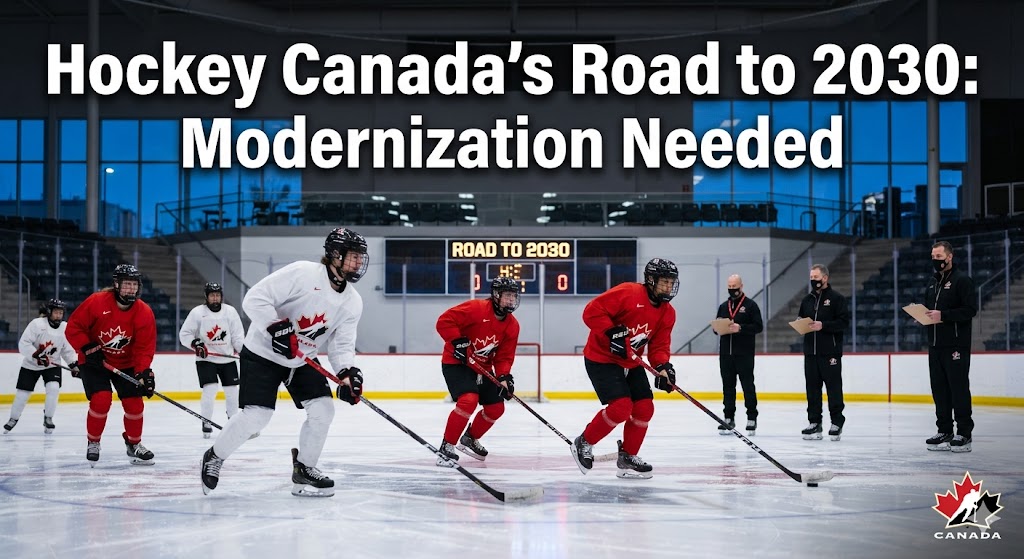
The 2026 Winter Olympics in Milano-Cortina have ended. This conclusion has left the Canadian women’s national hockey program at a definitive crossroads. A silver medal is an achievement most nations would envy. However, for a historically gold-focused program, the 2-1 overtime loss to the United States showed profound systemic stagnation.1 This defeat was not merely the result of a single bounce or a localized tactical error. It was the final punctuation of a four-year cycle. This period was characterized by an inability to adapt to the accelerating pace of the international game. There was also a rigid reliance on a veteran core that has begun to lose its speed advantage.3 To reclaim the top of the podium at the 2030 Winter Olympics, Hockey Canada must modernize its developmental pathways. They also need to fundamentally update their coaching philosophies and roster management strategies.
The 2026 Milano-Cortina Post-Mortem: A Statistical and Tactical Autopsy
The road to the 2026 silver medal was arguably one of the most tumultuous in the program’s recent history. The Canadian squad arrived in Italy after losing seven consecutive games to their American rivals. This stretch included a demoralizing 5-0 shutout in the preliminary round.5 That specific preliminary loss served as a harbinger of the final. It exposed a gap in transition speed. Canada faced high-danger scoring chances that they ultimately could not bridge.
Comparative Performance in the 2026 Gold Medal Final
| Statistical Category | Canada | United States |
| Final Score | 1 | 2 (OT) |
| Shots on Goal | 31 | 33 |
| Power Play Efficiency | 0/3 | 0/2 |
| Shorthanded Goals | 1 | 0 |
| Faceoff Win Percentage | 51.2% | 48.8% |
| Blocked Shots | 14 | 11 |
| Average Time on Ice (Top Pairing) | 24:12 | 23:53 |
The gold medal game showcased the enduring brilliance of Canadian goaltender Ann-Renée Desbiens. She turned aside 31 of 33 shots. This included several high-probability chances during American power plays in the first period.4 Canada struck first. Kristin O’Neill scored a shorthanded goal at the 0:54 mark of the second period. Laura Stacey assisted with the goal.1 However, the inability to extend that lead during subsequent power play opportunities proved fatal. As the game reached its final minutes, defending against the United States’ “waves” of attack took a significant physical toll. It also affected them psychologically. American captain Hilary Knight tied the game. She scored with 2:04 remaining. She capitalized on an extra-attacker scenario after goaltender Aerin Frankel was pulled.2 Megan Keller scored the decisive goal in the 3-on-3 overtime. Her goal resulted from a breakdown in neutral zone coverage. A stretch pass exploited a mismatch against Canadian defender Claire Thompson. She was reportedly playing through an upper-body injury.1
Historical Olympic Women’s Hockey Medal Outcomes (1998-2026)
| Year | Host City | Gold Medal | Silver Medal | Bronze Medal |
| 1998 | Nagano | United States | Canada | Finland |
| 2002 | Salt Lake City | Canada | United States | Sweden |
| 2006 | Turin | Canada | Sweden | United States |
| 2010 | Vancouver | Canada | United States | Finland |
| 2014 | Sochi | Canada | United States | Switzerland |
| 2018 | PyeongChang | United States | Canada | Finland |
| 2022 | Beijing | Canada | United States | Finland |
| 2026 | Milano-Cortina | United States | Canada | Switzerland |
The historical data confirms that Canada has secured five of the eight available gold medals. However, the title has passed back and forth between the North American neighbours in four of the last six Games.2 The 2026 result suggests that the United States has successfully integrated a “blend of youth and experience.” This is something that Canada currently lacks. Young phenoms like Laila Edwards (22) and Tessa Janecke provide a spark. The aging Canadian core could not neutralize this spark.1
The PWHL and the Erosion of the Centralization Model
The most significant structural shift influencing the 2026 cycle was the emergence of the Professional Women’s Hockey League (PWHL). The entire Canadian roster consisted of professional athletes for the first time in Olympic history. They spent most of the season with their respective clubs. They were not centralized in Calgary.10 Historically, Canada’s greatest competitive advantage was its centralization program. Players trained together for six months and played against elite men’s Junior A clubs. They moved the puck under pressures no other nation could replicate.4
In the 2026 cycle, PWHL training camps began in November. The league schedule paused only for international breaks and the Olympic window.6 This professionalization is vital for the long-term sustainability and visibility of the sport. However, it has come at the cost of the “team game” and cohesion that once defined Hockey Canada.4 The lack of sustained chemistry was clear in the 2026 gold medal game. Canada struggled to generate consistent zone time. They failed to capitalize on the open ice of 3-on-3 overtime. This format inherently favours the high-octane speed developed in the American NCAA-to-PWHL pipeline.4
PWHL Representation on the 2026 Canadian Olympic Team
| PWHL Team | Total Players Selected | Notable Athletes |
| Toronto Sceptres | 6 | Renata Fast, Natalie Spooner, Blayre Turnbull |
| Montréal Victoire | 5 | Marie-Philip Poulin, Ann-Renée Desbiens, Erin Ambrose |
| Vancouver Goldeneyes | 5 | Sarah Nurse, Emerance Maschmeyer, Claire Thompson |
| Ottawa Charge | 3 | Brianne Jenner, Jocelyne Larocque, Emily Clark |
| New York Sirens | 3 | Sarah Fillier, Kristin O’Neill, Kayle Osborne |
| Seattle Torrent | 1 | Julia Gosling |
The professional landscape also introduced new tactical elements. These include the “jailbreak” rule, which allows a shorthanded goal to end a penalty. More physical hybrid bodychecking has also been introduced. These changes have raised the floor of international play.12 For Canada to succeed in 2030, the national program must replicate the benefits of centralization. This needs to be done within the professional calendar. A more synergistic relationship between national team staff and PWHL coaches is required. Many of these coaches, like Troy Ryan (Toronto) and Kori Cheverie (Montréal), already hold dual roles.10
High-Performance Analysis: Identifying the Speed and Skill Gap
Expert critique following the 2026 Games has highlighted a “dwindling talent pool.” Critics note Hockey Canada’s unwillingness to infuse the roster with youth during the four-year cycle.3 The United States brought seven NCAA players and multiple PWHL rookies to Milan. In contrast, Canada relied on a roster where more than half the players were in their 30s. This included legend Marie-Philip Poulin (34), Jocelyne Larocque (37), and Natalie Spooner (35).3
The physical reality is that the international game has transitioned into a transition-based sprint. Analysis of shooting patterns across the PWHL and university leagues reveals important insights. Elite-level success increasingly depends on converting a defensive organization into rapid offensive strikes.15 Canadian defenders, while physically robust, have struggled with missed coverage and blunders under high-speed pressure.14
Developmental Performance Metrics: NCAA vs. U Sports
The reliance on the American NCAA system as the primary feeder for the national team remains a point of contention. In 2026, 100% of both the Canadian and American rosters had NCAA experience.18 The NCAA Division I level of play is statistically superior to Canada’s U Sports. Top Canadian university teams like Concordia rank in the middle of the pack when compared to NCAA DI benchmarks. 19
| League Level | Elite Prospect Age | Skill Development Focus | Professional Readiness |
| NCAA Division I | 18–22 | High-speed transition, NIL-funded facilities | High |
| U Sports | 18–24 | Tactical discipline, domestic stability | Moderate |
| PWHL | 22+ | Professional systems, physicality | Premier |
For Canada to win in 2030, it must address the gap in its “Canadian Development Model.” Many talented players choose to leave the sport entirely after university. They do this because they cannot make a PWHL roster. Additionally, they lack a secondary professional tier, similar to the AHL, to continue their development.20 The “Rise As One” blueprint identifies this as a critical barrier. It recommends a standardized high-performance pathway. This pathway is designed to keep more girls in the game through their early 20s.21
The “Rise As One” Strategy: A Roadmap to 170,000 Participants
Launched in late 2025, the “Rise As One” blueprint is Hockey Canada’s most ambitious attempt to revitalize the women’s game. Three-time Olympic gold medalist Gillian Apps chairs the initiative. It seeks to increase the number of women and girls playing hockey in Canada to 170,000 by 2030.22 The strategy is built on 14 national recommendations designed to eliminate barriers in underserved communities and standardize regional delivery.21
The 14 Recommendations of “Rise As One”
The recommendations are grouped into chronological categories: Accelerators (1-2 years), Building Blocks (3-4 years), and Game Changers (5-10 years). To secure gold in 2030, the “Building Blocks” and “Game Changers” are the most vital components of the roadmap.
- Implement the New Development Model: Creating a standardized path from grassroots to high performance.
- Commercial Sustainability: Securing corporate investment specifically for the women’s game.
- Governance and Oversight: Strengthening national and provincial leadership.
- Standardized Regional Delivery: Ensuring a girl in rural Saskatchewan has the same opportunities as one in Toronto.
- Improved Funding: Increasing direct financial support for national programs.
- Equitable Ice Time: Addressing the historical bias toward men’s and boys’ programming.
- Partnership Ecosystem: Strengthening ties with the PWHL, NCAA, and U Sports.
- Underserved Communities: Removing cultural and economic barriers for Black, Indigenous, and racialized participants.
- Gender Equity Mandates: Enforcing participation targets at all levels of governance.
- Data Foundations: Building a national database to track retention and performance metrics.
- Visibility and Celebration: Increasing public awareness and “marquee” event status for women’s championships.
- Leadership Pathways: Training the next generation of women coaches and officials.
- Ecosystem Education: Informing parents and associations on the benefits of female-specific hockey.
- Milestone Celebrations: Creating programs that honour the history and future of the game.
The implementation of these goals has faced early scrutiny. The launch of the “Hockey Canada Development Hub” in British Columbia was criticized. It offered significantly more spots for boys than girls in older age categories (U-15 to U-20). This highlights a disconnect between the “Rise As One” rhetoric and on-ground execution.24 To keep the 2030 Olympic goal viable, Hockey Canada needs to make sure high-performance resources are allocated fairly. This allocation is crucial during the critical developmental years of 14 to 18.
Tactical Modernization: Integrating Analytics and Sport Science
The pursuit of the 2030 gold medal will require an unprecedented integration of advanced analytics and sports science. Modern performance tracking now allows coaches to measure objective data points such as acceleration, deceleration, and “tight turn” efficiency.26 In high-performance hockey, the ability to reach top speed quickly is governed by the formula for force:
F = ma
Where F represents the force required, m is the mass of the player, and a is the desired acceleration. Data-driven training programs can now identify the cause of a player’s lack of speed. It may be due to skating technique, which requires on-ice skill work. Alternatively, it could be caused by explosive leg strength, necessitating off-ice resistance training.26
Performance Indicators for the 2030 High-Performance Program
| Metric | Current Team Avg (2026) | 2030 Target Objective |
| Neutral Zone Transition Speed | 3.4 seconds |  seconds seconds |
| High-Danger Scoring Chances (per 60) | 8.2 |  |
| Circle Possession Time | 38% |  |
| Exit with Possession (Defensive Zone) | 64% |  |
| Shooting Accuracy (Slot Area) | 18% |  |
The shift toward “micro-planning” in practice will be essential. Coaches can use 10-15-minute blocks with adjustable drill progressions. This approach will keep players engaged and help adapt to the increasing pace of international competition.27 Furthermore, coaches identify the use of Small Area Games (SAGs) as a “backbone” of modern coaching. It forces players to make decisions under pressure in game-like situations.27
Personnel Management: The 2030 Transition and the Next Generation
The 2030 quadrennial faces a daunting task. It is transitioning away from the “Golden Generation” of Marie-Philip Poulin, Brianne Jenner, and Natalie Spooner. The 2026 roster was criticized for being “aging and injured,” with several stars nearing retirement.3 The 2026 squad missed the chance to include young talents like Chloe Primerano, Caitlin Kraemer, and Eve Gascon. This was seen as a missed opportunity. Their inclusion could have provided vital mentorship and integration.3
Key Prospects for the 2030 Olympic Cycle
| Player | Current Status (2026) | Role for 2030 | Primary Attribute |
| Chloe Primerano | NCAA Standout | Top-Pair Defender | Elite mobility and puck-moving |
| Caitlin Kraemer | NCAA Standout | First-Line Forward | Pure goal-scoring instinct |
| Eve Gascon | NCAA Goaltender | Starting Goaltender | Proven resilience in high-pressure games |
| Stryker Zablocki | Emerging Prospect | Top-Six Forward | Exceptional linear speed |
| Sara Manness | Emerging Prospect | Two-Way Forward | Defensive responsibility and high IQ |
For the 2030 cycle to be successful, Hockey Canada must move away from its “familiarity bias.” It should embrace a meritocratic selection process that prioritizes speed. This process should focus on stylistic matchups against the United States.3 This likely involves a change in leadership. Critics have argued that General Manager Gina Kingsbury and Head Coach Troy Ryan should “fall on the sword.” They should do so if they cannot integrate new visions for the program.3 Potential future leaders in the coaching ranks include Kori Cheverie. She earned PWHL Coach of the Year honours in 2024. Also, legendary forward Caroline Ouellette is a potential leader. 13
The European Threat and Global Parity
The focus remains on the rivalry with the United States. However, Canada cannot afford to ignore the rising threat from Europe. Nations like Czechia, Switzerland, and Finland are no longer content with bronze medals. Czechia, in particular, has developed a physical and fearless identity under coach Carla MacLeod, a former Canadian star.29
The progress of these nations is driven by their players’ participation in the PWHL. It is also driven by their involvement in the Swedish Women’s Hockey League (SDHL). This participation has sharpened their skills in competition against North American competitors.29 Czechia has even launched its first all-girls U-16 league to build a sustainable domestic pipeline.30 If Canada does not continue progressing, a “European disruptor” could potentially advance. They might take one of the top two spots at the 2030 Olympics. This scenario was almost realized when Switzerland pushed Canada to a tense 2-1 semifinal in 2026. 4 Sweden upset the USA in the 2006 semifinals with a shootout winner. The final score was 3-2. They then lost to Canada 4-1 in the gold medal game. This was the only Olympics in which Canada and the USA failed to finish in the top two.
Conclusion: A Strategic Blueprint for 2030 Gold
The road to the 2030 Winter Olympics requires a fundamental shift in how Canada approaches women’s hockey. The “sovereignty” once maintained through centralization and a larger pool of players has been challenged. The sport’s professionalization and the tactical modernization of international rivals contribute to this challenge. To win gold in 2030, Hockey Canada must execute the following:
- Accelerate Roster Transition: Integrate elite U-22 and NCAA prospects into the senior national team immediately. This will build a core capable of matching American speed by 2030.
- Modernize Tactical Systems: Abandon rigid, veteran-centric play in favour of high-speed transition and analytics-driven offensive zone strategies.
- Reform the Development Pathway: Implement the “Rise As One” blueprint with genuine equity. Provide high-performance opportunities for girls from U-13 through to the professional ranks.
- Strengthen Coaching and Management: Empower new voices with modern visions to lead the program, prioritizing performance and adaptability over familiarity.
- Leverage the PWHL Advantage: Work collaboratively with the professional league. This collaboration ensures that national team players maintain peak physical conditioning. Players also achieve tactical cohesion year-round.
The silver medal of 2026 should serve as the “hard look in the mirror” that captain Marie-Philip Poulin called for.33 Canada has the talent, the history, and the resources to reclaim its position at the top of the podium. However, historical greatness is no longer a defence against the modern game’s evolution. The work for 2030 begins today. There is a commitment to speed and equity. There is also a relentless pursuit of excellence that transcends past successes.
Works cited
- In a thrilling comeback win, U.S. women take home Olympic hockey gold over Canada, accessed February 20, 2026, https://www.opb.org/article/2026/02/19/the-u-s-beats-canada-to-win-women-s-ice-hockey-olympic-gold/
- Winter Olympics 2026: USA defeat Canada 2–1 in overtime to win women’s ice hockey gold, accessed February 20, 2026, https://www.olympics.com/en/milano-cortina-2026/news/winter-olympics-2026-usa-defeat-canada-2-1-overtime-win-womens-ice-hockey-gold
- Opinion: If Canada Misses Gold At The 2026 Olympics, It’s Their …, accessed February 20, 2026, https://thehockeynews.com/womens/international/opinion-if-canada-misses-gold-at-the-2026-olympics-it-s-their-women-s-hockey-staff-that-should-fall-on-the-sword
- Canada falls to U.S. in overtime gold-medal game heartbreaker – TSN, accessed February 20, 2026, https://www.tsn.ca/olympics/article/canada-falls-to-us-in-overtime-gold-medal-game-heartbreaker/
- Ice Hockey, IIHF Women’s World Championship 2024: Canada regain title with 6-5 overtime victory over USA, accessed February 20, 2026, https://www.olympics.com/en/news/iihf-womens-worlds-2024-canada-beat-usa-final-overtime
- ‘So much hope’ as Team Canada goes for Olympic gold in women’s hockey, accessed February 20, 2026, https://globalnews.ca/news/11672349/canada-us-gold-medal-game/
- Team USA Takeaways: How U.S. Women’s Hockey Captured Gold Medal in Win Over Canada, accessed February 20, 2026, https://www.si.com/winter-olympics/team-usa-vs-canada-live-updates-from-womens-hockey-gold-medal-game
- Winter Olympics 2026: Highlights and daily results from Milano Cortina – 19 February, accessed February 20, 2026, https://www.olympics.com/en/milano-cortina-2026/news/winter-olympics-highlights-daily-results-19-february
- IIHF Women’s World Championship – Wikipedia, accessed February 20, 2026, https://en.wikipedia.org/wiki/IIHF_Women%27s_World_Championship
- TWENTY-THREE PWHL PLAYERS SELECTED FOR CANADIAN OLYMPIC WOMEN’S ICE HOCKEY TEAM, accessed February 20, 2026, https://www.thepwhl.com/en/news/2026/january/09/twenty-three-pwhl-players-selected-for-canadian-olympic-womens-ice-hockey-team
- Has the PWHL changed the Olympics for good? | The Big Story, accessed February 20, 2026, https://www.youtube.com/watch?v=miNwRlO1-f0
- The PWHL Has Found a Winning Formula for Women’s Hockey – Sports Illustrated, accessed February 20, 2026, https://www.si.com/nhl/pwhl-has-found-winning-formula-for-womens-hockey
- Troy Ryan returning to Canadian women’s hockey team bench for Olympics – Sportsnet.ca, accessed February 20, 2026, https://www.sportsnet.ca/olympics/article/troy-ryan-returning-to-canadian-womens-hockey-team-bench-for-olympics/
- Three Small Changes That Could Have Big Impacts For Team Canada – The Hockey News, accessed February 20, 2026, https://thehockeynews.com/womens/international/three-small-changes-that-could-have-big-impacts-for-team-canada
- A comparison of shot selection and goal scoring between collegiate and professional women’s and men’s ice hockey – Frontiers, accessed February 20, 2026, https://www.frontiersin.org/journals/sports-and-active-living/articles/10.3389/fspor.2025.1648099/full
- Exploring the dynamics of Women’s field hockey performance: A comparative analysis of the impact of opponent quality between Olympic Games and Chinese National Games – PMC, accessed February 20, 2026, https://pmc.ncbi.nlm.nih.gov/articles/PMC11378882/
- Canada Is Out Of Runway And In Desperate Need Of Change – The Hockey News, accessed February 20, 2026, https://thehockeynews.com/womens/international/canada-is-out-of-runway-and-in-desperate-need-of-change
- NCAA pipeline powers the women’s hockey field as 2026 Milan Cortina Olympics hits bracket play, accessed February 20, 2026, https://www.ncaa.org/news/2026/2/3/2026-olympics-ncaa-womens-ice-hockey-is-powering-the-2026-milan-cortina-winter-olympics.aspx
- How does the level of DI NCAA women’s hockey compare to U Sports and Girls Hockey, accessed February 20, 2026, https://www.champs.app/2024/09/how-does-the-level-of-di-ncaa-womens-hockey-compare-to-u-sports-and-girls-hockey/
- For Women’s Hockey, The PWHL Is Both The NHL And AHL, accessed February 20, 2026, https://thehockeynews.com/womens/pwhl/for-women-s-hockey-the-pwhl-is-both-the-nhl-and-ahl
- Rise As One – Hockey Canada, accessed February 20, 2026, https://cdn.hockeycanada.ca/hockey-canada/Hockey-Programs/Female/Downloads/rise-as-one-e.pdf
- Hockey Canada Unveils New Blueprint For Building Women’s And Girls’ Hockey In Canada, accessed February 20, 2026, https://thehockeynews.com/womens/other-news/hockey-canada-unveils-new-blueprint-for-building-women-s-and-girls-hockey-in-canada
- Blueprint published for building women’s and girls’ hockey in Canada – HockeyNL, accessed February 20, 2026, https://hockeynl.ca/blueprint-published-for-building-womens-and-girls-hockey-in-canada/
- Hockey Canada Justifies Lack Of Equity For Girls In New Development Hub Pilot Program, accessed February 20, 2026, https://thehockeynews.com/womens/other-news/hockey-canada-justifies-lack-of-equity-for-girls-in-new-development-hub-pilot-program
- Hockey Canada Launches First Development Hub With Significantly More Offerings For Boys Than Girls, accessed February 20, 2026, https://thehockeynews.com/womens/other-news/hockey-canada-launches-first-development-hub-with-significantly-more-offerings-for-boys-than-girls
- Maximize Hockey Training with Performance Tracking and Analytics, accessed February 20, 2026, https://drivehockey.com/maximize-hockey-training-with-performance-tracking-and-analytics/
- Year-in-Review: 7 Coaching Lessons from 2025 You Can Steal for 2026 | CoachThem, accessed February 20, 2026, https://coachthem.com/blog/year-in-review-7-coaching-lessons-from-2025-you-can-steal-for-2026
- Hockey Canada rounds out Women’s Olympic Team staff – TSN, accessed February 20, 2026, https://www.tsn.ca/hockey-canada/hockey-canada-rounds-out-women-s-olympic-team-staff-under-toronto-sceptres-troy-ryan-1.2341480
- The European disruptors: meet the women aiming to end North American dominance in ice hockey – Milano Cortina 2026, accessed February 20, 2026, https://www.olympics.com/en/milano-cortina-2026/news/european-disruptors-north-american-dominance-ice-hockey
- Czechia Fails To Advance: Analyzing Their Tournament, And Plotting A Path Forward, accessed February 20, 2026, https://thehockeynews.com/womens/international/czechia-fails-to-advance-analyzing-their-tournament-and-plotting-a-path-forward
- What Effect is the PWHL Going to Have on the SDHL? – The Ice Garden, accessed February 20, 2026, https://www.theicegarden.com/what-effect-is-the-pwhl-going-to-have-on-the-sdhl/
- Heart, work and desperation: What an underdog Canadian team needs to do to win Olympic gold | CBC Sports, accessed February 20, 2026, https://www.cbc.ca/sports/olympics/winter/hockey/canada-us-womens-hockey-olympic-gold-2026-milan-preview-9.7093743
- Canada relying on experience to repeat as Olympic women’s hockey champions – CBC, accessed February 20, 2026, https://www.cbc.ca/sports/olympics/winter/hockey/canada-womens-hockey-tournament-preview-2026-olympics-9.7072409

 ScortonBoy17.ca
Leave a comment