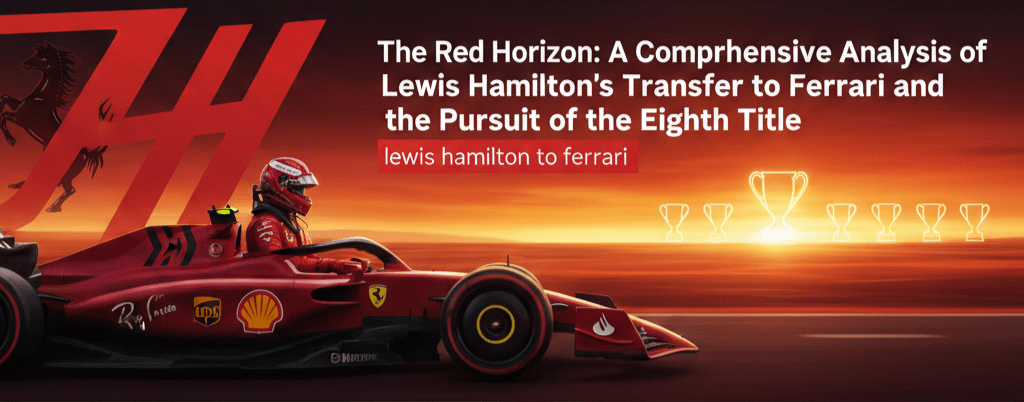
I. Introduction: The Gravitational Shift of Formula 1
Lewis Hamilton announced he would leave Mercedes-AMG Petronas. This was the team with which he redefined the statistical limits of Formula 1. He would join Scuderia Ferrari for the 2025 season. This change was not merely a transaction in the driver market. It was a seismic event that realigned the sport’s competitive, commercial, and historical tectonic plates. At the age of 40, most champions have transitioned to ambassadorships or other racing categories. Yet, Hamilton embarked on the most high-stakes gamble of his career. The objective was singular and almost mythical in its ambition. He aimed to secure an eighth World Drivers’ Championship. This would break the tie with Michael Schumacher. He would achieve this clad in the scarlet overalls of the team synonymous with Schumacher’s own legendary era.
This report provides an exhaustive, forensic examination of this transfer. It does not merely recount the events. It dissects the underlying strategic logic. The report examines the brutal reality of the 2025 “transition” season. It also looks into the looming technical warfare of the 2026 regulatory overhaul. By synthesizing financial data, telemetry analysis, paddock political movements, and historical precedent, we aim to answer the definitive question. Was the move to Maranello a masterstroke of foresight destined to crown the greatest career in F1 history? Or was it a romantic miscalculation that will leave the eighth title forever out of reach?
The narrative of Hamilton’s move is deeply intertwined with the concept of legacy. In Formula 1, the Ferrari drive is often viewed as the final frontier. It is a pilgrimage that every great driver feels compelled to make. Yet, history shows many champions who faced frustration instead of glory in Maranello. Alain Prost faced dismissal. Sebastian Vettel experienced unraveling. Fernando Alonso had near-misses. Hamilton’s arrival was intended to break this cycle. He aimed to leverage his experience. Frédéric Vasseur’s leadership would galvanize a team that has not won a Constructors’ Championship since 2008.
However, the 2025 season—Hamilton’s debut in red—has complicated this narrative. It was a season of profound struggle. He experienced a lack of podiums. There was a crushing performance deficit to his teammate, Charles Leclerc. As we analyze the data, a complex picture emerges. It is one of a driver fighting against muscle memory ingrained by a decade of Mercedes engineering. It also shows a team in the throes of a painful cultural restructuring. Additionally, a former employer is experiencing a renaissance. This undoubtedly stung the departing champion.
The verdict, however, does not rest on 2025 alone. The true judgment of this transfer lies in the unwritten chapters of 2026. A new engine formula promises to reset the grid. The report uncovers a critical, developing controversy here. It involves a potential technical loophole exploited by Mercedes. This loophole could render Hamilton’s move strategically catastrophic. The interplay between these elements—human performance, engineering philosophy, and regulatory governance—forms the crux of this analysis.
II. The Architecture of the Deal: Economics, Control, and Leverage
To understand the trajectory of Hamilton’s Ferrari tenure, one must first dissect the agreement that brought him there. The contract signed between Lewis Hamilton and Ferrari Chairman John Elkann was not a standard driver agreement. It restructured the sport’s commercial hierarchy. This change reflected the desperation of a team starved of success. It also highlighted the leverage of a driver transcending the sport.
2.1 The Financial Paradigm Shift
The financial terms of Hamilton’s transfer shattered existing records. They recalibrated the market value for top-tier talent even in the era of the cost cap. The team’s operational budget is strictly capped. However, driver salaries remain exempt. This exemption allows Ferrari to wield its financial might. They secure Hamilton using the legacy of their status as the most valuable luxury brand in the world.
2.1.1 The Compensation Structure
Financial analyses gathered intelligence about Hamilton’s compensation package for the 2025 season. It was structured to be the most lucrative in history. This surpassed even the dominant Max Verstappen. The total earnings for 2025 were estimated to be in the region of $100 million (€87 million).1
This figure is composed of a fixed base salary and a complex matrix of image rights and bonuses:
- Fixed Salary: Approximately $70 million. Some sources cite €55-60 million. He is the highest-paid driver in terms of guaranteed income. This eclipses Verstappen’s $65 million base.1
- Bonuses: Performance-related payouts were relatively modest in the initial structure compared to the base. They are estimated at around $0.5 million for 2025 due to the lack of race wins. This brings the total to a colossal fixed overhead for Ferrari regardless of on-track results.1
This structure marks a major shift from the current trend in modern Formula 1. The trend has moved toward lower base salaries. These salaries are heavily indexed to performance bonuses (the model employed by McLaren for Lando Norris and Oscar Piastri). Ferrari’s willingness to commit such a staggering fixed sum underscores the “Galáctico” nature of the signing. They were paying for the Hamilton brand as much as they were for the driver.
Table 1: 2025 Driver Compensation Hierarchy (Estimated)
| Driver | Team | Fixed Salary (USD) | Total Earnings (inc. Bonus) | Contract Model |
| Lewis Hamilton | Ferrari | $70 Million | $100 Million+ | Star Power / Fixed Heavy |
| Max Verstappen | Red Bull | $65 Million | $76 Million+ | Performance Indexed |
| Lando Norris | McLaren | $25 Million | $57.5 Million | Performance Indexed |
| Charles Leclerc | Ferrari | $30 Million | $30-40 Million | Hybrid |
| George Russell | Mercedes | $18 Million | $26 Million | Traditional Tier 1 |
1
2.1.2 Commercial Implications
The “Elkann Factor” cannot be overstated. John Elkann was the architect of this deal. He orchestrated Cristiano Ronaldo’s move to Juventus. Similarly, he viewed Hamilton as a vehicle to elevate the Ferrari brand beyond motorsport. Hamilton brings a global marketing leverage that is incomparable. His presence opens doors to fashion, music, and lifestyle demographics. These are areas that Formula 1 teams traditionally struggle to access.1
However, the analysis suggests a paradox. The commercial side of the deal was a resounding success. Ferrari’s stock price and merchandising revenue likely saw upticks correlated with the announcement. However, the on-track return on investment (ROI) in 2025 was abysmal. Ferrari spent over $100 million on its driver lineup. This included Hamilton and Leclerc. They only managed to finish behind McLaren. They also had to contend with a resurgent Mercedes.1 In strictly sporting terms, Hamilton’s 2025 season had a historically poor “dollar per point” efficiency. This was poor compared to drivers like Lando Norris or the rookie Kimi Antonelli.
2.2 Contractual Control and the 2028 Clause
Beyond the money, the duration and control mechanisms within the contract reveal Hamilton’s strategic caution. He did not sign a blind long-term commitment. Instead, he signed a deal that gives him the power to judge Ferrari’s progress.
The contract is widely reported as a “2+1” structure 2:
- Guaranteed Term: Hamilton is locked in for the 2025 and 2026 seasons. This ensures he is present for the first year of the new regulations. It gives him a chance to assess the competitiveness of the new Ferrari power unit.
- The Extension Clause: Crucially, the option to extend the contract through 2027 and 2028 is crucial. It lies entirely in the hands of the seven-time world champion.2
This unilateral clause places Ferrari in a complex strategic bind. If Hamilton underperforms in 2026, Ferrari is contractually obligated to retain him. This is true even if he wishes to continue for the salary or the brand association. This could potentially block the seat for younger talent (such as Oliver Bearman). Conversely, if the car is a failure, Hamilton can walk away without penalty. This asymmetry in the contract highlights just how much Ferrari was willing to concede to secure his signature.
III. The 2025 Autopsy: A “Nightmare” in Red
If the signing was the dream, the 2025 season was the rude awakening. Hamilton’s debut campaign with the Scuderia will be remembered not for a triumphant return to form. Instead, it will be noted as a statistical nadir. It tested the resolve of both driver and team. The season showed a profound inability to extract performance from the SF-25. Charles Leclerc, his teammate, drove this car to third in the championship. He also achieved multiple victories.
3.1 The Statistical Collapse
The raw numbers of the 2025 season present a stark reality that cannot be spun. For the first time, Lewis Hamilton didn’t secure a Grand Prix podium in a full season. His illustrious career spans back to his debut in 2007.5 While he secured a Sprint race victory, the feature races—the true currency of Formula 1—yielded nothing but frustration.
Table 2: 2025 Season Performance Summary
| Metric | Lewis Hamilton | Charles Leclerc | Delta |
| Championship Position | 6th | 3rd | -3 Positions |
| Total Points | 223 | 356 | -133 Points |
| Grand Prix Wins | 0 | N/A (Multiple) | Deficit |
| Grand Prix Podiums | 0 | 5+ | Deficit |
| Avg. Qualifying Gap | +0.255s | Reference | +0.255s Slower |
5
The points gap to his teammate is nearly 133 points. It is the largest internal deficit Hamilton has ever faced. This far exceeds his 2011 struggles against Jenson Button. It is even greater than his 2022 deficit to George Russell. This was not a case of bad luck; it was a fundamental lack of pace.
3.2 The Technical Disconnect: Why Hamilton Struggled
To understand why the move looked like a mistake in 2025, one must explore Hamilton’s driving style. It is technically incompatible with the Ferrari SF-25. Formula 1 cars are not generic; they are temperamental prototypes designed around specific aerodynamic and mechanical philosophies.
3.2.1 The Braking and Corner Entry Crisis
The core of the issue lay in the braking zones. Throughout his career, particularly during the Mercedes era, Hamilton perfected a “late braking” technique. He compresses the braking zone. He hits the pedal harder and later than almost anyone else. He relies on a rapid downshift strategy to rotate the car at the apex using the engine’s torque. He demands a car with an incredibly stable rear end to handle this aggressive entry.9
The Ferrari SF-25, however, was a car that thrived on a different philosophy—one that Charles Leclerc has mastered. The Ferrari required a more gradual downshift pattern to manage the engine braking and keep the platform stable. It was a “front-limited” car that needed to be finessed into the corner rather than wrestled.
Fred Vasseur, Ferrari Team Principal, candidly admitted that the team had underestimated the difficulty. They realized the challenge Hamilton would face in adapting to these nuances.11 It wasn’t just the physical driving; it was the “software” of the car. The brake-by-wire mapping was new to Hamilton. The differential settings were different as well. The energy deployment system was also unfamiliar after 12 years with Mercedes power. Every time he tried to apply his Mercedes muscle memory, the Ferrari reacted unpredictably. This led to lock-ups. He also missed apexes and lost confidence.
3.2.2 The Qualifying Deficit
This lack of confidence manifested most brutally in qualifying. In modern F1, tire preparation and confidence on the limit are everything over one lap. Hamilton could not trust the rear of the car on entry. As a result, he could not attack the corners with his usual ferocity.
The data shows a qualifying head-to-head drubbing: Leclerc beat Hamilton 16-7 (or 23-7 depending on Sprint inclusion).8 The average gap was 0.255 seconds.8 In a field where the top 10 are often separated by half a second, even a small time difference is crucial. It can make a big impact. This difference is significant. A quarter-second deficit can be a lifetime. This consistently resulted in Hamilton starting in the midfield (P6-P10). He had to destroy his tires in traffic. Meanwhile, Leclerc started at the front.
3.3 Specific Race Case Studies
3.3.1 The Silverstone Heartbreak
The British Grand Prix at Silverstone is Hamilton’s fortress, a track where he has won a record number of times. In 2025, it became a theater of disappointment. While the British crowd roared for him, Hamilton could only manage a 4th place finish.13
The pain was compounded by the identity of the drivers ahead. Lando Norris won the race in a McLaren. However, he was also beaten by Nico Hülkenberg in a shock result. Additionally, he finished nearly 40 seconds behind the winner. The comparison to George Russell was even more stinging. Although he finished 10th due to issues, he had shown superior pace in the Mercedes W16 throughout the season. Hamilton could not challenge for the win at home. This was a stark indicator of how far the Ferrari package—and his adaptation to it—was off the pace.
3.3.2 The Monza Experience
The Italian Grand Prix at Monza was the emotional epicenter of the season. This was Hamilton’s first race in front of the Tifosi as a Ferrari driver. The atmosphere was electric, with the “Red Sea” embracing their new champion.
However, the result was a sobering 6th place.15 Hamilton recovered well from a grid penalty. He started 10th and showed flashes of his racecraft. However, he finished behind his teammate Leclerc in 4th place. Painfully, he was behind his former teammate George Russell in 5th in the Mercedes. While Hamilton spoke publicly about the “incredible support,” he also mentioned being “full of life.”16 However, finishing off the podium at Ferrari’s home race was a difficult reality. Being beaten by a Mercedes symbolized the challenging nature of the transfer.
3.4 The Psychological Toll
The strain of the season was visible. Hamilton described the season as a “nightmare” that he had been “living for a while”.5 Radio communications between Hamilton and his race engineer, Riccardo Adami, were frequently tense. They were often punctuated by awkward silences. This situation led to speculation that Ferrari might need to replace Adami. The goal would be to better suit Hamilton’s communication needs for 2026.11
Even the Ferrari hierarchy showed cracks. Chairman John Elkann publicly criticized the drivers late in the season. This move undoubtedly added pressure to an already fractured environment.6 The driver was used to the protective, “no-blame” culture that Toto Wolff built at Mercedes. This public accountability was a culture shock.
IV. The Mercedes Renaissance: The “Seller’s Remorse”
Perhaps the bitterest pill for Hamilton to swallow in 2025 was not his own struggles. It was the success of the team he left behind. He believed Mercedes had lost its way technically. He thought Ferrari offered a better route to the top. The 2025 season suggested the opposite.
4.1 The W16 Resurgence
Mercedes-AMG finally shed the demons of the “zero-pod” concept. They corrected the erratic W13/W14/W15 lineage. As a result, they produced a competitive machine in the W16. The car addressed the specific weaknesses Hamilton had complained about for years. These included rear-end stability in high-speed corners. This improvement came just as he exited the team.19
The results were immediate. George Russell, liberated as the undisputed team leader, secured two Grand Prix victories (Canada and Singapore) and nine podiums.20 He finished 4th in the Drivers’ Championship with 319 points, nearly 100 points clear of Hamilton.
4.2 The Antonelli Factor
Adding insult to injury was the performance of Hamilton’s replacement, the 18-year-old prodigy Andrea Kimi Antonelli. Thrown into the deep end, Antonelli scored 150 points, finishing 7th in the standings.21
While Antonelli made rookie errors, his raw speed was undeniable. He secured a Sprint Pole in Miami and multiple podiums. He finished only one position behind Hamilton in the championship. The narrative in the paddock began to shift. Mercedes had successfully transitioned to the future. Meanwhile, Hamilton looked like a driver stuck in a difficult present. The W16 was capable of winning; the SF-25 was not. By moving, Hamilton had swapped a race-winning car for a midfield runner. This raised the uncomfortable question: Did he bail out on Mercedes just as they were turning the corner?
V. The 2026 Battlefield: A Regulatory War
If the analysis stopped at 2025, the verdict would be clear: the move was a failure. However, Hamilton’s contract was never really about 2025. It was a positioning move for 2026.
The 2026 season represents the biggest technical reset in Formula 1 history since 2014. The cars will be smaller, lighter, and feature active aerodynamics. But the crown jewel is the new Power Unit (PU) Regulations. Here is where the fate of Hamilton’s eighth title will be decided. A massive controversy is also brewing. It could ruin Ferrari’s best-laid plans.
5.1 The New Engine Formula
The 2026 power units will feature a 50/50 split between internal combustion (ICE) and electrical power (350kW). The MGU-H (Motor Generator Unit – Heat) has been removed to reduce complexity and attract new manufacturers like Audi. The engines must also run on 100% sustainable fuels.22
Crucially, the FIA introduced a new rule to limit costs. It aimed to level the playing field. This rule concerned the compression ratio of the engine. The maximum geometric compression ratio was reduced from roughly 18:1 (in current engines) to 16:1 (specifically 16.0).23
5.2 The Mercedes/Red Bull Loophole
Intelligence from the paddock suggests that a technical war has already erupted over this specific rule. It appears that Mercedes (Hamilton’s former team) and Red Bull Powertrains have found a loophole that Ferrari missed.
5.2.1 The “Thermal Expansion” Trick
The regulation states that the compression ratio must not exceed 16.0. However, the compliance check is performed when the engine is cold and static.
- The Innovation: Mercedes has reportedly designed their pistons and connecting rods using materials with specific thermal expansion coefficients. When the engine is cold (during the FIA check), it sits at 16.0:1. However, when the engine runs at race temperatures, the components expand in a calculated manner. This reduces the combustion chamber volume and increases the compression ratio back up to 18:1.23
- The Advantage: A higher compression ratio equals better thermal efficiency and more power. Estimates suggest this trick is worth 10kW (approx. 13 bhp). In Formula 1 terms, 13 horsepower is massive. It translates to a lap time advantage of 0.3 to 0.4 seconds.23
5.2.2 Ferrari’s Vulnerability
Ferrari, along with Honda (Aston Martin) and Audi, interpreted the rule as a “hard limit” regardless of temperature. They have reportedly designed their engines to stay at 16:1. They realized the Mercedes advantage. They have lodged protests. They demanded the FIA close the loophole because it violates the “spirit” of the regulations.23
However, the FIA has so far indicated that the rule as written only specifies static measurement. If this ruling stands, Mercedes will start the 2026 era with a baked-in advantage that Ferrari cannot replicate quickly. Redesigning an engine’s core geometry takes months, meaning Ferrari would be locked into a deficit until at least 2027.25
5.3 The Political Implications
This situation places Frédéric Vasseur in a desperate position. He is fighting a political war to get the Mercedes engine banned or the rules changed before the season starts. If he fails, Hamilton will have left the team with the “super-engine” to join a team that is structurally slower.
This echoes the 2014 hybrid era start, where Mercedes had a split-turbo advantage that secured them eight consecutive titles. Hamilton was the beneficiary then; he risks being the victim now. The irony is palpable. Hamilton’s move was based on the belief that Ferrari might ace the 2026 regs. However, it is his old team that seems to have outsmarted the rulebook again.
5.4 Chassis Innovations: Active Aero
Beyond the engine, the 2026 cars feature “Active Aero” to replace DRS. The cars will have movable wings on the front and rear. These wings reduce drag on straights. They also increase downforce in corners.22
Ferrari has been aggressive here. The SF-25 served as a testbed for suspension concepts. It switched to a pull-rod front suspension (similar to Red Bull/McLaren). This change was made to clean up airflow to the floor.17 This suggests Ferrari is correcting the chassis flaws of the past. However, in 2026, if the engine deficit is 13hp, even the best chassis will struggle to compensate.
VI. The Verdict: Was It the Right Decision?
Evaluating Lewis Hamilton’s move to Ferrari requires balancing the emotional, the financial, and the competitive realities.
6.1 The Case for “Yes” (The Romantic/Long-Term View)
- Legacy Security: Regardless of results, Hamilton is now a “Ferrari Driver.” This elevates his brand into a stratosphere occupied only by global icons. The $100 million salary confirms his status as the sport’s most valuable asset.1
- The 2027/2028 Potential: The contract gives Hamilton the option to continue. If Ferrari stumbles in 2026, they can fix the issues for 2027. By closing the engine loophole, he can still fight for the title. He is not trapped.
- Cultural Reset: Hamilton needed to leave Mercedes. The relationship had run its course. Even a struggle at Ferrari is a new challenge compared to stagnation at Mercedes.
6.2 The Case for “No” (The Competitive Reality)
- The Performance Downgrade: He left a team that won races in 2025 (Mercedes). He joined one that didn’t win with him (Ferrari). He was beaten by his replacement (Antonelli) and his former teammate (Russell).
- The Leclerc Problem: Charles Leclerc is in his prime and is faster over one lap. Hamilton is no longer the automatic Number 1. Beating Leclerc to win the title might be harder than beating the other teams.
- The Engine Loophole: If Mercedes carries a 0.3s engine advantage into 2026, the move is a strategic catastrophe. Hamilton will have walked away from the machinery required to win the 8th title.
6.3 Conclusion
The 2025 season concluded. The data suggests that the move to Ferrari was a miscalculation for the immediate term. In competitive terms, this decision didn’t pay off. Hamilton endured the worst statistical season of his career while his former team returned to winning ways.
However, the final verdict cannot be written until the 2026 engines fire up in Bahrain. If Frédéric Vasseur can win the political battle, it will neutralize the Mercedes engine advantage. Then, the “nightmare” of 2025 will be forgotten. Additionally, if Ferrari can build a chassis that restores Hamilton’s braking confidence, the “nightmare” of 2025 will be forgotten.
But the risk is existential. Hamilton is racing against time. He is also competing against a younger, faster teammate. Additionally, he may be up against a superior engine he chose to leave behind. The pursuit of the eighth title has shifted from being a probability at Mercedes. It has become a desperate, romantic crusade at Ferrari. This crusade currently seems uphill, against the wind, and on the back foot.
VII. Detailed Appendices and Data Tables
Appendix A: 2025 Comprehensive Standings Data
Table 3: Final 2025 Constructors’ Championship
| Pos | Team | Points | Status |
| 1 | McLaren-Mercedes | 666 | Champions (First since 1998) |
| 2 | Ferrari | 652 | Runner-up (Strong Leclerc Performance) |
| 3 | Red Bull Racing | 589 | Failed Title Defense |
| 4 | Mercedes | 468 | Resurgent (Wins + Podiums) |
| 5 | Aston Martin | 94 | Midfield Stagnation |
26
Table 4: Final 2025 Drivers’ Championship (Top 8)
| Pos | Driver | Team | Points | Wins |
| 1 | Max Verstappen | Red Bull | 437 | 7+ |
| 2 | Lando Norris | McLaren | 374 | Multiple |
| 3 | Charles Leclerc | Ferrari | 356 | Multiple |
| 4 | George Russell | Mercedes | 319 | 2 |
| 5 | Oscar Piastri | McLaren | 292 | Multiple |
| 6 | Carlos Sainz | Williams | 290 | N/A |
| 7 | Lewis Hamilton | Ferrari | 223 | 0 |
| 8 | Andrea Kimi Antonelli | Mercedes | 150 | 0 |
7
Appendix B: Technical Regulation Breakdown (2026)
Table 5: 2026 Power Unit Regulations vs. 2025
| Component | 2025 Spec | 2026 Spec | Impact |
| ICE Fuel Flow | 100 kg/h | Reduced (Energy limited) | Lower ICE Power |
| Electrical Power | 120 kW (160bhp) | 350 kW (470bhp) | Massive Torque Increase |
| MGU-H | Present | Banned | Simpler, Cheaper |
| Fuel | E10 (10% Ethanol) | 100% Sustainable | Combustion Challenge |
| Compression Ratio | ~18:1 (Free) | Max 16:1 (Static) | The “Loophole” Battleground |
22
Works cited
- F1 drivers’ salaries revealed: Lewis Hamilton’s salary makes teeth …, accessed December 26, 2025, https://www.italpassion.fr/en/competition/formule-1/f1-drivers-salaries-revealed-lewis-hamiltons-salary-raises-eyebrows/
- ‘Hamilton contract clause could put Ferrari in a difficult position’, accessed December 26, 2025, https://www.gpblog.com/en/rumors/hamilton-contract-clause-could-put-ferrari-in-a-difficult-position
- Lewis Hamilton | FORMULA 1 Contracts & Salaries – Spotrac.com, accessed December 26, 2025, https://www.spotrac.com/formula1/player/_/id/47369/lewis-hamilton
- Lewis Hamilton’s Ferrari F1 contract length and salary revealed: 2+1 and 100 million dollars a year – Pit Debrief, accessed December 26, 2025, https://www.pitdebrief.com/post/lewis-hamiltons-ferrari-f1-contract-length-and-salary-revealed-21-and-100-million-dollars-a-year/
- F1 2025 recap: Life at Ferrari becomes a “nightmare” for Lewis Hamilton, accessed December 26, 2025, https://www.motorsport.com/f1/news/f1-2025-recap-life-at-ferrari-becomes-a-nightmare-for-lewis-hamilton/10785774/
- Lewis Hamilton Ferrari approach questioned after disaster season, accessed December 26, 2025, https://racingnews365.com/lewis-hamilton-ferrari-approach-questioned-after-disaster-season
- 2024 F1 standings | GRR – Goodwood, accessed December 26, 2025, https://www.goodwood.com/grr/f1/2024-f1-standings/
- Final F1 2025 team-mate qualifying scores – The Race, accessed December 26, 2025, https://www.the-race.com/formula-1/f1-2025-qualifying-duels-team-by-team/
- The signs Hamilton’s chief problem hasn’t followed him to Ferrari – The Race, accessed December 26, 2025, https://www.the-race.com/formula-1/lewis-hamilton-key-weakness-hasnt-followed-him-to-ferrari/
- [Autosport] Fred Vasseur has admitted that he underestimated how difficult it would be for Lewis Hamilton to adapt quickly to life at Ferrari : r/formula1 – Reddit, accessed December 26, 2025, https://www.reddit.com/r/formula1/comments/1pqiurl/autosport_fred_vasseur_has_admitted_that_he/
- Vasseur calls for ‘better job everywhere’ to save Hamilton era – F1i.com, accessed December 26, 2025, https://f1i.com/news/556566-vasseur-calls-for-better-job-everywhere-to-save-hamilton-era.html
- F1 2025 qualifying head-to-head: United States GP – Motorsport.com, accessed December 26, 2025, https://www.motorsport.com/f1/news/f1-2025-qualifying-united-states-gp/10768293/
- 2025 F1 British Grand Prix – Silverstone results | RacingNews365, accessed December 26, 2025, https://racingnews365.com/2025-f1-british-grand-prix-silverstone-results
- 2025 British Grand Prix F1 results: Norris takes home win in front of record crowds – Silverstone, accessed December 26, 2025, https://www.silverstone.co.uk/news/2025-british-grand-prix-f1-results-norris-takes-home-win-front-record-crowds
- Italian Grand Prix 2025 F1 race results, accessed December 26, 2025, https://www.the-race.com/formula-1/italian-grand-prix-2025-f1-race-results/
- ‘It’s everything you could ever hope for’ – Hamilton praises Tifosi as he reflects on first Monza weekend with Ferrari – F1, accessed December 26, 2025, https://www.formula1.com/en/latest/article/its-everything-you-could-ever-hope-for-hamilton-praises-tifosi-as-he.37jor2RkYUPPxCFaFhZSuQ
- TECH ANALYSIS: The ‘significant changes’ that are giving Ferrari confidence in their 2025 car | Formula 1®, accessed December 26, 2025, https://www.formula1.com/en/latest/article/tech-analysis-the-significant-changes-that-are-giving-ferrari-confidence-in.2XQT2NTtK70LNqMKCaEGZO
- New Lewis Hamilton Ferrari Contract Clause Emerges as Staggering Pay Revealed, accessed December 26, 2025, https://www.sportbible.com/f1/lewis-hamilton-ferrari-contract-clause-revealed-863342-20251222
- TECH ANALYSIS: The one key weakness Mercedes have targeted on Russell and Antonelli’s brand-new W16 | Formula 1®, accessed December 26, 2025, https://www.formula1.com/en/latest/article/tech-analysis-how-mercedes-have-targeted-their-key-weaknesses-through-the.01qX10KtcigWQeyCCLAYvm
- 2025 GEORGE RUSSELL DRIVER STANDINGS – F1, accessed December 26, 2025, https://www.formula1.com/en/results/2025/drivers/GEORUS01/george-russell
- F1 Review: 2025’s rookie drivers | News, Sports, Jobs – The Mining …, accessed December 26, 2025, https://www.mininggazette.com/sports/2025/12/f1-review-2025s-rookie-drivers/
- Everything you need to know about the new F1 rules for 2026, accessed December 26, 2025, https://www.formula1.com/en/latest/article/everything-you-need-to-know-about-the-new-f1-rules-for-2026.48bv0VTxhIlhrQXmxercXk
- No hope for rivals until 2027? The impact of F1’s loophole controversy – The Race, accessed December 26, 2025, https://www.the-race.com/formula-1/everything-we-learned-about-impact-of-f1-2026s-loophole-controversy/
- Mercedes, Red Bull and F1’s 2026 engines: The loophole controversy explained, accessed December 26, 2025, https://www.motorsport.com/f1/news/mercedes-red-bull-and-the-2026-engines-whats-behind-the-recent-fuss-in-f1/10786380/
- Ferrari F1 already penalized for 2026? Mercedes engine trick legal – ItalPassion, accessed December 26, 2025, https://www.italpassion.fr/en/competition/formule-1/ferrari-f1-already-penalized-for-2026-the-mercedes-engine-tip-is-legal/
- 2024 Formula One World Championship – Wikipedia, accessed December 26, 2025, https://en.wikipedia.org/wiki/2024_Formula_One_World_Championship
- 2024 F1 Constructor Standings – GPFans, accessed December 26, 2025, https://www.gpfans.com/us/f1-standings/constructors/2024/
- 2024 TEAMS’ STANDINGS – F1, accessed December 26, 2025, https://www.formula1.com/en/results/2024/team

 ScortonBoy17.ca
Leave a comment