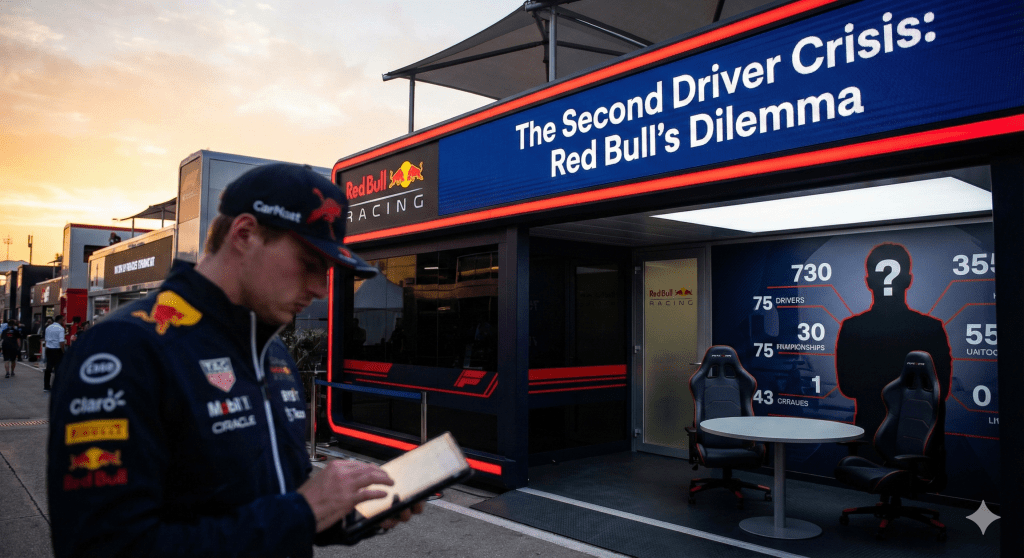
1. Introduction: The Post-Ricciardo Paradigm Shift
The conclusion of the 2018 Formula 1 season marked a watershed moment for Red Bull Racing. It precipitated a structural and operational crisis. This crisis has defined the team’s internal dynamics for more than half a decade. Daniel Ricciardo’s departure to Renault was more than a personnel change. It signified the loss of a critical benchmark and a stabilizing force within the Milton Keynes organization. Ricciardo was the only teammate who had consistently challenged Max Verstappen. He matched Verstappen’s pace and occasionally outperformed him over the course of a season.1 His exit created a vacuum. The team has struggled to fill this vacuum. This struggle has led to a revolving door of talent. This situation has exposed deep-seated issues in the team’s engineering philosophy, driver management culture, and strategic adaptability.
Since 2019, Red Bull Racing has been locked in a paradoxical struggle. They have achieved the zenith of sporting success with Verstappen winning multiple Drivers’ Championships. However, the second seat has become a graveyard for careers. The statistical disparity between Verstappen and his teammates is striking. Pierre Gasly, Alexander Albon, and Sergio Perez have faced significant challenges keeping pace with him. This gap is among the most severe in modern Formula 1 history. Verstappen consistently extracts the maximum theoretical performance from the machinery. His teammates frequently struggle to secure even half of his points haul. They often languish in the midfield despite driving championship-caliber equipment.2
This report provides an exhaustive, multi-dimensional analysis of this phenomenon. It argues that the “second driver problem” is not simply a matter of finding a driver with sufficient speed. Instead, it is the result of several complex factors. These include a vehicle design philosophy. This philosophy prioritizes peak performance over drivability. There is also a ruthless management culture. This culture erodes driver confidence. Additionally, there is a stalled junior development pipeline. Finally, there is immense psychological pressure of measuring oneself against a generational talent. This analysis explores the technical nuances of the “pointy” car concept. It also examines the financial ramifications of the 2024 Constructors’ Championship collapse. Furthermore, it considers the individual narratives of the drivers involved. Through these examinations, this analysis seeks to explain why the second seat at Red Bull is complex. It is widely considered the most difficult job in motorsport.
2. The Technical Chasm: Aerodynamic Philosophy and Vehicle Dynamics
To understand the struggles of Gasly, Albon, and Perez, one must first understand the machinery. The performance gap is deeply rooted in the specific vehicle dynamics. The aerodynamic characteristics of the Red Bull cars play a significant role. These cars are developed under the technical leadership of Adrian Newey and Pierre Waché. The team consistently aims for the fastest theoretical lap time. This design philosophy results in a vehicle with an extremely narrow and unforgiving operating window.
2.1 The Concept of the “Pointy” Front End
The recurring technical leitmotif in the analysis of Red Bull’s handling characteristics is the concept of a “pointy” front end. In the lexicon of Formula 1 engineering, a pointy car is characterized by exceptional front-end responsiveness and “bite.” When the driver applies steering input, the front axle responds instantly. It directs the nose of the car toward the apex with minimal delay. This characteristic allows for rapid rotation. This is especially true in slow-to-medium speed corners. This aspect is critical for lap time reduction on modern circuits.4
However, vehicle dynamics dictate a fundamental trade-off: a hyper-responsive front end typically comes at the expense of rear-end stability. If the front tires generate grip immediately upon turn-in, the rear tires must generate lateral force quickly. This balance is crucial to maintain the car’s path. If the rear axle cannot keep up with the rate of rotation initiated by the front, it loses traction. This failure leads to oversteer. The car pivots around its center of gravity quickly. This happens faster than the rear tires can support. This creates a sensation that the rear is “loose” or “nervous”.5
2.1.1 The Max Verstappen Preference
Max Verstappen possesses a driving style that is uniquely adapted to—and actively benefits from—this instability. His technique involves creating a sharp, V-shaped cornering line. He rotates the car quickly at the entry phase by using its natural tendency to oversteer. This effectively points the car straight towards the exit much earlier than a conventional driver. This allows him to straighten the steering wheel and apply throttle earlier and harder, maximizing exit speed.4
Verstappen’s sensitivity to oversteer is exceptionally high. His threshold for what constitutes an “uncontrollable” rear end is far beyond that of his peers. He can live with an “unbelievably nervous rear end.” He uses it as a tool for rotation rather than viewing it as a hindrance. This gives the engineering team the opportunity to aggressively adjust the front wing angles. They can also tweak the suspension geometry to prioritize nose authority. They do this knowing their lead driver can manage the resulting instability.4
2.1.2 The Sensitivity Trap for Teammates
For drivers like Sergio Perez and Alexander Albon, the Red Bull setup is a nightmare. They generally prefer a more neutral balance or even slight understeer, where the front pushes slightly. A driver who relies on rear stability to build confidence will struggle with the “pointy” Red Bull. It can be terrifying for them to push it to the limit. When they attempt to carry speed into a corner, they sense the rear is about to snap. This causes them to instinctively back off. They brake earlier or apply steering input more tentatively. This hesitation bleeds significant lap time, particularly in the braking and entry phases of the corner.5
Alex Albon illustrated this sensitivity vividly. He compared driving the Red Bull to playing a video game with high sensitivity. “There was so much nose on the thing. If you blew on the wheel, the car would turn… If you play Call of Duty, turn your sensitivity up to the highest it will go. That’s what it’s like to drive that car”.4 This analogy of “mouse sensitivity” explains why teammates often look amateurish alongside Verstappen. They struggle to control a vehicle that reacts violently to inputs. These inputs would be considered normal in any other car.
2.2 The High Rake Philosophy (2019–2021)
Prior to the regulatory overhaul in 2022, Red Bull Racing was the primary proponent of the “High Rake” aerodynamic concept. This design philosophy involved running the rear ride height of the car significantly higher than the front. It created a steep angle of attack relative to the track surface.
The aerodynamic logic of high rake is to increase the volume of the area between the diffuser and the ground. By expanding this volume, the car can theoretically generate more underbody downforce. It does this by accelerating the air faster through the diffuser throat.8 A high-rake car, such as the RB15 (2019) or RB16 (2020), could transform the entire floor. This transformation makes it a massive downforce-generating device. This capability effectively enhances the car’s performance. This design offers a higher peak performance ceiling. It surpasses the “flat rake” philosophy used by Mercedes.
However, the high rake concept introduced severe aerodynamic instability. The airflow must be “sealed” along the edges of the floor. This is necessary to maintain the low pressure under the floor. It prevents high-pressure air from leaking in. This sealing was achieved through complex vortices generated by the front wing and bargeboards.8
- The Instability Mechanism: The problem for drivers was the high sensitivity of these vortices to the car’s attitude. This includes roll, pitch, and yaw. If a driver entered a corner and the car rolled too much, the “seal” could break. The steering angle could also change the direction of the front-wing vortices, causing the “seal” to break.
- The Consequences: When the seal broke, the car would suffer a sudden, catastrophic loss of downforce. This meant the grip was inconsistent; it would be there one moment and gone the next. For a driver like Gasly or Albon, this inconsistency was confidence-shattering. They couldn’t predict when the car would stick. They also couldn’t foresee when it would spin. This unpredictability led to the “snappy” behavior frequently cited in their debriefs.7
Verstappen’s adaptability allowed him to drive around these aerodynamic stalls, catching the car when the grip dropped away. His teammates did not have that supernatural reflex. They lacked a specific adaptation. They were left fighting a car that fundamentally worked against their natural instincts.
2.3 Ground Effect and the Development Divergence (2022–2024)
The introduction of ground effect regulations in 2022 offered a potential reset. The new generation of cars relied on Venturi tunnels under the floor rather than high rake angles. The initial 2022 challenger, the RB18, was significantly overweight. It also had an inherent understeer balance. This was to combat the “porpoising” (aerodynamic bouncing) that plagued the grid.
This understeering, stable nature of the early RB18 suited Sergio Perez perfectly. He matched Verstappen’s pace in the early rounds of 2022. This effort culminated in a victory at the Monaco Grand Prix. For a brief window, it appeared the second driver problem was solved.11
However, the relentless march of F1 development soon reopened the chasm. Red Bull’s primary development goal was to shed weight and increase aerodynamic efficiency.
- The Shift Forward: As the car became lighter, the aerodynamicists refined the floor edges and suspension. These changes caused the car’s center of pressure to move forward. This adjustment aimed to unlock more theoretical lap time. A sharper front end allows for faster cornering speeds in simulation.
- The Divergence: The car became “pointier” throughout 2022 and into 2023 with the RB19. This change caused Perez’s performance relative to Verstappen to plummet. Perez explicitly stated, “Things were not coming naturally anymore, and I had to go very deep on my driving style… I struggled a little bit more”.12 The development path was driven by the need for ultimate speed. It inadvertently optimized the car for Verstappen’s unique tolerance for instability. This change moved it out of the operating window where Perez could function effectively.
By 2024, the RB20 had become a machine of extreme capability but fragile balance. Verstappen complained of handling issues as the season progressed. Despite this, he was still winning races. Meanwhile, Perez was frequently eliminated in Q1. The “window” of performance had closed for anyone except the most adaptable driver. This created a situation where the car was theoretically fast. However, it was practically undrivable for the second pilot.13
3. Case Studies in Failure: The Second Driver Graveyard
The systemic nature of the Red Bull second driver problem is complex. It is best understood through a granular analysis of the three drivers. These drivers attempted to fill Ricciardo’s seat. Each case study reveals a different facet of the same underlying issue. There is an incompatibility between the driver’s needs and the team’s machinery and culture.
3.1 Pierre Gasly (2019): The Aggression Mismatch
Pierre Gasly was promoted to Red Bull Racing for the 2019 season following a standout rookie campaign at Toro Rosso. His tenure at the senior team was disastrously short. It lasted only 12 races. He was then demoted back to the junior squad.
3.1.1 The Pre-Season Confidence Blow
Gasly’s troubles began before the first race. During pre-season testing in Barcelona, he suffered a massive crash at Turn 9, destroying the RB15.15 This incident had a dual effect. It deprived him of critical mileage to adapt to the complex car. It also shattered his confidence. He admitted to being “shaken” by the incident, noting it was one of the biggest of his career. In a team culture that demands instant performance, starting with a wrecked chassis put him immediately on the defensive.
3.1.2 Driving Style Incompatibility
Gasly’s driving style was described as “aggressive on the power.” This technique involves applying throttle early and hard to rotate the car on exit. While this worked in the lower-downforce junior categories, it destabilized the RB15. The 2019 Red Bull was traction-limited and suffered from rear instability on exit. Gasly’s heavy right foot exacerbated this, causing wheelspin and “snaps” of oversteer that overheated the rear tires.16
- The Feedback Loop: Gasly did not adapt his style to smooth out the throttle application. Instead, he tried to “chase the setup.” He demanded changes to the car to suit his aggression. This led him down engineering cul-de-sacs, separating his setup from Verstappen’s baseline and confusing the engineers.
3.1.3 The Result
The performance deficit was undeniable. In qualifying, Gasly was obliterated 1-11 by Verstappen. In races, he was frequently stuck in midfield traffic. He couldn’t overtake significantly slower cars because he lacked confidence in the braking zones. The nadir came at the Austrian Grand Prix. He was lapped by his own teammate. This humiliation signaled the end of his tenure. He scored just 63 points to Verstappen’s 181 during their time together.2
3.2 Alexander Albon (2019–2020): Overwhelmed by Sensitivity
Alexander Albon was promoted mid-2019 to replace Gasly. Albon was a rookie with only half a season of F1 experience. He was thrust into a high-pressure environment. The car was becoming increasingly difficult to drive.
3.2.1 The “Nervous” Rear and the RB16
Albon’s struggle was defined by the transition from the RB15 to the RB16 in 2020. The RB16 was notoriously unstable at the rear, a trait exacerbated by the high-rake philosophy. Albon, who prefers a car with a strong front end, relies on a predictable rear to commit to corners. He found the car’s behavior erratic. He noted that the aerodynamic balance shifted wildly with changes in wind direction. Different corner types also affected the balance, resulting in “snaps” that felt unprovoked.10
3.2.2 The Confidence Crisis
Albon’s racecraft was generally praised—he was willing to make bold overtakes that Gasly shied away from. However, his qualifying pace was decimated by his lack of trust in the car. Without confidence in the rear stability, Albon could not carry minimum speed into the corners. He would brake too late or too early, compromising his exit.
- The “Hamilton” Factor: Albon’s psychological momentum was derailed twice because of collisions with Lewis Hamilton. These occurred while fighting for podiums in Brazil 2019 and Austria 2020. These incidents denied him potential race wins or podiums that could have solidified his standing within the team.
3.2.3 Statistical Annihilation
The 2020 season statistics paint a grim picture. Albon was whitewashed 0-17 in qualifying by Verstappen. He scored 105 points to Verstappen’s 214. While Verstappen won two races and secured 11 podiums, Albon managed only two podiums. Crucially, Albon was rarely close enough to the front to support Verstappen strategically. This left Red Bull fighting against the two Mercedes cars with one hand tied behind their back.2 He was demoted to a reserve role for 2021. This was a move that nearly ended his career. However, he experienced a resurgence at Williams.
3.3 Sergio Perez (2021–2024): The Illusion of Stability and the Long Decline
Breaking with their tradition of promoting from within, Red Bull signed veteran Sergio Perez for 2021. Perez was brought in specifically for his experience, tire management, and steady hands.
3.3.1 2021: The Minister of Defence
Perez’s first season was considered a qualified success. While he struggled to match Verstappen’s raw pace (out-qualified 2-20), he delivered when it mattered most. He defended heroically against Lewis Hamilton in the season finale at Abu Dhabi. This was pivotal in securing Verstappen’s first world title.18 He fulfilled the brief: support Max, score points, and don’t crash.
3.3.2 The False Dawn and the Collapse (2022-2023)
The introduction of the ground effect cars in 2022 gave Perez a brief window of parity. However, as the car development moved towards a sharper front end (as detailed in Section 2.3), Perez’s form disintegrated.
- 2023 Disparity: In 2023, Red Bull produced the RB19, statistically the most dominant car in F1 history. Verstappen won 19 races. Perez won two. More damningly, Perez failed to reach Q3 (the top 10 shootout) numerous times. He often started races from the back of the grid in a car capable of lapping the field. The gap in points (575 vs 285) was the largest between a champion and runner-up in history.2
3.3.3 The 2024 Implosion
The situation reached a nadir in 2024. Perez’s performance collapsed entirely, with a string of Q1 eliminations and expensive crashes. He scored just 152 points to Verstappen’s 437. In the final eight races of the season, he contributed a negligible 9 points to the team’s total.11 The team’s loyalty to him was driven by commercial considerations. They lacked viable alternatives. This ultimately cost them the Constructors’ Championship.
4. The Psychological Blast Furnace: Management and Culture
The technical difficulty of the Red Bull car is daunting. An organizational culture uniquely hostile to struggling drivers worsens the situation. The environment at Milton Keynes is often described as a “pressure cooker,” driven primarily by the management style of Dr. Helmut Marko.
4.1 The “Sink or Swim” Philosophy
Helmut Marko, Red Bull’s Motorsport Advisor, oversees the driver program with a ruthless, Darwinian philosophy. Drivers are given opportunities early, but patience is nonexistent. If a driver does not perform immediately, they are publicly criticized and discarded.
- Public Shaming: Marko utilizes the media as a management tool. He frequently offers blunt, often brutal assessments of his drivers’ mental state and performance. He publicly questioned Perez’s focus, consistency, and employment status multiple times during the 2024 season.21 A driver already struggling with confidence in the car experiences increased anxiety. This public undressing also induces mistakes.
- The Gasly Precedent: During Gasly’s tenure, Marko and Team Principal Christian Horner publicly shifted between support and criticism. This vacillation created an atmosphere of uncertainty. Gasly later alluded to feeling unsupported. He stated that “promises were not kept.” This suggested a breakdown in trust between driver and management.23
4.2 The Verstappen Comparison Trap
The psychological weight of being Max Verstappen’s teammate cannot be overstated. Drivers are judged directly against a generational talent who is operating at the peak of his powers.
- The Vicious Cycle: Red Bull insider Calum Nicholas described a “vicious cycle” that destroys teammates. A driver like Albon or Perez might drive a perfect lap. They feel they have extracted 100% from the car. Then, they see Verstappen go three-tenths faster. This destroys their mental calibration. To bridge the gap, they start to “overdrive.” They brake later and push harder on entry. In a sensitive car like the Red Bull, this leads immediately to mistakes, spins, and crashes.
- Resilience: Nicholas noted that Verstappen’s resilience is his greatest weapon against teammates. Even if the car is poor, Verstappen drags a lap time out of it. His teammates, seeing this, assume the car is capable and blame themselves, leading to a spiral of self-doubt.24
4.3 The Power Struggle of 2024
The death of Red Bull founder Dietrich Mateschitz created a power vacuum that destabilized the team in 2024. A reported power struggle between Christian Horner and Helmut Marko led to confused decision-making regarding the driver lineup.
- Conflicting Agendas: Reports suggested Horner favored retaining Perez for commercial stability. Perez brings significant sponsorship and is huge in the North American market. Meanwhile, Marko pushed for younger talent like Liam Lawson. This friction led to the unusual decision to extend Perez’s contract in June 2024. It happened during his worst run of form. Horner later admitted this move was “very expensive” in terms of lost championship points.25
5. The Junior Team Pipeline Crisis
Red Bull’s second driver problem cannot be solved without addressing a critical secondary factor. Their Junior Team pipeline, once prolific, is now stagnant. For a decade, Red Bull was the envy of the paddock, producing Sebastian Vettel, Daniel Ricciardo, and Max Verstappen. However, since 2019, the well has run dry.
5.1 The Talent Drought
Gasly and Albon were rapidly promoted and then demoted. As a result, Red Bull found itself without a “ready” junior driver. No one was capable of stepping into the top seat.
- Yuki Tsunoda: Tsunoda possesses raw speed. However, for much of 2021-2023, he was viewed as too emotionally volatile. He was also seen as inconsistent for the pressure of the senior team. His development at AlphaTauri (now VCARB) was slow, and the team hesitated to promote him.1
- Liam Lawson: The New Zealander impressed massively during a five-race cameo in 2023, scoring points and looking immediately comfortable. However, due to internal politics and contractual obligations to Ricciardo and Perez, he was sidelined for 2024. This bottleneck created a situation where Red Bull had talent waiting. They refused to use it and preferred the known (but failing) quantity of Perez.28
5.2 The “B-Team” False Positive
Alex Albon highlighted a technical disconnect between the junior team and the senior team. The cars produced by Toro Rosso/AlphaTauri are generally designed to be more compliant. They are easier to drive. This aids rookie development. This creates a false positive. A junior driver can look excellent in the forgiving AlphaTauri. However, they hit a wall of difficulty when promoted to the “pointy,” unstable Red Bull. The skills required to drive the B-team car do not necessarily translate to the A-team car. This makes the internal promotion pathway treacherous.30
6. The Economic and Strategic Cost of the Crisis
The second driver problem has evolved from a sporting inconvenience. It has become a massive financial and strategic liability for Red Bull Racing. The collapse of Sergio Perez’s form in 2024 had tangible, multi-million dollar consequences.
6.1 The 2024 Constructors’ Championship Collapse
In 2024, Red Bull Racing finished a shocking 3rd in the Constructors’ Championship, despite Max Verstappen winning the Drivers’ Championship. They were overhauled by both McLaren and Ferrari.
- Prize Money Impact: The financial difference between finishing 1st and 3rd in the standings is substantial. Estimates indicate that 1st place (McLaren) earns approximately $140 million. In contrast, 3rd place (Red Bull) receives approximately $122 million. This represents a direct loss of approximately $18 million. The loss is solely due to the lack of points from the second car.31
6.2 The Cost Cap and Crash Damage
In the era of the budget cap (set at roughly $135 million), crash damage is a zero-sum game. Every dollar spent repairing a car is a dollar not spent on development.
- The Perez Bill: Sergio Perez was involved in several high-profile, chassis-destroying accidents in 2024. The most notable incidents were at Monaco (where his car was disintegrated on lap 1) and Hungary. These crashes are estimated to have cost the team millions in spare parts and manufacturing hours. Christian Horner explicitly stated that Perez’s lack of points and damage bill was “very expensive” for the team.25 This drain on resources likely hampered the development of the RB20 late in the season. This situation allowed McLaren to catch up.
6.3 Strategic Vulnerability
Beyond the money, the lack of a second driver compromised Verstappen’s races. In strategic battles, teams like McLaren and Ferrari could use their two cars to “pincer” Verstappen. One car could undercut (pit early) to force Verstappen’s hand, while the other extended the stint. Without a teammate to cover these moves or disrupt the rivals, Verstappen was frequently left fighting 1-vs-2. This strategic disadvantage forced Verstappen to take higher risks on track, increasing the likelihood of incidents.18
7. The 2024 RB20 Analysis: The “Disconnected” Balance
The 2024 season represents the lowest point of the second driver crisis. It offers a perfect case study of how technical and driver issues compound each other. The RB20 was designed to be a dominant evolution of the RB19, but mid-season upgrades unraveled its performance.
7.1 The Upgrade Misstep
Red Bull introduced a series of floor and bodywork upgrades throughout 2024 aimed at increasing peak downforce. However, these updates disrupted the aerodynamic balance of the car.
- The Disconnect: The upgrades created a “disconnect” between the front and rear axles. The car became unpredictable; it would understeer in some phases of the corner and snap into oversteer in others.
- Perez as the Warning Sign: Sergio Perez was the first to highlight these balance issues. He complained about them 10-12 races before they became critical for Verstappen. He noted that the car was “on a knife edge” and lacked the compliance he needed. Perez was already underperforming, and his confidence was shot. As a result, the team likely disregarded his feedback. They attributed the struggles to the driver rather than the engineering.13
- The Consequence: Verstappen began to struggle with the same “disconnected” feeling later in the season, post-Monza. Only then did the team acknowledge the correlation issues. These issues were between the wind tunnel and the track.36 By then, months of development time had been lost, and McLaren had established the fastest car on the grid. A second driver could have helped the team. They would provide trusted and consistent feedback. The team might have identified the development error earlier.
8. Future Outlook: 2025 and Beyond
As Red Bull looks toward the 2025 season, the second driver problem remains the team’s most pressing existential threat. The looming 2026 regulation changes add another layer of complexity.
8.1 The RB21 and Development Focus
Reports indicate that Red Bull has ceased radical development of the RB21 to focus on the 2026 car. However, they are still refining the package to widen the operating window. The team has acknowledged that the “pointy” philosophy may have reached its limit. A more compliant car is necessary not just for the second driver. It is also needed to allow Verstappen to extract performance without fighting the vehicle.38
8.2 The 2026 Reset
The 2026 regulations, featuring new power units (Red Bull Ford Powertrains) and active aerodynamics, offer a hard reset. This could solve the problem by introducing cars with different handling characteristics. Alternatively, it could exacerbate the issue if Red Bull’s new engine is uncompetitive. The uncertainty surrounding the 2026 project makes the choice of the second driver even more critical. The team needs an experienced hand to guide development. However, their current options (Perez, Lawson, Tsunoda) all carry significant risks.
9. Conclusion: The Systemic Paradox
Red Bull Racing faces challenges in finding a suitable partner for Max Verstappen. These struggles are not due to one failed decision. Nor are they the result of a run of bad luck. They are the product of a systemic paradox born of the team’s own success.
- The Verstappen Paradox: The team benefits from having a driver of Verstappen’s extraordinary calibre. His unique handling preferences also influence them. As a result, they naturally optimize the car’s design to exploit his strengths. This process creates a vehicle that is theoretically faster but practically undrivable for almost any other pilot. The more they optimize for Max, the harder the seat becomes to fill.
- The Cultural Paradox: The ruthless, high-pressure management culture effectively identified and hardened Verstappen. However, it is also the culture that shatters the confidence of those who try to support him. The “sink or swim” approach works for finding a world champion but fails at nurturing a supportive number two.
- The Engineering Paradox: In chasing peak aerodynamic performance, the team focused on the “pointy” front end. This narrowed the car’s operating window to a slit. Even their lead driver was eventually trapped in a development cul-de-sac. This mistake cost them the 2024 Constructors’ title.
The second seat at Red Bull Racing is widely regarded as the most difficult job in Formula 1. This is not because the drivers are untalented. A contradiction is required. The driver must be fast enough to match Verstappen but compliant enough to accept a supporting role. They have to handle a car designed for a unique genius. Additionally, they must survive a management culture that eats its young. Until Red Bull addresses these structural and engineering contradictions, the revolving door at Milton Keynes is likely to keep spinning.
Key Takeaway: The “second driver problem” is fundamentally an engineering and cultural problem. Solving it requires Red Bull to either design a car with a wider operating window. This might mean potentially sacrificing absolute peak performance. Alternatively, they need to fundamentally change how they support and manage the driver. This driver is tasked with the impossible job of being Max Verstappen’s teammate.
| Statistical Summary: Red Bull Teammate Comparison (2019-2024) | Verstappen | Teammate (Combined) |
| Championships Won | 4 | 0 |
| Race Wins | 62 | 5 |
| Pole Positions | 39 | 3 |
| Points Scored (Approx) | ~2,100 | ~900 |
| Avg. Qualifying Gap | Benchmark | +0.350s to +0.600s |
Data compiled from FIA official classifications and team reports.2
Red Bull hopes that they have finally found the perfect second driver with Isack Hadjar for the 2026 season. Only time will tell if this decision proves successful.
Works cited
- Max Verstappen’s team-mates over the years – Red Bull, accessed December 2, 2025, https://www.redbull.com/us-en/max-verstappen-team-mates
- IN NUMBERS: How Max Verstappen’s team mates fared against him with Yuki Tsunoda the latest to step up | Formula 1®, accessed December 2, 2025, https://www.formula1.com/en/latest/article/in-numbers-how-verstappens-team-mates-fared-against-him-with-lawson-the.2A7zHcadkyis7TvNGLnbmm
- Sergio Pérez’s disastrous last 8 races compared to Alex Albon and Pierre Gasly’s final 8 races at Red Bull Racing. : r/formula1 – Reddit, accessed December 2, 2025, https://www.reddit.com/r/formula1/comments/1ejmqpr/sergio_p%C3%A9rezs_disastrous_last_8_races_compared_to/
- What is a ‘pointy front end’ in F1? Verstappen’s preference explained …, accessed December 2, 2025, https://www.the-race.com/formula-1/what-is-a-pointy-front-end-max-verstappen-f1-preference/
- New to F1, could someone explain why Red Bull’s cars are so hard to drive? – Reddit, accessed December 2, 2025, https://www.reddit.com/r/F1Technical/comments/1jks7x9/new_to_f1_could_someone_explain_why_red_bulls/
- Why Max Verstappen is Unbeatable at Red Bull – Race CTRL, accessed December 2, 2025, https://www.racectrl.com/post/why-max-verstappen-is-unbeatable-at-red-bull
- Why Red Bull’s F1 Car Design Makes it So Hard to Drive – DRIVER61, accessed December 2, 2025, https://driver61.com/motorsport-engineering/why-red-bulls-f1-car-design-makes-it-so-hard-to-drive/
- Gary Anderson: Have new F1 rules hurt low-rake Mercedes? – The Race, accessed December 2, 2025, https://www.the-race.com/formula-1/gary-anderson-have-new-f1-rules-hurt-low-rake-mercedes/
- Has Red Bull hit the limit of its high-rake designs? – The Race, accessed December 2, 2025, https://www.the-race.com/formula-1/has-red-bull-hit-the-limit-of-its-high-rake-designs/
- Gary Anderson explains Red Bull’s aero instability puzzle – The Race, accessed December 2, 2025, https://www.the-race.com/formula-1/gary-anderson-explains-red-bulls-aero-instability-puzzle/
- Sergio Perez and Red Bull agree to part ways following conclusion of 2024 season – F1, accessed December 2, 2025, https://www.formula1.com/en/latest/article/perez-and-red-bull-agree-to-part-ways-following-conclusion-of-2024-season.4W2fhxOqQQX47kx3FY5Cpp
- Perez: Red Bull development has favoured Verstappen – Speedcafe.com, accessed December 2, 2025, https://speedcafe.com/sergio-perez-red-bull-development-favoured-max-verstappen/
- Sergio Perez claims media ‘didn’t understand’ slump with Red Bull’s issues now ‘so big that even Max Verstappen is feeling them’ – F1, accessed December 2, 2025, https://www.formula1.com/en/latest/article/perez-claims-media-didnt-understand-slump-with-red-bulls-issues-now-so-big.52Bwvq8po1xXlChfu0WdAz
- [Motorsport.com] Analysis of RB20 with Pierre Wache : r/formula1 – Reddit, accessed December 2, 2025, https://www.reddit.com/r/formula1/comments/1b0oinu/motorsportcom_analysis_of_rb20_with_pierre_wache/
- ‘Shaken’ Gasly confirms mistake caused big Barcelona testing shunt – F1, accessed December 2, 2025, https://www.formula1.com/en/latest/article/gasly-shaken-after-mistake-caused-heavy-crash.6BVirIqctWksfntU0lyIgo
- Gasly explains areas where he is struggling with Red Bull F1 car – FormulaRapida.net, accessed December 2, 2025, https://formularapida.net/en/gasly-explains-areas-where-he-is-struggling-with-red-bull-f1-car/
- Gasly’s style is too aggressive’ for Red Bull’s RB15 – F1i.com, accessed December 2, 2025, https://f1i.com/news/341326-gaslys-style-too-aggressive-for-red-bulls-rb15.html
- New Sergio Perez blow as F1 data reveals best Max Verstappen …, accessed December 2, 2025, https://www.planetf1.com/features/sergio-perez-alex-albon-pierre-gasly-f1-data-max-verstappen-red-bull-team-mate
- Here is a comparison of Sergio Perez’ result in the first 12 rounds in each season as a driver of Red Bull Racing : r/formula1 – Reddit, accessed December 2, 2025, https://www.reddit.com/r/formula1/comments/1e7cv5k/here_is_a_comparison_of_sergio_perez_result_in/
- Red Bull: Sergio Perez’s F1 woes proved ‘very expensive’ in 2024 – Motorsport Week, accessed December 2, 2025, https://www.motorsportweek.com/2024/12/18/red-bull-sergio-perezs-f1-woes-proved-very-expensive-in-2024/
- Marko Laughs Off Angry Wolff’s Outburst | GPToday.net, accessed December 2, 2025, https://www.gptoday.net/en/news/f1/292096/marko-laughs-off-angry-wolff-s-outburst
- Sergio Perez contract ‘useless’ as Helmut Marko confirms ‘end of season’ Red Bull decision, accessed December 2, 2025, https://www.planetf1.com/news/sergio-perez-contract-useless-helmut-marko-confirms-red-bull-decision
- Why Red Bull doesn’t want Gasly back – The Race, accessed December 2, 2025, https://www.the-race.com/formula-1/why-red-bull-doesnt-want-gasly-back/
- Max Verstappen’s teammate-crushing trait identified by Red Bull insider – PlanetF1, accessed December 2, 2025, https://www.planetf1.com/news/max-verstappen-teammate-crushing-trait-identified-calum-nicholas
- Horner: Perez’s lack of 2024 F1 points “very expensive” for Red Bull – Motorsport.com, accessed December 2, 2025, https://www.motorsport.com/f1/news/horner-perezs-lack-of-2024-f1-points-very-expensive-for-red-bull/10680460/
- It’s not Perez’s fault Red Bull got stung by its own hubris – The Race, accessed December 2, 2025, https://www.the-race.com/formula-1/sergio-perez-red-bull-f1-exit-hubris/
- In-Depth on Formula 1 Driver Academies: Red Bull Racing – grandprix247, accessed December 2, 2025, https://www.grandprix247.com/2025/04/29/in-depth-on-formula-1-driver-academies-red-bull-racing-junior-team-history/
- Helmut Marko’s Red Bull Downfall Accelerates as 2026 Driver Chaos Exposes His Lost Control – PFSN, accessed December 2, 2025, https://www.profootballnetwork.com/f1/red-bull-2026-driver-decision-marko-influence/
- How Red Bull’s junior programme lost its mojo – and then found it again | RacingNews365, accessed December 2, 2025, https://racingnews365.com/how-red-bulls-junior-programme-lost-its-mojo-and-then-found-it-again
- Alex Albon gives theory on why Red Bull juniors struggle at senior team : r/formula1 – Reddit, accessed December 2, 2025, https://www.reddit.com/r/formula1/comments/1laas23/alex_albon_gives_theory_on_why_red_bull_juniors/
- F1 prize money: How much do GP teams and drivers really make? – Motor Sport Magazine, accessed December 2, 2025, https://www.motorsportmagazine.com/articles/single-seaters/f1/f1-prize-money-how-much-do-gp-teams-and-drivers-really-make/
- F1 constructors: Which team has the most titles, 2024 prize money and more, accessed December 2, 2025, https://www.motorsport.com/f1/news/f1-constructors-which-team-has-the-most-titles-2024-prize-money-and-more/10680988/
- How many millions the F1 teams won in 2024 | RacingNews365, accessed December 2, 2025, https://racingnews365.com/how-many-millions-the-f1-teams-won-in-2024
- The 10 F1 2024 moments that cost Perez his Red Bull drive – Autosport, accessed December 2, 2025, https://www.autosport.com/f1/news/the-10-f1-2024-moments-that-cost-perez-his-red-bull-drive/10683185/
- F1 Special: How Sergio Perez’s Red Bull Dream Turned Into a Nightmare – autoevolution, accessed December 2, 2025, https://www.autoevolution.com/news/formula-1-special-how-sergio-perez-s-red-bull-dream-turned-into-a-nightmare-244407.html
- Perez details crucial Red Bull learnings after big upgrade | RacingNews365, accessed December 2, 2025, https://racingnews365.com/perez-details-crucial-red-bull-learnings-after-big-upgrade
- Red Bull’s Austin F1 update reversed balance issues at cost of ‘overall potential’ – Autosport, accessed December 2, 2025, https://www.autosport.com/f1/news/red-bulls-austin-f1-update-reversed-balance-issues-at-cost-of-overall-potential/10690462/
- Red Bull says the RB21 is maturing — but one or two surprises may come – GPblog, accessed December 2, 2025, https://www.gpblog.com/en/news/red-bull-says-the-rb21-is-maturing-but-one-or-two-surprises-may-come
- How a “different philosophy” helped Red Bull unlock the RB21’s potential – Motorsport.com, accessed December 2, 2025, https://www.motorsport.com/f1/news/Max-Verstappen-admits-Red-Bull-couldnt-unlock-RB21/10765269/

 ScortonBoy17.ca
Leave a comment