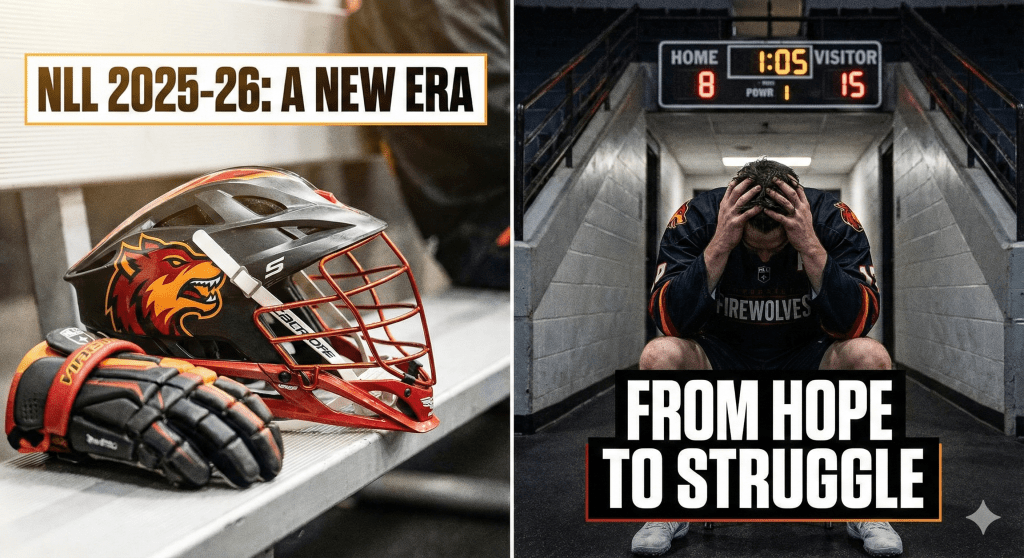
1. Executive Introduction: The Collision of Expectation and Reality
The 2025-26 National Lacrosse League (NLL) season was set to be pivotal. It promised to be a watershed moment for professional lacrosse in the Durham Region. The franchise formerly known as the Albany FireWolves relocated to Oshawa, Ontario. This was not just a mere change of address. It was a strategic repatriation of the sport to one of its most fertile historical grounds.1 The narrative constructed by the league and the organization was one of homecoming and immediate contention. The FireWolves were not arriving in Oshawa as a broken expansion project. They were not desperate for identity. They arrived as the reigning NLL finalists. The team had defied the odds in 2024 to come within a single victory of a championship.1
The opening month of this new era has not been defined by triumph. Instead, it has been marked by a jarring dissonance between expectation and performance. In the first four weeks, the Oshawa FireWolves achieved only one win. They suffered three losses. This puts them near the bottom of the league standings with a 1-3 record.3 More concerning than the win-loss record itself is the manner in which these defeats have occurred. The team was once celebrated for its dynamic, youthful offense. Now, they have experienced a catastrophic collapse in production. This has resulted in a league-worst goal differential of -14.3
This report serves as an exhaustive operational and strategic audit of the Oshawa FireWolves’ current trajectory. The main goal is to respond to the pressing question circulating among the fanbase and stakeholders. Does this slow start necessitate a change in leadership? Specifically, does it involve Head Coach and General Manager Glenn Clark? To answer this, we must look beyond the surface-level metrics of the standings. We must dissect the systemic failures of the offense. We should assess the psychological impact of relocation. Additionally, the roster construction philosophy must be analyzed. Furthermore, we need to consider the historical precedents of Clark’s tenure. The analysis suggests that the current product is failing to meet the market’s demands. However, the situation is nuanced. It involves a complex interplay of “sophomore slumps,” tactical rigidity, and the inevitable friction of transplanting a franchise.
2. The Geopolitical and Economic Context of Relocation
To fully appreciate the pressure mounting on the coaching staff, one must understand the stakes of the franchise’s move. The decision to leave Albany for Oshawa fundamentally altered the operating parameters and success criteria for the organization.
2.1 The “Lacrosse Capital” Imperative
Oshawa and the broader Durham Region hold a mythical status in the world of box lacrosse. The area is home to legendary feeder programs. These include the Whitby Warriors, the Clarington Green Gaels, and the Brooklin Lacrosse Club.4 The sport has deep Indigenous roots in the region. These roots date back centuries. The modern club infrastructure has produced a disproportionate number of NLL professionals.1
The NLL announced the relocation. Commissioner Brett Frood described Oshawa as “one of the core epicenters of the indoor lacrosse world”.1 This designation comes with a heavy burden. In Albany, the FireWolves were operating in a market where lacrosse was a growing curiosity. The team struggled with attendance even though they had on-floor success.6 In Oshawa, the fanbase is sophisticated, educated, and critical. They understand the nuances of the two-man game, defensive rotations, and transition offense.
Consequently, the “grace period” typically afforded to relocated teams is nonexistent in Oshawa. The fans do not need to be taught the rules. They must be convinced that the product is worthy of their money. It should also be worthy of their emotional investment. A 1-3 record shows anemic scoring. It is not viewed as “growing pains.” Instead, it is seen as a failure to utilize the talent available. The pressure on Glenn Clark is therefore amplified by the location. He is not just coaching a team. He is auditioning for the trust of a community. This community considers itself the custodians of the sport.
2.2 The Infrastructure of the Move
The move to the Tribute Communities Centre represented a significant upgrade in terms of specialized support. It also necessitated a shift in logistics. The City of Oshawa committed $50 million to renovations to modernize the facility, signaling a long-term partnership.5 The franchise was led by owner Oliver Marti. It incurred “meaningful” expenses to execute the relocation. These expenses were driven by the untenable economics of remaining in Albany.5
This financial context is relevant to the coaching discussion. The organization needs to sell tickets immediately to justify the relocation costs. A boring, low-scoring team is a difficult sell, even in a lacrosse hotbed. The attendance figures and community engagement metrics are inextricably linked to on-floor performance. If the team keeps losing games with scorelines like 11-2, the marketing campaign’s enthusiasm will fade. This could also happen with 9-5 losses. This could occur before the mid-season mark.
2.3 The “Youngest Team” Brand Identity
The organization has leaned heavily into a brand identity centered on youth. Marketing materials and press releases frequently cite the FireWolves as the “youngest team in the NLL”.2 This is a double-edged sword for the coaching staff.
- The Upside: It buys patience. Management can frame losses as “developmental experiences” necessary for long-term dominance.
- The Downside: It creates volatility. Young players, lacking the callous of experience, are prone to emotional swings and performance variances.
Coach Clark is not merely a tactician; he is a developer of talent. The current crisis tests his ability to manage the psyche of a young locker room. The team went from the high of a Finals appearance. They quickly fell to the low of a losing streak in a matter of months.
3. The Architect: Evaluating Glenn Clark’s Tenure and Philosophy
Any discussion regarding a coaching change must begin with a thorough examination of the incumbent. Glenn Clark is not a journeyman placeholder. He is the architect of the franchise’s current identity. He is arguably its most valuable asset.
3.1 The Dual Role: General Manager and Head Coach
Clark holds the dual title of General Manager and Head Coach.8 This consolidation of power is significant. In this structure, Clark the GM drafts the players, and Clark the Coach deploys them. There is no disconnect between the front office and the bench; the vision is singular.
- Implication for Dismissal: Firing a Coach/GM is organizationally traumatic. It requires untangling the entire lacrosse operations department. The owner, Oliver Marti, would likely need to step in directly. Alternatively, he could hire an interim GM to evaluate the coaching staff. This is a messy process in the middle of a season.
- Accountability: Conversely, this dual role means Clark has nowhere to hide. He cannot blame the GM for providing him with inadequate players, because he is the GM. The roster construction is entirely his design.
3.2 The Historical Track Record: A Cycle of Resurrection
Clark’s resume suggests a specific capability: the ability to engineer turnarounds. His career is defined by resilience and tactical adaptation.
- The Toronto Rock Era: As a player, he was a defensive cornerstone for the Toronto Rock dynasty. He won five NLL championships.9 He knows what a winning culture looks like from the inside.
- The New England/Albany Pivot: Clark successfully led the New England Black Wolves to the playoffs in five consecutive seasons. He achieved this before their relocation to Albany.9
- The 2024 Miracle: The most compelling argument for Clark’s retention is the 2023-24 season. In 2022-23, the Albany FireWolves finished dead last with a 3-15 record.10 Most organizations would have fired the coach then. Instead, Albany retained Clark. He responded by leading the exact same core to an 11-7 record. They made an NLL Finals appearance the very next year. This achievement earned him both the NLL Coach of the Year and NLL General Manager of the Year awards.9
Strategic Insight: This historical context is the “shield” protecting Clark right now. He has shown his ability in the past 12 months. He can take a losing team and turn them into a contender without changing the personnel. Ownership is likely viewing the current 1-3 start. They are comparing it through the lens of the 3-15 season. They trust that Clark has the roadmap to correct course.
3.3 The Coaching Staff Ecosystem
Clark does not operate in a vacuum. His coaching staff features long-time collaborators who provide continuity and specialized expertise.
- Clem D’Orazio (Assistant GM / Assistant Coach): D’Orazio has been with Clark since their days with the Toronto Beaches Jr. A club and the New England Black Wolves.11 He is deeply integrated into the defensive schemes and player personnel decisions.
- Darryl Gibson (Offensive Coordinator): A former teammate of Clark’s on the Toronto Rock, Gibson handles the offense.12 Given the current offensive struggles, Gibson is likely under more immediate pressure than Clark.
This tight-knit group represents stability, but it can also lead to a phenomenon known as “groupthink.” If the offensive systems are stale, the staff might not introduce fresh ideas easily. A team working together for over a decade could resist change. This situation might make it difficult to break the slump.
4. Anatomy of the Collapse: A 2025-26 Season Autopsy
We must determine if the current struggles are a blip or a trend. To do this, we need to dissect the first four games of the season with granular detail. The data reveals a team that is defensively sound but offensively broken.
4.1 Game 1: The Mirage of Stability vs. Toronto Rock (Nov 28, 2025)
- Result: Win, 8-7.13
- Narrative: The home opener at the Tribute Communities Centre was an emotional high. Playing against their geographic rivals, the Toronto Rock, the FireWolves secured a gritty, low-scoring victory.
- The Stats: The scoreline (8-7) was a throwback to defensive battles of the past. Goaltender Doug Jamieson was the star, anchoring the defence.
- The Warning Signs: Even in victory, the offense only managed 8 goals. They relied on a game-winner from Ethan Walker late in the fourth quarter. The transition game was limited, and the half-court sets were often disjointed. At the time, this was attributed to “first-game jitters.” The quality of the Rock’s defence, led by Nick Rose, was also a factor. In hindsight, it was the first data point of an offensive deficiency.
4.2 Game 2: The Catastrophe in Halifax (Dec 5, 2025)
- Result: Loss, 2-11.14
- Narrative: This game serves as the primary exhibit for the “crisis” narrative. Scoring only two goals in a professional lacrosse game is statistically aberrant.
- The Stats:
- Shots on Goal: Oshawa took 51 shots.15
- Goals Scored: 2.
- Shooting Percentage: ~3.9%.
- Power Play: 1-for-7.15
- Tactical Failure: The FireWolves were completely stifled by Halifax’s defence. Despite generating shot volume (51 shots), the quality of these shots was poor. The offense failed to penetrate the middle, settling for perimeter shots that Halifax goaltender Warren Hill easily absorbed. The power play, converting only once on seven opportunities, showed a lack of creativity and execution. This game exposed the offense not just as “cold,” but as structurally unsound against elite competition.
4.3 Game 3: Stagnation vs. Georgia Swarm (Dec 13, 2025)
- Result: Loss, 5-9.16
- Narrative: Hoping for a bounce-back, the FireWolves traveled to Georgia and produced another single-digit scoring effort.
- The Stats:
- Alex Simmons: Scored 3 goals (Hat Trick).16
- Rest of Team: Scored 2 goals.
- Goaltending: Doug Jamieson made 37 saves, keeping the team in the game despite the offensive ineptitude.
- Tactical Failure: This game highlighted the team’s over-reliance on individual brilliance. Alex Simmons had to play hero ball to generate offense. The secondary scoring—vital for any NLL team—was non-existent. The snippets mention “offensive woes” continuing and a failure to capitalize on transition opportunities.17
4.4 Game 4: The Home Disappointment vs. Vancouver (Dec 19, 2025)
- Result: Loss, 6-8.17
- Narrative: The team returned home to Oshawa. They faced a Vancouver Warriors squad they needed to beat. This victory was crucial to stabilize the season. Instead, they dropped their third straight game.
- The Stats: Another offensive output of under 10 goals. The defense held Vancouver to 8, which should be enough to win, but the offense could only muster 6.
- The Trend: Four games. Goal totals of 8, 2, 5, 6. The FireWolves are averaging 5.25 goals per game. The league average typically hovers around 11-12. This is not a slump; it is an offensive emergency.
This game hurt. The team was off to a great start. They just could not hold it together to get the win. Plus, I was at this game with my children.

5. Tactical Diagnosis: Why Can’t They Score?
The consistency of the offensive failure points to specific tactical issues rather than random variance.
5.1 The “Same-Side” Stagnation
Following the Halifax loss, Head Coach Glenn Clark identified a specific tactical flaw: “Too many same-side possessions.”.20
- The Mechanics: In box lacrosse, the offense must force the defence to rotate and the goaltender to move laterally. This is achieved by swinging the ball “east-to-west” (from one side of the floor to the other) rapidly.
- The Failure: The FireWolves are trapping the ball on one side of the floor. This allows the defence to overload that side without fear of being exposed on the backside. It allows goaltenders to set their feet and square up to shooters, drastically reducing the shooting percentage.
- Coaching Responsibility: Clark identified the issue. However, its persistence through Week 4 suggests a failure in coaching correction. Either the players are not executing the adjustments, or the adjustments are not being drilled effectively in practice.
5.2 The Collapse of the Two-Man Game
The FireWolves’ offense is predicated on the chemistry between Alex Simmons and Dyson Williams.
- 2024 Success: In the previous season, Simmons and Williams utilized a lethal pick-and-roll game.
- 2025 Reality: Opposing defences have adapted. They are switching aggressively on picks or double-teaming Simmons to force the ball out of his hands. The coaching staff has failed to implement a counter-strategy (e.g., slip picks, off-ball seals) to punish these defensive adjustments.
5.3 Power Play Ineptitude
The special teams unit is a microcosm of the broader struggles. Going 1-for-7 against Halifax 15 is indicative of a unit that lacks a clear plan.
- Static Formation: The power play unit appears static, relying on perimeter passing rather than player movement. Penalty kill units can expand their box without a threat to drive the middle. They can pressure the shooters, leading to low-quality shots or turnovers.
6. Personnel Analysis: The Roster’s Role in the Crisis
A coach is only as good as his players. Is the roster construction at fault?
6.1 The Sophomore Slump: Alex Simmons and Dyson Williams
The “Youngest Team” narrative relies on the continued ascent of its young stars.
- Alex Simmons: The 2024 Rookie of the Year is finding his sophomore season difficult. While he scored a hat trick against Georgia 16, his efficiency is down. He is often forcing shots through double teams, a sign of a player trying to do too much.
- Dyson Williams: The 2025 Rookie of the Year has been largely neutralized. Without the space he enjoyed last season, he has struggled to create his own shot.
- The Verdict: This is a classic “sophomore slump.” The league has tape on them now. The players need to evolve their games, but the coaching staff needs to put them in better positions to succeed.
6.2 The Goaltending Savior: Doug Jamieson
If there is one reason to believe the season is salvageable, it is Doug Jamieson.
- Performance: Jamieson has been elite. His save totals and save percentage are championship-calibre.21
- Strategic Implication: Jamieson’s performance proves that the defensive system (coached by Clark and D’Orazio) is working. The team is not losing because of defensive breakdowns; they are losing solely because of the offense. This insulates Clark from criticism regarding the defensive side of the ball.
6.3 The Kyle Jackson Release: A Message Sent
In a significant roster move, the FireWolves released veteran forward Kyle Jackson in December.22
- Significance: Jackson was a veteran presence meant to stabilize the young offense. His release signals that Clark is not sitting idly by. He is willing to cut veterans to shake up the room.
- Risk: Removing a veteran voice from a young locker room during a losing streak is risky. It places even more pressure on the young leaders (Simmons/Kurtz) to fill the void.
6.4 The Defensive Anchor: Kyle Rubisch
The offseason signing of Kyle Rubisch 23, a four-time Defensive Player of the Year, has paid dividends. His presence has stabilized the back end and aided Jamieson. This signing demonstrates that Clark (as GM) is capable of attracting and integrating elite talent.
7. The Verdict: Is a Coaching Change Required?
Based on the synthesis of the 2025-26 performance data, historical context, and roster realities, we weigh the arguments.
7.1 The Argument for Change (The “Panic” Button)
- Offensive Incompetence: The offense is historically bad. If the team cannot score more than 6 goals a game, they will not win. If the current staff cannot fix the “east-west” ball movement issue after four weeks, they may be out of ideas.
- Market Pressure: A 1-3 start in a new market is damaging. To retain the season ticket base, ownership might make a “splash” move. This action is to demonstrate seriousness about winning.
- Availability: The market is thin. However, there are always experienced lacrosse minds available. Notably, Bruce Alexander was just hired by Victoria 24, removing one top candidate.
7.2 The Argument for Retention (The “Patience” Path)
- The 2024 Precedent: Glenn Clark turned a 3-15 team into a finalist in one year. He has earned the benefit of the doubt.
- The Defence is Elite: Teams that have quit on their coach do not play defence like the FireWolves are playing. The effort level is high; the execution is the issue.
- Disruption Cost: Firing the GM/Coach destabilizes the entire franchise. It creates chaos in the front office and the locker room.
- Roster Youth: Young teams are volatile. Firing the coach for the inconsistencies of 21-year-old players is a shortsighted move that could stunt their development.
7.3 The Final Recommendation
A coaching change is NOT required at this time.
The struggles of the Oshawa FireWolves are severe, but they are diagnosable and correctable. The team possesses an elite defence and a world-class goaltender—the two hardest things to find in the NLL. The offensive struggles stem from a young core hitting a developmental wall. The tactical system needs simplification, not detonation.
Glenn Clark remains the best person to lead this group. His track record of developing talent and navigating adversity is exactly what is needed right now. Letting him go four games into the relocation would be a rash decision. This ignores the context of the team’s construction. It also overlooks the realities of the NLL.
8. Strategic Path Forward: Corrective Measures
While the coach should stay, the status quo cannot continue. The following strategic adjustments are critical for the FireWolves to salvage the 2025-26 campaign:
8.1 Tactical Overhaul on Offense
The coaching staff must implement a simplified offensive scheme immediately.
- Focus: Abandon the complex motion sets that are resulting in stagnation. Shift to a high-tempo transition game that utilizes the speed of players like Colton Watkinson and Will Johansen.20
- Action: Force the ball inside. The team needs to sacrifice shot volume for shot quality. This requires more off-ball picks. Physical play in the middle of the floor is also needed to create lanes for Simmons and Williams.
8.2 The Power Play Reset
Special teams must be the priority in practice. The unit needs to be rebuilt from scratch. This could involve simplifying the formation to a classic “umbrella.” The goal is to get the ball in the hands of the best shooters with time and space.
8.3 Roster Reinforcement
As GM, Clark needs to be active. The release of Kyle Jackson created roster space.
- Target: A veteran left-handed offensive coordinator on the floor—a player who can distribute the ball and calm the offense down.
- Trade Market: The trade deadline is approaching later in the season. Clark should explore moving draft capital. This will bring in immediate offensive help.
9. Conclusion
The Oshawa FireWolves are currently a team at war with itself—an elite defensive unit shackled to a non-functional offense. The disappointment of the 1-3 start is palpable, especially given the fanfare of the relocation. However, the foundational pieces for success are present. In Doug Jamieson, they have a goaltender capable of stealing games. In Glenn Clark, they have a coach with a proven history of navigating exactly this type of adversity.
The “Lacrosse Capital” of Canada demands a winner, and the patience of the Oshawa faithful is not infinite. But true contenders are built through stability, not reactionary firings. The FireWolves should stay the course with Glenn Clark. They should bet that the talent he assembled will find its rhythm. This should happen before the playoff window closes. The season is young. In the NLL, a hot goaltender and a few tactical tweaks often separate a slump from a championship run.
| Metric | Oshawa FireWolves (2025-26) | League Average (Est.) | Status |
| Goals Per Game | 5.25 | ~11.5 | Critical Failure |
| Goals Against Per Game | 8.75 | ~11.5 | Elite |
| Goal Differential | -14 | 0 | Poor |
| Power Play % | ~14% (Est.) | ~45-50% | Critical Failure |
| Save Percentage | >80% | ~76-78% | Elite |
Table 1: Key Performance Indicators for the First Four Weeks of the 2025-26 Season.
Works cited
- National Lacrosse League’s Albany FireWolves moving to Oshawa | CBC News, accessed December 22, 2025, https://www.cbc.ca/news/canada/toronto/national-lacrosse-league-albany-firewolves-moving-oshawa-1.7613592
- OSHAWA FIREWOLVES OFFICIALLY ANNOUNCED AS NAME OF NLL FRANCHISE, accessed December 22, 2025, https://www.tributecommunitiescentre.com/news/detail/oshawa-firewolves-officially-announced-as-name-of-nll-franchise
- 2025-26 NLL Standings – Lacrosse – TSN, accessed December 22, 2025, https://www.tsn.ca/lacrosse/nll/standings/
- Relocated Oshawa NLL Franchise Retains ‘FireWolves’ Nickname, Logo, accessed December 22, 2025, https://news.sportslogos.net/2025/09/09/relocated-oshawa-nll-franchise-retains-firewolves-nickname-logo/other/
- FireWolves professional lacrosse team relocates to Oshawa | The Chronicle, accessed December 22, 2025, https://chronicle.durhamcollege.ca/2025/09/firewolves-professional-lacrosse-team-relocates-to-oshawa/
- Reports: NLL’s FireWolves relocating to Oshawa for 2025-26 season, accessed December 22, 2025, https://www.tsn.ca/lacrosse/nll/reports-nll-s-firewolves-relocating-to-oshawa-for-2025-26-season-1.2347764
- Oshawa FireWolves – Wikipedia, accessed December 22, 2025, https://en.wikipedia.org/wiki/Oshawa_FireWolves
- Coaching Staff – Oshawa FireWolves, accessed December 22, 2025, https://oshawafirewolves.com/team/coaching-staff/
- Glenn Clark – Oshawa FireWolves, accessed December 22, 2025, https://oshawafirewolves.com/staff/glenn-clark/
- 2023 Albany FireWolves season – Wikipedia, accessed December 22, 2025, https://en.wikipedia.org/wiki/2023_Albany_FireWolves_season
- Clem D’Orazio – Oshawa FireWolves, accessed December 22, 2025, https://oshawafirewolves.com/staff/clem-dorazio/
- Darryl Gibson – Oshawa FireWolves, accessed December 22, 2025, https://oshawafirewolves.com/staff/darryl-gibson/
- Oshawa FireWolves vs. Toronto Rock – Philadelphia Wings Lacrosse, accessed December 22, 2025, https://wingslax.com/game/703329312/toronto-rock-vs-oshawa-firewolves/2025-11-28/
- accessed December 22, 2025, https://www.halifaxthunderbirds.com/news/detail/hill-thunderbirds-stymie-firewolves-for-season-opening-win#:~:text=HALIFAX%2C%20NS%20(December%205%2C,assists%20and%20one%20insurance%20goal.
- Halifax Thunderbirds vs. Oshawa FireWolves – Game – NLL, accessed December 22, 2025, https://www.nll.com/game/703344673/oshawa-firewolves-vs-halifax-thunderbirds/2025-12-05/
- SIMMONS SCORES THREE IN FIREWOLVES LOSS TO SWARM, accessed December 22, 2025, https://oshawafirewolves.com/news/simmons-scores-three-in-firewolves-loss-to-swarm/
- Weekend Fastbreak | Week 4 – NLL, accessed December 22, 2025, https://www.nll.com/news/weekend-fastbreak-week-4/
- Swarm Run Rampant in 9-5 Win; FireWolves Offensive Woes …, accessed December 22, 2025, https://www.reddit.com/r/NLL/comments/1pmefjp/swarm_run_rampant_in_95_win_firewolves_offensive/
- Standings – Oshawa FireWolves, accessed December 22, 2025, https://oshawafirewolves.com/schedule/standings/
- AFTER A TOUGH FIRST ROAD GAME, THE FIREWOLVES ARE READY TO BOUNCE BACK, accessed December 22, 2025, https://oshawafirewolves.com/news/after-a-tough-first-road-game-the-firewolves-are-ready-to-bounce-back/
- FIREWOLVES PLAYERS, HEAD COACH, & OWNER NAMED FINALISTS FOR NLL AWARDS, accessed December 22, 2025, https://oshawafirewolves.com/news/firewolves-players-head-coach-owner-named-finalists-for-nll-awards/
- National Lacrosse League News | NLL – Oshawa FireWolves, accessed December 22, 2025, https://oshawafirewolves.com/news/
- FIREWOLVES SET TO BEGIN 2025-2026 TRAINING CAMP PRESENTED BY VANGUARD ATHLETIC PERFORMANCE, accessed December 22, 2025, https://oshawafirewolves.com/news/firewolves-set-to-begin-2025-2026-training-camp-presented-by-vanguard-athletic-performance/
- Former assistant Bruce Alexander named Shamrocks head coach – Victoria Times Colonist, accessed December 22, 2025, https://www.timescolonist.com/sports/former-assistant-hamilton-named-shamrocks-head-coach-11652440

 ScortonBoy17.ca
Leave a comment