Introduction: The Perfect Storm
The 2025 Formula 1 season began with the expectation of a papaya-hued procession. Instead, it has delivered a perfect storm. After twenty rounds of breathtaking racing, the championship has been distilled into its purest and most volatile form. It is now a three-way battle for the ultimate prize. This battle is poised to be decided over a grueling four-race finale. The recent Mexico City Grand Prix was not merely another race; it was a seismic shift in the championship landscape. Lando Norris, after a masterful drive, seized the championship lead. However, his victory was met with the boos of a partisan crowd. This reaction is a stark reminder of the immense pressure that now rests on his shoulders. The result has left the Formula 1 world on a knife’s edge. It sets the stage for an explosive conclusion to one of the most compelling title fights in a generation.
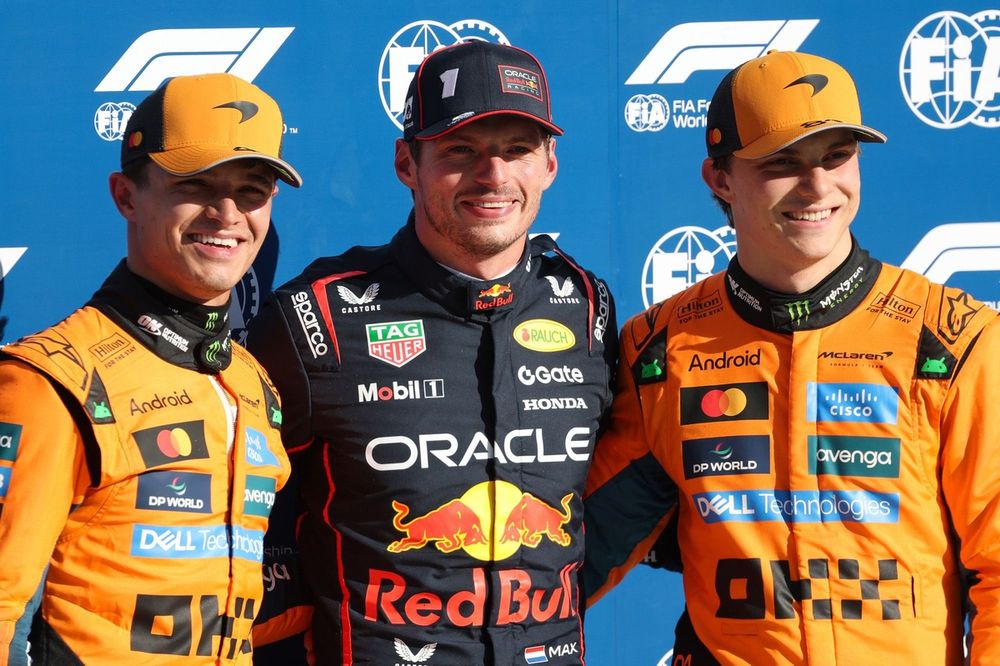
The protagonists in this high-stakes drama are a study in contrasts. Lando Norris is a prodigious talent. He has finally translated years of promise into a sustained title challenge. He finds himself at the summit by the slimmest of margins. His primary rival is not in another garage. Instead, the rival is on the other side of his own garage. It is Oscar Piastri, the unflappable Australian prodigy. Piastri has taken the sport by storm, challenging for the title in only his third season. Lurking just behind them is Max Verstappen. He moves with the relentless momentum of a predator sensing weakness. Verstappen is a formidable four-time World Champion. The points differential is perilously small, a testament to a season of fluctuating fortunes and relentless competition.
| Position | Driver | Team | Points |
| 1 | Lando Norris | McLaren | 357 |
| 2 | Oscar Piastri | McLaren | 356 |
| 3 | Max Verstappen | Red Bull Racing | 321 |
This is more than a simple contest of speed. It is a complex psychological battle. It is also a technological war fought on multiple fronts. The first narrative is a deeply human one. It depicts an intense intra-team battle at McLaren. Two drivers are navigating their first-ever title fight. They are being hunted by one of the most decorated champions in the sport’s history. The pressure is multifaceted and immense. The second is a war of philosophies waged in the design offices and wind tunnels of Woking and Milton Keynes. McLaren has taken a high-stakes strategic gamble. They halted in-season development of their 2025 car. This is to focus on the monumental 2026 regulation changes. In stark opposition, Red Bull Racing is mounting an all-out final assault. They are continuing to bring a stream of upgrades to its RB21. They aim to power Verstappen to a fifth crown. This fundamental divergence in strategy has become the central issue at the season’s end. It is a high-stakes chess match. The next move could prove decisive.
A Tale of Three Drivers
The Leader by a Thread: Lando Norris
After years of being heralded as a future champion, Lando Norris has finally arrived. His 2025 season has been a masterclass in consistency and speed. It culminated in his ascent to the top of the driver’s standings. This happened after a commanding victory in Mexico. This is not the Norris of previous seasons. This is a driver who has matured. He has eradicated the minor errors. He is now harnessing his raw talent to become a formidable championship contender. His journey to this point has been one of steady progression. It began with his maiden podium in 2020. It continued to his first win in 2024. He has built the experience and resilience necessary to lead a team like McLaren.
Yet, his position is uniquely precarious. The greatest threat to his championship ambition comes from within his own team. This is a psychological burden that few champions have had to bear so intensely. The boos he faced on the Mexico podium are a warning of the external pressures he must handle now. He is the man to beat. His historical performance at the final four circuits is a mixed bag that reflects this challenge. He has mastered the finale venue with a previous win at Yas Marina. He has also proven his one-lap pace with a pole position at Interlagos. However, his points haul from Las Vegas and Lusail has been comparatively modest. This suggests these could be weekends of damage limitation rather than outright attack. For Norris, the final four races are not just a test of speed. They are also a profound test of his mental fortitude.
The Prodigy’s Challenge: Oscar Piastri
Oscar Piastri is the ultimate disruptor. His career has been defined by an almost unprecedented ability to win. He claimed the Formula 3, Formula 2, and Formula Renault Eurocup championships in his rookie seasons. His 2025 campaign is remarkable. He achieved an incredible seven wins and fourteen podiums. This success shows that his winning trait has translated seamlessly to the pinnacle of motorsport. Piastri’s racing style is a blend of aggressive, decisive racecraft. He maintains a calm composure that belies his relative inexperience. He is the junior driver in the McLaren lineup. Yet, he has mounted a title challenge. It is, in every measure, equal to that of his more senior teammate.
This dynamic creates a fascinating internal conflict. Piastri does not race like a number two. He races to win. This mindset was forged in the crucible of his dominant junior career. His record at the upcoming circuits is particularly telling. While he has less F1 experience than his rivals, he excels at the Lusail International Circuit. He secured two podiums in his two appearances there. This suggests the high-speed, aero-dependent nature of the track suits his driving style perfectly. He has also been a consistent points-scorer at the other venues, proving his adaptability. Piastri’s challenge is not just about raw talent; it is about a champion’s mentality. He has proven his resilience under pressure many times. This makes him arguably the most dangerous driver in the fight.
The Hunter: Max Verstappen
Max Verstappen enters the final phase of the season as the apex predator of the Formula 1 grid. As a four-time World Champion with 68 career victories, his experience in high-stakes championship battles is unparalleled. While Norris and Piastri are navigating this territory for the first time, for Verstappen, it is familiar ground. He has an almost psychological advantage. He possesses an innate ability to absorb immense pressure. He delivers flawless, dominant performances when it matters most. This was never more evident than in his title-deciding victory at Yas Marina in 2021. That race has become part of Formula 1 folklore.
His historical data at the final four circuits is nothing short of formidable. He has three wins at Interlagos, one in Las Vegas, two at Lusail, and four at Yas Marina. He has tasted victory at every single one of the remaining venues. This is a driver who knows how to win on these specific battlegrounds. For much of the season, the Red Bull RB21 was a step behind the McLaren. However, a relentless, late-season development push has transformed the car. This resurgence has unleashed Verstappen. It turned him from a distant threat into the clear and present danger to the McLaren duo. He is no longer just chasing. He is hunting. History has shown that when Verstappen is in this mode, he is nearly unstoppable.
The one-point gap between the McLaren teammates creates a perilous dynamic, a classic “prisoner’s dilemma” on a global stage. Both drivers know they must beat the other to win their first world title. They are also aware that any on-track incident would be catastrophic. Any overly aggressive defense or optimistic lunge could lead to disaster. Taking each other out of a race would not just harm their individual campaigns. It would also directly benefit their common enemy. This could potentially gift-wrap the championship for Verstappen. This forces McLaren’s management into an incredibly difficult position. Do they risk it all by letting their drivers engage in a “gloves-off” battle? Or, do they use team orders to secure at least one title for the team? This internal psychological and strategic conflict may prove to be a greater threat to their championship hopes than Verstappen himself.
The War Room: McLaren’s Gamble vs. Red Bull’s Final Assault
McLaren’s Calculated Risk
The paddock is in shock. McLaren Team Principal Andrea Stella has confirmed that the development tap for the 2025 MCL39 has been turned off. There will be no further major upgrades for the remainder of the season. The entire team has shifted its focus. This includes everyone from its aerodynamicists to its manufacturing department. They are concentrating on the monumental regulation overhaul set for 2026. This decision is the strategic crux of the championship fight. It is a high-stakes gamble. They believe their current package is strong enough to hold off a charging Red Bull. They also think that having a head start on 2026 is beneficial for the long-term. This benefit outweighs the risk of losing the 2025 crown.
This is not a decision born of weakness, but of a calculated assessment of diminishing returns. Stella has publicly stated that continuing to push 2025 development would “heavily compromise” the 2026 project. This suggests the team believes their current car concept has reached a state of maturity. Further gains would be marginal and resource-intensive. His insistence was clear. Norris possessed the underlying pace to win in Austin, despite the lack of new parts. McLaren sent a message: The fight will be won not with new hardware, but with flawless execution. They value superior strategy and a deeper understanding of their existing package. They are betting on consistency and operational excellence to carry them over the line.
Red Bull’s Relentless Offensive
The lights are being turned off in McLaren’s development department. Meanwhile, the factory in Milton Keynes is burning brighter than ever. Red Bull has adopted the diametrically opposite strategy, engaging in a relentless late-season offensive. An official FIA document submitted before the Mexican Grand Prix revealed new components for the RB21. These include updates to the front corner. The engine cover and floor body were also updated. This effort continued the development push after the summer break. It has systematically transformed the car’s performance. This transformation allowed Verstappen to win three of the last four races.
Red Bull’s strategy is about more than just adding raw downforce. The upgrades aim to widen the car’s operational window. This makes the car more adaptable. It is also easier to set up across the varied circuits of the season finale. In the past, the car may have struggled with certain corner types or tyre behaviors. These new parts aim to iron out those inconsistencies. This adaptability could be their trump card. McLaren must perfect the setup of a known quantity. In contrast, Red Bull arrives at each weekend with a car that is still evolving. This evolution potentially unlocks new levels of performance.
The divergence in these two strategies is a fascinating reflection of each team’s position. McLaren has led the championship for most of the year. They feel their car has matured. They believe further development would yield diminishing returns. This makes the pivot to 2026 a logical, if risky, choice. Red Bull, having spent much of the year chasing, likely felt their car concept had more untapped potential. They saw a “more margin to develop efficiently,” as Stella himself speculated. They may also believe their experiences from pushing the 2025 car to its absolute limits are valuable. Understanding complex aerodynamic philosophies and tire behaviors under pressure provides data points. These can inform their 2026 design process. It is a fundamental disagreement. The best way to prepare for a new era of Formula 1 is debated. The 2025 Driver’s Championship is the immediate and spectacular battleground.
The Battlegrounds: A Four-Act Finale
The final four races present a diverse and demanding set of challenges. They are a quartet of distinct battlegrounds that will test every aspect of car performance. Driver skill will also be put to the test. The high-altitude chaos of Brazil contrasts with the high-speed glitz of Las Vegas. The abrasive, high-G corners of Qatar challenge drivers further. Finally, there is the ultimate pressure of the twilight showdown in Abu Dhabi. There is nowhere to hide. Two of these final four weekends will feature the F1 Sprint format. This adds another layer of complexity and opportunity. A maximum of 34 points is available to a single driver on those weekends alone.
| Race | Circuit | Key Feature | Special Format | Likely Challenge |
| São Paulo GP | Autódromo José Carlos Pace | Anti-clockwise, high altitude, unpredictable weather | Sprint Weekend | Setup Compromise, Tyre Wear |
| Las Vegas GP | Las Vegas Strip Circuit | Ultra-high speed street circuit, long straights | None | Tyre Warm-up, Low Downforce Setup |
| Qatar GP | Lusail Int. Circuit | Fast, flowing, high aero-dependency | Sprint Weekend | High Tyre Degradation, Track Limits |
| Abu Dhabi GP | Yas Marina Circuit | Twilight race, reconfigured layout | Finale | Evolving Track Conditions, Ultimate Pressure |
Round 21: São Paulo – The Interlagos Cauldron (Sprint Weekend)
The Autódromo José Carlos Pace, universally known as Interlagos, is a circuit steeped in history and drama. Its unique character is defined by an anti-clockwise direction, placing unusual physical strain on the drivers’ necks. It is a rarity. The dramatic elevation changes snake through the hills of São Paulo. The lap begins with a plunge into the iconic Senna ‘S’. This challenging left-right-left sequence is a prime overtaking spot. After this, the track heads down the long Reta Oposta straight. The middle sector is a tight, technical, and twisty sequence of corners. It demands high downforce and a nimble chassis. Then, the track climbs steeply through the final long, sweeping corner onto the main straight. The challenges are increased by the notoriously fickle weather. Tropical downpours can materialize in minutes. They can turn the race on its head.
The inclusion of the Sprint format at Interlagos makes it a weekend of immense strategic importance. With only a single 60-minute practice session before the cars are locked into Parc Fermé, teams face a monumental challenge. They must find a setup that provides low-drag straight-line speed for the long blasts in sectors one and three. At the same time, they need enough downforce to be competitive in the twisty sector two. This is a classic setup compromise, and the Sprint format compresses the time to perfect it to almost nothing. A wrong call on Friday morning could cripple a driver’s entire weekend. For example, setting the car up for a dry track only for rain to arrive later. For the title contenders, this poses a massive risk increase. A single misstep could lead to a disastrous points loss.
In the championship calculus, this track could favor any of the three contenders. Verstappen has a formidable record here with three victories. Norris has proven he can be exceptionally fast, having previously secured pole position. Piastri’s record is less established, making this a key test for him. The long straights should suit the upgraded, slippery Red Bull. However, the flowing, technical middle sector has been McLaren’s traditional territory.
Round 22: Las Vegas – High Stakes on the Strip
The Las Vegas Grand Prix is an outlier, a unique spectacle of speed and glamour. The 3.8-mile (6.2 km) street circuit is defined by its immense 1.2-mile (1.9 km) straight down the iconic Las Vegas Strip, where cars will reach speeds in excess of 215 mph (346 kph). The layout features 17 corners. Many of these are slow, 90-degree bends that punctuate the long straights. These bends demand immense braking performance and traction. The event is a night race held in the desert in late November. It presents a singular technical challenge: cold ambient temperatures.
The primary strategic consideration in Las Vegas is tyre management, specifically tyre warm-up. In the cold, getting the tyres into their optimal temperature window is exceptionally difficult, particularly for a single qualifying lap. Drivers will struggle for grip, and the risk of lock-ups and errors will be high. Teams will be forced to run extreme low-downforce setups to maximize their potential on the long straights. However, this setup will compromise braking stability. It will also affect grip in the slow-speed corners. The street circuit is tight and unforgiving. Keeping tyres warm is also difficult. These factors make the probability of Safety Car interventions extremely high. It adds another layer of strategic unpredictability to the race.
Verstappen won the chaotic inaugural race here in 2023. He proved he can navigate the challenges and emerge on top. Both Norris and Piastri have struggled in Vegas. This track may be a potential bogey for them. On paper, the circuit’s emphasis on straight-line speed and power should heavily favor the Red Bull’s efficient aerodynamic package. This race may be the biggest hurdle for McLaren in the final run-in. It also offers a prime opportunity for Verstappen to make significant inroads in the championship fight.
Round 23: Qatar – Desert Duel Under the Lights (Sprint Weekend)
The Lusail International Circuit is a modern, purpose-built facility that presents a very different challenge. It is a fast, flowing track defined by its relentless sequence of medium- and high-speed corners. The 3.367-mile (5.419 km) layout puts enormous energy through the tyres, particularly the sweeping triple-apex right-hander at Turns 12, 13, and 14, which is one of the most demanding complexes on the calendar. The main straight is over a kilometer long, offering a crucial DRS-assisted overtaking opportunity into Turn 1.
As the final Sprint weekend of the season, the stakes in Qatar are astronomical. The single most critical factor at Lusail is tyre degradation. The high lateral G-forces generated through the fast corners place immense strain on the rubber. Managing tyre life over both the 100km Sprint and the full Grand Prix is paramount to success. In previous races here, tyre wear has been a major storyline. Several failures in the inaugural event highlighted the extreme nature of the circuit. Furthermore, track limits are notoriously difficult to enforce at Lusail. The wide, inviting run-off areas tempt drivers to push beyond the white lines. This adds another potential source of penalties and controversy. Such issues could have championship implications.
This circuit is a proven stronghold for two of the three contenders. Verstappen has two wins here, while Piastri has an outstanding record of two podiums from two starts. Norris also has a podium finish to his name, demonstrating the McLaren’s suitability to the track’s high-speed nature. The race will be a fascinating battle between McLaren’s inherent aerodynamic efficiency and the newly upgraded Red Bull. All three drivers have shown strong form here. Qatar is poised to be an incredibly close and pivotal battle. This could decisively swing the championship momentum heading into the final race.
Round 24: Abu Dhabi – The Twilight Showdown at Yas Marina
Yas Marina, the traditional host of the Formula 1 season finale, is a circuit designed for spectacle and pressure. Following its significant reconfiguration in 2021, the track became a faster, more flowing challenge. Several slow chicanes were removed, particularly in the final sector. A sweeping, banked corner was introduced at the new Turn 9. These changes created more overtaking opportunities. They also produced a better racing product. The layout is now a true all-rounder’s test. It is dominated by the two long straights in the second sector. It also features a technical sequence of corners around the iconic hotel and marina in the final sector.
The race’s unique twilight format presents a dynamic strategic challenge. The Grand Prix starts in the late afternoon sun and finishes under the full glare of the circuit’s state-of-the-art floodlights. As the sun sets, the track temperature plummets, which significantly alters the car’s balance and the way the tyres behave. Drivers and engineers must anticipate this evolution, adapting their driving style and strategy throughout the race. Yas Marina, as the final race of the season, is the ultimate pressure cooker. In this environment, every decision is magnified. Any mistake is final.
The circuit holds immense historical significance for Verstappen. He clinched his dramatic first world title here in 2021. Additionally, he has a total of four victories at the venue. However, Norris is also a proven winner in Abu Dhabi. He demonstrates that he can master the technical challenges and the pressure of the finale. Piastri, too, has valuable experience at the circuit from his junior career. He raced and won here on his way up the ladder. It is a fitting stage for the final confrontation. The circuit demands a blend of straight-line speed, aerodynamic performance, and technical precision. This perfectly mirrors the strengths of the two contending teams.
Conclusion: The Final Verdict – Permutations and Predictions
The Formula 1 circus is preparing for its four-race grand finale. The championship hangs in a delicate balance. Every point will be fought for with fierce intensity. The intricate web of variables—driver psychology, team strategy, and circuit characteristics—creates a number of compelling scenarios that could unfold.
One possibility is the McLaren Civil War. If Max Verstappen encounters misfortune in Interlagos, the title could change hands. Similar issues on the streets of Las Vegas would have the same effect. The title could become a direct duel between Lando Norris and Oscar Piastri, with the winner taking all. This situation presents an immense challenge for the McLaren management. They must navigate the treacherous waters of an intra-team battle for the ultimate prize. Another scenario is the Red Bull Onslaught. If Verstappen’s current momentum continues, he could dominate the next two races. This would allow him to enter the final double-header as the championship leader. As a result, the McLaren drivers would be forced into a desperate, high-risk chase. Aggressive moves would become a necessity. The most tantalizing scenario, however, is the Deadlock. All three drivers would remain in mathematical contention heading into the final race at Yas Marina. This situation sets the stage for a legendary, three-way showdown under the Abu Dhabi lights.
Offering a definitive prediction is a fool’s errand in a championship this close. The McLaren MCL39 is a superbly balanced and proven package. In Norris and Piastri, the team possesses two drivers of exceptional talent. Red Bull Racing has relentless development momentum. Max Verstappen’s unparalleled experience and mental fortitude in championship finales give them an edge. It appears to be marginal, yet potentially decisive. The deciding factor will likely be execution, particularly during the two punishing Sprint weekends in Brazil and Qatar. These weekends offer immense reward but also immense risk. A single setup miscalculation or strategic error by McLaren in one of these high-pressure sessions could create a small opening. This could allow Verstappen to turn the tide decisively in his favor.
Ultimately, the 2025 season will be remembered as a classic. It is a year that has seen a generational talent in Lando Norris finally reach the summit of the sport. A phenomenal prodigy in Oscar Piastri rewrote the rulebook for a young driver. Max Verstappen, the reigning champion, was forced to dig deeper than ever before to defend his crown. Regardless of who ultimately lifts the trophy, this thrilling conclusion has redefined Formula 1’s competitive landscape. It heralds a spectacular new era of competition at the very pinnacle of motorsport.

 ScortonBoy17.ca
Leave a comment