The Host’s Gambit: Building a Contender on Home Ice
Italy is the host nation for the Milano Cortina 2026 Winter Olympics. This grants Italy an automatic berth into the men’s ice hockey tournament. This is a prestigious honor. It comes with the immense pressure of performing on the world’s biggest stage. This opportunity is a date with destiny for Italian hockey. It offers a chance to captivate a nation. It allows Italian hockey to redefine its place in the global hockey landscape. However, the path forward is a Herculean task.
The Azzurri are ranked 18th in the world by the International Ice Hockey Federation (IIHF). They have been drawn into the formidable Group B. They will face perennial powerhouses Finland and Sweden. They will also compete against a deep and talented Slovakian squad. With the landmark agreement, NHL players will return to the Olympics for the first time in 12 years. These opponents will be laden with superstars. This makes Italy’s challenge exponentially greater.
To avoid being merely a ceremonial participant, the Italian Ice Sports Federation (FISG) has embarked on an ambitious two-pronged strategy. The first prong aims to maximize the potential of its established European-based professionals. It also focuses on integrating a promising new generation of homegrown talent. The second, and more critical, prong focuses on aggressively pursuing North American-born players of Italian descent. These players, known as the oriundi, will inject much-needed high-level skill and depth into the lineup.
The linchpin of this entire endeavor is the hiring of legendary Finnish coach Jukka Jalonen. Jalonen is not a mere figurehead. He is a coaching icon. He has led Finland to Olympic gold and multiple World Championship titles. His presence signals a profound shift in ambition for the Italian program, moving from hope to expectation. The “Jalonen Effect” yielded immediate and tangible results. At the 2025 IIHF Division I Group A World Championship, he guided the Azzurri to a second-place finish. This achievement secured a monumental promotion to the elite Top Division for the 2026 IIHF World Championship.
The Foundation: The “First Six” and Jalonen’s Core
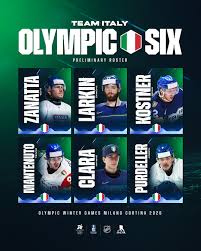
In June 2025, the Italian federation announced the first six players named to its preliminary Olympic roster. This group forms the unshakeable foundation of the team. This selection was a deliberate act of strategic messaging. It perfectly balances the three pillars of the modern Italian hockey program. These pillars include homegrown youth developed in elite North American junior leagues. There are also long-serving veterans forged in top European professional leagues. Finally, there are integrated North American oriundi who have demonstrated a long-term commitment to the national team. This composition sends a clear signal of unity and defines the team’s multifaceted identity.
The Undisputed Cornerstones
- Damian Clara (G): The future of Italian hockey. Clara is a towering 6’6″ goaltender. He made history as the highest-drafted Italian-born player ever. The Anaheim Ducks selected him in the second round of the 2023 NHL Draft. He is just 21 years old by the time of the Olympics. He is the program’s brightest hope. He has already gained professional experience in Finland and the American Hockey League (AHL).
- Diego Kostner (F): The consummate veteran. A 33-year-old center, Kostner has over 15 seasons of experience in Switzerland’s top-tier National League. He offers leadership and defensive responsibility. He also provides stability down the middle for HC Ambri-Piotta and the national team.
- Thomas Larkin (D): The Captain. A 34-year-old, American-born defenseman who has become the heart and soul of the Azzurri. Larkin is a former Columbus Blue Jackets draft pick. He has AHL experience. Larkin has had a long, decorated career in Europe’s top leagues. He is the undisputed leader of the blue line.
- Daniel Mantenuto (F): The prime-age point producer. Mantenuto is a 28-year-old Canadian-born forward. He has emerged as a go-to offensive player for his club, HC Bolzano. He is also a significant player for the national team, where he has been a consistent offensive force.
- Tommy Purdeller (F): The dynamic young winger. At 21, Purdeller represents the new wave of Italian talent. He honed his skills for two seasons with the Peterborough Petes of the Ontario Hockey League (OHL). His breakout performance at the 2025 promotion tournament was impressive. He was a point-per-game player.
- Luca Zanatta (D): The reliable defensive stalwart. A 35-year-old veteran, Zanatta provides a steady, calming presence on the back end. His defensive discipline will be crucial for a team that will likely spend significant time in its own zone.
The Supporting Cast (Virtual Locks)
Beyond the “First Six,” several other veteran players are all but guaranteed a spot on the final roster. Their consistent performance ensures their inclusion. These players are important to the team’s structure. Defenseman Alex Trivellato, who plays alongside Larkin in Germany’s elite DEL, is a lock for the top pairing.
Phil Pietroniro, a right-shot, offensive-minded defenseman, is playing in the top Czech league. He is essential for his puck-moving ability. He also significantly contributes to the power play. Up front, long-time national team forward
Luca Frigo provides leadership and secondary scoring , while
Daniel Tedesco is a non-negotiable inclusion after leading the 2025 promotion tournament with a remarkable eight points in five games.
The Eligibility Gauntlet: Italy’s Pursuit of the Oriundi
The most critical chapter in Italy’s Olympic journey is its quest to recruit high-level North American talent. The outcome of this effort will single-handedly determine the team’s potential for competitiveness. IIHF Bylaw 4 presents the major challenge. It stipulates that a player with new citizenship must have participated for “at least two consecutive hockey seasons.” The player must also have engaged in 16 consecutive months in their new country’s national competitions. This is equivalent to 480 days. This residency requirement makes it extremely difficult for an active NHL or AHL player to get an Italian passport. It prevents them from joining the team for the Olympics.
Recognizing this, the Italian Federation has engaged in a high-stakes negotiation. They are holding direct talks with both the IIHF and the NHL. Their aim is to seek a solution. The NHL’s return to the Olympics after a 12-year absence gives it significant leverage. The league has a vested commercial interest in a globally appealing tournament. A non-competitive host nation is detrimental to the “product.” This has led to reports of the NHL’s “eagerness” to help find a way to bolster Italy’s roster. This situation is fascinating politically. The NHL’s commercial interests are pitted against the IIHF’s mandate. The IIHF aims to uphold the integrity of its eligibility rules.
It is crucial to understand the specific goal of this lobbying effort. This effort does not attempt to overturn the rule. The rule prevents players from switching national allegiances after representing another country at a senior IIHF-sanctioned event. NHL stars of Italian descent, such as Adam Fantilli and Frank Vatrano, are considered ineligible. Adam Fantilli has won multiple gold medals for Canada. Frank Vatrano has represented the United States. The main goal is to secure a limited, one-time “host nation exemption.” This exemption would waive the 16-month residency requirement. It applies to players who hold or can obtain Italian citizenship through ancestry. These players must have never played for another country. A political compromise like this would let the IIHF improve the tournament’s quality. It would not dismantle its core principles. This makes including high-level oriundi a realistic possibility.
Projecting the 25-Man Roster: Locks, Bubbles, and Wild Cards
The following 25-man roster projection assumes that the Italian Federation secures a limited residency waiver. This waiver is for uncapped players of Italian heritage. This roster comprises three goaltenders, eight defensemen, and fourteen forwards.
| Player Name | Position | Age (Feb 2026) | 2025-26 Club (Projected) | Status |
| Goaltenders | ||||
| Michael DiPietro | G | 26 | Boston Bruins (NHL)/Providence (AHL) | Wild Card |
| Damian Clara | G | 21 | San Diego Gulls (AHL) | Lock |
| Davide Fadani | G | 24 | EHC Kloten (NL) | Bubble |
| Defensemen | ||||
| Thomas Larkin (C) | RD | 35 | Schwenninger Wild Wings (DEL) | Lock |
| Alex Trivellato | LD | 33 | Schwenninger Wild Wings (DEL) | Lock |
| Phil Pietroniro (A) | RD | 31 | Rytiri Kladno (Czechia) | Lock |
| Luca Zanatta | LD | 35 | HC Pustertal (ICEHL) | Lock |
| Peter Spornberger | LD | 27 | Schwenninger Wild Wings (DEL) | Bubble |
| Greg DiTomaso | RD | 29 | SG Cortina (AlpsHL) | Bubble |
| Daniel Glira | LD | 31 | HC Pustertal (ICEHL) | Bubble |
| Dylan Di Perna | LD | 29 | HC Bolzano (ICEHL) | Bubble |
| Forwards | ||||
| Daniel Tedesco | LW | 32 | Guildford Flames (EIHL) | Lock |
| Daniel Mantenuto | C | 28 | HC Bolzano (ICEHL) | Lock |
| Tommy Purdeller | RW | 21 | HC Pustertal (ICEHL) | Lock |
| Luca Frigo (A) | LW | 32 | HC Bolzano (ICEHL) | Lock |
| Diego Kostner | C | 33 | HC Ambri-Piotta (NL) | Lock |
| Anthony Salinitri | RW | 27 | Stavanger Oilers (Norway) | Lock |
| Dustin Gazley | LW | 37 | HC Pustertal (ICEHL) | Bubble |
| Bryce Misley | C | 26 | Asiago Hockey (ICEHL) | Bubble |
| Michele Marchetti | RW | 31 | Asiago Hockey (ICEHL) | Bubble |
| Daniel Catenacci | LW | 32 | HC Pustertal (ICEHL) | Bubble |
| Tommaso de Luca | C | 21 | HC Ambri-Piotta (NL) | Bubble |
| Nicholas Saracino | RW | 33 | HC Bolzano (ICEHL) | Bubble |
| Alex Petan | C/W | 33 | Fehérvár AV19 (ICEHL) | Bubble |
| Ivan Deluca | LW | 28 | HC Pustertal (ICEHL) | Bubble |
Goaltending Analysis
Italy’s goaltending situation represents both its greatest potential strength and its biggest question mark. The final composition of the trio hinges entirely on off-ice negotiations.
- The Wild Card: Michael DiPietro. His inclusion is the ultimate game-changer. He had a spectacular 2024-25 season. He won the Aldege “Baz” Bastien Memorial Award as the AHL’s most outstanding goaltender. He achieved this with a 2.05 GAA and .927 save percentage. His talent is undeniable. If cleared to play, the 26-year-old immediately becomes the starting netminder. He gives Italy a legitimate chance to steal a game against a world power.
- The Prodigy: Damian Clara. As a “First Six” member and a top NHL prospect, Clara is a lock. The experience of being on the Olympic stage at 21, even as a backup, will be invaluable for his development. It will also benefit the future of the national program.
- The Incumbent: Davide Fadani. Fadani earned his spot by backstopping the team to promotion in 2025. He played a crucial role in high-pressure games. This includes a shootout loss to Ukraine where he was the netminder. He provides quality depth and is rewarded for his recent success, getting the nod over veteran Andreas Bernard.
Defensemen Analysis
The blue line will be built around a core of veterans playing in Europe’s top leagues.
- Top Pair: The all-DEL pairing of left-shot Alex Trivellato and right-shot captain Thomas Larkin is the team’s clear shutdown unit. They are tasked with facing the opponent’s best players.
- Second Pair: Luca Zanatta (L) and Phil Pietroniro (R) offer a blend of styles. Zanatta is the steady, defensive conscience, while Pietroniro is the primary puck-mover and power-play quarterback from the back end.
- Third Pair & Depth: The remaining spots will be a battle. Peter Spornberger offers built-in chemistry, playing with Larkin and Trivellato at Schwenninger in the DEL. Greg DiTomaso is a right-shot puck mover who impressed at the 2025 tournament. Daniel Glira and Dylan Di Perna provide size, physicality, and a defense-first mentality to round out the corps.
Forwards Analysis
The forward group will rely on chemistry forged at recent international tournaments and in the cross-border ICE Hockey League.
- Top Line: The trio of Daniel Tedesco, Daniel Mantenuto, and Tommy Purdeller formed Italy’s most dangerous offensive weapon in 2025. This trio proved their offensive prowess. They will be counted on to generate the bulk of the offense.
- Second Line: A veteran scoring line featuring Luca Frigo, Diego Kostner, and Anthony Salinitri. Kostner and Frigo provide two-way intelligence. Salinitri brings pure speed and finishing ability. This is evidenced by his key goals in past tournaments.
- Third Line: An energy/checking line likely composed of oriundi Dustin Gazley, Bryce Misley, and Michele Marchetti. They will be tasked with a heavy forecheck, disrupting opponents, and providing secondary scoring.
- Fourth Line & Depth: The final spots will go to versatile players. Daniel Catenacci, a former first-round OHL pick, brings grit. Tommaso de Luca, a skilled 21-year-old playing in Switzerland’s top league, is a key piece for the future. Veterans Nicholas Saracino, Alex Petan, and Ivan Deluca provide experience, physicality, and lineup flexibility.
Tactical Blueprint and Defining Success
Under Jukka Jalonen, Italy will not attempt to out-skill its formidable Group B opponents. Instead, the team’s identity will be forged in defensive structure and discipline. This approach mirrors the system that brought Finland so much international success. The tactical blueprint will be a highly structured, five-man defensive system. It is designed to clog the neutral zone. It will block shots and limit high-danger scoring chances. The game plan will be to frustrate opponents, slow the pace, and force them into making mistakes. Offense will be generated almost exclusively through opportunistic counter-attacks and capitalizing on turnovers.
For this strategy to have any chance of success, special teams must be a net positive. The power play, likely quarterbacked by Pietroniro and Tedesco, must be ruthlessly efficient and convert its limited opportunities. More importantly, the penalty kill will be the team’s lifeblood. Discipline will be critical. Taking penalties against the lethal power plays of Finland and Sweden would be disastrous.
Ultimately, a successful Olympic tournament for Italy cannot be defined by the final standings or a medal. Success will be measured by their ability to compete with pride. They need to keep games against hockey’s superpowers respectable. They might potentially orchestrate a single, historic upset on home ice. The ultimate victory for Italian hockey would be to leverage the global spotlight of the Milano Cortina Games. They aim to captivate the nation. A new generation of players can be inspired by this. The prominent roles of young, homegrown stars like Damian Clara and Tommy Purdeller exemplify this long-term goal. Their efforts ensure that the tournament’s legacy endures long after the final buzzer sounds.

 ScortonBoy17.ca
Leave a comment