Introduction: The 12-Year Wait is Over
The long winter for international hockey is finally over. The world’s best players are set to return to the Olympic stage. This comes after a 12-year hiatus. They will play in the Milano Cortina 2026 Winter Games. A landmark agreement was finalized in July 2025. The National Hockey League (NHL), the NHL Players’ Association (NHLPA), and the International Ice Hockey Federation (IIHF) were involved. This agreement has ushered in a new golden era of best-on-best competition. For an entire generation of superstars, this is their first chance to chase Olympic glory. Many, including American phenom Auston Matthews, have been vocal about this dream for years.
This accord does more than just open the door for Milan. It establishes a thrilling new cadence for the sport. A major international tournament is scheduled every two years. These tournaments alternate between the Olympics (2026, 2030) and a revamped World Cup of Hockey (2028, 2032). The men’s hockey tournament in Italy is set to run from February 11-22, 2026. It will be the first chapter in this exciting new story.
For Team USA, this tournament represents more than just a return to the Games. It is, without exaggeration, the single greatest opportunity for Olympic gold since the “Miracle on Ice” in 1980. The current American talent pool is unprecedented. It boasts a staggering combination of high-end skill and remarkable depth at every position. This reality positions them as a co-favorite alongside their perennial rival, Canada. The challenge now falls to General Manager Bill Guerin to assemble these world-class pieces into a cohesive, gold-medal-winning machine.
Part I: The Guerin Doctrine and the Foundational Six
The Architect’s Vision
Team USA General Manager Bill Guerin is at the helm of this historic endeavor. He is a man who understands the weight of expectation. His mission is unambiguous. “We have to win,” Guerin stated. He is looking to end a best-on-best title drought. This drought dates back to the 1996 World Cup of Hockey. To achieve this, he has established a clear team-building philosophy, which can be described as the “Guerin Doctrine.” Drawing from his own decorated career, which sometimes disappointed, Guerin knows that raw talent alone does not guarantee victory.
The core tenet of his doctrine is a focus on constructing a true team, not merely a collection of all-stars. “You have to fight the urge, you know?” Guerin admitted, acknowledging the temptation presented by the deep American player pool. “It doesn’t always come down to points. It comes down to fit and role”. This philosophy suggests that every player selected will have a specific purpose. Some very good players—even stars—will be left at home if they don’t fit the overall composition. Guerin intends to build a unique squad for this tournament. He has made it clear. He will not simply “run it back with the same team” that competed at the 4 Nations Face-Off. He is willing to make significant changes based on performance and fit.
The Cornerstones of the Republic
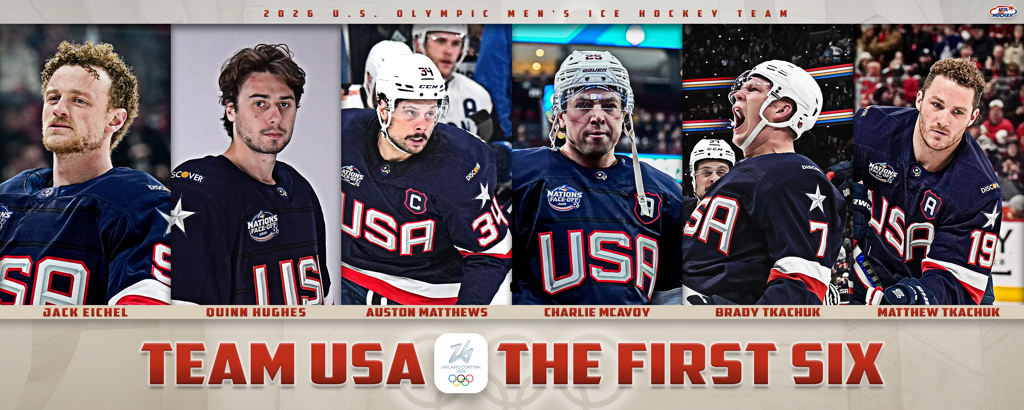
On June 16, 2025, Guerin and USA Hockey laid the foundation for the 2026 roster by naming six cornerstone players. This initial group was also selected for the 4 Nations Face-Off. They represent the undeniable core around which the rest of the team will be built.
- Forwards: Auston Matthews (Toronto Maple Leafs), Jack Eichel (Vegas Golden Knights), Matthew Tkachuk (Florida Panthers), Brady Tkachuk (Ottawa Senators)
- Defensemen: Quinn Hughes (Vancouver Canucks), Charlie McAvoy (Boston Bruins)
These selections are not just locks; they define the team’s identity. This group features elite goal-scoring from Matthews, arguably the world’s best sniper. Eichel, the 2023 Conn Smythe Trophy winner, provides powerful, championship-proven two-way play. The Tkachuk brothers add an unparalleled combination of grit, skill, and agitation. On the blue line, the duo offers a modern and mobile defensive foundation. Quinn Hughes, the 2024 Norris Trophy winner as the league’s top defenseman, partners with Charlie McAvoy. He is a dominant all-around force. Together, they create a formidable defense.
The selection of these six players immediately establishes a high bar for every other hopeful. The challenge for Guerin is not a lack of talent, but an abundance of it. In previous eras, selecting “role players” meant finding gritty, defensive-minded forwards. The 2014 roster, for example, included players like Dustin Brown and Ryan Callahan specifically for their leadership and physical play. In 2026, the American talent pool is so deep. The players who will fill these “bottom-six” roles are legitimate NHL stars. They regularly post 30-goal, 70-point seasons. The critical task for management, therefore, is not finding role players. Instead, it involves convincing established stars to embrace a specialized, and perhaps reduced, role. This adjustment is crucial for the collective goal of winning gold. The definition of a “role player” for Team USA has evolved. It now considers which star players possess the versatility, defensive conscience, and team-first mentality. These qualities help them thrive outside the offensive spotlight.
Part II: Assembling the Firepower: The 14-Man Forward Corps
The 14-man offensive unit is built around the four foundational forwards. This unit must blend overwhelming skill with tactical versatility. This combination is required to win a short, intense tournament. With an Olympic roster size of 25 (14 forwards, 8 defensemen, 3 goalies), every spot is precious.
The Top Six: Elite and Unstoppable
- Line 1: Brady Tkachuk – Auston Matthews – Matthew Tkachuk This line features Brady Tkachuk, Auston Matthews, and Matthew Tkachuk. It is projected to be one of the most dominant. It will be difficult to play against trios in the entire tournament. It combines the NHL’s premier goal-scorer in Matthews with two of the game’s most effective and physically imposing power wingers. The Tkachuk brothers bring a rare blend of high-end skill. They offer a relentless net-front presence. Their game-changing agitation perfectly complements Matthews’s lethal shot. This combination, which has been floated in various expert projections, presents a true nightmare matchup for any opposing defense.
- Line 2: Jake Guentzel – Jack Eichel – Jack Hughes This line is constructed for speed, creativity, and clinical finishing. Eichel is a powerful driving center. He has already proven he can lead a team to the highest level. He captured the Conn Smythe Trophy during the Vegas Golden Knights’ 2023 Stanley Cup victory. He is flanked by Jake Guentzel, a prolific scorer. Guentzel potted 41 goals in the 2024-25 season. He has a long history of thriving alongside elite centers. On the other wing is Jack Hughes, one of the most dynamic and electrifying playmakers in the world. Placing Hughes on the wing is strategic. It injects his game-breaking talent into the top-six forward group. This move also accommodates the Americans’ incredible depth down the middle.
The Bottom Six: Versatility is the Weapon
- Line 3: Kyle Connor – Dylan Larkin – Matt Boldy This example shows the application of the Guerin Doctrine. Building a complete team truly comes into focus here. Dylan Larkin is the ideal third-line center. He is a captain for the Detroit Red Wings. He brings elite speed and a responsible 200-foot game. He can shut down opposing top lines and still contribute offensively. He is joined by Kyle Connor, who led all U.S.-born players with 41 goals in the 2024-25 season. While an elite scorer, Connor was used ineffectively at the 4 Nations Face-Off. Placing him in a slightly more sheltered role allows him to focus on what he does best. He can concentrate on putting the puck in the net with support from a defensive stalwart like Larkin. Minnesota’s Matt Boldy completes the line. He is a big, skilled winger who plays a strong two-way game. This creates a highly effective, possession-driving trio.
- Line 4: J.T. Miller – Vincent Trocheck – Alex Tuch This could be the best fourth line in the tournament. It is a unit comprised entirely of NHL stars who embrace the hard-nosed aspects of the game. J.T. Miller is a physical forward who scores high and excels in all three zones. He finished among the top American scorers in 2023-24. Vincent Trocheck provides a crucial element. He is a tenacious, right-shot faceoff specialist. This is a coveted asset for critical defensive-zone draws and penalty killing. Buffalo’s Alex Tuch is the line’s identity player. He brings a unique package of size (220 lbs) and speed. His punishing physicality makes him perfectly suited for an energetic, tone-setting role.
The Extras (13th & 14th Forwards): Specialized Tools
- Tage Thompson (C/RW, Buffalo Sabres): Thompson is a true wild card. His massive frame is a matchup problem that few teams can solve. His elite one-timer makes him a lethal weapon, particularly on the power play. His clutch performance at the 2025 IIHF World Championship was remarkable. He scored the overtime goal to win gold for Team USA. This significantly bolsters his case.
- Clayton Keller (LW/RW, Utah Mammoth): Keller brings both leadership and high-end production. He captained the 2025 World Championship gold-medal team and posted 90 points in the 2024-25 NHL season. His versatility allows him to slot anywhere in the lineup and contribute, providing both skill and a proven winning pedigree.
| Line | Left Wing | Center | Right Wing |
| 1 | Brady Tkachuk (OTT) | Auston Matthews (TOR) | Matthew Tkachuk (FLA) |
| 2 | Jake Guentzel (TBL) | Jack Eichel (VGK) | Jack Hughes (NJD) |
| 3 | Kyle Connor (WPG) | Dylan Larkin (DET) | Matt Boldy (MIN) |
| 4 | J.T. Miller (NYR) | Vincent Trocheck (NYR) | Alex Tuch (BUF) |
| Extras | Clayton Keller (UTA) | Tage Thompson (BUF) |
The Toughest Cuts: An Embarrassment of Riches
The depth of the American talent pool means that several elite players will inevitably be left off the final roster. The most notable omission is Dallas Stars forward Jason Robertson. This decision, while controversial, mirrors the 2014 snub of high-scoring forward Bobby Ryan. In 2014, the management team had a specific line of thought. They believed Ryan was a pure goal-scorer. If he wasn’t playing on a scoring line, he was not an ideal fit for a bottom-six checking role. This “Bobby Ryan Rule” appears to be a core part of the Guerin Doctrine. Robertson, an elite offensive talent who scored 80 points in 2024-25 , is the 2026 equivalent. His game does not fit the physical demands of a fourth-line role. It does not suit the two-way play required for such a role. This is particularly true compared to players like Tuch or Miller. This makes him a difficult fit under this team-building philosophy.
Similarly, Montreal’s Cole Caufield, who scored 37 goals in 2024-25 , is a victim of this same logic. His primary value is goal-scoring. The lineup is deep. His defensive game may not be strong enough for a depth role in a best-on-best tournament. Other phenomenal players like Chris Kreider, Brock Nelson, and Matthew Knies are not included. This is a testament to the deepest American forward pool in history.
Part III: The New American Supremacy: The 8-Man Blue Line
For decades, Team USA’s defense, while solid, was often seen as a step behind Canada’s. That is no longer the case. The 2026 American blue line has transformed into arguably the team’s greatest strength. It is defined by elite mobility and superb puck-moving ability. The team boasts a formidable balance of offensive dynamism and shutdown capability. This skill set is perfectly suited for the larger Olympic ice surface.
The Top Four: A Quartet of Norris Caliber Talent
- Pairing 1: Quinn Hughes (L) – Charlie McAvoy (R) This is a dream pairing of two foundational pillars. Hughes is the reigning Norris Trophy winner. He is the premier offensive defenseman in the game. He led all blueliners in scoring during the 2023-24 season. McAvoy is powerful and elite. He is an all-around defenseman who can dominate physically. He can shut down the opposition’s best players and drive play forward with authority. Their contrasting yet complementary styles create a perfectly balanced and dominant top pair.
- Pairing 2: Zach Werenski (L) – Adam Fox (R) The second pair is nearly as formidable as the first. Zach Werenski was a Norris Trophy finalist in 2024-25. He led all American defensemen with 82 points. He was also a key member of the gold-medal-winning World Championship squad. His partner is Adam Fox. He is a past Norris winner. He is also one of the most intelligent and creative puck-movers in the NHL. Together, this duo would control the pace of play, dominate possession, and generate relentless offense from the back end.
The Bottom Four: Shutdown Specialists and Dynamic Depth
- Pairing 3: Jaccob Slavin (L) – Brock Faber (R) This duo projects as the team’s designated shutdown pair. They executed this role with remarkable success at the 4 Nations Face-Off. Slavin is widely regarded as one of the league’s smartest and most effective pure defensive defensemen. He is joined by Brock Faber. Faber emerged as a reliable, minute-munching defender in a spectacular rookie season. He provides a steady, calming presence. This pairing gives the coaching staff a trustworthy anchor to deploy against any top line in the world.
- Extras (7th & 8th Defensemen): The Future and the Veteran
- Jake Sanderson (L, Ottawa Senators): Sanderson is an elite skater whose game is rapidly ascending to elite status. His mobility is a massive asset on the big ice. He has proven he can handle tough matchups. He can also log significant minutes. He provides exceptional depth and can seamlessly step into a top-four role if required.
- Seth Jones (R, Florida Panthers): Jones earned his place on this roster. He delivered a tremendous performance during the Florida Panthers’ 2025 Stanley Cup championship run. He provides a big frame, a coveted right-handed shot—balancing the corps with four lefties and four righties—and valuable veteran leadership. His inclusion over 4 Nations member Noah Hanifin solidifies the right side of the defense.
| Pairing | Left Defense | Right Defense |
| 1 | Quinn Hughes (VAN) | Charlie McAvoy (BOS) |
| 2 | Zach Werenski (CBJ) | Adam Fox (NYR) |
| 3 | Jaccob Slavin (CAR) | Brock Faber (MIN) |
| Extras | Jake Sanderson (OTT) | Seth Jones (FLA) |
The Toughest Cuts: The Next Wave
The most painful cut on defense is Montreal’s Lane Hutson. After a historic rookie season that earned him the Calder Trophy, his offensive talent is undeniable. However, multiple analyses raise legitimate questions. Is his defensive game ready to withstand the pressure of facing the world’s best forwards? This is crucial in a high-stakes Olympic tournament. He is edged out by the more proven two-way games of Sanderson and Jones. New Jersey’s Luke Hughes is another incredibly skilled young defenseman. However, he is simply a victim of the extraordinary logjam of elite, left-shot puck-movers on the roster.
This defensive corps marks a paradigm shift for USA Hockey. The group is stacked with Norris Trophy winners and finalists, and its collective skating ability is second to none. This mobility is crucial. The stout defensive skills of players like McAvoy and Slavin enhance this mobility. It transforms the blue line from a position of past concern into one of global supremacy. This transformation may be the single biggest X-factor in the quest for gold.
Part IV: The Goaltending Trinity: America’s Unrivaled Advantage
If the defense represents a new strength, the goaltending represents an established and overwhelming advantage. Team USA has what is widely considered the world’s deepest and most talented goaltending pool. This “seriously imposing” and “unmatched” group serves as the team’s ultimate safety net.
The Starter: The Reigning MVP
- Connor Hellebuyck (Winnipeg Jets): The decision for the starting job is clear and data-driven. Hellebuyck is not just the reigning Vezina Trophy winner as the league’s best goaltender. He is also the reigning Hart Trophy winner as the NHL’s Most Valuable Player. His advanced statistics from the 2024-25 season were simply staggering. According to MoneyPuck, he led all NHL goaltenders with a +39.6 Goals Saved Above Expected (GSAx) and an incredible 6.6 Wins Above Replacement (WAR). These metrics provide objective and empirical proof. They show that he was, by a significant margin, the most valuable and effective netminder on the planet. While some may question his past performances in high-stakes international games, his statistical superiority makes him the undisputed No. 1.
The Backups: Elite in Their Own Right
- Jake Oettinger (Dallas Stars): Oettinger is the ideal No. 2, a proven big-game performer who has already established himself as one of the league’s top clutch goalies. He has amassed 20 playoff wins over the past two postseasons. This is the second-most in the NHL during that span. He has the size and unflappable composure to thrive under the brightest lights. He competed in a head-to-head playoff series against Hellebuyck and out-dueled him. This proved he is more than capable of stealing games against the world’s best.
- Jeremy Swayman (Boston Bruins): Swayman had a difficult 2024-25 season with the Bruins. He demonstrated his resilience and talent by backstopping Team USA to gold at the 2025 World Championship. USA Hockey’s management selected him for the 4 Nations Face-Off. This decision, despite his regular-season struggles, speaks volumes about their confidence in him. He is a supremely talented goaltender and an incredible luxury to have as the third option.
| Rank | Goalie | 2024-25 Team | Key Stat (2024-25) |
| Starter | Connor Hellebuyck | Winnipeg Jets | +39.6 GSAx |
| Backup | Jake Oettinger | Dallas Stars | .909 SV% |
| Third Goalie | Jeremy Swayman | Boston Bruins | 2025 World Championship Gold |
The Toughest Cuts: A Crowded Crease
Leaving goalies like Vancouver’s Thatcher Demko and Calgary’s Dustin Wolf off the roster is a testament to the Americans’ depth. Demko is a fantastic goaltender. However, he loses out to the three selected based on their more recent success in high-leverage international or playoff competition. Wolf is a rising phenom and is the clear goalie of the future. However, the 2026 Games are likely one cycle too early for him to join this veteran-laden trio.
This goaltending “problem” is a luxury crisis. Most nations would be thrilled to have just one of these netminders. Team USA has three elite options, providing an unparalleled safety net. This depth mitigates the risk of injury or a cold streak and provides a significant psychological advantage. It is Team USA’s ultimate trump card, an advantage that no other country, including Canada, can definitively match.
Conclusion: A Golden Opportunity in Milan
The 25-man roster projected here represents the pinnacle of American hockey talent. It is a group defined by overwhelming offensive firepower. It also boasts a revolutionary mobile defense and the world’s most dominant goaltending trio. The pieces are all in place. General Manager Bill Guerin possesses the talent, depth, and a solid philosophical framework. He can mold this collection of individual stars into a true team. This team is built on both elite skill and role-specific versatility.
The path to Olympic glory is fraught with challenges. A formidable Canadian team will surely stand in the way. This roster gives the United States its most legitimate opportunity to capture men’s hockey gold in 46 years. The opportunity is data-supported and strategically sound. The American eagle is ready to achieve Olympic triumph. This is a historic moment, the first in a generation.

 ScortonBoy17.ca
Leave a comment