Introduction: The Green and Black Insurgency
In the crucible of 1997, the World Wrestling Federation (WWF) was in a fight for its life. The company was losing viewers to its chief competitor, World Championship Wrestling (WCW). It was also losing the critical “Monday Night War” for television ratings. The family-friendly “New Generation Era,” with its clear-cut heroes and villains, felt increasingly dated. A seismic shift was necessary for survival. In response, the WWF embarked on a radical creative overhaul. They rebranded their flagship program as the aggressive Raw Is War. The aesthetic became grittier, featuring a red-and-black color scheme. The content also shifted sharply into more adult-oriented and unpredictable narratives.
D-Generation X (DX) emerged from this chaotic landscape. This faction became a primary engine of the WWF’s nascent “Attitude Era”. More than just a collection of wrestlers, DX was a cultural catalyst. Their identity was a potent mix of sophomoric humor. It often included profane, overt sexual innuendo. They showed profound and unapologetic disrespect for any and all forms of authority. This anarchic spirit resonated deeply with a cynical Generation X demographic. This group was a cohort of “latchkey kids” who had grown up independent. They were skeptical of institutions and were starved for anti-heroes who mirrored their worldview.
The unprecedented success of D-Generation X wasn’t just about creative booking. It was a perfect storm where reality and performance collided violently. The group’s genesis was rooted in the real-life backstage camaraderie. A clique of wrestlers held political influence. This real-life influence fused with the on-screen necessity for a new antagonist group. This new group drove storylines with its dominance. This was amplified by a gamble on “Crash TV” booking. This style was defined by shocking swerves and controversial angles. It blurred the lines between performer and character. This ultimately helped turn the tide in the WWF’s war against WCW.
Part I: The Degenerate Genesis (1997–1998)
D-Generation X began as a villainous stable. It was a tight-knit unit designed to insulate its leader, Shawn Michaels. This group aimed to amplify his already antagonistic persona. This era was defined by its exclusivity. It was marked by personal rivalries. A series of events would irrevocably alter the course of professional wrestling.
Table 1: D-Generation X Membership and Timeline Across Major Incarnations
| Incarnation Name | Active Years | Core Members | Alignment |
| The Original Degenerates | 1997–1998 | Shawn Michaels, Triple H, Chyna, Rick Rude | Heel |
| The DX Army | 1998–1999 | Triple H, Chyna, X-Pac, Road Dogg, Billy Gunn | Face |
| The McMahon-Helmsley Era | 1999–2000 | Triple H, X-Pac, Road Dogg, Billy Gunn, Stephanie McMahon, Tori | Heel |
| 2006 Reunion | 2006–2007 | Triple H, Shawn Michaels | Face |
| 2009 Reunion (PG Era) | 2009–2010 | Triple H, Shawn Michaels, Hornswoggle (mascot) | Face |
The Kliq Connection and Formation
The seeds of D-Generation X were planted in the real-life friendship of Shawn Michaels and Hunter Hearst Helmsley (Triple H). Both were prominent members of “The Kliq,” a powerful backstage faction of friends that held considerable sway within the WWF. Kevin Nash and Scott Hall, fellow Kliq members, departed for WCW where they formed the revolutionary New World Order (nWo). WWF management was reportedly hesitant to pair its remaining members, Michaels and Helmsley, on-screen.
Despite this reluctance, the on-screen alliance began to coalesce on the August 11, 1997, episode of Raw Is War. During a match between Michaels and Mankind, both Triple H and his imposing bodyguard, Chyna, interfered. The segment culminated with the surprise return of “Ravishing” Rick Rude, who revealed himself as Michaels’ new “insurance policy”. With this, the original four-person lineup—Michaels, Triple H, Chyna, and Rude—was unofficially created. They operated as a unit to protect Michaels. Their goal was to antagonize his foes.
This initial version of the group was not a balanced collective of equals. It was, in essence, a star vehicle constructed around its brilliant but notoriously difficult leader. Shawn Michaels was unpopular backstage in 1997. Rude appeared on-screen as an “insurance policy.” Chyna’s presence as an enforcer mirrored a real-world need for protection. The group’s primary function was to ensure Michaels won and retained his championships, effectively operating as a “protection racket.” During promos, Michaels was the clear centerpiece. He often dominated the microphone. Michaels spoke over Triple H, positioning him as his clear subordinate.
The War of Words: Feuding with The Hart Foundation
DX’s first major rivalry was deeply personal. It was an ideological war against Bret “The Hitman” Hart and his pro-Canada, anti-America stable, The Hart Foundation. The feud was unique for its time, pitting two prominent heel factions against one another. It was this heated conflict that gave the group its name. On the October 6, 1997, episode of Raw, Bret Hart was disgusted with Michaels’ crass behavior. He dismissed him as “nothing more than a degenerate”.
A week later, on October 13, Michaels and Triple H appeared in a promo that would define their identity. Michaels defiantly embraced the insult. He officially christened the group “D-Generation X.” They framed themselves as the embodiment of the cynical, apathetic Generation X stereotype. This segment also marked the first on-air utterance of their infamous slogan, “Suck It!”. Their villainous antics escalated, including mocking the respected WWF Commissioner Sgt. Slaughter by giving him the nickname “Sgt. Slobber” and, in an act of ultimate disrespect, picking their noses with the Canadian flag.
The Montreal Screwjob: The Point of No Return
The simmering real-life animosity between Michaels and Hart reached its boiling point at Survivor Series in November 1997. WWF owner Vince McMahon conspired with Michaels and others. They secretly changed the pre-determined finish of the WWF Championship match. This is now arguably the most infamous incident in wrestling history. Hart was leaving for WCW. He had refused to lose the title to his rival in Canada. As a result, Michaels trapped Hart in his own signature Sharpshooter submission hold. Referee Earl Hebner, following McMahon’s order, signaled for the bell. He awarded the championship to a stunned Michaels. Hart never submitted.
The “Montreal Screwjob” was a cataclysmic event that shattered the illusion of professional wrestling. For D-Generation X, it was a coronation. Michaels and Triple H were complicit in the betrayal. Any remaining shades of moral ambiguity were erased. They were now the undisputed, most reviled villains in the company. The fallout was immediate. Rick Rude, a close friend of Hart’s, was legitimately disgusted by the incident and quit the WWF. Since Raw was pre-taped, he could appear on both WWF Raw and WCW Nitro on the same night. This was a major shot fired in the Monday Night War. Rude’s presence had been more significant than it appeared. His established, arrogant persona was a forerunner to the DX ethos. His veteran status lent main-event credibility to the group. The still-ascending Triple H did not yet possess this credibility on his own. His departure underscored the real-world loyalties and animosities that fueled the entire era.
The Reign of the Degenerates (Late 1997 – Early 1998)
With the Hart Foundation dismantled and Bret Hart gone to WCW, DX ran roughshod over the WWF landscape. They brutally turned on and humiliated the remaining Hart Foundation member, Jim “The Anvil” Neidhart, by luring him into the group only to assault him and spray-paint “WCW” on his back. Their on-screen behavior devolved into pure sophomoric rebellion. They played strip poker in the middle of the ring, mooned the live audience to reveal “Merry X-Mas” painted on their backsides, and mocked every conceivable authority figure. Commissioner Slaughter demonstrated their disdain for tradition. He forced Michaels and Triple H to wrestle each other for the European Championship. In response, Michaels theatrically staged a mock match. He laid down and allowed Triple H to pin him for the title. They made a mockery of the championship and the commissioner who ordered the match.
The End of an Era: WrestleMania XIV
The original incarnation of D-Generation X met its end in a spectacular implosion at WrestleMania XIV in March 1998. The preceding months had been tumultuous. At the Royal Rumble in January, Shawn Michaels suffered a severe back injury during a Casket Match against The Undertaker. He herniated two discs and crushed another. The injury was so severe it would force him into a four-year retirement.
Leading into WrestleMania, DX appeared stronger than ever. They formed an alliance with boxing heavyweight champion “Iron” Mike Tyson. Tyson was slated to be the “special guest enforcer” for Michaels’ WWF Championship defense against “Stone Cold” Steve Austin. However, the alliance was a ruse. At the climax of the main event, Tyson turned on DX. He delivered a lightning-fast three-count. This allowed Austin to capture the championship. As a furious Michaels confronted him, Tyson laid him out with a single punch and tore off his DX shirt to reveal a Stone Cold shirt underneath. The moment was a symbolic passing of the torch. DX had ignited the Attitude Era as its premier villains. It was now in the hands of its ultimate anti-hero, Steve Austin. With its leader broken and betrayed, the first chapter of D-Generation X was over.
Part II: The DX Army and the Attitude Offensive (1998–1999)
In the wake of Shawn Michaels’ departure, D-Generation X did not fade away. Instead, it was reborn. Triple H took over as the new leader. The group changed from an exclusive, villainous clique. It became a populist army of fan-favorite rebels. This second incarnation, the “DX Army,” became the faction’s most popular form. It launched unforgettable offensives. These offensives were instrumental in the WWF’s victory in the Monday Night War.
A New General, A New Army
On March 30, 1998, the night after WrestleMania XIV, Triple H appeared in the ring. This was during the episode of Raw is War. He declared himself the new leader of D-Generation X. He announced that it was time for expansion. He introduced his new recruits: the recently fired WCW wrestler and fellow Kliq member Sean Waltman, now known as X-Pac. He also introduced the reigning WWF Tag Team Champions. They were The New Age Outlaws (Road Dogg Jesse James and “Bad Ass” Billy Gunn). This new five-person lineup—Triple H, Chyna, X-Pac, and the Outlaws—was immediately dubbed the “DX Army”.
The New Age Outlaws were a natural fit. Their own rebellious, trash-talking gimmick ran parallel to DX’s. They had already informally associated with the group in late 1997. During that time, they assisted in an attack on the Legion of Doom. Their official induction solidified a perfect factional structure. Triple H was the main-event-level leader. The charismatic X-Pac covered the mid-card. The Outlaws dominated the tag team division. The trailblazing Chyna was the group’s enforcer and a force in the burgeoning women’s division. The audience response was immediate and overwhelming. Initially, they were positioned as heels. However, their undeniable charisma and anti-authority antics quickly made them the most popular act in the company. This forced a shift to fan favorites.
This transformation from an exclusive club to an inclusive “army” was the key to their explosion in popularity. Where the original DX was “Shawn’s friends,” the DX Army was a movement the audience felt a part of. Their catchphrases, especially Road Dogg’s “Oh, you didn’t know?” call-and-response intro, were designed for mass participation, turning arenas into a unified chorus of rebellion. Their merchandise flew off the shelves. The New Age Outlaws alone boasted the third-highest sales in the entire company. They were only behind Stone Cold Steve Austin and The Rock.
The Art of the Parody: Mocking the Enemy
A signature weapon in the DX Army’s arsenal was the elaborate, cutting, and often controversial parody. These skits showcased their comedic timing and charisma. They served as a powerful tool to dismantle the credibility of their rivals.
The Nation of Domination Parody (July 6, 1998)
In one of the most famous segments in Raw history, DX aimed at The Rock’s Nation of Domination. It was also one of the most infamous segments. The group appeared in costume. They impersonated their rivals. Triple H was “The Crock,” Road Dogg was “B’Lo Brown,” Billy Gunn was “The Gunnfather,” X-Pac was “Mizark” (Mark Henry). Guest comedian Jason Sensation was Owen Hart. The segment was filled with inside jokes and exaggerated imitations. Triple H mocked The Rock’s signature eyebrow raise. He also twisted The Rock’s catchphrase into “You should have smelled what The Crock was cookin’.” The skit was immensely popular. Many who were involved remember it fondly. Billy Gunn later called it “the funniest thing we ever did.” However, the segment’s legacy is complicated by the use of blackface by the white performers. This decision was reportedly approved by the Nation members at the time. Yet, it remains one of the Attitude Era’s most problematic and culturally insensitive moments. This is especially true when viewed through a modern lens.
The Corporation Parody (December 14, 1998)
Later that year, DX turned their satirical fire on their new primary antagonists, Vince McMahon’s villainous Corporation. The group once again appeared in full costume. Triple H reprised his role as “The Crock.” Road Dogg played Vince McMahon. Two midgets represented stooges Pat Patterson and Gerald Brisco. They literally kissed his rear end. Billy Gunn was a diaper-clad Shane McMahon. X-Pac played Ken Shamrock. Chyna was The Big Boss Man. Jason Sensation returned to parody the new Corporate Commissioner, Shawn Michaels. The promo was a masterclass in sophomoric humor. It featured a running gag about sphincters. They mocked Shane for having “doo doo” in his diaper. The parody was a perfect example of how DX used comedy. They effectively undermined the very concept of authority. Their powerful corporate rivals were portrayed as absurd and pathetic figures.
These parodies represent the double-edged sword of the Attitude Era’s “anything goes” ethos. They were creatively brilliant, producing legendary television that resonated with the audience’s anti-establishment sentiment. At the same time, they serve as a historical document of the era’s cultural blind spots. They showcase a willingness to push boundaries. Sometimes, these crossed into territory that is rightly considered unacceptable today.
The WCW Invasion: Firing the Shot Heard ‘Round the World
On April 27, 1998, D-Generation X executed an audacious stunt. It may be the single most daring act in the history of professional wrestling. For months, WCW had run their live Monday Nitro show in arenas nearby. They chose locations just down the road from where the WWF was taping Raw. This was a clear attempt to disrupt their competitor’s business. Vince McMahon was fed up. At the urging of Triple H and then-writer Vince Russo, he approved an unprecedented counter-attack. It was a literal invasion.
Decked out in army fatigues, the DX Army commandeered a military vehicle. It is often referred to as a tank, though technically a self-propelled rocket launcher. They drove from the Hampton Coliseum, the site of Raw, to the Norfolk Scope, where Nitro was broadcasting live. They had no concrete plan. They also had no idea whether they would be met with police or a rival gang of wrestlers. Nevertheless, they rolled up to the enemy’s front door. With cameras rolling, they rallied the thousands of fans waiting outside, who erupted in chants of “DX!” and “WCW Sucks!” before Triple H, megaphone in hand, declared war on WCW and demanded they be let in. WCW security refused to open the large bay door. This visual painted them as the cowards hiding from a fight.
The segment was a monumental game-changer in the Monday Night War. It shattered the unwritten rule of never acknowledging the competition on-air in such a direct, confrontational manner. It portrayed the WWF as the bold, unpredictable rebels and WCW as the stagnant, defensive corporate entity. The “invasion” is widely considered a major turning point that helped the WWF seize momentum and ultimately win the war. The group would follow up with similar “invasions” of the CNN Center and WCW’s corporate headquarters in Atlanta.
The Beginning of the End: Internal Strife and a New Era
By 1999, the DX Army’s incredible run was winding down. This was largely a strategic storyline to elevate Triple H. He moved from a faction leader to a singular main event superstar. The group began to fracture from within. At WrestleMania XV, Chyna, who had briefly left the group, appeared to rejoin. That night, both she and Triple H viciously betrayed X-Pac. They aligned themselves with their former enemies, The Corporation. This betrayal sparked feuds between the former stablemates. They fought over the rights to use the “DX” name and logo. This effectively dissolved the popular DX Army. This splintering was not a creative failure. Instead, it was a calculated success. The faction ended at its peak to launch Triple H into the next phase of his career. This new phase would see him marry Stephanie McMahon on-screen. It would also establish the dominant McMahon-Helmsley Era.
Part III: Echoes of Rebellion: Reunions and Re-imaginings (2000–Present)
The Attitude Era incarnation of D-Generation X ended around the turn of the millennium. The group’s name and spirit would be resurrected multiple times over the next two decades. These reunions, however, were not simple nostalgia acts. Each reformation served as a fascinating barometer. It indicated the shifting corporate identity and creative philosophy of the WWF/E. This reflects the company’s evolution from a rebellious underdog to a global entertainment juggernaut.
The McMahon-Helmsley Alliance (Late 1999 – 2000)
The first reformation occurred in late 1999, but this was a DX in name only. Triple H became the undisputed leader. Now aligned with the McMahon family, the group re-formed as a heel faction. This version of DX had shed its anti-authority skin; they were now the authority. Their purpose shifted to the consolidation of corporate power. They served as the ruthless enforcers for the dominant McMahon-Helmsley Regime that controlled the WWF. The group quietly fizzled out by mid-2000. Its members drifted into other storylines. Triple H solidified his status as a solo main event champion.
The 2006 Reunion: Comedy Over Chaos
Triple H and Shawn Michaels ended their bitter and bloody on-screen feud. This rivalry spanned from 2002 to 2004. They officially buried the hatchet and reformed D-Generation X in June 2006. This reunion took place during the “Ruthless Aggression Era.” This period, while still edgy, was more polished than the chaotic Attitude Era. This new DX was a duo, not an army. Their rebellion was focused and comedic. It was directed against their mutual enemy, Vince McMahon.
Their antics were more akin to elaborate pranks than genuine anarchy. Memorable moments from this run included doing a pitch-perfect impersonation of Vince and Shane McMahon. They orchestrated a stunt that covered the McMahons and their allies, The Spirit Squad, in green slime. Later, they added a brown substance intended to resemble feces. They also vandalized WWE’s corporate headquarters and Mr. McMahon’s private jet. This run was a commercial and critical success. However, it was cut short in January 2007. Triple H suffered a legitimate, severe quadriceps tear, putting him on the shelf for months.
The PG Era Degenerates (2009–2010): A Tamed Rebellion
The final major DX reunion occurred in 2009, squarely within the confines of WWE’s new “PG Era.” By this time, WWE had become a publicly-traded company, and its programming was now strictly family-friendly. The D-Generation X that returned was a heavily sanitized version of its former self. The edgy humor and anti-authority rage were gone. They were replaced by goofy backstage segments. There was incessant shilling of their own merchandise and slapstick comedy.
During this run, the duo captured the Unified WWE Tag Team Championships, their first and only tag title reign together. However, the period is most remembered for the addition of the leprechaun character Hornswoggle as the group’s official “mascot.” Critics widely panned this move. Older fans found it cringe-worthy. They saw it as a complete betrayal of the rebellious, cool factor that had once defined the group. The run concluded in 2010. The storyline shifted to focus on Shawn Michaels’ obsession with defeating The Undertaker at WrestleMania. This obsession ultimately led to his retirement.
The evolution of these reunions created a legacy paradox for the group. For historical purists and fans who grew up with the Attitude Era, the later runs were disappointing. They felt that the PG version represented a significant dilution of the brand. They saw two middle-aged men rehashing juvenile jokes that lacked the original’s authentic, dangerous edge. Yet, for a newer, younger generation of fans, the 2006 and 2009 versions were their introduction to DX. For them, the act was fun, comedic, and entertaining, creating a positive association completely detached from its historical context. This has resulted in a divided view of the group’s legacy. Its “coolness” heavily relies on which era a fan experienced first.
Conclusion: The Enduring Legacy of Two Words
The story of D-Generation X is a study in contradiction. It’s a tale of rebels who became rulers. They are anti-heroes who became Hall of Famers. It tells of a cultural phenomenon whose legacy is both celebrated and debated. Their journey from on-screen degenerates to off-screen executives demonstrates their indelible impact. They once sought to subvert the professional wrestling industry, making their transformation remarkable.
The Hall of Fame: An Unlikely Coronation
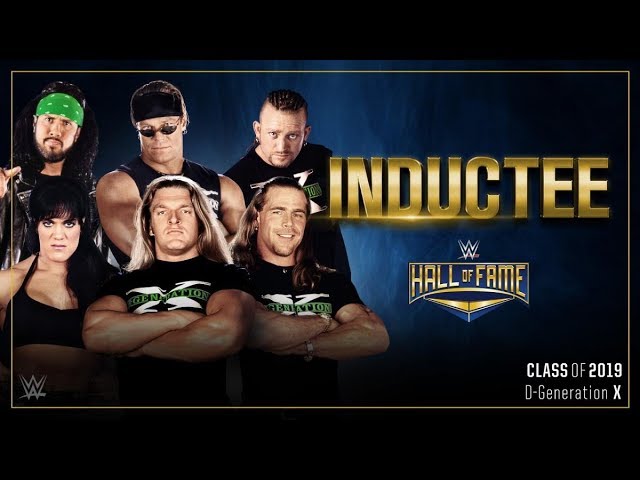
In 2019, the ultimate anti-establishment group changed its status. D-Generation X was inducted into the WWE Hall of Fame. The class included the six core members of its most famous incarnations. They were Triple H, Shawn Michaels, Chyna, X-Pac, Billy Gunn, and Road Dogg. The honor made Shawn Michaels only the second person in history, after Ric Flair, to be inducted twice.
The most significant aspect of the induction was the posthumous inclusion of Chyna. For years after her death, fans had clamored for her induction. However, WWE management had been reluctant. They cited the controversial nature of her post-wrestling career in adult films. The group induction was seen as a calculated corporate maneuver. WWE honored her trailblazing contributions and appeased a vocal fanbase. This was done while avoiding the perceived public relations risks of a solo induction. A solo induction would require a singular focus on her entire life story. During their speech, the members of DX heavily praised Chyna. They called her a true trailblazer. Her pioneering efforts made the historic women’s main event of that year’s WrestleMania possible. It was a masterful resolution to a long-standing PR problem.
The Blueprint for Rebellion: Influence on Modern Wrestling
The influence of D-Generation X on the generations of wrestlers that followed is undeniable. DX and their WCW contemporaries in the nWo created the modern template for the “cool heel” or anti-hero faction. These are groups that fans cheer for despite their villainous actions. Their formula is successful due to a blend of in-ring excellence and infectious charisma. It is driven by catchphrases and a strong, marketable brand identity. This has been emulated by countless stables since. This influence is evident in later WWE groups like Evolution. This group was led by Triple H himself. The influence has extended across the wrestling world to factions like Bullet Club. Its offshoot, The Elite, has also adopted a similar anti-authority, rule-breaking, and merchandise-heavy model.
Final Analysis: Revisionist History or Rightful Place?
A critical debate continues to surround DX’s precise place in wrestling history. WWE frequently positions them as one of the three foundational pillars of the Attitude Era. They are mentioned alongside Stone Cold Steve Austin and The Rock. WWE credits them as essential to winning the Monday Night War. Some historical accounts support this view, highlighting their groundbreaking role in shifting the company’s creative direction.
However, a prominent counter-argument among wrestling historians and critics suggests this is a form of “revisionist history.” It is said to overstate DX’s importance. This viewpoint is especially emphasized when compared to the industry-altering paradigm shift of the nWo. It is also noted against the singular, meteoric popularity of Steve Austin. This perspective often frames the popular DX Army as a beloved upper-mid-card act that provided crucial entertainment. Meanwhile, the true main event story that drove business was the feud between Austin and Vince McMahon.
The Ultimate Irony: From Degenerates to The Authority
Perhaps the most fascinating, and ironic, chapter of the D-Generation X story is its conclusion. The rebels who built a legacy on defying authority have become The Authority. Paul “Triple H” Levesque now serves as WWE’s Chief Content Officer, the ultimate arbiter of the company’s creative direction. Shawn Michaels is the Senior Vice President of Talent Development Creative, shaping the next generation of superstars in NXT.
The crotch chops and catchphrases are the group’s most visible legacy. However, its most impactful legacy may be its role in launching the executive career of Triple H. This role is also its most enduring. The stable was his launchpad from a blue-blood mid-carder to a main-event player. Leading the DX Army gave him his first taste of heading a massively successful brand-within-a-brand. The storylines surrounding the group directly integrated him into the McMahon family, both on-screen and off. D-Generation X provided the platform. It transformed Triple H from a performer into the eventual heir to the corporate kingdom. He once mocked this very institution. The ultimate degenerates became the ultimate architects of the very institution they once vowed to destroy.

Leave a Reply