Introduction: The Rug Pulled Out
On February 7, 2024, the professional wrestling world was jolted by a corporate press release. Scott D’Amore was terminated as President of Total Nonstop Action (TNA) Wrestling. He was widely credited with resurrecting a promotion left for dead. The news did not land as a simple executive shuffle. Instead, it was a profound shockwave through a locker room that was, by all accounts, on an unprecedented high. Just weeks earlier, the company had triumphantly returned to its TNA branding. They sold out The Palms in Las Vegas for its Hard To Kill pay-per-view. The atmosphere was electric with optimism. The talent had rallied behind D’Amore’s vision. They held a meeting to process the news. They also penned a letter protesting the decision. For them, the move felt inexplicable. Josh Alexander, TNA’s longest-reigning World Champion, later expressed this feeling with raw honesty. He said, “Then it felt like the rug was just pulled out from under you”.
That single quote encapsulates the central conflict of Scott D’Amore’s career. He is a quintessential builder. He is a wrestling lifer. His professional journey has been a relentless cycle of creating, nurturing, and rebuilding wrestling entities from the ground up. His story begins in a humble coffee shop in Windsor, Ontario. It reaches the presidential office of a global promotion. This journey is one of deep-seated passion and an intimate understanding of the wrestling business. Yet, his abrupt dismissal highlights a fundamental schism that has long defined the industry. There is a clash between a leader steeped in the creative and personal culture of the locker room. The corporate parent company prioritizes synergy. The company focuses on bottom-line integration. To understand Scott D’Amore, you must appreciate the journey of a man dedicated to stabilizing a brand. He worked tirelessly to mend broken bridges in the wrestling world. He championed a vision for growth, but found it didn’t align with the owners’ agenda. His story did not end there. Instead, the severing of that tie was the catalyst for his most ambitious and personal project yet.
Part I: Forged in Windsor – The Can-Am Foundation
The Making of a Wrestler
Scott Francis D’Amore was born on August 8, 1974, in Windsor, Ontario. His immersion in professional wrestling began at the remarkably young age of sixteen. In 1991, he started training under Doug Chevalier, making his professional debut on June 14, 1992, in Amherstburg, Ontario. He recognized the need for deeper knowledge in 1993. He sought guidance from three respected veterans. These veterans were “Irish” Mickey Doyle, Denny Kass, and future WWE star Al Snow. This foundational training provided him with a robust understanding of in-ring psychology and mechanics.
This education quickly led to opportunities on the industry’s biggest stages. Between 1993 and 1996, D’Amore worked at the World Wrestling Federation (WWF). He also worked at World Championship Wrestling (WCW) as an enhancement talent. These roles, while not glamorous, were invaluable. They offered a firsthand look at how the two largest wrestling companies in the world operated. This included television production and backstage politics. During his time with WCW, he frequently trained at the infamous WCW Power Plant. It was a grueling facility. It was designed to forge the company’s next generation of stars. This period of his career was a practical education in the wrestling business at its highest level. This experience profoundly shaped his future endeavors as a promoter and executive.
The Birth of Border City Wrestling (BCW)
While gaining experience in the major leagues, D’Amore was simultaneously laying the groundwork for his own empire back home. In late 1992, in a Windsor coffee shop, D’Amore founded Border City Wrestling (BCW). He established it with Doug Chevalier and Chuck Fader. Starting with modest crowds at LaSalle’s Centennial Arena, BCW was born from a passion for the local wrestling scene. When Chevalier left the area in 1994, D’Amore took over booking responsibilities. By 2000, he was the sole owner of the promotion.
BCW became D’Amore’s personal laboratory for promotional and booking concepts. His philosophy was clear: blend promising local rookies with established veterans to create a compelling product. He built the company on the backs of local talent like himself, Chris Pillon, and Otis Apollo. He also featured his own trainers, Mickey Doyle and Denny Kass, to lend credibility and experience to the cards. D’Amore demonstrated a keen sense of market trends. He astutely tapped into the burgeoning popularity of mixed martial arts. He did this by booking early UFC stars like Dan “The Beast” Severn for exhibitions. This move was well ahead of its time for a small independent promotion.
Long before the term “Forbidden Door” became a wrestling buzzword in the 2020s, Scott D’Amore was practicing its principles. He did this in the bingo halls and arenas of Ontario. His booking strategy at BCW was a masterclass in inter-promotional collaboration. In 1998, he leveraged a friendship between his talent D’Lo Brown and Dwayne “The Rock” Johnson. This connection brought The Rock—then the reigning WWF Intercontinental Champion—and Mark Henry to a BCW show. This event drew the promotion’s largest crowd at the time. When the influential Extreme Championship Wrestling (ECW) went out of business in 2001, D’Amore recognized an opportunity. BCW became a new home for many of ECW’s displaced, “extreme” superstars. Icons like Sabu, Tommy Dreamer, and Jerry Lynn became regulars at the Ciociaro Club, BCW’s new, larger venue. This pattern of collaboration continued for decades. BCW would later form partnerships with Japanese promotions like Pro Wrestling Noah. The promotion hosted special events featuring top stars from New Japan Pro-Wrestling (NJPW). They had a historic show. The prestigious All Japan Pro Wrestling (AJPW) Triple Crown Championship was defended for the first time on North American soil. This long history of navigating complex logistics and managing egos helped D’Amore develop a unique diplomatic skillset. This would become his hallmark as an executive at TNA.
The Can-Am Wrestling School: A Talent Pipeline
Complementing his promotional work was D’Amore’s passion for teaching. He operated the Can-Am Wrestling School. It became a direct feeder system for BCW. Eventually, it fed into the entire wrestling world. The school solidified D’Amore’s reputation not just as a booker. It also established him as a premier trainer and mentor. He could identify and mold raw talent into future stars. The wrestlers who passed through the Can-Am school show its influence. They form a veritable who’s who of TNA’s most important homegrown figures. It was this ability to cultivate talent from the ground up that would become his most valuable asset.
| Wrestler | Connection / Accomplishments |
| Bobby Roode | Can-Am graduate; Future TNA World Heavyweight Champion; Member of Team Canada & Beer Money, Inc. |
| Eric Young | Can-Am graduate; Future TNA World Heavyweight Champion; Member of Team Canada |
| Chris Sabin | D’Amore’s pupil; Multi-time TNA X Division & World Champion; Member of Motor City Machine Guns |
| Alex Shelley | Trained by D’Amore; Future TNA World Champion; Member of Motor City Machine Guns |
| Petey Williams | Can-Am graduate; Innovator of the Canadian Destroyer; TNA X Division Champion & Captain of Team Canada |
| Moose | Trained by D’Amore; Future TNA World Champion |
| Rosemary | Trained by D’Amore; TNA Knockouts Champion |
| A-1 | D’Amore’s student; Member of Team Canada |
Part II: “O Canada” – The Coach and His Stable
The On-Screen Persona: “Coach D’Amore”
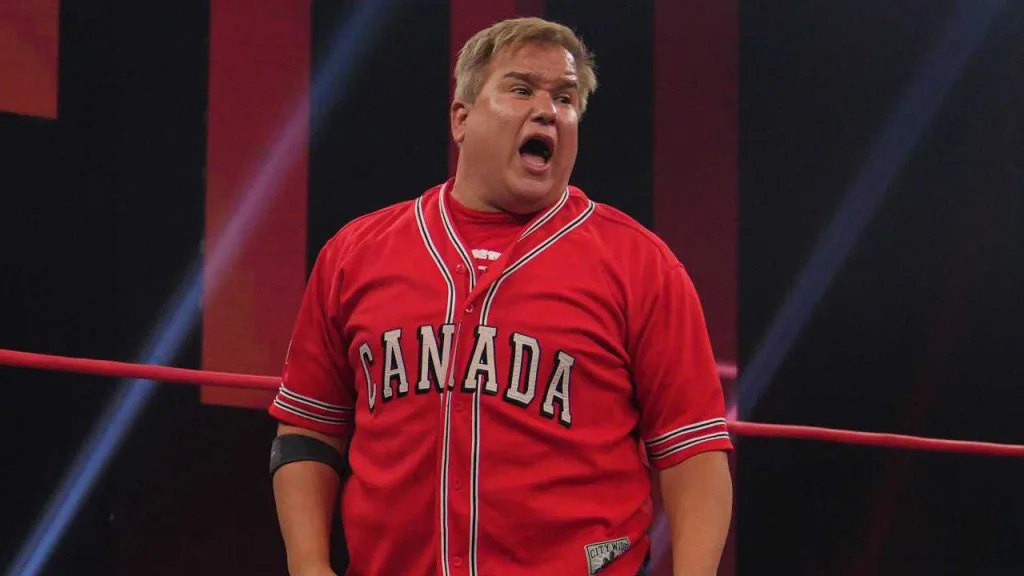
In 2003, Scott D’Amore brought his multifaceted expertise to the burgeoning Total Nonstop Action Wrestling (TNA). He immediately took on backstage responsibilities. However, he became most famous to the viewing audience for his on-screen character: the obnoxious and overbearing “Coach D’Amore”. As the manager of the heel faction Team Canada, D’Amore was a caricature of a stereotypical coach. He was loud-mouthed and constantly interfered in his team’s matches. He always clutched a hockey stick adorned with a Canadian flag. His antics frequently drew the ire of commentator Mike Tenay. Tenay memorably branded him a “big fat load” and “Canadian bacon”.
Years later, as an on-screen authority figure, D’Amore would reflect on his character philosophy. He never wanted to be a mundane, suit-wearing official like WWE’s Jack Tunney. Instead, he preferred a more “tongue in cheek” approach. He described his character as a “jerk” who enjoyed the banter with talent. His modus operandi was to give wrestlers what they asked for. However, it was always in the “least advantageous way for you.” This approach created compelling television by acting as a clever and often petty obstacle to both heroes and villains. His persona was honed during his time as “Coach.” His primary goal was to get his team over using any means necessary.
Team Canada: A Star-Making Machine
Team Canada was formed in 2004, initially for TNA’s international X-Cup tournaments. The initial lineup included the mercurial Teddy Hart and high-flyer Jack Evans. D’Amore later solidified the group around a core of his Can-Am Wrestling School graduates. Petey Williams served as the captain. The faction featured the powerhouse Bobby Roode. It also included the versatile Eric Young and the rugged Johnny Devine. They were a quintessential anti-American heel stable. They marched to the ring to a mocking version of “O Canada.” They draped their flag over vanquished opponents.
The group quickly became a cornerstone of TNA programming. They engaged in memorable feuds with top babyface acts like the 3Live Kru (Ron Killings, Konnan, and B.G. James) and the legendary Team 3D (Brother Ray and Brother D-Von). They were also key allies in Jeff Jarrett’s dominant “Planet Jarrett” super-stable, cementing their place in the main event scene. The faction was ultimately forced to disband in a dramatic, high-stakes match in July 2006. However, their two-year run was instrumental. It established several of TNA’s most important future stars.
A crucial layer to this era was the synergy between D’Amore’s on-screen role and his rapidly growing backstage influence. He joined TNA in 2003 as a road agent, immediately using his position to bring in his student, Chris Sabin. He was soon added to the creative team and, in May 2005, was appointed head of the TNA booking team. For a significant period, D’Amore was both the on-screen manager and the off-screen head writer. He led the very wrestlers he was managing. This was not a coincidence, but a powerful and rare convergence of roles. His on-screen absence was included in the show with an attack angle at Slammiversary 2005. This move was necessary to accommodate his expanding off-screen workload. This duality allowed him to strategically craft storylines. These storylines elevated his hand-picked talent—Williams, Roode, and Young. They would go on to become the bedrock of TNA for the next decade and beyond. He was writing the story where he was the main character. This unique position allowed him to directly shape the company’s future.
| Member | Role | Championships Won in TNA |
| Scott D’Amore | Coach/Manager | N/A |
| Petey Williams | Captain | TNA X Division Championship (1 time) |
| Bobby Roode | Enforcer | NWA World Tag Team Championship (2 times) – with Eric Young |
| Eric Young | Member | NWA World Tag Team Championship (2 times) – with Bobby Roode |
| Johnny Devine | Original Member | N/A (during tenure with team) |
| A-1 | Powerhouse | N/A |
| Teddy Hart | Original Captain | N/A |
| Jack Evans | Original Member | N/A |
| Tyson Dux | World X Cup Member | N/A |
Part III: The Architect of the Anthem Era
The State of Decay
When Scott D’Amore returned to the promotion—then known as Impact Wrestling—in 2017, he walked into a company in turmoil. The “LOLTNA” narrative, born from years of creative missteps and backstage drama, was pervasive among wrestling fans. The promotion had lost its crucial U.S. television deal with Spike TV in 2014. This led to a period of decline marked by monetary issues. There was also constant personnel turnover and a diminished public profile. The brand itself was damaged. It cycled through a confusing series of name changes. These changes were from TNA to Impact Wrestling to, briefly, Global Force Wrestling (GFW) and back again. This eroded its identity. By many measures, it lagged behind its longtime rival. Ring of Honor was now considered the definitive number-two promotion in North America.
The Rebuild
D’Amore’s second tenure began as part of a familiar team. Jeff Jarrett brought him back. Jeff had been appointed by new parent company Anthem Sports & Entertainment to run the promotion. D’Amore assumed the title of Vice President of International Relations, a role he had previously held in Jarrett’s GFW project. When Jarrett’s relationship with Anthem soured and he was terminated, D’Amore’s influence grew exponentially. He was elevated to Head of Creative and, on December 5, 2017, was named Co-Executive Vice President alongside Don Callis. After Callis’s departure, D’Amore held the role alone. On March 13, 2023, he was officially promoted to President of Impact Wrestling. This marked the culmination of a steady, six-year climb to the top of the company he was tasked with saving.
Creative Philosophy: Stability and Storytelling
D’Amore’s booking philosophy was the antithesis of the chaotic creative that had plagued the company for years. He championed a patient, “slow build” approach rooted in “compelling storytelling” and high-quality, “athletic matches”. Fans and analysts praised this strategy. They noted that he brought a much-needed sense of order. He booked a “very stable and consistent show that makes sense”. He weathered what one observer called a “perfect storm of shit”. He rebuilt the TNA/Impact name from the ground up. He signed great talent and elevated them to a level where they became recognized stars.
His tenure was defined by long-term, satisfying character arcs that rewarded loyal viewers and homegrown talent. The most prominent example was the world title reign of Josh Alexander. After a dramatic storyline where he was “sent home” by D’Amore, Alexander returned to win the Impact World Championship. He went on to hold it for a record-setting 335 days. This reign was celebrated for its quality matches and strong booking. Similarly, D’Amore orchestrated the emotional world title victory for TNA original Alex Shelley. This victory was long overdue. It was another moment that resonated deeply with the fanbase. Perhaps his most significant creative victory was successfully lobbying for the official rebrand back to the TNA name. He fought for this change for many years. He understood the brand recognition that the TNA initials still held, even after many years of being dormant. As Josh Alexander recounted, even border guards who didn’t recognize “Impact Wrestling” immediately knew “TNA”. The rebrand was a massive success, galvanizing the locker room and the fanbase just before his dismissal.
The Forbidden Door Diplomat
Leveraging the diplomatic skills he honed in BCW, D’Amore transformed Impact into a central hub for inter-promotional collaboration.
- New Japan Pro-Wrestling (NJPW): D’Amore inherited a toxic relationship with NJPW. He recounted how the Japanese promotion “hated TNA” due to poor business practices in the past. It took years of patient effort to demonstrate that the new leadership was different. Mending the fence with superstar Kazuchika Okada was a major symbolic victory. His infamously terrible excursion to TNA years prior had been a major source of animosity. Getting Okada to forgive the company was a monumental achievement. Convincing him to return for a match signaled a new era of trust.
- All Elite Wrestling (AEW): During the COVID-19 pandemic, D’Amore and AEW’s Tony Khan engineered a high-profile partnership. D’Amore described the collaboration as having “real high points” and praised Khan as a “gentleman to do business with”. The angle saw AEW World Champion Kenny Omega win the Impact World Championship. This move brought significant mainstream attention. It popped a television rating and a pay-per-view buyrate at a time when Impact desperately needed it. However, the partnership was a source of major friction among the TNA faithful. Fans and even some talent felt the booking made Impact look weak and subservient. Criticisms focused on Tony Khan’s “paid ads.” In these, he regularly denigrated the TNA brand. Another criticism was that Omega never lost the title to a TNA-contracted wrestler. Instead, he dropped it to fellow AEW star Christian Cage on an AEW show. There was also a general feeling that AEW talent was protected at the expense of TNA’s roster.
- World Wrestling Entertainment (WWE): D’Amore’s most groundbreaking diplomatic achievement was forging a working relationship with the industry monolith, WWE. He initiated the process. He reached out to contacts at WWE. This led to a direct text message from Paul “Triple H” Levesque that “started the ball rolling.” This led to a series of unprecedented collaborations. TNA licensed match footage to WWE for Ken Shamrock’s Hall of Fame induction. A senior WWE official told D’Amore that this had never happened before with another wrestling company. This was followed by then-Knockouts Champion Mickie James making a shocking appearance in the WWE Women’s Royal Rumble match. The partnership reached a new level when Jordynne Grace appeared in the 2024 Rumble. D’Amore saw this as a “tremendous step in legitimizing what we had done through all the years at Impact/TNA.” Unlike the AEW relationship, the WWE partnership was seen as respectful. It was mutually beneficial. WWE treated TNA and its championships with a level of reverence.
| Date/Period | Role/Title |
| 2003–2005 | Road Agent / Creative Team Member |
| May 2005–2008 | Head of TNA Booking Team |
| 2009–2010 | Road Agent, Knockouts Division |
| 2017 | Vice President of International Relations |
| December 2017–2021 | Co-Executive Vice President (with Don Callis) |
| 2021–2023 | Executive Vice President (sole) |
| March 2023–Feb 2024 | President of Impact/TNA Wrestling |
Part IV: A Difference in Vision – The Anthem Breakup
The Firing
The decision to terminate Scott D’Amore came from TNA’s parent company, Anthem Sports & Entertainment. Anthem’s official statement described the move as strategic. It aimed to further integrate TNA Wrestling into Anthem’s Entertainment Group. The goal was to leverage the parent company’s broader resources in production, marketing, and ad sales. The promotion is now under Anthony Cicione’s leadership. He is a “seasoned television operator” and President of Anthem’s Entertainment Group.
D’Amore’s own account aligns with this, though from a different perspective. He confirmed there was a fundamental “difference of opinion” on the company’s strategic direction. He believed 2025 was the year to “really take some major shots.” He advocated for ambitious plans like running shows in iconic venues such as New York’s Hammerstein Ballroom. He also proposed taking the Bound For Glory pay-per-view to Tokyo or London. These plans, he felt, did not align with Anthem’s more conservative vision for the brand. The conflict was not about performance—the company was on an upswing—but about philosophy. It was a classic case of a wrestling-focused leader’s ambitious vision for growth. It clashed with a corporate parent’s desire for controlled, synergistic integration.
The Locker Room’s Voice
The reaction from the TNA locker room was swift, emotional, and overwhelmingly supportive of their fired president. The talent’s testimonials paint a vivid picture of a leader who had earned their deep loyalty and respect.
- Josh Alexander: The man D’Amore booked as his record-breaking champion felt the loss acutely. He felt the firing was unexpected. It was like having the “rug pulled out” from under a locker room. That locker room was “riding high” on success. Alexander’s connection to D’Amore was profoundly personal. He had moved his family to Windsor to become the head trainer at D’Amore’s Can-Am school. This was a life-altering decision made just months before the firing.
- Jordynne Grace: The dominant Knockouts Champion was unequivocal about her allegiance. “I only really signed here because I had faith in Scott,” she said. “He was gonna do good things for me and good things for the company.” She credited D’Amore for setting “in motion the whole rebirth of TNA”. Her faith in the company was deeply connected to D’Amore’s leadership. When he departed, she immediately requested an early release from her contract. Her contract was set to run until October, but she was granted the release. She firmly believes she would have re-signed and remained with TNA had he stayed.
- Moose: The former NFL player turned TNA World Champion described D’Amore as a “huge mentor”. He stated his loyalty plainly: “It’s one of those things if Scott D’Amore isn’t here, then Moose isn’t here.” He expressed shock at the firing. However, he urged a level of trust in Anthem’s leadership. He acknowledged that the company’s owner, Len Asper, had saved TNA from extinction years earlier.
The Ultimate Gambit: The Attempted Purchase
In the weeks following his termination, D’Amore made a move that cemented his status as a wrestling lifer. He put together a financing plan and presented Anthem with a formal offer to purchase TNA Wrestling outright. He later clarified the sequence of events to dispel any rumors: “I got let go. Then I tried to buy it. This is a more logical series of events”. His motivation was simple and powerful: “Look, I think I know where I want this thing to go. I think we can take it to new places. I’m willing to put my money where my mouth is. I’m also willing to put others’ money where my mouth is”. Sources close to Anthem described the offer as “legitimate” and “worthy of consideration,” but it was ultimately rejected.
This sequence of events began with being fired at a creative and commercial high point. It continued with receiving an outpouring of loyalty from top stars. Finally, it concluded by trying to buy the entire company. This is perhaps the most defining moment of Scott D’Amore’s legacy. It was not the action of a disgruntled employee, but of a passionate builder trying to protect his creation. His leadership had successfully resurrected a tarnished brand. He forged unprecedented industry partnerships. He cultivated a locker room culture of loyalty and motivation. The firing and subsequent buyout attempt showed that his commitment was not just to a job. It was to the TNA brand and its talent. He believed in the specific vision he had fought to realize. It was a powerful declaration. His conviction was public. He believed in what a wrestling promotion could and should be. He maintained this belief even in defiance of its corporate owners.
Part V: The Maple Leaf Rises Again
A New Beginning
The sting of the firing was hard to bear, as was the rejection of his buyout offer. Once these feelings subsided, D’Amore did what he has always done: he started building. On August 8, 2024, he announced that he had acquired the trademarks to the historic Maple Leaf Wrestling brand. He was launching a revival, aptly named Maple Leaf Pro Wrestling (MLP). The mission was clear: to honor the rich legacy of one of Canada’s most storied wrestling territories. This was a promotion that featured legends like Ric Flair and Bruno Sammartino. It also aimed to showcase the electrifying energy of today’s top stars. It was a venture designed to be a premier Canadian wrestling company from its inception.
Building a Foundation for Excellence
D’Amore’s approach to launching MLP was a masterclass in strategic planning, reflecting his decades of experience. He immediately surrounded himself with a world-class team to ensure a high-quality product from day one. He made a decisive move to show his commitment to production value. He convinced legendary executive producer Keith Mitchell to come out of retirement. Mitchell is the man behind the look of WCW’s Nitro, TNA’s launch, and AEW’s first years. D’Amore called it a “super honor” to have Mitchell’s unparalleled knowledge on his team. To be the voice of the new promotion, he signed Mauro Ranallo. Ranallo is widely considered one of the best play-by-play commentators in the history of combat sports. The inaugural two-night event, “Forged in Excellence,” was scheduled for October 2024 in Windsor. It was set to stream live globally on Triller TV. This signaled an immediate focus on professional presentation and international reach.
Maple Leaf Pro Wrestling is not just a rebound project for Scott D’Amore. It is the ultimate distillation of his entire career. It represents the logical culmination of every role he has ever held. In MLP, he is once again the builder. He is creating a promotion from the ground up. He repeats what he did with Border City Wrestling three decades earlier. He is the Canadian conduit. He revives a legendary national brand. His explicit goal is to provide a platform for Canadian talent. He aims to celebrate the country’s rich wrestling history. He is the diplomat. The debut cards positioned MLP as a new hub for collaboration. They featured talent from TNA, AEW, and NJPW. And finally, he is the visionary, now completely free from the constraints of corporate oversight. In Maple Leaf Pro, Scott D’Amore executes his unique vision without any compromise. He builds a team that reflects his life’s work entirely. The product mirrors his career achievements.
Conclusion: The Measure of a Lifer
Scott D’Amore’s journey through the world of professional wrestling is sprawling. It is a narrative of resilience, ambition, and an abiding passion for the business. He is a figure who cannot be defined by a single role. He has been the in-ring talent, the obnoxious on-screen coach, and the savvy independent promoter. He has been the star-making trainer, the head booker, and the international diplomat. He has also been the company president. His legacy is not etched onto a single championship belt. Instead, it is built into the very foundations of the institutions he created. It is visible in the careers he shaped and the brand he resurrected from the brink of oblivion.
From the Can-Am Wrestling School that produced a generation of TNA mainstays, D’Amore has always been a builder. The Border City Wrestling promotion served as his lifelong creative laboratory. His leadership of Team Canada was a masterstroke of dual-purpose booking. It created a memorable television act. At the same time, it elevated the future cornerstones of the company he was also writing for. His second tenure at TNA was a monumental success in stabilization and rebuilding. He mended fences with promotions around the globe. He turned a pariah into a partner. He restored a level of respectability and relevance that had seemed lost forever.
Ultimately, his story is a testament to a deep, personal connection to the art and business of wrestling. His firing from TNA, a painful and public blow, paradoxically solidified his legacy. The overwhelming support from his talent showed a man whose commitment transcended that of a mere employee. His subsequent attempt to buy the company he loved also revealed this. It was the act of a lifer fighting for his vision. Now, with Maple Leaf Pro Wrestling, that vision is finally his and his alone. Scott D’Amore is free from corporate agendas. This freedom gives him the chance to build his purest legacy project. It’s a promotion forged in his own image. It is ready to succeed based solely on his career merits. A career spent learning, creating, and enduring in the world of professional wrestling.

 ScortonBoy17.ca
Leave a comment