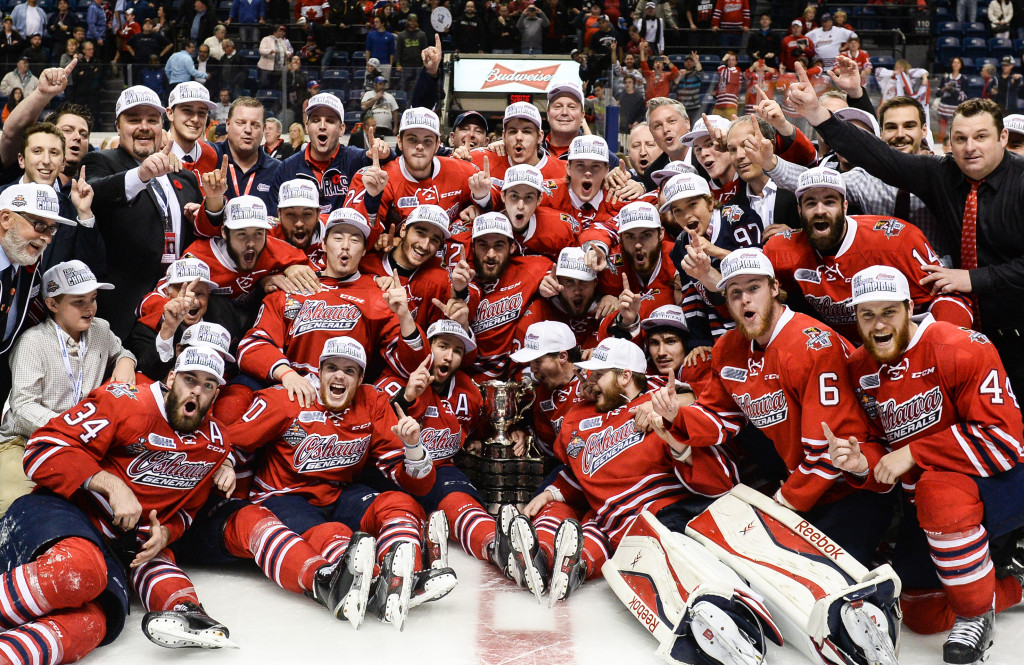
The Oshawa Generals are revered in the grand theatre of Canadian junior hockey. Few franchises possess their decorated history. They are a cornerstone of the Ontario Hockey League (OHL). They are also a titan within the broader Canadian Hockey League (CHL). Their name is synonymous with both dynastic dominance and legendary alumni. The club’s trophy case tells a story of unparalleled success: a record 13 J. Ross Robertson Cups as OHL champions and a CHL-high five Memorial Cups as the undisputed best in the nation.
But the story of the Oshawa Generals is far more than a simple accounting of championships. This saga is quintessentially Canadian. It is a narrative forged in the industrial heart of a motor city. The narrative is tested by literal and figurative fires. It is defined by a remarkable capacity for resilience. It tells the story of a team whose identity is deeply connected to its community. This identity is evident from its very name to the arenas built by the hands of its fans. Through the decades, this bond has been the foundation for legends. These legends range from the revolutionary Bobby Orr to the generational talents of Eric Lindros and John Tavares. This is the history of a franchise. Here, the mantra “Once a General, always a General” is not just a slogan. It’s a sacred creed echoing through more than 80 years. It echoes of triumph, tragedy, and tradition.
Table 1: The Generals’ Championship Pedigree. This table summarizes the franchise’s major championship victories. It underscores their status as one of the most successful teams in CHL history.
| Championship | Years Won |
| Memorial Cup | 1939, 1940, 1944, 1990, 2015 |
| J. Ross Robertson Cup | 1938, 1939, 1940, 1941, 1942, 1943, 1944, 1966, 1983, 1987, 1990, 1997, 2015 |
The Motor City’s First Shift – Forging an Identity (1908-1944)
The roots of hockey in Oshawa run deep, predating the iconic “Generals” moniker. The city first entered the Ontario Hockey Association (OHA) junior division in the 1908-09 season. During this time, they formed a team known as the Oshawa Shamrocks. Ed Bradley, a prominent local businessman, organized the team. They found early success in “The Big Rink,” later known as the Bradley Arena. In June 1928, this wooden arena burned to the ground. This event dramatically foreshadowed future challenges. The team was forced into a temporary relocation until a new venue could be constructed. By the early 1930s, the team was known as the Oshawa Majors. They captured an OHA title in 1935. However, it was later stripped due to a protest.
The modern franchise was officially born in 1937, and its name established an identity that would define it for generations. The team became the Oshawa Generals. They were named in honor of their primary sponsor, General Motors of Canada. GM was the city’s largest employer and economic engine. This was not just a case of corporate branding. It reflected a “company town” where the citizens’ lives were deeply intertwined with the auto industry. The McLaughlin family founded the McLaughlin Motor Car Company. They steered its merger to create GM Canada. The family were instrumental civic figures. They were key backers of the city’s hockey ambitions. The McLaughlins helped to fund the construction of arenas. This powerful symbiotic relationship between the team, the city, and its primary industry was transformative. It created a stable environment. The team was well-resourced, allowing for immediate success. This success was unprecedented.
Under the shrewd management of Matt Leyden, the newly christened Generals started a period of dominance. This dominance was unmatched in OHL history. From 1937 to 1944, the team established the “OHA Dynasty,” capturing an incredible seven consecutive OHA championships (the J. Ross Robertson Cup). Their reign extended across the country. They won three Memorial Cups in that span. These victories cemented their status as Canada’s junior hockey powerhouse in 1939, 1940, and 1944.
This dynasty was built on a culture of excellence that went beyond the ice. The Generals organization gained a reputation for treating its players exceptionally well. This was a key factor in attracting the best young talent. Players received weekly stipends. They were given free admission to local attractions. Most importantly, team sponsors provided full scholarships for them to attend school. This commitment to player welfare paid dividends. It resulted in producing 20 NHL alumni from the dynasty era alone. This included future Hockey Hall of Fame members Ted Lindsay and builder Father David Bauer.
Trial by Fire – Tragedy, Rebirth, and a Boy Wonder (1953-1966)
The Generals’ story of resilience is most powerfully embodied by the two great fires that have shaped its history. The first fire in 1928 was a setback. The second was a catastrophe that nearly extinguished the franchise for good. In the early morning hours of September 15, 1953, the Hambly Arena was engulfed in flames. It had been the team’s home since 1930. The blaze was so intense. Within an hour, the entire structure was a lost cause. Only twisted steel and remnants of the brick facade remained. The financial devastation was massive. Losses were estimated between $350,000 and $500,000. This was a staggering sum at the time and was only partially covered by insurance.
For the Generals, the timing was calamitous. The fire occurred just one week before the start of the new season. It destroyed all of the team’s equipment and uniforms. Homeless and without resources, the franchise was forced to disband, beginning a nine-year hiatus from the OHA. The hockey spirit in the region, however, refused to die. Some players joined a senior team, the Oshawa Truckmen. This team later became the famed Whitby Dunlops. The club would go on to win national championships. They would also win world championships, keeping the local talent pool active and engaged.
The rebirth of the Generals began in 1962, orchestrated by manager Wren Blair. A crucial and franchise-altering partnership with the NHL’s Boston Bruins and their president, Weston Adams, made the revival possible. The agreement centered on constructing a new arena for the team. It was a project fueled by a community determined to bring its Generals back. With the slogan “Let’s build it ourselves, for ourselves,” volunteers, including local unionized auto workers, raised $1.4 million to fund the project. The result was the Oshawa Civic Auditorium, which officially opened its doors on December 11, 1964. While the “Civic” was under construction, the reborn Generals played home games at Toronto’s Maple Leaf Gardens. They also played in nearby Bowmanville (my hometown!). This was a testament to their determination to return.
This alliance with the Bruins proved to be the masterstroke that defined the team’s new era. The tragedy of the fire paradoxically created the conditions for a glorious resurrection. As part of their affiliation, the Bruins began placing top prospects with the Generals. In 1962, they sent a 14-year-old defenseman from Parry Sound named Bobby Orr to Oshawa. He was a prodigy, a player who would revolutionize the sport. Orr competed against players four and five years his senior. He became an instant sensation. His explosive offensive style from the blue line was unlike anything the league had ever seen.
Orr’s impact was immediate and profound. In the 1964-65 season, the team’s first full year in the new Civic Auditorium, he broke his own scoring record. As a defenseman, he scored 34 goals. The following year, 1965-66, was the culmination of the team’s rebirth. Captained by Orr, who scored an incredible 38 goals, the Generals defeated the Kitchener Rangers to win the J. Ross Robertson Cup—their first OHL championship in 22 years. They advanced to the Memorial Cup final against the Edmonton Oil Kings. Orr played through a significant injury for most of the series. Although the Generals ultimately fell in six games, their message was clear: they were back. The boy wonder delivered by the Bruins partnership had legitimized the reborn franchise and launched its second golden age.
Table 2: A Home for Hockey – The Arenas of the Generals. This timeline tracks the franchise’s home arenas. It highlights the recurring theme of destruction and renewal. This theme is central to the team’s identity.
| Arena Name | Years of Operation | Key Event |
| Bradley Arena | 1908–1928 | Destroyed by fire in 1928, forcing the team’s first relocation. |
| Hambly Arena | 1930–1953 | Home of the OHA Dynasty; destroyed by a catastrophic fire in 1953, leading to a 9-year hiatus. |
| Oshawa Civic Auditorium | 1964–2006 | The “House that Orr Built.” It was home to the 1966, 1983, 1987, and 1990 OHL champions. The arena also hosted the 1990 Memorial Cup winners. |
| Tribute Communities Centre | 2006–Present | Modern downtown arena; home to John Tavares and the 2015 OHL and Memorial Cup champions. |
The Grind, The Glory, and The Grudge (1967-1988)
Bobby Orr and his talented cohort departed after the 1966 Memorial Cup run. This ushered in a period of rebuilding. The late 1960s and 1970s experienced teams struggling with several “dismal seasons” in the standings. They could not replicate their previous success as they hoped. However, a franchise’s strength is not always measured in championships. Even during these lean years, the Generals solidified their reputation as a premier development program. They consistently produced rugged, high-character players. These players went on to long NHL careers. The fans in Oshawa may not have been cheering for a winning team every night. However, they saw the rise of future NHL stars. These stars included Terry O’Reilly, Rick Middleton, Lee Fogolin, Greg Malone, and Dale Tallon. This ability to cultivate professional talent maintained the organization’s prestige and laid the groundwork for its next ascent.
That ascent began in earnest in 1979 with the hiring of coach Paul Theriault. His arrival heralded a new era of sustained competitiveness. Theriault led the team to nine consecutive winning seasons, transforming the Generals back into an OHL powerhouse. Under his guidance, the team captured two J. Ross Robertson Cups in 1983 and 1987 and made two appearances in the Memorial Cup tournament. In 1987, the Generals hosted the Memorial Cup at the Civic Auditorium. They participated as both OHL champions and the host city. They reached the championship final before falling to the Medicine Hat Tigers.
Rivalry Spotlight: The Peterborough Petes
This era was also defined by the crystallization of one of junior hockey’s most bitter and violent rivalries. The proximity to the Peterborough Petes—a short drive up the highway 115—created a deep-seated animosity between the two clubs. Their fanbases often clashed in spectacular fashion on the ice. Two incidents, in particular, have become the stuff of OHL legend.
The first occurred on March 24, 1981, during a playoff series. Tensions ignited before the game even began, as players from both teams began jawing during the pre-game warmup. The conflict rapidly escalated into a full-scale brawl involving players, coaches, and even fans who came onto the ice. In a surreal scene, Durham Regional Police officers struggled to separate the combatants while Generals coach Bill LaForge and Petes coach Dave Dryden engaged in their own scuffle, with Dryden later claiming LaForge had ripped his suit. The OHL came down hard on LaForge, suspending him for 50 games for his role in the melee.
Six years later, on December 12, 1987, the rivalry reached another boiling point. With minutes left in the game, Peterborough’s Kris King delivered a crushing hit on Generals goaltender Jeff Hackett. The Generals immediately erupted, leading to a bench-clearing brawl. The incident was further marred by allegations. A Peterborough trainer allegedly directed racial slurs at Generals defenseman Jim Paek. Paek is of Korean descent. These brawls were more than just hockey fights. They were raw, emotional explosions. The incidents forged a tough, resilient identity for the Generals. They also cemented the rivalry with the Petes as one of the most intense in all of hockey.
The Next One – The Eric Lindros Era (1989-1992)
The Paul Theriault era of sustained success was coming to an end. At the same time, the Generals were about to be defined by the arrival of another singular, transcendent talent. In 1989, a 16-year-old Eric Lindros joined the team, a player of unprecedented hype, size, and skill. Often dubbed “The Next One” in reference to Wayne Gretzky’s moniker, Lindros was a 6-foot-4 power forward. He weighed 235 pounds. Lindros could skate, score, and physically dominate opponents like the junior ranks had never seen. His path to Oshawa was fraught with controversy; he was drafted first overall by the Sault Ste. Marie Greyhounds but refused to play for them, eventually forcing a trade to the Generals.
His impact was immediate. Lindros joined a strong Generals team filled with veteran players. He was the final piece they needed to reach the pinnacle of junior hockey. In the 1989-90 season, he was a key force in leading the team to its fourth Memorial Cup championship. In a thrilling final hosted at Copps Coliseum in Hamilton, the Generals defeated the Kitchener Rangers in double overtime. Lindros did not score in the four-game tournament. However, he was a dominant physical presence. He was also a playmaking force, racking up 9 assists.
If his rookie season was about team glory, his sophomore campaign was a showcase of individual brilliance. During the 1990-91 season, Lindros put together one of the most dominant seasons in OHL history. In just 57 regular-season games, he scored an astounding 71 goals and added 78 assists for 149 points. He received multiple accolades. He won the Eddie Powers Memorial Trophy as the league’s top scorer. He also won the Red Tilson Trophy as its most valuable player. Additionally, he earned the CHL Player of the Year award and the CHL Top Draft Prospect Award.
Lindros’s tenure perfectly illustrates the “superstar cycle” that has defined so much of the Generals’ history. Like Bobby Orr before him, his arrival instantly elevated a good team. It turned them into a championship-caliber one. This created a distinct and unforgettable era. His legacy in Oshawa was cemented on March 6, 2008. The franchise retired his #88 jersey and declared it “Eric Lindros Day” in the city.
A New Century, A New Home, A New Phenom (2000-2015)
The turn of the millennium marked a period of major change for the Oshawa Generals. This occurred both on and off the ice. The team captured a J. Ross Robertson Cup in 1997, thanks to a dramatic overtime winner from future NHL star Marc Savard. The years that followed were about modernization. They were also about setting the stage for the next chapter. In 2004, a major era ended. The Humphreys family had owned the team since its resurrection in 1962. They sold the franchise to John Davies.
This change in ownership coincided with a physical move that brought the team firmly into the 21st century. In November 2006, the Generals played their final game at the venerable but aging Civic Auditorium. They then moved into a new, state-of-the-art downtown arena. The arena was initially named the General Motors Centre. The move symbolized a fresh start and a renewed commitment to providing a premier experience for players and fans.
The team was settling into its new home. During this time, it welcomed a new phenom. This phenom arrived under unprecedented circumstances. In 2005, the OHL created the “exceptional player status” rule. This rule allows a player to enter the league a year early at age 15. The condition is that they must demonstrate rare and extraordinary abilities. John Tavares was the first player ever granted this status. The Generals held the first overall pick. They eagerly selected him.
Tavares immediately lived up to the hype, launching an assault on the OHL record books. He was named CHL Rookie of the Year in 2006 after scoring 45 goals. In his second season, 2006-07, he scored an incredible 72 goals. He broke a 31-year-old record for goals by a 16-year-old. This record was previously held by Wayne Gretzky. That year, he was named the CHL Player of the Year. Though his Generals teams never won a championship, Tavares left an indelible mark. He eventually set the all-time OHL record with 215 career goals.
The franchise’s evolution continued in the front office. In 2008, Rocco Tullio bought out John Davies to become the team’s majority owner. In 2010, he welcomed former NHL star Adam Graves as a partner. He also brought in decorated OHL coach Peter DeBoer. This formed a stable and ambitious ownership group. The Tavares era, combined with the new arena and new ownership, represented a complete modernization of the franchise. It re-energized the fanbase. It professionalized the team’s operations. This created the fertile ground from which the next championship team would grow.
Table 3: Generations of Greatness – The Superstar Eras. This table provides a look at the OHL careers of the three most iconic players in Generals history. These players defined their eras. This highlights the cycle of generational talent propelling the franchise.
| Player | OHL Seasons | GP | G | A | Pts | Key Accomplishments with Generals |
| Bobby Orr | 1962–1966 | 194 | 83 | 195 | 278 | J. Ross Robertson Cup (1966), Memorial Cup Finalist (1966) |
| Eric Lindros | 1989–1992 | 95 | 97 | 119 | 216 | Memorial Cup (1990), CHL Player of the Year (1991), Red Tilson Trophy (1991) |
| John Tavares | 2005–2009 | 247 | 215 | 218 | 433 | CHL Player of the Year (2007), CHL Rookie of the Year (2006), All-Time OHL Goal Leader |
The Fifth Star – Champions Again (2015-Present)
The modernization efforts of the mid-2000s came to full fruition in the 2014-15 season. The victory did not happen suddenly. It was the culmination of years of strategic team-building under the ownership of Rocco Tullio. The expert coaching of D.J. Smith also played a crucial role. The team had shown flashes of its potential the previous season, winning the Leyden Trophy as division champions in 2013-14. In 2014-15, they became an unstoppable force. They set new franchise records for most wins (51). They also achieved the most points (108) in a single season.
This regular-season dominance carried over into the playoffs. The Generals stormed through the OHL postseason, capturing their 13th J. Ross Robertson Cup by defeating the highly touted Erie Otters, led by Connor McDavid, in the championship series. It was the franchise’s first OHL title in 18 years.
Their journey was not over. At the 2015 Memorial Cup in Quebec City, the Generals continued their masterful play. They went undefeated through the round-robin portion of the tournament, earning a direct berth into the championship final. There, they faced the WHL champion Kelowna Rockets in a tense, hard-fought battle. The game went to overtime. Rookie forward Anthony Cirelli scored at 1:28 of the extra frame to give the Generals a 2-1 victory. This win secured their fifth Memorial Cup. The win solidified their place as the most successful active franchise in the CHL.
This championship success provided the momentum for the franchise. It helped secure its long-term future in a way few junior teams ever can. In April 2025, owner Rocco Tullio, the City of Oshawa, and arena operators Oak View Group made an announcement. They launched a historic 30-year partnership. The agreement keeps the Generals in Oshawa until at least 2055. It includes a $50 million investment from the city to modernize the Tribute Communities Centre. This landmark deal ensures that generations of future fans will be able to cheer on their hometown team. The team has remained competitive since its last championship. They have added Bobby Orr Trophies as Eastern Conference Champions in 2023-24 and 2024-25. This signals that the pursuit of a sixth star is well underway.
Once a General, Always a General
The history of the Oshawa Generals is a rich tapestry woven with threads of glory, community, and extraordinary resilience. This story deeply acknowledges its roots in the city’s industrial identity. The partnership with General Motors gave the team its name and purpose. It is a narrative uniquely defined by its ability to rise, phoenix-like. The team emerged from the literal ashes of two devastating arena fires. Each time, it returned stronger and more determined.
The club’s legacy is carried by hockey royalty. These remarkable players have worn its iconic red, white, and blue. The Generals have been a cradle for greatness since the dynasty-builders of the 1940s. Generational pillars defined their eras, including the revolutionary Bobby Orr, the dominant Eric Lindros, and the exceptional John Tavares. The heroes of the 2015 championship team continued this tradition. They carved their own chapter into the franchise’s storied history.
Ultimately, the phrase “Once a General, always a General” transcends being a simple team slogan. It is a declaration of a shared identity, a bond connecting players, owners, and fans across the decades. It conveys a history of overcoming adversity. It celebrates unparalleled success. It embodies the heart and soul of a city and the very best of Canadian junior hockey.

 ScortonBoy17.ca
Leave a comment