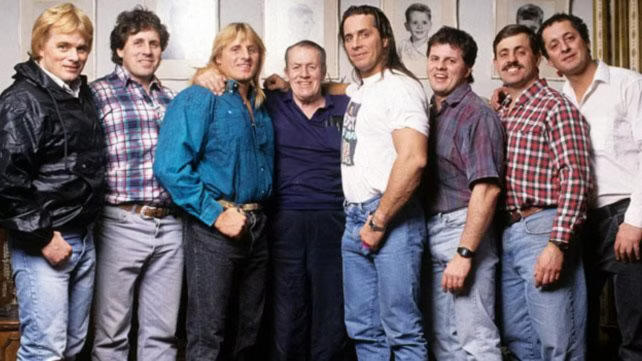
Introduction: The House on Patterson Heights
In the Patterson Heights neighborhood of Calgary, Alberta, stands a mansion that is more than just a home. It is a landmark in the history of professional wrestling. For decades, the Hart House was the geographic and spiritual epicenter of a sports-entertainment empire, a place of profound contradictions. It was a bustling family home that raised twelve children. Yet, its basement was a notoriously brutal training ground known as “The Dungeon.” Wrestlers described it as a “torture chamber.” It was a site of immense creative output. It launched the careers of global superstars. Simultaneously, it was a place of deep personal suffering. It bore witness to the fractures of a family dynasty. The story of the Hart family is, in many ways, a reflection of professional wrestling. It is a sprawling, multi-generational saga of family, business, and art. It often shows the brutal intersection of all three.
The Hart dynasty was forged in the harshness of the Canadian prairies. It was tempered in the infamous Dungeon. They fundamentally reshaped North American professional wrestling through technical innovation. Their compelling, reality-based storytelling was also a key factor. Patriarch Stu Hart built a regional territory that became a cultural institution and a factory for world-class talent. His children and in-laws then took that foundation. They conquered the global stage. This defined an entire era of the World Wrestling Federation (WWF, now WWE). However, their unparalleled legacy is bound to a series of devastating tragedies. These tragedies and public controversies exposed the human cost of the industry they loved. These events claimed lives and ended careers. They also fractured the family from within. This left behind a complex and cautionary tale of triumph and trauma. It continues to resonate throughout the wrestling world.
Part I: The Patriarch and the Promotion
The foundation of the entire Hart dynasty rests upon two of patriarch Stu Hart’s creations. His regional promotion, Stampede Wrestling, is one. His legendary training school, the Hart Dungeon, is the other. The man’s character was forged in the crucible of the Great Depression. This directly shaped the identity of his promotion. It also influenced the unique brand of wrestler he produced. His personal history of hardship laid the philosophical foundation. This foundation was for tough, resilient, and technically proficient performers. They would carry his family’s name to international acclaim.
Forged in the Prairies: The Making of Stu Hart
Stewart “Stu” Hart’s life began with a degree of hardship that would become central to his personal mythology. He survived a childhood during the Great Depression on the unforgiving Canadian prairies. At times, he sheltered in a tent through the brutal winters. He found his salvation in the sport of wrestling at an Edmonton YMCA, channeling his resilience into athletic prowess. He became a decorated amateur wrestler. He won the Dominion Amateur Championship in the middleweight division in 1937. He also won the light-heavyweight title in 1940. His dream of representing Canada at the 1940 Olympics was ultimately thwarted by the outbreak of World War II, a pivotal moment that redirected his ambitions toward the professional ranks.
Stu served in the Royal Canadian Navy during the war. After his service, he made his way to New York City in 1946. There, he trained under the legendary promoter Toots Mondt. The world of 1940s professional wrestling was rough-and-tumble. Veterans often subjected new performers to a harsh “weeding out” process. Despite being initially dismissed as a “pretty boy” by his peers, Stu quickly adapted. His legitimate background in catch wrestling allowed him to earn respect in the ring. It was during this time in New York that he met Helen Smith. She would become his wife. Helen became the matriarch of the Hart family. She provided the stable foundation for the entire family business.
Stu’s own formative experiences were significant. First, he survived the prairies. Then, he experienced a brutal initiation into the wrestling business. These experiences directly informed the philosophy he would later employ as a trainer. The Dungeon was not merely a gym; it was a systematized recreation of the hardships he had endured. In his mind, to succeed in the demanding world of professional wrestling, one needed a survival instinct. It required a high tolerance for pain. He had developed both. His infamous “stretching” sessions directly applied this belief. They served as a method to test a student’s mettle. He weeded out the “cocky” or those who did not respect the physical toll of the craft. This ensured that only the toughest and most dedicated would survive. This process was just as he had survived.
“Ring-A-Ding-Dong Dandy”: The Rise and Fall of Stampede Wrestling
In 1948, Stu Hart, along with his partner Al Oeming, established a wrestling promotion in Edmonton called Klondike Wrestling. This venture went through several name changes. It included Big Time Wrestling and Wildcat Wrestling. In 1967, it solidified its iconic identity as Stampede Wrestling. The promotion became a key territory within the National Wrestling Alliance (NWA). Its influence stretched across Western Canada. It also reached parts of the American Northwest. The operation was a true family affair. Stu handled the wrestling side. His wife Helen managed the business. She oversaw scheduling, advertising, and payroll. Together, they transformed it into a quintessential “mom-and-pop organization”.
For decades, Stampede Wrestling was more than just a local promotion; it became an integral part of Alberta’s cultural fabric. Generations of fans followed the “testosterone-fueled soap opera” religiously, with weekly shows at the Victoria Pavilion becoming a community staple. The promotion was so ingrained in local culture. It became a featured attraction at the world-famous Calgary Stampede festival each year. This connection to Canadian identity was deep-rooted. It later provided the authentic emotional core for the Hart Foundation’s anti-American storyline in 1997, which was wildly successful.
The 1980s, however, brought the national expansion of Vince McMahon’s World Wrestling Federation. This expansion signaled the end of the traditional territory system. In 1984, Stu Hart sold Stampede Wrestling to McMahon. The deal was a pivotal moment. It funneled Stampede’s top talent—Bret Hart, Davey Boy Smith, and Dynamite Kid—directly into the WWF. This move launched their international careers. According to Bret Hart, McMahon never fully paid his father for the territory. The promotion was sold back to the Hart family in 1985, with Stu’s son Bruce taking the reins. This second iteration of Stampede introduced a new wave of future stars. This group included Owen Hart, Brian Pillman, and Chris Benoit. However, the promotion struggled to compete in the new landscape. It officially closed in December 1989 due to internal conflicts and financial pressures. Later revival attempts by Bruce and Ross Hart in the 1990s and 2000s met with sporadic success. These attempts marked the end of an era.
Stampede Wrestling was a successful regional entity. Its most enduring legacy may be its role as a crucial talent incubator. This incubator fostered the very global powerhouse that rendered it obsolete. The Harts were able to develop unique wrestlers. These wrestlers were technically gifted and high-flying, making their promotion a prime target for acquisition by the expanding WWF. The 1984 sale was more than a simple business transaction. It marked a key moment where the old territory system began to support its own successor. It seeded the WWF with the very performers. These performers, most notably Bret Hart, would go on to redefine its main event style in the following decade.
The School of Hard Knocks: Deconstructing the Hart Dungeon
The Hart Dungeon was located in the cramped, low-ceilinged basement of the Hart mansion. It became one of the most mythologized training grounds in wrestling history. Its reputation was built on Stu Hart’s unique and grueling training methodology, centered on the practice of “stretching.” This involved applying legitimate submission holds from catch wrestling. These holds were often excruciatingly painful to test a student’s physical and mental fortitude. The process was designed to instill respect for the business. It was also meant to weed out those who lacked the toughness to endure its rigors. Many who experienced it described the Dungeon as a “torture chamber.” Stu never charged his students for training. This was a testament to his passion for the art form.
The list of wrestlers who survived the Dungeon reads like a hall of fame roster. It includes all eight of Stu’s sons. The list also features “Superstar” Billy Graham, Greg Valentine, Jim “The Anvil” Neidhart, Davey Boy Smith, and Brian Pillman. Future WWE main eventers like Chris Jericho, Edge, and Christian are also among them. The first woman to officially graduate from the Dungeon was Stu’s granddaughter, Natalya Neidhart.
However, the popular narrative focusing solely on Stu’s painful stretching overlooks a critical component of the Dungeon’s success. Stu provided the brutal conditioning and philosophical grounding. Day-to-day instruction in the art and craft of professional wrestling was largely handled by two Japanese wrestlers. They taught how to structure a match, execute moves safely, and protect an opponent. These wrestlers were Mr. Hito and Kazuo Sakurada (also known as Tokyo Joe). Bret Hart himself has been clear about what he learned. He gained toughness from his father. However, he learned how to be a professional wrestler from Hito and Sakurada.
This reality reveals that the Dungeon operated not on a single philosophy, but on a highly effective “dual-faculty” system. Stu Hart served as the “Dean of Discipline.” His primary role was to filter applicants. He also instilled a foundational level of toughness and respect for the business. Those who passed his test were then handed over to the “Professors of Craft,” Mr. Hito and Tokyo Joe, who taught them the intricate science of in-ring performance. This two-pronged approach resolves the central paradox of the Dungeon. It explains how a school famous for inflicting legitimate pain produced some of the safest workers. It also created the most technically sound and respected workers in the history of the business.
Part II: The Golden Generation: A Kingdom of Sons and In-Laws
The second generation of the Hart family and their wrestler spouses transformed the family name. They changed it from a respected regional power into a global phenomenon. Bret Hart’s transcendent stardom led this cohort of performers. They defined the WWF’s “New Generation” era in the 1990s. Their real-life family ties were woven into some of the most compelling and enduring storylines in the company’s history. Their collective success cemented the Hart dynasty’s claim as wrestling’s first family.
| Name/Ring Name | Generation | Family Connection | Key Role(s) | Major Championships & Career Highlights |
| Stu Hart | 1st | Patriarch | Promoter, Trainer, Wrestler | Founder of Stampede Wrestling; Trained numerous legends in “The Dungeon”; WWE Hall of Fame (2010) |
| Bret “The Hitman” Hart | 2nd | Son of Stu | Wrestler | 5x WWF Champion, 2x WCW World Champion; 2x King of the Ring; 2x WWE Hall of Fame (Individual & Hart Foundation) |
| Owen Hart | 2nd | Son of Stu | Wrestler | 2x Intercontinental Champion, European Champion, 4x Tag Team Champion; 1994 King of the Ring |
| Bruce Hart | 2nd | Son of Stu | Wrestler, Booker, Promoter | Head booker for Stampede Wrestling’s second run; Multiple Stampede championships |
| Keith Hart | 2nd | Son of Stu | Wrestler, Firefighter | 8x Stampede International Tag Team Champion (5x with Bret); Participated in Survivor Series 1993 |
| Jim “The Anvil” Neidhart | 2nd (by marriage) | Son-in-law (married Ellie Hart) | Wrestler | 2x WWF Tag Team Champion (with Bret Hart); WWE Hall of Fame (with Hart Foundation) |
| Davey Boy Smith | 2nd (by marriage) | Son-in-law (married Diana Hart) | Wrestler | Intercontinental, European, and Tag Team Champion; Main event of SummerSlam 1992; WWE Hall of Fame |
| Natalya Neidhart | 3rd | Granddaughter of Stu; Daughter of Jim Neidhart & Ellie Hart | Wrestler | 2x WWE Women’s World Champion, WWE Women’s Tag Team Champion; First female Dungeon graduate |
| David Hart Smith (Davey Boy Smith Jr.) | 3rd | Grandson of Stu; Son of Davey Boy Smith & Diana Hart | Wrestler | Unified WWE Tag Team Champion; Multiple championships in NJPW, AJPW, MLW, and NWA |
The Excellence of Execution: The Ascent of Bret “The Hitman” Hart
Bret Hart was a decorated champion in his father’s Stampede Wrestling promotion. In 1984, he arrived in the WWF as part of the talent acquisition after Stu sold the territory. Bret, dubbed “The Excellence of Execution,” introduced a new style to the WWF main event. This was during an era dominated by hulking, cartoonish characters. His matches were grounded in technical wrestling. His believable selling impressed the audience. Additionally, his intricate in-ring storytelling changed perceptions of what a top superstar could look and wrestle like.
His ascent to the top of the company defined the WWF’s “New Generation” era of the mid-1990s. His five reigns as WWF Champion began with a victory over the legendary Ric Flair in 1992. This match signaled a changing of the guard. He became the only two-time winner of the King of the Ring tournament. He won the inaugural pay-per-view version in 1993. Additionally, he was a co-winner of the 1994 Royal Rumble. Over a career that spanned five decades, Bret Hart captured 32 major championships. His achievements cemented his status. He famously said, he is “The Best There Is.” He is “The Best There Was.” He is “The Best There Ever Will Be.”
The Power and the Pink: The Original Hart Foundation
In 1985, Bret Hart joined forces with his brother-in-law, the powerhouse Jim “The Anvil” Neidhart, to form The Hart Foundation. The team was a perfect synthesis of contrasting styles. Bret’s smooth technical skill (“The Pink”) perfectly complemented Neidhart’s raw strength and explosive charisma (“The Black”). Managed by the boisterous Jimmy Hart (no relation), they wore iconic pink-and-black gear. Their dynamic in-ring work made them one of the most memorable acts of the 1980s wrestling boom.
The Hart Foundation captured the WWF Tag Team Championship on two occasions. They began their first reign by defeating their own relatives, The British Bulldogs (Davey Boy Smith and Dynamite Kid). This classic feud perfectly exemplified how the family’s real-life connections were masterfully woven into major WWF storylines. Their use of technical wrestling and power moves set a new standard for tag team wrestling. This success established them as one of the greatest tag teams in WWE history.
The King of Harts: The Brilliant, Tragic Career of Owen Hart
The youngest of the Hart sons, Owen, followed his family into the business. He first made a name for himself in Stampede Wrestling. He also had an early WWF run as the masked, high-flying Blue Blazer. After gaining further international wrestling experience, he returned to the WWF. His career would be forever defined by a masterful feud with his older brother, Bret.
The sibling rivalry storyline began at Survivor Series 1993. It exploded at the 1994 Royal Rumble. There, Owen turned on Bret in a fit of jealousy. This culminated in a classic match at WrestleMania X. Owen scored a shocking and clean victory over his brother. His brother was the reigning WWF Champion at the time. Now a premier villain, Owen adopted Bret’s signature pink-and-black attire. He used the Sharpshooter submission to mock him. After winning the 1994 King of the Ring tournament, he crowned himself “The King of Harts”. Owen’s career was tragically short. However, he was a highly decorated performer. He captured the Intercontinental, European, and Tag Team Championships on multiple occasions.
The Extended Family: Bulldogs, Anvils, and Brothers
The Hart dynasty’s influence extended well beyond Stu’s sons. The family was bolstered by a formidable group of in-laws who became integral to their story. Davey Boy Smith, who married Diana Hart, and his cousin, the revolutionary but volatile Dynamite Kid, formed The British Bulldogs. Their innovative, high-impact style, blending British technicality with Japanese strong style, revolutionized tag team wrestling in North America. Jim “The Anvil” Neidhart was married to Ellie Hart. He was the powerhouse of the original Hart Foundation. He was also a key figure in the family’s on-screen dramas. Neidhart most notably sided with Owen during his 1994 feud with Bret.
Other brothers also played important roles. Bruce Hart was a key creative force in Stampede Wrestling. He served as the booker during its 1980s revival. Known for his innovative ideas, he emphasized speed and athleticism over sheer size. Keith Hart was a decorated tag team champion in Stampede. He frequently teamed with Bret. After this, he embarked on a career as a firefighter. Bruce and Keith memorably joined Bret and Owen for a four-brother team at the 1993 Survivor Series. This was a rare showcase of the family’s depth.
This intricate web of relationships allowed the Hart family to function as a unique ecosystem. It was self-sustaining for generating wrestling talent and narrative. Stu Hart created the infrastructure with his promotion and training school. He trained his own sons and future sons-in-law. They became the top stars and creative minds of his territory. When this talent pool moved to the WWF, their deep-rooted, real-life family connections provided the perfect storylines. These connections were the source material for the company’s most compelling narratives. The Harts didn’t just join the wrestling business. For a significant period, they were their own wrestling business. They created a powerful blend of reality and fiction. This blend resonated with audiences on a deeply emotional level.
Part III: The Pinnacle and The Pit: Triumph, Betrayal, and Tragedy
The year 1997 marked both the creative zenith and the beginning of the end for the Hart family’s golden era. In just over two years, the family experienced their greatest collective triumph. They faced a betrayal that would change the course of wrestling history. They also endured a tragedy that left an indelible scar on the industry and the family itself.
Canadian Stampede: The Anti-American Rebellion
In the spring of 1997, the Hart Foundation was reformed. This came after Bret Hart’s legendary “double-turn” match against “Stone Cold” Steve Austin at WrestleMania 13. This time, it was not just a tag team but a full-fledged, multi-national stable. The group consisted of Bret, Owen, their brothers-in-law Jim Neidhart and Davey Boy Smith, and close family friend Brian Pillman. They adopted a pro-Canadian, anti-American stance. This created a unique dynamic. They were cheered as heroes in Canada. They were reviled as villains in the United States.
This storyline was extraordinarily effective because it tapped into genuine cultural sentiments and the Hart family’s authentic Canadian identity. The angle reached its emotional peak at the In Your House: Canadian Stampede pay-per-view in Calgary. In front of a rabid hometown crowd, the Hart Foundation defeated an all-star American team led by Steve Austin. The entire extended Hart family filled the ring in a moment of pure jubilation. This post-match celebration remains one of the most iconic and emotionally resonant images in WWE history. At the height of their dominance, the stable held all the major men’s championships in the WWF. They dominated all titles at the same time. Bret held the WWF Championship. Owen held the Intercontinental Championship. Davey Boy held the European Championship, and Owen & Davey Boy held the Tag Team Championship.
The Montreal Screwjob: The Night That Changed Wrestling Forever
The Hart Foundation’s triumphant run came to an abrupt and controversial end at Survivor Series in November 1997. The backstory is complex. Bret Hart was the reigning WWF Champion. He had signed a lucrative contract to join the rival promotion, World Championship Wrestling (WCW). This occurred after WWF owner Vince McMahon told him the financially struggling company could no longer afford his long-term deal. Bret took pride in being Canadian. He did not want to disappoint his home country fans. Therefore, Bret refused to lose his final match for the championship to his real-life adversary, Shawn Michaels, in Montreal.
McMahon, paranoid that Bret would take the WWF Championship to WCW television, orchestrated a secret plan. During the main event match, Shawn Michaels held Bret in his own signature Sharpshooter submission hold. McMahon then ordered referee Earl Hebner to ring the bell. This action awarded the match and the title to Michaels, even though Bret had not submitted. This unscripted betrayal was famously captured in the documentary Hitman Hart: Wrestling with Shadows. It shattered the industry’s unspoken code. It also publicly exposed the mechanics of the business. The immediate aftermath was chaotic. Bret was enraged. He spit in McMahon’s face at ringside. Later, he punched the owner backstage. The “Montreal Screwjob” led to Bret, Davey Boy Smith, and Jim Neidhart leaving for WCW. It also created a bitter, decade-long rift between the Hart family and WWE.
A Fall From Grace: The Unspeakable Death of Owen Hart
On May 23, 1999, the Hart family and the wrestling world suffered an unimaginable tragedy. At the Over the Edge pay-per-view in Kansas City, Owen Hart was performing under his lighthearted “Blue Blazer” superhero gimmick. He was scheduled to make a dramatic entrance by being lowered from the arena’s rafters.
Tragically, the stunt went horribly wrong. A quick-release harness mechanism—reportedly chosen against the advice of rigging experts in an effort to cut costs and achieve a more theatrical effect—malfunctioned. Owen was released prematurely and fell 78 feet, striking the ring ropes before crashing to the mat. The impact severed his aorta, and he died within minutes from internal bleeding. While the fall itself was not broadcast on live television, the horrific aftermath was witnessed by the more than 16,000 fans in attendance. In one of the most heavily criticized decisions in the company’s history, Vince McMahon ordered the show to continue after Owen was taken from the ring. Later that night, announcer Jim Ross had the somber task of informing the pay-per-view audience that Owen Hart had passed away.
Owen’s death cannot be viewed as an isolated incident; it is a tragic and direct consequence of the Montreal Screwjob. After the Screwjob shattered the Hart Foundation, Owen tried to get a release from his WWF contract. He wanted to leave with his brother and brothers-in-law. However, Vince McMahon refused. Owen was left alone in the company. He lacked his family support system, and as a result, his character drifted. Eventually, he was repackaged into the comedic Blue Blazer persona. This specific gimmick led to the elaborate, high-risk entrance stunt booking. That stunt ultimately cost him his life. The two defining tragedies of the Hart family are not merely parallel events in their history. They are causally and devastatingly linked. This chain reaction of loss began with a broken promise in a Montreal ring.
Part IV: The Fractured Dynasty: Aftermath and The Next Generation
In the 21st century, the Hart legacy has been defined by the immense shadow of its past. The years following the tragedies were marked by legal battles and public disputes. These disputes exposed deep family divisions. A new generation made determined efforts to honor their family’s name. They navigated its considerable baggage.
A House Divided: Lawsuits, Books, and Betrayal
In the wake of Owen’s death, his widow, Martha Hart, launched a wrongful death lawsuit against the WWF. The suit, which was joined by Owen’s parents, was settled out of court in November 2000 for approximately $18 million. The legal battle, however, created a deep and painful schism within the Hart family. Martha became estranged from most of her in-laws. She criticized those she felt had sided with the wrestling promotion for the sake of their own careers. They chose this path rather than seeking justice for Owen. In 2010, she filed a second lawsuit against WWE. This lawsuit was over the unauthorized use of Owen’s name and likeness on various commercial products. It was also settled out of court.
The family’s internal turmoil spilled into the public domain through a series of competing autobiographies. In 2001, Diana Hart released Under the Mat. It was a highly controversial tell-all book filled with sensational and often unsubstantiated allegations. These included claims of sexual assault against her then-husband, Davey Boy Smith. The book was widely criticized for its factual inaccuracies. It was pulled from shelves after Martha Hart filed a lawsuit for libel. In contrast, Bret Hart’s 2007 autobiography, Hitman: My Real Life in the Cartoon World of Wrestling, was meticulously detailed. It was a critically acclaimed account of his life and career. It was praised for its honesty. This honesty was evident even when it painted an unflattering picture of his own personal failings. Martha Hart also published a book. It was titled Broken Harts: The Life and Death of Owen Hart. The book focused on her life with Owen. It made a powerful, evidence-based case for the WWF’s negligence in his death.
The period following the tragedies was not just a time of grieving for the Harts. It became a battle for the narrative. The family fractured into camps with conflicting priorities. Martha sought justice and aimed to protect Owen’s memory. Some siblings sought to maintain a working relationship with the industry’s dominant company. Others aimed to tell their own version of the family’s story. These competing memoirs became weapons. They were used in an internal war over who owned the Hart legacy. They also determined whose version of the truth would become the accepted historical record. This public conflict was fueled by grief, financial interests, and long-simmering resentments. It arguably caused as much damage to the family’s internal cohesion as any external event.
Carrying the Torch: The Third Generation
Their family’s history holds immense weight. Despite this, a third generation of Harts has stepped into the ring to carry on the legacy. The most prominent of these is Natalya Neidhart, the daughter of Jim “The Anvil” Neidhart and Ellie Hart. Natalya was the first woman to graduate from the Hart Dungeon. She has been a mainstay in WWE for over 15 years. This is the longest tenure of any female performer in the company’s history. She is a multiple-time world and tag team champion. Natalya holds several Guinness World Records for her longevity. These include the most matches and pay-per-view appearances by a female WWE wrestler. Her role is cemented as a respected veteran and the “Queen of Harts.”
Harry Smith is the son of Davey Boy Smith and Diana Hart. He has carved out a successful global career. He often wrestles as Davey Boy Smith Jr.. In WWE, he was a member of The Hart Dynasty with his cousin Natalya and her husband, Tyson Kidd. They won the Unified WWE Tag Team Championship. Since leaving WWE, he has achieved significant success internationally. He found particular success in Japan. He has won multiple championships in New Japan Pro-Wrestling (NJPW). He has also won multiple championships in All Japan Pro Wrestling (AJPW). He also achieved success in Major League Wrestling (MLW) in the United States. His success demonstrates the enduring respect the Hart and Smith names command worldwide. The “Hart Foundation” name itself has been revived in various forms. Examples include The Hart Dynasty in WWE. Another example is the New Era Hart Foundation in MLW. These examples showcase the lasting brand power of the family name.
Symbolic Closure: Bret vs. Vince at WrestleMania
More than twelve years after the Montreal Screwjob, Bret Hart made a dramatic return to WWE in 2010. This return resulted in a storyline. It culminated in a No Holds Barred match against Vince McMahon at WrestleMania XXVI. The angle was built entirely on the real-life animosity between the two men.
The match itself was not a display of technical wrestling but an exercise in storytelling and catharsis. In a moment of poetic justice, McMahon’s plan to once again screw Bret backfired. The entire Hart family, including the third-generation Hart Dynasty, turned on the chairman. This allowed Bret to unleash over a decade of pent-up frustration. Bret’s victory was sealed with a Sharpshooter. It forced McMahon to submit. This provided a powerful and symbolic conclusion to one of the most infamous feuds in wrestling history. It was significant both on-screen and off. This event, along with Bret’s two inductions into the WWE Hall of Fame, marked a mending of the fractured relationship. He was inducted individually in 2006 and as part of The Hart Foundation in 2019. This reconciled the family’s most iconic member with the company. The company was the source of his greatest triumphs and deepest betrayals.
Conclusion: The Unbreakable Hart
The Hart family’s impact on the landscape of professional wrestling is immeasurable. Stu’s gritty territory became a cultural touchstone. Bret’s technical revolution in the main event transformed wrestling. They elevated the art of in-ring storytelling. The Harts produced a lineage of performers whose skill and dedication were second to none. Their influence persists today. It is visible in the work of countless modern wrestlers. These wrestlers grew up idolizing their matches. They still seek to emulate their style of making wrestling feel real.
This legacy, however, was forged at an almost unimaginable human cost. The family’s story chronicles profound loss. It is marked by premature deaths (Dean, Owen, Davey Boy Smith, Jim Neidhart). There were career-ending injuries (Bret Hart, Tyson Kidd) and deep, public fractures that tore the family apart. They gave everything they had to the business, and in return, the business took almost everything from them.
Ultimately, the Hart legacy is not a simple tale of triumph or tragedy, of heroes or villains. It is a testament to an almost paradoxical resilience. The name “Hart” has become synonymous with wrestling itself—with all the pain, passion, artifice, and undeniable reality of the life. It is the story of a dynasty that built an empire, saw it crumble, and yet somehow endured. Their name remains an unbreakable, if deeply scarred, pillar of the sport they helped to build.

 ScortonBoy17.ca
Leave a comment