I. Introduction: A New Era of Unprecedented Labor Peace
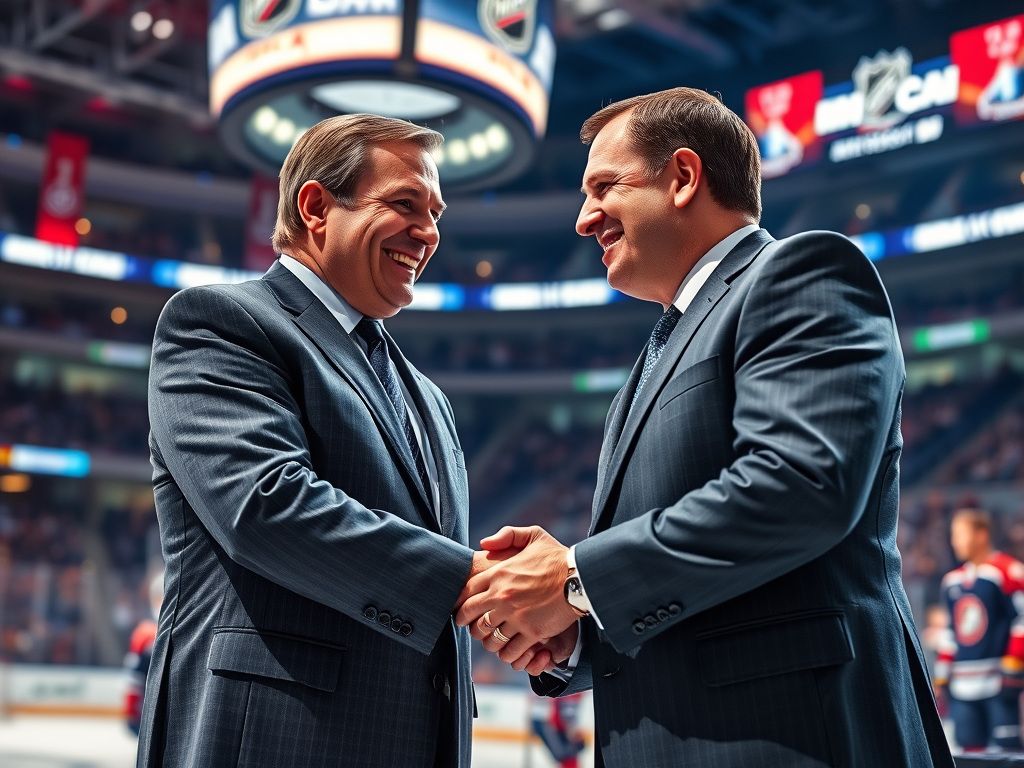
The Handshake that Ended a War
The National Hockey League (NHL) and the NHL Players’ Association (NHLPA) have entered a new era of labor peace. This era is arguably unprecedented. It culminated in the ratification of a four-year extension to the Collective Bargaining Agreement (CBA). This agreement will govern the league from the 2026-27 season through 2029-30. This agreement stands in stark contrast to the league’s tumultuous labor history. It has been marked by bitter disputes, player strikes, and multiple lockouts. These events led to the cancellation of half a season in 1994-95. They caused the entire 2004-05 campaign to be canceled. Additionally, there was another shortened season in 2012-13. NHL Commissioner Gary Bettman and NHLPA Executive Director Marty Walsh shook hands. This gesture symbolizes a fundamental shift. The shift is from confrontational brinkmanship to proactive collaboration.
A testament to this new paradigm is the timing of the agreement itself. The deal was formally ratified in July 2025. This ratification occurred more than 14 months before the expiration of the existing CBA on September 15, 2026. This is the earliest an extension has been reached during Bettman’s tenure. His tenure began in 1993. This period has otherwise been defined by last-minute crises and work stoppages. The collaborative atmosphere, described by Bettman as “completely refreshing,” has been credited as the primary driver of the early accord. This positive working relationship has already borne fruit. It facilitated the successful launch of the 4 Nations Face-Off. It also secured NHL player participation in the 2026 and 2030 Winter Olympics. These initiatives have built significant trust and momentum between the two parties.
Why Now? The Economic Imperative
The motivation behind this newfound harmony is rooted in a powerful economic imperative: the business of hockey is booming. The league is experiencing record-breaking revenues and attendance. This success fuels a projected salary cap that is set to skyrocket in the coming years. The cap, which stood at $39 million when it was introduced in 2005-06, is projected to reach $113.5 million by the 2027-28 season. Both the owners and the players recognized that another work stoppage would be catastrophic. It would derail this powerful growth trajectory. This would damage the sport’s value in the eyes of fans. It would also affect sponsors and media partners. A long-term agreement provides stability. It is essential for securing lucrative media rights deals. This agreement fosters confidence among business partners who invest heavily in the league’s success.
The league reportedly favored a longer deal for maximum stability. However, the agreed-upon four-year term represents a strategic victory for the NHLPA. NHLPA Director Marty Walsh has emphasized a key point. A shorter agreement ensures more players will have the opportunity to participate in negotiations. They can also influence the next round. This is a direct lesson learned from past long-term CBAs. For example, the 10-year deal signed in 2013 allowed an entire generation of players to start and finish their careers. They did so without ever having a voice in the rules that governed their employment. The NHLPA is prioritizing more frequent negotiations. This ensures it remains responsive to the needs of its current members. It sets the stage for potentially more iterative bargaining cycles in the future. These cycles are expected to be less contentious.
II. The Unchanged Foundation: Understanding the Core Economic Engine
The 50/50 Split and Hockey Related Revenue (HRR)
The division of Hockey Related Revenue (HRR) is central to the NHL’s economic system. This foundational principle has not changed in the new CBA. HRR is the specifically defined pool of money that the league and the players split 50/50. This revenue is broadly defined as the operating income derived directly or indirectly from the playing of NHL games. The major components include:
- Gate Receipts: Revenue from all ticket sales for preseason, regular season, and postseason games.
- Concessions and Merchandise: In-arena sales of food, beverages, and team-branded novelty items.
- Broadcasting Rights: National, international, and local revenue from television, radio, and digital broadcasts.
- Sponsorships: Revenue from fixed and temporary arena signage, dasherboards, and other league or club sponsorships.
Critically, the definition of HRR also contains significant exclusions. The most impactful of these are franchise expansion and relocation fees. When the league adds a new team, the entire sum goes exclusively to the existing owners. Examples include the Vegas Golden Knights ($500 million fee) and the Seattle Kraken ($650 million fee). It does not enter the HRR pool and therefore has no direct impact on player salaries or the salary cap. Future expansion fees could potentially reach $2 billion or more. This exclusion is a monumental long-term victory for the owners. It is also certain to be a major point of contention in the 2030 negotiations. Other non-HRR sources include revenue from non-NHL teams (like AHL or ECHL affiliates), proceeds from loans, and interest income.
Taming the Escrow Beast
The target is a 50/50 revenue split. The mechanism used to enforce it—escrow—has been the single most contentious issue for players over the last decade. Escrow is a system designed to ensure player compensation stays within limits. At the end of each fiscal year, total compensation must not exceed their 50% share of actual HRR. The salary cap for a given season is calculated based on projected HRR from the previous year. However, if teams spend near the salary cap ceiling, their total payroll often goes beyond 50% of the actual HRR. This is ultimately generated. When this happens, the overage is paid back to the owners. This is done from a fund created by withholding a percentage of every player’s salary throughout the season.
For years, this withholding percentage fluctuated unpredictably. It sometimes reached double digits. This created immense frustration and financial uncertainty. Players never knew what their take-home pay would be. The COVID-19 pandemic made this issue worse. It created a massive escrow debt owed by the players to the owners. Revenues plummeted while player salaries remained on the books.
The 2020 Memorandum of Understanding (MOU) addressed this by establishing a fixed, declining cap on the escrow percentage. This measure was designed to pay down the pandemic debt. It also provides players with much-needed predictability. The new CBA continues this philosophy. While escrow itself has not been eliminated, it has been turned from a volatile, unknown tax into a predictable deduction. It is now capped. This stability has been lauded by player leaders like John Tavares as a significant improvement over the old system. This concession from the owners was likely crucial. It was a bargaining chip used to gain player approval for other significant changes. Most notably, it facilitated the expansion to an 84-game season. The players accepted more physical wear and tear. In return, they gained financial certainty regarding their contracted salary. They know precisely how much they will receive.
Table 1: Projected Salary Cap and Minimum Salary Growth (2024-2030). Salary cap projections are based on media reports and league announcements. Minimum salaries are as specified in the new CBA MOU. Salary floors are calculated based on the established formula.
| League Year | Salary Cap (Upper Limit) | Salary Floor (Lower Limit) | NHL Minimum Salary |
| 2024-25 | $88.0 million | $65.0 million | $775,000 |
| 2025-26 | $95.5 million | $70.6 million (projected) | $775,000 |
| 2026-27 | $104.0 million | $76.9 million (projected) | $850,000 |
| 2027-28 | $113.5 million | $84.0 million (projected) | $900,000 |
| 2028-29 | Not Projected | Not Projected | $950,000 |
| 2029-30 | Not Projected | Not Projected | $1,000,000 |
III. Reshaping the Game: The 84-Game Season and Its Ripple Effects
More Games, More Revenue
The new CBA’s main feature is the expansion of the regular season from 82 to 84 games. This change will take effect in the 2026-27 season. The primary motivation for this change is financial. For the owners, the addition of 32 regular-season games across the league means each team has one extra home game. This change translates directly into more HRR through increased ticket sales. It also boosts concessions, parking revenue, and local broadcast fees. This expanded revenue pool is the engine that drives a higher salary cap, benefiting both sides of the labor equation.
Beyond the financial implications, the 84-game schedule provides a neat solution to a long-standing scheduling quirk. With 32 teams organized into four divisions of eight, an 84-game slate allows for a perfectly balanced schedule matrix. Under the new format, each team will play:
- Four games against every opponent in its own division (2 home, 2 away) for a total of 28 games.
- Three games against every opponent in the other division within its conference for a total of 24 games.
- Two games against every opponent in the other conference (1 home, 1 away) for a total of 32 games.
This structure guarantees that divisional rivals will face each other four times every season. This setup eliminates the imbalanced rotation of the previous system. In that system, some rivals only met three times a year. This change enhances the importance of divisional play. It ensures more frequent matchups between historic rivals. This is a clear benefit for fan engagement.
The Player Perspective: A Calculated Trade-Off
From the players’ standpoint, the extended season represents a significant trade-off. The most immediate cost is the increased physical toll. Two additional games, combined with the associated travel, heighten the risk of injury and burnout over an already grueling season. The league’s previous experiment with an 84-game schedule in the early 1990s received lukewarm enthusiasm. It is remembered as a cautionary tale.
However, the players agreed to this change in exchange for clear benefits. The most direct benefit is financial. The extra games generate increased HRR. This increase leads to a higher salary cap and, consequently, higher player salaries. The deal was further sweetened by a corresponding reduction in the preseason schedule. The exhibition slate will be cut from a range of six to eight games down to just four per team. Veteran players with 100 or more NHL games will be limited to appear in only two preseason contests. This limitation spares them from the physical risk of meaningless games.
This change to an 84-game season seems like a universal revenue driver. It also functions as a subtle mechanism to bolster competitive balance. The NHL relies heavily on gate-related revenue. It accounts for 44% of total revenue. This percentage is higher than in other major North American sports leagues. For instance, the NFL relies on it for 17% of its revenue. Small-market teams, which often have less lucrative local media and sponsorship deals, are disproportionately dependent on these ticket sales. For these franchises, the guaranteed revenue from one additional home game provides a more significant boost to their bottom line. It is more impactful than it is for their large-market counterparts. This additional revenue ensures that lower-revenue teams can meet the rising salary floor demands more easily. It supports the league’s goal of creating a competitively balanced environment. All 32 teams have a viable path to success.
IV. The New Contract Landscape: Reining in Creative Accounting
Shorter Leashes: Reducing Maximum Contract Terms
A fundamental change in the new CBA is the reduction of maximum contract lengths. Starting with the 2026-27 season, players re-signing with their current team can sign contracts for a maximum of seven years. This is a decrease from the previous limit of eight years. For unrestricted free agents signing with a new club, the maximum term will be reduced from seven years to six.
This is a significant structural shift with dual implications. It curtails long-term financial risk for team owners. It does so by reducing their exposure to lengthy, high-value contracts. This impact is crucial for players. Their performance may decline due to age or injury in the later years of a deal. For players, the change is more complex. It forces them to re-enter the free agent market more frequently during their prime earning years. However, it also eliminates the ultimate security of a locked-in eight-year contract. This new reality will profoundly reshape the strategies of general managers and agents. It is especially true for the marquee free agent class of 2026-27 and beyond.
Closing the Loopholes: A Trifecta of Restrictions
The 2026-30 CBA introduces a trio of new rules. These rules are specifically designed to eliminate the creative contract structures. General managers had perfected these structures to circumvent the spirit, if not the letter, of the salary cap.
- Signing Bonus Cap: Total signing bonuses on any new contract are now capped at 60% of the contract’s total compensation. This is a major win for the owners, as it effectively dismantles the “lockout-proof” contract. Previously, star players could negotiate deals where most of their compensation was paid in signing bonuses. These bonuses are guaranteed even in the event of a work stoppage. This structure was famously employed in the contracts of players like Leon Draisaitl. It was also used in the contracts of Mitch Marner. This gave players significant leverage in labor disputes. The new cap rebalances that power dynamic back toward the owners. It also creates fair competition for teams in high-tax jurisdictions. These teams previously used massive, tax-advantaged signing bonuses to compete with teams in states with no income tax.
- Elimination of Deferred Salary: The practice of deferring compensation to years beyond the contract’s term is no longer allowed. This applies to all new deals. This closes a loophole. Teams previously lowered a player’s annual average value (AAV) and cap hit by pushing actual cash payments into the future. Cap-savvy teams like the Carolina Hurricanes and Toronto Maple Leafs used this tactic.
- Reduced Salary Variability: The new agreement places tighter restrictions on the year-to-year salary variance within a contract. This prevents the extreme front-loading or back-loading of salaries that teams used to align with their specific salary cap windows. The contract signed by defenseman Vladislav Gavrikov had significant salary drops in its final years. It is cited as a prime example of a structure that would no longer be permissible under the new rules.
The Players’ Financial Wins
The owners secured major victories by closing contract loopholes. The NHLPA also achieved financial gains. These gains are significant but less-publicized. They benefit the entire membership. The new CBA includes “landmark player benefit improvements.” There is a particular focus on enhanced health insurance coverage. It also includes post-career health insurance stipends.
Most critically, the players successfully negotiated a shift in how certain costs are accounted for within the HRR framework. The financial burden of workers’ compensation premiums will be paid entirely from the owners’ 50% share of revenue. Employer payroll taxes, estimated to be approximately $70 million annually, are also included. Previously, these costs were deducted from the total HRR pool before the 50/50 split was calculated. This change effectively adds $35 million per year directly to the players’ share. The amount then flows to all players through a higher salary cap.
This combination of new contract restrictions and broad-based benefit improvements reveals a sophisticated and strategic shift by the NHLPA. The union leadership conceded on mechanisms—such as unlimited signing bonuses and long-term contracts—that primarily benefited the league’s elite superstars. In return, they secured financial gains. These benefits positively impact every single player in the league. This ranges from the highest-paid stars to those earning the league minimum. This represents a strategic pivot toward collectivism, prioritizing the financial health and security of the union’s “middle class.” It was a major victory for the NHLPA’s negotiating team. This success was likely instrumental in achieving the smooth and overwhelming ratification of the agreement by the full player membership.
V. Forging Competitive Balance: The End of the Wild West
The “Kucherov Rule”: A Playoff Salary Cap
The new CBA introduces a significant on-ice competitive change. A playoff salary cap will be implemented. This is set to begin with the 2026-27 postseason. This rule directly targets the controversial “LTIR loophole” that had become a major point of contention among teams and fans.
Under the old system, the salary cap did not apply during the playoffs. This rule allowed teams to place a player with a significant cap hit on Long-Term Injured Reserve (LTIR). They did this during the regular season. They used the resulting cap space to acquire talent at the trade deadline. Then, they activated the injured star for Game 1 of the playoffs without having to become cap compliant. Stanley Cup contenders like the Tampa Bay Lightning did this with Nikita Kucherov. The Vegas Golden Knights used it with Mark Stone. The Florida Panthers leveraged this practice with Matthew Tkachuk. Many saw it as a form of cap circumvention. It undermined the league’s competitive balance.
The new rule eradicates this loophole. On each playoff game day, teams must submit a 20-player game roster, including 18 skaters and two goaltenders. The total cap hit of this roster must fit under the established regular-season salary cap ceiling. This includes all other regular-season cap obligations such as buyouts and retained salary. Crucially, player cap hits will not be pro-rated in the playoffs. Instead, the full AAV of every player on the game day roster counts toward the cap.
To further tighten the system, the CBA also introduces stricter rules for regular-season LTIR relief. If a player is placed on LTIR but is expected to return during the same season or playoffs, the team’s cap relief is now limited to the league’s average salary from the previous season (approximately $3.82 million in 2024-25). A team can receive full cap relief for the player’s entire salary only if the player is medically certified. This certification must confirm that the player will be out for the remainder of the regular season. It must also confirm they will be out for the playoffs.
Curbing the Middle Man: The Double Retention Rule
The new CBA also takes aim at another form of creative cap management: the “double retention” trade. A player’s contract cannot be subject to a second salary retention within 75 regular season days of the first. The contract needs to wait 75 regular season days before another retention transaction. This makes complex three-team trades, where a rebuilding team acts as a “broker,” significantly more difficult to execute. They retain a portion of a player’s salary in exchange for assets. This is especially challenging near the trade deadline. The 75-day clock only counts regular season days. Therefore, teams can’t move a player traded with retention at the deadline again soon. Further retention is not possible until well into the following season. This forces contending teams to absorb a larger portion of a player’s cap hit themselves. It will likely reduce the movement of high-priced stars. General managers are compelled to plan major acquisitions much earlier in the season.
Eliminating “Paper Transactions”
The league also closed a minor but frequently used loophole by banning “paper transactions.” This involved assigning a player to the AHL on paper for a single day. It was often a day off. This allowed teams to accrue a small amount of daily cap space. The player never had to physically report to the minor league team. Under the new CBA, a player who is loaned to the minors must physically report to their AHL club. They need to play in at least one game before they are eligible to be recalled to the NHL roster. There is an exception for emergency goalie recalls. While the cap savings from this practice were marginal, they were a tool used by teams pressed against the ceiling. Its elimination demands more precise long-term cap planning and removes another avenue for GMs to manipulate their cap situation.
The playoff cap, the double retention rule, and the ban on paper transactions are three significant changes. They indicate the league’s clear effort to enforce the spirit of the hard cap system. The league’s actions are concerted. The underlying philosophy is to ensure that a dollar of salary cap space is truly a dollar. This promotes a more level playing field. Clever accounting cannot overcome financial limitations. This will likely reshape team-building strategies. There will be a greater premium on drafting, development, and long-term planning. This will be prioritized over acquiring high-priced rental players at the deadline.
Table 2: Comparative Analysis of “Big Four” League Economic Structures. This table provides a high-level comparison of the core economic systems governing the major North American professional sports leagues.
| Metric | National Hockey League (NHL) | National Football League (NFL) | National Basketball Association (NBA) | Major League Baseball (MLB) |
| Salary Cap Type | Hard Cap with a floor and ceiling. | Hard Cap with a floor. | Soft Cap with multiple “aprons” and a luxury tax. | No Cap, but a “Competitive Balance Tax” (luxury tax). |
| Player Revenue Share | 50% of Hockey Related Revenue. | ~48% of All Revenue. | ~51% of Basketball Related Income. | ~56% (Estimated, no formal split). |
| Contract Guarantees | Predominantly Guaranteed. | Largely Non-Guaranteed. | Predominantly Guaranteed. | Predominantly Guaranteed. |
| Revenue Sharing | Moderate; includes national media deals and playoff gate receipts. | Extensive; all national media revenue and 34% of gate receipts are shared. | Moderate; includes national media deals and a shared pool for lower-revenue teams. | Complex; involves a central fund and local revenue sharing based on market size. |
VI. The Player Pipeline: A New Path to the Pros
The 19-Year-Old Exception: A Developmental Game-Changer
The new CBA introduces one of the most forward-thinking changes. It creates a new developmental pathway for elite prospects. Starting in 2026-27, each NHL organization can assign one 19-year-old player. This player must be drafted from the Canadian Hockey League (CHL). They will join the team’s American Hockey League (AHL) affiliate for the season.
This rule addresses a long-standing developmental inefficiency created by the NHL-CHL transfer agreement. Under the previous system, 18- and 19-year-old players drafted from the CHL encountered challenges. They were not yet ready for the NHL. They had to be returned to their junior teams. These players had to return to junior teams because they were not ready for the NHL. For many high-end prospects, this was a crucial developmental year. They spent it at a level where they had clearly outgrown the competition. This situation stunted their growth, according to many observers. Studies show cases like that of New York Rangers prospect Brennan Othmann. He was too good for the OHL. At 19, he was not quite ready for the NHL. These examples highlighted the need for an intermediate step. The new rule provides exactly what is needed. It allows a top prospect to face the challenge of professional hockey in the AHL. This prevents them from spinning their wheels in junior.
The Ripple Effect on CHL and NCAA Hockey
This change was not made in a vacuum. This move directly responds to a recent NCAA rule change. This rule now allows players with CHL experience to play college hockey. It creates a significant new competitor for top-tier Canadian talent. The decision by 2026 projected No. 1 pick Gavin McKenna to commit to Penn State University shocked the hockey development world. It signaled a potential exodus of talent from the CHL to the NCAA.
The 19-year-old AHL exception is the NHL and CHL’s powerful counter-offer. It creates a new, compelling choice for elite prospects. They can now weigh the NCAA path, which focuses on education and offers a longer developmental timeline. Alternatively, the CHL-to-AHL path presents the opportunity to turn professional at 19. This path allows players to play against men in the AHL. It also enables them to begin earning a professional salary and signing bonus from their entry-level contract. Some players may feel enticed to remain in the CHL. They know that a professional option is now available a year earlier. This rule fundamentally reshapes the power dynamics of North American hockey development. It weakens the CHL’s former monopoly. However, it also provides the CHL with a potent recruiting tool to compete with the NCAA. For NHL teams, it grants them more direct control over the development of their most valuable prospects.
Standardizing the System
The new CBA aims to streamline the player pipeline. It standardizes the period for which teams hold the rights to their draft picks. Starting with the 2027 NHL Draft, teams will retain exclusive rights to an 18-year-old draftee for four years. For players drafted at 19 or older, the rights period will be three years. This change simplifies a previously convoluted system that had different rules and deadlines for NCAA, CHL, and European league players. It provides NHL teams with greater clarity and uniformity in managing their prospect pools.
The long-term effect of these changes will be a more stratified and strategic approach to player development. NHL general managers must weigh a player’s talent. They also need to consider their optimal developmental path when making draft selections. This could lead to a future where more physically mature, NHL-ready prospects are fast-tracked through the CHL-to-AHL pipeline. Players who may benefit from a longer developmental curve are directed toward the NCAA. This change will make the AHL an even more critical and high-stakes development league. It is likely to feature a younger and more skilled talent pool. This could enhance its own commercial appeal.
VII. Deconstructing the New Mandate: The 2026 “Emergency Goaltender Replacement”
The new Memorandum of Understanding (MOU) ratified as part of the CBA extension dismantles the old EBUG system. It replaces it with a structured, professionalized process. Effective in the 2026-27 season, the “Emergency Goaltender Replacement” (EGR) policy aims to bring predictability. The policy also intends to introduce control to what was once a chaotic and romanticized quirk of the rulebook.
1.1 The New World Order: From Shared Resource to Team Asset
The most fundamental change is the shift from a shared, local resource to a dedicated team asset. Under the old system, a single EBUG was stationed at the home arena. It could be called upon by either the home team or the visiting team. This created the potential for conflicts of interest. The most famous example is the David Ayres story. He played against the organization that employed him.
The new EGR policy eliminates this possibility entirely. Beginning in 2026, each of the NHL’s 32 teams will be required to employ its own EGR. This individual will travel with the team for all home and away games. They will ensure that two designated emergency goalies are present at every single contest. There will be one goalie for each club. This change standardizes the process across the league and places the responsibility for emergency preparedness squarely on each individual franchise.
1.2 The Letter of the Law: Eligibility and Vetting
The CBA outlines a stringent set of eligibility requirements. This prevents teams from using the EGR position to stash high-level talent or circumvent roster limits. As detailed in the MOU, an individual is ineligible to serve as a club’s “Emergency Goaltender Replacement” if they have :
- Played an NHL Game under a Standard Player Contract (SPC). This immediately disqualifies anyone with official NHL experience, no matter how brief.
- Played in more than 80 career professional hockey games. This prevents career minor-leaguers (AHL/ECHL) from filling the role.
- Played professional hockey in the prior three (3) seasons. This creates a “cooling-off” period. It ensures that recently retired professionals are not eligible. Players fresh out of the minor leagues are also not eligible.
- Another current contractual obligation that would preclude them from serving. This is a catch-all to prevent conflicts with other leagues or employment.
- Are on the Reserve List or Restricted Free Agent List of any NHL Club. This clause ensures the EGR is completely untethered from any team’s prospect pool or contractual control.
1.3 The Spirit of the Law: The “Capability” Clause and NHL Oversight
Beyond the strict prohibitions, the MOU states that the “objective” of the policy is for teams to employ “capable goaltenders”. While “capable” is a subjective term, the league has instituted a vetting process to enforce this standard. Teams must submit the name of their proposed EGR to the NHL Central Registry. They must also provide the “detailed playing experience” for approval. This must be done at least 48 hours before the start of the season. If a team needs to change its designation during the season, it must submit the new candidate’s information. This submission must occur 24 hours prior to a game. This gives the league direct oversight and veto power. It allows the league to assess whether a candidate meets the eligibility criteria. It also checks if the candidate meets the baseline standard of capability.
1.4 Operational and Contractual Realities
The new rules provide teams with logistical and financial flexibility. The EGR is allowed to work in another capacity with the club. This could be as a goaltending coach, skills coach, trainer, or member of the management staff. This is a significant departure from the old system. In the old system, the EBUG often could not be a paid employee of the home team. This measure was to avoid the very conflict of interest the Ayres situation exposed. This dual-role allowance makes it far more practical for teams to have a dedicated individual travel with them full-time.
The CBA also specifies the limited circumstances under which an EGR can be used. A team can dress its EGR only if an injury incapacitates one or both of its rostered goalies. This applies before or during the game.
Table 3: Old EBUG System vs. New EGR Policy
| Feature | Old EBUG System (pre-2026) | New EGR Policy (2026 onwards) |
| Provisioning | Home team provided one EBUG for both teams | Each team employs and travels with its own EGR |
| Travel | Local to home arena; did not travel | Travels with the team to all home and away games |
| Eligibility | Loosely defined amateur; often former college/junior player | Strict criteria: no NHL SPC games, <80 pro games, 3-year pro hiatus |
| Compensation | Typically unpaid; signed Amateur Try-Out (ATO), kept jersey | Employed by the club, potentially in a dual capacity |
| Conflict of Interest | High potential (e.g., David Ayres playing against Leafs org) | Eliminated; EGR is loyal to one team only |
| League Oversight | Minimal; teams maintained local lists of available amateurs | Mandatory; EGR must be approved by NHL Central Registry |
| Fan Experience | Source of rare, unpredictable, “Cinderella” stories | Standardized, professionalized role; loss of romantic unpredictability |
The new EGR rule, while aiming to professionalize the process, paradoxically institutionalizes the role of a “permanent amateur.” The eligibility criteria are not designed to find the best possible emergency goalie. Instead, they aim to find a predictable and non-threatening one. The league and the NHLPA recognized a problem. If the position were open to any non-roster player, teams would be incentivized. They could stash a near-NHL-caliber goalie as an EGR. This would effectively create a third-stringer who doesn’t count against the roster or salary cap. This would undermine the CBA’s strict roster and financial regulations. To prevent this, the rules create a firewall. The prohibitions disqualify recently retired stars because of prior NHL experience. They also disqualify career minor-leaguers and promising young prospects due to recent professional play and total professional games played. The result is a system that funnels teams toward a very specific profile. This profile is an individual with a respectable amateur background, likely NCAA hockey. This individual is several years removed from high-level competition. This ensures all emergency players have a standardized skill level across the league. It balances the need for a capable body with the imperative to prevent strategic exploitation of the rule.
Section 2: The Rationale for Reform: Balancing Romance with Reality
The decision to dismantle the EBUG system was not made in a vacuum. The league, its teams, and the players’ union all had a convergence of interests. They concluded that the risks and liabilities of the old way outweighed its romantic appeal.
2.1 The League’s Perspective: Competitive Integrity and Risk Mitigation
For the NHL’s head office, the primary driver was the preservation of competitive integrity. The EBUG system, while producing great stories, introduced an unacceptable level of randomness into the game. The league aimed to remove the “jankiness” of the old rule. They wanted to standardize the emergency procedure. Outcomes were to be determined by professional athletes, not by chance.
Furthermore, the league needed to establish clear “guard rails.” This was to prevent teams from exploiting the position for a competitive advantage. For instance, teams could use it as an off-the-books development spot for a prospect. Alternatively, they might stash a highly skilled third goalie. Finally, the David Ayres incident highlighted significant legal and liability concerns. The spectacle of an employee competing directly against their employer raised complex employment law questions. These include the duty of loyalty. A formalized, team-specific EGR system neatly resolves these legal ambiguities and mitigates the league’s exposure to such conflicts.
2.2 The Teams’ Perspective: Control and Predictability
From the perspective of individual franchises, the change is about gaining control and minimizing risk. No general manager or coach wants a crucial game decided by an unvetted amateur. This is especially true for games with potential playoff implications. They have never met this amateur. While the Ayres story ended in a win for Carolina, that outcome was far from guaranteed.
The new system allows teams to select their own EGR. Crucially, that person can practice with the team throughout the season. This ensures at least a baseline level of familiarity with the team’s players, coaches, and defensive systems. This is a significant improvement over throwing a complete stranger into the net. This shift from chaos to control is a welcome development for team management focused on predictable performance.
2.3 The NHLPA’s Perspective: A New Class of Jobs
For the NHL Players’ Association, the new rule represents a clear victory. The EGR is not a full-fledged player under an SPC. However, creating 32 new, full-time, traveling positions is a tangible benefit for the union’s broader constituency. Many speculate about these roles. Former players are expected to fill them, providing stable income. This allows them to remain involved with a team in a coaching or development capacity. This aligns perfectly with the NHLPA’s core mission of creating and securing employment opportunities for its members and alumni.
2.4 The Cultural Cost: The End of a Dream
The logical arguments for the change are compelling, but they come at a cultural cost. The move to a professionalized EGR system marks the definitive end of a tradition. It was one of the most unique and beloved in all of professional sports. The stories of accountants, Zamboni drivers, and financial advisors were known for their one shot at NHL glory. These tales embodied a powerful “Cinderella” narrative. Now, this narrative is extinct. These moments created a profound connection between fans and the game. They reminded us that, under the right set of bizarre circumstances, an ordinary person could live an extraordinary dream.
The new, sanitized rule, while logical, eliminates this element of romantic chance. Longtime EBUGs like Ben Hause of the Colorado Avalanche have publicly acknowledged that their “swan song is coming up.” This signals a poignant end to a unique era in hockey history. The league has made a calculated trade: the magic of the improbable for the certainty of the professional.
VIII. Other CBA Items
- European Free Agents aged 25-27 will no longer be required to sign an Entry Level Contract (ELC). They will follow the same Entry Level Rules as North American Players.
- Teams will be allowed to sign players to 10 day PTO (Professional Try Out) contracts mid-season. They will also have the right of first refusal for any NHL contract offered.
- Players will not be permitted to have endorsement deals involving tobacco or cannabis, including CBD.
- Players with zero NHL games will need to wear cut-resistant neck protection. This rule starts in the 2026-27 NHL season.
IX. Conclusion: Long-Term Stability and the Battles of 2030
A Blueprint for Growth
The 2026-2030 Collective Bargaining Agreement is a landmark achievement. It is not recognized for its radical overhaul of the system. Instead, it is notable for its deliberate embrace of stability, partnership, and predictable growth. The league and the NHLPA systematically closed loopholes that encouraged cap circumvention. They provided cost certainty for both owners and players. They created new revenue streams through an expanded 84-game season. With these actions, the league and the NHLPA have constructed a solid economic foundation for the next half-decade. A clear international calendar fortifies this stability. It features NHL participation in the 2026 and 2030 Olympics. The recurring World Cup of Hockey serves as a key pillar of the league’s global growth strategy. The agreement signifies the NHL’s economic model has matured. It prioritizes the health of the overall business. It maintains the competitive balance’s integrity over past high-risk, high-reward gambits.
Unresolved Issues and the Next Negotiation
Despite the current climate of unprecedented labor peace, this CBA presents clear delineations. It establishes the battle lines for the next major negotiation in 2030. Several key issues remain unresolved and are certain to resurface:
- The Definition of HRR: This will likely be the central conflict. The league is poised for further expansion. Franchise fees are projected to exceed $2 billion. The NHLPA will almost certainly mount a major push to have expansion revenue included in the HRR pool. The owners have fiercely protected this revenue stream. Any change would represent a seismic shift in the league’s economic structure.
- The Existence of Escrow: While the rate of escrow is now capped and predictable, the basic mechanism remains. Players still bear the financial risk of revenue shortfalls. This remains a core grievance for the union. The NHLPA will continue to advocate for alternative systems that shift more of this risk onto the owners.
- Media Rights and New Revenue Streams: The league’s current U.S. media rights deals with ESPN and TNT will expire in the coming years. Under this CBA, a new Canadian deal with Rogers begins soon. The value of the next U.S. media contract will have a monumental impact on league revenues. It will also affect the salary cap. This will set the financial stage for the entire 2030 negotiation.
- Player Empowerment: The relaxation of the dress code is a small but symbolic victory for player individuality. Now players can endorse wine and spirits, further symbolizing these victories. This trend is likely to continue. Players will seek greater control over their personal brands. They want more say in marketing rights. Additionally, they aim for a larger voice in league matters.
Final Verdict
The 2026-2030 CBA is a testament to what can be achieved when partnership replaces antagonism. It addresses the most significant grievances of the past decade—escrow uncertainty and cap loopholes. It also implements pragmatic changes designed to grow the game for the benefit of all stakeholders. It is an agreement built on a shared understanding that a healthy, stable league is the most profitable league. It ensures five years of labor peace. It sets a course for continued prosperity. It also tees up a fascinating and high-stakes negotiation in 2030. During this negotiation, the very definition of the league’s shared revenue will be on the table.
Table 4: Key Rule Changes in the 2026-2030 NHL CBA. This table summarizes the most impactful changes implemented in the new agreement.
| Category | Previous Rule (Pre-2026) | New Rule (2026-2030) |
| Max Contract Term | 8 years (re-signing), 7 years (free agent) | 7 years (re-signing), 6 years (free agent) |
| Signing Bonus Structure | No limit on percentage of total contract value. | Total signing bonuses capped at 60% of total contract value. |
| Deferred Salary | Permitted in contracts. | Prohibited in all new contracts. |
| Playoff Roster/Cap | No salary cap in the playoffs. | Game day roster must be compliant with the regular-season salary cap. |
| Salary Retention | No restriction on “double retention” trades. | A contract cannot be retained a second time within 75 regular season days. |
| AHL Eligibility (CHL) | Players must be 20 years old to play in the AHL. | Each team may assign one 19-year-old CHL draftee to the AHL per season. |
| Regular Season Length | 82 games. | 84 games, with a reduced 4-game preseason. |
| Player Benefit Costs | Costs like workers’ comp were deducted from HRR before the 50/50 split. | Key costs ($70M annually) are now paid from the owners’ 50% share. |

 ScortonBoy17.ca
Leave a comment