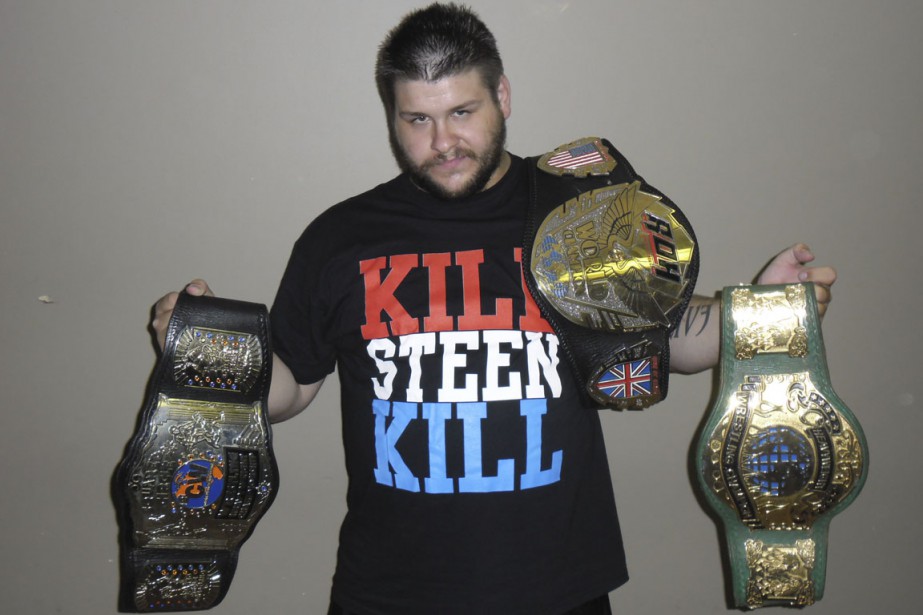
Introduction: A Stunner in Dallas, A Story in the Making
On April 2, 2022, in front of nearly 80,000 people at AT&T Stadium, the glass shattered. “Stone Cold” Steve Austin was the foul-mouthed avatar of the most profitable era in wrestling history. He marched to a WWE ring for his first match in 19 years. His opponent was not a chiseled, company-anointed heir apparent. It was Kevin Owens. By his own admission, he looks more like a guy who lives on beer and McDonalds. He does not resemble a prototypical main event star. The ensuing No Holds Barred brawl headlined the first night of WrestleMania 38. It was a chaotic, cathartic, and stupendous moment. To view this singular event as an anomaly is to misunderstand it. It’s not just a stroke of right-place, right-time luck. It fundamentally overlooks the two-decade journey that made it not just possible, but logical.
The match in Dallas was the ultimate culmination of a career built on unwavering authenticity. It showcased a defiant spirit forged in the crucible of the independent circuit. Additionally, it highlighted an uncanny ability to bend the wrestling world to his will. Kevin Steen, the man who would become Kevin Owens, is arguably the blueprint for the modern professional wrestler. He is a performer for whom history is not a liability to be jettisoned, but an asset to be weaponized. His career spans from the grimy bars of Montreal to the grandest stage of them all. It is a single and continuous narrative. The trust placed in him was immense. He carried a 57-year-old legend through his final match. This responsibility shows the unique, indispensable space he has carved out in the industry. This is the story of how a kid from Quebec, who learned English by mimicking
Monday Night Raw, became one of the most important, decorated, and consistently compelling figures of his generation.
Part I: The Rebellion – Forging a “Nightmare” in the Indies
The Rougeau Doctrine vs. The IWS Revolution
The journey of Kevin Yanick Steen began, as it does for so many, with a videotape. At age 11, his father rented WrestleMania 11. The match between Diesel and Shawn Michaels captivated him. It instantly hooked him on the spectacle of professional wrestling. This fascination led him to begin training at 14 with Quebec-based wrestler Serge Jodoin. A year later, in 1999, he joined the wrestling school of former WWF star Jacques Rougeau Jr., a move his supportive parents funded, believing it was the best path to a potential WWE career.
At Rougeau’s school, Steen was a prodigy. He was bright, athletic, and picked up the craft with remarkable speed, even boasting a 450 splash in his arsenal. For three years, he was Rougeau’s star pupil, winning consistently. However, a deep philosophical conflict was brewing. The wrestling Rougeau taught was, in Steen’s own words, “boring as hell”. Matches were meticulously choreographed from start to finish, with no room for improvisation, wrestler communication, or audience interaction. They were designed to be performed in a repetitive manner. This approach resulted in a product that was technically sound. However, it was “entirely emotionally sterile”.
This rigid system stood in stark contrast to what was happening elsewhere in the Montreal wrestling scene. In 2003, a friend showed Steen a tape from International Wrestling Syndicate (IWS). This promotion was known for its grungy, hardcore style. They wrestled mostly in bars to rowdy, engaged crowds. The action was raw, improvised, and visceral. Intrigued, Steen defied Rougeau’s ban on attending other shows. He secretly sneaked into an IWS event in July 2003. There, he was captivated by the freedom and the connection between the performers and the audience.
The conflict peaked. Rougeau offered the 18-year-old Steen the opportunity of a lifetime, which was a guaranteed WWE tryout match. The catch was an ultimatum. To get the tryout, Steen had to commit exclusively to Rougeau’s system. He was required to name Rougeau as his agent for a 15% cut of his future salary. Steen also had to give up wrestling for IWS and the burgeoning independent scene he had fallen in love with. After a sleepless night working at a gas station, Steen made a decision that would define his entire career. He told Rougeau he couldn’t do it. He chose passion over the perceived safe bet. He turned his back on a direct line to his WWE dream. He stayed true to the wrestling style that resonated with him.
This “Rougeau Rebellion” was more than just an early career anecdote. It was a microcosm of the central conflict of Kevin Steen’s professional life. He rejected Rougeau’s pre-packaged, sterile product. He favored IWS’s raw authenticity. This was a fundamental rejection of a wrestling philosophy he found hollow. This singular choice set a pattern for the next two decades. He prioritized authentic character and organic storytelling over the “correct” or “guaranteed” career path. It was the first time he insisted on being “Mr. Wrestling” on his own terms. This theme would re-emerge years later. His gritty, family-motivated “Prizefighter” persona clashed with John Cena’s corporate-approved heroism. He would also argue with WWE creative to maintain the integrity of his character’s long history. This act of defiance was the foundational stone upon which his entire ethos was built.
“Mr. Wrestling” Goes Stateside: Conquering the Indies
Having chosen his path, Steen immersed himself in the independent scene, quickly becoming a pillar of IWS. He would go on to hold the IWS World Heavyweight Championship three times, reigning for a cumulative 473 days. In a pivotal moment for the promotion, he became the first IWS champion to defend the title internationally. He defeated Roderick Strong for Jersey All Pro Wrestling (JAPW) in October 2004. During his time in IWS, he clashed with local legends and future stars. He had formative battles against the monstrous Pierre Carl Ouellet (PCO).
His reputation soon spread south of the border. Steen began making a name for himself in the United States. He wrestled for prominent independent promotions like Combat Zone Wrestling (CZW) and Pro Wrestling Guerrilla (PWG). In the ultraviolent world of CZW, he captured the CZW Iron Man Championship. He held it for 364 days. This was a testament to his durability and brawling prowess.
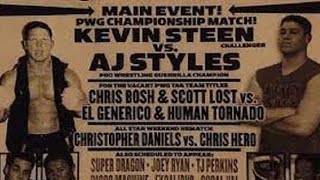
However, it was in Southern California’s PWG that “Mr. Wrestling” truly became a phenomenon. On August 6, 2005, he defeated A.J. Styles to win his first PWG Championship. He would go on to hold the promotion’s top prize a record three times, for a combined 469 days. He excelled in the tag team division as well. He captured the PWG World Tag Team Championship on three separate occasions. Twice, he partnered with his career-long rival El Generico. Once, he teamed with Super Dragon. His work in PWG showcased his complete skillset. He was a brutal brawler who could absorb punishment. He was an agile big man who could fly. He was also a master of in-ring psychology and character work. His performances earned him Wrestler of the Year honors in 2005, 2011, and 2012 from SoCal Uncensored. This success cemented his status as one of the most acclaimed and sought-after talents on the independent circuit.
Part II: The Unending War – Steen vs. Generico in Ring of Honor
A Brotherhood Forged and Shattered
Kevin Steen conquered promotions across North America. The most defining chapter of his independent career was written in Ring of Honor (ROH). He performed alongside a masked luchador from Montreal named El Generico (the future Sami Zayn). They debuted in ROH in 2007, and their chemistry as a tag team was immediate and undeniable. The passionate ROH fanbase dubbed them “Steenerico.” They quickly rose through the ranks. The duo engaged in classic battles with teams like The Briscoe Brothers. On September 19, 2008, they reached the pinnacle of the division, winning the ROH World Tag Team Championship.
Their partnership, however, was destined for a violent end. At Final Battle on December 18, 2009, after a frustrating loss, Steen grabbed the microphone and spoke of his friendship with Generico before delivering a shocking low blow. As his stunned partner looked up at him in disbelief, Steen smashed a steel chair over his head, shattering their team and igniting one of the most acclaimed rivalries of the modern era. This act became the “original sin” of the Kevin Steen character, a moment of brutal betrayal that would echo throughout his entire career.
What followed was a year-long masterclass in psychological storytelling. Steen, now venomous and manipulative, became a heel. He enlisted the help of veteran Steve Corino. Together, they furthered his crusade against his former friend. He played relentless mind games. Initially, he refused to even step in the ring with Generico. He forced their mutual friend Colt Cabana to fight on Generico’s behalf. The feud was layered, emotional, and intensely personal, earning the Wrestling Observer Newsletter’s “Feud of the Year” award for 2010. The first chapter of their war culminated at Final Battle 2010, exactly one year after the betrayal. In an unsanctioned “Fight Without Honor,” Steen put his ROH career on the line against Generico’s sacred mask. The match was a brutal, bloody spectacle. In the end, Generico overcame his tormentor, pinning Steen after a chair shot that mirrored the one from a year prior, and seemingly banishing him from Ring of Honor for good.
The Reign of SCUM and the Ladder War
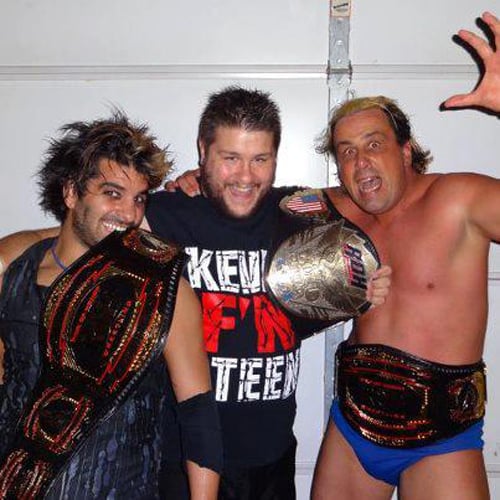
Steen’s exile was temporary. He returned to ROH in 2011, embarking on a path of destruction that led him to the ROH World Championship. At Border Wars on May 12, 2012, in Toronto, he defeated Davey Richards to capture the title. This created a euphoric moment for the Canadian crowd. They witnessed one of their own reach the top. His 328-day reign was defined by an anti-authority, villainous persona. He formed the faction S.C.U.M. (Suffering, Chaos, Ugliness, and Mayhem) with Steve Corino and Jimmy Jacobs. They terrorized the promotion. They opposed anyone who stood for its code of honor.
This reign set the stage for the final, epic confrontation with his nemesis. At Final Battle 2012, Steen defended his ROH World Championship against El Generico in a brutal Ladder War. This match was not just a collection of high spots. It was the thematic endpoint of their four-year story in the promotion. The match was a violent crescendo filled with callbacks to their past battles. Steen was looking to permanently end Generico’s career. Generico fought with the desperation of an avenging spirit. The unforgettable conclusion of the match had Steen delivering a package piledriver to Generico through a contraption of ladders. This allowed him to retain his championship.
The post-match scene was as significant as the match itself. A triumphant Steen paused his celebration, looked down at the broken body of his rival, and helped him to his feet. There was no hug, no handshake, no breaking of character. It was a quiet, tense moment of acknowledgment—a shared understanding that their war in this arena was finally over, providing closure and allowing both men to move on.
This years-long feud serves as the Rosetta Stone for the Kevin Owens character. It is the foundational text for everything he would become in WWE. The 2009 betrayal established his core motivation. He was willing to sacrifice any relationship for career advancement. He would later justify this trait as “providing for his family.” Each significant betrayal that followed was a direct echo of this original sin. This includes his attack on Sami Zayn in NXT and the “Festival of Friendship” implosion with Chris Jericho. The narrative complexity of the ROH feud, with its psychological warfare and high stakes, set the template for the layered, personal stories he would excel at telling on a global stage. The eventual reunion and championship victory with Zayn at WrestleMania 39 was not just a feel-good moment; it was the cathartic resolution to a story that began 14 years prior, making it one of the most consistent and rewarding long-term character arcs in modern wrestling history.
Part III: The Prizefighter Arrives – A Hostile Takeover of WWE
From “Kill, Steen, Kill” to “Fight, Owens, Fight”
In August 2014, after 14 years of grinding on the independent circuit, Kevin Steen signed with WWE. He was assigned to the developmental brand, NXT. He adopted the ring name Kevin Owens as a tribute to his son, Owen. His son was named after the late Owen Hart, one of Steen’s wrestling idols. His arrival was heralded with immense anticipation from fans who knew of his “Mr. Wrestling” reputation.
He made his televised debut at NXT TakeOver: R Evolution on December 11, 2014. He defeated CJ Parker in the opening match. The bout was a perfect introduction. It was a dominant victory that showcased his toughness. He suffered a legitimately broken nose from an errant palm strike but finished the match undeterred. However, the true statement of intent came later that night. In the main event, his career-long rival Sami Zayn (formerly El Generico) finally achieved his dream. Sami Zayn won the NXT Championship in an emotional climax. As the roster celebrated with Zayn in the ring, Owens emerged, seemingly to share in his friend’s triumph. Instead, he brutally attacked Zayn, powerbombing him spine-first onto the hard ring apron. Owens announced his arrival in one shocking moment. He reignited wrestling’s greatest feud on a new stage. He declared that his past was not being erased but weaponized.
This ruthless aggression defined his early NXT run. He was not there to pay dues; he was there to win titles and make money for his family. This “Prizefighter” persona was immediately validated. Just two months after his debut, Owens participated in NXT TakeOver: Rival on February 11, 2015. He challenged Zayn for the NXT Championship. He didn’t just win. He annihilated his former friend. He delivered a relentless series of powerbombs until the referee stopped the match. The decisive, brutal victory cemented him as the most dangerous man in NXT and began his 143-day reign as champion.
The Debut Heard ‘Round the World
While still reigning as NXT Champion, Kevin Owens made one of the most impactful main roster debuts in WWE history. On the May 18, 2015, episode of Raw, he answered United States Champion John Cena’s open challenge. But instead of a match, Owens delivered a mission statement. He declared that he already had a prize—the NXT Championship—and that Cena’s title didn’t interest him. He then attacked Cena, laying him out with his signature Pop-up Powerbomb before contemptuously stomping on the U.S. Championship belt while hoisting his own title high.
The debut was a masterstroke of booking, reportedly pushed for by Cena himself, who recognized Owens’s immense talent and potential. It immediately established Owens as a major threat. It subverted audience expectations. This resulted in a powerful meta-narrative. There was the gritty, authentic, unpolished champion of the hardcore fans. Opposing him was the polished, corporate-endorsed face of WWE. This narrative culminated at the Elimination Chamber event on May 31, 2015. In his first official main roster match, Kevin Owens defeated John Cena clean in the middle of the ring. The victory shocked the WWE Universe and instantly validated Owens as a main event-caliber star. Their series of matches was lauded for its in-ring quality. It told a compelling story. The series earned “Best Storyline” and “Match of the Year” accolades from Rolling Stone.
Owens’s immediate success represented a paradigm shift in what a top WWE star could look and act like. For years, the company’s prototype was the chiseled, larger-than-life figure personified by Cena. Owens, with his everyman physique that drew criticism from some corners, was the antithesis of this model. His feud with Cena was a direct confrontation between these two ideals. Owens held his own on the microphone. He defeated the company’s top star cleanly. WWE made a definitive statement with this victory. His success followed in the footsteps of performers like CM Punk and Daniel Bryan. It proved that elite in-ring ability and undeniable charisma could triumph. Authentic character work was more important than traditional aesthetic prerequisites. He didn’t succeed despite his look, he succeeded. His look reinforced his character’s authenticity as a no-nonsense brawler. This made his victories over “superheroes” feel more grounded and, therefore, more significant.
A Grand Slam of Betrayals and Championships
Owens’s main roster career has been filled with championships and memorable moments. These are extensions of the core character he forged in the indies. He is a Grand Slam Champion. He has captured the Intercontinental Championship twice and the United States Championship three times. He also won the Universal Championship and the Undisputed Tag Team Championship.
His 188-day reign as WWE Universal Champion, which began on August 29, 2016, added a new layer to his character. He won the vacant title after Triple H interfered on his behalf, turning on Seth Rollins. This positioned Owens as the chosen champion of The Authority. It created a complex heel who was both a dominant force and a coward needing protection. The moment he was handed the title by Triple H was a perfect blend of kayfabe and reality. His emotional “thank you” in the ring was not only directed at the character. It was also clearly expressed to the man who had believed in him and championed his cause behind the scenes.
Perhaps the most infamous moment of this era was the “Festival of Friendship” on the February 13, 2017, episode of Raw. For months, Owens and Chris Jericho had formed an entertaining and beloved “best friend” duo. Jericho threw an extravagant, over-the-top festival to celebrate their bond, complete with showgirls, magicians, and custom art. The segment masterfully blended comedy with what felt like genuine, heartfelt emotion from Jericho, lulling the audience into a false sense of security. The turn was sudden and brutal. Owens gifted Jericho a new list, “The List of KO,” with only one name on it: Chris Jericho. He then viciously attacked his friend, powerbombing him on the apron and smashing his face into an LED screen. The segment, a spiritual successor to the Generico betrayal, was a storytelling masterpiece, made even more impressive by the revelation that Owens himself conceived the “List of KO” idea. It was another stark reminder that for the Prizefighter, ambition always trumps allegiance.
Part IV: The Trusted Hand – Cementing a Legacy
WrestleMania Moment I: Coaxing a Rattlesnake
As his career progressed, Owens evolved from a pure antagonist into something more. He became one of the most reliable and trusted performers in the entire company. This status was cemented in the lead-up to WrestleMania 38. Owens felt left off the card. He reverted to his heelish roots. He launched a series of scathing promos insulting the state of Texas. This was a calculated and classic heel tactic. It was designed for one purpose: to lure Texas’s biggest icon, “Stone Cold” Steve Austin, out of his 19-year retirement.
The plan worked. The segment was billed as a confrontational “KO Show.” It became an impromptu No Holds Barred match in the main event of WrestleMania Saturday. Owens was the perfect, and perhaps only, choice for this monumental task. He was a masterful talker who could carry the build on his own. He was a world-class heel who could generate the necessary animosity. Most importantly, he was a safe and talented veteran worker. He could be trusted to guide a 57-year-old legend through a physical brawl without risking injury or tarnishing a legacy.
A clear pattern emerges when analyzing Owens’s most significant WWE moments. He was the man John Cena hand-picked to work with to elevate the next wave of talent. He was the villain for Chris Jericho’s most memorable babyface turn. Vince McMahon chose him to take a legitimate headbutt. This was done to kickstart a high-profile feud with Shane McMahon. And he was the one entrusted with the health and legacy of Steve Austin. This is not accidental. It demonstrates a profound level of trust from the highest echelons of WWE management and from the legends themselves. They know Owens is a masterful storyteller. He understands the gravity of these moments. He will always prioritize the integrity of the performance. Being the go-to “trusted hand” for moments that
WrestleMania Moment II: Brothers, Enemies, Champions
The grand, overarching narrative of Kevin Owens’s career came full circle at WrestleMania 39. Owens and Sami Zayn had feuded for years. They formed brief and tumultuous alliances. Finally, Owens fully reunited with his oldest friend and rival, Sami Zayn. In the main event of Night 1, they challenged The Usos for the Undisputed WWE Tag Team Championships.
Their victory was more than just a title change. It was the ultimate, cathartic payoff to a story. This story began nearly 20 years prior in the wrestling halls of Montreal. The journey raged through the independents. It defined an era of Ring of Honor. The rivalry was violently re-ignited in NXT. It continued to weave its way through their main roster careers. Winning the titles together, in the main event of WrestleMania, provided a triumphant resolution to their “Fight Forever” narrative. This achievement solidified their shared legacy. It stands as one of the most successful and compelling examples of long-term storytelling. It is also one of the best cross-promotional storytelling methods in the history of professional wrestling.
Conclusion: The Authentic Blueprint
Kevin Owens’s career serves as a model for the modern superstar. He is a versatile in-ring performer who blends brutal brawling with surprising agility. He is a master of the microphone who can be hilarious, terrifying, or heartbreaking with equal conviction. He is also a storyteller of the highest order. His influence extends beyond his accolades. He defines what a top-tier wrestler can be. Authenticity and talent can shatter any preconceived corporate mold.
He has blurred the lines between “heel” and “face.” He grounds his actions in an unwavering and often relatable motivation. Even the most heinous betrayals are motivated by his desire to be the best and provide for his family. His greatest achievement is not just a single championship. Instead, it is the creation of a cohesive, compelling, and continuous character arc. This arc spans multiple decades and promotions. He has never jettisoned his past. He has built upon it. This demonstrates that in the art of professional wrestling, a performer’s history is their greatest asset. He is the Prizefighter, the family man, the betrayer, the hero, and the trusted hand. He is all of these things at once, because he has always been, authentically, Kevin Steen.
Appendix: Major Championship Accomplishments
The following table provides a quantitative summary of the major championships won by Kevin Steen/Owens throughout his career. It underscores the “Prizefighter” persona that has defined his journey across multiple promotions.
| Promotion | Championship Title | Reigns | Date of First Victory | Total Days Held (Cumulative) |
| International Wrestling Syndicate (IWS) | IWS World Heavyweight Championship | 3 | June 15, 2004 | 473 |
| IWS Canadian Championship | 1 | May 24, 2008 | 126 | |
| Combat Zone Wrestling (CZW) | CZW Iron Man Championship | 1 | August 13, 2005 | 364 |
| Pro Wrestling Guerrilla (PWG) | PWG World Championship | 3 | August 6, 2005 | 469 |
| PWG World Tag Team Championship | 3 | July 29, 2007 | 315 | |
| Ring of Honor (ROH) | ROH World Championship | 1 | May 12, 2012 | 328 |
| ROH World Tag Team Championship | 1 | September 19, 2008 | 203 | |
| WWE (NXT) | NXT Championship | 1 | February 11, 2015 | 143 |
| WWE (Main Roster) | WWE Universal Championship | 1 | August 29, 2016 | 188 |
| WWE Intercontinental Championship | 2 | September 20, 2015 | 132 | |
| WWE United States Championship | 3 | April 2, 2017 | 96 | |
| Undisputed WWE Tag Team Championship | 1 | April 1, 2023 | 154 |
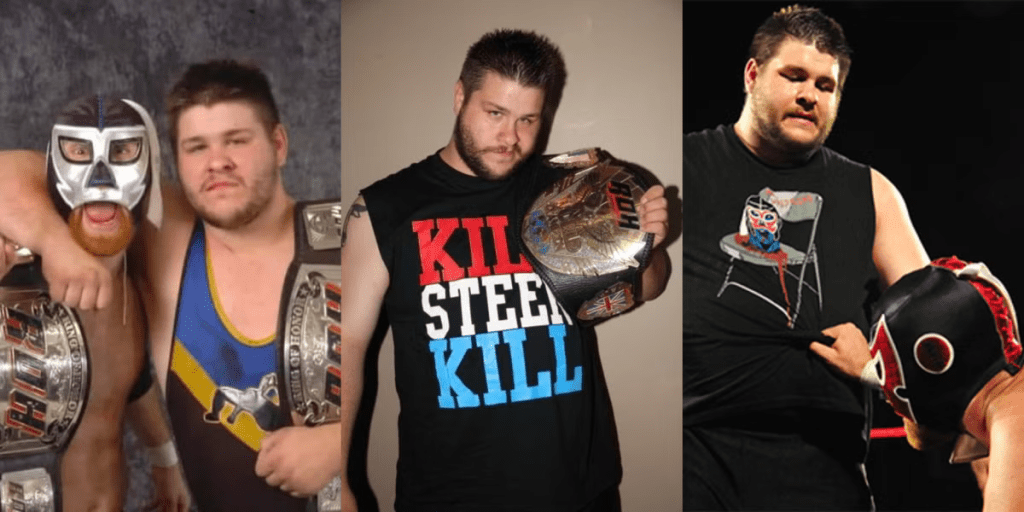
Kevin is my favourite wrestler currently in any promotion. On April 4, 2025, he unfortunately announced that he has a serious neck injury. It will require surgery. He would not be able to compete in his match against Randy Orton at Wrestlemania. As of this writing, he has still not had the surgery. They are adopting a wait and see approach. They want to determine how well it can heal on its own. They will decide before completing the procedure. As he said on Cody Rhodes’ podcast, What Do You Wanna Talk About, he was doing well for a while. He experienced no pain. Suddenly, all the symptoms had come back all at once. Hopefully he is able to get the surgery done soon. Then he can recover and return to a normal life, whether he comes back to wrestling or not.
KILL STEEN KILL!

 ScortonBoy17.ca
Leave a comment