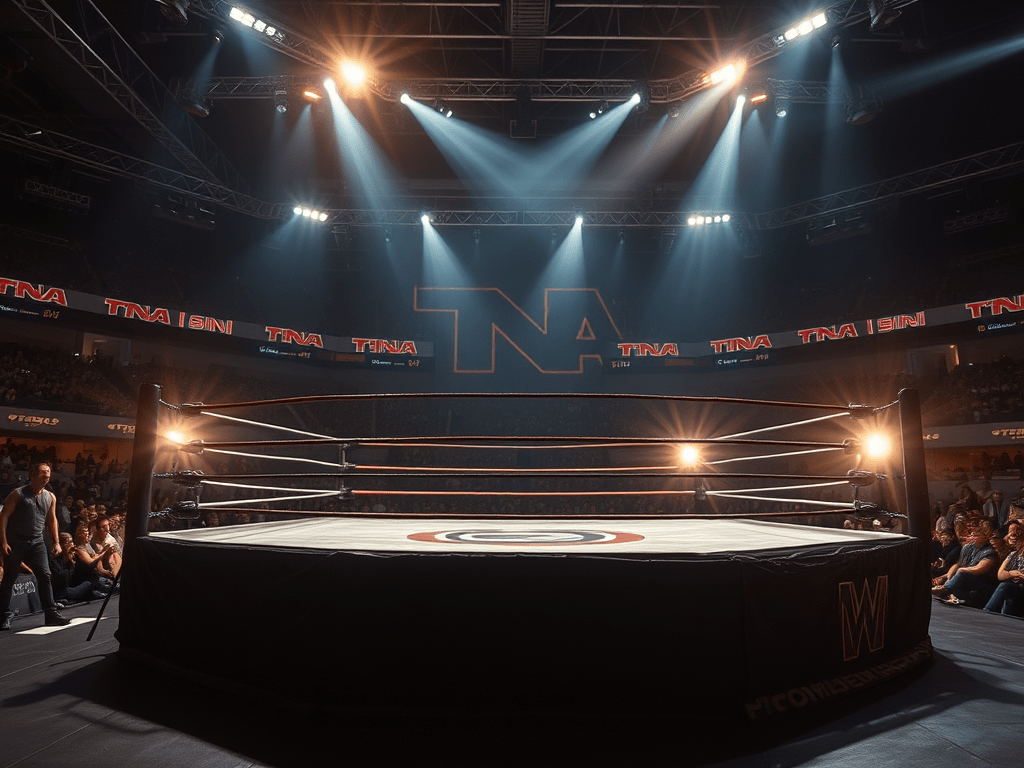
For over two decades, Total Nonstop Action (TNA) Wrestling has existed as a paradox in the professional wrestling landscape. It is a story of improbable survival. It is a promotion born from the ashes of a fallen empire. The promotion has repeatedly stared into the abyss of its own demise, only to claw its way back. TNA’s history is a turbulent narrative filled with breathtaking innovation. The company baffled many with its self-sabotage. It pioneered the most exciting in-ring styles of its generation with the X-Division. It also revolutionized women’s wrestling with its Knockouts. Yet, the company simultaneously found itself mired in identity crises. Financial turmoil and creative decisions alienated its most loyal fans.
TNA was founded in 2002 as a desperate gamble in a world monopolized by WWE. It has worn many faces. It was an NWA territory and a Spike TV powerhouse. It was a would-be Monday night competitor. It also became a nomad wandering the cable television wilderness. Now, in its most unexpected chapter yet, it has come full circle. The company has resurrected the very TNA name it once abandoned. It is embracing the nostalgia of its peak years. They are also forging an unprecedented partnership with the same monolithic competitor it was created to oppose. This is not just a history of a wrestling company. It is an analysis of a brand at a critical crossroads. The brand is perpetually fighting for its identity and its future.
Part I: The Asylum Years – A Weekly Gamble (2002-2004)
The Post-WCW Void and a Desperate Gambit
In 2001, the professional wrestling world contracted into a singularity. The World Wrestling Federation (WWF, later WWE) purchased its two largest competitors. These were World Championship Wrestling (WCW) and Extreme Championship Wrestling (ECW). This move allowed WWF to achieve a near-total monopoly on the industry. In this desolate landscape, veteran promoter Jerry Jarrett was on a fishing trip. He was accompanied by his son, former WCW headliner Jeff Jarrett, and digital media pioneer Bob Ryder. They had a conversation that sparked an audacious idea. They decided to create a new national promotion.
The venture, initially under the parent company J Sports & Entertainment, LLC, faced an immediate and seemingly insurmountable obstacle: television. With WWE dominating the airwaves, no major network was willing to take a chance on a new wrestling entity. This led the Jarretts to a business model born of pure necessity: a weekly pay-per-view. NWA-TNA, as it was first known, would broadcast a two-hour show every Wednesday night. The cost was $9.99. The logic was simple. Four weekly shows would approximate the cost of a single WWE monthly PPV. This offered fans a continuous alternative. It was a high-risk strategy, but it was the only one available. The company launched its first show on June 19, 2002, from the Von Braun Center in Huntsville, Alabama. It quickly relocated to the Tennessee State Fairground Sports Arena in Nashville. This venue would be affectionately nicknamed the ‘TNA Asylum’.
Crafting an Identity: The NWA, The X-Division, and Creative Chaos
TNA did not have the brand recognition of its defunct predecessors. It made a shrewd strategic move by affiliating with the National Wrestling Alliance (NWA). This collaboration enabled the fledgling promotion to “rent” the history of the NWA World Heavyweight and World Tag Team Championships. It also provided prestige. It instantly gave their main events a sense of legitimacy. This legitimacy would have otherwise taken years to build. At their inaugural event, the first NWA World Heavyweight Champion of the TNA era was crowned. Former UFC champion Ken Shamrock took the title. This immediately established a credible figurehead for the company.
While the NWA provided a link to the past, TNA’s first true innovation was the X-Division. With the rallying cry, “It’s not about weight limits, it’s about no limits,” the company created a showcase. This featured a fast-paced, high-risk, athletic style of wrestling. It was a stark departure from the heavyweight-dominated WWE product. The division was built on the work of three pioneers. There was the established veteran Jerry Lynn, the intense Low Ki, and a dynamic young upstart named AJ Styles. Their series of groundbreaking matches defined the division and became TNA’s calling card for in-ring quality. On the company’s second-ever broadcast, AJ Styles defeated Lynn, Low Ki, and Psicosis. He became the first X-Division Champion. This victory cemented his status as the cornerstone of the new promotion.
The creative direction of the Asylum Years was a direct product of its unsustainable business model. The immense pressure to convince fans to part with $10 every week forced a chaotic blend of programming. For every brilliant X-Division match, there was an element of “Attitude Era” shock value designed to generate buzz. This included established legends like Scott Hall and Ricky Steamboat. It also featured celebrity appearances from figures like Chris Rock and Toby Keith. Controversial gimmicks like the phallus-costumed tag team The Johnsons were part of it. The hardcore-wrestling dwarf, Puppet, also participated. Vince Russo’s arrival to the creative team further amplified this philosophy. He coined the name “Total Nonstop Action.” This was a deliberate double entendre intended to attract a more adult audience on PPV.
This relentless need to deliver a “must-buy” event each week created a crucible that forged TNA’s core identity. The financial model directly influenced the creative output. It forced a level of experimentation. Such experimentation would have been unlikely in a traditional television format. This strategy resulted in two approaches. On one hand, there was groundbreaking, high-quality wrestling like the X-Division to appeal to purists. On the other hand, there were shocking and often bizarre gimmicks to generate weekly buzz. The weekly PPV model failed financially. However, its very existence acted as a creative catalyst. It shaped the company’s DNA for years to come.
Financial Collapse and the Carter Era Begins
Despite the creative energy, the weekly PPV model was a financial catastrophe. Initial reports fed to the Jarretts suggested buyrates of around 50,000 per week. However, the reality was a fraction of that. It was closer to 10,000. This discrepancy quickly pushed J Sports & Entertainment to the brink of bankruptcy.
Salvation came from an unlikely source. In October 2002, Panda Energy International, a Texas-based energy company, acquired a 72% controlling interest in TNA. The company had no prior experience in the wrestling industry. This acquisition saved TNA from imminent collapse. The following year, Dixie Carter was appointed President of the newly reorganized TNA Entertainment, LLC. She is the daughter of Panda Energy’s founder. This buyout marked the end of the Jarretts’ ownership. It ushered in an era of financial stability. However, this era would eventually be defined by its own brand of turbulence. While the weekly PPV model would limp on until September 2004, its failure had already irrevocably altered the company’s destiny.
The initial partnership with the NWA, while a brilliant short-term solution, created a long-term identity problem. By borrowing legitimacy, TNA delayed the need to establish its own. When the agreement eventually ended in 2007, TNA was forced to create its own World Heavyweight Championship from scratch. To the audience, this was a brand-new title replacing one with decades of history. The X-Division Championship was a TNA-native creation. It felt special from its inception. In contrast, the TNA World Championship was born as a substitute. This created an “original sin” for the company’s top prize. It fostered a perception that it was secondary. This is a feeling the company has struggled to overcome for its entire existence.
Part II: Reaching for the Mountaintop – The Spike TV Era (2005-2009)
A New Home and Stability
After the weekly PPV experiment concluded, TNA had a brief and unremarkable run on Fox Sports Net. The company’s fortunes, however, changed dramatically in 2005 when it secured a transformative television deal with Spike TV. The network had recently lost WWE’s flagship program,
Raw, and was eager for wrestling content. TNA’s new show, TNA Impact!, debuted on Spike TV on October 1, 2005.
This partnership provided TNA with its first taste of genuine financial stability and widespread national exposure. The company relocated its tapings from the gritty “TNA Asylum.” They moved to a dedicated soundstage at Universal Studios in Orlando, Florida. This location was dubbed the “Impact Zone.” The deal with Spike meant TNA was no longer paying for a timeslot. Instead, the network controlled advertising revenue. This was in exchange for broadcasting the show. Viewership saw immediate and sustained growth.
Impact! moved from a late Saturday slot to a primetime Thursday slot, eventually expanding to two hours in 2007. The show became a ratings success for Spike. It achieved profitability for the first time around 2008. It regularly attracted between 1.3 and 1.9 million viewers.
The Game-Changing Signings: Angle and Sting
The Spike TV era was defined by a series of high-profile talent acquisitions. These acquisitions lent the promotion an unprecedented level of credibility. The full-time arrival of “The Icon” Sting in 2006 was a major coup. However, the signing that truly shifted the landscape was that of Kurt Angle later that year. Angle was a reigning, main-event-level WWE superstar and an Olympic gold medalist. He chose to leave WWE and sign with TNA. This move sent shockwaves through the industry. His arrival was a powerful statement that TNA was a viable and desirable destination for the world’s top talent. Angle’s debut feud with Samoa Joe was a critical and commercial triumph. He then became the inaugural TNA World Heavyweight Champion. This achievement cemented his place as a franchise player.
Sting’s presence provided a legendary aura and a series of dream matches. His decision to choose TNA over a long-awaited run in WWE was also revealing. He cited discomfort with WWE’s creative direction. Additionally, he feared his WCW legacy would be buried. These were key factors in his choice. This underscored the alternative identity TNA was successfully cultivating. TNA signed other major stars such as Christian Cage, Booker T, Kevin Nash, and Scott Steiner. These acquisitions transformed the TNA roster into a formidable collection of talent.
The Pillars of TNA: X-Division and the Knockouts
While big-name signings drew mainstream attention, TNA’s growth was built upon two innovative and homegrown pillars. The X-Division set the standard for in-ring work rate. It produced iconic encounters like the 2005 Unbreakable three-way match between AJ Styles, Christopher Daniels, and Samoa Joe. This bout is often cited as one of the greatest in company history. The division also introduced signature match types. These include the Ultimate X, the Steel Asylum, and the Xscape match. This further distinguished the TNA product.
The formal establishment of the Knockouts Division in 2007 was equally revolutionary. At a time when women’s wrestling in WWE was often presented as secondary “Diva” content, TNA took a different approach. It showcased its female performers as serious, athletic competitors on par with their male counterparts. This focus on credibility resonated with audiences, and segments featuring the Knockouts often drew some of
Impact!‘s highest ratings. Gail Kim was crowned the first-ever TNA Knockouts Champion at Bound for Glory 2007. Her subsequent rivalry with the dominant Awesome Kong became one of the most acclaimed feuds in TNA’s history. This rivalry defined the division for years to come.
The success during this period was a result of a carefully balanced “Dual-Identity” strategy. TNA pursued mainstream relevance by signing former WWE stars. They also focused on cultivating a loyal fanbase of wrestling purists. A superior in-ring alternative in the X-Division and Knockouts helped achieve this. One identity brought casual viewers to the channel; the other convinced them to stay. The disruption of this delicate balance would later prove to be the catalyst for the company’s decline.
| Channel and Timeslot (ET) | Years | Rating or Viewership |
| Spike (Sat. 11pm) | 2005–2006 | 0.7 Rating |
| Spike (Thurs. 11pm) | 2006 | 0.9 Rating |
| Spike (Thurs. 9pm) | 2006–2007 | 1.0 Rating |
| Spike (Thurs. 9pm; 2hrs) | 2007–2010 | 1.2 Rating (avg. 1.3m-1.9m viewers) |
Table 1: TNA Impact! Viewership Trajectory on Spike TV (2005-2010). Data sourced from.
Crucially, Spike TV was more than just a broadcaster; it was an active financial partner. The network helped pay the lucrative contracts of top talent and funded expensive international tours. This deep financial entanglement enabled TNA’s “golden era” growth but also created a dangerous dependency. The company’s operational budget was artificially inflated by Spike’s investment. When that relationship eventually fractured, TNA didn’t just lose its television home. It lost a crucial part of its business infrastructure. This was a blow that made the subsequent collapse much more severe.
Part III: The Hogan-Bischoff Invasion – An Identity Crisis (2010-2014)
The Arrival and the “New Monday Night War”
By late 2009, TNA was a stable and profitable organization, but TNA President Dixie Carter was ambitious for more. She made a bold move to elevate the company to mainstream success. She signed Hulk Hogan and Eric Bischoff. These two figures are most synonymous with WCW’s 1990s challenge to WWE. She gave them significant creative power.
Their arrival was heralded with a bold declaration of war. On January 4, 2010, TNA aired a special live, three-hour episode of Impact! directly opposite WWE Raw. The show featured Hogan’s TNA debut. It included a slew of other surprises. This delivered the highest television rating in the company’s history with an average of 2.2 million viewers, peaking at 2.9 million for Hogan’s appearance. However, it was a lopsided victory. WWE countered with the shocking return of Bret Hart to
Raw for the first time in over 12 years, drawing a massive 5.6 million viewers and soundly winning the night.
TNA saw the record rating as a sign of success, despite the clear disparity. In March 2010, they made the fateful decision to move Impact! to Monday nights permanently. The move was an unmitigated disaster. Viewership plummeted, with ratings dropping to a 0.84 and losing 15-20% of the audience over the course of a single broadcast. By May 2010, less than three months after the move began, TNA quietly retreated back to its Thursday night timeslot.
A Shift in Philosophy and Alienating the Base
The failure of the “New Monday Night War” was not simply a matter of ratings. It resulted from a fundamental clash of philosophies. This clash alienated the company’s core audience. The Hogan-Bischoff regime immediately began dismantling the very things that made TNA unique. The iconic six-sided ring was a visual identifier for the brand. The new leadership replaced it with a traditional four-sided ring because they felt it was “stupid”.
Creative focus shifted dramatically away from the homegrown talent that had built the company. Stars like AJ Styles and Samoa Joe were pushed aside. The X-Division workhorses were also marginalized. This was done to benefit Hogan and his friends. This group included The Nasty Boys and radio personality Bubba the Love Sponge. Other aging veterans like Ric Flair and Rob Van Dam were also prioritized. In what was seen as a symbolic demotion, AJ Styles was repackaged. Once the company’s original franchise player, he became a “mini-Ric Flair.” He was portrayed as a cheap imitation of a legend instead of the unique star he was. The creative process, once praised for its long-term potential, descended into chaos. Vince Russo was still heavily involved. Storylines were frequently changed on the day of shows. This abandoned coherent booking for short-term shock value.
Storyline Overhauls: Immortal and Aces & Eights
The on-screen product reflected this shift in philosophy. In 2010, the central storyline was the formation of “Immortal.” This villainous supergroup was led by Hogan, Bischoff, Jeff Jarrett, and Jeff Hardy. They aligned with Ric Flair’s “Fortune” faction, which was a group of TNA’s younger stars. The angle faced widespread criticism from fans. They saw it as a blatant and uninspired retread of WCW’s New World Order (nWo) storyline from the 1990s.
From 2012 to 2013, the show was dominated by another all-encompassing stable angle, “Aces & Eights.” A mysterious biker gang fought against the TNA roster for over a year. The storyline consumed a vast majority of television time. The angle culminated in the reveal of Bully Ray as the group’s leader and a subsequent TNA World Championship reign. The storyline was ambitious in scope. It was criticized for its excessive length. Many other wrestlers and divisions within the company were sidelined.
The Beginning of the End: Financial Strain and the Loss of Spike
The new strategy was a financial failure. The expensive contracts for older, non-drawing talent and costly decisions like taking Impact! on the road full-time did not translate into increased revenue or viewership. Ratings, which had peaked in 2009, stagnated and then began a slow, steady decline.
The relationship with their television partner frayed. In 2014, Spike TV announced it would not be renewing TNA’s contract. The reasons were multifaceted. TNA was reportedly seeking a significant increase in rights fees at a time when its ratings were falling. The issue was exacerbated by the secret re-hiring of Vince Russo as a consultant. Spike executives had made it clear he was not to be involved with the creative team. Russo accidentally emailed a wrestling journalist. He intended to send it to TNA announcer Mike Tenay. This error revealed his involvement. This was a major breach of trust. Dixie Carter faced heavy criticism for her handling of the negotiations. This marked the unceremonious end of the nine-year partnership that had defined TNA’s most successful era.
The one-night ratings victory on January 4, 2010, proved to be a curse. It created an unrealistic benchmark that the company could never again hope to achieve. This anomaly was misinterpreted by management as a new baseline, leading directly to the ill-fated permanent move to Mondays. When the ratings inevitably cratered, it fostered a sense of failure and desperation that led to years of creative flailing. TNA spent the remainder of its time on Spike chasing the ghost of that one night. This pursuit ultimately contributed to its financial strain. It also led to their departure from the network.
Part IV: The Wilderness Years – A Fight for Survival (2015-2018)
The Nomadic Search for a Home
TNA lost the Spike TV deal in 2014, sending the company into a tailspin. This began a nomadic period of wandering the fringes of the American cable landscape. The company bounced between networks with progressively smaller viewership and reach, each move further diminishing its visibility and relevance.
- Destination America (2015): TNA landed on the Discovery-owned Destination America. There were public statements of optimism from Dixie Carter. She spoke about a new era. However, the partnership soured almost immediately. Ratings were much lower than they had been on Spike. Advertisers were reportedly reluctant to buy time during the wrestling block. The relationship was reportedly dysfunctional. One infamous story suggests Carter had accidentally included a network executive on an email. In that email, she was complaining about them. Within months, the network had canceled Impact Wrestling, a decision that was kept secret for a time. A mid-year move from Friday to Wednesday nights only exacerbated the ratings slide, with the total audience dropping by 33%.
- Pop TV (2016-2018): In 2016, TNA found a new home on Pop TV. The network was available in more homes than Destination America. However, its programming skewed heavily female. This was a potential mismatch for the traditional wrestling demographic. Viewership remained low, consistently hovering in the 200,000-300,000 range and sometimes dipping lower. By 2018, Pop TV moved Impact! out of its primetime slot to 10 p.m., a clear signal that the show was not a priority for the network.
- Pursuit Channel (2019): The company’s next move, to the Pursuit Channel in 2019, was widely seen as a nadir. An outdoor-themed network with extremely limited distribution, the partnership was a sign of desperation. Many cable subscribers did not even have access to the channel, making the show incredibly difficult to find.
| Network | Years | Average Viewership |
| Spike TV | 2013-2014 | ~1.0 million |
| Destination America | 2015 | ~371,000 |
| Pop TV | 2016-2018 | ~300,000 |
| Pursuit Channel | 2019 | ~195,000 |
Table 2: TNA/Impact Wrestling’s Post-Spike TV Viewership Decline. Data sourced from.
Financial Ruin and the Anthem Takeover
The catastrophic loss of television revenue plunged the company into severe financial distress. Reports of late or missed payments to talent became a recurring issue. In 2016, Billy Corgan emerged as a key financial backer for the company. He is the frontman for the Smashing Pumpkins. He was eventually named company president. However, the relationship quickly deteriorated. Corgan entered a bitter legal battle with TNA and Dixie Carter. He sued them over unpaid loans he had made to keep the company afloat.
Anthem Sports & Entertainment saved the company from complete collapse. They are the Canadian parent company of Fight Network and had been TNA’s broadcast partner in Canada. Anthem had also been loaning TNA money throughout 2016. In January 2017, Anthem settled the lawsuit with Corgan. They acquired a majority stake in TNA. This led to the formation of a new subsidiary called Anthem Wrestling Exhibitions. As part of the acquisition, Dixie Carter resigned as chairwoman. She was moved to an advisory role with no decision-making power. This effectively ended her tumultuous 14-year run at the helm of the company.
The Rebranding Chaos: Impact, GFW, and the Devalued Titles
The Anthem era began with a wave of chaotic rebranding efforts, symptomatic of a deeper identity crisis. In March 2017, the company officially shed the TNA name and rebranded as “Impact Wrestling,” named after its television show. The decision aimed to create distance from the negative connotations. The “LOLTNA” reputation had plagued it for years.
However, this new identity was immediately thrown into disarray. Jeff Jarrett returned to a leadership role. A decision was made to merge Impact Wrestling with his own Global Force Wrestling (GFW) promotion, which was largely unproven. This initiated a period of profound confusion. In 2017 alone, the company’s World Championship went through five different names. First, it was called the TNA World Heavyweight Championship. Then, it changed to the Impact Wrestling World Heavyweight Championship. Next, it became the Unified GFW World Heavyweight Championship. After that, it was named the GFW Global Championship. Finally, it settled on the Impact Global Championship. The constant changes made the company and its titles a running joke among wrestling fans. The GFW experiment was short-lived. Anthem cut ties with Jarrett in October 2017. The promotion reverted to the Impact Wrestling name. Significant damage had already been done to its credibility.
This period of extreme instability, however, inadvertently set the stage for the company’s eventual recovery. By hitting rock bottom, the promotion was forced to abandon all pretensions of competing with WWE. This “ego death” was a necessary prerequisite for the slow, humble, and wrestling-focused rebuild that would follow. The company had to nearly die. This process taught it how to live within its means. It also helped the company rediscover what made it special in the first place.
Part V: The D’Amore Doctrine – Rebuilding from the Ashes (2018-2023)
A New Philosophy: Stability and Trust
After the tumultuous GFW debacle, Anthem Sports & Entertainment made significant leadership changes. They appointed Scott D’Amore and Don Callis as Executive Vice Presidents in late 2017. D’Amore, a longtime TNA employee with a background in booking and talent relations, took the lead on the creative direction. D’Amore’s leadership ushered in a new philosophy starkly different from previous eras. His stated mission was to rebuild the company patiently. He aimed to focus on a quality in-ring product and compelling long-term storytelling. Most importantly, he wanted to earn back the trust of both fans and the industry “one fan at a time”.
A key part of this doctrine was the detoxification of the brand’s reputation. D’Amore worked to create a stable, professional locker room environment, a stark contrast to the chaos of the past. This internal cultural shift was arguably more important than any single on-screen angle. It transformed the company from a backstage laughingstock into a respected and reliable place to work. This change made future partnerships with major promotions possible.
Opening the Forbidden Door
Under D’Amore’s leadership, Impact Wrestling became a central hub for inter-promotional collaboration. This willingness to work with others was a cornerstone of his rebuilding strategy.
- AEW (2020-2021): A high-profile partnership saw then-AEW World Champion Kenny Omega appear regularly on Impact!, eventually defeating Rich Swann to win the Impact World Championship at the Rebellion PPV in 2021. The crossover brought a significant number of eyes to the Impact product. However, the partnership was not without criticism. Many longtime Impact fans felt the booking often featured AEW personalities denigrating the Impact brand in paid advertisements. This ultimately made their home promotion look weak. It appeared subservient. The working relationship quietly ended in October 2021.
- NJPW (2021-2024): D’Amore made a concerted effort to repair the relationship with New Japan Pro-Wrestling. It had been severely strained for nearly a decade. The strain was due to TNA’s poor handling of a young Kazuchika Okada’s excursion. This successful diplomatic effort led to a fruitful partnership. The partnership included co-promoted events like Multiverse United. It also involved talent exchanges that saw NJPW stars like Jay White and Juice Robinson appear on Impact!.
A Stable Home on AXS TV
A crucial step toward stability came in 2019 when parent company Anthem acquired AXS TV. In October of that year, Impact! moved to the network. This gave the promotion a secure broadcast home owned by its own parent company. It was the first time since the Spike deal ended. This move eliminated the constant threat of cancellation and allowed for genuine long-term planning. While AXS TV’s household reach is limited, its viewership has remained modest. The numbers are typically between 70,000 and 150,000 viewers. Despite this, it has been consistent, providing a reliable platform for the product.
The Shocking Dismissal
D’Amore’s leadership was widely praised for stabilizing the company. He was promoted to President of Impact Wrestling in March 2023. He strongly supported the decision to rebrand the company back to its TNA roots for 2024. This move generated significant positive buzz.
In February 2024, Anthem terminated D’Amore’s contract. This decision stunned the wrestling world and the company’s own locker room. It happened only weeks after the successful TNA rebrand had launched at the Hard to Kill pay-per-view. He was replaced by Anthem media executive Anthony Cicione. The official reason provided was a desire to “further integrate TNA Wrestling into Anthem’s Entertainment Group.” They wanted to leverage the parent company’s resources more directly. Subsequent reports revealed that D’Amore had tried to purchase the company from Anthem after being fired. His comments indicated a fundamental disagreement over the company’s future direction.
This abrupt change in leadership exposed an unresolved tension at the heart of the company. D’Amore, a lifelong wrestling person, focused on running TNA as a wrestling company first. He prioritized the on-screen product, locker room morale, and industry relationships. Anthem decided to replace him with a corporate executive. This suggests a different vision. TNA is now viewed as a content asset to be managed within a larger media portfolio. This clash between a “wrestling-first” and a “content-first” philosophy is the central conflict that now defines TNA’s uncertain future.
Part VI: The Future is Now – TNA is Back (2024-Present)
Back to the Future: The TNA Rebrand
In one of the most surprising moves of its recent history, the company made a major announcement. This occurred at its Bound for Glory pay-per-view in October 2023. It would officially rebrand from Impact Wrestling back to Total Nonstop Action (TNA) Wrestling. The change took effect at the Hard to Kill pay-per-view in January 2024.
The decision was driven by a confluence of factors. Fans at live events had never stopped chanting “TNA,” a clear sign of the name’s enduring brand recognition. The company’s international broadcast partners also reportedly preferred the TNA name, with some still using it internally. The move strategically aimed to unite the company’s fragmented history under its most famous banner. It also sought to capitalize on the powerful pull of nostalgia for its Spike TV peak. The rebrand brought promises of a new visual presentation. It also included plans for larger venues and a renewed mission to “disrupt and change wrestling.” This generated a level of buzz the company had not seen in years.
An Unprecedented Alliance: The WWE/NXT Partnership
Even more shocking than the rebrand was the formalization of a partnership with its oldest and largest competitor, WWE. These developments built on one-off appearances by TNA Knockouts Champions in WWE’s Royal Rumble match. Mickie James appeared in 2022. Jordynne Grace appeared in 2024. The two companies announced a groundbreaking, multi-year partnership in January 2025.
The collaboration is centered on talent exchanges between TNA and WWE’s developmental brand, NXT. This has led to a flurry of crossover appearances. TNA mainstays like Jordynne Grace and Joe Hendry have appeared on NXT programming. They have challenged for NXT championships. NXT talent has consistently participated in TNA matches. This includes wrestlers like Wes Lee, Charlie Dempsey, and the No Quarter Catch Crew. The partnership reached a new level of integration when NXT’s Trick Williams defeated Joe Hendry at the
NXT Battleground event to win the TNA World Championship, making TNA’s top champion an active, WWE-contracted performer.
The Current Landscape and Roster
Today, TNA finds itself in a unique and intriguing position. Its roster includes established veterans who have returned to the fold, such as The Hardys and Nic Nemeth. It also features TNA loyalists like Moose, Eddie Edwards, and Steve Maclin, who have weathered the storms. The lineup showcases homegrown rising stars such as Mike Santana and Leon Slater. The Knockouts division remains perennially strong, led by champion Masha Slamovich. Additionally, there is a rotating cast of NXT talent.
The company remains on AXS TV in the United States. It is also pursuing growth internationally. The company has recently secured new television deals in major markets. These include Canada, on Sportsnet 360, replacing WWE after they moved to Netflix, and India. Its streaming service, TNA+, continues to be a key part of its distribution model. The recent launch of a free tier aims to increase accessibility and attract new viewers.
The rebrand and the WWE partnership are closely linked. These represent a pragmatic dual strategy to combat the company’s biggest weakness: obscurity. The rebrand taps into the nostalgia of its most visible era to re-engage lapsed fans. The WWE deal leverages the industry leader’s massive platform to reach new fans. This acknowledges that the “Impact Wrestling” brand, shown on a network like AXS TV, was not strong enough. It could not grow on its own.
Conclusion & Future Outlook: Navigating the Crossroads
TNA Wrestling has faced more than twenty years of volatile peaks and near-fatal valleys. Now, it is arguably more stable and relevant than it has been in a decade. Yet, it stands at a profound crossroads. Its future is defined by one central question. Can it leverage its unprecedented partnership with WWE to grow its own brand? Or will it be consumed by it, becoming little more than a high-profile developmental territory?
The opportunity is immense. The WWE crossover provides TNA with a level of exposure and legitimacy it could not possibly achieve on its own. Featuring its talent and championships on WWE programming enhances TNA’s value to potential major television networks. This remains the company’s most critical long-term goal. However, the risk is equally significant. An NXT star holds its World Championship. The shows feature a steady rotation of WWE developmental talent. TNA risks undermining its own roster. It may cement a public perception that it is a “feeder system” rather than a distinct, viable alternative.
The company’s long-term future might be to pioneer a new role in the modern wrestling ecosystem. This role would be as the first officially sanctioned “super territory.” In an era where WWE is increasingly open to collaboration, TNA could carve out a unique and sustainable niche. It would not be a direct competitor. Instead, it would serve as a vital part of the global wrestling landscape. It could become a neutral ground. Here, developmental talent gets seasoned. International stars can work in North America. Veterans can contribute without the grueling schedule of a top promotion. This would be a radical redefinition of success for a company that once tried to start a war.
Ultimately, the path forward requires a delicate balancing act. The WWE partnership is a bridge, not a destination. Its success should not be measured by the number of crossovers. Instead, it should be evaluated based on whether it can secure a television deal on a network. The network should have significantly broader reach than AXS TV. Only then can TNA generate the revenue it needs to build its own exclusive stars. It must also retain these stars and stand on its own two feet. The story of TNA has always been one of survival. Its future will be determined by whether it can finally evolve from merely surviving to truly thriving.

 ScortonBoy17.ca
Leave a comment