Introduction: The Phantom of the Draft
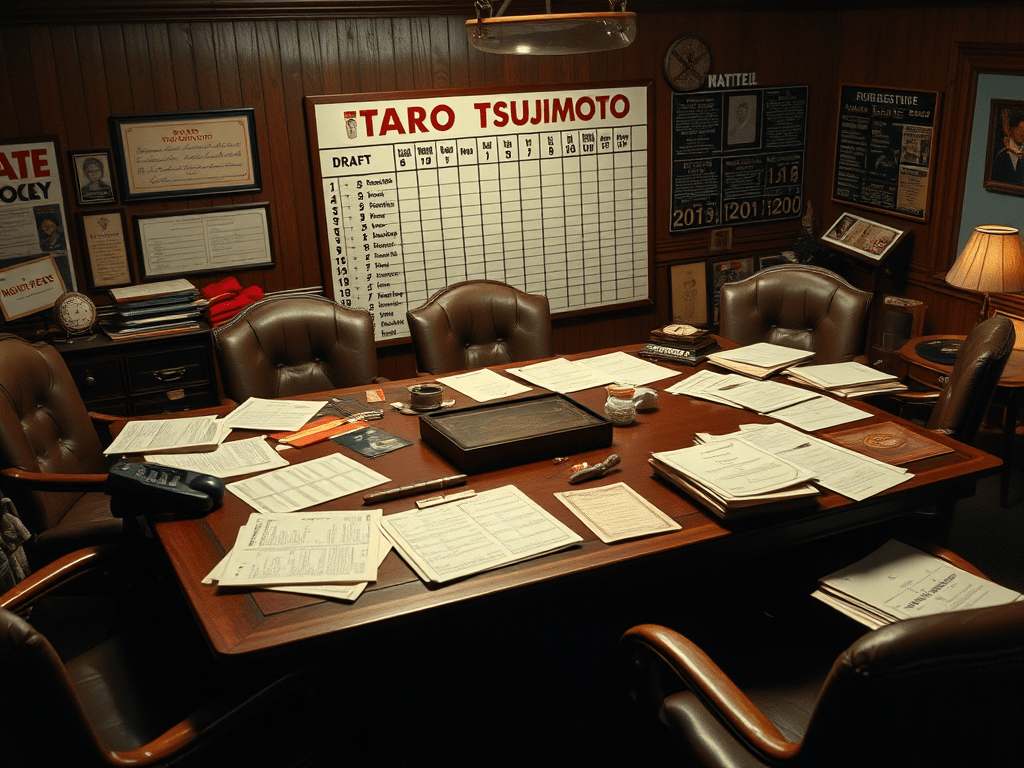
The 1974 National Hockey League Amateur Draft did not take place in a glittering arena. Prospects did not walk a stage under bright lights. Instead, it was a secretive event. It occurred over three painstaking days. The process was conducted via a crackling conference call from the league’s headquarters in Montreal. By the time the 11th round began, patience among the league’s general managers had worn thin. Then, with the 183rd overall pick, the Buffalo Sabres made a selection that seemed poised to make history. General Manager George “Punch” Imlach made the announcement. He chose Taro Tsujimoto, who was a swift-skating center from the Tokyo Katanas of the Japan Ice Hockey League. In that moment, the NHL had seemingly drafted its first-ever Japanese prospect. This was a landmark moment for the international growth of the sport.
There was just one problem. The player, the team, and the entire backstory were a complete fabrication. This was not a clerical error or a case of mistaken identity; it was an audacious, meticulously crafted hoax. An exasperated Imlach conceived an act of protest. He executed it with the help of his public relations director. It became a middle-finger memo to the NHL, cleverly disguised as a draft pick.
The story of Taro Tsujimoto is more than just one of the greatest pranks in sports history. It is a tale that can only be understood through its unique historical context. The professional hockey landscape was torn apart by a bitter league war. A defiant personality stood at the helm of a young franchise. It was a pre-digital world where information was scarce and trust was a vulnerability. The immediate issue it caused was a procedural headache for the NHL. It was also a moment of profound embarrassment. The NHL tried to erase the pick from its records. But the prank’s long-term legacy became something its creators never intended. The league attempted to nullify the pick. It failed in the court of public opinion. Buffalo fans transformed the phantom player into a beloved folk hero. The story of Taro Tsujimoto is about an act of rebellion against a flawed system. A community co-opted it and forged it into an enduring legend. This legend has outlived the protest itself.
A League at War: The Cauldron of the 1974 NHL Draft
You need to understand the chaotic environment of the mid-1970s. Only then can you grasp how a fictitious player could be drafted into the world’s premier hockey league. Professional hockey was in the midst of a civil war. The established National Hockey League had been the undisputed hegemon of the sport for decades. It was locked in a bitter and expensive battle with the upstart World Hockey Association (WHA). The WHA began play in 1971. The WHA was not merely a minor league. It was a direct competitor that aggressively poached NHL talent with higher salaries. Crucially, the WHA was willing to sign underage junior players—a practice the NHL had traditionally forbidden.
This “player war” forced the NHL to react. The NHL made two fateful decisions for its 1974 Amateur Draft. They wanted to prevent the WHA from getting the jump on the next generation of talent. First, it rescheduled the draft to late May. This was two days before the WHA’s scheduled draft. This move was to give its teams a head start on contract negotiations. Second, and most consequentially, it shrouded the entire process in secrecy. Instead of a public event, the draft was conducted via a private conference call originating from the NHL’s Montreal office. League President Clarence Campbell would phone each of the 18 teams. He read the list of players who had already been selected. Then, he waited for that team to make its pick.
The result was a procedural nightmare. The process was agonizingly slow, a monotonous marathon of names read over a telephone line. The draft lasted for three full days, from May 28 to May 30. It ballooned to a record 25 rounds, with a total of 246 players selected. Both figures remain the highest in NHL history. The sheer length and tedium exhausted the participants. As the rounds deepened, teams began to simply pass on their selections. Some rounds featured picks from only a handful of franchises.
The NHL’s strategy of secrecy aimed to outmaneuver an external rival. However, it unintentionally created a massive internal vulnerability. By removing the draft from public view, the league eliminated all media scrutiny and real-time fact-checking. The entire system was built on the assumption. It assumed that the general managers on the other end of the line were acting in good faith. This information vacuum resulted from the league’s defensive posture against the WHA. It created the perfect conditions for a clever and defiant mind to exploit the system’s flaws. The very shield the NHL had erected would be turned against it.
The Autocrat and the Prankster: The Mind of Punch Imlach
The mind that conceived the hoax belonged to George “Punch” Imlach, the general manager and coach of the Buffalo Sabres. Imlach was a titan of the sport. He was a Hockey Hall of Fame builder. He had guided the Toronto Maple Leafs to four Stanley Cup championships in the 1960s. This included their most recent championship in 1967. He was a brilliant hockey man, but his success was built on a foundation of absolute control. Imlach was famously known as a “harsh taskmaster.” He was an “autocratic” leader. He was not above verbally or even physically abusing his players to motivate them.
His abrasive style created deep divisions in his dressing rooms. He favored older, veteran players who saw him as their last chance for glory. However, he frequently clashed with younger stars. Frank Mahovlich, a Hall of Fame forward, experienced conflicts under Imlach’s rule in Toronto. He later called his final four seasons with the coach “the worst four years of my life.” Imlach did not suffer fools. He viewed any challenge to his authority with contempt. This applied whether the challenge came from players, management, or the league itself. Maple Leafs owner Stafford Smythe asked Imlach to relinquish his coaching duties. Imlach bluntly responded, telling Smythe to “fire him or leave him alone.”
This defiant personality was the perfect catalyst for an act of rebellion. By the 11th round of the 1974 draft, Imlach had reached his breaking point. He had already selected the last player he believed had any realistic shot of making the NHL. He was disgusted by the “slow, tedious” process he was being forced to endure. Other GMs chose to passively endure the farce by passing on their picks. Imlach chose a more active form of protest.
He found a willing co-conspirator in the Sabres’ puckish public relations director, Paul Wieland. Wieland was a creative mind. He understood the entertainment side of the business. He had a history of orchestrating his own pranks, including annual April Fools’ Day press releases. Together, the autocrat and the prankster set out to mock the very process they were a part of. The Tsujimoto hoax was not a random lark; it was the quintessential Imlach act. It combined his sharp hockey acumen. He recognized the futility of the late rounds. It combined his disdain for bureaucratic incompetence. Lastly, it combined his innate flair for the dramatic. It was an act of performance art that perfectly reflected the character of the man behind it.
The Birth of a Legend: Crafting Taro Tsujimoto
The creation of Taro Tsujimoto was a masterstroke of simple, clever details. The idea to draft a Japanese player was strategic. In 1974, Japan was a hockey backwater from an NHL perspective. It was a place so far off the scouting map. A claim of a star player there would be nearly impossible to disprove on short notice.
The name itself was born from the local Buffalo landscape. Paul Wieland recalled a grocery store he frequently passed on his drives. It was owned by a Japanese American man named Joshua Tsujimoto. Imlach’s secretary was dispatched to call Mr. Tsujimoto, securing his permission to use the family name and asking for a common Japanese first name. He suggested “Taro”.
The fictional team was an even more clever inside joke. Imlach christened the team the “Tokyo Katanas”. A katana is a famous type of Japanese long sword, a direct and witty parallel to the Buffalo “Sabres”. With a name and a team in place, they created a brief but plausible backstory. Taro Tsujimoto was a 5’9″, 165-pound center from Osaka. He had tallied 15 goals and 25 points in the Japan Ice Hockey League the previous season.
This entire fabrication was possible only because of the technological limitations of the era. In 1974, there was no internet, no Google, no online player databases like EliteProspects or HockeyDB. Verifying the existence of a player from a remote league was challenging. It involved making a series of expensive international phone calls. Alternatively, people could send telegrams. This effort was unlikely to be undertaken by any team or journalist for a late, 11th-round draft pick. The success of the hoax was predicated on this information asymmetry. In a world before instant global communication, the word of a respected NHL general manager was taken as bond. The Tsujimoto story is a perfect time capsule. It is an artifact of an analog world. In that world, a well-told lie could travel halfway around the world before the truth could get its boots on.
The Pick, The Press, and The Period of Deception
Punch Imlach got on the phone with NHL President Clarence Campbell. It was deep into the third day of the draft, and boredom had long set in. With the 183rd overall pick, he confidently announced the Sabres’ selection of Taro Tsujimoto of the Tokyo Katanas. Campbell, an unsuspecting administrator focused on procedure, accepted the pick without question. According to Wieland, the most humorous part of the moment was hearing Campbell spell the unfamiliar Japanese name. He spoke in his formal tone. He had to say each letter—T-A-R-O, T-S-U-J-I-M-O-T-O—to the other GMs on the conference call. They were likely scrambling through their scouting books in confusion.
The pick was made official. It was entered into the league’s records, and when the draft concluded, the official list was distributed to the media. Major, authoritative outlets reported the selection of Taro Tsujimoto. This included The Hockey News. Their reports lent the hoax an immediate and powerful air of legitimacy. The press took an interest, recognizing the historic potential of the first Japanese player being drafted into the NHL.
Imlach and Wieland fully committed to the deception. They kept it a secret from almost everyone. This included the team’s owners, the Knox brothers. For weeks, they fielded media inquiries about their mysterious prospect. They vaguely stated that he would be “coming soon.” They were also hopeful he would make it to training camp. The prank reached its zenith as training camp approached. A locker stall was prepared for Tsujimoto in the Sabres’ dressing room, complete with a custom No. 13 jersey, leaving actual players to wonder about the new arrival. In a final act of mischief, Wieland spotted a Japanese man in the team’s hotel. He then had “Taro Tsujimoto” paged over the intercom. This sent owner Seymour Knox scrambling to greet his new player. Wieland found this very amusing.
The Unraveling and The Fallout
The charade could only last so long. The reality of training camp was looming, and there was no player to fill the locker. Imlach finally came clean. He admitted to the league and the press that Taro Tsujimoto did not exist. The reaction from the NHL head office was swift and stern. President Clarence Campbell, who had been personally duped on the call, was reportedly “not funny” about the matter. The league’s official response was to declare the 183rd pick an “invalid claim” and scrub it from the official records. For years, Tsujimoto’s name still appeared in some editions of the NHL Guide and Record Book. It was a ghost in the machine. It was systematically removed in the late 1980s.
The league’s reaction was punitive, aimed at erasing an embarrassing transgression, rather than reformative. Imlach’s prank starkly exposed a gaping hole in the league’s draft protocol. There was a complete lack of a verification system for prospects. Yet, there is no evidence that the incident prompted any immediate changes. The draft remained a private affair until the NHL-WHA rivalry ended. In the 1980s, it became a public, televised event. This change was driven more by a desire for fan engagement and marketing. It was not primarily to prevent another phantom pick. The league perceived the Tsujimoto affair not as a critical system failure. Instead, they saw it as an isolated act of misbehavior by a rogue GM. It was an embarrassment to be swept under the rug.
Beyond the institutional fallout, the hoax had a tangible, on-ice consequence: an opportunity cost. While an 11th-round pick is statistically a long shot to make the NHL, the 1974 draft was historically deep. Several future NHL players of consequence were selected after the non-existent Tsujimoto. Most notably, the Montreal Canadiens used the 199th pick on forward Dave Lumley. He would later win two Stanley Cups with the Edmonton Oilers dynasty in the 1980s. Even later, at pick No. 214, the New York Islanders selected defenseman Stefan Persson. He became a key member of their own dynasty. He won four consecutive Stanley Cups from 1980 to 1983. The Sabres wasted a pick on a joke. By doing so, they gave up a chance to add a contributing piece to their roster. This chance was, however, slim.
The Afterlife: How a Phantom Became a Buffalo Icon
If the story had ended with the NHL’s invalidation of the pick, Taro Tsujimoto would be a mere footnote. He would be a piece of trivia for hockey nerds. But what happened next transformed the prank into a legend. Far from being forgotten, Tsujimoto was immediately and enthusiastically embraced by the Buffalo Sabres fanbase. The timing was perfect. During the 1974-75 season, the young Sabres caught fire. They were led by the dazzling “French Connection” line. The team made an improbable run all the way to the Stanley Cup Final. This ignited a “Sabres fever” throughout Western New York.
The ghost of the draft became the spirit of the arena. At Buffalo’s Memorial Auditorium, known affectionately as “The Aud,” Tsujimoto became a grassroots phenomenon. Fans began hanging homemade banners from the balconies that read “Taro Sez…” followed by a witty or taunting message directed at the opposing team. During lopsided games, chants of “We Want Taro! We Want Taro!” would echo through the building. For a young franchise, founded only in 1970, the Tsujimoto story became a foundational myth. It gave the club a unique identity. The Sabres were seen as clever and fun-loving underdogs who had outsmarted the stuffy NHL establishment. It was an “us against the world” narrative. This story resonated deeply with the city’s own blue-collar, underdog persona. It forged a powerful bond between the team and its community.
This legacy has proven remarkably durable. The Sabres organization recognizes the story’s cultural power. They have kept the legend alive. Tsujimoto remains listed as their 11th-round pick in team media guides. The phantom player has been commercialized and immortalized in the modern era. In 2011, trading card company Panini America included a Tsujimoto “rookie card” in its Score set. This card quickly became a sought-after collector’s item. In 2013, the New Era Cap Company launched a series of “Tokyo Katanas” hats. This was to commemorate the 40th anniversary of the pick. To this day, fans can be seen at Sabres games wearing custom jerseys with “TSUJIMOTO 74” on the back. Paul Wieland, the prank’s co-architect, even titled his 2019 autobiography Taro Lives!. The ghost of the 183rd pick had become a permanent and beloved citizen of Buffalo.
Anatomy of a Hoax: Tsujimoto in the Pantheon of Sports Pranks
The Taro Tsujimoto story, while unique in its details, belongs to a grand tradition of sports hoaxes and fabrications. Placing it alongside other famous examples shows what makes it so distinct. It explains why its legacy is one of affection rather than infamy. A comparative analysis highlights the critical role of motive in shaping a hoax’s cultural afterlife.
The closest parallel to the Tsujimoto story is “The Curious Case of Sidd Finch.” In 1985, esteemed writer George Plimpton published a story in Sports Illustrated. It was about a mysterious New York Mets pitching prospect who could throw a baseball 168 mph. Like Tsujimoto, Finch was a complete fabrication, an elaborate April Fools’ Day joke. Both hoaxes were media-savvy, well-crafted, and initially believed by many. However, the key difference lies in the perpetrator and purpose. Finch was an external prank played on the sports world by a media outlet for entertainment. Tsujimoto was an internal act of protest played by a league insider against his own league’s bureaucracy.
This distinction becomes even starker when comparing Tsujimoto to hoaxes born of malicious deceit. In 1996, a soccer player named Ali Dia convinced Southampton manager Graeme Souness. Ali Dia claimed he was the cousin of FIFA World Player of the Year George Weah. This deception secured him a professional contract. He played in one disastrous match before being exposed as a fraud. In 1980, Rosie Ruiz crossed the finish line as the female winner of the Boston Marathon. Later, it was discovered that she had jumped into the race during the final mile. These were not pranks; they were fraudulent acts committed for personal and financial gain. They cheated Southampton’s players. Most directly, they cheated the marathon’s rightful winner, Jacqueline Gareau. These athletes were robbed of their deserved spots and moments of glory.
The motive is what ultimately defines the legacy. The hoaxes of Ali Dia and Rosie Ruiz are remembered with contempt. These acts were selfish and violated the spirit of competition. Punch Imlach’s prank, in contrast, was aimed upward at a powerful, impersonal institution. The “victim” was not another player or team, but the dignity of the NHL office. This portrayal as a victimless crime against bureaucracy enabled the public to sympathize with the prankster. Fans in Buffalo especially sided with the clever trickster over the stuffy establishment. This benign, satirical intent is crucial. It allowed the story of Taro Tsujimoto to be celebrated as a legend. Other stories are remembered only for their infamy.
Conclusion: More Than a Joke
The story of Taro Tsujimoto is a perfect storm. It is a singular event born from the confluence of a defiant general manager and a bitter league rivalry. This rivalry necessitated a flawed and secret draft. A pre-digital information landscape made the impossible plausible. A passionate fanbase was eager for a myth to call its own. It started as an act of cynical protest. However, it blossomed into a cherished symbol of a city’s love for its team.
What started as an “issue” for the NHL exposed its procedural vulnerabilities embarrassingly. It became an invaluable asset for the Buffalo Sabres. The league tried to erase Taro Tsujimoto from history, but in doing so, only cemented his legendary status. The tale captures a bygone era in professional sports. It was a time before 24-hour news cycles and instant verification. A good story could still take on a life of its own. It is a testament to the unique power of sports folklore. It forges identity and creates legends. This sometimes happens out of nothing more than a shared joke and a bit of thin air. Taro Tsujimoto never scored a goal, never took a shift, and never even existed. Yet his impact on the game is real and lasting. This is particularly true for the city of Buffalo. His impact surpasses that of many players whose names were actually called on that long, strange day in May 1974.

 ScortonBoy17.ca
Leave a comment