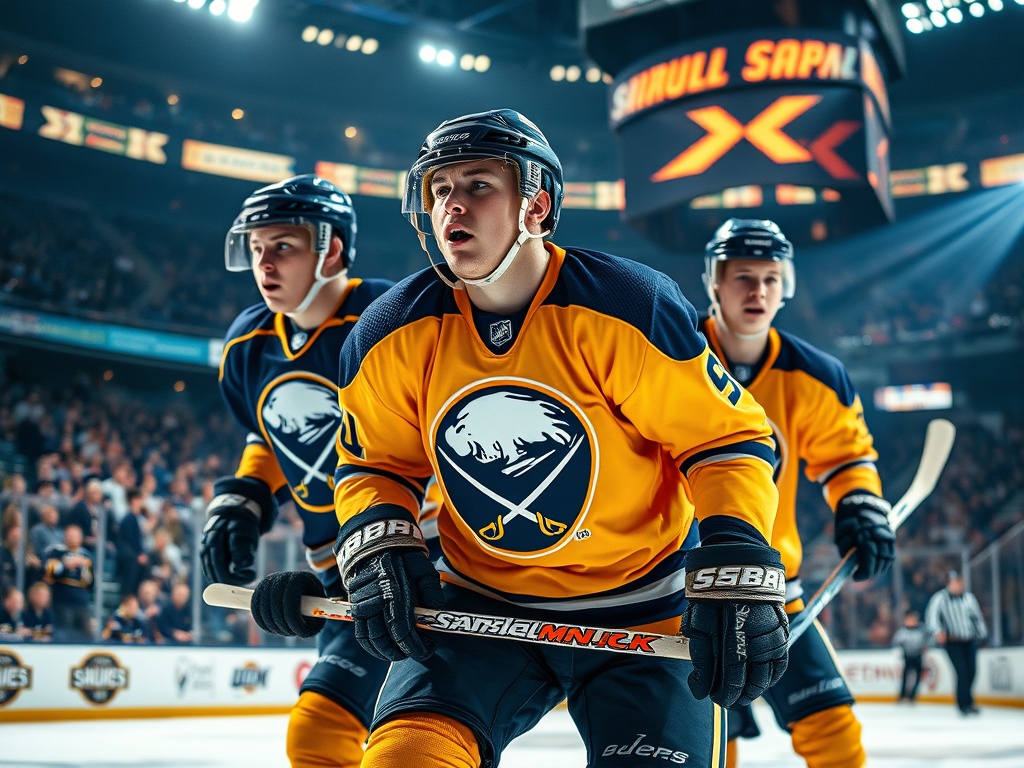
Introduction: The View from the Summit
In the immediate aftermath of the 2004-05 NHL Lockout, a season lost to labor strife, the league was reborn. A new salary cap, new rules designed to open up the game, and a fresh start for all 30 teams. In Buffalo, a city with a deep and often tortured hockey history, this new era started unexpectedly. It shone with explosive brilliance. The Buffalo Sabres had+6000 preseason odds to win the Stanley Cup. The team was largely written off. It emerged not just as a surprise, but also as a phenomenon. They were young, fast, and relentless, playing a high-octane brand of hockey that captivated the league.
Paradoxically, the lockout that had crippled the NHL proved to be a critical incubator for this specific group. While the league sat dormant, a burgeoning core of future Sabres stars emerged. Goaltender Ryan Miller spent an entire season with the AHL’s Rochester Americans. Austrian sniper Thomas Vanek joined him. Clutch winger Jason Pominville was also part of the team. They marinated together and developed their skills. This forged a unique chemistry. It was a shared identity that, when unleashed upon an unsuspecting NHL in the 2005-06 season, proved devastating.
Led by the dynamic and cerebral co-captains Daniel Brière and Chris Drury, the Sabres shocked the hockey world. They amassed 52 wins and 110 points, powered by a top-five offense that scored 276 goals. Their thrilling playoff run saw them dispatch the Philadelphia Flyers and Ottawa Senators. They fell in a heartbreaking Game 7 of the Eastern Conference Finals to the eventual Stanley Cup champion Carolina Hurricanes. It felt not like a fluke, but a declaration of intent.
They proved it the following season. In 2006-07, the Sabres reached their apex. They won the Presidents’ Trophy as the NHL’s best regular-season team. They achieved 53 wins and a franchise-record 113 points. Their offense was the league’s most potent. They scored 298 goals. Brière posted a career-high 95 points. Vanek exploded for 43 goals and achieved a remarkable +47 plus-minus rating. Their season ended in another Eastern Conference Finals disappointment. This time, it was an upset loss to the Senators. However, the feeling in Buffalo was one of supreme confidence. They had a young, dominant core. Miller was their star goaltender. Brière and Drury were two of the league’s best leaders. A Stanley Cup seemed not just possible. It was inevitable. From this lofty summit, no one could have foreseen the franchise’s precarious position. They were about to plunge into the longest winter in NHL history.
Part I: The Original Sin – The Summer of 2007
The fall from grace was not a gradual erosion. It was a sudden, cataclysmic event. It was a self-inflicted wound from which the franchise has never truly recovered. The summer of 2007 stands as the singular inflection point. It serves as a case study in managerial malpractice. This malpractice dismantled a contender in a matter of hours. On July 1, 2007, a day branded “Black Sunday” by the Buffalo media, both co-captains departed. Daniel Brière and Chris Drury left the team. They were the undisputed heart and soul of the team.
The front office received the blame for this exodus. General Manager Darcy Regier led the office, alongside the ownership group of Tom Golisano. This was not a case of players chasing the biggest paycheck or wanting to leave a losing situation. On the contrary, both Brière and Drury expressed a strong desire to remain in Buffalo. The critical failure of management was a fundamental misunderstanding of their stars’ intentions. Brière later revealed that he and Drury were a package deal, a unified front. “The thing is Chris Drury and I wanted to play together, we wanted to keep the team together,” Brière stated. “If one was going to sign, it was coming as a package”.
Despite this, the Sabres’ front office chose to prioritize re-signing Drury. They viewed the two as separate negotiations. They underestimated their resolve to stick together. This initial strategic error was compounded by a series of tactical blunders:
- Inflexible Negotiation Policy: Regier adhered to a strict, self-imposed policy of not negotiating contracts during the regular season. This rigid approach, while perhaps intended to avoid distraction, proved disastrous. Both of his superstar captains reached the open market as unrestricted free agents. The team lost all leverage and control there.
- Lack of Communication: The policy created a communication vacuum that left the players feeling unwanted. Brière said the team “never really had any discussions” with him. This was about a new contract until four or five days before free agency began. By then, the damage was done.
- A Broken Agreement: The situation with Drury was even more egregious. Reports surfaced that Drury and the Sabres had reached a verbal agreement on a new contract before the 2006-07 season. However, Regier failed to officially sign and formalize the deal. Feeling the deal was not being honored, Drury ultimately rescinded the agreement.
On July 1, the inevitable happened. Brière, feeling slighted, signed a massive eight-year, $52.5 million contract with the Philadelphia Flyers. Hours later, Drury, whose childhood team was the New York Rangers, signed a five-year, $35.25 million deal with them, despite the Sabres reportedly matching the offer at the last minute. The loss of their on-ice production was immense. They contributed a combined 164 points in their final season. However, the loss of their leadership and the team’s core identity was incalculable.
In the chaotic days that followed, the front office committed its final, and perhaps most damaging, error. The fan base was in revolt. The Edmonton Oilers saw an opportunity. They signed restricted free agent Thomas Vanek to a seven-year, $50 million offer sheet. Regier and the Sabres faced a public relations nightmare. They also faced the prospect of losing their top three offensive players in the span of a week. As a result, Regier and the Sabres felt compelled to match the offer.
This was a panic-driven decision to stop the immediate bleeding, but it sacrificed the franchise’s long-term health. By matching the offer sheet, the Sabres forfeited the compensation they would have received from Edmonton: four first-round draft picks. Those picks would eventually be used by the Oilers to select Tyler Myers and Magnus Paajarvi. They also selected future Hart Trophy winner Taylor Hall and Ryan Nugent-Hopkins. The Sabres could have acquired a treasure trove of assets for a swift re-tooling. Instead, they allocated a massive portion of their salary cap to one player. They allocated a massive portion of their salary cap to one player. Their decision was made out of desperation. This decision, born directly from the initial failure to retain the captains, cemented a path of mediocrity. It established a pattern of reactive decisions and short-sighted management. This poor asset management would haunt the franchise for the next 15 years. The summer of 2007 was not just the end of a great team. It was the blueprint for a decade of failure.
Part II: The Unraveling (2008-2013)
The departure of Brière and Drury was not a wound that could be patched over; it was a mortal blow. The 2007-08 season served as the immediate and stark proof. The Sabres were defending Presidents’ Trophy winners. They became the first team in the post-lockout era to win the trophy. The following season, they missed the playoffs. The team faced such a profound leadership void. As a result, they abandoned a traditional captaincy. They opted instead for a monthly rotation among players like Jochen Hecht, Toni Lydman, and Brian Campbell.
While the offense remained potent, finishing fourth in the NHL with 255 goals, the team’s identity had vanished. The clutch and steadying presence of their former captains was gone. Their absence was most felt during a disastrous 10-game losing streak in late December and January. This ultimately doomed their season. They finished with 90 points. They missed the postseason by a narrow margin. This collapse seemed unthinkable just months prior. It was highly unlikely to occur if the team’s leadership structure had remained intact.
The team tread water for the next few seasons, good enough to be competitive but no longer a true contender. They missed the playoffs again in 2008-09 before returning for two consecutive first-round exits in 2010 and 2011. It was during this period of stagnation that another seismic shift occurred. In February 2011, natural gas tycoon Terry Pegula purchased the team from Tom Golisano for $189 million. His arrival was met with euphoric optimism. Pegula, a passionate fan himself, promised to spare no expense. He famously declared at his introductory press conference that the Sabres’ “reason for existence is to win a Stanley Cup.” He also stated that he would create a “Hockey Heaven” in Buffalo.
Initially, Pegula’s ownership signaled a move away from the budget-conscious Golisano era. The team made a splash in free agency. Most notably, they signed forward Ville Leino to a massive contract. This contract quickly became an albatross. This attempt to spend their way back to relevance failed. The Sabres made the playoffs in Pegula’s first partial season in 2011. However, the drought that would come to define the franchise began the very next year, 2011-12.
When the quick-fix spending spree backfired, the organization’s philosophy swung violently in the opposite direction. Under the continued direction of GM Darcy Regier, the patient deconstruction of the remaining post-lockout core began. This process occurred from 2013 to early 2014. During this period, the franchise systematically traded away its most prominent players. This action signaled a full commitment to a long-term rebuild.
| Player(s) Traded | Date | Acquiring Team | Full Return Package |
| Jason Pominville (Captain) | April 3, 2013 | Minnesota Wild | Johan Larsson (F), Matt Hackett (G), 2013 1st Round Pick (Nikita Zadorov), 2014 2nd Round Pick (Vaclav Karabacek) |
| Thomas Vanek | October 27, 2013 | New York Islanders | Matt Moulson (F), 2014 1st Round Pick (Sam Reinhart), 2015 2nd Round Pick (Brendan Guhle) |
| Ryan Miller & Steve Ott (Captain) | February 28, 2014 | St. Louis Blues | Jaroslav Halak (G), Chris Stewart (F), William Carrier (F), 2015 1st Round Pick (Jack Eichel – pick traded to BUF), 2016 3rd Round Pick |
Pegula’s arrival was initially seen as the salvation of the franchise. It inadvertently highlighted a critical flaw. This flaw would become a hallmark of his ownership: impatience. The shift from a “win-now” spending spree to a “scorched-earth” teardown showed there was no coherent vision. There was no stability or long-term planning at the highest level. This instability set the stage for one of the most controversial and ultimately unsuccessful chapters in NHL history.
Part III: Operation Tank and the Flawed Foundation (2013-2021)
With the remnants of the contending team stripped away, the Sabres embarked on a new, explicit, and deeply controversial strategy. The period from 2013 to 2015 was defined by a “scorched-earth” rebuild. This was a deliberate and transparent effort to finish at the bottom of the NHL standings. The goal was to secure a generational talent in the draft. This was not merely rebuilding; this was “Operation Tank.”
The era began with a house cleaning. Longtime GM Darcy Regier was fired in November 2013, ending a 16-year tenure. In his place, owner Terry Pegula hired beloved Sabres alumnus Pat LaFontaine as President of Hockey Operations. LaFontaine, in turn, hired Tim Murray. Murray was a career scout with the Ottawa Senators. He became the new General Manager in January 2014. Murray was given a clear mandate: tear it all down and accumulate assets.
The most significant move of this teardown was the February 2014 trade. Franchise goaltender Ryan Miller and captain Steve Ott were traded to the St. Louis Blues. The trade was so contentious within the Sabres’ own front office. It reportedly led to LaFontaine’s shocking resignation after just three months on the job. The rookie GM Murray was left with unchecked control over the franchise’s direction.
With Murray at the helm, the tank commenced in earnest. The Sabres finished dead last in the NHL in both the 2013-14 and 2014-15 seasons. They were icing rosters that were, by design, not competitive at the NHL level. The explicit goal was to secure one of the top two picks in the 2015 NHL Entry Draft. This draft class was heralded for two can’t-miss, generational talents: centers Connor McDavid and Jack Eichel. The pursuit of these players, dubbed the “McEichel Derby” by local media, became an obsession.
In April 2015, the plan hit a snag. Despite finishing with the worst record and the best odds, the Sabres lost the draft lottery to the Edmonton Oilers. Edmonton selected McDavid, and Buffalo was left with the consolation prize: American phenom Jack Eichel.
This is where the rebuild went disastrously off-script. Murray and the Pegula ownership group endured two seasons of intentional, often embarrassing losing. They demonstrated a critical lack of patience for a proper, multi-year build around their new cornerstone. Murray had a vast collection of draft picks. Instead of using these picks to build an organic pipeline of talent, he immediately pivoted to a “win-now” mentality. On the same day he drafted Eichel, Murray made blockbuster trades. He traded a haul of prospects and high draft picks to acquire established veterans. These included center Ryan O’Reilly, winger Evander Kane, and later, goaltender Robin Lehner. The message was clear: the rebuild was over before it had truly begun.
This impatient strategy created a toxic cycle of failure. The team was not good enough to win. However, they had traded away the very draft capital the tank was designed to accumulate. The result was perpetual mediocrity and a vortex of instability at the highest levels of the organization. This chaos is best illustrated by the constant turnover in leadership positions throughout the Pegula era.
| Role | Name | Tenure Start | Tenure End |
| General Manager | Darcy Regier | June 1997 | November 2013 |
| General Manager | Tim Murray | January 2014 | April 2017 |
| General Manager | Jason Botterill | May 2017 | June 2020 |
| General Manager | Kevyn Adams | June 2020 | Present |
| Head Coach | Lindy Ruff | July 1997 | February 2013 |
| Head Coach | Ron Rolston | February 2013 | November 2013 |
| Head Coach | Ted Nolan | November 2013 | April 2015 |
| Head Coach | Dan Bylsma (Had announced Mike Babcock as coach only for him to go to Toronto instead) | May 2015 | April 2017 |
| Head Coach | Phil Housley | June 2017 | April 2019 |
| Head Coach | Ralph Krueger | May 2019 | March 2021 |
The tank did not just fail to deliver Connor McDavid; its flawed execution poisoned the organization’s culture. It fostered an environment where losing was acceptable, and the subsequent impatience squandered the opportunity to build a sustainable winner. Jack Eichel, the supposed savior, was dropped into this maelstrom of dysfunction. The failure of his era was not due to the player. He consistently put up elite numbers. Instead, it was a catastrophic failure of the organization. They failed to provide a stable and competent environment for a star player to succeed. The foundation laid by the tank was rotten from the start.
Part IV: The Bitter Divorce – The Eichel Injury Dispute
Years of dysfunction, instability, and broken promises built up over time. This culminated in a public and ugly conflict. The conflict led to the departure of the franchise’s second generational talent in 15 years. The saga of Jack Eichel’s neck injury was not merely a medical disagreement. It was a power struggle between a disenchanted superstar and a fractured organization. It was a bitter divorce played out on a public stage.
The conflict began in March 2021, when Eichel suffered a herniated disk in his neck during a game. As the injury failed to heal with rest, a fundamental impasse over surgical treatment emerged. Eichel and his team of independent medical experts advocated for an artificial disk replacement (ADR) surgery. This procedure is common in other sports and for the general public. However, it had never been performed on an active NHL player. The Sabres’ medical staff refused to approve the procedure. They cited the lack of precedent. They also mentioned potential unknown risks for a high-impact athlete. They insisted on a more traditional anterior cervical discectomy and fusion (ACDF) surgery.
Under the terms of the NHL’s Collective Bargaining Agreement, the team has the final say. It decides on the medical treatment of its players. The Sabres chose to stand firm on this contractual right, creating a stalemate. The relationship deteriorated rapidly. In May 2021, Eichel publicly voiced his frustration. He stated there was a ‘disconnect’ between him and the organization. He was not comfortable with this situation. The dispute festered through the offseason. In September 2021, as training camp opened, the Sabres officially stripped Eichel of his captaincy. He subsequently failed his team physical. He was placed on injured reserve. GM Kevyn Adams confirmed the two sides remained at odds. The relationship was broken beyond repair.
On November 4, 2021, the saga reached its inevitable conclusion. Eichel was traded to the Vegas Golden Knights along with a third-round pick. In return, they received a package centered around forwards Peyton Krebs and Alex Tuch. It also included a first-round pick in 2022 and a second-round pick in 2023.
The aftermath served as a final, damning indictment of the Sabres’ handling of the situation. The Golden Knights immediately granted Eichel permission. He underwent his preferred ADR surgery. The surgery was performed successfully on November 12, 2021. He returned to the ice for Vegas just three months later. On March 10, 2022, he played his first game back in Buffalo. The spurned fanbase greeted him with a chorus of boos. After the Sabres won the game, Eichel expressed his lingering bitterness. He remarked, “This is about the loudest I’ve heard this place ever. Really. After it took seven years, and me leaving for them to get into the game”.
The ultimate vindication for Eichel, and the ultimate sting for Sabres fans, came in the spring of 2023. He led the Golden Knights to a Stanley Cup championship. He finished as the leading scorer in the playoffs with 26 points in 22 games.
The Eichel dispute was a perfect, tragic bookend to the Brière and Drury saga. In both situations, the franchise’s best players and leaders left. Managerial inflexibility was to blame. There was also a complete breakdown in relationship management. In 2007, it was a failure of contract negotiation and communication. In 2021, it was a failure of medical trust and collaboration. In both cases, the organization focused on being contractually or procedurally “right.” This focus was over being strategically smart. They alienated their most valuable assets in the process. The outcome was the same. The franchise player leaves. They find immense success elsewhere. The Sabres are left to pick up the pieces. This was the final, definitive proof. The problem was not the players. It was a deep, systemic, and cultural rot within the organization. This issue had spanned multiple GMs. It included two ownership groups and nearly two decades.
Conclusion: Anatomy of a Drought
The story of the Buffalo Sabres’ post-lockout downfall is not one of bad luck or circumstance. It is a cautionary tale of compounded errors. It chronicles how a series of poor decisions, rooted in a broken organizational culture, can dismantle a contender. This creates a cycle of failure that lasts for decades. The result is the longest postseason drought in the history of the National Hockey League. It spans 14 seasons and counting as of the end of the 2024-25 season. This dubious record stands as a monument to sustained mismanagement.
The original sin was the catastrophic summer of 2007. The decision to let go of co-captains Daniel Brière and Chris Drury happened because of inflexible negotiation tactics. These tactics were flawed. This action shattered a winning culture. It replaced it with one of instability and reactive decision-making. This single event was the first domino in a long and painful chain reaction.
This culture of failure was inherited and then amplified by the ownership of Terry Pegula, which began in 2011. His tenure started with the immense promise of “Hockey Heaven.” However, it has been defined by impatience. There is also a lack of coherent vision and a tendency to meddle in hockey operations. This situation has caused a revolving door of general managers and head coaches. It prevents any semblance of stability from taking root. As a result, national media outlets have ranked Pegula as the worst owner in the NHL. The fanbase has shifted from energized to being in “revolt”.
The failed “scorched-earth” tank occurred. The subsequent botched rebuild around Jack Eichel followed it. These were not separate disasters. They were symptoms of this same underlying disease. GM Tim Murray traded away a trove of draft picks for a quick fix. This decision was a direct reflection of an ownership group unwilling to see a proper rebuild through. The public and acrimonious divorce with Eichel was the inevitable result. It marked the failure of an organization that had repeatedly shown an inability to manage its most valuable assets. It also struggled with managing relationships.
From Brière and Drury to Eichel, the pattern is undeniable. The franchise’s best players have left not due to a desire for more money. It was not because of a bigger market either. They were driven away by systemic dysfunction. The longest winter in NHL history is the direct and logical result of this top-to-bottom organizational malpractice. Since 2007, the Buffalo Sabres’ story is the ultimate lesson in professional sports. Talent, no matter how generational, cannot overcome a broken culture. The cost of such failure is measured not just in losses. It also leads to the erosion of trust with a loyal fanbase and a generation of squandered hope.

 ScortonBoy17.ca
Leave a comment