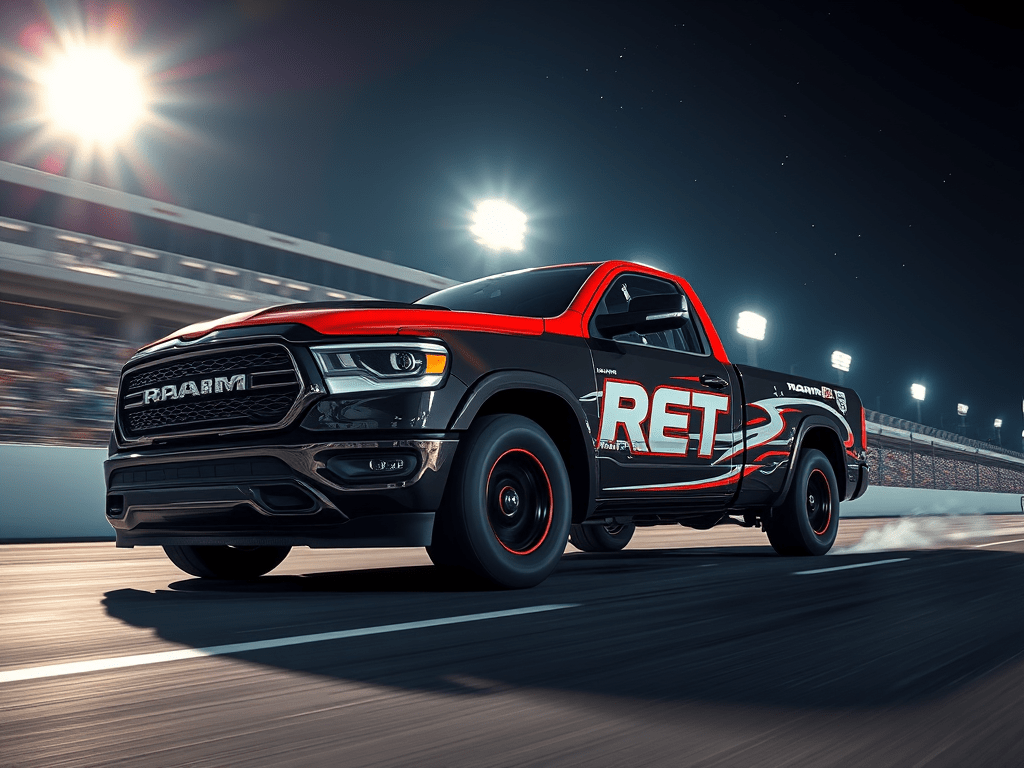
The NASCAR Craftsman Truck Series is poised for a significant shake-up with the confirmed return of RAM in 2026. This development was announced by the Stellantis-owned brand. It marks the end of a 13-year hiatus from factory-supported NASCAR competition. (Although they never left the NASCAR Canada Series). It also introduces a fourth Original Equipment Manufacturer (OEM) to a series. The series hasn’t seen such diversity in over a decade. As the 2026 season approaches, the paddock is abuzz with speculation about which teams might align with the returning powerhouse.
I. The Return of the Ram: A New Contender Enters the Truck Series Arena
A. RAM’s Roaring Return: Setting the Stage for 2026
RAM’s re-entry into the NASCAR Craftsman Truck Series is more than just a nostalgic nod. It’s a strategic move with clear ambitions. The brand carries a notable legacy in truck racing. It was one of the founding manufacturers of the series in 1995. The brand secured Bobby Hamilton’s 2004 Truck Series championship with a Dodge Ram. The brand aims to make an immediate impact. Dodge was the original brand. RAM later became a distinct brand from Dodge. Dodge also boasts manufacturer’s titles in the Truck Series in 2001, 2003, and 2004. Factory support for Dodge in NASCAR’s top series concluded after 2012, with the Truck Series efforts winding down after 2013.
For its 2026 comeback, Ram CEO Tim Kuniskis has stated a goal. He aims to have “somewhere between four and six trucks” ready for the season opener at Daytona. This target signals a serious commitment. It suggests RAM is actively seeking partnerships with established teams. They may also combine operations to quickly build a formidable presence. Kuniskis has been clear that this venture is not intended as a “one-hit wonder”. Instead, the Truck Series program is considered a potential stepping stone. It may lead to a Dodge return to the premier Cup Series, possibly in 2027 or later. However, this timeline remains fluid.
The decision to return now, after more than a decade, stems from persistent customer and dealer demand. Kuniskis describes it as the “absolute right time” and a “solid plan”. Furthermore, with an estimated 50 percent of NASCAR’s fanbase owning trucks, the marketing synergy is undeniable.
RAM’s choice to re-enter NASCAR via the Craftsman Truck Series is a well-calculated decision. The series offers a less complex pathway compared to the Cup Series. It is also less resource-intensive. This simplicity is primarily due to the use of Ilmor spec engines and common body elements. This allows RAM to focus on developing OEM-specific aerodynamic components like the nose, hood, fenders, and tail. RAM can re-establish its brand presence. It can also renew technical partnerships without the immediate undertaking of a full engine development program required for Cup competition. This phased approach allows RAM to build momentum and gather crucial experience before potentially tackling the premier series.
The return aligns strongly with RAM’s brand identity. It emphasizes “toughness” and “high performance, durability, and innovation”. These attributes resonate deeply within the NASCAR environment. Kuniskis focuses on the RAM brand for this initial re-entry. This decision underscores a targeted marketing strategy. It aims at a core demographic of truck owners within the NASCAR fanbase, despite the long-term Dodge Cup aspirations. This isn’t merely about racing; it’s about reinforcing brand image and market relevance.
The arrival of a fourth OEM is a significant development for NASCAR. The organization has actively sought to expand its manufacturer base since Dodge’s departure. NASCAR executives like John Probst have hailed RAM’s return as a “major moment.” It indicates the sport’s continued strength as a platform for major brands. This move could invigorate the competitive landscape among manufacturers. It might stimulate further interest from other OEMs. These OEMs might be observing RAM’s re-entry strategy.
II. Why Switch? The Allure of a New OEM Partnership
For NASCAR Craftsman Truck Series teams, the arrival of a new manufacturer like RAM presents a compelling opportunity. However, it is a complex set of opportunities. The decision to switch allegiances is never taken lightly, but the potential benefits can be transformative.
A. The “New Kid on the Block” Advantage
Aligning with RAM in the early stages of its return offers teams the chance to achieve “cornerstone” or “flagship” status. Such a position often comes with more focused factory support. Teams gain greater access to resources and enhanced marketing attention. This is compared to being one of many teams under an established OEM umbrella. For organizations looking to rebrand or rebuild, RAM provides a fresh slate. It also offers the opportunity to be central to a new manufacturer’s narrative in the sport. Initially, with fewer RAM-backed teams, a chosen partner might enjoy more direct communication. There is also less internal competition for developmental resources.
B. The Truck Series: An Ideal Entry Point for OEMs and Teams
The Craftsman Truck Series, by its very structure, is an attractive arena for new OEM involvement. A common Ilmor spec engine is used. Figures like Brad Keselowski and Kevin Harvick highlight this. It significantly lowers the barrier to entry. RAM can field competitive entries without needing an expensive engine development program. This costly process is a primary hurdle for Cup Series entry.
Manufacturers can focus on aerodynamic differentiation and brand identity. They achieve this through the design of the truck bodies—specifically the nose, hood, front fenders, and tail. This design mirrors their production counterparts and projects their image onto the track relatively quickly. The series is also known for a degree of parity. Well-managed and well-engineered teams can compete for victories. This setup offers a platform for teams to potentially elevate their status through a new OEM partnership.
Teams considering a switch to RAM will undoubtedly engage in a careful risk-versus-reward calculation. Aligning with a manufacturer re-entering the sport after a long absence carries inherent uncertainties. There may be potential teething issues with new components. Additionally, questions about long-term commitment arise despite current assurances. However, the “solid plan” articulated by RAM’s leadership is designed to assuage these concerns. The reward for taking such a leap is substantial. Teams have the potential to become a “big fish in a small pond.” They can enjoy premier status and directly influence the development and direction of a new factory racing program. RAM is targeting four to six trucks for its debut season. The manufacturer must successfully convince several teams. This will ensure the teams believe that the reward outweighs the perceived risks.
RAM’s arrival will inevitably trigger a new competitive dynamic among OEMs. Existing manufacturers—Chevrolet, Ford, and Toyota—may find it necessary to reinforce support for their key Truck Series outfits to prevent defections. As Kevin Harvick noted, these established OEMs might “have to lose some people.” Alternatively, they could increase their spending to retain their top teams. This situation could indirectly benefit even those teams that ultimately choose not to switch.
Certain teams find the “clean slate” appeal of partnering with a new OEM particularly strong. This is especially true for teams like the rumored return of GMS Racing. GMS Racing, which previously ceased operations as a Chevrolet-affiliated team, could find a partnership with RAM to be logistically simpler. Rekindling past alliances or trying to integrate into an already crowded field with an established manufacturer could be more complex. It represents a mutual fresh start. RAM can onboard an experienced team without directly “poaching” from an active competitor. Personnel and expertise would naturally be drawn from the wider talent pool.
III. Prime Candidates: Which Teams Might Make the Leap to RAM?
RAM plans to field four to six trucks in 2026. The question of which teams will carry their banner is paramount. The current landscape of the NASCAR Craftsman Truck Series offers several intriguing possibilities. These range from established powerhouses to teams seeking a strategic revival. There are even possibilities for new entities.
Table 1: Current Full-Time NASCAR Craftsman Truck Series Teams (2025 Overview – Selected Multi-Truck Operations & Key Single-Truck Teams)
| Team | Current Manufacturer (2025) | Approx. No. of Full-Time Trucks (2025) |
|---|---|---|
| ThorSport Racing | Ford | 5 |
| McAnally-Hilgemann Racing | Chevrolet | 4 |
| Spire Motorsports | Chevrolet | 4 (often with multiple drivers per truck) |
| TRICON Garage | Toyota | 5 |
| Niece Motorsports | Chevrolet | 3-4 (often with multiple drivers per truck) |
| Front Row Motorsports | Ford | 2 |
| Reaume Brothers Racing | Ford | 3 (planned) |
| Rackley W.A.R. | Chevrolet | 1 |
| Halmar Friesen Racing | Toyota | 1 |
| CR7 Motorsports | Chevrolet | 1 |
| Young’s Motorsports | Chevrolet | 2+ (often with multiple drivers) |
| Hattori Racing Enterprises | Toyota | 1 (part-time anticipated) |
Data compiled from various sources including. Table focuses on teams with potential capacity or strategic interest.
A. The Established Powerhouses: Could a Top-Tier Team Defect?
- ThorSport Racing: ThorSport Racing is the longest-tenured team in the NASCAR Craftsman Truck Series. It is the only full-time operation based in Ohio. The team is a perennial championship contender. They are currently fielding five Ford F-150s. The team’s history shows a willingness to switch manufacturers. They previously aligned with Chevrolet from 1996 to 2011. They also partnered with Toyota during 2012 to 2018 and again from 2021 to 2022. Ford was their manufacturer from 2019 to 2020 and from 2023 to the present. Notably, they have never run Dodge or RAM trucks. They have a proven ability to win championships—six in the Truck Series. Their experience with different OEMs would be immensely valuable to RAM. This provides immediate credibility and performance. ThorSport has extensive infrastructure and experience. This could anchor RAM’s program. It might fulfill a significant portion of the manufacturer’s initial 4-6 truck target. While their current relationship with Ford is strong, ThorSport’s history shows they are pragmatic. They take a business-minded approach. They are not averse to change if a more compelling strategic partnership emerges. Among fans, online discussions have noted varying performance periods. These are sometimes speculatively linked to levels of OEM support. This underscores the perception that they constantly evaluate their competitive standing. For RAM, ThorSport offers a turn-key, championship-caliber operation. For ThorSport, RAM could offer lead-OEM status. It could provide the chance to pioneer a new manufacturer’s efforts. This role is potentially more influential than the one they currently hold. Likelihood: Medium to High.
B. The Strategic Movers: Teams Seeking a Competitive Edge or Revival
- GMS Racing (Potential Return): The strongest and most persistent rumors link RAM’s return to a revived GMS Racing. GMS ceased its formidable Truck Series operations after the 2023 season. It was previously a Chevrolet powerhouse. The team amassed 45 wins and two championships. A return with RAM would offer GMS a clean slate. It would provide the opportunity to be foundational to a new OEM program. They could leverage their proven expertise. They may also utilize some retained infrastructure. Rumors also suggest that Spencer Gallagher, son of team owner Maury Gallagher, could be involved as a driver. This pairing appears highly logical. It provides RAM with an experienced, championship-winning organization. GMS gains a direct factory partnership from the outset of their comeback. This avoids the complexities of rejoining a crowded Chevrolet stable. The recent move of Rackley W.A.R. into GMS’s former fabrication building adds an interesting, though perhaps unrelated, layer to the facility aspect of a GMS return. Likelihood: High.
- McAnally-Hilgemann Racing (MHR): MHR has steadily grown into a significant four-truck Chevrolet operation, demonstrating race-winning capability. The team switched from Toyota to Chevrolet for the 2022 season. It was at this time that they formed a technical alliance with the then-active GMS Racing. This history of OEM change for strategic benefit makes them a candidate. If MHR perceives a ceiling to their advancement within the Chevrolet hierarchy, they might consider RAM as an option. This is particularly true with Spire Motorsports also fielding a large, Cup-driver-supported Chevy presence. RAM could offer a more direct path to premier factory team status. Their past GMS alliance could even facilitate a move if GMS indeed partners with RAM. MHR represents the kind of ambitious, multi-car team with upside that a new OEM would find attractive. Likelihood: Medium.
- Rackley W.A.R.: Currently a single-truck Chevrolet team, Rackley W.A.R. has shown ambition. This is evident with its recent partnership with Kevin Harvick Incorporated. They have also moved into the former GMS Racing fabrication facility in Statesville, NC. These developments signal an intent to grow and enhance their program. While their current ties are to Chevrolet, and KHI has strong Chevy links, their infrastructure expansion could attract RAM. Such growth could make them an appealing, well-equipped option if the team seeks a more prominent OEM role. Likelihood: Low to Medium.
- Front Row Motorsports (FRM): FRM fields two competitive Ford entries in the Truck Series. It is alongside its expanding Cup program. FRM won the 2022 Truck Series championship with Zane Smith. FRM has a deep and successful relationship with Ford across all its NASCAR endeavors. This strong partnership makes a switch highly unlikely. However, they represent the caliber of team RAM would ideally seek. They are proven championship winners with robust operational capacity. A move would be a seismic shift for FRM. Likelihood: Low.
- Hattori Racing Enterprises (HRE): Historically, Hattori Racing Enterprises (HRE) was a strong single-truck Toyota team. They were the 2018 series champion. HRE’s future has an element of uncertainty after the tragic passing of owner Shigeaki Hattori in April 2025. Mr. Hattori had a profound and long-standing relationship with Toyota. If the team continues under new leadership or ownership, RAM could offer stability and resources. This support would be valuable during a transitional period if the new structure seeks a different path. This is a sensitive situation, and any potential OEM shift would depend entirely on the decisions made by HRE’s successors. Likelihood: Medium, highly dependent on the team’s future direction.
C. The New Blood & Wildcards: Could RAM Launch with Fresh Faces?
Beyond established teams, RAM might look to smaller existing operations eager to elevate their status with factory backing. Reaume Brothers Racing, currently Ford and expanding, is a multi-truck outfit. Young’s Motorsports, operating with Chevrolet, is another multi-truck team. These teams could be interested in a closer OEM relationship. However, no specific rumors currently link them.
A particularly intriguing wildcard is the strong link between RAM’s return and social media personality/ARCA driver Cleetus McFarland (Garrett Mitchell). McFarland is rumored to be a potential driver and brand ambassador. Comments from Michael Waltrip during a FOX broadcast amplified this notion. He suggested McFarland would be truck racing in 2026. This potential partnership indicates that RAM is seeking new and innovative ways to generate buzz. They are trying to engage a younger, digitally-native audience. This aligns with CEO Tim Kuniskis’s stated desire to “bring fresh new interest and engagement”. McFarland’s involvement could be with an existing team that switches to RAM. Alternatively, it could be a new effort formed around his unique appeal.
RAM will likely pursue an “anchor team” strategy. They plan to secure at least one established, multi-truck operation like ThorSport or a revived GMS for immediate competitiveness. Additionally, they will supplement this with smaller or newer teams. This may possibly include a unique entity involving McFarland. The history of the Truck Series shows that manufacturer loyalty can be quite fluid. Teams like ThorSport and MHR make pragmatic switches based on support and opportunity. Should a major team make the leap to RAM, it could trigger a domino effect. This may compel other OEMs to adjust their support strategies for remaining teams.
Table 2: Speculative RAM Team Candidates – Key Considerations
| Team | Current Manufacturer (2025) | Potential Strengths for RAM | Potential Hurdles | Author’s Speculative Likelihood of Switching to RAM |
|---|---|---|---|---|
| ThorSport Racing | Ford | Championship pedigree, 5-truck capacity, OEM switch history | Strong current Ford ties | Medium to High |
| GMS Racing (Return) | N/A (Prev. Chevrolet) | Championship history, experienced personnel, strong rumors | Re-establishing operations | High |
| McAnally-Hilgemann Racing | Chevrolet | 4-truck capacity, race-winning, past OEM switch | Current Chevrolet commitment | Medium |
| Rackley W.A.R. | Chevrolet | Ambition, new facility, KHI partnership (could also be hurdle) | Recent Chevy investments, KHI ties | Low to Medium |
| Hattori Racing Ent. | Toyota | Championship history, established team | Uncertainty after owner’s passing, deep Toyota roots | Medium |
| Cleetus McFarland-linked Entity | N/A | Massive fan engagement, unique marketing, brand ambassador potential | Building a competitive team structure if new | Medium (for involvement in some capacity) |
Export to Sheets
IV. Building the Herd: What RAM Will Look For in Partner Teams
As RAM scouts for its inaugural teams, several key attributes will likely top their criteria list:
- A. Performance and Competitiveness: First and foremost, RAM will seek teams with a proven track record of winning races. They should also be contending for championships. A quick impact is crucial for a returning manufacturer.
- B. Infrastructure and Capacity: Well-equipped facilities are essential. Experienced personnel are crucial for a program aiming for four to six entries. The capability to reliably field multiple trucks is also important.
- C. Driver Talent: Teams boasting established veteran drivers or nurturing promising young talent will be highly attractive. The links to Cleetus McFarland also suggest an openness to unconventional driver profiles that can expand reach.
- D. Marketing and Brand Alignment: RAM will look for partners who can effectively represent the brand and connect with fans. CEO Tim Kuniskis has emphasized a plan to “set us apart from the field.” This plan will bring fresh new interest and engagement to America’s Motorsport.
- E. Long-Term Vision and Stability: Organizations with solid financial foundations will be prioritized. They must have a clear strategy for growth that aligns with RAM’s broader NASCAR ambitions. This includes the eventual potential move to the Cup Series.
RAM’s approach will likely involve balancing “win-now” objectives with “build for the future” strategies. This could mean partnering with established teams for immediate results and credibility. It may also involve fostering developmental opportunities for new talent or unique personalities who can bring “fresh new interest”. The primary focus is on RAM trucks. However, existing positive relationships with team principals or key personnel could subtly influence partnership discussions. This is typical in large corporate engagements.
V. The Ripple Effect: How RAM’s Entry Reshapes the Truck Series Landscape
RAM’s return is not an isolated event. It will send ripples throughout the NASCAR Craftsman Truck Series. This will impact existing OEMs, competitive balance, and overall fan engagement.
- A. Impact on Existing OEMs (Chevrolet, Ford, Toyota): The introduction of a fourth manufacturer will intensify competition. This will particularly affect top-tier teams. It will also heighten the demand for promising drivers and skilled personnel. Existing OEMs may need to re-evaluate their support for current Truck Series partners. They might also bolster that support to ensure loyalty and prevent defections. Kevin Harvick echoes this sentiment. This could lead to a reshuffling of the “pecking order” within each OEM’s stable.
- B. Overall Competitive Balance: Historically, increased manufacturer participation enhances the overall health and unpredictability of a racing series. If RAM-backed teams become competitive quickly, it could lead to a more diverse array of winners. There would also be more championship contenders. This shift benefits the sport as a whole.
- C. Further OEM Interest? A successful and impactful re-entry by RAM could serve as a compelling case study for other manufacturers. NASCAR officials have confirmed ongoing discussions with other potential OEMs, with Honda frequently mentioned in industry speculation. RAM’s commitment might just be the catalyst needed. It could encourage another brand to take the plunge. This is particularly true for the more accessible Truck Series.
- D. Fan Engagement: New manufacturer involvement typically generates significant excitement and fresh storylines, which can boost fan interest. RAM CEO Tim Kuniskis has explicitly stated this as a goal. He aims to leverage NASCAR’s passionate fanbase. He also wants to expand its appeal.
The arrival of a fourth OEM will likely intensify the “arms race” in the Truck Series. Spec components like the Ilmor engine help mitigate some costs. However, competition will heat up in areas like aerodynamic development. Body design is key for RAM. Competition will also rise in simulation technology and the recruitment of top engineering and crew talent. This will push all manufacturers to elevate their programs.
RAM’s return also validates NASCAR’s broader strategy. These efforts aim to make the sport attractive to manufacturers through initiatives like the Next Gen car in Cup. Cost-containment measures and stable rule packages also play a role. It signals that NASCAR’s platform is viewed as a valuable arena for marketing and technology demonstration. As RAM establishes its presence, a tiered support system may likely emerge. There could be one or two “fully factory” flagship teams. Several “technical partner” teams may receive varying levels of direct support. This is a common model for OEMs managing multi-team portfolios.
VI. Conclusion: A New Chapter for the Craftsman Truck Series
The return of RAM to the NASCAR Craftsman Truck Series in 2026 marks an exciting new chapter. It brings fresh possibilities to one of NASCAR’s most competitive divisions. While official team alignments are yet to be announced, preparations are underway. These efforts aim to create a significant shift in the series’ landscape. A fourth OEM is expected to battle for supremacy. Established teams may find new homes, and fresh partnerships could emerge. This promises a dynamic and intriguing period ahead. As RAM looks to build its herd, the coming months will be critical. They will shape not only RAM’s NASCAR future. Additionally, they will influence the competitive fabric of the Truck Series for years to come. Anticipation for 2026 is already building. The NASCAR world watches keenly. Everyone wants to see which teams will be powered by RAM.

 ScortonBoy17.ca
Leave a comment