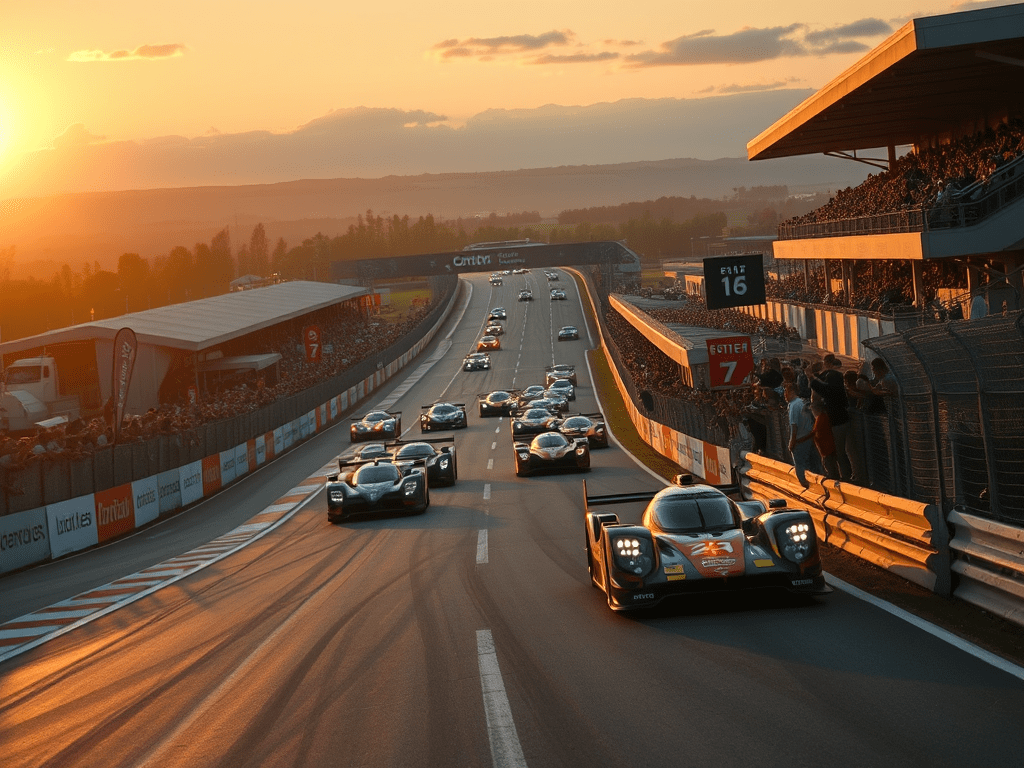
The 24 Hours of Le Mans stands as the undisputed pinnacle of motorsport. It is a unique crucible where speed, strategy, and sheer human endurance are tested to their absolute limits. For over a century, the Circuit de la Sarthe in France has been the hallowed ground. There, legends are forged, and automotive innovations are born. It is where the drama of motorsport unfolds in its most grueling and captivating form. It is more than just a race. It is an institution. It is a testament to the relentless pursuit of mechanical and human excellence. We delve into its rich history, exploring its audacious beginnings to eras of iconic rivalries and technological leaps. At the same time, we eagerly anticipate the 2025 edition. It promises another chapter in this extraordinary saga.
I. A Century Forged in Speed and Resilience: The History of the 24 Hours of Le Mans
The story of the 24 Hours of Le Mans is deeply intertwined with the evolution of the automobile. It also reflects the insatiable human desire to push its boundaries.
A. The Genesis: More Than Just a Race (1923)
The Sarthe region of France was a cradle of early automotive pioneering. Amédée Bollée, a Le Mans native, created “L’Obéissante” in 1873. It was one of the world’s first steam-powered road vehicles. The vehicle was capable of reaching 40 km/h. It famously drove from Le Mans to Paris in 1875. The region’s love for the automobile deepened when it hosted the first Grand Prix of the Automobile Club de France. This event happened in 1906.
Against this backdrop, the idea for a 24-hour endurance race was conceived. In 1922, Georges Durand was a prominent figure in Sarthe. He was already instrumental in bringing the 1906 Grand Prix to the region. Georges Durand planned a new kind of automotive contest with Charles Faroux. Charles Faroux was the head of the newspaper L’Auto. They collaborated with Émile Coquille, a wheel manufacturer. Their vision, the “Grand Prix d’Endurance de 24 Heures,” was not solely about outright speed. Most races of the era were characterized by outright speed. Instead, it tested the ultimate vehicle reliability. It tested robustness and the stamina of both car and driver over a full day and night. Initially, there was a concept for a Rudge-Whitworth Triennial Cup. Winners would be declared based on the furthest distance covered over three consecutive 24-hour races. However, this idea was abandoned by 1928.
The inaugural race took place on May 26-27, 1923, on public roads around Le Mans. Thirty-three cars embarked on this unprecedented challenge. André Lagache and René Léonard in their Chenard & Walcker Type U3 9CV Sport emerged victorious. They covered the distance at an average speed of 92 km/h. The legend had begun.
B. The Evolution of a Legend: The Circuit de la Sarthe
The Circuit de la Sarthe is as much a character in the Le Mans story as any driver or car. It is a unique, semi-permanent track. It ingeniously blends dedicated racetrack sections with public roads. These roads, for most of the year, serve everyday traffic. This hybrid nature contributes significantly to its challenge and mystique.
The original 1923 layout spanned over 17 kilometers (approximately 10.7 miles) and was considerably more perilous than its modern iteration. Sections like the infamous Maison Blanche are now part of motorsport lore. It was a high-speed portion notorious for its narrowness and lack of runoff. These sections have been removed or modified for safety. Over its century-long existence, the track has undergone extensive modifications. Safety concerns primarily drove these changes. The track gradually shortened to its current length of approximately 13.626 kilometers (around 8.47 miles).
Perhaps the most iconic feature of the circuit is the Mulsanne Straight (Ligne Droite des Hunaudières). Originally an almost 6-kilometer (3.7-mile) uninterrupted stretch of public road, it allowed cars to reach incredible speeds, pushing engines and aerodynamics to their limits. For safety, two chicanes were introduced in 1990. These chicanes break up this immense straight. They reduce the sustained top speeds and the stress on components.
Even the race start itself has evolved. The famous “Le Mans Start” initially saw drivers lined up across the track from their cars. At the drop of the flag, they would sprint to their vehicles. They jumped in and started the engines. They roared off – often without securing safety harnesses until well underway. This procedure was modified in 1970. Drivers started inside their cars. However, the start was still a standing one. By 1971, this transitioned to the rolling “Indianapolis start” still used today, a clear nod to prioritizing safety.
The very nature of the Circuit de la Sarthe has made Le Mans an unparalleled test bed for automotive innovation. Its combination of high-speed straights demands aerodynamic efficiency and engine power. Technical corners test handling and braking. The sheer 24-hour duration stresses every component. Manufacturers were, and still are, forced to develop cars that are not only fast but also incredibly durable and efficient. Advances in aerodynamics, engine technology, and braking systems have often been pioneered or perfected at Le Mans. Innovations in tire compounds are developed here. Even lighting, crucial for night racing, originates from Le Mans. These innovations eventually find their way into everyday road cars. This direct link to real-world applicability underscores the race’s founding principle of testing and improving automotive technology.
C. Eras of Dominance and Unforgettable Rivalries
The history of Le Mans is marked by periods. During these times, certain manufacturers or legendary drivers etched their names into immortality. There were also epic David-and-Goliath battles and fierce marque-versus-marque showdowns.
i. The Roaring Twenties and the Bentley Boys
In the nascent years of Le Mans, one British marque quickly established an aura of invincibility: Bentley. The “Bentley Boys” were a charismatic group. They consisted of wealthy British gentlemen drivers, playboys, and adventurers. They piloted their powerful green machines to five victories in the race’s first decade. Notably, these included four consecutive wins from 1927 to 1930 (1924, 1927, 1928, 1929, 1930). Figures like Sir Henry ‘Tim’ Birkin, Woolf Barnato (heir to a diamond fortune and later Bentley’s chairman), Dr. J.D. ‘Benjy’ Benjafield, and racing journalist S.C.H. ‘Sammy’ Davis became heroes of the era. They often showcased their daring exploits on the track in cars like the Bentley 3 Litre. They also showcased them in the formidable Bentley Speed Six. Their flamboyant lifestyles off it helped elevate the image of both Bentley and motorsport. This turned Le Mans into an elite social event. One famous tale is Woolf Barnato’s wager to beat “Le Train Bleu” from Cannes to Calais. He aimed to reach his London club before the train even arrived in Calais. The wager perfectly encapsulated their audacious spirit.
ii. Post-War Resurgence and the Rise of Ferrari and Jaguar (1940s-1950s)
Racing came to a halt in 1940 due to the outbreak of World War II. The circuit and surrounding areas suffered damage. The race resumed in 1949 after significant reconstruction efforts. This post-war era saw the emergence of new powerhouses. Ferrari became synonymous with Le Mans glory. It clinched its first victory in 1949 with a 166MM. Luigi Chinetti and Peter Mitchell-Thomson drove the car.
British manufacturer Jaguar also made its mark. Its C-Type and D-Type models were aerodynamically advanced. They brought a new level of design sophistication and speed to endurance racing in the 1950s.
However, this “golden decade” was marred by motorsport’s darkest day: the 1955 Le Mans disaster. During the race, Pierre Levegh’s Mercedes-Benz 300 SLR crashed into the crowd opposite the pits. This tragedy resulted in the deaths of Levegh and more than 80 spectators. Many more were injured. The catastrophe sent shockwaves through the motorsport world and beyond. Several European countries temporarily banned motor racing. Mercedes-Benz immediately withdrew from motorsport, a decision that lasted for decades.
The 1955 disaster became a grim but crucial turning point. It forced a fundamental re-evaluation of safety standards across all forms of motorsport. At Le Mans itself, the entire pit complex was razed and rebuilt further back. This change widened the pit straight. Initially, there was still no barrier between the track and pit lane. More broadly, the incident led to sweeping reforms in circuit design, car construction standards, and measures for crowd protection globally. While safety had always been a concern, the scale of the 1955 tragedy made it an undeniable priority. It fundamentally reshaped how motorsport approached risk and responsibility. Both participants and spectators were affected.
iii. The Titans Clash: Ford vs. Ferrari (1960s)
The 1960s at Le Mans were defined by one of the most legendary rivalries in motorsport history. It was the colossal battle between Ford and Ferrari. The feud started when Henry Ford II’s attempted buyout of Ferrari in 1963 fell through. This last-minute setback was a personal snub to the American industrialist. Ford wanted to beat Enzo Ferrari on the world’s biggest motorsport stage. Ford launched an ambitious program to conquer Le Mans. The program was hugely expensive.
The weapon of choice was the Ford GT40. After initial years of development, the team faced heartbreaking failures in 1964 and 1965. The crucial involvement of Carroll Shelby’s team was vital. The GT40, particularly the 7-litre V8-powered Mark II, became a formidable machine. The effort culminated in a stunning 1-2-3 finish for Ford in 1966, an iconic moment immortalized in motorsport lore. Ford continued its dominance. It won the next three editions with the Mk IV in 1967. The original GT40, campaigned by John Wyer Automotive Engineering, clinched victories in 1968 and 1969. Legendary drivers like New Zealanders Bruce McLaren and Chris Amon (winners in ’66), and Americans Dan Gurney and A.J. Foyt (winners in ’67), became heroes of this era. Gurney exuberantly sprayed champagne on the podium in 1967. This spontaneous act inadvertently started a now-cherished motorsport tradition.
iv. Porsche’s Reign: Engineering Endurance (1970s-1980s)
If the 1960s belonged to Ford vs. Ferrari, the 1970s and especially the 1980s were overwhelmingly the era of Porsche. The German manufacturer from Stuttgart cemented its status as the most successful marque in Le Mans history. They eventually accumulated an astounding 19 overall victories.
Their success began with the iconic Porsche 917. The 917K had a powerful air-cooled flat-12 engine. It delivered Porsche’s first overall Le Mans wins in 1970 (Hans Herrmann/Richard Attwood) and 1971 (Helmut Marko/Gijs van Lennep). The 1971 victory also set a new distance record that stood for decades, covering 5,335.313 km.
Porsche achieved significant victories throughout the 1970s. They continued to innovate with models like the turbocharged, open-cockpit 936. The 936 had victories in 1976, 1977, and later in 1981. They even had success with the production-based 935. The Kremer Racing privateer team achieved a remarkable win in atrocious weather in 1979 with the 935.
The 1980s witnessed an almost unbreakable stranglehold by Porsche. The factory and privateer teams used the technologically advanced Porsche 956 and its evolution, the 962. They achieved seven incredible consecutive victories from 1981 through 1987. This period underscored Porsche’s mastery of endurance racing engineering, reliability, and strategy. Legendary drivers like Jacky Ickx secured six Le Mans wins, many with Porsche. Derek Bell was a five-time winner, all with Porsche. These drivers became synonymous with the marque’s success.
v. The Winds of Change: New Challengers and Technologies (1990s)
Porsche’s long reign eventually faced new challengers. In 1988, Jaguar, with its XJR-9LM, broke Porsche’s seven-year winning streak. Sauber-Mercedes followed with the C9 in 1989. This marked Mercedes’ first Le Mans win since their pre-1955 involvement. Jaguar won again in 1990. A truly historic moment came in 1991. Mazda became the first Japanese manufacturer to win Le Mans. To date, they remain the only one. They achieved this with the distinctive, screaming rotary-engined 787B.
The 1990s also saw the spectacular but short-lived GT1 era, where road-going supercars were transformed into extreme racing machines. McLaren famously won on its Le Mans debut in 1995 with the F1 GTR. This car wasn’t even initially designed for such an arduous race. This period brought immense manufacturer interest and some of the most exotic-looking cars ever to grace La Sarthe.
vi. Audi’s Technological Ascendancy: TDI and Hybrid Power (2000-2016)
The new millennium marked the beginning of Audi’s dominant era. The manufacturer redefined efficiency and technological innovation at Le Mans. Between 2000 and 2014, Audi claimed an incredible 13 victories.
Their campaign began with the Audi R8 LMP prototype. It secured a hat-trick of wins from 2000 to 2002. The prototype benefited from the introduction of TFSI (Turbo Fuel Stratified Injection) direct injection technology in 2001. This was a revolutionary step at the time. Now, it is common in road cars. Customer teams also took the R8 to victory in 2004 and 2005.
Audi demonstrated its “Vorsprung durch Technik” (Advantage through Technology) philosophy. It did this by pioneering diesel power at the front of the Le Mans grid. In 2006, the Audi R10 TDI became the first diesel-powered car to win the 24 Hours of Le Mans. This achievement was something many thought impossible. TDI technology would go on to win eight times in total for Audi. The R15 TDI later set a new distance record. It was during what was the fastest Le Mans race ever at the time. Remarkably, during its TDI era at Le Mans, Audi made significant improvements. They managed to reduce the diesel consumption of their sports prototypes by 46 percent within a decade. This showcased a relentless pursuit of efficiency.
The next technological frontier for Audi was hybridization. In 2012, the Audi R18 e-tron quattro made history as the first hybrid vehicle to win Le Mans. It seamlessly blended a TDI engine with an electric motor driving the front axle. This innovative machine remained unbeaten for three consecutive years (2012-2014). Audi’s success in sustaining diverse powertrain technologies was remarkable. This included TFSI petrol, TDI diesel, and hybrid diesel-electric. It truly underscored Le Mans’ role as a crucible for powertrain innovation. The extreme demands of the 24-hour race provided the perfect environment. It allowed Audi to develop, test, and prove technologies. These innovations would directly influence the efficiency, performance, and reliability of Audi’s production vehicles. This fulfilled the race’s original mandate in a modern context.
vii. The Modern Hypercar Era (2021-Present)
After Audi’s departure, Porsche and Toyota dominated the LMP1 hybrid era. A new top category called Hypercar was launched in 2021. This new formula includes Le Mans Hypercar (LMH) bespoke prototypes. It also includes Le Mans Daytona h (LMDh) cars based on a shared chassis spine. It was designed with simpler rules and cost-capped performance. This aims to attract a wider range of manufacturers.
The Hypercar era has indeed heralded a new golden age of manufacturer involvement. Toyota continued its success. The regulations have enticed iconic names like Ferrari, Peugeot, Cadillac, and Porsche to return or bolster their top-class efforts. These efforts are joined by Alpine and BMW. For 2025, Aston Martin and Lamborghini (though Lamborghini is focusing on IMSA for 2025) will join as well. Ferrari made a triumphant return to the top class. The team won the Centenary Le Mans in 2023. They backed it up with another victory in 2024. This success signals a fiercely competitive landscape.
II. The 2025 24 Hours of Le Mans: A New Chapter Unfolds (June 14-15, 2025)
The anticipation for the 93rd running of the 24 Hours of Le Mans is palpable. A packed grid and compelling storylines are present across all classes. The event marks the fourth round of the 2025 FIA World Endurance Championship (WEC). It offers double points. This makes it a crucial race for championship aspirations.
A. The Countdown Begins: Race Week Schedule
The pilgrimage to La Sarthe for teams and fans begins well before the main event. The key dates for the 2025 24 Hours of Le Mans are as follows :
- Friday, June 6 & Saturday, June 7: Scrutineering involves technical inspections in the Le Mans city center. It is a chance for fans to see the cars up close.
- Sunday, June 8: Official Test Day – the first opportunity for all cars to run on the full circuit.
- Wednesday, June 11: Free Practice sessions and the first Qualifying Practice.
- Thursday, June 12: More Free Practice. This is followed by the thrilling Hyperpole sessions for LMP2, LMGT3, and then Hypercars. These sessions will determine the top grid positions.
- Friday, June 13: The traditional Drivers’ Parade through Le Mans city center.
- Saturday, June 14: Morning Warm-up. There will be official commencement ceremonies. The iconic start of the 24 Hours of Le Mans begins at 4:00 PM local time.
- Sunday, June 15: The checkered flag falls at 4:00 PM, followed by the podium ceremony.
Spectator activities are a huge part of the Le Mans experience. These include autograph sessions, pit walks, concerts, and funfairs. They create a festival atmosphere throughout the week.
B. The Contenders: Hypercar Class Preview
The headlining Hypercar category boasts an impressive 21-car entry for 2025. It features eight distinct manufacturers. Many more cars from these marques are in other categories. This promises an intense battle for overall victory.
i. The Titans and the Challengers: Manufacturer Deep Dive
- Ferrari (499P – LMH):
- Teams & Drivers: The Prancing Horse fields three 499Ps. These include the factory #50 with Antonio Fuoco, Nicklas Nielsen, and Miguel Molina. The factory #51 features Alessandro Pier Guidi, James Calado, and Antonio Giovinazzi. Additionally, the customer #83 AF Corse entry includes Robert Kubica, Yifei Ye, and Phil Hanson.
- Form: Ferrari has dominated the WEC field in 2025. They have won the opening three rounds in Qatar, Imola, and Spa. This success has established a strong lead in both the Constructors’ and Drivers’ championships. They are chasing a remarkable third consecutive Le Mans victory after triumphs in 2023 (#51) and 2024 (#50).
- Outlook: Undeniably the favorites given their current form, car optimization, and experienced team. However, the unique Le Mans-specific Balance of Performance (BoP) poses a significant challenge. The ever-increasing strength of the competition means a hat-trick will be a monumental task.
- Toyota (GR010 Hybrid – LMH):
- Teams & Drivers: Toyota Gazoo Racing fields two GR010 Hybrids. The first is #7, driven by Mike Conway, Kamui Kobayashi, and Nyck de Vries. The second is #8, driven by Sébastien Buemi, Brendon Hartley, and Ryo Hirakawa.
- Form: Currently second in the WEC Manufacturers’ standings. While they haven’t secured a podium in 2025 yet, the #8 crew has consistently achieved top-five finishes through astute strategy. Regaining the Le Mans crown is their primary objective for the season.
- Outlook: Toyota brings immense experience, a proven and reliable car, and a roster of world-class drivers. Their topping of the official Test Day times suggests they have the pace to challenge. They are always a major threat at La Sarthe.
- Porsche (963 – LMDh):
- Teams & Drivers: A strong four-car Porsche 963 contingent is present. It includes three cars from Porsche Penske Motorsport. The #4 car is driven by Felipe Nasr, Nick Tandy, and Pascal Wehrlein as an invitational entry. The #5 car is driven by Julien Andlauer, Michael Christensen, and Mathieu Jaminet. The #6 car is driven by Kévin Estre, Laurens Vanthoor, and Matt Campbell. Proton Competition fields the #99 for Neel Jani/Nico Pino/Nico Varrone. A fifth Porsche 963 (Proton) is on the reserve list.
- Form: The WEC season has been challenging for Porsche, with a best finish of eighth. However, their IMSA WeatherTech SportsCar Championship campaign has been stellar. They have achieved four consecutive victories. They are fiercely chasing a historic 20th overall Le Mans win.
- Outlook: The factory effort appears more cohesive this year. The 963 has received an “Evo Joker” update aimed at improving top speed, a crucial factor at Le Mans. Considered dark horses, they can never be underestimated.
- Cadillac (V-Series.R – LMDh):
- Teams & Drivers: Four Cadillac V-Series.R hypercars will take the start, marking 75 years since the first Cadillac competed at Le Mans. Hertz Team JOTA runs two WEC entries: #12 (Will Stevens/Norman Nato/Alex Lynn) and #38 (Earl Bamber/Sébastien Bourdais/Jenson Button). Two invitational IMSA teams join them. The #101 Wayne Taylor Racing with Andretti includes Ricky Taylor, Jordan Taylor, and Filipe Albuquerque. The #311 Whelen Cadillac Racing (Action Express Racing) features Jack Aitken, Felipe Drugovich, and Frederik Vesti.
- Form: It has been a tough season for Cadillac in both WEC and IMSA. However, they recently secured an IMSA podium. They finished a strong third overall at Le Mans in 2023.
- Outlook: The “One Cadillac” approach, fostering collaboration between all partner teams, aims to maximize performance. The V-Series.R has proven to be well-suited to the Le Mans circuit and could be very incisive.
- BMW (M Hybrid V8 – LMDh):
- Teams & Drivers: BMW M Team WRT campaigns two M Hybrid V8s. Car #15 is driven by Dries Vanthoor, Raffaele Marciello, and Kevin Magnussen. Car #20 is driven by René Rast, Robin Frijns, and Sheldon van der Linde.
- Form: The team has made significant strides in 2025. This progress was aided by a “Joker” update to the car’s brakes. This update boosted driver confidence. The #20 car finished second at Imola and was fighting for second at Spa before a late retirement.
- Outlook: Considered a strong dark horse contender. The BoP for Le Mans gives them a notable power gain above 250 km/h. This boost could be highly beneficial on the long straights.
- Alpine (A424 – LMDh):
- Teams & Drivers: The French marque fields two Alpine A424s through Alpine Endurance Team. The teams are #35 (Paul-Loup Chatin/Ferdinand Habsburg/Charles Milesi) and #36 (Mick Schumacher/Frédéric Makowiecki/Jules Gounon).
- Form: The team appears transformed from its challenging 2024 debut. New full-time drivers Makowiecki and Gounon have integrated well. The #36 crew has achieved two consecutive podium finishes in WEC this season. Reliability and performance have seen significant improvements.
- Outlook: Alpine is aiming for a strong result on home soil. A podium finish is a realistic ambition if they maintain their current trajectory. The car is known for its good top speed.
- Peugeot (9X8 – LMH):
- Teams & Drivers: Peugeot TotalEnergies enters two 9X8s: #93 (Paul Di Resta/Mikkel Jensen/Jean-Eric Vergne) and #94 (Loïc Duval/Malthe Jakobsen/Stoffel Vandoorne).
- Form: The radical wingless concept has been heavily revised. The latest evolution for 2025 features a conventional rear wing and other updates. While pace has been evident at times, it hasn’t consistently translated into strong results. Both cars qualified in the top 10 at Spa but faltered in the race.
- Outlook: This is a crucial home race for Peugeot. The BoP has granted them the largest weight break compared to 2024. However, they also face a power reduction. They are expected to struggle for outright competitiveness.
- Aston Martin (Valkyrie – Non-Hybrid LMH):
- Teams & Drivers: Aston Martin makes its top-class return. Two Valkyrie LMHs are run by The Heart of Racing (THOR) under the Aston Martin THOR Team banner. They are #007 (Harry Tincknell/Tom Gamble/Ross Gunn) and #009 (Alex Riberas/Marco Sorensen/Roman De Angelis).
- Form: The program has had a limited test schedule. Pace has been gradually improving with experience and BoP adjustments. At Spa, the cars were around 2.6-2.7 seconds off pole position.
- Outlook: The primary objective for the spectacular V12-powered, non-hybrid Valkyries is to finish the demanding 24-hour race. The BoP assigns them the class minimum weight and maximum power below 250 km/h, presenting a unique opportunity on paper. However, the team acknowledges that significant development work is still needed to be truly competitive at the front.
Table 1: 2025 Hypercar Entry Snapshot
| Team Name | Car Model (Type) | Key Drivers (Exemplar) | Brief Outlook/Strength |
|---|---|---|---|
| Ferrari AF Corse (#50, #51) | Ferrari 499P (LMH) | Pier Guidi, Fuoco, Giovinazzi | Reigning Champions, Unbeaten in 2025 WEC, Strong Favorites |
| AF Corse (#83) | Ferrari 499P (LMH) | Kubica, Ye | Proven Privateer, Capable of Upsetting Factory Cars |
| Toyota Gazoo Racing (#7, #8) | Toyota GR010 Hybrid (LMH) | Kobayashi, Buemi, Hartley | Vast Experience, Seeking Redemption, Test Day Pace |
| Porsche Penske (#4, #5, #6) | Porsche 963 (LMDh) | Estre, Vanthoor, Tandy, Nasr | Seeking 20th Win, IMSA Form, BoP Power Gain Above 250km/h |
| Proton Competition (#99) | Porsche 963 (LMDh) | Jani, Pino | Experienced Privateer, Long Shot |
| Cadillac Hertz Team JOTA (#12, #38) | Cadillac V-Series.R (LMDh) | Stevens, Bamber, Button | Proven WEC Team, Strong Le Mans Record for Car |
| Cadillac WTR (#101) | Cadillac V-Series.R (LMDh) | R.Taylor, J.Taylor, Albuquerque | Top IMSA Team, “American Dream” Contender |
| Cadillac Whelen (#311) | Cadillac V-Series.R (LMDh) | Aitken, Drugovich | Strong IMSA Entry, Adding to Cadillac Firepower |
| BMW M Team WRT (#15, #20) | BMW M Hybrid V8 (LMDh) | D.Vanthoor, Rast, Magnussen | Dark Horse, Significantly Improved, BoP Power Gain Above 250km/h |
| Alpine Endurance Team (#35, #36) | Alpine A424 (LMDh) | Schumacher, Chatin, Makowiecki | Home Race, Transformed Team, Recent Podium Form |
| Peugeot TotalEnergies (#93, #94) | Peugeot 9X8 (LMH) | Di Resta, Duval, Vergne | Revised Car, Home Race Pressure, BoP Weight Break |
| Aston Martin THOR Team (#007, #009) | Aston Martin Valkyrie (LMH Non-Hybrid) | Tincknell, Sorensen | Ambitious Return, Lightest/Most Powerful (BoP), Finish Goal |
ii. The Balancing Act: Demystifying the 2025 Balance of Performance (BoP)
The Balance of Performance (BoP) is a regulatory tool. It is employed by the Automobile Club de l’Ouest (ACO) and the FIA. The goal is to equalize the performance potential of the diverse machinery within the Hypercar class. This includes balancing different car concepts (LMH vs. LMDh), engine types, and hybrid versus non-hybrid systems, all with the aim of fostering closer and more competitive racing. It is often described as a “necessary evil,” and its implementation is a constant source of discussion and debate.
Crucially, the BoP for the 24 Hours of Le Mans operates under a distinct methodology compared to other WEC rounds. It is not supposed to be influenced by the performance observed in the preceding races of the 2025 season. It also should not be affected by the results of the 2024 Le Mans event. Instead, the Le Mans BoP is mainly derived from the cars’ homologated parameters, which are their intrinsic design characteristics. Extensive simulation work also plays a critical role. Real-time race data from the current competitive season is not considered. This makes the Le Mans BoP a unique annual “reset,” adding a layer of unpredictability.
For 2025, the key BoP adjustments for the Hypercar class (compared to their 2024 Le Mans BoP or initial homologation for new cars) include :
- Ferrari 499P: Minimum weight of 1042 kg (-1 kg from 2024), maximum power of 515 kW (+7 kW) below 250 km/h. However, it receives the largest power reduction above 250 km/h, losing 2.9% (approximately 14.9 kW), making it the least powerful car in a straight line at very high speeds.
- Toyota GR010 Hybrid: Maintains its 1053 kg minimum weight (same as 2024) but gets a significant power boost to 520 kW (+12 kW, class maximum) below 250 km/h, with a 1.3% power reduction above this threshold.
- Cadillac V-Series.R: Sees a slight weight increase to 1037 kg (+1 kg) and an 8 kW power increase to 517 kW below 250 km/h, with a minimal 0.8% power drop above.
- Alpine A424: Also gains 1 kg to 1039 kg. It includes a 10 kW power increase to 517 kW below 250 km/h. However, it faces a 1.7% power reduction above.
- Peugeot 9X8: Receives the most substantial weight break, coming down 22 kg to 1039 kg. This is paired with a minor 1 kW base power reduction to 507 kW below 250 km/h and a 1.2% power drop above, making it the second-least powerful car at high speeds.
- Porsche 963: Minimum weight is now 1041 kg after a 1 kg reduction. The base power remains at 511 kW below 250 km/h. Critically, it benefits from a 1.4% power gain above 250 km/h (to 518.2 kW).
- BMW M Hybrid V8: Shares the 1039 kg minimum weight with Peugeot and Alpine. Its base power is 510 kW below 250 km/h, but it receives the largest power gain above this speed: +2.0%, taking it to a class-high 520.2 kW.
- Aston Martin Valkyrie (New Car): The class minimum weight is assigned as 1030 kg. The maximum power is set at 520 kW below 250 km/h, with a 0.8% power reduction above.
The overarching aim of these adjustments is to level top speeds. This is a critical performance differentiator on Le Mans’ long straights. The BoP suggests Cadillac could be particularly incisive. Porsche’s “Evo Joker” (aerodynamic update) combines with its high-speed power gain. BMW’s significant power increase above 250 km/h is tailored for Le Mans. Conversely, Alpine’s power loss at high speeds might handicap its impressive base velocity. Peugeot is still anticipated to face a tough race despite its weight reduction. Ferrari and Toyota are leveraging their vast racing expertise and experience. They are still tipped as the underlying favorites. The balance of power between them appears similar to last year. Overall, the expectation is for an intensely close battle at the front.
The process of setting the Le Mans BoP is separate from the season-long methodology. This often leads to intense scrutiny. Speculation frequently accompanies the process. The adjustments are intended to be based on objective car characteristics. However, features like varying power delivery profiles above certain speeds reveal a complex effort. This effort attempts to harmonize vastly different automotive philosophies. This can sometimes lead to perceptions of “BoP gamesmanship” by manufacturers in the lead-up to the event. Ultimately, these BoP parameters will be a central talking point throughout race week. Teams will dissect their performance relative to rivals. They will do so under these specific Le Mans conditions. This adds another layer to the strategic complexity of the event.
iii. Fierce Battles Beyond: LMP2 and the Rebirth of LMGT3
While the Hypercar battle for overall glory takes center stage, fierce competition is guaranteed in the supporting classes.
- LMP2: The Le Mans Prototype 2 (LMP2) class will feature a strong grid of 17 identical Oreca 07 chassis. All cars are powered by Gibson V8 engines. LMP2 is not part of the full WEC season in 2025, apart from a Pro/Am requirement. However, it remains a hugely popular and competitive category at Le Mans. The field is packed with talent, including seasoned professionals and rising stars. Notable names include former overall Le Mans winner and reigning Hypercar champion André Lotterer. W Series champion Jamie Chadwick is also featured. Renger van der Zande, Pietro Fittipaldi, Oliver Jarvis, Dane Cameron, and Louis Deletraz are included as well. Several Pro/Am entries will also be vying for class honors, ensuring battles throughout the field.
- LMGT3: The 2025 season marks an exciting new era for GT racing at Le Mans. This is due to the introduction of the LMGT3 class. The class replaces the long-standing GTE Am category. This change aligns Le Mans and WEC with global GT3 regulations, attracting a diverse and expanded grid of 24 cars. A major storyline is the rekindling of the historic Ford vs. Ferrari rivalry, this time in the GT ranks. The Ford Mustang GT3 will go head-to-head with the Ferrari 296 LMGT3. This offers a tantalizing precursor to Ford’s planned return to the Hypercar class in 2027. The WEC LMGT3 championship leaders heading into Le Mans, the #33 TF Sport Corvette Z06 GT3.R crew of Ben Keating, Jonny Edgar, and Daniel Juncadella, will be looking to cement their advantage. Close behind in the standings is the #21 Vista AF Corse Ferrari 296 LMGT3 (François Heriau/Simon Mann/Alessio Rovera). Other key contenders include the #78 Akkodis ASP Team Lexus RC F GT3. It is driven by Arnold Robin, Jack Hawksworth, and Finn Gehrsitz. The Team WRT BMW M4 GT3s feature the #46 car piloted by motorsport icon Valentino Rossi. He is joined by Kelvin van der Linde and Ahmad Al Harthy. The ever-popular #85 Iron Dames Porsche 911 GT3 R includes Sarah Bovy, Michelle Gatting, and Rahel Frey. Note driver lineup consistency. The grid is further bolstered by entries from Manthey Racing (Porsche). Additional entries include other Aston Martin Vantage AMRs, McLaren 720S Evos, and Mercedes-AMG GT3 Evos. This promises a vibrant and unpredictable contest. The LMGT3 BoP has also seen adjustments. The Chevrolet Corvette Z06 GT3.R and Ford Mustang GT3 appear to be beneficiaries, receiving power increases and weight decreases. The Porsche 911 GT3 R, while lighter, has had its base power reduced. The new Mercedes-AMG GT3 Evo is the heaviest car in the class.
The transition to the global GT3 platform for Le Mans and WEC represents a significant strategic shift. It has significantly increased manufacturer appeal. It has also lowered the barrier to entry for teams compared to the more specialized and expensive GTE formula. This is clearly reflected in the impressive variety of prestigious brands now competing. This diversity, together with the pro-am driver lineups inherent to the class, ensures close-quarters racing. It revives classic manufacturer feuds and creates new ones. More broadly, the adoption of LMGT3 aligns WEC and Le Mans with other major GT championships around the world. It strengthens the entire sports car racing ecosystem. This is achieved through offering a clearer development path for teams and drivers. It also creates a more unified global marketplace for GT3 machinery.
C. Narratives in the Making: Key Storylines to Follow for Le Mans 2025
Beyond the technical specifications and team lineups, Le Mans is a tapestry woven with compelling human and competitive narratives. The 2025 edition is rich with them:
- Ferrari’s Hat-Trick Quest: Can Maranello achieve a historic third consecutive Le Mans overall victory? The competition is even stronger and more prepared this time. Can they navigate the specific challenges of the Le Mans BoP?
- Toyota’s Redemption Song: Toyota has had near misses in recent years. They have experienced vocal frustrations over BoP. Can this highly experienced Japanese manufacturer leverage its proven package and strategic acumen? Will they be able to reclaim the top step of the podium?
- Porsche’s Drive for 20: The Weissach marque is on a quest for its landmark 20th overall Le Mans win. Will the WEC championship-leading #6 crew of Estre/Vanthoor/Campbell carry their form? Can the IMSA stars in the #4 invitational entry cause an upset?
- The American Dream: There are four Cadillac entries. These include strong contingents from IMSA regulars Wayne Taylor Racing with Andretti. Whelen Cadillac Racing (Action Express) is also part of this bid. There’s a serious attempt for an American LMDh-platform car to take overall honors.
- The Rise of the “Upstarts”: BMW M Team WRT has significantly improved their 2025 WEC form. Can they convert this performance into a surprising Le Mans win? Can Alpine Endurance Team achieve a podium finish with promising BoP adjustments?
- Aston Martin’s Ambitious Return: What can the visually stunning Valkyrie achieve on its debut? What can this sonically stunning car do in the premier class after a 14-year absence? A finish would be an achievement, but the BoP offers a tantalizing prospect on paper.
- Peugeot’s Home Race Pressure: All eyes will be on the heavily revised 9X8. Can the French manufacturer finally deliver a strong and reliable performance on home soil after a challenging development period?.
- The Ford vs. Ferrari Saga Continues (LMGT3): This iconic rivalry is reignited in the LMGT3 class. It promises a fierce battle for GT honors. It adds another layer of historical resonance to the event.
- Valentino Rossi’s Le Mans Journey: The global motorsport icon is continuing his four-wheel adventure. He is competing in the LMGT3 class with Team WRT’s BMW M4 GT3. This journey is drawing huge attention.
- Driver Milestones: Porsche’s Nick Tandy can complete the ‘Grand Slam’ of overall victories in all four major 24-hour endurance races. He will achieve this if the #4 Porsche Penske entry wins. These races include Le Mans, Daytona, Nürburgring, and Spa. Sébastien Buemi, with four Le Mans wins, continues his pursuit of further glory.
The enduring magic of Le Mans lies not just in the quest for an overall winner. It is also in these multi-layered dramas. The event captivates because of the simultaneous unfolding of individual class battles. There are also intricate team strategies. Drivers pursue personal ambitions. The weight of historical narratives also plays a part. Storylines such as Ferrari’s potential hat-trick provide excitement. Toyota’s relentless pursuit of redemption adds intensity. Porsche’s historic milestone captures attention. The ambitious return of Aston Martin invokes nostalgia. The rekindled Ford vs. Ferrari GT battle creates numerous points of engagement for fans worldwide. These human stories of triumph, heartbreak, perseverance, and ambition are crucial to the Le Mans legend. They are as important as the technological prowess on display. This ensures the race remains far more than just a 24-hour demonstration of speed.
Conclusion: Why Le Mans Endures – The Unbreakable Spell of the 24 Hours
The 24 Hours of Le Mans has cast an unbreakable spell for over one hundred years. It captivates the world of motorsport and beyond. It is a unique alchemy. It blends a profoundly rich history with the relentless push of cutting-edge technology. It draws on the deepest reserves of human endurance. The race offers the kind of unpredictable, unscripted drama that only a twice-around-the-clock battle can provide.
Despite a century of evolution in cars, regulations, and the circuit itself, the core challenge of Le Mans remains unchanged. Competitors must conquer time, distance, and the perceived limits of both engineering and the human spirit. This core trial continues to attract the world’s greatest manufacturers. It also draws the most talented drivers. Additionally, it brings millions of passionate fans to the fields of La Sarthe each June.
The 2025 edition stands poised to add another thrilling chapter to this enduring legacy. The depth of competition in the Hypercar class involves multiple manufacturers. They field potent contenders, promising a battle royale for overall honors. The intrigue of the LMP2 category is captivating. The vibrant, diverse new era of LMGT3 racing will ensure compelling action throughout the entire 24-hour journey.
The stage is set. The engines will soon roar. The tricolor will fall. Enthusiasts around the globe need to tune in. They should share their predictions. Once again, they can immerse themselves in the unparalleled magic that is the 24 Hours of Le Mans.

 ScortonBoy17.ca
Leave a comment